Qatar: Security guards subjected to forced labour

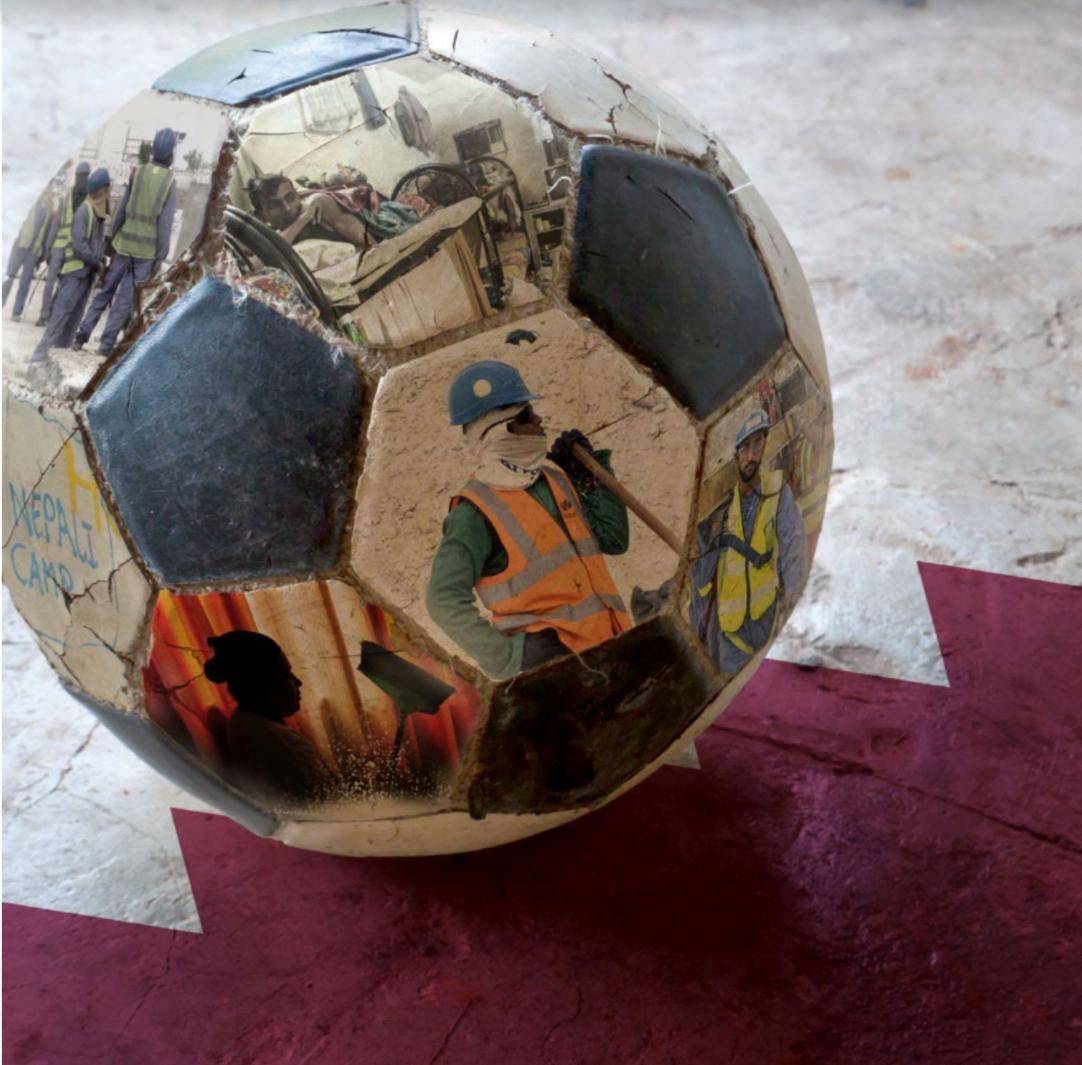
Security guards in Qatar are working in conditions which amount to forced labour, including on projects linked to the 2022 FIFA World Cup, Amnesty International has found. In a new report, They think that we’re machines, the organization documented the experiences of 34 current or former employees of eight private security companies in Qatar.    

The security guards, all migrant workers, described routinely working 12 hours a day, seven days a week – often for months or even years on end without a day off. Most said their employers refused to respect the weekly rest day which is required by Qatari law, and workers who took their day off anyway faced being punished with arbitrary wage deductions. One man described his first year in Qatar as “survival of the fittest”.   

In 2017 Qatar embarked on a promising agenda to tackle labour issues. It has introduced important legal reforms including a new minimum wage and improved access to justice, and repealed key aspects of the abusive kafala system. However, these reforms are not being effectively implemented. What’s more, many of the abuses Amnesty International documented are violations of Qatari laws and regulations predating the reforms.    

“The abuses we uncovered can all be traced back to the massive power imbalance that still exists between employers and migrant workers in Qatar, indicating that there are still major gaps in the authorities’ enforcement of labour laws. Many of the security guards we spoke to knew their employers were breaking the law but felt powerless to challenge them. Physically and emotionally exhausted, workers kept reporting for duty under threat of financial penalties – or worse, contract termination or deportation,” said Stephen Cockburn, Amnesty International’s Head of Economic and Social Justice.   

“Despite the progress Qatar has made in recent years, our research suggests that abuses in the private security sector – which will be increasingly in demand during the World Cup – remain systematic and structural. Employers are still exploiting their workers in plain sight, and­ the Qatari authorities must take urgent measures to protect workers and hold abusers accountable.”   

Amnesty International is calling on Qatar to urgently investigate abuses in the private security sector, publish its findings, and offer redress for workers, including ensuring they get adequate rest and pay. Qatar should also publish a detailed action plan for effectively tackling forced labour practices in the sector.    

Abuses on World Cup-related sites   

Amnesty International conducted in-depth interviews with 34 current or former security guards, supervisors and safety officers between April 2021 and February 2022. This built on earlier research in 2017 and 2018 when the organization interviewed 25 guards from one security company. The consistency of their accounts across multiple companies indicates that the abuses they faced are systemic, rather than isolated incidents.   

The 34 workers interviewed for the latest report were employed by eight different private companies, which have provided services for sites including government ministries and football stadiums, as well as other infrastructure projects that will be essential for the 2022 World Cup, such as hotels, transport systems and sports facilities. At least three of the companies have provided security for FIFA tournaments, including the 2020 FIFA Club World Cup (postponed to 2021) and the 2021 FIFA Arab Cup.     

In 2020, FIFA and its partner in Qatar, the Supreme Committee for Delivery and Legacy, pledged to do more to improve the working and living conditions of people employed in the service and hospitality sectors in Qatar. Enhanced labour standards have been expanded to cover World Cup service workers, and the bodies have embarked on other initiatives, especially for hotel staff. But these promises have yet to fully materialize in the security sector, as Amnesty International’s report illustrates.   

“They think that we’re machines”   

Qatari law and regulations restrict working hours to a maximum of 60 hours per week, including overtime, and is clear that everyone is entitled to one full, paid rest day each week. This reflects international law and standards – rest is a fundamental human right.    

Despite this, 29 of the 34 security guards told Amnesty International they had regularly worked 12 hours a day, and 28 said they were routinely denied their day off, meaning many worked 84 hours per week, for weeks on end.     

Milton*, from Kenya, worked for a security company at a hotel until 2021. He said that on a typical day he would leave his accommodation at 6.30 am and return at 8 pm, and that he often went months without a single day off. Abdul, from Bangladesh, worked as a security guard from 2018 to mid-2021, and said he did not have a day off for three years.   

Zeke, from Uganda, worked at the FIFA Club World Cup in February 2021. He told Amnesty International how he had to complete a week-long training session in preparation for the tournament. The eight-hour training took place immediately after his regular shift each day.    

“Imagine working a 12-hour shift then being driven to the training centre, then you do training for eight hours. All night. Then you report to work at 5am – you get four hours sleep and you train the whole week. They think that we’re machines,” Zeke said.    

No rest    

To take the rest day they were legally entitled to, security guards had to seek express permission from their employers. This was often refused and taking a rest day without permission could result in wage deductions, amounting to forced labour. The International Labour Organization (ILO) defines forced labour as work that is performed involuntarily or under the threat of penalty, including financial penalty.    

Edson, from Uganda, said of his employer:   

“They would say ‘we don’t have enough security, so you have to work’. We didn’t have any option. If your supervisor says go to duty you have to go, or they cut your salary.”    

Jacob, also from Uganda, used to work for a company guarding access roads and receiving deliveries at Khalifa International Stadium. He told Amnesty International that taking the mandatory rest day without permission could result in a penalty of up to 200 riyals (more than five days’ pay).   

Many guards travelled to Qatar having paid hefty recruitment fees, only to find that the pay and working conditions were very different to what they had been promised. Workers often felt unable to complain for fear of the consequences, as Lawrence, from Kenya, explained:   

“They say at the job you have a lunch break of one hour, but we don’t have one and they don’t pay you. They say Friday is an off day, but it is an off that you don’t have…You cannot complain – if you do you are terminated and deported.”   

Amnesty International also found that four of the companies in the report are still not paying overtime at the rate required by law, meaning they are in some cases cheating guards out of hundreds of riyals – sometimes as much as eight days’ pay – each month.    

Penalties for illness, toilet breaks   

Qatari law requires that employees prove their illness from day one of their absence, with a note from a doctor approved by their employer. However, in a context where migrant workers can struggle to access healthcare, for example due to location or lack of available free time as described above, this rule is often unrealistic and allows abusive employers to further punish workers .   

Ben, from Uganda, told Amnesty International he worked 18 months straight without a rest day. One day in 2021 he was ill and stayed home. Ben said his supervisor told him there was not enough manpower for him to take the day off sick, and two days’ pay were docked from his wages – one for the absence, and one for not providing a sick note.    

Some guards reported being heavily financially penalised for ‘misdemeanours’ such as not wearing their uniform properly, or for leaving their post to use the toilet without someone to cover for them.
  

Juma described how powerless workers felt to object to such penalties:   

“There is no way to challenge it. Yes, we know the rules, and what the labour law says, but how can you challenge this? You are not in a position to do so.”   

Migrant workers in Qatar are prohibited from forming or joining trade unions, which exacerbates the power imbalance.   

Harsh working and living conditions   

Fifteen of the guards Amnesty International interviewed were routinely deployed outside in intense heat, including during summer months when outdoor working is supposed to be restricted, and in some cases with no shelter or drinking water. This is despite the well-documented risk that heat stress poses to workers’ lives.    

Since 2017, Qatar has implemented restrictions on outdoor working during the hottest months. In 2021 the summer working hours ban was extended and migrant workers were given the right to stop working if they believe the heat is threatening their health. But Amnesty International’s research shows that authorities must do more to enforce protections for outdoor workers, including those in the security sector.   

Emmanuel, who was deployed to a luxury hotel to patrol the swimming pool, car park and beach, said:
  

“When it is very hot, sometimes the Qatar laws say no one is allowed to work outside… but security [guards], where are we supposed to go?”    

Similarly, although the Qatari authorities have issued clear guidelines on living conditions, Amnesty International heard from eighteen of the security guards that their accommodation was overcrowded and unsanitary.    

Racism    

Amnesty International also documented discrimination on the basis of race, national origin and language. The security guards interviewed for the report, who are mostly from Uganda and Kenya, said that workers from sub-Saharan Africa are often deployed in the harshest conditions, for example those which require them to work in the heat for long periods. They also said they received lower wages than other guards, in particular Arabic-speaking workers, for doing the same jobs.  

Asher, from Kenya, was stationed at various sites in Qatar until 2021. He said:   

“They pay us by nationality. You may find a Kenyan is earning 1,300, but the same security from the Philippines gets 1,500. Tunisians, 1,700. Pay is according to nationality”.   

Omar said his bosses used racist stereotypes to justify harsh and discriminatory treatment of him and his colleagues:   

“They say ‘you are an African, you can work 12 hours because you are strong’.”    

Accounts of racial discrimination echo the findings of the UN Special Rapporteur on contemporary forms of racism, who visited Qatar in late 2019. While Qatar has no specific law prohibiting racial discrimination, such treatment is still in breach of Qatar’s constitution and international law. 

FIFA direct links to abusive employers   

FIFA and the Supreme Committee did not renew the contracts of two of the three companies that were providing security to World Cup sites and reported them to the Ministry of Labour after they found evidence themselves of some of the issues Amnesty International documented. However, neither body provided sufficient detail to assess whether this disengagement was carried out responsibly, transparently, and as a last resort. Amnesty International’s research also indicates that both FIFA and the Supreme Committee should have been aware of the potential for abuse much earlier.   

Neither FIFA nor the Supreme Committee conducted adequate due diligence before contracting the companies, and they compounded this failing by not identifying and addressing abuses in a timely manner. As a result, both bodies benefitted from these companies’ services while abuses were taking place, and have a responsibility to provide, or cooperate in providing, remedy for workers who experienced labour abuses while deployed at World Cup-related sites and events.   

“With the World Cup just months away, FIFA must focus on doing more to prevent abuses in the inherently perilous private security sector, or see the tournament further marred by abuse,” said Stephen Cockburn.    

“More broadly, FIFA must also use its leverage to pressure Qatar to better implement its reforms and enforce its laws. Time is fast running out – if better practices are not established now, abuses will continue long after fans have gone home.”   

Background   

Amnesty International has not named the eight companies in its report, due to the risk of high-profile clients terminating their involvement at short notice. This could lead to job losses and worsen the situation for migrant workers. Amnesty International has, however, provided details to Qatar’s Ministry of Labour, as well as to FIFA and the Supreme Committee for Delivery and Legacy where relevant, and urges them to investigate further.    

In response to Amnesty International’s allegations, Qatar’s Ministry of Labour acknowledged that “individual cases of wrongdoing need to be dealt with immediately”. However, it disputed that these signify “underlying issues with the robust system Qatar has introduced”, and stated that “[T]he prevalence of rule-breaking companies has and will continue to decline as enforcement measures take hold and voluntary compliance increases among employers.”   

The Supreme Committee said that irrespective of regulations or monitoring systems, some contractors will always try to “bypass the system.” It went on to confirm its commitment to address and rectify breaches. FIFA provided background information but did not respond to Amnesty’s allegations.  
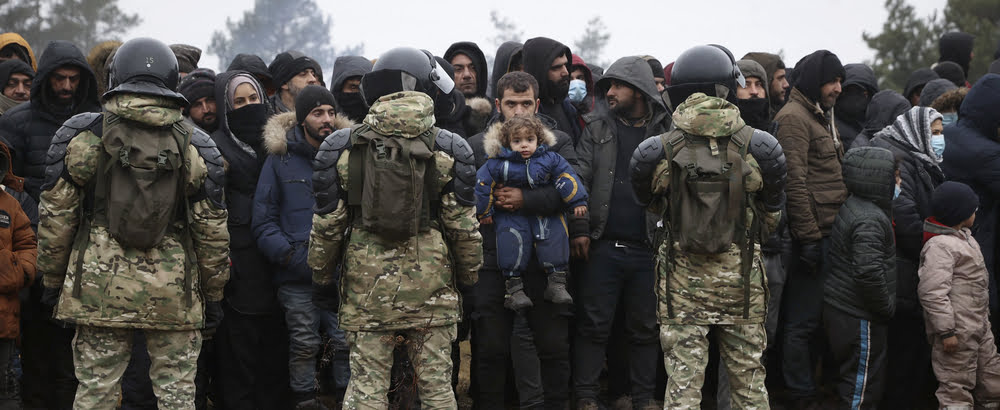
Poland/Belarus: New evidence of abuses highlights ‘hypocrisy’ of unequal treatment of asylum-seekers 

  • Authorities violating rights of asylum-seekers, including strip searches and other degrading treatment, in overcrowded detention centres
  • Some people forcibly sedated during return
  • Pushbacks and arbitrary detention in stark contrast with welcome shown to those fleeing Ukraine
  • Spokespeople available

The Polish authorities have arbitrarily detained nearly two thousand asylum-seekers who crossed into the country from Belarus in 2021, and subjected many of them to abuse, including strip searches in unsanitary, overcrowded facilities, and in some cases even to forcible sedation and tasering, Amnesty International said today.

Additionally, after a hiatus during winter, more asylum-seekers are now trying to enter Poland from Belarus, where they are unable to access further funds due to international sanctions and risk harassment or apprehension by Belarusian police due their irregular immigration status. At the Polish border they face razor wire fences and repeated pushbacks by border guards sometimes up to 20-30 times.

“Asylum-seekers who crossed the Belarus border into Poland, including many forced to do so by Belarusian Border Guards, are now detained in filthy, overcrowded detention centres where guards subject them to abusive  treatment and deny them contact with the outside world,” said Jelena Sesar, Regional Researcher at Amnesty International.

“This violent and degrading treatment stands in stark contrast to the warm welcome Poland is offering to displaced people arriving from Ukraine. The behaviour of the Polish authorities smacks of racism and hypocrisy. Poland must urgently extend its admirable compassion for those entering the country from Ukraine to all those crossing its borders to seek safety.”

Arbitrary detention and abysmal detention conditions

Polish border guards have systematically rounded up and violently pushed back people crossing from Belarus, sometimes threatening them with guns. The vast majority of those who have been fortunate enough to avoid being pushed back to Belarus and to apply for asylum in Poland are forced into automatic detention, without a proper assessment of their individual situation and the impact detention would have on their physical and mental health. They are often held for prolonged and indefinite periods of time in overcrowded centres that offer little privacy and only limited access to sanitary facilities, doctors, psychologists, or legal assistance.

Almost all of the people Amnesty International interviewed said they were  traumatized after fleeing areas of conflict and being trapped for months on the Belarusian-Polish border. They also suffered from serious psychological problems, including anxiety, insomnia, depression and frequent suicidal thoughts, undoubtedly exacerbated by their unnecessary metres. For most, psychological support was unavailable.

Retraumatized inside a military base

Many of the people who Amnesty spoke to had been in Wędrzyn detention centre, which holds up to 600 people. Overcrowding is particularly acute in this facility, where up to 24 men are detained in rooms measuring just eight square metres.

In 2021, the Polish authorities decreased the minimum required space for foreign detainees from three square meters per person to just two. The Council of Europe minimum standard for personal living space in prisons and detention centres is four square meters per person.

People held in Wędrzyn recounted how guards greeted new detainees  by saying “welcome to Guantánamo”. Many of them were victims of torture in their home countries before enduring harrowing experiences both in Belarus and on the border of Poland. The detention centre in Wędrzyn forms part of an active military base. The facility’s barbed wire walls — and the persistent sound of armoured vehicles, helicopters and gunfire from military exercises in the area — only serves to retraumatize them.

“Most days we were woken up by the sounds of tanks and helicopters, followed by gunshots and explosions. This would go on all day, sometimes. When you have nowhere to go, no activities [to] take your mind off it or a space for even a brief respite, this was intolerable. After all the torture in prison in Syria, threats to my family, and then months on the road, I think I was finally broken in Wędrzyn,” Khafiz, a Syrian refugee, told Amnesty International.

In Lesznowola Detention Centre, detainees said that guards’ treatment left them feeling dehumanized. The staff called detainees by their case numbers instead of using their names and meted out excessive punishments, including isolation, for simple requests, such as asking for a towel or more food.

Nearly all those interviewed reported consistently disrespectful and verbally abusive behaviour, racist remarks and other practices that indicated psychological ill-treatment. 

Men who Amnesty International interviewed uniformly  complained about the manner in which body searches were  conducted. When people were  transferred from one detention centre to another, they were forced to undergo a strip search at each facility, even though they were in state custody at all times. In Wędrzyn, people recounted abusive searches. For example, all newly admitted foreigners are kept together in a room, required to remove all of their clothes and ordered to perform squats longer than necessary for a legitimate check.

Violent forcible returns

Amnesty International interviewed several people who were forcibly returned as well as some who avoided return and remain in detention in Poland. Many said the Polish border guards who conducted the returns coerced them into signing documents in Polish that they suspected included incriminating information in order to justify their returns. They also said that, in some cases, border guards used excessive force, such as tasers, restrained people with handcuffs, and even sedated those being returned. 

Authorities attempted to forcibly return Yezda, a 30-year old Kurdish woman , with her husband and three small children. After being told that the family would be returned to Iraq, Yezda panicked and screamed and pleaded with the guards not to take them. She threatened to take her life and became extremely agitated. “I knew I could not go back to Iraq and I was ready to die in Poland. While I was crying like that, two guards restrained me and my husband, tied our hands behind our backs, and a doctor gave us an injection that made us very weak and sleepy. My head was not clear, but I could hear my children, who were in the room with us, crying and screaming.”

“We were asked to go through the airport security and the guards told us to behave on the plane. But I refused to go. I remember noticing that I didn’t even have any shoes on, as in the chaos at the camp, they slipped of my feet. My head was not clear, and I couldn’t see my husband or the children, but I remember that they forced me on the plane that was full of people. I was still crying and pleading with the police not to take us.” Yezda said that she broke her foot as she fought the guards who tried to put her on the plane. Yezda and her family were returned to Warsaw after the airline refused to take them to Iraq. They remain in a camp in Poland for now.

Volunteers and activists have been barred from accessing the border of Poland and Belarus, and some have even faced prosecution for trying to help people cross the border. In March, activists who had helped people both on Poland’s borders with Ukraine and with Belarus were detained for providing life-saving assistance to refugees and migrants on the Belarussian border, and now face potentially serious charges.

Stranded at the border

On 20 March, the Belarusian authorities reportedly evicted close to 700 refugees and migrants, including many families with young children and people suffering from severe illnesses and disabilities, from the warehouse in the Belarusian village of Bruzgi which had accommodated several thousand people in 2021.

People who were evicted from the warehouse suddenly found themselves stranded in the forest, trying to survive in sub-zero temperatures without shelter, food, water or access to medical care. Many remain in the forest and experience daily abuse from the Belarusian border guards, who use dogs and violence to force people to cross the border into Poland.

“Hundreds of people fleeing conflict in the Middle East and other parts of the world remain stranded on the border between Belarus and Poland. The Polish government must immediately stop pushbacks. They are illegal no matter how the government tries to justify them. The international community – including the EU – must demand that those trapped on Poland’s border with Belarus be afforded the same access to EU territory as any other group seeking refuge in Europe,” said Jelena Sesar.

Ukraine: Apparent war crimes by Russian forces in Bucha must be investigated

Following reports of apparent war crimes committed by Russian military forces against civilians in Bucha, Agnès Callamard, Secretary General of Amnesty International, said:

“These reports from Bucha are showing a wider pattern of war crimes including extrajudicial executions and torture in other occupied areas of Ukraine.

“We fear the violence suffered by civilians in Bucha at the hands of Russian soldiers is not unique. These incidents should be investigated as war crimes.

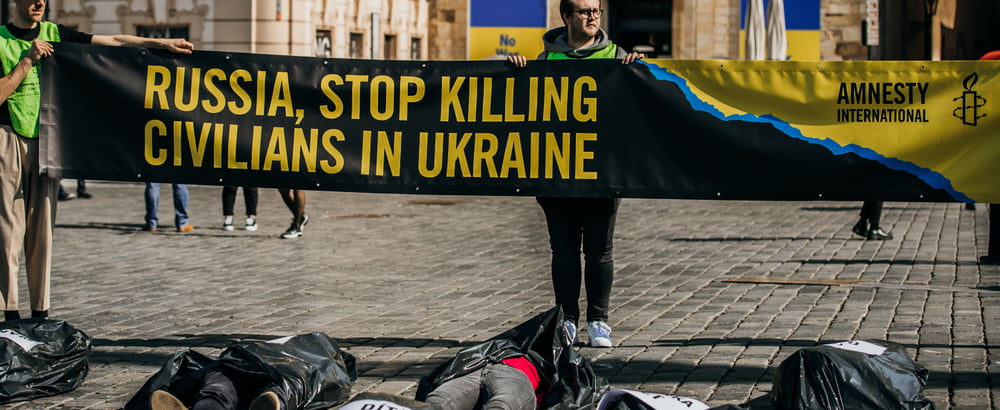
“To date, Amnesty International has gathered evidence of civilians in Ukraine killed by indiscriminate attacks in Kharkiv and Sumy Oblast, documented an airstrike that killed civilians queueing for food in Chernihiv, and gathered evidence from civilians living under siege in Kharkiv, Izium and Mariupol.”

Later this week, Amnesty International will publish new testimony gathered during an on-the-ground investigation in a number of towns in the wider Kyiv region.

As Russia continues its war against Ukraine, Amnesty International is continuing to document violations of human rights and international humanitarian law. All of Amnesty International’s outputs published to date – including news updates, briefings and investigations – can be found here.

Russia’s aggression against Ukraine is itself a crime under humanitarian law.

Ethiopia: Crimes Against Humanity in Western Tigray Zone

Immediate humanitarian access, protection of communities key

  • Tigrayans in the disputed Western Tigray Zone of Ethiopia have experienced a relentless campaign of ethnic cleansing by security forces from the neighbouring Amhara region and their allies.
  • The campaign of killings, rape, mass detentions, and forcible transfers amounts to war crimes and crimes against humanity.
  • The Ethiopian government needs to call on security forces and militia to end these atrocities, allow humanitarian agencies access, including to detention facilities, and support credible justice efforts to ensure those responsible for grave crimes are held accountable.

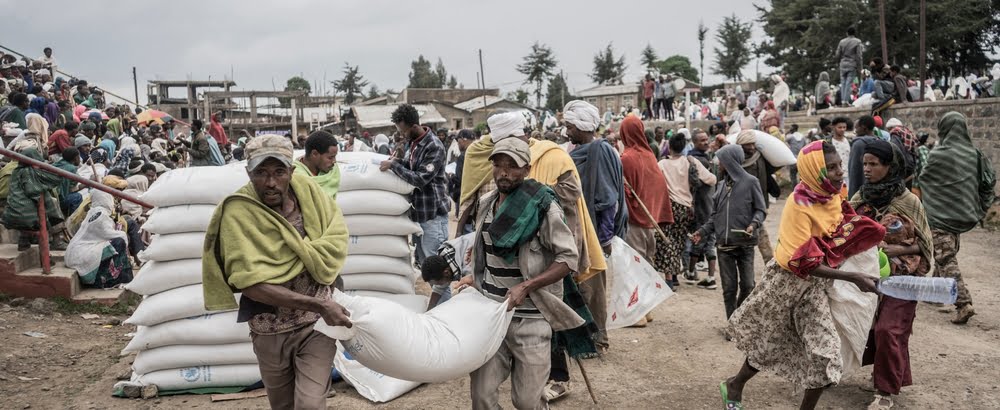
Amhara regional security forces and civilian authorities in Ethiopia’s Western Tigray Zone have committed widespread abuses against Tigrayans since November 2020 that amount to war crimes and crimes against humanity, Amnesty International and Human Rights Watch said in a new report released today (6 April). Ethiopian authorities have severely restricted access and independent scrutiny of the region, keeping the government’s campaign of ethnic cleansing largely hidden.

The report, ‘We Will Erase You From This Land’: Crimes Against Humanity and Ethnic Cleansing in Ethiopia’s Western Tigray Zone, documents how newly-appointed officials in Western Tigray and security forces from the neighbouring Amhara region, with the acquiescence and possible participation of Ethiopian federal forces, systematically expelled several hundred thousand Tigrayan civilians from their homes using threats, unlawful killings, sexual violence, mass arbitrary detention, pillage, forcible transfer, and the denial of humanitarian assistance. These widespread and systematic attacks against the Tigrayan civilian population amount to crimes against humanity, as well as war crimes.

“Since November 2020, Amhara officials and security forces have engaged in a relentless campaign of ethnic cleansing to force Tigrayans in Western Tigray from their homes,” said Kenneth Roth, Executive Director of Human Rights Watch. “Ethiopian authorities have steadfastly denied the shocking breadth of the crimes that have unfolded and have egregiously failed to address them.”

The Ethiopian government should ensure immediate and sustained access to the region for humanitarian agencies, release all those arbitrarily detained, and investigate and appropriately prosecute those responsible for abuses. Any consensual agreement reached by the parties to the armed conflict should include the deployment of an AU-led international peacekeeping force to the Western Tigray Zone to ensure the protection of all communities from abuses.

“The response of Ethiopia’s international and regional partners has failed to reflect the gravity of the crimes that continue to unfold in Western Tigray,” said Agnès Callamard, Secretary General of Amnesty International. “Concerned governments need to help bring an end to the ethnic cleansing campaign, ensure that Tigrayans are able to safely and voluntarily return home, and make a concerted effort to obtain justice for these heinous crimes.”

Western Tigray Zone is a fertile administrative area in Ethiopia’s Tigray region. Claims over Western Tigray have been the source of heightened boundary and identity disputes since 1992. Western Tigray came under the control of the Ethiopian National Defense Forces (ENDF) and allied forces and militias from the Amhara region within two weeks of the outbreak of conflict in Tigray in November 2020.

During the initial offensives, Ethiopian federal and allied forces carried out war crimes against Tigrayan communities, including indiscriminate shelling of towns and extrajudicial executions, forcing tens of thousands to flee to neighbouring Sudan and to other parts of Tigray. Tigrayan militias and local residents also carried out war crimes against Amhara residents and visiting labourers during a massacre in Mai Kadra town on November 9, the first publicly reported large-scale massacre of this conflict.

In the ensuing months, newly-appointed administrators in Western Tigray and Amhara Special Forces – a regional paramilitary force – undertook a campaign of ethnic cleansing against Tigrayan residents of the area.

Over 15 months, Amnesty International and Human Rights Watch researchers interviewed more than 400 people, including in-person interviews of Tigrayan refugees in Sudan, and remote interviews of Tigrayan and Amhara residents of Western Tigray and the Amhara region who suffered or witnessed abuses. Researchers also consulted medical and forensic reports, court documents, satellite imagery, and photographic and video evidence that corroborated accounts of grave abuses.

Campaign of ethnic cleansing

Amhara regional security forces, militias, and newly appointed authorities carried out a coordinated campaign of ethnically targeted persecution beginning in late 2020.

In several towns across Western Tigray, signs were displayed ordering Tigrayans to leave, and local administrators discussed their plans to remove Tigrayans in open meetings. A Tigrayan woman from Baeker town described threats she faced by Fanos, an irregular Amhara militia: “They kept saying every night, ‘We will kill you… Go out of the area’.” Pamphlets appeared giving Tigrayans 24-hour or 72-hour ultimatums to leave or be killed.

The authorities rounded up thousands of Tigrayans for long-term detention and abuse in overcrowded facilities. Amnesty International and Human Rights Watch believe thousands of Tigrayans are still held in life-threatening conditions today.

Security forces also used gang rape, accompanied by verbal and physical abuse, abduction, and sexual slavery. A 27-year-old Tigrayan woman said that a militia member told her as the men raped her: “You Tigrayans should disappear from the land west of [the Tekeze River]. You are evil and we are purifying your blood.”

Authorities in Western Tigray also imposed restrictions on movement, humanitarian assistance, speaking the Tigrinya language, and access to farmland to coerce Tigrayans to leave. Amhara security forces, and in some places Eritrean forces present in Western Tigray, looted crops, livestock, and equipment, depriving Tigrayans of their means of survival. A 63-year-old farmer from Division village watched as a group of men destroyed his home. One of the men told him: “This is not your land. You have nothing to claim here.”

Many Tigrayan communities, facing starvation and intimidation, felt they had no choice but to leave. In other instances, local authorities provided trucks or buses to expel tens of thousands of Tigrayans, sending them east, toward central Tigray.

This coordinated campaign continued for months. Tens of thousands of Tigrayans had fled or been expelled by March 2021. Abuses and expulsions escalated again in November 2021, when tens of thousands of older and sick Tigrayans, young mothers, and children were expelled, while Amhara forces arrested and detained thousands of adult men, shooting at those who tried to flee.

Tekeze River bridge massacre

On January 17 2021, Amhara militias known as Fanos and local residents rounded up and detained dozens of male Tigrayan residents of the town of Adi Goshu.

Members of the Amhara Special Forces rounded up and summarily executed about 60 Tigrayan men by the Tekeze River. Witnesses and the few men who survived believed the killings were a revenge attack after the Amhara forces suffered heavy losses during fighting with Tigrayan forces the previous night.

“When they shot at us, I fell first and then I saw also when the others in front of me were shot and fell,” said a 74-year-old survivor. “And the people behind me fell on me and covered me… After that, they said, ‘The Tigrayans don’t die easily, shoot again’.”

The massacre prompted a mass exodus of Tigrayans from Adi Goshu.

Deaths in detention sites

Former detainees held in sites across Tigray said many people died in detention sites run by the Amhara forces and Fano militias. Some died as a result of torture, denial of medical care, and lack of food and water; guards killed others. A 72-year-old farmer said: “They [Amhara militia guards] kept telling us that Tigrayans deserve to be starved…to death.”

Both Ethiopian federal forces and Amhara authorities have denied allegations of ethnic cleansing in Western Tigray. On February 25, Amnesty International and Human Rights Watch wrote to Ethiopian federal and Amhara and Tigrayan regional authorities concerning the organizations’ findings. At time of writing, only the Amhara regional government had responded.

In armed conflict, all parties are obligated to respect international humanitarian law – the laws of war. Amhara regional forces and forces aligned with the Ethiopian government in the Western Tigray Zone committed the war crimes of murder, torture, rape, deportation and forcible transfer, and enforced disappearance. Such violations committed as part of a widespread or systematic attack on a civilian population in furtherance of a state or organizational policy constitute crimes against humanity.

The Ethiopian federal government and its international and regional partners should take concrete steps to protect all communities in Western Tigray, including by immediately releasing Tigrayans arbitrarily detained there, and allowing protection monitoring. On March 24, the government announced a humanitarian truce. Regardless of any truce or ceasefire, Ethiopia’s federal and regional authorities should allow unhindered, independent, and sustained humanitarian assistance.

The government should also demobilize and disarm all abusive militia forces in Western Tigray, and vet Amhara Special Forces and Ethiopian federal forces and remove those implicated in serious abuses, Amnesty International and Human Rights Watch said. Civilian officials, including interim authorities in Western Tigray, and security force personnel implicated in serious abuses should be suspended pending investigations.

Any consensual agreement by all parties should include the urgent deployment of an AU-led international peacekeeping force with a robust civilian protection mandate to Western Tigray. This is crucial to promote human rights, allow the delivery of humanitarian aid, and to help protect at-risk communities in Tigray. Ethiopia’s international and regional partners should support these calls.

Ukraine: Russia’s cruel siege warfare tactics unlawfully killing civilians – new testimony and investigation

The Russian military’s siege warfare tactics in Ukraine, marked by relentless indiscriminate attacks on densely-populated areas, are unlawfully killing civilians in several cities, Amnesty International said today in a new on-the-ground investigation.

For the first time, Amnesty International field investigators in Ukraine have independently verified physical evidence of banned cluster munitions, the use of which violates international law. They have also collected testimony that documents Russian siege tactics, including unlawful indiscriminate attacks, disruption of basic utilities, cuts to communication, destruction of civilian infrastructure, and restrictions on access to medicine and healthcare.  

In recent weeks, Russian forces have been using inherently indiscriminate weapons – such as cluster munitions, and inaccurate weapons with wide-area effects such as unguided ‘dumb’ bombs and Multiple Launch Rocket Systems (MLRS) salvos – in attacks on densely-populated civilian areas.

As such, Russian forces’ assaults on towns and cities and wanton destruction of the infrastructure of daily life violates international humanitarian law and international human rights law. Launching indiscriminate attacks which kill or injure civilians also constitute war crimes.

“A defining feature of these cruel sieges is Russia’s relentless indiscriminate attacks, which cause utterly devastating harm over time,” said Joanne Mariner, Director of Amnesty International’s Crisis Response Programme.

“For five weeks now, civilians across Ukraine have seen their cities razed day-by-day. Our on-the-ground research has documented how some of society’s most at-risk people are disproportionately suffering as these brutal siege tactics continue.

“Civilians trapped in cities under siege must urgently have access to humanitarian corridors to enable the safe evacuation of all who wish to leave. Humanitarian supplies must also be allowed to reach those who remain behind.”

Amnesty International conducted in-person and remote interviews with people who experienced sieges in five cities, including Kharkiv and Mariupol. Amnesty International’s Crisis Evidence Lab analyzed relevant satellite imagery, and verified videos and photos of the incidents described below. In the coming weeks, Amnesty International will publish further evidence gathered during on-the-ground investigations in Ukraine.

Indiscriminate attacks 

Russian forces reached the northern suburbs of Kharkiv in the first days of the invasion, and quickly implemented siege tactics, attempting to encircle the city and firing inaccurate weapons into populated areas.

Amnesty International has documented a broad pattern of unlawful indiscriminate attacks across populated areas in Kharkiv. On 28 February, three MLRS salvos struck the northern part of the city and killed at least nine civilians, including children, and wounded at least another 18.

In an attack on the morning of 4 March, Olesky Stovba, a 41-year-old father, was injured by a cluster munition while buying groceries on Zaliznychna Street in Kharkiv’s Mala-Danylivka district.

He told Amnesty International: “We found some food, and we stood outside the food shop and I heard a great sound. I turned myself and I saw a lot of little fire. It was the height of my knees, 50 metres from me. I fell down, and my wife too, and I felt something hit my right leg… I pulled down my trousers and saw lots of blood.”

Surgeons later removed three fragments from his right groin, calf, and foot. Amnesty International’s Crisis Response weapons investigator examined the physical evidence in person, and confirmed the largest fragment was from either a 9N210 or 9N235 cluster munition.

Kharkiv’s Saltivka district has also been repeatedly targeted during the siege of the city. Amnesty International’s Crisis Evidence Lab verified 22 incidents in the district, showing damage to civilian areas including schools, residential blocks, food markets, and a tram depot, between 27 February and 16 March. Photos from strikes depict remnants of Smerch rockets and cluster munitions across the area.

One man*, who has been running a bomb shelter in Saltivka, told Amnesty International: “It has become my new reality — shootings and bombings, helping old women out of the rubble, no gas, no water, no electricity. Once every three days, we boil ice for water. There are 300 people in the shelter. The majority are older, fragile, [they have] asthma, diabetes. There are some who haven’t left the shelter in three weeks. The biggest problem in Saltivka is that the elderly die for lack of medicine, from shock, from a heart attack. It is important to get them in the ground and bury them, it will get warmer soon and they will decompose.”

In a shelter in Lviv, Amnesty International researchers interviewed a 16-year-old girl who had been evacuated alone from Kharkiv. The organization verified a photo showing the remains of a 220mm Uragan rocket that struck close to her family’s apartment complex, which is near a school.

She told Amnesty International: “The missile struck at night, and I smelled the fire and felt the waves. All of my family, we all live in the corridor of the apartment building from the first day of the war.”

Amnesty International has previously confirmed that cluster munitions killed a child and two other civilians taking shelter at a preschool in Sumy Oblast, and documented an airstrike that killed civilians queueing for food in Chernihiv.


Denial of basic services

Communication with civilians in besieged cities is extremely difficult due to disrupted mobile and internet service. Many people spend the majority of their time in underground bomb shelters with weak or no signal. Access to communications and the internet are essential for safety, and for access to vital information regarding possible evacuation routes.

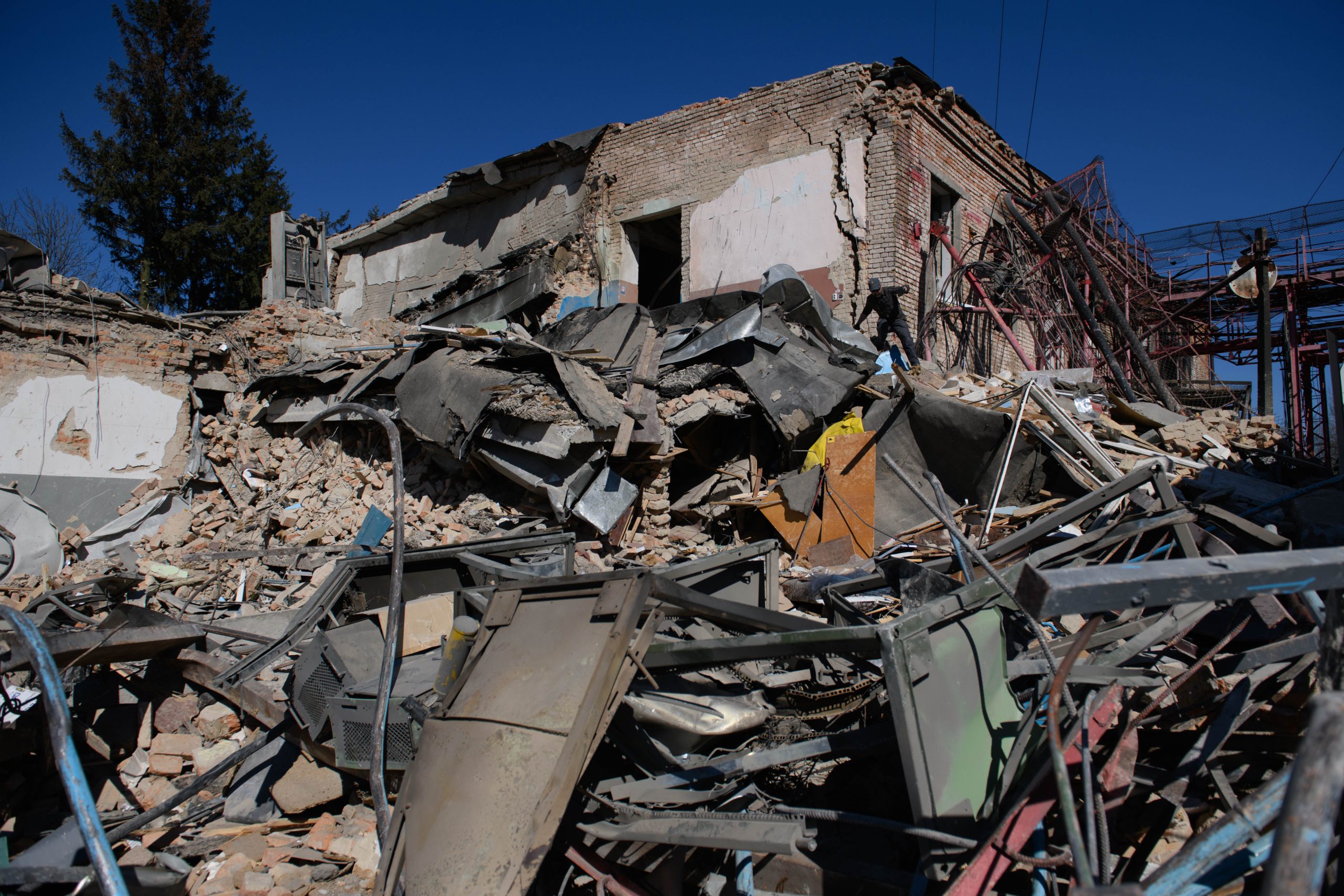
In the cities of Kharkiv and Izium, compounds containing TV towers were damaged by strikes. Open-source research and satellite imagery analysis by Amnesty International shows that Kharkiv’s TV tower compound was likely damaged twice between 27 February and 17 March, and service outages were reported from 6 March. A building associated with Izium’s TV tower was damaged on 12 March, then further damaged by 20 March. Open-source reports again confirmed disruption to broadcasting. Many older residents rely on television for news and for emergency information from the government.

Amnesty International previously documented how civilians in Izium are on the brink of a humanitarian disaster as Russian forces have bombarded the town since the invasion began.

Impact on at-risk people

The conflict continues to have a significant impact on older people and people with disabilities, which siege warfare further exacerbates.

Alexander Mihta, a 39-year-old in Kharkiv, is diabetic and has severe trouble walking due to the damage the disease has caused to his feet. He drove his wife and daughter to the Polish border, but then had to stay in Ukraine following the implementation of martial law. His apartment building in Kharkiv was struck by Smerch rockets, which smashed steam pipes, cutting heating and flooding the lower floors. Amnesty International’s Crisis Evidence Lab verified 21 photos that confirmed damage to the residential building. Mihta later escaped to a shelter in Lviv with his father.

He told Amnesty International: “The shelling worsened the whole time. I needed food, so I left and went to shop. I have diabetes and I ran when the shelling worsened, and I twisted my leg. I was trying to get to the bomb shelter but couldn’t. I broke six bones, and they [doctors] want to amputate.”

Amnesty International also interviewed a 61-year-old woman* who has stayed in Kharkiv to care for her mother, aged 84, who has dementia and is unable to travel.

She said: “The old people, we are staying. My mother can hardly move… We are from Luhansk and had to get my mother from Luhansk… We left for my daughter’s flat in Kharkiv and we are stuck here. One in every 24 hours we spend outside.

“I talk to my mother. I take her to the toilet and help her undress. I have to always explain to her why we are in Kharkiv, and why we are in the basement. She has dementia and always forgets why she is in the basement, and I have to tell her all day long. She used to have a decent life, she could walk in the garden. Not anymore.”

Older people and people with disabilities, as well as other groups who may face particular risks and challenges when fleeing, should be prioritized for evacuation, as specificied in international humanitarian law. Planning and communication about evacuations and safe humanitarian corridors must also be undertaken in an inclusive way, including by ensuring that information, transportation, and services are all accessible.

Singapore: Shameful resumption of executions after more than two years won’t end drug-related crime 

Responding to reports that the Singapore government executed Abdul Kahar bin Othman on 30 March, Amnesty International Southeast Asia Researcher Rachel Chhoa-Howard said:  

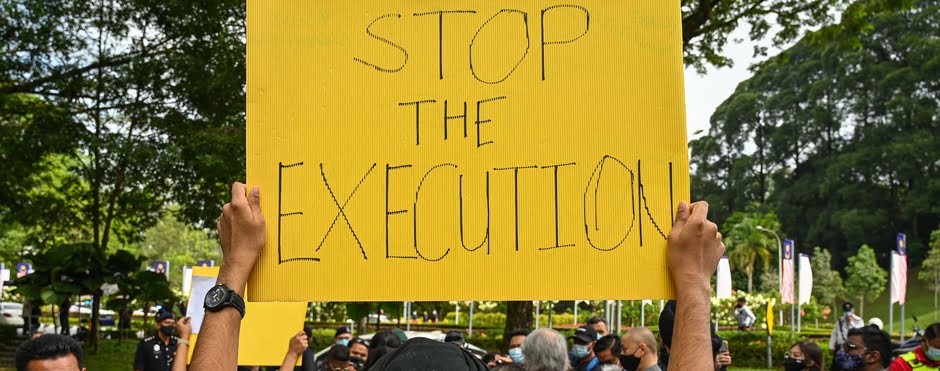
“After two years of no executions, the hanging of Abdul Kahar bin Othman, who was sentenced for drug-related offences and to the mandatory death penalty, is a shameful breach of international law. 

“There is overwhelming evidence that punitive drug policies, including imposing the death penalty for drug use and possession, do not solve problems associated with drugs. The Singapore government should focus on evidence-based and community-based approaches rooted in the respect of public health and human rights to avert drug dependence and other societal harms that may result from the use of drugs. 

“Singapore’s use of the death penalty is out of step with the global trend towards abolition and the country is among a handful that still resort to executing those convicted of drug-related crimes. After a short hiatus of no executions in Singapore, we call on the authorities to halt a feared new wave of hangings. The government must also urgently establish an official moratorium on all executions and review the scope of the death penalty for drug-related offences as first moves towards its full abolition.”  

Background  

Before today, the last known execution in Singapore was carried out in November 2019. 

The family of Abdul Kahar bin Othman were provided notice and asked to make arrangements for last visits in a letter dated 23 March. He was convicted of drug trafficking and sentenced to the mandatory death penalty in 2015. 

The execution comes a day after a Singapore court upheld the death sentence for Malaysian national Nagaenthran Dharmalingam, despite medical experts finding that he had an intellectual disability. He could be executed within days. 

Nagaenthran’s appeal hearing was postponed in November when he tested positive for Covid-19. His appeal hearing was re-set to 29 March and, with other appeals exhausted, was one of his last opportunities for him to be spared execution. In the ruling, the court rejected arguments about the decline of his mental state, and they have similarly dismissed challenges based on his intellectual ability. 

International human rights law and standards further prohibit the imposition of the death penalty for drug-related offences and as the mandatory punishment for any offences. All those who have had their execution set in Singapore since late 2021 have been convicted of and sentenced to the mandatory death penalty for drug-related offences. 

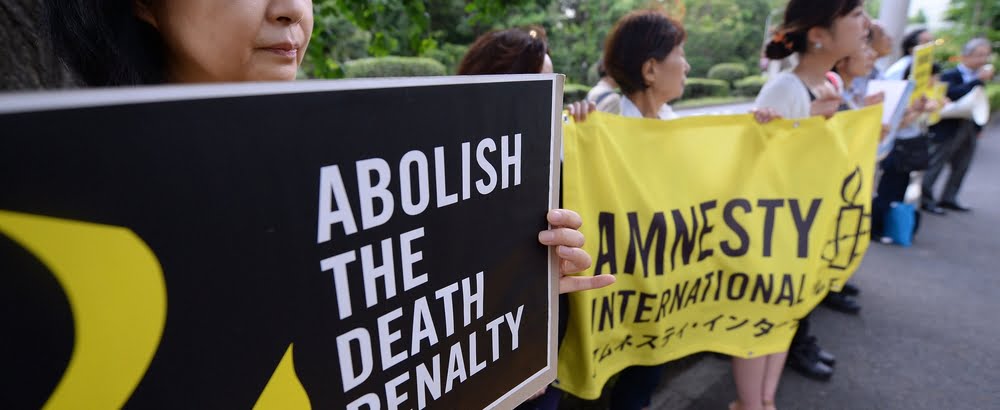
Amnesty International opposes the death penalty unconditionally, in all cases and under any circumstances. More than two-thirds of countries all over the world have abolished the punishment in law or practice.

Why trans visibility is important to me

Robbie (they/them), Allyship Coordinator for Amnesty International Australia, celebrates their personal experience on Transgender Day of Visibility, an annual event on March 31 dedicated to raising awareness of transgender and gender diverse people all around the world.

I came out to myself as trans only a few weeks after Transgender Day of Visibility in 2018. Growing up, the only LGBTQIA+ people I knew were Graham Norton and Ellen DeGeneres, and the only trans people were unnamed characters who were the butt of the joke in the 90s sitcoms I watched with my family.

It wasn’t until I was in my early twenties that I even heard the word non-binary, or met my first trans friend. I didn’t learn about trans history, see trans people on my screen or read about trans characters until after I realised I myself was trans and not because trans people don’t exist, but simply because in the stories I was shown our experiences were not told. I always wonder how much my life would have changed if I had grown up with people to follow, to tell me my experiences were ok, and to show me all the things I could be as an adult.

Four years later, Transgender Day of Visibility (TDOV) continues to be a day when I can truly express my unending gratitude for the trans people in my life. It is a chance to celebrate and feel pride in my identity. It’s a chance to give thanks to the trans people around me and to acknowledge the many, many people who have come before me and walked a much harder path than my own. TDOV is my chance to connect to a community that has raised me, fed me (literally), allowed me to grow, caught me when I fell and dusted the dirt off my shoulders. I have never before felt the love that I feel from the trans community, and that’s why, for me, TDOV is a day to acknowledge what I owe (what we all owe) to the trans people around us. 

This TDOV I am celebrating the trans people who have given me strength to go on, who have continued to light the way, and who have simply just existed in places where they’ve been told they shouldn’t.

I’m celebrating my trans friends, my chosen family, the writers, podcasters, makers, actors, historians, YouTubers, celebrities, drag kings and queens and every single trans person who continues to change the world everyday.

For many trans people visibility isn’t a choice, a privilege or a celebration – there is so often a cost that comes with our visibility. When we celebrate trans visibility, we also celebrate the people for whom visibility isn’t a choice or option, the people whose visibility isn’t recognised, the trans people for whom visibility isn’t a celebration, and those who remain invisible, unsafe or unheard.

Every trans person has their own experience. Multiple visibilities are even more important than ever. 

So without further ado, below is a short list of some of the trans people to read, listen to, watch, and follow on this TDOV!

Read

Beyond the Gender Binary by Alok Vaid-Menon deconstructs the gender binary and asks us to reimagine what gender looks like beyond “just two stars in the galaxy”. Alok is a writer, performer and public speaker who advocates for transgender and gender diverse rights.

Finding Nevo by Nevo Zisin is a coming of age autobiography written by activist, student, writer and public speaker Nevo Zisin. Finding Nevo explores gender, identity, and discovering who you are, and gives us an important insight into what it means to question, learn and grow in gender.

A Natural History Of Transition by Callum Angus is a collection of short stories exploring the neverending evolution of transition and transness. From a man who gives birth to a cocoon, to a religious sect who transition every Winter, to a person who becomes a mountain – Callum combines magic, transness, relationships, bugs and the natural world to explore what transition means.

Watch

Trans 101 – The Basics

This incredible resource by Minus18 was created by youth at Minus18 and Ygender as they dive into gender identity, language, expression and more! It’s an incredible resource to understand more about trans experiences, and how you can be a better ally to the trans people in your life.

You Can’t Ask That – Transgender

ABC show You Can’t Ask That uses questions sourced from the public to breakdown stereotypes and answer questions about minority groups in Australia. You Can’t Ask That allows you to learn more about what it means to be transgender while answering the questions you might not know how to ask.

Listen

QueerStories

QueerStories is a national LGBTQIA+ storytelling project created by theatre-maker Maeve Marsden. QueerStories celebrates LGBTQIA+ experiences and the fierce, funny, heartbreaking and vulnerable stories that come out of them. A book, podcast and series of events, you can find QueerStories on Spotify to listen to episodes featuring emerging and professional trans talent as they tell their stories.

The Gender Reveal

The Gender Reveal is a podcast created by Tuck Woodstock exploring the vast diversity of trans experiences through interviews with a wide array of trans, nonbinary and two-spirit people. Released every Monday the show is an amazing resource for allies and trans people alike.

Follow

Schuyler Bailar

Schuyler Bailar was the first openly transgender Division 1 NCAA swimmer. He is an outspoken advocate for transgender athletes and fights for cultural inclusion for LGBTQIA+ and Asian American athletes. 

Jackie Turner

Jackie Turner is an organiser and campaigner who is passionate about trans inclusion in the workplace and in people-powered movements. 

Naavikaran

Naavikaran is a producer, poet, choreographer, LGBTQIA+ advocate and educator. You can listen to her story on QueerStories, follow her on social media, support her work on Ko-Fi or by attending events she runs in Brisbane.

Darcy Vescio

Darcy Vescio is an Aussie rules footballer playing for the Carlton Football Club.

Minus18

Minus18 is an LGBTQIA+ youth organisation focused on leading change, building social inclusion, and advocating for an Australia where all young people are safe, empowered, and surrounded by people that support them. They provide education and resources for LGBTQIA+ youth and allies.

TransHub

ACON’s TransHub is a resource hub full of information on trans rights, allyship and education. If you’re new to trans allyship or a trans person looking for resources TransHub is a great place to start off your search.

Solidarity message

In recent months, we have seen an increase in organised and coordinated divisive political and media discourse around the rights of the trans and gender diverse community.

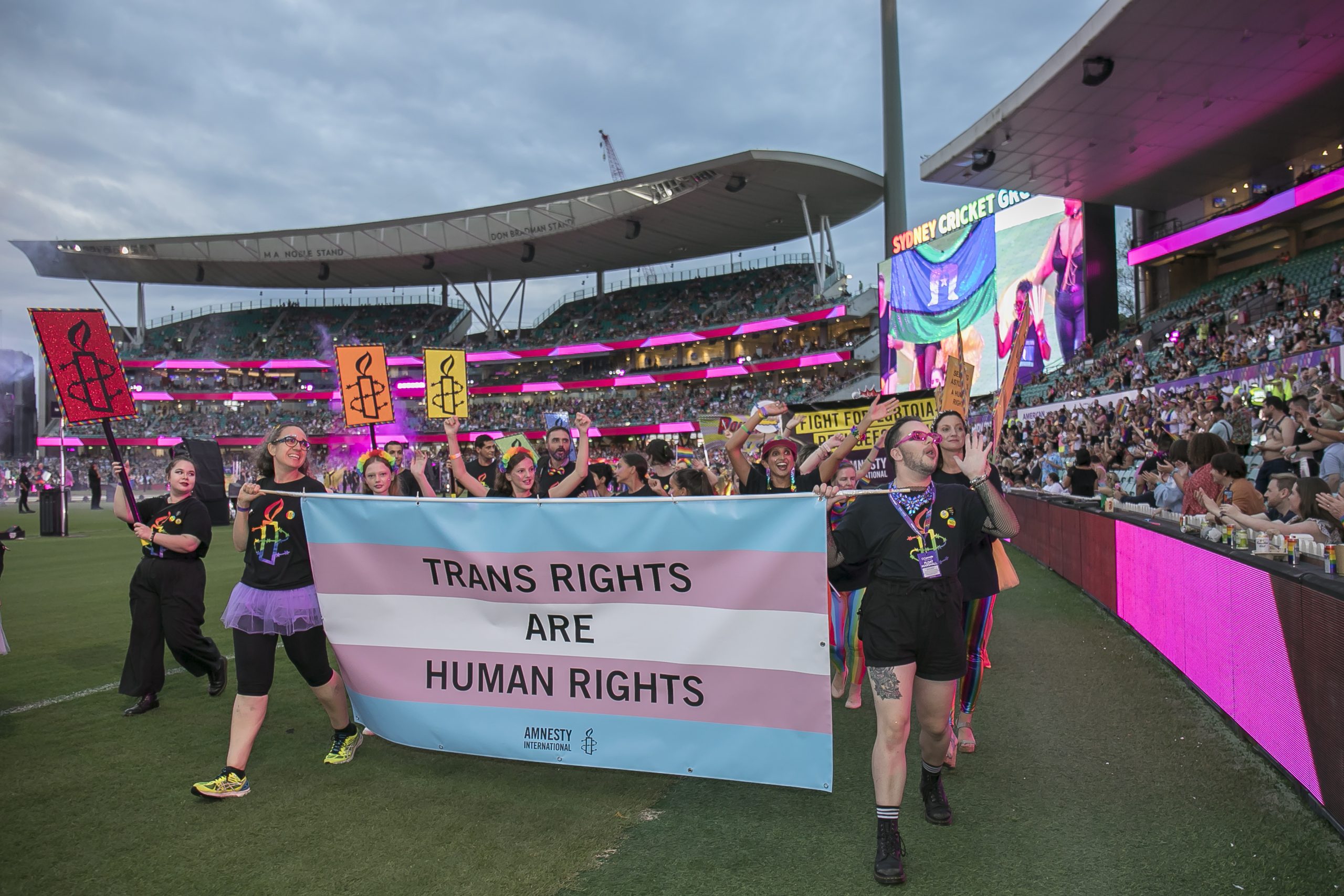
There is no debate. Trans rights are human rights. Simple as that.

We will keep fighting for a world where all trans and gender non-conforming people can live with access to healthcare, safety and freedom.

Solidarity, love and thanks to the trans community, today and always.

Singapore: Executions feared as soon as Wednesday after two years with no hangings

Responding to the rejection of the death penalty appeal of Malaysian national Nagaenthran Dharmalingam and the imminent execution of Abdul Kahar bin Othman in Singapore, Amnesty International’s Southeast Asia Researcher Rachel Chhoa-Howard said:

“A man sentenced to the mandatory death penalty for drug-related offences faces execution on Wednesday, and fears are growing that more are to come. After two years without any executions, we urge the Singapore government to refrain from reinstating the use of this cruel punishment.

“Nagaenthran Dharmalingam lost his appeal, clearing the way for his execution by hanging as early as this week. This shocking outcome is despite serious concerns about his intellectual and mental capacity, and collective outrage from around the world.

“Throughout his 18 years in power, Prime Minister Lee Hsien Loong’s cabinet has not once approved an order for the President to grant clemency to someone facing execution. But if there was ever a time to do so, it would be now.

“The government must act immediately to stop a grave travesty of justice from taking place and end its inhumane, shameful strategy of using the death penalty to address drug-related problems.

“The use of the death penalty in Singapore violates international human rights law and standards. The death penalty is never the solution to crime or the solution to address the risks and harms of using drugs. We call on the government to abolish the death penalty once and for all.”

Background

There was mass outrage last year when, despite medical experts finding that Nagaenthran Dharmalingam has an intellectual disability, his family learned that the Singapore authorities had scheduled his execution for 10 November. Concerns mounted when his family reported that his mental health had deteriorated significantly when they visited him in prison, where he appeared to not fully understand what was happening to him.

The UN body monitoring compliance of the Convention on the Rights of Persons with Disabilities (CRPD), to which Singapore is a party, stated that the imposition of the death penalty on people whose mental and intellectual disabilities is prohibited. 

Nagaenthran’s appeal hearing was postponed in November when he tested positive for Covid-19. His appeal hearing was re-set to 29 March and, with other appeals exhausted, was one of his last opportunities for him to be spared execution. In the ruling, the court rejected arguments about the decline of his mental state, and they have similarly dismissed challenges based on his intellectual ability.

International human rights law and standards further prohibit the imposition of the death penalty for drug-related offences and as the mandatory punishment for any offences. All those who have had their execution set in Singapore since late 2021 have been convicted of and sentenced to the mandatory death penalty for drug-related offences.

The authorities of Singapore have set another execution for this Wednesday, 30 March. The family of Abdul Kahar bin Othman were provided notice and asked to make arrangements for last visits in a letter dated 23 March. He was convicted of drug trafficking and sentenced to the mandatory death penalty in 2015.

Amnesty International opposes the death penalty in all cases and under any circumstances.

Urgent actions must be taken on refugee crises in Ukraine, Afghanistan and Myanmar

Australia must urgently increase its humanitarian intake in the face of the refugee crises in Ukraine, Afghanistan and Myanmar, Amnesty International Australia said.

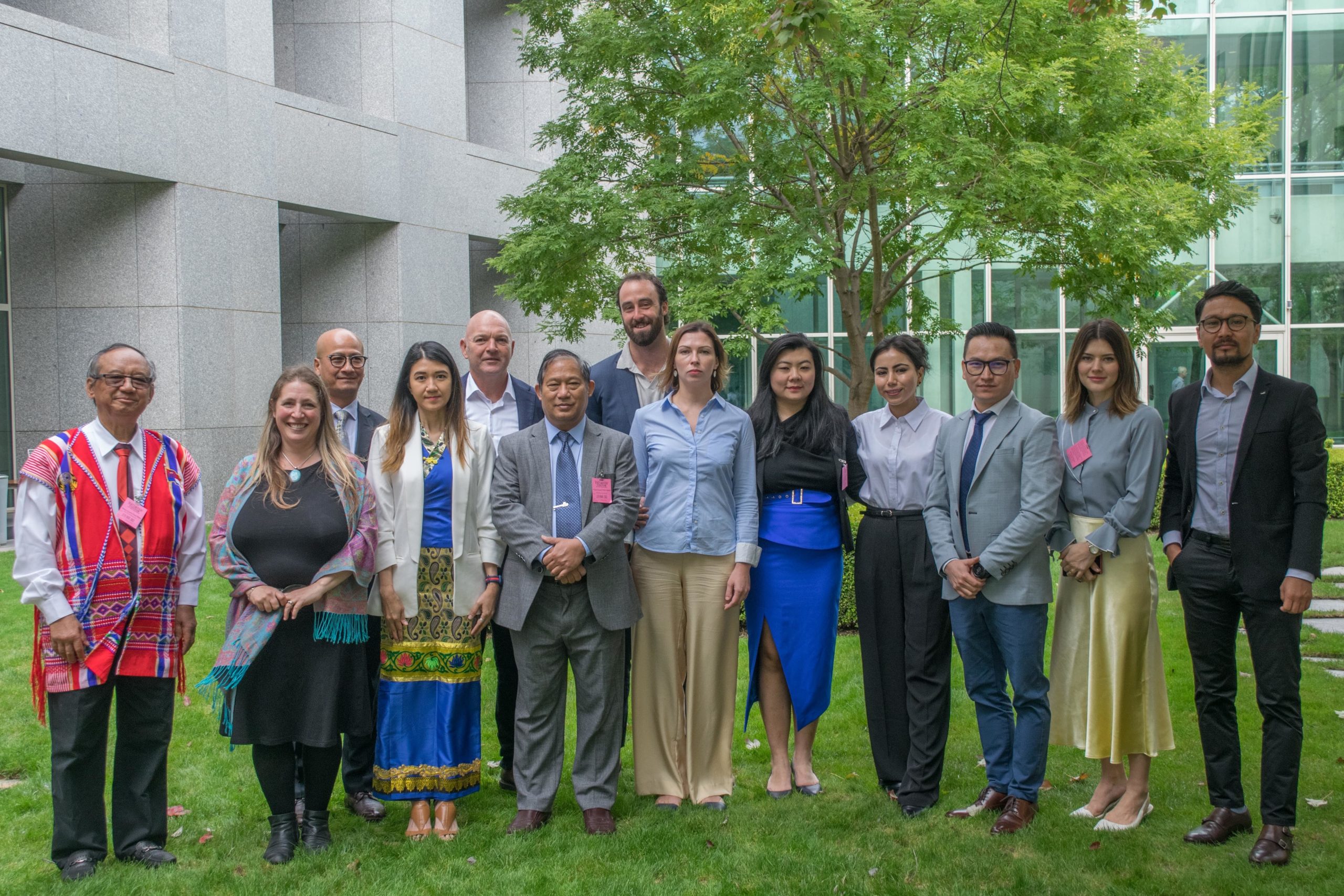
Diaspora groups representing people from Ukraine, Afghanistan and Myanmar have met with various members of the Australian Parliament to ask for more help for people fleeing their homes.

“Since 2020, Australia has reduced its annual humanitarian intake by 5000 places each year, we have capacity to help and we should be doing a lot more,” Amnesty International Australia Campaign Director, Tim O’Connor, said.

“Australians are generous and we know people want to do what they can – we hope the Government takes this into consideration in the forthcoming budget.”

Sitarah Mohammadi from the Afghan community said the needs of people fleeing Afghanistan has only intensified in the months since the Taliban seized control. 

“A special humanitarian intake for Afghanistan would enable Australia to respond more effectively to those most at risk among the 6.5 million people now displaced inside and outside of Afghanistan,” Mohammadi said.

“Since the Taliban’s violent takeover of Afghanistan in August, more than 150,000 Afghan nationals have applied for humanitarian visas in Australia but, despite the dire situations they face, few have much hope of finding protection in Australia. In addition, refugees from Afghanistan on temporary visas must also be granted permanent protection and enabled to reunite with their families.”

Ievgeniia Chesnakova from the Australian Ukrainian community said people seeking refuge from the horrors of war need an understanding that Australia welcomes them.

“For those who have been granted a tourist visa there needs to be communication that they can get moved to Australia, flights to Australia and assurances they will be assisted when they arrive, as well as a path to permanency.”

Ko Naing Saulsman, a representative of the Myanmar community, said despite other world events dominating headlines, the need in Myanmar is no less pressing.

“The situation in Myanmar is a humanitarian emergency that will continue getting worse due to the military junta’s consistent attacks on civilian areas. The international community needs to increase the refugee intake for people fleeing Myanmar as well as urgent humanitarian assistance along the India and Thailand border.”

Amnesty International Report 2021/22: The state of the world’s human rights

The Amnesty International Report 2020/21 documents the human rights situation in 154 countries and presents recommendations for governments and others. It is essential reading for policy makers, advocates, activists and anyone with an interest in human rights.

In the world

From a human rights perspective, 2021 was largely a story of betrayal and hypocrisy in the corridors of power. Promises to “build back better” after the Covid-19 pandemic were little more than lip service, with some governments even redoubling their exploitation of the pandemic to bolster their own positions.

Hopes of global cooperation withered in the face of vaccine hoarding, reluctance to confront climate change and narrow self-interest. Promises of economic recovery were undercut by lacklustre debt relief and entrenched income inequality. Advances in science and technology were undermined by corporate greed and governments’ complicity or exploited to stifle dissent and keep refugees and migrants from crossing borders.

But hopes for a better post-pandemic world were kept alive by courageous individuals, social movements and civil society organisations. Their efforts and limited hard-won victories should prompt governments to live up to their promises.

The report explores three key trends arising from Amnesty International’s 2021 human rights research in 154 countries: health and inequalities, civic space and Global North pushback on refugees and migrants.

At home

The Amnesty International Report 2020/21 highlights there is still a long way to go in ensuring that the human rights of all individuals are protected and supported in Australia.

  • Australia continued to incarcerate children as young as 10 years old, but efforts to raise the age of criminal responsibility to 14 progressed. Despite widespread public support, the Australian government displayed reluctance to move on an important reform which would have a significant impact on the health and wellbeing of First Nations children. Whilst there was some progress in the nation’s capital with the ACT Government committing to increase the age to 14, no other states are yet to follow suit.
  • Australia’s brutal treatment of refugees and asylum seekers continued. The number of refugees accepted for resettlement in Australia decreased from 18,750 in 2020 to 13,750 in 2021. Although the government announced an end to offshore processing in Papua New Guinea by the end of the year, the indefinite and arbitrary detention of refugees and asylum seekers continued.
  • Australia failed to tackle climate crisis. The government continued to fund coal and gas development projects, often in violation of First Nations people’s rights. Further, Australia failed to adopt carbon emission reduction targets consistent with its obligations under the Paris Agreement and human rights law.  
  • Australia failed to to defend LGBTQIA+ rights. Government announced plans to introduce a revised Bill on Religious Freedom to further entrench discrimination against LGBTQIA+ people.
  • Australia’s response to sexual and gender-based violence against women remained inadequate. Recommendations for legislative reforms made by the Australian Human Rights Commission in 2020 following its inquiry into sexual harassment in the workplace had still not been fully implemented by the end of the year.
  • No one was held accountable for alleged war crimes committed by Australian troops in Afghanistan.

“There are still too many people who are unable to access their basic human rights in Australia. The continued failure of members of society including refugees, asylum seekers and First Nations People to access their rights, demonstrates the urgent need for the government to implement an overarching single Human Rights Act that defends and protects the rights of all people.”

Sam Klintworth, Amnesty International Australia Director

On a domestic level, Amnesty International Australia’s 2025 Vision looks ahead with a clear vision for the next five years, of hope and renewed commitment to continuing to challenge injustice and create real, lasting change on key issues: anti-racism, LGBTQIA+ rights, Indigenous justice, climate justice, refugee rights and women’s rights.

On a global level, the latest Amnesty International Annual Report 2021/22 details the concerns and calls for actions to governments and others.