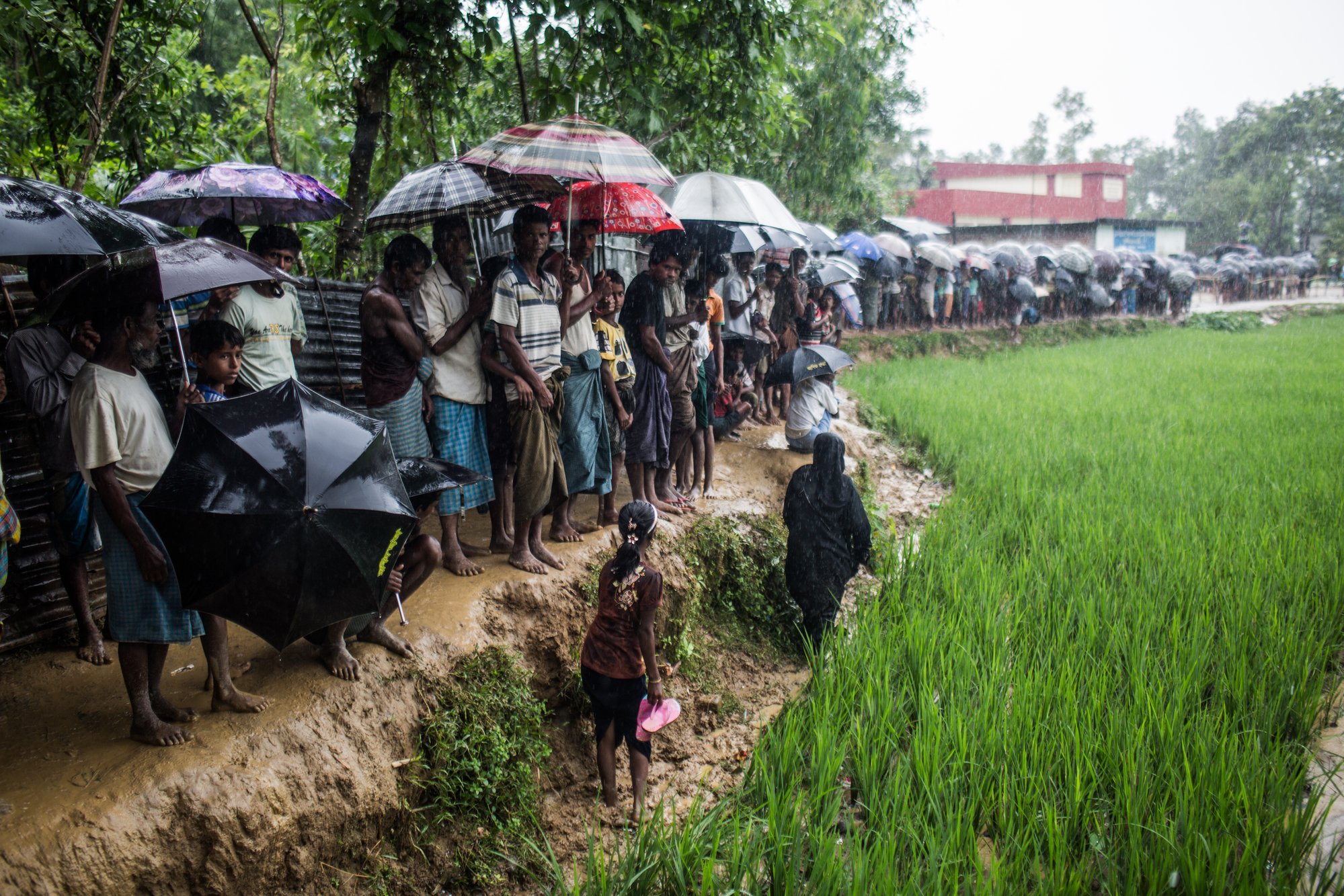
The Rohingya ‘camp of the widows’ faces new peril as monsoon arrives in Bangladesh

Nestled deep within the Hakimpara camp, perched on the edge of a hill, is a cluster of homes belonging to more than a dozen Rohingya women. They arrived here last September, making the arduous, weeks-long journeys — by foot and then by boat — to the safety of Bangladesh.

They fled different villages, making separate journeys. Along the way, they each suffered a similar tragedy. They lost their husbands and, in many cases, their babies, too.

This is known as the “camp of the widows”.

Amid a population of more than 800,000 people who have fled crimes against humanity committed by the Myanmar military — arson, rape, murder, torture and other horrors — these women are the most vulnerable people in these camps.

They turn to each other for support and solidarity. They have no means of earning an income. They cannot leave the camps. The thought of returning back to Myanmar remains a forbidding one, reviving traumatic memories of the injustices that forced them across the border. And yet, their existence here remains a precarious one.

Nine months after fleeing one tragedy, they could be swept away by another. They have survived the past few months on the most meagre rations. Now the tiny, sweltering dwellings they call home could be lashed by fierce rains and violent winds that are gathering in the form of the looming monsoon season and the annual threat of cyclones.

Over recent weeks, more than 1,100 homes have been damaged by sharp winds, affecting nearly 10,000 people. Soon, that number could rise into the hundreds of thousands.

Claire Mallinson meeting with Rohingya women in a shelter. © AI/Salman Saeed

Widow couldn’t walk alone

Ambia Khatun, a 60-year-old widow I met, struggles to walk. Her left leg was disfigured when the military beat her last August. It curves in a way that means she has to hobble.

When she was seeking shelter, she couldn’t walk by herself. She spent her life savings pay people to help her, being carried on the shoulders of strangers as they traversed hills and crossed the Naf river that divides Bangladesh and Myanmar.

She doesn’t know what happened to her husband, her children or their children. She is taking care of an eight-year-old from a nearby village who clings to her for hope.

She is scarcely alone. At least 80 per cent of the camp’s population is made up of women and children. Most of the women are illiterate, victims of Myanmar’s entrenched and discriminatory system of apartheid that systematically denied the Rohingya access to services like education.

They fled gender-based violence in Myanmar and remain at risk of it in the camps here as well. They are trapped in their homes, unable to seek livelihoods as day labourers that many men have been able to.

When I asked what she needs, Ambia expressed only the most basic requests, things we all take for granted. She wants more tarpaulin to protect her home. She wants an umbrella to shield her from the rain. She wants a place to be able to cook her own food.

Because she struggles to walk by herself, she hasn’t been able to register for her own rations. For the past few months, she has been relying on the generosity of her camp neighbours who share portions of the Ramadan dawn and evening meals with her and the eight-year-old child in her care.

The rains have already started. The water drips through their roofs and turns their floors into mud. Snakes and insects are a constant hazard, the women say.

The winds cause their homes to shake, shearing off parts of their roofs or doors. But this is merely the beginning.

When the monsoon arrives, these frail settlements could collapse. The mud hills on which they are perched could give way as they turn into mud. And the howling winds could cause more damage that anyone seems prepared to acknowledge.

Focus must switch to long-term

Until now, the humanitarian effort has been mainly focused on trying to provide shelter to the hundreds of thousands of Rohingya whose huts are clustered closely together for as far as the eye can see. There has been little thought given to how these people will be able to sustain themselves over the long term.

While many express the hope of being able to return to their villages in Myanmar’s Rakhine State — when the conditions are right, when there is peace, and they are able to get their rights — it is unlikely that they will be able to return any time soon. And while they continue to languish in Bangladesh, there are woefully inadequate preparations for the extreme weather that is coming their way.

Over the coming weeks, according to UN coordinators on the ground, there are 200,000 people at risk. As the situation currently stands, they may lose their homes, once again.

They may be separated from their loved ones. Some may even lose their lives. This does not have to be inevitable.

So far, less than a fifth of the UN’s appeal for US$950 million this year has been committed. Australia and the international community should not wait until disaster strikes to help the Rohingya.

This article originally appeared here on the ABC website.
Threat of criminal prosecution for charities still looms despite Committee report

In response to today’s release of the Parliamentary Joint Committee on Intelligence and Security’s report into the National Security Legislation Amendment (Espionage and Foreign Interference) Bill, Claire O’Rourke, Director of External Affairs at Amnesty International Australia has expressed grave concern around the Labor Party’s support for the Government’s dangerous lurch towards authoritarianism.

“Under this Bill charities, including Amnesty, who hold the Australian Government to account on its human rights record could face criminal charges – this is not only outrageous, it’s downright terrifying.”

“Under this Bill charities, including Amnesty, who hold the Australian Government to account on its human rights record could face criminal charges – this is not only outrageous, it’s downright terrifying.”

“This is clear Government overreach, and a cynical exercise by both sides of politics to shield themselves from the scrutiny of Australian civil society, including charities.

“In their haste to appear tough on national security, both parties have trampled all over our right to freedom of expression.

“In addition to the Committee’s recommendations released today, the Bill must be further amended to provide robust exemptions for civil society, so we can continue to hold the government of the day accountable without fear of prosecution or imprisonment.”

ADF ‘war crimes’: Amnesty International has grave concerns over Afghanistan allegations

Responding to media reports that a Defence inquiry uncovered allegations within the Australian Defence Force of war crimes committed by special forces personnel in Afghanistan, Amnesty International Australia’s Campaigns Manager Tim O’Connor said:

“Amnesty International is extremely concerned about these reports. The reports, as well as Amnesty’s own research, highlight the urgent need for transparency around the ADF’s operations in conflict zones, and a timely and thorough investigation of its involvement and behaviour.

“At the end of March, Defence made welcome but unacceptably slow admissions of ADF responsibility for civilian deaths in Mosul. And just this week, Amnesty published our investigation into the war of annihilation in Raqqa. That had devastating consequences for the civilian population, and the ADF’s role in it is still unclear.

There are mounting questions around the ADF breaching international human rights law.

Tim O’Connor, Amnesty International Australia Campaigns Manager

“There are mounting questions around the ADF breaching international human rights law. Amnesty International calls on the Australian Government to be transparent about the ADF’s activities, and to inform the Australian media and public as soon as possible about such incidents.”


Russia: The bravest World Cup team you’ve never heard of

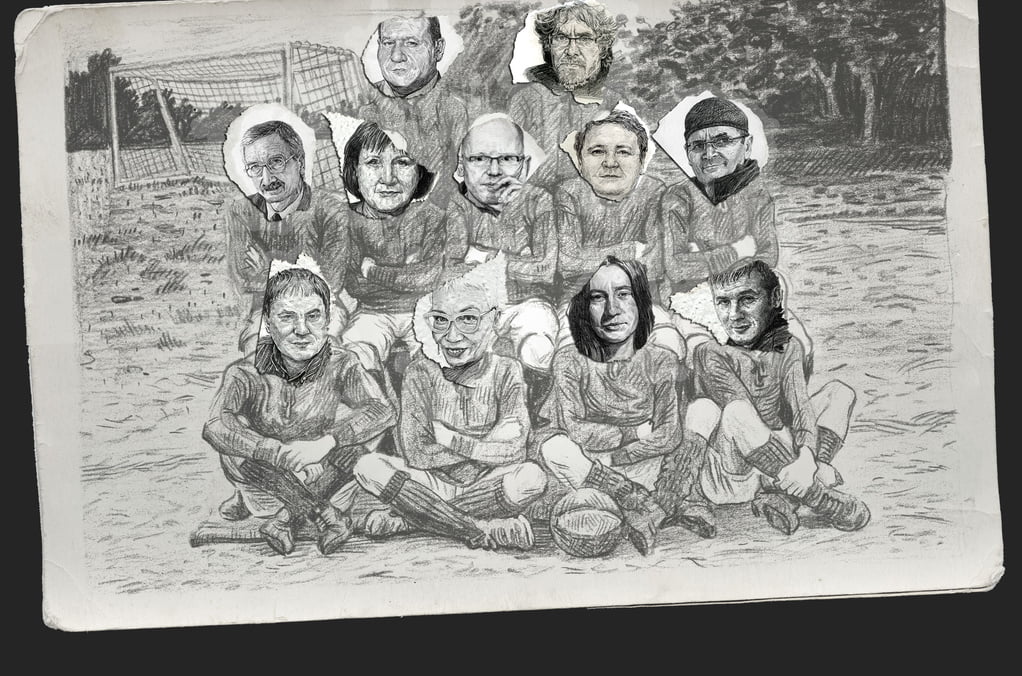
As Russia prepares for the opening game of the FIFA World Cup 2018, Amnesty International is shining a spotlight on 11 Russian human rights champions who routinely put their lives on the line to defend human rights in Russia.

A new campaign, Team Brave, will profile a human rights defender from each of the 11 regions hosting World Cup matches to raise awareness of their important work, and Amnesty International supporters from around the world will send messages of solidarity to show these brave individuals that they are not alone.

“As World Cup excitement builds, we want to highlight the work of the inspiring men and women who risk their lives and freedom to fight for human rights in Russia. The lineup of Team Brave includes activists who have fought to end torture in police stations, protect the environment, defend LGBTI rights and sex workers’ rights, and support victims of domestic violence – they are the real champions in Russia,” said Inga Kelekhsaeva, Russia Campaigner at Amnesty International.

Global attention may be on the stadiums but we will continue to closely monitor the authorities’ crackdown on human rights.

Inga Kelekhsaeva, Russia Campaigner at Amnesty International

“Throughout the World Cup, Amnesty International supporters from all over the world will be cheering on these brave human rights defenders and demanding an end to the constant harassment and intimidation by the Russian authorities. Global attention may be on the stadiums but we will continue to closely monitor the authorities’ crackdown on human rights.”

Team Brave highlights the stories of 11 human rights defenders across Russia.

They are:

  • Grozny: Oyub Titiev, the head of the NGO Memorial’s office in Chechnya imprisoned under bogus charges since January 2018
  • Sochi: Andrei Rudomakha, an environmental human rights defender who was brutally attacked in 2017
  • St Petersburg: Irina Maslova, who founded a movement to defend the rights of sex workers.
  • Volgograd: Igor Nagavkin, who worked on fighting torture and corruption in the Volgograd region until he was arbitrarily detained in October 2016.
  • Rostov-on-Don: Valentina Cherevatenko, a women’s rights activist
  • Kaliningrad: Igor Rudnikov, an independent journalist investigating cases of corruption until his arbitrary detention in 2017.
  • Samara: Oksana Berezovskaya, who runs an LGBTI rights organization
  • Nizhny Novgorod: Igor Kalyapin, who founded the Committee Against Torture
  • Kazan: Yulia Fayzrakhmanova, an environmental human rights defender
  • Yekaterinburg: Aleksei Sokolov, who fights torture and other abuses in the prison system
  • Saransk: Vasiliy Guslyannikov, the founder of the NGO Mordovian Republic Human Rights Centre

Many of these human rights defenders have faced harassment, intimidation, physical attacks, smear and in some cases have been arbitrarily detained simply for carrying out their vital work.

As part of the Team Brave campaign, Amnesty International is asking supporters to take action for three of the human rights defenders featured, who remain in prison to date or whose assailants remain at large.

Oyub Titiev has been detained for almost six months on fabricated charges because of his human rights work. Environmental human rights defender Andrei Rudomakha was brutally assaulted in 2017 by unknown assailants for documenting illegal construction work on the Black Sea coast, and his attackers still walk free. Igor Nagavkin has spent more than a year and a half in pre-trial detention on trumped-up charges for his work defending prisoners’ rights and combating torture and corruption.

“We are calling for the Russian authorities to score a hat trick by immediately and unconditionally releasing Oyub Titiev and Igor Nagavkin, and conducting a prompt, thorough and effective investigation into the brutal assault on Andrei Rudomakha. The World Cup brings people together from all over the world, and we want to harness some of this energy to fight for freedom and justice for these courageous human rights defenders,” said Inga Kelekhsaeva.

“The Russian authorities cannot continue to intimidate and harass every critic into silence. With the eyes of the world on Russia, they must decide what they want the legacy of this World Cup to be. There can be no winners in Russia until human rights defenders are recognized, protected and free to do their important work unobstructed and without fear of reprisals.”

Background information

On 29 May, FIFA took the important step of launching a complaints mechanism for human rights defenders and media representatives to report rights violations and committed to supporting human rights defenders and freedom of the press in relation to FIFA’s activities.

With the 2018 World Cup taking place amidst a crackdown on human rights by the Russian authorities, FIFA commitments and mechanisms will be put to the test. Amnesty International has urged the Football’s governing body to be ready to confront the Russian authorities and use all of its leverage to effectively protect human rights defenders and stop the 2018 World Cup providing the backdrop for a renewed wave of oppression.

Australia must match aid to Rohingya camps with political action

Amnesty International Australia’s National Director, Claire Mallinson has just returned from visiting Rohingya refugee camps near Cox’s Bazar in Bangladesh and is warning that urgent action is needed before the imminent monsoon season hits, to prevent catastrophic loss of life.

“What we just witnessed was a scene where 900,000 people – 80% of them women and children – are living in homes made of bamboo and plastic, built on top of mud, and perched very precariously on bare hills and the monsoon season is almost here,” said Claire Mallinson.

“Although the agencies on the ground are sand-bagging everywhere, it is estimated that 200,000 people are at risk of landslides, with 25,000 at very high risk of losing their makeshift homes, being injured or losing their lives.

“Urgent action from the international community is needed now. So far, less than a fifth of the United Nations’ requested US$950 million in relief funds has been committed. Australia, as one of the most generous donors, can take a leadership role to mitigate this crisis on our doorstep and encourage others to do more.”

The Australian Government’s ties to the Myanmar military could delegitimise any calls it may make on the international community to step up.

However, the Australian Government’s ties to the Myanmar military could delegitimise any calls it may make on the international community to step up, Claire Mallinson said.

“Without cutting military ties with Myanmar, Australia is undermining efforts to save hundreds of thousands of people – mostly women and children – from impending catastrophe.”

The forced exodus to Bangladesh of some 900,000 Rohingya people from northern Myanmar’s Rakhine State since last August followed a brutal ethnic cleansing campaign against them by the Myanmar military amounting to crimes against humanity. This included systematic gang rapes of women and girls, horrific mass killings of men, women and children, and the burning of whole villages to the ground.

Australia is out of step with many of its key allies – such as the United States, the United Kingdom, Canada, France and the European Union – who have already cut ties with Myanmar’s military over the violence.

Myanmar has reportedly agreed to a ‘memorandum of understanding’ to allow a UN fact-finding mission into Rakhine State. However, a timeframe has not yet been agreed.

“Now that Myanmar is making noises about allowing the UN access to Rakhine State, it is timely for Australia to encourage it in that direction by cutting all military ties” – Claire Mallinson

“Now that Myanmar is making noises about allowing the UN access to Rakhine State, it is timely for Australia to encourage it in that direction by cutting all military ties until such access is indeed granted,” said Claire Mallinson.

Along with cutting military ties with Myanmar, Amnesty International is calling on the Australian Government to explore all avenues for accountability and justice for the crimes committed in Myanmar. In particular, to explore an immediate mechanism for evidence collection and preservation for future criminal prosecutions and to support a reference by the UN Security Council of the crimes to the International Criminal Court. Amnesty also calls on Myanmar to dismantle the systemic discrimination against the Rohingya in Rakhine State.

Local Whittlesea council supports community sponsorship for refugees

The Whittlesea council today marked a significant milestone in Australia’s response to the global refugee situation passing a motion in support of the Amnesty International campaign to expand and improve the current federal government refugee community sponsorship program.

“Whittlesea is the first local council in Australia to get behind expanding this neighbourhood-led solution to the global refugee crisis,” said Shankar Kasynathan, Refugee Campaigner at Amnesty International Australia.

“Whittlesea is the first local council in Australia to get behind expanding this neighbourhood-led solution to the global refugee crisis.”

Shankar Kasynathan, Refugee Campaigner at Amnesty International Australia.

Community sponsorship is a model where ordinary members of the community sponsor visas for refugees from around the world, who wish to begin the process of rebuilding their lives in Australia.

The motion, led by Kris Pavlidis, Mayor of Whittlesea, calls on the Federal Government to make the intake of refugees under community sponsorship separate from the existing humanitarian intake, and to lower the program’s prohibitive visa fees.

“Whittlesea is one of almost 150 local councils across the country that have already declared themselves Refugee Welcome Zones, saying they are ready to receive their new neighbours. Now that the Whittlesea has led the way, we hope other local councils around the country will take their commitment one step further by adding their voices to the call for a greater community sponsorship program,” said Shankar Kasynathan.

The community sponsorship model has worked successfully for almost 40 years in Canada, which has welcomed over 280,000 refugees through the program, in addition to its humanitarian intake.

In contrast, Australia’s community sponsorship program is capped at only 1,000 places this year, and each time one of these is allocated, a place is lost out of the 13,500 in the humanitarian program.

“We can see from Canada’s example that the kindness of neighbours can help people who have lost everything to start again. We hope ordinary people across Australia will see the success of this and say, ‘Let’s do our bit and help bring these vulnerable people to safety’,” said Shankar Kasynathan.  

Turkey: One year since the imprisonment of Taner Kılıç, demands for his release will not be silenced

Despite the Turkish government’s cynical crackdown on human rights, activists for justice and freedom will not be silenced, Amnesty International said on the first anniversary of the detention of Taner Kılıç.

The Honorary Chair of Amnesty International Turkey was arrested on 6 June 2017 on a baseless charge of belonging to a terrorist organisation. More than a million people have since raised their voices and backed Amnesty’s campaign for his immediate release.

“Today we mourn the year of Taner Kılıç’s life that Turkey’s government has unjustly taken from him, but this is also a moment to redouble our efforts to secure his release and that of many other civil society activists whose work has cost them their freedom,” said Salil Shetty, Amnesty International’s Secretary General.

“Turkish authorities have fostered a climate of fear by mercilessly persecuting those who dare to speak out. But today, Taner’s hundreds of thousands of supporters worldwide stand in solidarity to send a resounding message to the Turkish government: we will not be silenced.”

“Turkish authorities have fostered a climate of fear by mercilessly persecuting those who dare to speak out” – Amnesty International’s Secretary General Salil Shetty

Taner Kılıç has been charged with “membership of the Fethullah Gülen Terrorist Organisation” based on the false allegation that he downloaded ByLock, a messaging application the authorities say was used by followers of Fethullah Gülen. The government holds the group responsible for the July 2016 coup attempt.

However, no credible evidence has been presented to substantiate the claim that Taner downloaded ByLock. On the contrary, two independent forensic experts found that there was no trace of ByLock ever having been on his phone.

Taner was sent to jail on 9 June 2017, three days after being arrested, and has since become a symbol of the many human rights defenders and other activists who have been targeted as part of the human rights crackdown that has gripped Turkey since the failed coup.

Ten other human rights defenders, including İdil Eser, the Director of Amnesty International Turkey, were detained a month later. Eight of them were held for almost four months before being released on bail at their first hearing in October 2017.

They are all accused of “membership of a terrorist organisation”, a baseless allegation for which the prosecution has failed to provide any evidence that would stand up to scrutiny.

In December 2017, Turkish authorities admitted that thousands of people were wrongly accused of downloading ByLock. Lists containing the numbers of 11,480 mobile phone users were published by the authorities, leading to mass releases, but Taner was not among them.

“The evidence of Taner’s innocence is emphatic. His detention is a gross injustice that exposes Turkey’s flawed justice system and the government’s cold-blooded pursuit of anyone deemed to oppose them,” said Salil Shetty.

“Taner has been imprisoned solely because he is a passionate defender of human rights. With his next trial hearing coming up this month, he must be released, cleared of the baseless charges against him and allowed to resume his crucial work.”

More than a million people from 194 countries and territories have signed Amnesty International appeals demanding the release of Taner Kılıç and all other human rights defenders in Turkey imprisoned solely for their peaceful activism.

The campaign for his release has been supported by governments, artists and celebrities including Ben Stiller, Sting, Zoë Kravitz, Zach Galifianakis and Ai Weiwei.

In April 2018, an Amnesty International report, Weathering the storm: Defending human rights in Turkey’s climate of fear, revealed how few areas of Turkey’s once vibrant independent civil society have been left untouched by the ongoing state of emergency.

A nationwide crackdown on civil society has resulted in mass arbitrary detentions and dismissals, the hollowing out of the legal system and the silencing of human rights defenders through threats, harassment and imprisonment.

Taner’s next hearing is set for 21 June. If he is found guilty of the charges against him, he could face up to 15 years in jail.

How can we ease the human cost of climate change?

On World Environment Day Alice Appel, runner-up of our 2018 Blogging Competition, looks at the human cost of climate change and the effects of climate disasters on countries around the world.

Climate Refugee. These words combined can often trigger unease and frustration. The UNHCR estimates that an average of 21.5 million people each year have been forcibly displaced by weather-related natural disasters. And instances of fertile land becoming desert, sea level rises and changes in soil composition – which all impact the migratory flow of people – are increasing. However, forced migration from climate-related disasters is not yet included in the definition of refugee in the 1951 Refugee Convention.

Anthropogenic climate change – otherwise known as global warming – puts pressure on social systems and communities and it is unsurprising people are being forced to relocate and seek refuge in foreign lands. But the misnomer in the climate change and migration discourse is the framing of the problem as a flaw of developing countries and faulting these communities as incapable of adapting.

Climate change highlights the drift between Western lifestyle and the earth’s ecosystems. Industrialisation and modern economics has pegged humanity’s success to commodities and trade. Taking our global society down a destructive path and ignoring obvious indicators such as rising air temperature is counterintuitive to conservation of life on earth.

The knowledge and approach urgently needed to tackle the consumption rate of fossil fuel around the world today, comes from the resilient people on the ground facing the effects of climate change.

Fiji

Fiji has stepped up to the global stage to boost the voices of people bearing the consequences of climate change. The glorious archipelago of 3,000 islands – home to 900,000 people – has begun the process of relocating townspeople to new villages and is planning to move 45 coastal villages over the next 5 to 10 years to escape coastal floods. Fiji was the first country to ratify the 2016 Paris Agreement on climate change.

Prime Minister Frank Bainimarama presided over last year’s Cop23 in Bonn and loss and damage compensation was prominent on his agenda. As those living in Fiji know, with every inch of sea-level rise, 10 square feet of arable land is lost. Under Bainimarama’s leadership, COP23 became a Talanoa Dialogue and the Fijian Prime Minister highlighted there wouldn’t be negotiations but “straight talking” focused on actions and ambitions to address the rights to clean water, air and better quality of life.

Bangladesh

Straight talking happens on a grassroots level in Bangladesh as well. Located in a disaster prone region of the world, flooding is a regular threat. Eighty per cent of the country is situated on flood plains and riverbank erosion has displaced between 50,000 and 200,000 people annually. Research shows climate-related disasters compound social vulnerabilities and poverty. 24.3% of Bangladesh’s population live in poverty and when flooding consumes their villages, they must seek work in urban areas and migrate. These coastal towns are dependent on agriculture and when landmass decreases, employment and the economy fail as well.

Education, decentralisation and improved infrastructure could help reduce damage and risk across Bangladesh and in other affected areas around the world.

What comes next?

The economies of China, the European Union and the United States contribute to more than half of the total global emissions, while the bottom 100 countries account for just 3.5 per cent – with Bangladesh contributing as little as 0.3 per cent to global emissions.

Julie-Anne Richards at Climate Change Advocacy argues the next stage of climate change talks must focus on financial retribution and could include “a global fossil fuel extraction levy, or aviation levies, or financial transaction taxes. There are a number of ways of raising funds that won’t come from government treasuries, and will instead come from the industries that are causing climate change.”

Unlike armed conflict, climate change doesn’t have a battlefield but the suffering, loss and displacement make it a human rights issue. To atone for the obvious imbalance of natural resource consumption Western society must accept responsibility and acknowledge that resilient nations like Fiji and Bangladesh will lead society forward with a strategy that respects nature.

A degree stuffed down her pants, Alice Appel is a freelance writer and filmmaker travelling naturally. She’s lived in Mexico, Japan and Barcelona but originally from a backyard in Sydney. Writes what her conscience says.

Amnesty Turkey’s Taner Kılıç: a year of imprisonment

Today marks one full year of imprisonment for human rights lawyer and Amnesty Turkey’s Honorary Chair Taner Kılıç. Taner is just one of many prisoners of conscience in the history of Turkey and his arrest and imprisonment highlights a climate of fear in the country.

Fotis Filippou, Amnesty International’s Director of Campaigns for Europe, describes the precarious situation human rights defenders face in Turkey.

To be forgotten. People who have been wrongfully imprisoned say the fear of being forgotten is one of their biggest worries in prison.

The chilling fear that eventually, nobody will care about what happens to them. A creeping anxiety that they will languish in captivity, while the world outside slowly forgets their very existence.

Such thoughts have also slipped through the mind of Amnesty Turkey’s Honorary Chair, Taner Kılıç. On 6 June, the human rights lawyer will have been deprived of his freedom for a whole year, although he’s done nothing wrong.

But throughout this ordeal, he has gained strength from the support of people all over the world. “Even if an imprisoned person may fall in the illusion that he would be forgotten even by his closest ones – like ‘forgotten prisoners’ – my situation has been the opposite in fact. In addition to my family and friends, I’ve become known in and watched by the world thanks to Amnesty International.”

A close up photo of Taner Kiliç speaking into a microphone
Taner Kiliç © Private

Taner is one of many

Unfortunately, our colleague and friend Taner is just one of the many prisoners of conscience in the history of Turkey. For decades, Amnesty activists have campaigned for and given hope to wrongfully imprisoned people in the country.

In 1964, ex-president Bayar sent a letter from jail to thank Amnesty for campaigning for his release.

In 1971, Professor Mümtaz Soysal wrote the following lines from prison, knowing that Amnesty activists all over the world were demanding his release. “Soon, night will fall and they’ll close the cell doors. I don’t feel lonely, I am with the whole of mankind and mankind is with me.”

A group of people gather in a street in London with banners saying 'Turkey, give Taner the best gift: FREEDOM'.
Staff members at Amnesty’s International Secretariat mark the birthday of Taner Kiliç © Amnesty International

A climate of fear in Turkey

After the failed coup attempt in July 2016, the authorities have deliberately used the ongoing state of emergency as an excuse to wipe out civil society. Human rights defenders, journalists, union members, lawyers and other civil society actors live in a constant climate of fear, not knowing if they’re next in line for the dawn knock on their door because of a tweet, an article, a speech, for simply doing their work.

For each and every one of them, one more day of imprisonment is one more day of injustice.

At Amnesty International, we will never tire of fighting for their release. We will keep talking about Turkey and support the brave people on the ground that struggle to defend human rights in the country.

And we will keep counting the days until Taner steps out of the prison gates, and, finally, can embrace his wife and daughters in freedom.

Until this moment comes, you can help keep his spirits up by sending messages of solidarity. As Taner says: “Your letters and support give me power”.

Let’s continue to show him, and the other people wrongfully imprisoned in Turkey, that they will never be forgotten prisoners.

Brave Case updates

Tashi Wangchuk

UPDATE 01/08/18

Tashi is doing well and supported in knowing that people are working with him to end his imprisonment. He has been reading lots of Buddhist scriptures, continues to study Chinese, started learning English, and with his lawyer working on a request for appeal against his five year sentence for “inciting subversion” which was handed down in May.

Taner Kilic

UPDATE 21/08/18

On 15 August, Taner Kilic was released from prison in Turkey. After fourteen months behind bars, Taner is finally back in the arms of his wife and daughters. Taner is still charged with “being a member of an armed terrorist organisation”. If convicted, he could face 15 years in prison. We will continue to campaign for the Turkish authorities to drop the charges against Taner. Please continue to take action for him.

Tep Vanny

UPDATE 21/08/18

Tep Vanny has been released from prison following a royal pardon after more than 700 days in detention. Thank you to everyone who took action and who campaigned in their communities for Tep Vanny!

Sakris Kuplia

UPDATE 10/05/18

Following campaigning from activists during Write for Rights, Sakris is now able to carry out his work defending transgender rights in a safe and enabling environment. In Australia, we will continue campaigning for Sakris, and all Finnish people, to obtain legal gender recognition without suffering degrading treatment.

Hoo Yew Wah

UPDATE 13/07/18

In an unprecedented and welcomed step Malaysian authorities announced today that the executions of 17 death row prisoners have been put on hold, pending the review of the country’s death penalty laws. Planned executions are kept secret by authorities until days before they are carried out – so we don’t know who the 17 people are. We need to keep calling for clemency for Hoo Yew Wah, so make sure he gets off death row.