Amnesty International is appalled by Australia’s decision to vote against last night’s United Nations Human Rights Council resolution calling for an independent investigation into Israel’s killings of over 100 Palestinians.
“Australia is on the wrong side of history. Last night it was one of only two countries, the other being the United States, who voted against the UN Human Rights Council resolution to investigate the killings of over 100 Palestinians, including children, and injuries to thousands,” said Diana Sayed, Crisis Campaigner at Amnesty International Australia.
“The actions of the Israeli military were a violation of international standards, in some instances committing what appear to be wilful killings constituting war crimes.”
“Australia must use every opportunity to ask the Israeli authorities to immediately rein in the military to prevent any further loss of life and serious injuries,” said Diana Sayed.
At least 12 children killed
Amnesty International is dismayed and alarmed at the mass killings and injuries of Palestinians in the context of the “Great March of Return” protests in the Gaza Strip.
In their response to these protests, since 30 March, Israeli forces have killed at least 102 Palestinians, including at least 12 children, two journalists and one paramedic. As many as 60 people died in one day alone, on 14 May, during protests commemorating 70 years of Palestinian displacement and dispossession.
Eyewitness testimonies, and video and photographic evidence suggest that many were deliberately killed or injured, while posing no imminent threat to Israeli soldiers and snipers.
3,600 injured
Israeli forces have used high-velocity military weapons and ammunitions to disperse protesters, injuring approximately 3,600 Palestinians, including men, women and children– a shocking and appalling number.
Many who have not died have suffered life-changing injuries, and will likely face further complications, infections and some form of physical disability. Others, including health workers treating the injured, have suffered tear gas inhalation, while ambulances have been partially damaged.
Hospitals are struggling to cope with the volume of serious injuries without adequate resources and chronic shortages of fuel, electricity and medical supplies caused mainly by Israel’s illegal blockade.
Accountability for lives shattered
Some protesters have engaged in some forms of violence including by throwing stones and Molotov cocktails or burning tires. Others have attempted to cross or breach the fence. However, Amnesty International is not aware of any protesters that have posed an imminent threat to Israeli soldiers and snipers located behind the fence, and protected by gear, sand hills, drones and military vehicles.
The high number of apparently unlawful killings, including possible wilful killings, and injuries in the context of these recent protests is unprecedented and requires accountability that Amnesty International believes Israel is unwilling to deliver.
The Israeli army announced in April that it would launch an investigation into some of these killings. Amnesty International believes such an announcement is not sufficient, in light of Israel’s historic failure to ensure independent, impartial, thorough and transparent criminal investigations for alleged war crimes and other serious violations in the Occupied Palestinian Territories.
The Human Rights Council’s establishment of an international Commission of Inquiry investigating the circumstances of the deaths and injuries in the context of these recent protests would be an important step towards achieving much needed accountability for many whose lives have been shattered by this violence.
The Australian government is attempting to walk away from the human rights crisis it has created for refugees and asylum seekers in Papua New Guinea (PNG) by winding back critical healthcare services, despite the ongoing plight of the people trapped in its offshore detention centres, Amnesty International said as it released a new briefing today.
Over the past six months the Australian government has terminated trauma and counselling services for refugees and asylum seekers in PNG, and moved refugees to new detention centres where they have reduced access to healthcare.
“Nearly five years after Australia began implementing its harmful and illegal offshore detention policy, the situation for refugees and asylum seekers trapped in PNG is as desperate as ever. Rolling back healthcare at this time is making a grave situation even worse.”
Graham Thom, Refugee Coordinator at Amnesty International.
“Nearly five years after Australia began implementing its harmful and illegal offshore detention policy, the situation for refugees and asylum seekers trapped in PNG is as desperate as ever. Rolling back healthcare at this time is making a grave situation even worse,” said Graham Thom, Refugee Coordinator at Amnesty International.
“Last year two refugees committed suicide in Manus Island, illustrating the terrible price of confining vulnerable people to remote detention centres. In the wake of these tragedies Australia has inexplicably cut counselling and trauma services, just one of a raft of changes which will make it even harder for refugees and asylum seekers in PNG to access healthcare.”
Refugees left to suffer
Refugees and asylum seekers in PNG have faced serious challenges in accessing healthcare for years, as Amnesty International has documented in a new briefing released today. In November 2017 Amnesty International researchers visited Port Moresby, the capital of PNG, and spoke to refugees and asylum seekers who had been sent there from Manus Island for medical treatment.
Several people described waiting for months for treatment for serious health conditions including suspected cancerous lumps, kidney stones, gastric problems, typhoid, dengue fever, vision impairment, mobility challenges and mental health problems.
A number of refugees were told by medical professionals that treatment is not available in PNG due to lack of equipment or specialists, but transfers to Australia have either been delayed or denied.
One refugee who has stomach and kidney problems described how during an operation he had a stent inserted into his stomach, and doctors told him it would be removed after six weeks. Eight months later, the stent had not been removed and was pressing against his bladder, causing bleeding. He said he was informed by doctors that there are currently no specialists in PNG who can remedy his condition.
“Australia has gone to extraordinary lengths and enormous cost to implement its offshore detention policy, which is severely limiting refugees and asylum seekers’ access to healthcare. Refugees in PNG live in prison-like conditions and lack freedom of movement, so they rely on the Australian government for accommodation, security, food and healthcare,” said Graham Thom.
“For as long as offshore processing continues, Australia is responsible for ensuring that refugees have prompt access to adequate healthcare, including by transfers to Australia.”
“For as long as offshore processing continues, Australia is responsible for ensuring that refugees have prompt access to adequate healthcare, including by transfers to Australia.”
Reduced access to services
Prior to October 2017, refugees and asylum seekers in PNG were treated by the private health contractor International Health and Medical Services (IHMS), the private Pacific International Hospital in Port Moresby, or transfer to Australia. Translation and counselling services were provided in conjunction with other healthcare services.
Significant changes to the provision of healthcare took place in October 2017, when the Australian government forcibly transferred refugees and asylum seekers in Manus Island to three newer centres, only one of which has a medical clinic. The UN’s refugee agency (UNHCR) has described the new arrangement as “vastly inadequate”.
Samuel (not his real name) has been waiting for treatment since he suffered a heart attack in February 2017. Two doctors who treated him in Port Moresby recommended he be sent to Australia for further tests and treatment, which requires Australian government approval. Samuel collapsed again in November 2017, but a few days earlier medical services had been completely withdrawn from the detention centre as part of the move to close it. As a result, other refugees spent more than four hours trying to obtain assistance from security contractors to get Samuel to the nearest hospital. He said he was discharged after a few hours because the hospital did not have the right equipment to further diagnose him.
Despite reported suicides and the fact that the refugee population in Manus Island has one of the highest recorded rates of refugee mental health disorders in the world, the Australian government also terminated contracts with psycho-social support services in October 2017, which means refugees no longer have access to counselling. Amnesty International is calling for these to be reinstated as a priority.
Other changes include reduced operational hours, removal of translators to ensure refugees adequately understand and consent to treatment, and increased reliance on PNG’s public hospitals to provide emergency and after-hours healthcare.
Amnesty International has reiterated its calls for the Australian government to bring all refugees and people seeking asylum to Australia immediately, or to a safe third country, and offer them the protection they need and deserve. In the meantime, Australia is responsible for ensuring that refugees have access to adequate healthcare in PNG.
“Only by ending offshore processing can Australia end the physical and mental torment of refugees and asylum seekers in PNG.”
Graham Thom.
“Only by ending offshore processing can Australia end the physical and mental torment of refugees and asylum seekers in PNG,” said Graham Thom.
“Until this happens, the very least Australia can do is try to limit harm by ensuring refugees can access the healthcare they need.”
Background
In 2016 the US and Australia brokered a deal under which the US agreed to resettle 1,250 refugees from Australia’s offshore centres, but the deal cannot provide protection for everyone. Hundreds of refugees and asylum seekers will be left languishing on Manus Island if Australia does not end offshore processing or find a safe country to settle them. It is in this context that the Australian government is winding back crucial health services it provides to refugees in its care.
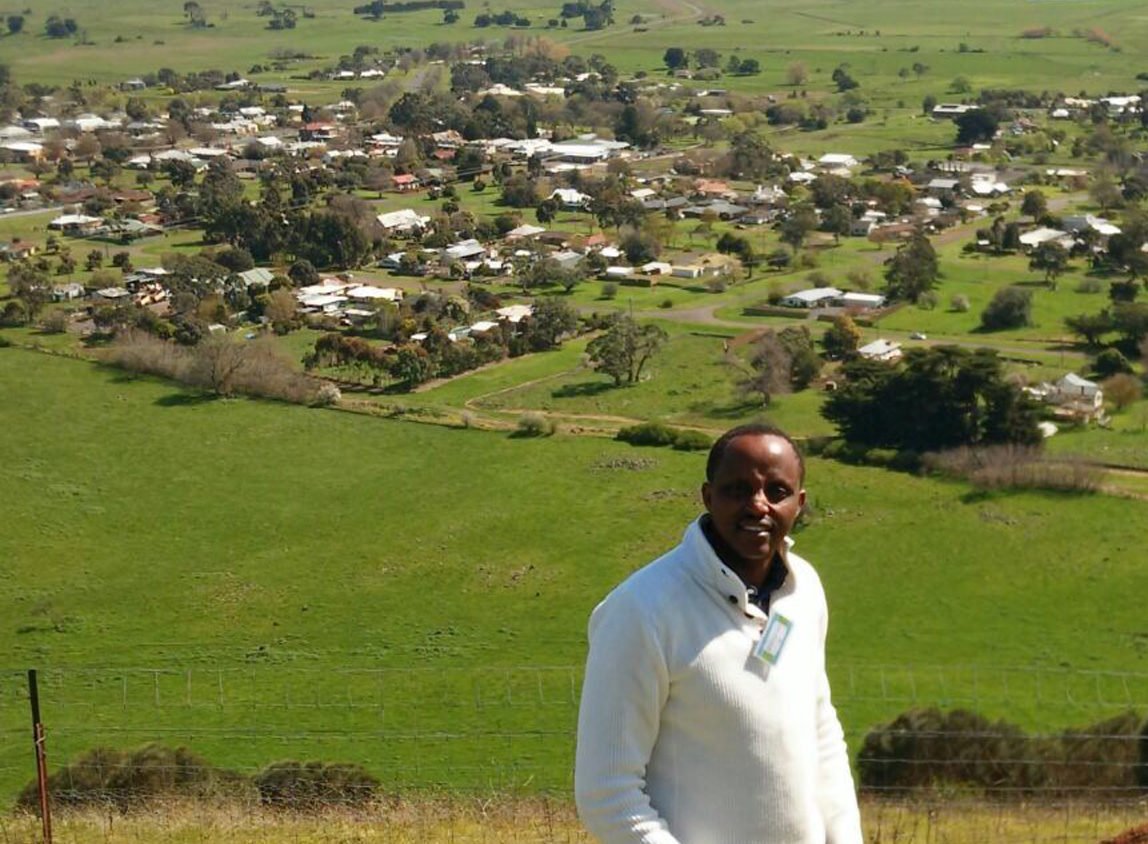
“I was born in Rwanda, but was raised in Nakivale refugee camp in Uganda and lived there until I was 16 years old.
As a young man I came to Australia as a student. Now I live in Sydney and I help to resettle refugees in Australia, including in places like Mingoola and Armidale.
Dreams of rural life
In Australia I was seeing one consistent problem: people with refugee backgrounds being resettled in the cities where employment prospects are few. Some found the city contributed to depression and social isolation.
People from Africa often come to Australia from war-ravaged countries. They are from Rwanda and other places close by, and have been displaced by civil war. Many of these people had rural backgrounds and struggle sometimes to adapt to urban lifestyles.
“The key issue among our community is that a big number of them want to live in rural areas because they feel they have roots that touch the land.”
If you ask them, ‘what was your dream when you applied to come to Australia,’ they say, ‘We hoped we were going to be put in the countryside, to connect ourselves with agricultural life and have a garden’.
This is why I became passionate about helping families with refugee backgrounds move from Australia’s cities to regional Australian communities.
In 2016 I helped African refugees resettle in Mingoola, a speck of a town on the border of NSW and Queensland. Julia (a local community leader in Mingoola) and I saw a solution to both our problems – a country town with declining population, and a rural lifestyle for refugees. It was a meeting of dreams.
The locals in Mingoola renovated abandoned farm houses and in no time, African families started to move in.
“For refugees it gave them an opportunity to return to their roots.”
New neighbours for Armidale
At the moment more than 200 skilled farming families, most with generations of experience working the land in central Africa, want to relocate from Australian cities to regional areas like New England in New South Wales. They miss that agricultural life, to be on the land, having animals, growing crops….and building a community. The families are looking for farm cottages and small blocks of land outside main regional centres like Armidale, Glen Innes and Tamworth.
The Armidale region is a perfect location to resettle refugees – there’s ongoing employment at the tomato farm, trauma counselling, settlement services, a refugee nurse, a homework centre… and in addition, a community that is multicultural.
So one morning in 2016, I walked into a room full of refugee advocates in Armidale, New South Wales, and asked them, “How can I help?”
I’m now reaching out to farmers in the Armidale region to find suitable homes for families and looking forward to seeing more families resettled in the area.
Looking to the future
The communities I am working with are ready to lead the resettlement of refugees, and refugee families are prepared for their lives in regional neighbourhoods.
This is why I and my organisation support Amnesty’s campaign to expand and improve community sponsorship for refugees. We have been doing this already, and looking to the future, we are ready and willing to work with local councils and other groups, to facilitate regional and rural resettlement through community sponsorship.
The International Day Against Homophobia, Biphobia and Transphobia is today, May 17 and has many different meanings to individuals with different experiences:
To Charlie Maycraft, who identifies as queer and non-binary, this is a day of action, and a day to pay respect to the elders of our community who fought for acceptance and opportunity decades ago.
For Nina, as a queer woman, she would like to use this day to celebrate the diversity of our LGBTQ+ community and educate the broader community about the endless spectrum of identities.
The struggle for action and respect for the LGBTQI community is continuing, and one which deserves more than one day to talk about. Whether it is standing in solidarity with LGBTQI+ communities who are denied their rights both here and abroad, or the stigma we face in often unseen ways.
Six month’s on from winning Marriage Equality, we celebrate and we continue to fight for true equality.
Microaggressions are forced upon marginalised people every day, an act which appears harmless in its intent, however the person on the receiving end is adding this event to the many other microaggressions they may have experienced.
A microaggression may be something such as asking a same gender couple about their sex life, or a trans person to describe their genitals or the surgery they may or may not have had.
Sometimes these questions stem from curiosity – but would be inappropriate if anyone else were asked. Asking ourselves why we feel entitled to know the details of private information about certain people is a vital part of undoing years of conditioned bigotry. Solidarity begins with inclusiveness.
Being a subject of othering is an isolating experience. You begin to question yourself, your identity, and the relationships you form around you. On a day like IDAHOBIT, I want us all to analyse our language and behaviour, because these are what affect others the most.
If there’s a particular subject you feel you lack knowledge on – maybe it’s intersex people, or the non-binary spectrum – find some resources and read up on appropriate terminology regarding that group, and you’ll find yourself learning something new and equipping yourself with right words to say when you may find yourself in a position to defend a vulnerable person.
The beautiful thing about technology is that it gives us the power to educate ourselves – and a willingness to learn is the most valuable characteristic an ally can have.
“It is not our differences that divide us. It is our inability to recognise, accept and celebrate those differences.” Audre Lorde
Nina:
“I see a future where we no longer need a list of identities. Individuals will be just that, individual. However, we are not ready for that just yet.”
I still find myself choosing to hide my identity around strangers for fear of stigmatisation. Marriage equality is an amazing step, but to remove stigma and judgement takes generations.
With marriage equality finally a reality in Australia, we must not lose sight of the bigger picture; equality for all.
On a recent trip to Sweden, where discrimination based on sexual or gender identity has been banned since 1987, where marriage equality has been around since 2009, and where an openly lesbian woman is a Bishop of the Church, I was surprised to hear my Swedish friend talk about the recent rise of anti-LGBTQ+ sentiments.
Hearing this made me more determined than ever to continue the fight for acceptance of diverse identities, to ensure that we never go backwards and only move towards a more inclusive world.
LGBTQ+ people are devastatingly still facing persecution in many countries around the world, and even here in Australia.
It is imperative that the LGBTQ+ community rallies together for each other. With so much support for the marriage equality campaign from all types of identities and minorities, it is time to band together to stand up for others marginalised in the LGBTQI community.
About the Authors
Nina Ashfield is the former convenor of the University of the Sunshine Coast (USC) Amnesty Action Group and is now a member of the Maroochydore group. Nina’s pronouns are she/her and she is currently active in Amnesty Refugee Rights and the LGBTQI Network.
Charlie Maycraft is the Diversity Chair of the USC Group. Charlie’s pronouns are they/them and they are passionate about human rights & studying for their social work degree.
Yemeni civilians are struggling to stay alive amid fierce ground and air attacks in the raging battle to retake western coastal governorates from Huthi armed group control, and the worst could be yet to come, Amnesty International warned after carrying out a field investigation in the south of the country.
The organisation interviewed 34 civilians who arrived in Aden after the clashes displaced them from several villages and towns in Hodeidah Governorate between January and early May. They spoke of terrifying mortar attacks, air strikes, landmines and other dangers amid the new offensive as forces loyal to the internationally recognised Yemeni government, supported by ground troops and air cover from the Saudi Arabia-led coalition, attempt to rout Huthi forces.
“The human impact of this fresh military offensive on Yemen’s western coastal areas is clear in the distressing stories shared by civilians displaced by the conflict. It is a glimpse of what potentially lies in store on a wider scale if the fighting encroaches on the densely populated port city of Hodeidah,” said Rawya Rageh, Senior Crisis Response Adviser at Amnesty International.
“We are very worried about what appear to be indiscriminate attacks and other violations of international humanitarian law. All parties have an obligation to do their utmost to protect civilians. They are putting the lives and livelihoods of hundreds of thousands more at risk.”
Life on the frontline
Since the offensive began in December 2017, many of those displaced from southern parts of Hodeidah Governorate described suffering sleepless nights and harrowing days as they huddled in their homes amid the bombardment.
Civilians from Zabid, al-Jarrahi, Hays and al-Khawkhah – around 100-150km south of Hodeidah city and port – told Amnesty International how they and many others fled to Aden, in the south of the country, as fighting intensified. Some wept as they spoke of relatives and loved ones killed in the conflict.
As both sides engaged in fierce clashes, an assortment of munitions, bullets and shrapnel ripped through civilian homes, and Saudi Arabia-led coalition air strikes also killed and injured civilians.
“We left because of the bombardment and the war around us. They would fire mortars over our head. Every day people would die, every day we would see ripped bodies around us, blown to smithereens. Can we stay there? We had to leave to escape alive. We couldn’t live in such danger,” Hassan, a 26-year-old displaced fisherman from Qataba village in al-Khawkhah, told Amnesty International.
“Every day people would die, every day we would see ripped bodies around us, blown to smithereens. Can we stay there? We had to leave to escape alive” – Displaced fisherman
Even after they escaped the fighting, some civilians continued to receive crushing news of loved ones being killed or injured back home.
A woman from Qataba managed to escape to safety in Fuqum, on the outskirts of Aden, but other family members were not so lucky. She told Amnesty International how a relative who stayed in Qataba broke the news that her seven-year-old nephew was killed on 6 May when a mortar or other projectile landed on a shop where he was buying food. He and his father had stayed behind because they could not afford the trip to flee the fighting.
Exodus from the western coast
Displaced civilians described an exodus as fighting intensified. According to the United Nations, clashes along Yemen’s western coast have displaced around 100,000 people in recent months, most of them from Hodeidah Governorate.
Fleeing was costly. The vast majority of those Amnesty International spoke to said they could only fund the trip by selling precious belongings, such as wedding rings, property deeds and livestock.
They paid to leave on private buses and trucks, forking out an average of 10,000 riyals (around USD$30 under the conversion rate used in Huthi-controlled territories) per person, a small fortune in the local economy, where the clashes had forced many to stop working. In some cases, large families paid up to 150,000 riyals (USD$480) to flee.
Mined roads, Huthi checkpoints and other hazards along the way meant that, for some, what should be on average a six-hour drive to Aden became a terrifying ordeal lasting up to three days.
Buses carrying fleeing civilians were blown up by landmines and other explosive devices allegedly planted by the Huthis in a bid to prevent government forces from advancing, and two people said they saw severed body parts along the route.
A farmer interviewed in a hospital where his daughter is in intensive care said that as he was escaping with his eight children and other family members during the first week of May, they drove over a landmine that severely injured his 13-year-old daughter and killed his wife’s grandmother. Landmines are inherently indiscriminate and are banned under international law.
“It was really a difficult trip. By God we suffered. There were rockets flying above us. Someone would stop us and say there are projectiles, and then someone else would stop us and say there are landmines, and we would just scream. All the way from when we left and until we arrived we were screaming and crying” – Displaced breastfeeding mother
One woman said she had a miscarriage as soon as she arrived in Aden, which she attributed to the fear and exhaustion caused by the journey.
A 25-year-old woman from Qataba said she was so terrified that she covered her eyes for almost the entire trip and did not breastfeed her baby for more than 13 hours on the last leg of the journey:
“It was really a difficult trip. By God we suffered. There were rockets flying above us. Someone would stop us and say there are projectiles, and then someone else would stop us and say there are landmines, and we would just scream. All the way from when we left and until we arrived we were screaming and crying. We saw dead bodies and we saw others ripped to pieces. We left not thinking we would survive. We thought we would surely die… [but] by the end of it we hoped we died instead of going through what we went through.”
She managed to bring her two daughters, aged nine-months and four-years-old, with her, but in the chaos of the clashes she left her mother and her seven-year-old son behind in Qataba.
Several people told Amnesty International they had attempted to leave Hodeidah Governorate up to three times before finally succeeding. Huthi forces allegedly branded some civilians ‘terrorists’ for abandoning their towns and villages, and in other cases people said they were aware of Huthis forcing busloads of fleeing civilians to turn back.
Some waited for several months in hopes the clashes would subside, but eventually decided to leave in late April or early May. A woman from Hays told Amnesty International:
“We were hoping the war would end, but it only got worse. The bombardment became heavier. It became so random. Bullets would land every which way, between the homes, just randomly. We would try to hide the children by the wall. … We would hide my mother and the children under the beds. The children would cry. Even at night we couldn’t get any sleep.”
Some of the displaced have scattered across relatively more secure parts of Hodeidah Governorate. Others have traveled to different southern governorates, including Aden, Lahj and Abyan, as well as eastward to Hadramawt and Mahra on the far side of the country.
In the absence of formal camps for internally displaced persons (IDPs), many of the displaced civilians interviewed by Amnesty International in Aden have sought makeshift shelter in precarious settings, including buildings under construction or crumbling structures that were badly damaged in a previous round of fighting between the Huthis and government forces in Aden in 2015. Reminders of that earlier conflict abound – from flattened buildings to signs warning of landmines in the area.
Violations amid shifting battle lines
Those displaced in recent weeks said the battle lines are constantly shifting as government and Huthi forces take control of different areas.
Civilians caught in the middle face a range of violations of international humanitarian law by both sides.
Huthi fighters have fired mortars, which are notoriously imprecise, repeatedly into populated civilian areas. According to a man from Hays, one hit a hospital courtyard on 25 March, injuring his 13-year-old son and killing a pharmacist and a nurse. The use of mortars in the vicinity of concentrations of civilians violates the prohibition on indiscriminate attacks.
Huthi forces further endanger civilians by basing troops and vehicles in civilian neighbourhoods. They have also allegedly mined roads and have otherwise prevented civilians from leaving; in other cases they have expelled people from their homes in areas recently taken from government control.
“Civilians fleeing in terror have reported a range of violations – we urge all sides to enforce strict compliance with international humanitarian law, and stop their forces from recklessly endangering civilians” – Rawya Rageh, Amnesty International
A woman from al-Jarrahi told Amnesty International how Huthi forces have forcibly recruited civilian men and boys, including her 13-year-old brother.
Survivors have also said that Saudi Arabia-led coalition air strikes had killed civilians, leaving them in constant fear for their lives. Displaced civilians described how three civilians were killed in two air strikes in Zabid and al-Jarrahi in January.
“The most vulnerable among the civilian population are bearing the brunt of this new offensive in Yemen’s war. All sides must abide by international humanitarian law, including taking all feasible precautions to minimise civilian casualties and the destruction of homes and civilian infrastructure,” said Rawya Rageh.
“Civilians fleeing in terror have reported a range of violations – we urge all sides to enforce strict compliance with international humanitarian law, and stop their forces from recklessly endangering civilians.”
The release of long-time Malaysian opposition leader and Amnesty International prisoner of conscience Anwar Ibrahim is a landmark moment for human rights in the country, the organisation said today.
Anwar, who has twice been imprisoned on politically motivated “sodomy” and corruption charges, received a royal pardon following last week’s election win for the Pakatan Harapan coalition led by Mahathir Mohamad. Amnesty International has campaigned on Anwar’s case for 20 years.
“Anwar should never have been jailed in the first place, and his long overdue release is an important step towards the restoration of justice and human rights in Malaysia after so many years of political persecution by previous governments,” said Salil Shetty, Amnesty International’s Secretary General.
“The new government should now repeal the repressive laws that muzzle freedom of expression and assembly and that were used relentlessly to target government critics and human rights defenders under the previous government.” – Amnesty International’s Secretary General Salil Shetty
“This day should go down as a landmark moment for human rights in the country, but the new government must not stop here. Rather, this should be the first of many more positive changes.
“The new government should now repeal the repressive laws that muzzle freedom of expression and assembly and that were used relentlessly to target government critics and human rights defenders under the previous government.”
Two decades of political persecution
Today’s release ends Anwar Ibrahim’s second lengthy spell in jail for his political views.
He was first arrested in 1998, while Deputy Prime Minister, after calling for political reform. He was dismissed from government and charged with corruption and committing ‘illegal’ homosexual acts – allegations he has always denied.
Anwar was beaten up while in police custody and convicted for corruption in 1999 and for ‘sodomy’ in 2000. He remained imprisoned until 2004 when his conviction was overturned.
The second ‘sodomy ’ case against Anwar Ibrahim began in 2008. The Malaysian High Court cleared him of all charges in 2012, but the Court of Appeal overturned the acquittal in March 2014 and sentenced him to five years in prison.
On 10 February 2015, Malaysia’s Federal Court, the highest court in the country, upheld the decision of the Court of Appeal. The conviction disqualified him from political office and contesting the 2018 general elections.
He served more than three years of his latest jail term and was due to be released in June. But the royal pardon that Mahathir Mohamad has promised to seek for him will make him eligible for office again. Mahathir has vowed to step aside and allow Anwar to assume the premiership once he has been pardoned and elected to parliament.
Anwar Ibrahim’s repeated imprisonments occurred amid a wider crackdown on freedom of expression and peaceful political dissent in Malaysia.
Amnesty International began campaigning on Anwar Ibrahim’s case when he was first arrested in 1998. Its members have since participated in numerous letter-writing campaigns calling for his release.
Until early this year, Anwar served as the de facto leader of the opposition as the head of Pakatan Rakyat (People’s Alliance), a coalition of three opposition parties.
However, ahead of the 2018 general election he joined forces with Mahathir to topple Najib Razak’s Barisan Nasional coalition party, which had been in power for almost six decades.
On 11 May, students at Middle East Technical University (ODTÜ) held their annual Pride march, in defiance of a ban on all LGBQTI events in Ankara, Turkey. Despite ODTÜ upholding the ban, hundreds of students peacefully marched on the university campus for Pride.
What happened?
The Pride march has taken place for the last seven years on the day after the annual spring festival, an event celebrating different cultures which has been organised by student groups for the last 31 years.
In April 2018, university authorities informed the Ankara Governorate of the spring festival and the Pride march.The Governorate responded that both the festival and march could not go ahead because of the risk of ‘provocation’.
The university’s rector told the march organisers that he would ask for the spring festival to go ahead, but would not negotiate in favour of the Pride march. The students were told that the Pride march would not be allowed to take place.
Background
Following a failed coup attempt in July 2016, an ongoing state of emergency has decimated human rights in Turkey.
The work of civil society organisations has been curtailed as swathes of Turkish society are left in a state of constant fear. Prominent journalists, academics, human rights defenders and other activists have been subjected to arbitrary detention and – if found guilty in unfair trials – long prison sentences.
The impact of the crackdown on civil society has been particularly huge for the LGBTQI community.
In November 2017, authorities in Ankara introduced an indefinite ban on LGBTQI events. LGBTQI organisations KAOS GL and Pink Life have mounted legal challenges to the ban, but the ban has forced a vibrant community to near invisibility.
It is a far cry from the Turkey of even just a few years ago, when LGBTQI organizations were increasingly visible and vocal – the last Istanbul Pride in June 2014 saw tens of thousands of people marching through the streets in a display of joyous confidence.
But students haven’t given up hope. When they were told the university wouldn’t allow Pride march, they asked the international community to stand in solidarity with them, and petition the rector and the Ankara Governorate to allow the Pride march to take place.
How did you help?
After hearing the student’s appeal, Amnesty International supporters around the world sent emails to the University, asking them to allow the Pride march to go ahead without hindrance. The students told Amnesty International they were very grateful for the organization’s support in solidarity and email actions. They shared the following message:
“We could not stay silent and resign ourselves to the ban. We had to oppose it, we had to march. The ban on our pride march was illegal and it was against our existence. The reason we could resist the ban and move forward was the international support and solidarity by Amnesty International activists around the world. We could not have gone further without your support.”
What next?
Hundreds of university students in Ankara showed bravery. By marching, the students sent an important message to authorities and to all LGBTQI-rights supporters in Turkey: that they couldn’t be silenced.
They defied the blanket ban on LGBTQI events in Ankara and went ahead with their peaceful march. In doing so, they have paved the way for more progress. It’s the time for Ankara authorities to lift the ongoing ban on LGBTQI events in the city entirely.
In response to Israeli forces killing over 50 Palestinian protesters in Gaza and injuring countless others, including children, Amnesty International Australia’s Crisis Campaigns Coordinator Diana Sayed said,
“We call on Foreign Minister Julie Bishop to condemn the Israeli military’s excessive use of force in the strongest terms possible, and for Australia to use its diplomatic powers to ensure a successful United Nations resolution calling for a full investigation.
“This is another horrific example of the Israeli military using excessive force and live ammunition in a totally deplorable way. This is a violation of international standards, in some instances committing what appear to be wilful killings constituting war crimes.”
Responding to reports that dozens of Palestinians have been killed and hundreds injured by the Israeli military during protests along the fence that separates Gaza and Israel since yesterday, Philip Luther, Research and Advocacy Director for the Middle East and North Africa at Amnesty International, said:
“This is another horrific example of the Israeli military using excessive force and live ammunition in a totally deplorable way. This is a violation of international standards, in some instances committing what appear to be wilful killings constituting war crimes.
“Today’s footage from Gaza is extremely troubling and, as violence continues to spiral out of control, the Israeli authorities must immediately rein in the military to prevent the further loss of life and serious injuries.
“While some protestors may have engaged in some form of violence, this still does not justify the use of live ammunition.
“Under international law, firearms can only be used to protect against an imminent threat of death or serious injury.”
Medical reports from Gaza since yesterday indicate that dozens of people have been shot in the head or chest. Amnesty International last month documented research from the Gaza Strip that showed the Israeli military were killing and maiming demonstrators who pose no imminent threat to them.
The mother is everything – she is our consolation in sorrow, our hope in misery, and our strength in weakness. She is the source of love, mercy, sympathy, and forgiveness. He who loses his mother loses a pure soul who blesses and guards him constantly. – Khalil Gibran
Mums all over Australia sacrifice so much so that their kids can live their best lives. For #AussieMums who have traveled here from Afghanistan, Sri Lanka, Sierra Leone or Vietnam, those sacrifices include having to make dangerous journeys – not out of greed, or stupidity, but because they are fleeing harm and death with young families to protect and think of.
Many mums will spend Mother’s Day surrounded by their children, grandchildren and loved ones. However there are so many more that will not know if their children survived treacherous voyages across the Aegean or Mediterranean sea in seeking safety.
This Mother’s Day let’s pay our humblest of respects, gratitudes and thanks to #RefugeeMums all over the world who sacrifice so much of themselves for their children.
As a refugee from Afghanistan, we fled our home in Herat for the capital of Kabul because the Socialist regime installed in Afghanistan after the Soviet invasion was disappearing dissidents. We feared for my husband, who was a Doctor with the police. Our eldest daughter was 3 years old and I was 8 months pregnant with our youngest daughter when we were forced to leave.
We got fake passports to travel by air to India. Having small children, we couldn’t risk paying smugglers to get us out of the country, or traveling by foot through the Hindu Kush mountains. This was nearly 35 years ago now, and the situation for Afghans hasn’t improved at all. We were the lucky ones who got out early, but it was a close call.
My baby girl was born in India, and was 6 months old by the time we arrived in Australia. My earliest memory here was going to English courses while balancing motherhood. I had to discontinue the course, because the daycare wouldn’t accept children under 1 years old, and I got told that I should prioritise my child rather than studying English. I will never forget how overwhelmed and upset I was that the option of bettering myself was no longer available to me. We had lost our entire extended family network. We were alone and trying to find our way, and now this door was closed to me too.
I knew when we left Afghanistan that I might never see my father again – and I never did. When you leave your entire life behind, you have to face that reality. I was a primary school teacher and had to give up my career. We left our house and everything we had accumulated as newlyweds at that stage of our lives. We just wanted to live, so none of the material stuff mattered.
Without knowing the language when we arrived in Australia, not knowing our way around, alone and without much family around we forged our way. We went on to buy multiple businesses, hire Australian and other Afghan staff, sponsor other Afghan families to come to Australia; 30-40 in total, who went on to sponsor more to come to Australia.
From day 1 we were on a journey to improve ourselves and contribute to Australian society. We worked 7 days a week and didn’t take vacations so that we could give our children the best life possible. We had all the opportunities in the world and we have been very grateful.
I am very proud of my two daughters – my eldest is in pharmaceutical sales and my youngest is an international human rights lawyer, now working at Amnesty and contributing back. We had another child who was born in Perth, a son this time, and they have gone on to be an inspiring writer going off to do their Masters Degree in the US. We built our dream home in Perth and live a life we are very proud of.
Nalini Kasynathan
My family and I came to Australia in 1987. Even back then, it was not easy for people to come to Australia. We were lucky to be sponsored. We came with the clothes we had, and next to no savings. We spent it all to get here.
Things were difficult for us back in Sri Lanka. I still have memories of hiding my children in the attic of a neighbour’s house. The homes of our Tamil neighbours were burnt. Many Tamils were killed or assaulted, and we were lucky not to have been among them. This is why we left. Otherwise we would still be there, happily.
It was very hard for my husband and I to accept help from the individuals and organisations who helped us when we moved to Australia. We had never asked for anything in our lives. So it was a humbling experience to be desperate for the basics – clothes for our children, books for their schooling, and even food to eat. It was an experience I would not wish on anyone, and as grateful as we were for the assistance, it was emotionally very hard to accept that life had changed so dramatically.
Both my husband and I loved our lives as academics. We raised our children in a beautiful town where our university was. We have embraced life here in Australia, but life has never been quite the same.
I worked in the aid and development sector for much of my life – I was with Oxfam Australia for almost 30 years, where I was a gender specialist. Women’s empowerment and rights became the main focus of my work at Oxfam. This work was very important to me and I am glad to have done it. I am retired now, and looking after my grandkids.
Each of my four children have chosen careers that are focused not on making money, but on helping others. Our children haven’t forgotten where they come from or how we came here, and they have dedicated their lives to fairness, public service and social justice. It makes me happy to know that they are good people, doing good things… although the youngest one, he’s a bit of a trouble maker.
I was born in Sierra Leone, west of Africa, where there was a civil war in 1990-91. My grandfather was politically active, so my family was a target and we had to flee as refugees. We traveled to Gambia and there was no refugee camp there, so we stayed for three years. We applied for refugee status through UNHCR and were granted visas to come to Australia in 2001. We have been in Australia ever since – 18 years now.
Khadija and her son.
My first memory of Australia was that it was cold. I came from a tropical background, so it was a reality check to experience Adelaide in June! We had to adapt to not seeing people on the streets – it felt like a ghost town, and we wondered where all the people were. Supermarkets and snacks from the Asian grocer brought us comfort as we found similar foods to back home, and our first trip to the city was eye-opening. We noticed people looking at us a bit differently and they thought we were Sudanese, but we weren’t. The stereotyping was hard.
In Australia it hit home that we were now a minority. Being told to go back to where we came from was confronting. I missed living in a place where there was nothing wrong with my skin colour, my background or my home.
I missed out on knowing my grandfather, extended family and cousins. We came from a culture where extended family networks are so important, so being here with a nuclear family and not speaking the same language felt very isolating. Only having each other to rely on brought us closer, but it was still a constant struggle.
I miss being home and getting mentoring from older women, sharing our family history and cultural heritage. My fondest memories are of climbing trees, picking mangoes, running around and playing in Gambia. We had so much freedom, and the lack of sense of time is a very African trait that I still cherish. I miss the cultural nuance of hospitality, food, family and banding together. Having no access to TV and technology, everyone spent time together. The simple life was so free.
Motherhood has not slowed me down; I have made the system work for me. As an African-Australian woman I tell people who ask me to appear on panels or at events that my baby is coming – there is no stopping or slowing me down. This is what a modern African-Australian woman looks like. I chose the best parts of both of my cultures to feel empowered. I am not shy when I get a business opportunity. I make it work.
I didn’t feel welcome when I came to Australia, but this was my new home, so I had to make it my new home. No one else was going to do that for me. I took up volunteering as a way of understanding my new home and interacting outside my comfort zone. Understanding principles of a “fair go” and “mateship” made me feel like it was my home. I felt like I had so much to offer and there was finally space for me to share my experience and do advocacy to make social services more culturally appropriate for people like me.
I am nobody’s victim. I am a single Mum, doing it all and I am empowered. I want other women of colour to see someone in me who reflects them, so they are inspired too.
Having a beautiful child was a miracle, and motivated me even more to make this world a better place for him. I want him to know that his Mum is helping to make sure that every child and woman feels welcome here, and are safe and free from domestic violence and child abuse. Making sure that other people coming to Australia from non-English speaking backgrounds have equal access to services.
I want my son to see me as a feminist. I want him to know that women are equal and that he needs to be an ally. I want him to see me living a life that is fulfilled, and impacting the world that is bigger than me. I refuse to accept toxic masculinity in my home, and it starts with me and my son.
After the Vietnam war, my family was persecuted because my Dad was an officer in the army. It was difficult to get an education, so at 13 years old I learnt to sew, made hats of bamboo and worked in a factory. I was married in 1981, and in 1982 – when I was 6 months pregnant with my son, Anh – we traveled to Indonesia by boat. It took us 4 days and 5 nights. I was so unwell and could barely eat.
In July, Anh was born. Life was hard in Indonesia. We had little opportunity, but we wanted to give our children a better opportunity than to work on farms with cows.
In 1983, we paid 3 ounces of gold per person to get out of Vietnam to Indonesia. We applied to be accepted as refugees to Australia while we were in Indonesia and we were accepted, so from there we traveled by plane to Australia.
In Indonesia we were so scared, but in Australia we were so happy. It was so spacious and safe here, but learning English was difficult and we had no money. I risked life and death to come to Australia, but I missed feeling connected with my country.
I found a sewing machine at the Midway market, and started making garments for the Vietnamese community. I really wanted to be a designer, but I had to sew to make a living, feed and educate my son, and send money to my family in Vietnam. I am a divorced, single Mum who has worked hard over the years on little sleep.
I tried my best to be a hard worker. The only time I have ever accepted benefits was when I was just divorced. I want to contribute to this country that has helped me and my family so much. I hope I’ve taught my kids a sense of responsibility to help out.
One of my proudest moments as a mum was at my son’s 21st birthday party. I got a thank-you speech in Vietnamese acknowledging everything – I want to see the video again!
Seeing my children go through high school and university and seeing all their successes is so affirming for me as a single Mum. There was so much negativity in the community when I got divorced, and an idea that my children would grow up naughty. I’m proud to have proven them all wrong.
Thank you to Australia for the opportunity. They have been nice, kind and generous in allowing me and my kids to grow up in a safe and well-educated society.