Sudan: Death sentence for raped teenager is an intolerable cruelty

A Sudanese court’s sentencing of a 19-year-old woman to death for killing her rapist husband in self-defence highlights the failure of the authorities to tackle child marriage, forced marriage and marital rape, Amnesty International said today.

Noura Hussein Hamad has been held in the Omdurman Women’s Prison since May 2017, and was today handed the death sentence for killing the man her father forced her to marry when she was 16 years old.

“Noura Hussein life-long wish was to become a teacher but she ended up being forced to marry an abusive man who raped and brutalised her. Now she has been slapped with a death sentence by a court which refused to recognise the existence of rape within marriage.

“Noura Hussein is a victim and the sentence against her is an intolerable act of cruelty,” said Seif Magango, Amnesty International’s Deputy Regional Director for East Africa, the Horn and the Great Lakes.

“The death penalty is the ultimate cruel, inhuman and degrading punishment and to apply it to a rape victim only highlights the failure of the Sudanese authorities to acknowledge the violence she endured. The Sudanese authorities must quash this grossly unfair sentence and ensure that Noura gets a fair retrial that takes into account her mitigating circumstances.”

“The Sudanese authorities must quash this grossly unfair sentence and ensure that Noura gets a fair retrial that takes into account her mitigating circumstances” – Seif Magango, Amnesty International’s Deputy Regional Director for East Africa, the Horn and the Great Lakes

Noura Hussein was married against her will to Abdulrahman Mohamed Hammad at the age of 16. The first marriage ceremony involved the signing a marriage contract between her father and Abdulrahman. The second part of the marriage ceremony took place in April 2017, when she was forced to move into Abdulrahman’s home upon having completed high school. When she refused to consummate the marriage, Abdulrahman invited two of his brothers and a male cousin to help him rape her. Sudanese law allows children over the age of 10 to marry.

On 2 May 2017, the three men held Noura Hussein down while Abdulrahman raped her. The next morning he tried to rape her again but she managed to escape to the kitchen where she grabbed a knife. In the ensuing scuffle, Abdulrahman sustained fatal knife wounds.

Noura then fled to her family home, but her father handed her over to the police, who opened a case against her. A medical examination report from the fight with Abdulrahman indicated she had sustained injuries including a bite and scratches.

At her trial in July 2017, the judge applied an outdated law which did not recognize marital rape.  Noura Hussein was charged under the Criminal Act (1991) and found guilty of intentional murder on 29 April 2018 at the Central Criminal Court of Omdurman.

Amnesty International opposes the death penalty in all cases without exception regardless of the nature or circumstances of the crime; guilt, innocence or other characteristics of the individual; or the method used by the state to carry out the execution. As of today, 106 countries have abolished the death penalty for all crimes and more than two-thirds of the world’s countries are abolitionist in law or practice.

Could Australia become complicit in war crimes?

It is a national pastime to ponder the question: what are Australian values?

I have a similar question for the current government: What does the Australian government value and does that align with its citizens?

Despite being one of the richest countries in the world, our government appears to value money over people’s lives, as we are now willing to sell arms to one of the most brutal coalitions operating on the planet.

Are we really a country that values profits more than protecting innocent children, women and men from being slaughtered?

Amnesty International Australia and its hundreds of thousands of supporters believes the answer is no.

Australians want better from our government than that. There is inconsistency in Australia’s new position on the United Nations Human Rights Council, its commitments to upholding human rights and the global arms trade treaty, and what appears to be a grubby money grab. We believe that we are owed an explanation from our government about what deals it is doing in our name.

The ABC has reported that Defence Industry Minister Christopher Pyne discussed potential arms deals with United Arab Emirates Foreign Minister Sheikh Abdullah bin Zayed bin Sultan Al Nahyan at Parliament House yesterday.

That is the same United Arab Emirates committing appalling human rights abuses as a Saudi-led coalition partner in the war in Yemen. Since March 2015, the coalition has conducted scores of unlawful airstrikes hitting schools, hospitals, markets and homes, killing tens of thousands of civilians.

There is extensive evidence that the irresponsible flow of arms have led to these deaths: the airstrikes have been documented by Amnesty International, the United Nations and others. Many are likely war crimes.

A recent UN Human Rights Council resolution condemning the ongoing violations of human rights and international humanitarian law in Yemen reflects growing international outrage at the actions of all parties to the conflict.

So Christopher Pyne meeting the UAE Foreign Minister to talk arms deals is a chilling turn of events.

Back in July last year, Defence Industry Minister Christopher Pyne said he was looking to increase Australia’s weapons exports to the United Arab Emirates, among other target markets. At the time, Amnesty raised a big red flag.

And in January this year Prime Minister Malcolm Turnbull said he wanted Australia to become one of the world’s top 10 arms exporters to target markets including the Middle East.

We raised a red flag then too, asking, who exactly are we contemplating selling arms to?

This latest news also makes Amnesty International see red.

The Australian government has consistently ignored calls and concerns around the lack of transparency and immorality of Australia’s arms trade.

Amnesty International has consistently and repeatedly called for the Australian government to provide transparency around its arms sales to Saudi Arabia, and its coalition partners such as the United Arab Emirates.

The Australian government has consistently and repeatedly refused to provide that information.

Australia prides itself as a leader in the successful negotiation of the Arms Trade Treaty in 2013.

What could possibly have changed in Australian values since then?

In the space of a few short years, we now find ourselves at grave risk of being complicit in war crimes by selling arms to the United Arab Emirates.

As a global arms control leader, it is appalling that Australia would contemplate expanding arms exports to the UAE, while they are part of a Saudi-led Coalition annihilating men, women and children in Yemen.

Australia is obliged under the Arms Trade Treaty not to authorise weapons transfers to countries where there is an overriding risk these weapons could be used to commit or facilitate serious violations of international human rights or humanitarian law.

Exporting arms to the United Arab Emirates clearly poses just such a risk.

Our government needs to fully inform the Australian people about the intention behind, and the operation of, our arms trade.

The Australian government risks having blood on its hands if it allows Australian companies to profit from the slaughter of innocent men, women and children.

And that would be the opposite of everything Australians value.

Five ways to raise kids with a social conscience

This Mother’s Day, blogger and mum Kathleen Zwiener looks at ways we can raise our children to have a social conscience.

As I lay in the hospital bed after the birth of my first child, stroking the soft down on his newborn head, realisation swept over me: every person wrongly imprisoned, every asylum seeker locked up in offshore processing, every girl denied an education, is someone’s child.

I knew this before in the abstract, but in that moment, as I lay in a darkened room inhaling that intoxicating newborn smell, I had never felt more motivated to fight to make the world that he would grow up in a better, more just place.

In that moment, I thought about the things I wanted to do with my beautiful son to encourage him to care for others and to have a social conscience.

1. Talk about it

Since becoming a mum, I am even more sensitive to the sadness in the world. A part of me wants to forever shelter my sons from the darkness. While I hope to be honest with my children as they grow, there are positive ways to share a passion for human rights with our littlies.

The book We Are All Born Free is a sweet interpretation of the Universal Declaration of Human Rights for children. Reading it together is such a lovely way to begin the conversation about human rights and social justice.

2. Do good

When I was little, I watched my parents like a hawk. Everything they did – from picking up rubbish to bringing a meal to a neighbor who is unwell – made an impression on me and helped me to think outside of myself.

Collecting food for those in need, or volunteering for an organisation that you are passionate about is a great way to model empathy and begin teaching your child how to live a more ethical life.

3. Buy ethically

The amount of stuff you ‘need’ for a baby is overwhelming and it’s easy to forget that many items are made by children working in horrible conditions.

Ethical Clothing Australia is a great way to connect with brands that protect the rights of people involved in the production of your clothes. Purebaby has lovely organic children’s clothes, made with social responsibility in mind.

By being open with my children about shopping with a conscience. I hope to connect them with the people involved in the making of the things we wear, play with, and consume every day.

4. Write a letter together

My relationship with human rights began with writing letters to people being denied justice or freedom. The physical process of putting pen to paper made me feel connected to issues I cared about and the people who were fighting to change the world.

As my sons grow, I hope to share this with them. I’d like to create the opportunity to discuss injustices but also to teach them how they can be involved in making the world a better place. A great way to begin this conversation today is by signing this petition to stand with India’s Adivasi Indigenous people, kicked off their lands to make room for business development.

5. Celebrate the people who have paved the way

An important part of my human rights journey has been learning about the amazing women and men who have come before in the fight for justice and those who are already doing essential advocacy all around the world.

I am inspired by photographer Jamie Moore who took a series of photos of her daughter dressed as heroes who have changed the lives of women today. This is such a creative way to begin a dialogue about human rights heroes, and to give my children role models in their own journey with social justice.

In the coming years, as my children become interested in Elsa or Batman, I will show them that an ice castle isn’t a prerequisite for embracing your power. I hope to teach them that not all crusaders for justice wear a mask or a cape. In fact, most of the superheroes I know are armed with a pen or a megaphone, courageously standing up against the bad guys, and fighting for the rights of sons and daughters everywhere.

Talking with women’s health rights advocate, Khadija Gbla

Anti-FGM campaigner Khadija Gbla was born in Sierra Leone and resettled in Australia with her family as a teenager. Khadija survived female genital mutilation (FGM) at the age of nine.

“I was three years old when the war started in Sierra Leone. My family escaped to Gambia where I spent my childhood, and 10 years later we came to Adelaide, South Australia as refugees.

I remember that, while I was grateful to arrive in Australia, the transition from Africa to Australia was very difficult. I experienced racism, I got sick and had post-traumatic stress disorder.

Volunteering as catharsis

As a way to cope I threw myself into education and volunteering. With my work I found focus.

“As a student I soon discovered I had a unique talent: the ability to translate across two very different cultures.”

I began volunteering for Women’s Health Statewide, a service that helps women with their health and wellbeing needs. This is where I started talking to health professionals about female genital mutilation (FGM)  — helping them understand what it is, where it happens, the cultural beliefs that surround it and how to tackle it.

It’s estimated that more than 200,000 women in Australia have experienced female genital mutilation; I’m one of them.

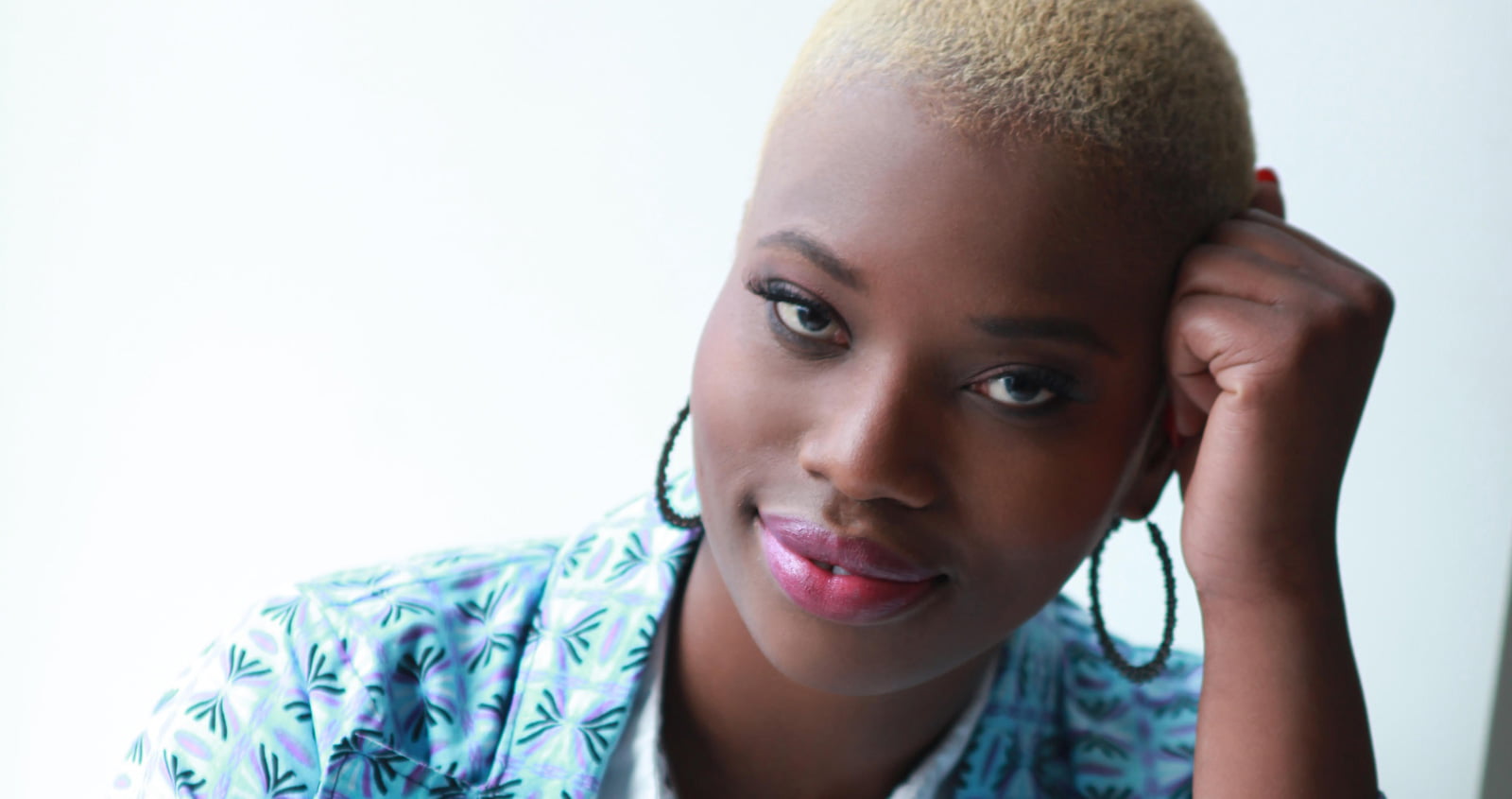
Close up shot of a smiling woman with hoop hearings
Campaigner Khadija Gbla educates health professionals about female genital mutilation. © Private

At every stage of your life it [FGM] impacts you; every woman has her own shame and isolation in her experience. I want people to know how terrible this is, what a violation of women and girl rights. There is so much education that needs to be done. It’s up to us to end this human rights violation.

Establishing my business

I’ve now established a business, Khadija Gbla Cultural Consultancy, which provides cultural competency training for organisations and keynote speaking. I’ve also started No FGM Australia, a not-for-profit which aims to protects girls from female genital mutilation and supports women affected  through advocacy, policy, child protection, women’s health and FGM training for organisations.

“I don’t like walking around being the face of FGM. I’d rather be the face of lipstick, because I have nice lips; but ending FGM is of the utmost importance.”

It’s essential that we raise awareness about sexual and mental health issues among girls and women from our new and emerging communities. It’s not always easy to discuss these things with newly-arrived refugees, but it’s important and I have worked hard to organise my community. It ends with me. It ends with our generation. If I have a daughter or daughters, this is not going to continue.

Recognition

In 2011 I was honoured to be named Young South Australian of the Year and as a finalist for young Australian of the Year.

I’ve been fortunate to travel all over the world to advocate for women who have experienced FGM. I’ve represented Australia at the Harvard National Model United Nations, Commonwealth Youth Forum and the Australian and Africa Dialogue, and speak regularly at events to make sure that the experiences and voices of our diverse communities are heard.

I did a Ted Talk about FGM, ‘My mother’s strange definition of empowerment’, and it now has over 2 million views and has inspired many people to take action on the issue.

Looking forward

Currently I’m in partnership with Dr Fariba Behnia Wilson to create a Desert Flower centre in Adelaide to provide holistic medical care for survivors of FGM in Australia.

When I look back over my re-settlement journey as a refugee with my family, I see the power of communities and neighbourhoods in being able to make the life of a refugee so much easier in their first years in Australia.

New initiatives like fairer community sponsorship would help the two-way communication essential to us all getting along. This was critical for me. Sponsorship is not just a way to bring refugees safely to Australia, it is also a way the community can lead in building a more empathetic and healthy society.

Khadija Gbla is an advocate for women’s health rights in Australia – working to ensure other young women don’t ever have to go through what she experienced.

USA: Routine separation of asylum-seeking families violates international law

The US government must stop separating asylum-seeking parents from their children and denying them access to asylum procedures through prolonged detention, said Amnesty International today in response to reports of the US Department of Homeland Security’s adoption of a draconian family separation policy that will apply to anyone who presents themselves at the U.S.-Mexico border. The policy was also referenced today in remarks by Attorney General Sessions.

“The idea that children can be protected by tearing them away from their families defies all sense of logic and humanity.”

Margaret Huang, executive director of Amnesty International USA

“The idea that children can be protected by tearing them away from their families defies all sense of logic and humanity,” said Margaret Huang, executive director of Amnesty International USA. “These are children who have already suffered the trauma of violence and persecution in their native countries and the arduous journey to seek safety. Why in the world would the US government institute a policy that would compound their distress by separating them from their families, claiming it’s for their own good? This is a monstrous policy that flies in the face of human rights, and should be rescinded immediately.”

“Criminalizing and stigmatizing parents who are only trying to keep their children from harm and give them a safe upbringing will cause untold damage to thousands of traumatized families who have already given up everything to flee terrible circumstances in their home countries,” said Erika Guevara-Rosas, Americas Director at Amnesty International.

“Prying infant children from their parents’ arms as they seek asylum is a flagrant violation of their human rights. Doing so in order to push asylum seekers back into dangerous situations where they may face persecution is also a violation of US obligations under refugee law.”

Amnesty International has documented US immigration agents forcibly separating families of asylum seekers, even when they have proof of their family relationships and the persecution that they have fled. The long-term detention of asylum seekers is widely documented to negatively affect both their psychological well-being and their ability to lodge asylum claims under US law.

The attorney general has also implemented a broader policy that essentially treats all asylum seekers as criminals by prosecuting them in federal court and incarcerating them in federal prisons.

For additional background, see the June 2017 Amnesty International report, Facing Walls, which documents how US border authorities have routinely denied asylum seekers the ability to claim asylum at US ports of entry, resulting in greater irregular flows of asylum seekers across the US-Mexico border.

Earlier this year, Amnesty International campaigned to reunite four families separated from each other at the border in violation of existing Department of Homeland Security policy to keep families together. In addition to calling on DHS agencies to remedy these violations, Amnesty International asked its 7 million members, supporters and activists worldwide to take action on behalf of the families.

The call to action can be found here: https://www.amnestyusa.org/urgent-actions/urgent-action-border-officials-forcibly-separate-families-usa-ua-256-17/


Meaningful Movement: Towards A New Kind Of Activism

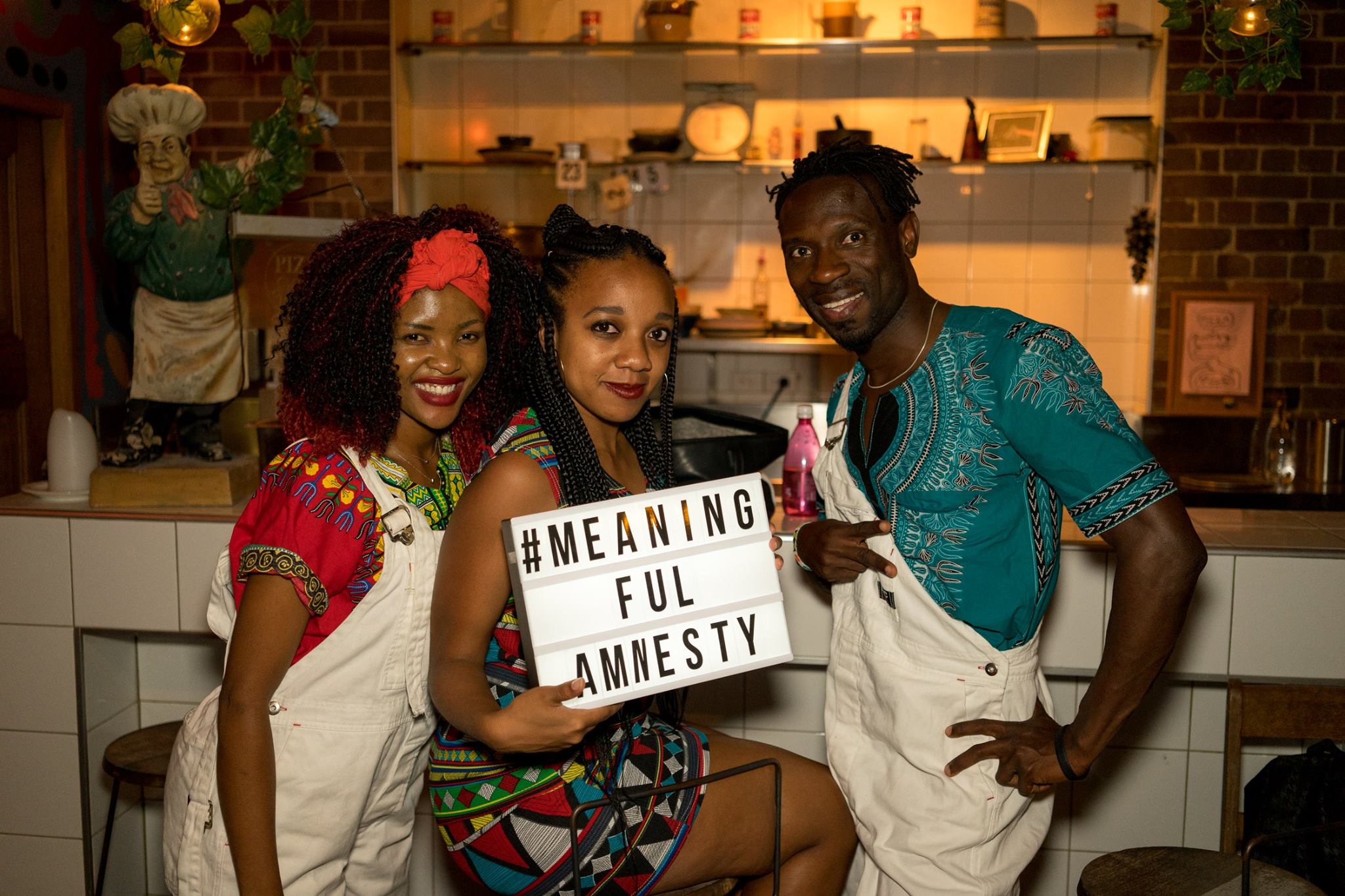
Founded in August last year by Michael Carr and Ellen McNeill, Meaningful Movement is in a unique member of the Amnesty International Australia family.

What is Meaningful Movement?

The group is dedicated to celebrating the work that our Amnesty networks do in promoting human rights. The newly founded group brings together the creative community and our existing activist networks to host quarterly events to raise funds and awareness for the ongoing fight against oppression and injustice around the world.

Now this might not sound all that revolutionary, yet where Meaningful Movement splits from the pack is in it’s emphasis on celebration, not only of the great work being done but of the people doing it. Founded to give all the hardworking volunteers and staff at Amnesty as place to kick up their heels together a couple of times a year, the group has widened it’s scope, seeking to celebrate all change makers from around the world and all walks of life.

Having recently hosted the hugely successful Meaningful Movement on Women’s Rights event on the 5th of April, we sat down to ask founder and former creative director Michael Carr about the group’s origins, work and goals for the future.

What made you want to start Meaningful Movement?

Look activism can be a bit of a slog at times. Whether it be lobbying governments or engaging with the community, with all the problems we’re working it’s easy to lose track of the victories. Meaningful Movement was founded with that in mind, as a group dedicated to celebrating the positive changes activism has achieved and the people who dedicate their lives to achieving them. More than anything we wanted to establish a new model of activism, that works as a support to more traditional forms and that seeks to inspire others to join the cause through positivity.

How has the group changed since it started? 

Well it started out as a collaborative effort between the Meaningful Movies and Meaningful Music groups in August 2017. At the beginning we were each doing our own events, but we teamed up on one and it soon became apparent that both groups were stronger together than they were apart, and so Meaningful Movement was born. Since then the events have slowly changed, moving from monthly to quarterly, and focussing on short films rather than features and documentaries in order to open up the program to more music, live art and performance. We’ve gone from strength to strength too with our last event breaking our personal best fundraising record. 

How did you build up such an awesome and diverse team?

We recruited both within Amnesty and via social media and various university faculties looking to find like minded people who believed in our mission. The interest was huge, and so we didn’t really have a problem with finding people. A big part of this I think came from the fact we advertised for specific roles with specific titles such as Social Media Manager and Event Producer rather than just looking for volunteers. This meant we found recruits who already had an idea of how they could contribute to the group, and although there was a lot of role sharing and swapping in the first few months, framing the group in more professional terms with titles and a role description helped bring in the kind of candidates we wanted.

I stepped back from the Creative Directorship in March after laying the groundwork for the last event, and seeing the new recruits just pick up the program and run with it has been truly inspiring. It was also very necessary, as since my departure the new team members have been expanded the team and made the program their own, which is the best thing any founder could hope for, even if it was nerve wracking letting go.

We’ve also been very lucky to work in partnership with amazing community groups like Heartdancers and StayFly, creative collectives such as The Ladies Network and local media like FBi Radio and 2ser, not to mention all the great artists, filmmakers, musicians and performers that have donated their time. So it’s a broad church, in a good way.

Can you tell us a bit about the last few events and what to expect from the group in the future? 

Of course. Well we rounded out 2017 with ‘A Night To Unite’ which in many ways was the first Meaningful Movement event as it sought to draw together all the different action groups and campaigns Amnesty was running into one big party.  We were lucky enough to host a screening of the Academy Award nominated documentary Fire At Sea by Gianfranco Rossi about the European migrant crisis, and we also had some great performances by Heartdancers and live music from singer/producer CLYPSO and hip hop artist Dobby. It was a great success, building on our previous events, and it was the last time we hosted the program on a Tuesday, which having grown in popularity felt too big to be held so early in the week.

With that in mind, we took a few months off and decided we should move the program to a Thursday night, and host quarterly rather than monthly events, in order to give us to time to work on making the events bigger and better. Returning to our spiritual home at Freda’s in Chippendale on 5th of April 2018, the event – going under the name Meaningful Movement on Women’s Rights – was our most successful to date, breaking our personal best fundraising record and featuring an amazing and diverse line-up of talent. Instead of showing a feature film we curated a selection of short films from local female directors, with Heartdancers once again providing some amazing performers to get everyone moving,  Milan Ring, Kimchi Princi and House of Riot Djs handling dance floor duties and StayFly curating the live art program, and dedicating their works to the group.

As for the future, I have to remain tight lipped, but let’s just say that we will be moving outside of our usual stomping ground and looking to take the community engagement further afield in Sydney and beyond.

Activist SkillSHARE: 5 workshops in making change

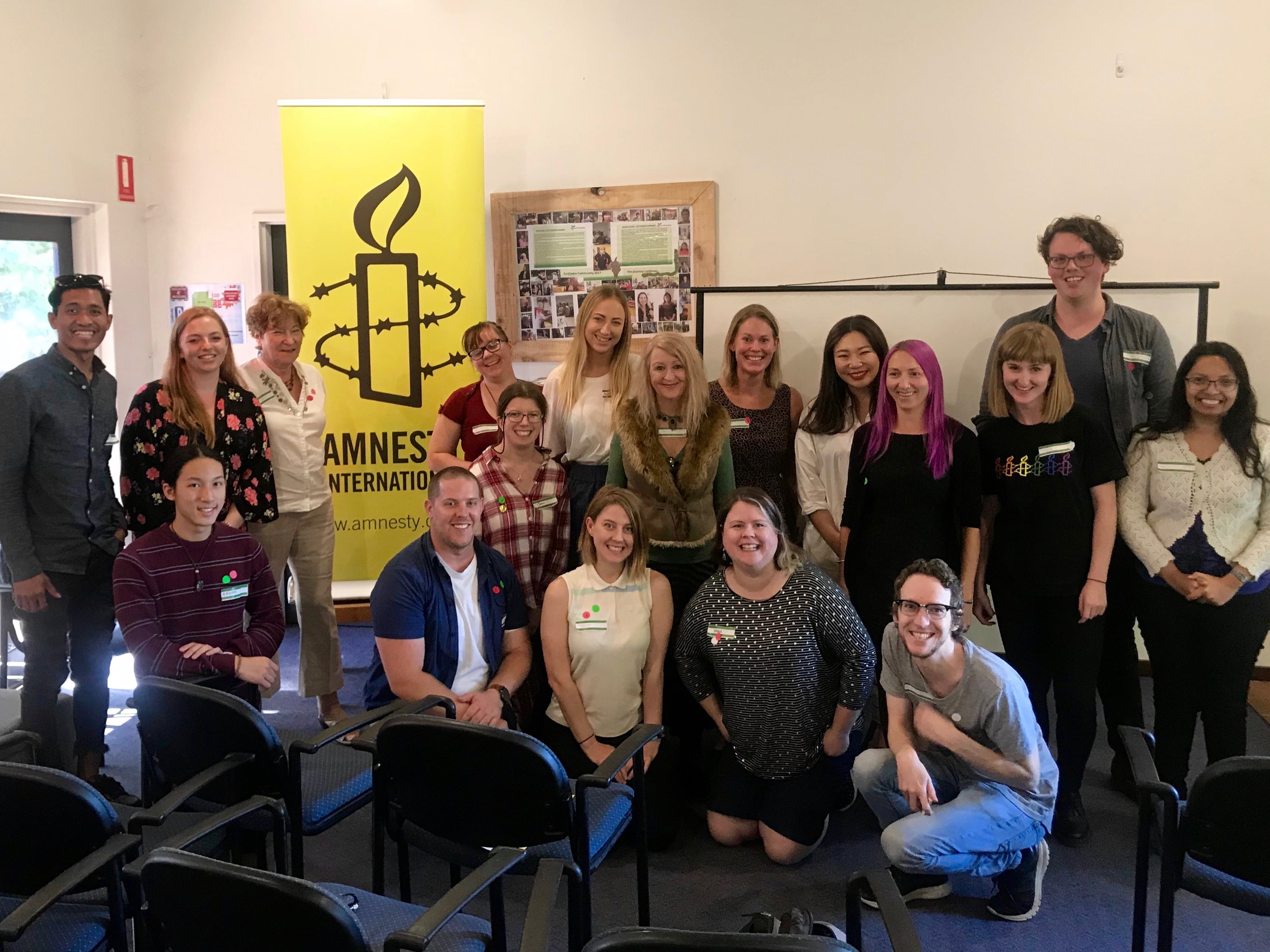
The Amnesty International WA SkillSHARE for 2018 brought activists together for training sessions in ally-ship, values and frames, and shared conversations about their vision for the region. Our volunteer training team share their insights into the day.

Jasmine Ruscoe

“These days never fail to inspire me as I see the value and the power of our community at its fullest when we work together. I was particularly pleased with the Allyship and Inclusive Language session and how well it was received. I feel that it is important that we learn how to engage with and support Rights Holders in significant but appropriate ways. I was also very excited to try out the new experimental workshops that were designed to create a dialogue around the values of Amnesty, our community, and our work. I look forward to seeing how our results shape the future of Amnesty WA!” 


Brendan Cooper

“The best part of the day for me was the amount of meaningful connections that were made. It was inspiring to witness so many people sharing stories, ideas, tips, and their visions for the future. Listening to everyone discuss what they wanted to achieve and how they planned to turn their visions into reality left me feeling energised and more motivated than ever to make sure that we, the Training Team, are working hard to support and empower everyone in the Amnesty community to be the best and baddest activists they can be”


Chloe Trotter

“This was my first SkillSHARE and it was filled with enthusiasm. I am new to the training team and being involved in this event made me feel proud. The best part of the day for me was that everyone played both roles, trainers and trainees at the same time. Newcomers such as myself appreciated some valuable tips and useful tactics and the experienced activists were highly motivated by fellow activists. I loved being part of the networking that happened over lunch and hearing everyone’s thoughts and ideas for campaigns and actions. It was so positive and inspiring. The success of this event made me feel extremely enthusiastic and excited for the future!” 


We couldn’t do a day like this without the input and enthusiasm of all the activists involved who come deliver sessions and participate. Everyone’s willingness to share their knowledge and support each others activism is what makes us the amazing community we are. There was a real buzz in the room at this SkillSHARE and to us that means all our hard work paid off!

We have plenty more exciting workshops lined up too – some of which will be based on activists’ own suggestions from the SkillSHARE! – so keep your eyes peeled! We look forward to seeing you at a training very soon

Jasmine, Brendan and Chloe are responsible for planning developing and implementing WA’s training program. This team of volunteers build a stronger and more skilled community of activists. A key part of their role is coordinating and delivering the biannual SkillSHAREs in the region. 

RAR National Conference, Wondonga Update

This years RAR Conference was attended by Amnesty Tasmania’s Southern Group & North West Group.

The conference exceeded all expectations with inspirational speakers, including Gillian Triggs, Julian Burnside, The UN High Commissioner for Refugees, Thomas Albrecht and many others.

A highlight of the conference was the presentation of the 2018 Tampa Award via live connection by phone, microphone with video link to Behrouz Boochani on Manus Island, with Nick McKim making the presentation, followed by 350 people singing ‘We Shall Overcome’ so he and others, could hear it on Manus.  Southern Group member, Anne Moon will deliver the award to him in person on her next trip.

All Amnesty Delegates agreed that the ‘absolute best thing’ was being an integral part of the impromptu but determined initiation of the WODONGA DECLARATION (or CHARTER) of HUMAN RIGHTS. This introductory statement was passed unanimously from the floor of the conference:

‘There is an urgent need for an Australian Charter of Human Rights which recognises that all people are born free and equal in dignity and rights.

We call for The Parliament of Australia to meet, protect, and uphold our legal and moral obligations under International human rights conventions and human rights laws.’

This came from a throw-away line in Gillian Triggs’ keynote speech, that ‘we could perhaps even have the Wodonga Bill of Rights’ …and so we ran with it.   

‘Australia has now joined the UN Human Rights Council in 2018. Engagement with the council may

help persuade Australia’s politicians that it is important to meet our international human rights

obligations’.  Professor Gillian Triggs.  (A good point to use when meeting with politicians.)

CHINA: Banning of Peppa Pig ‘Ridiculous new example of state crackdown’

Responding to news that the Chinese government has removed an estimated 30,000 Peppa Pig videos from the internet, Patrick Poon, Amnesty International’s China researcher, said:

“Banning Peppa Pig is further proof of just how sensitive the Chinese government’s censorship is.

“Last year, outlawing Winnie the Pooh was laughed at, and now we have a ridiculous new example of the state’s crackdown on the freedom of the internet.

“These ludicrous bans show that the Chinese government is relentless in its pursuit to get rid of any online content that could be considered a threat to the regime, no matter how irreverent or subtle the message might be.”

“These ludicrous bans show that the Chinese government is relentless in its pursuit to get rid of any online content that could be considered a threat to the regime, no matter how irreverent or subtle the message might be.”

Last year, images of Winnie the Pooh were banned from the internet after users posted pictures comparing the cartoon character to President Xi Jinping.

Six inspiring journalists who lived to tell the truth

From Trump’s attacks on the media, to the record number of journalists currently languishing behind bars – not to mention those being tortured and killed simply for reporting on human rights abuses – our right to free speech is under attack.

Now more than ever, we value our right to a free and independent press and respect the extraordinary individuals who risk their lives to get the truth out there. Zoe Smith tells us six (of countless more) journalists worthy of our thanks and celebration this World Press Freedom Day.

1 Shawkan

Mahmoud Abu Zeid (also known as Shawkan) is an award-winning Egyptian photojournalist, arrested during Egypt’s anti-government protests in 2013. He has been detained in Cairo’s infamous Tora Prison for over 1,100 days without trial, and tortured throughout his detention.

In March 2016, Shawkan was charged with six offences, and as a result faces the death penalty.

In a letter from 2015, Shawkan wrote: “After more than 850 days in the black hole without fairness and justice, I am lost in limbo.” The last sentence reads: “KEEP SHOUTING, JOURNALISM IS NOT A CRIME”.

Reporters Without Borders have said “working as a journalist in Egypt has become as dangerous as openly demonstrating against the regime”. 

Take action for Shawkan now

Mahmoud Abu Zeid © Ayman Aref Saad

2 Peter Greste

Latvian-Australian journalist Peter Greste was imprisoned in Cairo in late 2013 amid false allegations of aiding the Muslim Brotherhood, along with his two Al Jazeera colleagues. Greste, who had been covering Egypt’s political unrest, was landed a seven-year jail sentence despite there being no evidence to support the charge. His case was dropped in February 2015, and he was released after spending 400 days in prison (his colleagues were also later freed).

Greste has since used his profile to campaign for press freedom around the world.

“One of the things that’s made [Australia] one of the most stable and peaceful countries on earth is our robust democracy, founded on the principles of press freedom,” Greste told Amnesty.

“We need to see more public comments, more arguments, in support of press freedom. We need to see the default position being to defend press freedom, rather than to assume we need to go to national security.”

© SaltyDingo

3 Santosh Yadav

Indian journalist Santosh Yadav was arrested in September 2015, following accusations of having links with a Maoist leader, and involvement in a Maoist-led armed attack. He was held under the Chhattisgarh Special Public Security Act and the Unlawful Activities Act (both anti-terrorism legislations) but released in March 2017 after spending 17 months in jail.  

Yadav has reported on a number of human rights abuses in Bastar and helped place family members of those arrested by state police in touch with free legal services. It’s believed his work to expose injustices in the area is what led to him being targeted by local authorities.

In a statement following his release, Yadav expressed his desire to continue to highlight the plight of tribals in his region.

“I want to devote my life to social service for the tribals of Bastar,” he said. “Working in Bastar as a journalist is very difficult and dangerous, but the voice of the tribals should reach out to the world.”

4 Wa Lone and Kyaw Soe Oo

Wa Lone and Kyaw Soe Oo are Reuters journalists facing 14 years in prison simply for doing their job.

In December 2017, the men were arrested and detained without any access to lawyers, family or the outside world. For two weeks, no one knew of their whereabouts. They were then charged with possessing government documents with the intention of sending them to a foreign news agency.

The law under which they were charged is broad and vague and often used by authorities to silence dissent.

Journalists like Wa Lone and Kyaw Soe Oo face intimidation, harassment and even imprisonment for reporting on sensitive issues.

Join our call on the authorities to release Wa Lone and Kyaw Soe Oo immediately and to drop the charges unconditionally.

Reuters journalists Wa Lone (L) and Kyaw Soe Oo © REUTERS/Antoni Slodkowski

5 Behrouz Boochani

Journalist, writer, and film producer Behrouz Boochani is an Iranian Kurdish asylum-seeker who has been detained on Manus Island since 2013. Boochani reported for a number of Iranian newspapers and co-founded the Kurdish magazine Werya, where he published articles on Kurdish culture and minority rights. The offices of Werya were raided in early 2013, forcing Boochani to flee Iran. He was later intercepted while attempting to reach Australia, and transferred to Manus Island.

While in detention, Boochani has documented his experiences from within the camp; posting articles (published in several newspapers, including the Guardian), taking photos, and filming on a small mobile phone. He has produced a documentary “Nowhere Lines: Voices of Manus Island” shot entirely from his phone, and continues to report on the human rights abuses happening inside the facility.

In 2017 Boochani won Amnesty International Australia’s award for print journalism for his series ‘Voices of Manus‘, featured in The Guardian and The Saturday Paper.

Behrouz Boochani has been reporting from Manus Island. © AI
Behrouz Boochani has been reporting from Manus Island © AI