Yemen: Huthi missile attack on Saudi Arabian cities is a possible war crime

Responding to reports that the Huthi armed group in Yemen fired seven ballistic missiles at airports in Riyadh and other Saudi Arabian cities overnight on Sunday, killing one civilian, Samah Hadid, Middle East Deputy Director for Campaigns at Amnesty International, said:

“Launching indiscriminate attacks is prohibited by international humanitarian law and can constitute a war crime. A high death toll may have been averted, possibly due to the missiles being intercepted, but that doesn’t let the Huthi armed group off the hook for this reckless and unlawful act. These missiles cannot be precisely targeted at such distances, so their use in this manner unlawfully endangers civilians.

“These unlawful attacks must not be used as an excuse by the Saudi Arabia-led coalition to indiscriminately attack civilians or further exacerbate Yemen’s humanitarian crisis by imposing yet more restrictions on importing aid and essential goods such as food, medicine and fuel.

“We have documented extensively how all sides have violated international law in the Yemen conflict over the past three years. Saudi Arabia-led coalition airstrikes have recklessly destroyed and damaged Yemeni homes, hospitals, schools and markets. As a result, thousands of civilians have lost their lives and millions are displaced and in dire need of humanitarian aid. But violations by one side do not give the other side license to flout international humanitarian law.”

Background

According to initial media reports, including from the Saudi Arabian state press agency, all seven missiles were intercepted and destroyed, but an Egyptian national was killed after sustaining shrapnel wounds in the aftermath.

The Huthi missiles were launched on the third anniversary of the beginning of the Saudi Arabia-led coalition’s campaign of airstrikes in Yemen.

Scrap proposed laws that would suffocate NGOs, create climate of secrecy

The Australian government must immediately scrap proposed new laws that, if passed, would suffocate the work of civil society, intimidate whistleblowers and limit scrutiny of government, Amnesty International said.

The bills – the Electoral Funding and Disclosure Reform Bill and the National Security Legislation Amendment (Espionage and Foreign Interference) Bill – are currently being reviewed by Parliamentary Committees, the first of which is due to report back this Wednesday.

“These bills are clear examples of government overreach in the name of national security, which could silence critical voices. It appears that authorities are attempting to prevent organizations from working on issues they consider ‘sensitive’, such as the shutting down of offshore refugee processing centres. These bills would help to hide government dealings from public scrutiny,” said James Gomez, Amnesty International’s Director of Southeast Asia and the Pacific.

“Australia is trying to join the ranks of governments around the world – from Cairo to Budapest to New Delhi – using the legal books to stifle civil society and to draw a cloak of secrecy around their own dealings. These bills must be scrapped immediately.”

Abandoning critical work

The Electoral Funding and Disclosure Reform Bill would impose arbitrary restrictions on civil society organizations, forcing them to abandon or curtail their advocacy on critical areas of public policy, such as Indigenous Peoples’ rights, children’s rights and the environment.

The bill would force NGOs to register as a “political campaigner” if they work on an issue that could be discussed during an electoral campaign. The proposed law contains vague and overly broad definitions that would leave NGOs in complete uncertainty about which issues can be publicly discussed.

The law would require charities to put in place onerous procedures that restrict foreign donations to funding administration, rather than to improving people’s lives. This would add substantial administrative requirements, an unreasonable burden for many organizations already operating on meagre resources.

Attempt to choke civil society

The Espionage and Foreign Interference Bill would impose criminal penalties for the receipt of what is broadly defined as “sensitive” information. While the bill contains certain provisions to protect journalists, the law does not contain any safeguard to protect whistleblowers who divulge human rights abuses or other information of public interest, nor for other human rights defenders who may discuss human rights concerns with representatives of foreign governments.

The bill would even criminalize sharing information that has already been made public, such as retweeting leaked information, even if people are unaware of its security classification.

“If passed, these bills will erode the rights to freedoms of expression and association in direct contravention to Australia’s obligations under international human rights law. The Australian Parliament must stop this open attempt to choke civil society”, said James Gomez.

“Chilling effect”

In a submission to the Australian Parliament, the UN Special Rapporteur on the right to privacy also raised concerns that the Espionage and Foreign Interference Bill would have a “chilling effect” on human rights.

The provisions contained in the proposed legislation are overly broad, and the criminal penalties for disclosures that do not threaten national security and would be in the public interest are a disproportionate penalty that contravene the right to freedom of expression.

Since the bills were introduced in Parliament late last year, they have been met with outcry by civil society and media organisations.

“The Australian government must heed the warnings by human rights lawyers and civil society organisations that these bills are damaging to Australian civil society and unreasonably encroach on human rights. Any further attempts to pass these two laws and to unduly restrict human rights must end immediately,” said James Gomez.

Background

Amnesty International’s submission to the Inquiry Into Electoral Funding And Disclosure Reform Bill 2017 can be read here.

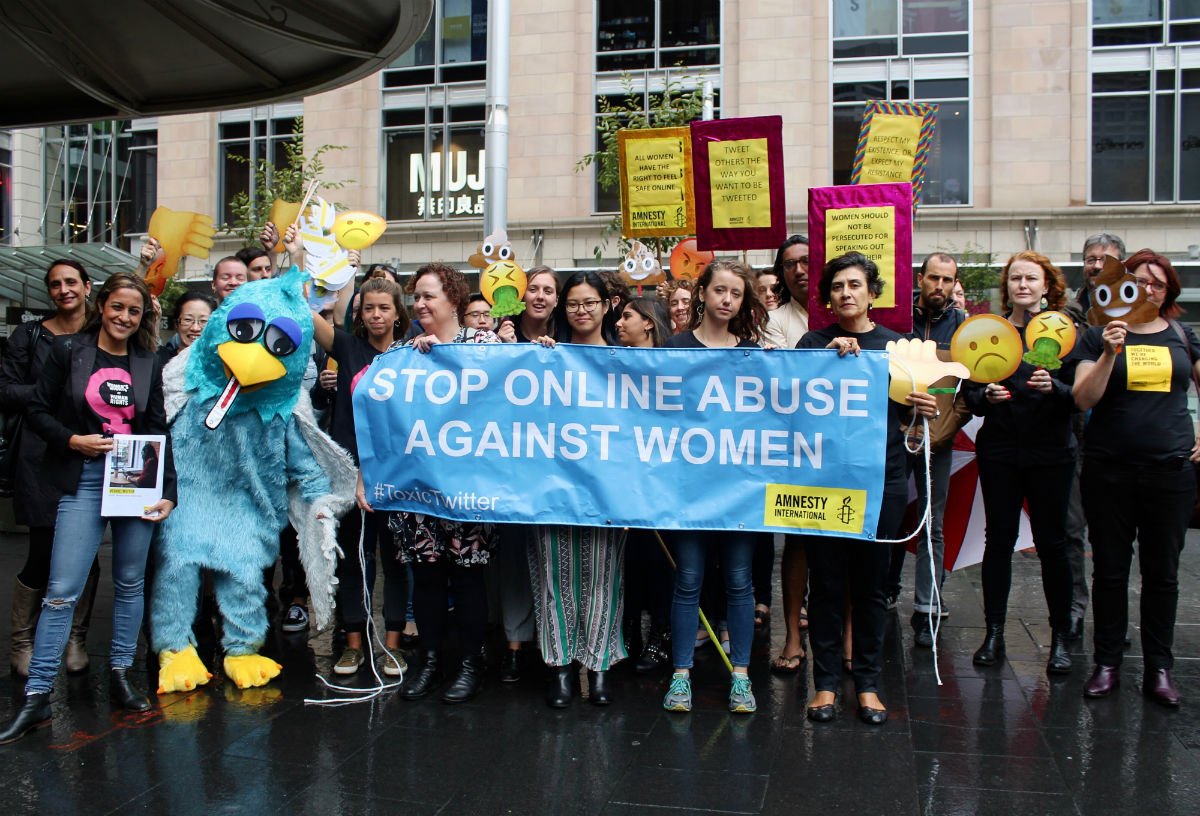
Twitter fails to protect women’s human rights: new report

Twitter’s recent claim to “stand with women around the world” rings hollow in light of the multi-billion-dollar social media platform’s longstanding failure to protect women users from violence and abuse, said Amnesty International today as it published new research into women’s experiences on the platform.

The new report, #ToxicTwitter: Violence and abuse against women online, shows that the company is failing to respect the human rights of women because of its inadequate and ineffective response to violence and abuse. It includes a series of concrete recommendations for how Twitter can become a safer place for women.

“Women have the right to live free from discrimination and violence, both online and offline. But by letting abuse against women flourish, Twitter is undermining these rights. Despite repeated promises to clean up the platform, many women are logging onto Twitter to find death threats, rape threats and racist or homophobic slurs littering their feeds,” said Azmina Dhrodia, Technology and Human Rights Researcher at Amnesty International.

“Our investigation shows that Twitter is failing to provide adequate remedies for those who experience violence and abuse on their platform. As a company it needs to do much more to respect the human rights of women.”

CEO Jack Dorsey issued a plea for help this month, pledging to make the company publicly accountable on efforts to improve the “health” of conversation on its platform. However, despite several requests from Amnesty International, Twitter refused to provide meaningful data publicly on how the company responds to reports of violence and abuse.

“It is great that Jack Dorsey is asking for help and feedback on this issue, but Twitter’s refusal to disclose meaningful information about how they are dealing with online violence against women makes it hard to know how to address the problem. Twitter should take concrete steps proactively, such as – at a minimum – committing to respond to users who report abuse,” said Azmina Dhrodia.

Twitter said it disagreed with Amnesty International’s findings. In a statement, the company said it “cannot delete hatred and prejudice from society”, and explained it had made more than 30 changes to its platform in the past 16 months to improve safety and had increased the instances of action taken on abusive tweets. The company repeated its refusal to share data on how it addresses reports of abuse. It said such data “is not informative” because “reporting tools are often used inappropriately”.

Amnesty International acknowledges that context is important when sharing any raw data, but there is nothing to stop Twitter providing context alongside data, and the company’s human rights responsibilities means it has a duty to be transparent in how it deals with reports of violence and abuse.

“Twitter has repeatedly tried to shift attention away from its own responsibilities by focusing on the wider issue of hatred and prejudice in society. We are not asking them to solve the world’s problems. We are asking them to make concrete changes that truly demonstrate that abuse against women is not welcome on Twitter,” said Azmina Dhrodia.

The report is based on a combination of quantitative and qualitative research conducted over the past 16 months. It is based on interviews with 86 women and non-gender binary individuals, including politicians, journalists, and ordinary users across the UK and USA, about their experiences of Twitter’s failure to take reports of abuse seriously.

Twitter’s own policies on hateful conduct prohibit violence and abuse against women, and Twitter has a reporting system in place for users to flag accounts or Tweets that are in violation of this policy.

However, the report says Twitter fails to let users know how it interprets and enforces these policies or how it trains content moderators to respond to reports of violence and abuse. The report concludes that abuse is inconsistently enforced or sometimes not even responded to at all, meaning abusive content stays on the platform despite violating the rules.  

Miski Noor, a gender non-conforming communications specialist for Black Lives Matter Global Network, said: “Twitter is going to have to say whether they’re for the people or they’re not. Twitter has the power to change the way women and femmes are experiencing abuse, or even if we experience abuse, on their platform. After all, they are the convenors of the space and they have the power to change our experiences.”

The impact of abuse

Like all businesses, Twitter has a responsibility to respect human rights, including the rights to live free from discrimination and violence and to freedom of expression and opinion. However, Amnesty International’s research shows that Twitter’s failure to adequately tackle violence and abuse by its users contributes to silencing women on the platform.

In 2017 Amnesty polled 4,000 women in eight countries and found that over three quarters (76%) of women who had experienced abuse or harassment on a social media platform made changes to how they use the platform. This included restricting what they post: 32% of women said they’d stopped posting content that expressed their opinion on certain issues.

An Amnesty poll carried out in Australia found that three in 10 Australian women experienced online abuse, and that effects suffered included stress, anxiety, panic attacks and disturbed sleep.

In 2018, the same Amnesty poll carried out in Australia found that three in 10 Australian women experienced online abuse, and that effects suffered included stress, anxiety, panic attacks and disturbed sleep.

Amnesty International has documented how women of colour, women from ethnic or religious minorities, LGBTI women, non-binary individuals and women with disabilities, are targeted with additional and particular types of abuse. This can have the effect of driving already marginalised voices further out of public conversations.

US journalist Imani Gandy told Amnesty International, “I get harassment as a woman and I get the extra harassment because of race and being a black woman. They will call white women a ‘c*nt’ and they’ll call me a ‘n*gger c*nt’. Whatever identity they can pick they will pick it and use it against you. Whatever slur they can come up with for a marginalised group – they use.”

Curating a less toxic experience

The report outlines concrete recommendations for how Twitter can become a safer and less toxic place for women. These include:

  • Sharing specific examples of violence and abuse that will not be tolerated;
  • Sharing data on response times to reports of abuse, setting targets and reporting regularly; and
  • Ensuring that decisions to restrict content are consistent with international human rights law and standards

Twitter should also focus on enabling and empowering users to curate a safer and less toxic Twitter experience. This should include creating awareness campaigns about the different safety and privacy features available.

“The past few months have seen a surge of solidarity and activism from women around the world, and there’s no doubt that Twitter has an important role to play in movements like #MeToo,” said Azmina Dhrodia.

“Twitter’s recent initiatives shows that it wants to be a part of this change, but women who’ve experienced abuse on the platform simply aren’t buying it. Without taking further concrete steps to effectively identify and account for violence and abuse against women on its platform, Twitter cannot credibly claim to be on women’s side.”
What’s in a name?

Sara Saleh is an Arab-Australian human rights and refugee advocate, grassroots activist and artist.

My name is ethnically ‘ambiguous’, but it is actually a Hebrew name with British spelling that rolls off an Australian tongue worn by me, Sara – an Arab, Muslim woman.

A name palatable to mainstream, never mispronounced in school roll call or misspelled paying a bill over the phone. I have never felt compelled to change it during a coffee order for fear of judgment or to appease someone.

It’s a name that tells you more about me before I tell you about me. A name that speaks in a universal language that says to people: I am not a threat.

But whatever name I have, whatever name you call me – the outcome seems to be the same.

As Muslim women, we are constantly painted in a somewhat confused, but islamophobic light of threat and ‘model’ citizen, aggressor and victim, oppressor and oppressed.

We are fetishized and hated and when we ‘succeed’ by neo-liberal societal standards – we are told it’s because we are ‘not like the others’.

We are talked about, talked at… but rarely are we the ones talking, or being listened to.

As Muslim women, our citizenship is conditional, aspects of our identity policed, our achievements sanitised, our activism silenced – at the best of times.

All of this is tantamount to emotional and psychological abuse, a deprivation of dignity, and one needn’t look beyond our own backyard to see this play out.

We have the mere illusion of freedom that purports to include us, only at the expense of our own overlaying identities and beliefs.

Writing this in the wake of International Women’s Day, I acknowledge the privilege I have, which I actively choose to use to speak out, facilitate support and take action against injustice in what is a hostile environment for minority communities.

For many Muslim women and women of colour, myself included, this moral obligation to fight injustice comes at a high cost. We are met with endless attempts to silence us, dismiss us, other us, demonise us, or erase us altogether.

Whether this deliberate incitement comes from TV presenters, publicly elected officials, or members of the public, it repeatedly reinforces this country’s fundamentally flawed characteristic: we are built on colonisation and genocide, and we are seemingly OK with it.

Cost of speaking up

Whilst women continue to be verbally and physically harassed in public places, the vicious vitriol extends well into virtual spaces – one name  for you: Yassmin Abdel-Magied.

We are subject to a barrage of misogynistic cyber bullying by anonymous users who hide behind screens with no fear of retribution or accountability.

Various human rights organisations like Amnesty International have highlighted the harmful impacts on women’s emotional wellbeing and sense of safety, others have classified it as a form of gender-based violence or violence against women.

Amnesty’s latest report into online violence against women, #ToxicTwitter: Violence and Abuse Against Women, highlights the responsibilty

#ToxicTwitter features interviews with 86 women and non-gender binary individuals about their experiences with facing violence and abuse on Twitter, and the company’s response. Interviewees explained the silencing effect it has and the negative impact on their freedom of expression, the psychological impact of violence and abuse on the platform, and their frustration at Twitter’s poor response.

This behaviour does not just come down to a single individual, and it won’t end until we have wider cultures of respect, equality, and a diverse representation that must be cultivated both offline and online.

We need a culture that understands power disparities and addresses them. We need spaces that normalise our presence, instill safeguards for our mental health and well-being, and prioritise and elevate those who are particularly vulnerable – because freedom of speech doesn’t come freely to all.

And, perhaps most importantly, we need help to do it.

Solidarity and support: what can you do?

I don’t have all the answers, but here are a few basics to being a good, intersectional ally.

Sit down and listen

Give up your voice

  • When asked to speak at an event or participate in a panel, ask yourself if there is someone from that specific community, who is better equipped.
  • Let us take the lead (online or otherwise) because ultimately, we speak for ourselves.
  • Report trolls if you are in a position to do so, or address the topic at hand without detracting from our voices (like every other community, there is no single representative or dominant view but a plurality of opinions).

Facilitate opportunities

  • If you are in a position to do so, create space, especially for those who are hardest to reach.
  • Don’t indulge in tokenism – women of colour are not an afterthought or a KPI to be met.
  • Don’t impose your own solutions on what needs to be said or done.
  • Don’t expect us to be grateful or to make it “easy” for you – we put in enough emotional labour as it is building resilience in our own communities.

Donate

Time or resources may not always be appropriate, but you can support organisations doing critical work, including:  

Take action with Amnesty

Stand with women facing online abuse and ask CEO and Co-Founder, Jack Dorsey, to stop abuse of women on his social media platform.

“I am not free while any woman is unfree, even when her shackles are very different from my own.” — Audre Lorde

Bipartisan ACT milestone brings Australia closer to refugee solution

The Australian Capital Territory today marked a significant milestone in Australia’s response to the global refugee situation, with Labor, Liberal and Greens MLAs voting unanimously to call on the Federal Government to broaden the refugee community sponsorship program.

“The ACT Parliament is the first at any level of government in Australia to get behind expanding this neighbourhood-led solution to the global refugee crisis,” said Shankar Kasynathan, Refugee Campaigner at Amnesty International Australia.

Community sponsorship is a model where ordinary members of the community sponsor visas for refugees from around the world, who wish to begin the process of rebuilding their lives in Australia.

New neighbours

The motion, led by MLA Shane Rattenbury, calls on the Federal Government to make the intake of refugees under community sponsorship separate from the existing humanitarian intake, and to lower the program’s prohibitive visa fees.

“The ACT is one of almost 150 local government areas across the country that have already declared themselves Refugee Welcome Zones, saying they are ready to receive their new neighbours. Now that the ACT has led the way, we hope other State and Territory governments and local councils around the country will take their commitment one step further by adding their voices to the call for a greater community sponsorship program,” said Shankar Kasynathan.

Model for success

The community sponsorship model has worked successfully for almost 40 years in Canada, which has welcomed over 280,000 refugees through the program, in addition to its humanitarian intake.

In contrast, Australia’s community sponsorship program is capped at only 1,000 places this year, and each time one of these is allocated, a place is lost out of the 13,500 in the humanitarian program.

“We can see from Canada’s example that the kindness of neighbours can help people who have lost everything to start again. We hope ordinary people across Australia will see the success of this and say, ‘Let’s do our bit and help bring these vulnerable people to safety’,” said Shankar Kasynathan.

Israel/OPT: Palestinian child activist Ahed Tamimi’s 8-month prison sentence ‘ruthless’

The eight-month prison sentence imposed on Palestinian child activist Ahed Tamimi is a flagrant attempt to intimidate those who dare challenge the circumstances of the ongoing Israeli occupation, Amnesty International said today.

17-year-old Ahed Tamimi was sentenced to eight months and a 5000 shekels fine (around AUD$1850), with a three-year suspended sentence after entering into a plea deal at Ofer military court in the Israeli-occupied West Bank.

She was accused of aggravated assault and 11 other charges after a video showing her shoving, slapping and kicking two Israeli soldiers in her home village of Nabi Saleh on 15 December 2017 went viral on Facebook.

“By sentencing Ahed to eight months in prison, the Israeli authorities have confirmed yet again that they have no regard for the rights of Palestinian children, and have no intention to reverse their discriminatory policies” said Magdalena Mughrabi, Amnesty International’s Deputy Director for the Middle East and Africa.

“Under the Convention on the Rights of the Child to which Israel is a state party, the arrest, detention or imprisonment of a child must be used only as a measure of last resort and for the shortest appropriate period of time.

“Today’s sentence is another alarming example of the Israeli authorities’ contempt for their obligations to protect the basic rights of Palestinians living under their occupation, especially children. Ahed Tamimi is a minor. Nothing she did warrants her continued imprisonment and she must be released immediately.”

“Today’s sentence is another alarming example of the Israeli authorities’ contempt for their obligations to protect the basic rights of Palestinians living under their occupation, especially children.”

Ahed was convicted on four of the 12 charges against her including incitement, aggravated assault and two counts of obstructing Israeli soldiers. Her mother Nariman was sentenced to eight months in prison in addition to a fine of 6000 shekels (around AUD$2200) and a three-year suspended sentenced for assisting in assaulting a soldier, obstructing a soldier and incitement. Ahed’s cousin, Noor Tamimi, was fined 2000 shekels (around AUD$740).

“The Israeli authorities must stop responding to relatively small acts of defiance with such disproportionately harsh punishments. By ruthlessly targeting Palestinians, including children, who dare challenge Israel’s oppressive occupation, the authorities are neglecting their responsibilities under international law as an occupying force.”

Hundreds of Palestinian children are prosecuted every year through Israeli juvenile military courts. Those arrested are systematically denied their rights and subjected to ill-treatment including in some cases physical violence. There are currently approximately 350 Palestinian children in Israeli detention.

Background

Ahed Tamimi was arrested on 19 December 2017 after her mother, Nariman Tamimi, also a prominent activist, posted the footage of her altercation with Israeli soldiers online. Nariman Tamimi was arrested later that day, while Ahed’s cousin, Nour Tamimi, was arrested the following morning. Nour was released on 5 January pending trial, and was sentenced yesterday (21 March) to the time she had already spent in prison.

Ahed confronted the soldiers amid a demonstration in Nabi Saleh against US President Donald Trump’s recent decision to recognise Jerusalem as the capital of Israel.

The incident took place on the same day that one of Ahed’s other cousins, 15-year-old Mohammad Tamimi, was hit in the head at close range by a rubber bullet fired by an Israeli soldier and sustained serious injuries.

Teenager in Banksia Hill asking to go to adult prison after 328 days in isolation

The WA Government must urgently close the punishment unit in Perth’s Banksia Hill Juvenile Detention Centre, and answer questions about the WA youth justice system, said Amnesty International today.

A teenager locked up for 328 days in the so-called ‘Intensive Support Unit’, an isolation cell the size of a car parking space, is asking to be transferred to an adult prison, but yesterday had this application delayed by a fortnight.

“What does it say about the harm being done in this unit that a teenager would rather be locked up in a harsh adult prison than suffer another day in Banksia Hill?” said Rodney Dillon, Indigenous Rights Advisor at Amnesty International Australia.

“Corrections Minister Fran Logan cannot leave him another day in these conditions.”

An independent investigation is underway into the teenager’s allegations, including excessive use of force, limited access to a psychologist, and being only allowed his daily exercise within a cage.

He claims he was subjected to degrading treatment such as being denied access to a shower and other basic services, having to ‘earn’ the use of bedding materials, and having to kneel for his food or being fed through a grill in the door. He also alleges he was held in solitary confinement, with as little as 10 minutes a day out of his cell, for at least two weeks.

“That’s not rehabilitation”

Today Kylee Douglas, the teenager’s mother, said about her son:

“I’d just like his suffering, his nightmare in the ISU to come to an end. As his mother, I feel so helpless knowing that I can’t protect him from any of this.

“I’m anxious about the aftermath of what Banksia Hill has caused. When he’s finally released, I’m afraid they will have done so much damage I will never get my son back. They’ve absolutely destroyed any remnants of what my boy was, even a year ago. I’m afraid that loving, goofy, generous son, who would give you his last dollar and the shirt off his back, will no longer be there. That’s not rehabilitation.”

Given the seriousness of the claims, Amnesty International wrote to Corrections Minister Fran Logan in January calling for young people to be moved out of ISU while the investigation is underway. The Minister did not respond to this call in his reply to the organisation.

Since December, Amnesty International has also made repeated requests to the WA Government about Freedom of Information applications regarding the WA youth justice system, and still has not received a decision in writing.

First Nations people targeted

The organisation reiterates that the ISU must immediately be shut while these allegations are investigated, and calls on the WA Government to start making moves to close down Banksia Hill altogether.

“This Government needs to learn from the Northern Territory, which committed to shut the horrific Don Dale children’s prison and instead build accommodation designed to heal and support children. We want to see a justice system in WA that supports children to thrive, rather than locking them up and further traumatising them,” said Rodney Dillon.

WA has the country’s highest rate of overrepresentation of Indigenous children in detention, with Aboriginal and Torres Strait Islander children 44 times more likely to be locked up than non-Indigenous children.

Rodney Dillon said, “This teenager is of Maori background, and the discrimination that Maori kids face in the ‘injustice’ system is the same as facing Aboriginal kids. They are targeted because they are First Nations people.”


Australia-ASEAN Summit: Leaders must take a stand against ethnic cleansing of Rohingya

Leaders of the Association of Southeast Asian Nations (ASEAN) and Australia must take a strong stand against ongoing crimes against humanity targeting Rohingya in Myanmar as they meet this weekend, Amnesty International said.

Aung San Suu Kyi, Myanmar’s State Counsellor and de facto political leader, is expected to attend the first ever ASEAN-Australia Summit, taking place in Sydney on 17-18 March.

“The orchestrated campaign to drive Rohingya out of Myanmar and ensure they cannot return must end. Even if the violence has subsided, ethnic cleansing continues – authorities are starving Rohingya and erecting security force bases on their lands in a bid to force them out,” said James Gomez, Amnesty International’s Director for Southeast Asia and the Pacific.

“The human rights crisis in Rakhine State, and Myanmar as a whole, must be top of the agenda this weekend in Sydney. ASEAN has been shamefully silent on what is happening in one of its member states so far. It is high time for the organisation to take meaningful action, and to call an emergency ASEAN Summit to address the issue.”

Amnesty International has documented how the Myanmar security forces have engaged in a brutal campaign of ethnic cleansing against the Rohingya people since August 2017, which amounts to crimes against humanity.

This week, Amnesty International revealed how Myanmar is militarizing northern Rakhine State – until recently home to the majority of Rohingya – by building bases for security forces on torched Rohingya villages.

The summit is taking place just weeks after media reports exposed that Australia is planning to keep supporting the Myanmar military during 2018 through training programs worth almost $400,000.

“Australia’s continued engagement with the Myanmar military is unacceptable and must end immediately. These are the same soldiers who just months ago killed Rohingya, burned villages, committed rapes and drove hundreds of thousands to flee in a vicious campaign of ethnic cleansing. It is also the same military that is responsible for war crimes against ethnic minority civilians in northern Myanmar,” said James Gomez.

“Myanmar’s regional neighbours – including Australia and ASEAN – must send a signal that crimes against humanity are unacceptable and will not go unpunished. They should not appear to condone such crimes by providing support and cooperation to the security forces that are responsible.”

Australia: Cruel and inhuman refugee policies

ASEAN leaders must also pressure Australia to end its unlawful and cruel refugee policies. Amnesty International has documented how Australia’s “offshore processing” policies amount to torture or other ill-treatment, as refugees are held in squalid conditions on Manus Island and Nauru in violation of international law.

Earlier this year, Amnesty International highlighted how Australia had abandoned hundreds of refugees to their fate in Papua New Guinea, by moving them to new centres that lack basic services and leave refugees vulnerable to violence.

“Australia’s lack of humanity when it comes to refugees is affecting the whole region. ASEAN leaders must push their Australian counterparts to take their obligations under international law seriously and respect the human rights of refugees,” said James Gomez.

Crackdown on human rights defenders

Amnesty International urges ASEAN governments to prioritise the mounting challenges faced by human rights defenders (HRDs) across the region. Over the past year, several governments have intensified a crackdown on human rights defenders, relying on harassment, draconian laws and even physical violence to stop their peaceful activities.

Over the next 12 months, three countries in the region – Malaysia, Cambodia and Thailand – will hold general elections. There are already worrying signs that authorities in these countries are using the upcoming polls as an excuse to restrict space for the rights to freedom of expression and association even further.

“From Hanoi to Manila, those brave enough to speak up for human rights are increasingly doing so at their own peril. It’s deeply worrying that the crackdown on civil society is becoming a trend across the region. Government must do all they can to stop this alarming backslide and instead work together to create a safe space for human rights defenders,” said James Gomez.

My First Mardi Gras

By Hannah Wahlsten,WA LGBTQI Rights Network Convener

Over a decade ago before I came out to my family, before I became a LGBTQI activist, I watched the Mardi Gras parade on the television in my home and wished for the chance to be amongst the people that lined the streets.

All those years ago, I never believed that one day I would not only get my wish but that I’d walking in Mardi Gras alongside fellow Amnesty activists.

Last year was busy with campaigning in my community for marriage equality and broader rights for LGBTQI people. When I received the news that I was going to Sydney to attend Mardi Gras on behalf of Amnesty International WA LGBTQI Network, I was incredibly honoured with some very teenaged excitement thrown in. Yet it wasn’t until I was sitting in the Perth Airport at 5:00 AM on Saturday morning that it really hit me where I was going (not even as I packed my rainbow socks, suspenders and tutu) that for the first time I was going to Mardi Gras.

Hannah (second from left) with staff and SANT activist Vincent at Mardi Gras © Andy Miller Imaginarium Photography

My only experience previously with LGBTQI parades had been campaigning at the Pride Parade in Perth, the energy and anticipation at the start is always an extraordinary feeling, and a feeling I love. Being at Mardi Gras and seeing the 200 floats with the thousands upon thousands of my fellow LGBTQI people all there to celebrate our community (with lots of glitter) gave me that same feeling only amplified onto a grander scale. Particularly this year of all years when all our years of campaigning had finally culminated in Marriage Equality becoming law.

This is not the end. Defend Equality 

As we were the last float on the parade I had the opportunity to watch part of the parade with the rest of the crowd, finding an excellent spot to watch thanks to some of the wonderful Amnesty International NSW activists. Who, upon discovering it was my first Mardi Gras ensured I got the most out of it, with them I got to laugh, smile, cheer on the other groups and fill my heart with the extraordinary amount of love I felt for my community and reminding me why I continue to fight.

AIA Chair and National Director at Mardi Gras © Andy Miller Imaginarium Photography


Then it was our turn, I could feel my heart pounding in my chest to the beat of the music playing from the speakers in front of us as I moved onto the parade route with my fellow banner carriers and helpers. The music moving us as we danced along the route carrying the banner displaying our message “This is not the End. Defend Equality”.  

It was a message that reminded us that while we have won the battle of Marriage Equality there are many battles that we still need to fight. It reminds us that there are communities such as the Transgender community, the Intersex Community, LGBTQI Refugees and our beautiful LGBTQI Indigenous community that still have fights ahead and that we need to stand with them so that no one is left behind.

Lizzi and Nancy from AIA NSW LGBTQI Network
© Andy Miller Imaginarium Photography

We are honored to stand on the shoulders of the brave activists who came before us, like the 78’ers, who’s moving story was featured in the recent short telemovie ABC Riot. I was honored to see some of them in attendance, waving Refugees welcome signs. But we know for our community the fight does not end here. Amnesty International has always stood alongside our community, having marched every year since Mardi Gras began in 78 as a protest and this being the 20th year the Amnesty float was organised by activists.

It is so important we continue this fight, with recent cases like this January when police in Aceh Province Indonesia raided five beauty salons – a common workplace for transgender women in Indonesia – and arrested 12 people they assumed to be transgender women. We need to take action and stand with those abused because of their LGBTQI status and continue to stand in solidarity.

© Andy Miller Imaginarium Photography

As I marched, I was filled with a wonderful warmth (that only got larger), as we danced covered in glitter, down the street. I was so amazed that I was actually there cheering, laughing, dancing with all these other wonderful activists, some who had done this many times before, others who had never attended like me and ones who like me had travelled a great distance to be there. We had International representatives with us, alongside myself from Western Australia and a wonderful fellow activist from South Australia, all of us there together. But I know we cannot forget our LGBTQI brothers and sisters who still cannot live freely.

The next day as I sat in Sydney’s Domestic Terminal waiting to board my flight home with glitter still in my hair, the inspiration and energy from the night before still filled me, re energising me for the battles to come.

Mardi Gras was an experience more than ten years in the making and was worth every moment I waited.

Get involved with Amnesty International LGBTQI Network here

A big thank you to the NSW LGBTQI Network who has been organising AIA presence in Mardi Gras for the last 20 years. In particular to Lizzi Price, Robin Millar and Nancy Mills. We would not be as bright without you! 

Myanmar: Military land grab as security forces build bases on torched Rohingya villages

Myanmar’s Rakhine State is being militarised at an alarming pace, as authorities are building security force bases and bulldozing land where Rohingya villages were burned to the ground just months ago, Amnesty International said in a new briefing today.

Through eyewitness testimony and expert analysis of satellite images, Remaking Rakhine State reveals how flattening of Rohingya villages and new construction have intensified since January in areas where hundreds of thousands fled the military’s campaign of ethnic cleansing last year. New roads and structures are being built over burned Rohingya villages and land, making it even less likely for refugees to return to their homes.

“What we are seeing in Rakhine State is a land grab by the military on a dramatic scale. New bases are being erected to house the very same security forces that have committed crimes against humanity against Rohingya,” said Tirana Hassan, Amnesty International’s Crisis Response Director.

“This makes the voluntary, safe and dignified return of Rohingya refugees an even more distant prospect. Not only are their homes gone, but the new construction is entrenching the already dehumanising discrimination they have faced in Myanmar.”

Bulldozing and destruction

The Myanmar authorities launched a vicious campaign of ethnic cleansing little more than six months ago, on 25 August 2017, in response to attacks by the Rohingya armed group the Arakan Rohingya Salvation Army (ARSA).

The military killed women, men, and children, committed rape and other forms of sexual violence against women and girls and systematically burned hundreds of villages, clearly committing crimes against humanity. More than 670,000 people have fled into Bangladesh.

Although the violence in Rakhine State has subsided, the campaign to drive Rohingya out of their homeland – and ensure they cannot return – continues but has taken on new forms.

Amnesty International’s latest research reveals how whole villages of burned Rohingya houses have been bulldozed since January. Even surrounding trees and other vegetation have been removed, rendering much of the landscape unrecognisable. This raises serious concerns that the authorities are destroying evidence of crimes against the Rohingya, which could hinder future investigations.

“The bulldozing of entire villages is incredibly worrying. Myanmar’s authorities are erasing evidence of crimes against humanity, making any future attempts to hold those responsible to account extremely difficult,” said Tirana Hassan.

Amnesty International has also documented recent examples of looting, deliberate burning and demolition of abandoned Rohingya homes and mosques across northern Rakhine State.

New infrastructure for security forces

Even more troubling than the destruction is what is being built in its place. Authorities have launched an operation to rapidly expand security infrastructure across Rakhine State, including bases to house the military and Border Guard Police, as well as helipads.

The pace of construction is alarming. Satellite imagery reveals how, in just a few months, new bases have been erected over torched Rohingya land, with whole villages and even nearby forests cleared to make room.

Amnesty International’s analysis of satellite imagery has confirmed that at least three new security bases are being built in northern Rakhine State – two in Maungdaw Township and one in Buthidaung Township. Construction appears to have started in January.

The largest of the new bases is in the village of Ah Lel Chaung in Buthidaung Township, where eyewitnesses said that the military forcibly evicted Rohingya people from certain areas to make way for construction. Many of the villagers saw no option but to flee into Bangladesh.

“People are in a panic. No one wants to stay because they are afraid of more violence against them,” said a 31-year-old man who fled to Bangladesh in January when the military erected a new fence and security post close to his village.

In the once mixed ethnicity village of Inn Din – where Amnesty International has documented how security forces and their proxies killed Rohingya villagers and torched their homes in late August and early September 2017 – satellite imagery shows what appears to be a new security force base being built where the Rohingya part of the village used to be.

Housing and refugee reception centres

Satellite imagery also shows how new refugee reception centres – meant to “welcome” Rohingya who return from Bangladesh – are surrounded by security fences and close to areas with a heavy presence of military and border guard personnel. A massive new transit centre to temporarily house returning Rohingya is built on top of a burned Rohingya village in Maungdaw Township, and also shows signs of heightened security.

There are serious concerns that the Myanmar authorities are planning to house Rohingya in the centres for a prolonged period and restrict their freedom of movement. Tens of thousands of Rohingya, who were driven from their homes during waves of violence in 2012, have for years been confined to open-air prisons in squalid displacement camps. Most rely on aid for their basic needs.

Eyewitnesses also told Amnesty International how non-Rohingya people were living in new villages that have been built on burned Rohingya homes and farmland over the past months. This is worrying since authorities have in the past resettled members of other ethnic groups into Rakhine State as part of efforts to develop the region.

“Rakhine State is one of the poorest parts of Myanmar and investment in development is sorely needed. But such efforts must benefit everyone in the state regardless of their ethnicity, not entrench the existing system of apartheid against Rohingya people,” said Tirana Hassan.

“The remaking of Rakhine State is taking place in a shroud of secrecy. The authorities cannot be allowed to continue their campaign of ethnic cleansing in the name of ‘development’.

“The international community, and in particular each donor state, has a duty to ensure that any investment or assistance it provides does not contribute to human rights violations. Contributing to entrenching a system that systematically discriminates against Rohingya and that makes the return of refugees even less likely could amount to assisting in crimes against humanity.”

Read the Full Report > Remaking Rakhine State