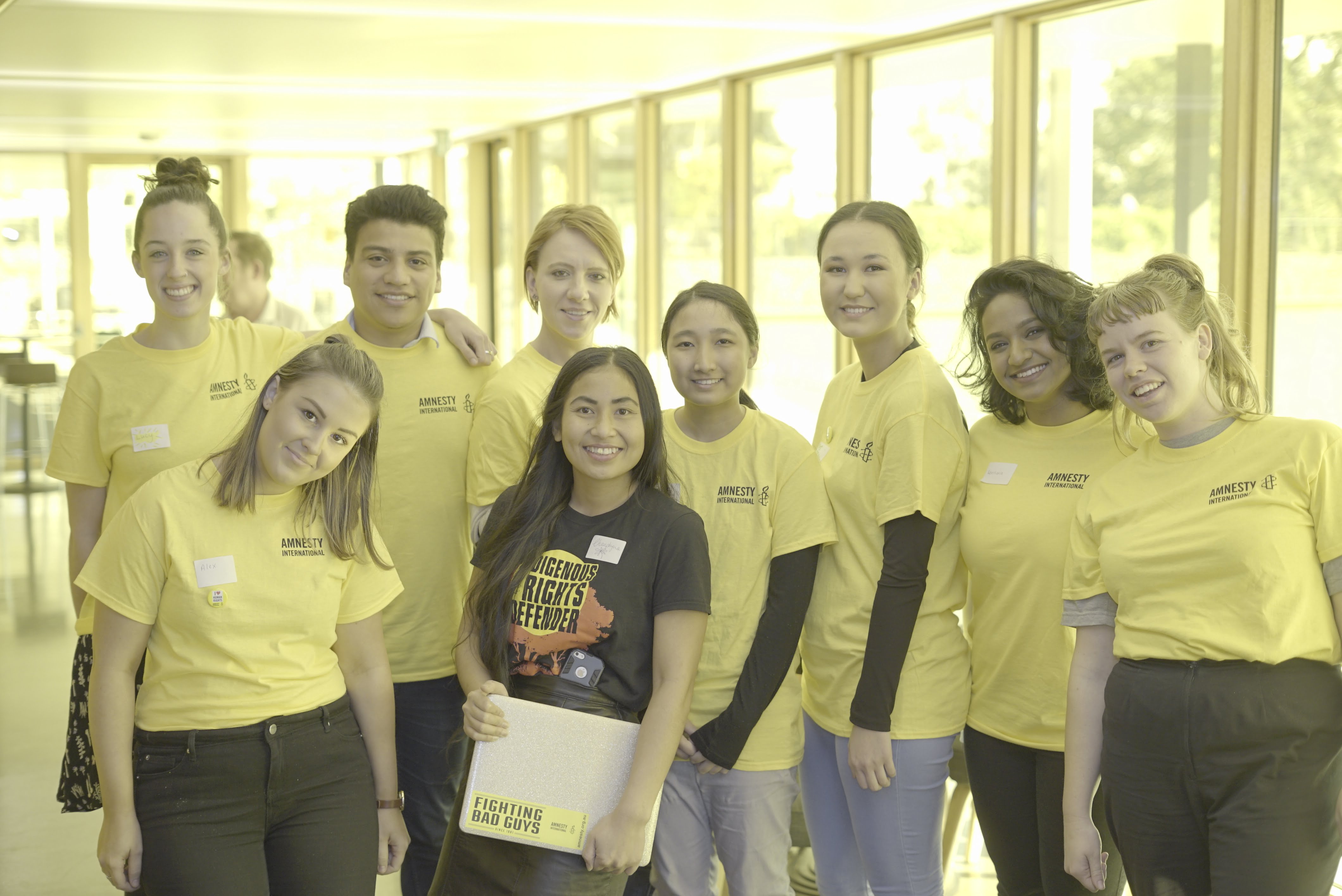
As a Leader Bulletin subscriber, we know you’re a committed Amnesty supporter! Which is why we’d love you to participate in your Branch Annual General meeting (BAGM) in May, and also why you should consider nominating for your Branch Committee in 2018!
Want to try something new or are you interested in becoming a regional leader? There’s two things you can do to be more involved in our governance – come along to your Branch Annual General Meeting (BAGM), and consider nominating to become part of your local Branch Committee.
What’s a BAGM?
Branch Annual General Meetings (BAGMs) are held annually in each region. This year they will take place on Saturday 19 May.
At BAGMs our members, activists, volunteers, staff and partner organisations get together to share ideas and contribute to our key campaigns and programs, and to learn of organisational updates. BAGMs are also where our members vote on resolutions to go to the National AGM. Anyone can attend BAGM, but only Amnesty financial members can vote.
To find out more about your regional BAGM contact your Activist Support Coordinator or Branch Committee.
What do Branch Committees do?
Amnesty International Branch Committees (BCs) are teams of elected members in each region who help to coordinate and develop local human rights activism. BCs provide support and motivation to activists, volunteers and members in each region, and undertake governance responsibilities for their region. Check out our Branch Committee resources to learn more.
How can you take part in all of this?
Come and be part of your BAGM! Anyone can attend although you need to be a financial member of Amnesty to vote on resolutions.
We’re also holding info sessions to get you prepared for BAGM resolution drafting and Branch Committee nominations:
Reacting to the news that Australia and Papua New Guinea have begun deporting some men from the Manus Island facilities, Amnesty International’s Refugee Researcher Kate Schuetze said,
“No asylum seeker should be arrested or deported until they have been given a fair opportunity to present their case for asylum. To do so creates a serious risk that Papua New Guinea and Australia are breaching their international obligations on non-refoulement.
“Asylum seekers have been assessed under a process that lacks credibility and procedural fairness. Some asylum seekers have been denied the right to present evidence in support of their claims and others have been denied the right to appeal their decisions because of gaps in Papua New Guinea law. In addition, there is no clear protection framework for those who are at risk of serious violation of their rights if they are returned to their countries of origin.”
Background
Nine Bangladeshi asylum seekers have been taken into custody in Papua New Guinea by Australian and PNG officials, and are awaiting possible deportation. Some were arrested on 9 March 2018, while others were taken to Bomana Prison in Port Moresby last week.
Emma works as a journalist while studying a Masters in Human Rights and volunteering with Amnesty International WA.
Earlier this year Perth volunteers and activists workshopped new ways of building momentum at the Perth Tactics Jam.
I tagged along as a new communications volunteer to get to know the people who take time out of their busy lives to raise awareness for causes they are passionate about. The Jam was a perfect opportunity to gather likeminded people in one room and brainstorm new and innovative project ideas. It was also a chance for activists who were feeling a bit lost to get some direction while empowered activist leaders were able to build connections across different action groups.
To brainstorm you need brain food, so to kick things off we ordered pizza and introduced ourselves and our stories, sharing personal experiences and the ‘why’ behind our activism. From my perspective as a relative newcomer to activism, it was a great insight into how different people from all walks of life with different backgrounds and different passions can come together to share ideas for change.
The discussion led to the first question of the night – “what was the most meaningful activism we each had engaged in with Amnesty over the last year?”
The stories were all deeply personal and inspiring and we explored what made those particular moments different? What was a common theme in everyones experience and could we replicate it? We tried to be as specific as possible and eventually developed a theory of change:
‘Human Rights impact is made through empathy-building conversations on the ground.’
But what were the practical tactics we could use to achieve this goal in our projects? What kind of obstacles commonly get in the way of our activism and meaningful action?
This was the tricky part as everyone has different obstacles in their lives, whether its work, uni, or kids. How could we work around these factors and what steps could we take to lessen them in our activism?
We determined that our effective, simple tactics should consider;
Repercussions – can anyone do this regardless of who they are?
Less prep more presence – does each action take less than an hour to prep for?
Access – can all 200 of our WA activists reach the space and audience this uses?
Rinse-and-repeatability – how simple is this action to continuously execute?
From here we were introduced to the goal of generating 10,000 signatures in 2018 and played the alphabet game to generate a range of ideas that could meet all of the steps above and the end goal of names on paper.
Some of the ideas had potential, some focused on the novelty factor and some were downright weird. While it may not have been the more fruitful exercise, the activists definitely had fun and enjoyed the challenge of shaping their ideas around the signature goal. A smaller, more practical goal for each activist group might be a way to avoid crazy ideas that could be hard to implement.
For example the number of signatures could be determined by the size of the action group, 3000, 2500, 2000, 1500, 1000 depending on the number of volunteers and time they could commit to the implementing the idea. If the goal was broken into smaller chunks it could lead to more practical and effective ideas and not leave volunteers disheartened by the enormity of the task.
All in all it was a good experience for myself as a new volunteer, and for current activists to build connections and foster a culture of sharing tactics to enable empathy building conversations on the ground. In future it would be great to have more tactics jams to come up with practical, achievable tactics to break that big goal of 10,000 signatures into smaller, more manageable goals.
From China to Syria, Kenya to Egypt, girls and women are rising up and risking their lives to stand up for what they believe in. Activists, lawyers, sisters and students, these women have put their lives on the line, fought for lost loved ones and stood up for strangers. Now it’s their time to shine. Meet the inspiring women defending human rights around the world…
Wu Rongrong
Wu Rongrong, China
Wu Rongrong is best known for being one of China’s “Feminist Five” – a group of women arrested in 2015 for planning a campaign to tackle sexual harassment. The arrests, which coincided with International Women’s Day, led to an international outcry, garnering support from the likes of Hillary Clinton. Although the women were released, the “Feminist Five” have remained under surveillance.
Prior to her arrest, Wu Rongrong was a leader of the Women’s Rights Action Group, whose bold, creative stunts have drawn public attention to gender inequality and sexism. The group have shaved their heads to protest against discriminatory higher college admission requirements for female applicants, and worn wedding dresses spattered with red ink to protest against domestic violence.
“Women face many challenges throughout their lives, but many of these issues often remain invisible. For example, survivors of sexual harassment not only experience unspeakable pain, but also lack efficient legal protection. If victims were not blamed, but emboldened to seek redress, it would help to reduce sexual harassment.”
Wu Rongrong
On top of her advocacy work, Wu Rongrong is also a social worker and registered counsellor. She is currently pursuing a master’s degree in Human Rights Law.
Noura Ghazi Safadi
Noura Ghazi Safadi, Syria
For Syrian human rights lawyer Noura Ghazi Safadi, campaigning for the rights of prisoners of conscience is about love, hope and family. Born in Damascus in 1981, Noura has been a lawyer for many years, focusing on human rights, detention and disappearances. She had an early introduction to human rights violations against political prisoners when her father was arrested. Her husband Bassel Khartabil Safadi, a digital activist who was arrested by the Syrian government in 2012, was executed in 2015.
“My father was a political prisoner several times. I used to visit him in Adra prison and attend his trial hearings. Once, I had a run-in with the commanding officer of the patrol that was transporting [him] to court.”
“I swore to him and my father that I would become a lawyer and defend prisoners of conscience. I was 12 years old at the time. And when Bassel [her husband] was arrested, defending my own prisoner of conscience became my obsession.”
“Since my husband was executed, [I feel] every prisoner’s case is my business and it’s my responsibility to fight for them. I feel women are best placed to deal with this issue, because of the leading role they play in building Syria’s future. They have demonstrated that they are capable of handling every obstacle before them, whether it’s to do with security, the community, or life generally.”
Joy Wathagi, Kenya
Joy Wathagi is an Amnesty International youth leader in Nairobi,Kenya,and she’s taking a stand for a teenager thousands of miles away. Student Taibeh Abbasi, 18, lives in Norway and dreams of becoming a doctor, but she’s at risk of being deported to Afghanistan, a country she’s never been to. When Joy heard that Taibeh’s classmates were organizing protests she wanted to show solidarity, so she decided to participate in the #TellNorway campaign on social media to highlight Taibeh’s case.
Joy Wathagi
“When I heard that Norway was going to deport teenagers I was filled with sadness and wanted to do something about it,” Joy says. “I remembered all the refugees that came to my country, Kenya. I have met people from Somalia, Sudan and Rwanda and seen that they deserve to live here as much as any Kenyan.”
“I have gone to school with many refugees, grown with them, and they have become my life-long friends. I would truly hate to see them get sent back.”
Joy Wathagi
“Afghan refugees are going back to the same situation that they left behind. It is cruel and unfair. They have become part of the fabric of Norwegian society and must be treated as such. My biggest motivation to contribute to the #TellNorway campaign was the determination to save people’s lives and give them a chance to live in safety with dignity and purpose. Saying ‘go back to your country’ is the most thoughtless and selfish phrase that I keep hearing and it breaks my heart. As countries, we need to provide support and not build fences.”
Shackelia Jackson, Jamaica
Grief turned Shackelia Jackson into an activist. On 20 January 2014, Shackelia’s brother Nakiea Jackson was busily preparing lunch at the restaurant where he worked when he was shot dead by police. They said Nakiea matched the description of a man they were looking for after a robbery. Shackelia has been fighting ever since to bring those responsible to justice, braving police intimidation and harassment.
“The pain that my family and I suffered forced me to fight for justice for my brother and for all victims of police brutality. I have become a broken sister who speaks out so that others won’t forget.”
Shackelia Jackson
Shackelia has joined dozens of other families in Jamaica who live with similar tragedies, many of whom have joined forces to put a stop to police violence.
Shackelia Jackson
“I was set on a life-altering path to bring about the legislative and policy changes that will secure justice for all and end state violence and terrorism in Jamaica, so that future lives can be saved. And despite relentless attempts by the Jamaican authorities to stop me succeeding in this, I am undeterred, and I refuse to give up.”
“I am undeterred because I was given the shoulder of giants to stand on. Amnesty International and its allies have provided me with a global platform to rewrite a history of wrong. Kindness reminded me that I was broken, not destroyed.”
Wanjeri Nderu
Wanjeri Nderu, Kenya
In 2012, Wanjeri Nderutook a brave step. She left her financial job to become a social justice activist.
Since she switched careers, Wanjeri’s work has included fighting against extra-judicial executions by Kenyan police, campaigning successfully to free four Kenyans detained in South Sudan and advocating for free, peaceful and fair elections in Kenya.
However, she’s paid a price for speaking out. Wanjeri was arrested for participating in peaceful protests in 2013 and she’s faced attacks both online and offline. In 2015, she was physically attacked by a man, who approached her car and said, ‘Wacha kelele, ama tutakumaliza’ (Stop making noise otherwise we will finish you). He then hit her in the eye and walked away. She also received relentless misogynistic abuse from a group of men on Twitter for an entire day.
“The group leader kept tagging more people onto his insults, inviting them to join in. I counted about eight men in total who took part. The insults were extremely personal, body shaming me and my family.”
In a bid to protect herself and her family, Wanjeri has sought refuge elsewhere in Kenya, however she won’t let the actions of a few silence her. She remains a vanguard for a new generation of activists, determined to speak out for what they believe in.
Azza Soliman, Egypt
Azza Soliman
Azza Soliman bravely speaks out for survivors of torture, arbitrary detention, domestic abus eand rape in Egypt. She co-founded the Centre for Egyptian Women’s Legal Assistance and later Lawyers for Justice and Peace, which provide impoverished women and girls with legal aid, support and literacy lessons.
Azza’s courageous and selfless work led to her being labelled a spy and a national security threat by the Egyptian authorities. In December 2016, Azza was arrested and interrogated by authorities. She was released after being briefly detained, but is facing charges such as receiving foreign funding in order to slander Egypt’s image. Azza has been banned from travel, her assets have been frozen and she could face time in prison. But this incredible woman hasn’t given up the fight.
“The struggle to enhance and support women and human rights is long and tiring,” says Azza. “Yet, I still have hope. The overwhelming messages of support and love I have received [through Amnesty International’s Write for Rights campaign] reminds me I am not alone and that my work is appreciated and recognized.”
“I can see new generations taking the torch and leading the way to a better future. One day, we will overcome these difficulties and challenges – that’s what keeps me going.”
Zhang Leilei*, China
Zhang Leilei
Activist Zhang Leilei is a woman on a mission to end sexual harassment in China. In 2017, she designed subway ads to raise awareness of the issue, but they were rejected by the subway authorities. So Zhang Leilei turned herself into a human billboard, and women around the country followed suit!
Now Zhang Leilei is taking her activism to universities. Earlier this year a professor was sacked after being accused of harassment by a former student. This sparked a widespread public discussion and Zhang Leilei saw an opportunity to push for change. Along with others, she called for students and alumni to write open letters to their universities demanding proper mechanisms for reporting sexual harassment. People didn’t need much convincing.
Less than two weeks after Zhang Leilei put out her call, students and alumni from up to 70 universities published their own open letters. They’ve already had a real impact – national reports say that the Ministry of Education in China is looking into setting up new systems to prevent sexual harassment.
*Zhang Leilei is a pseudonym
Hortense Lougué, Burkina Faso
Hortense Lougué
Hortense Lougué must be one of the busiest women in Burkina Faso. Having grown up in a country fraught with injustice and inequality, where girls can be forced into marriage or to undergo Female Genital Mutilation (FGM), she has dedicated her life to ending gender-based violence, and has set up multiple projects to advance education and human rights. Hortense Lougué now works with young girls and women who have been forced into marriage or suffered FGM, providing education on how to tackle these issues.
“I have been an activist, general secretary, program coordinator and today I am an executive director of the Association of Support and Awakening Pugsada (ADEP), an NGO focused on improving the legal status and socio-economic living conditions of girls.”
“I lead 10 projects and through determination and perseverance, we are committed to improving the lives of girls and women in Burkina Faso.”
Hortense Lougué
Many of these women are part of Amnesty International’s Brave Campaign, which strengthens the recognition and protection of human rights defenders around the world.
Your ability to raise your voice about issues you care about is under threat. The federal government has proposed new laws that will silence Australians and avoid accountability.
The changes will tie charities up in red tape and make it difficult for us to use your crucial donations for the purpose they were given. Amnesty is working with other charities to stop these changes.
Proposed changes to restrict the work of NGO’s
Amnesty is working to ensure that charities and civil society are not impacted by three ‘foreign interference bills’ put forward by the Federal Government in December 2017.
The changes in these bills would undermine civil society’s crucial role in helping government make policy decisions that affect all Australians. Perhaps most frighteningly, the bill would obstruct charities’ work in exposing evidence that holds governments to account, like Amnesty’s advocacy to reduce incarceration rates of Indigenous kids.
Charities work to support Australians, particularly those in need, and help put issues you care about at the centre of decision-making. Essential funds for life-saving medical research, to alleviate poverty, to support Indigenous self-determination, and to protect our forests, rivers and wildlife are now at risk.
Restricting advocacy by charities sends a deeply troubling message – that our government is seeking to avoid accountability. Their actions would have a chilling effect on our democracy.
Parliamentary Committees have been examining the bills and Amnesty has made a submission which you can read here. You can also check out this great piece of legal analysis by Professor Anne Twomey.
Hands off our Charities Alliance
Amnesty has joined a group of like-minded charities and NGO’s in the Hands off our Charities alliance. We are working together with groups like the Australian Council of Social Services (ACOSS), Caritas Australia and the Australian Conservation Foundation to protect the right of charities to engage in public debate.
So how does this relate to human rights?
This year is the 20th anniversary of the adoption of the UN Declaration on the Right and Responsibility of Individuals, Groups and Organs of Society to Promote, and Protect Universally Recognized Human Rights and Fundamental Freedoms. Article 13 of the Declaration stresses the right of associations to solicit, receive and utilise financial resources. The proposed Bill would contradict this Article, and also impact the rights to freedom of expression and of association set out in the International Covenant of Civil and Political Rights, to which Australia is a party.
Amnesty are also concerned about the precedent this bill sets for the international community. It has the potential to help justify measures that stifle the voices of human rights defenders. Sadly, such measures have already been introduced in several states, like what’s happening in Hungary right now.
This bill is example of Government overreach impacting on the vibrancy of Australia’s civil society and the capacity for human rights organisations in Australia to effectively advocate for their cause.
You can raise this issue with your local MP or Senators in your State. You can provide them with a copy of Amnesty’s submission to the Parliamentary Inquiry, outline your concerns and explain to them why Amnesty’s work is important to you. The impact that you can have by contacting your representative directly can’t be understated. Don’t forget to please let us know how you go.
Amnesty International Australia was appalled to see the timid ‘diplospeak’ as laid bare in the FOI documents obtained by Guardian Australia. This confirms that not only is Australia intent on continuing its ties with the Myanmar military, but it is employing a sickening softly softly approach despite the horror being inflicted on the Rohingya people. With Australia about to host ASEAN in Sydney, the time for diplospeak is over.” – Amnesty International Australia’s Crisis Campaigns Coordinator Diana Sayed
Reacting to the UN’s claim that Myanmar is continuing its campaign of ethnic cleansing against Rohingya including through “forced starvation”, James Gomez, Amnesty International’s Director of Southeast Asia and the Pacific, said:
“The UN’s findings sadly echo our own – there is no question that the Myanmar authorities’ vicious campaign of ethnic cleansing against Rohingya is still ongoing. Fleeing Rohingya told us how they are still being forcibly starved in a bid to quietly squeeze them out of the country.
“This is yet more evidence that any plans for organised repatriation of Rohingya refugees from Bangladesh are extremely premature. No one should be returned to Myanmar until they can do so voluntarily, in safety and dignity – something that is clearly not possible today.
“The Myanmar authorities must end all operations aimed at forcing Rohingya out of their homeland, whether at gunpoint or through starvation. It is also high time the international community took meaningful action, including by imposing an arms embargo and targeted sanctions.”
This news comes on the heels of confirmation that the Australian Government intends to continue its support of the Myanmar military. Amnesty International Australia’s Crisis Campaigns Coordinator Diana Sayed said,
“Amnesty International Australia was appalled to see the timid ‘diplospeak’ as laid bare in the FOI documents obtained by Guardian Australia. This confirms that not only is Australia intent on continuing its ties with the Myanmar military, but it is employing a sickening softly softly approach despite the horror being inflicted on the Rohingya people. With Australia about to host ASEAN in Sydney, the time for diplospeak is over.”
Background
On 7 February 2018, Amnesty International published a briefing that showed how the ethnic cleansing campaign against the Rohingya was still ongoing. It detailed how authorities were withholding food, engaging in systematic theft and subjecting women and girls to sexual violence. The full briefing is available here.
The Sri Lankan authorities must respect human rights under the state of emergency, says Amnesty International.
A state of emergency was declared in Sri Lanka after two incidents of serious violence against members of the country’s Muslim minority. On 5 March, a mob set homes, shops and a mosque ablaze in the Digana area of Kandy, in central Sri Lanka. The incident came just days after a similar attack in the eastern coastal district of Ampara, on 26 February.
“It is important that the authorities take action against mobs who have incited hatred and carried out acts of violence against religious minorities. They have a duty to protect vulnerable groups and hold the perpetrators accountable. But a state of emergency must not become a pretext for further human rights abuses.”
Biraj Patnaik, Amnesty International’s South Asia Director.
“It is important that the authorities take action against mobs who have incited hatred and carried out acts of violence against religious minorities. They have a duty to protect vulnerable groups and hold the perpetrators accountable. But a state of emergency must not become a pretext for further human rights abuses,” said Biraj Patnaik, Amnesty International’s South Asia Director.
The declaration of the state of emergency comes amid fears that violence against members of the Muslim minority may spread to different parts of the country. Under emergency powers, the authorities have sweeping powers, including to search, arrest, and detain. A state of emergency was previously in force from 1971 to 2011.
Prime Minister Ranil Wickremesinghe tweeted: “As a nation that endured a brutal war we are all aware of the values of peace, respect, unity and freedom. The government condemns the racist and violent attacks that have taken place over the last few days. A state of emergency has been declared and we will not hesitate to take further action.”
“While it is positive that the government wishes to prevent further violence, any steps taken to address the problem, however, must meet Sri Lanka’s obligations under international human rights law, including the absolute prohibition on torture, unfair trials and arbitrary detention,” said Biraj Patnaik.
The Sri Lankan authorities must respect human rights under the state of emergency, says Amnesty International.
A state of emergency was declared in Sri Lanka after two incidents of serious violence against members of the country’s Muslim minority. On 5 March, a mob set homes, shops and a mosque ablaze in the Digana area of Kandy, in central Sri Lanka. The incident came just days after a similar attack in the eastern coastal district of Ampara, on 26 February.
“It is important that the authorities take action against mobs who have incited hatred and carried out acts of violence against religious minorities. They have a duty to protect vulnerable groups and hold the perpetrators accountable. But a state of emergency must not become a pretext for further human rights abuses,” said Biraj Patnaik, Amnesty International’s South Asia Director.
The declaration of the state of emergency comes amid fears that violence against members of the Muslim minority may spread to different parts of the country. Under emergency powers, the authorities have sweeping powers, including to search, arrest, and detain. A state of emergency was previously in force from 1971 to 2011.
Prime Minister Ranil Wickremesinghe tweeted: “As a nation that endured a brutal war we are all aware of the values of peace, respect, unity and freedom. The government condemns the racist and violent attacks that have taken place over the last few days. A state of emergency has been declared and we will not hesitate to take further action.”
“While it is positive that the government wishes to prevent further violence, any steps taken to address the problem, however, must meet Sri Lanka’s obligations under international human rights law, including the absolute prohibition on torture, unfair trials and arbitrary detention,” said Biraj Patnaik.
In 2017 we saw hundreds of thousands of Rohingya refugees flee ethnic cleansing in Myanmar and the formal closure of the Manus Island detention centre. We were all left with the question: where to from here?
Amnesty Australia’s new Refugee Campaign Coordinator, Shankar Kasynathan, explains how Australians can do their bit to solve the world’s refugee crisis.
My father used to be a teacher. He taught philosophy at a university in the hill country of Sri Lanka. It was his dream job. He made friends easily with activists and students and loved being able to share his knowledge with them. After a long day at work, he would call his mother and sisters – who lived in a fishing village several hours away – from a payphone to check they were okay.
Although he didn’t know it at the time, my father was being closely watched as he did these things. The Vice Chancellor of his university compiled a list of Tamil academics he felt were behaving suspiciously and gave it to the authorities. My father’s everyday activities were observed and reported to the police.
Ultimately, his associations with Tamil students and activists made him a terror suspect. He was questioned on the notorious Fourth Floor of Sri Lanka’s Criminal Investigation Department – reputedly a torture facility, with rumours of people falling from windows. Thankfully my father survived.
In 1987, my family and I fled Sri Lanka, leaving behind the arbitrary police searches and our sense of fear. We came to Australia in search of refuge.
We weren’t forced to come by boat. Others have been.
We weren’t re-routed to the hell that is Manus Island or Nauru. Others have been.
We were sponsored. Others must be.
Community-led, neighbourhood-driven solutions are how my family and I escaped a life of persecution, cruel racism, and life-threatening situations.
As a four-year-old, I remember the gifts we received from church groups at our home in Mount Waverley. Beds. A TV. The food we ate. The dining table we gathered around as a family. I remember my sisters and I laughing over the Melway (Melbourne’s road map) which – back in 1987 – showed a cross at the location of our home. The house we were renting was a social housing property managed by the council and a church. We later bought it, and it’s still home today.
The generosity we received is not unfamiliar to other families who have come to this country seeking protection. Communities around Australia look to our government to deliver a fair, safe and orderly system for refugees but successive governments have failed. We are witness to the cruelty and abuse resulting from their failure and we have raised our voices loudly in response.
“All cities are mine, and everyone is my kinsman.” Kaniyan, Tamil philosopher circa 1st Century BC
Building power in communities
Over 1.19 million women, men and children need to be resettled in a safe country, yet only 30 countries offer just over 100,000 annual resettlement places. This is a global issue and all governments, including Australia, need to do their bit.
It’s time to start focusing on the solutions.
It’s time to start building power in our communities and wielding it.
It’s time to get to work. We can build safe and inclusive communities and welcome those who need our help.
Community sponsorship – where everyday people in the community contribute towards the cost of resettling a refugee – has worked in Canada for over 40 years. Together, Canadians have helped more than 280,000 refugees find safety. It can work here in Australia as well.
Australia’s current proposed community sponsorship model is limited and expensive for people to take part in. The Australian Government needs to expand and improve the program so more families can start to rebuild their lives in safety, just like mine did 30 years ago.
We must harness the strength and compassion in the nearly 150 self-declared refugee welcome zones around the country. These Local Government Areas provide homes to refugees with incredible stories of sacrifice, courage and contributions to the communities they live in.
There is a goodness that lives in our families, communities and neighbourhoods – to reach it we just need to walk beyond our fears. If we can go and build our homes there, raise our children there, look out for each other there, we will all live fortunate lives.
The Syrian government and its ally Russia have escalated a bombing campaign in Eastern Ghouta, an area in the Damascus Countryside home to 400,000 civilians. The attacks have left scores dead and hundreds injured.
Escalation of attacks
The latest round of bombings follow six years of siege during which Syrians have been trapped in a daily barrage of attacks to deliberately kill and maim them. The relentless bombing of Eastern Ghouta constitutes a war crime.
On 24 February, the United Nations Security Council (UNSC) voted on a much-delayed resolution calling for humanitarian aid into Eastern Ghouta and a partial ceasefire. While this is a welcome development, starving civilians awaiting life-saving assistance and protection from deliberate bombardment should not have to wait on a UNSC resolution or ceasefire.
On 25 February, reports emerged of a chemical attack in Eastern Ghouta.
“The situation in Eastern Ghouta is worse than words can say…a shame to humanity.” – Pediatrician, 16 February 2018
The siege
In February 2017, the Syrian government captured the areas of al-Qaboun and Barze, which border the Harasta neighbourhood of Eastern Ghouta. The government closed all smuggling tunnels that had for years guaranteed a minimum flow of food, water, and medical supplies.
On 3 October, the Syrian government further tightened the siege by closing the last remaining entry point to Douma, the al-Wafideen checkpoint, preventing access to medical and humanitarian aid and barring civilian movement. Only three aid convoys have been allowed in since, both significantly under-stocked to address the humanitarian needs of the population. All medical supplies were removed by the government.
Since October, the humanitarian situation in Eastern Ghouta has significantly deteriorated with prices of medicine and basic food supplies, like milk and bread, skyrocketing.
Syrian government forces are no longer attacking in a certain pattern that would allow civilians to avoid dangerous areas…All areas are being targeted at any time of the day. – Mahmoud, resident of Misraba in Eastern Ghouta
According to medical personnel in Eastern Ghouta, 14 people have died while awaiting medical evacuation. The medical evacuation of 572 people with severe injuries and chronic diseases has been pending approval from the Syrian government since July 2017.
On 27 December 2017, the Syrian government approved the medical evacuation of 29 critical cases from Eastern Ghouta. This evacuation was completed on Friday 29 December 2017 with 17 children, six women, and six men transferred to hospitals in Damascus, where they are being treated for serious injuries or medical conditions such as heart disease, cancer, and kidney failure.
Medical personnel corroborated news about the evacuation being agreed after negotiations that led to the release of individuals held by the armed opposition. These 29 cases were at the top of the list of patients awaiting medical evacuations due to the urgency of the cases.
529 more patients still require urgent medical treatment for their injuries and diseases.
A humanitarian crisis
Doctors and medical workers are unable to provide adequate medical care to the injured and ill due to lack of adequate surgical supplies, medical equipment and medicine. This particularly impacts the treatment of chronic diseases such as cancer, heart disease and diabetes.
As a result, doctors are using expired medicine from destroyed hospitals. There has also been a rise in cases of acute malnutrition, especially in children, exacerbated by the lack of access to food, humanitarian aid, and other life-saving necessities.
This video shows Hajji Bahgat Dayy, a 76-year-old trapped Eastern Ghouta.
How you can help
The attacks on innocent people in Eastern Ghouta must be stopped and humanitarian aid must be allowed into the area.
We succeeded in creating pressure and noise around the world for Aleppo and we can do the same now.