ACT NOW: Say YES to marriage equality

The High Court of Australia has ruled that the Federal Government’s postal survey on marriage equality will go ahead. It’s not the result we were hoping for; we support marriage equality, because we hold it to be a human right (here’s why), and human rights should never be put up for popular vote.

Everyone deserves to be treated equally under the law and to be free from discrimination on the basis of gender and sexual orientation. Unfortunately for the LGBTQI community in Australia, that isn’t the case right now.

But now that the postal survey is happening –  it’s time to say YES. Let’s make sure that Australia says YES to marriage equality, that all Australians who believe in equality, fairness, commitment and love stand with the LGBTQI community and say YES.

Make your pledge to vote YES

Keen to make sure your Action Group says YES?

Marriage equality toolkit

(PDF, 843KB)

Want to add to some colour to your community?

Posters, posters posters!

Amnesty International is a proud partner and supporter of the Equality Campaign. Head to yes.org.au to find out what else you can do to bring home a YES on marriage equality.

There have been incredible marriage equality rallies across Australia so far. Supporters turning out in their thousands in Sydney, Brisbane, Melbourne and Tasmania … Adelaide, it’s your turn next.

PS. It’s going to a be a confronting few months for our LGBTQI friends, families and colleagues —  we need to stand together, stay strong and keep each other safe. You can learn more about how to support each other on the road to Marriage Equality here.

Trump: Is ending DACA the final straw?

Following President Trump’s decision to revoke the Deferred Action for Childhood Arrivals (DACA) programme, affecting the future of nearly 800,000 people in the US, journalist Liz Fields takes a look at the upshot of Trump’s presidency — so far — on human rights and civil liberties.

A new world order has set in, and an explosive populist is at its helm. Explosive, because if nothing else, Donald Trump, the real estate mogul and reality-TV star-turned-US president, has certainly shaken things up on Capitol Hill, and is doing a decent job of peddling the same brand of disruptive politics overseas. In the last eight months, spats with media, reality television-esque firings and hirings, and brash tweets at all hours have quickly become the hallmarks of Trump’s America. Some critics have called out the theatrics as a smokescreen for the administration’s attempts to mask quiet policy changes, quietly erode human rights, and/or as a divert from investigations into any potential collusion with Russians during the 2016 election. Others have defended the president’s isolationist policies, especially on immigration and trade, as an attempt to bring back American jobs and uphold his campaign promises.

In the midst of this chaos, and daily dramatic headlines, it can be hard to track what impact the 45th US president has actually had both on domestic and global issues.

A photograph of President Donald Trump at his inauguration in January 2017. The image shows President Trump standing in front of a microphone in mid-sentence and pointing the index finger on his right hand towards the crowd (out of picture). Trump is wearing a dark coat, white shirt and red tie.
President Donald Trump at his inauguration in January 2017 © Alex Wong/Getty Images

Controversial decisions

Keystone XL pipeline

In his first months in office, Trump has not only tried to implement many socially destructive policies, but has reversed many civil protections implemented under his predecessor, Barack Obama. Those include Trump’s revival of the Keystone XL pipeline, despite months of mass protests over the risk of oil spills onto native lands and waterways. The pipeline started shipping its first gallons of oil early this summer, but litigation is still ongoing in federal court over the project.

Deferred Action for Childhood Arrivals (DACA)

Last week, the Trump administration ended DACA, an Obama-era policy that protects certain undocumented immigrants from being deported. Trump has long promised to end DACA, which provides work permits for immigrants who were brought to America as children (known as ‘Dreamers’). You can expect a fight, though. Nearly 800,000 people could be forced to leave the country as a result of the decision.

Gender pay gap

In late August Trump also pulled back an Obama-era initiative intended to close the gender pay gap. The former policy would have mandated transparency from employers who would be forced to collect data on how much they pay workers of different genders, races and ethnicities. The White House claimed “the proposed policy would not yield the intended results” and is “enormously burdensome”. Trump’s own daughter, Ivanka, supported backtracking on the policy, despite her purported advocacy on women’s issues.

A photograph showing protesters outside Trump International Hotel in Washington DC. The image shows the backs of peoples' heads and arms in the air holding signs. The sign in shot says 'Borders: What's up with that? Where's your "WE"DOM'. The hotel signage can be in the foreground.
Protesters outside Trump International Hotel in Washington DC © John/Flickr

Immigration ban

Trump’s attempted ban on immigrants from six Muslim-majority states from entering the US is still playing out in the American legal system, and has found its way to the Supreme Court — the US’s highest court, which has decided to hear the case. In the meantime, the Supreme Court justices have reinstated parts of the ban against travellers from Syria, Iran, Yemen, Somalia, Libya, Somalia, and Sudan, but narrowed the terms of the ban by exempting those with “a bona fide relationship with a person or entity in the United States.”

Transgender rights

Trump has also recently signed a directive to the military that would reinstate a prohibition on transgender people from service, in yet another reversal of an Obama-era guideline that allowed transgender people to serve openly. The new policy would also prevent the Defense Department from spending any money on transgender reassignment surgeries, but Trump left it up to Defense Chief Jim Mattis to decide whether or not to remove currently serving transgender personnel from the armed forces. Already at least one lawsuit has been filed against the ban in a Washington District Court. The judge assigned to the case last week was the same one responsible for blocking the first iteration Trump’s immigration ban.

Police brutality

At the same time as blocking rights for women, the LGBTQ community, minorities, and immigrants, Trump has seemingly also endorsed police brutality. In July, he suggested to a group of police officers in New York that they should hit suspects’ heads on car doors while arresting them.

“When you see these towns and when you see these thugs being thrown into the back of a paddy wagon, you just see them thrown in, rough, and I said, ‘Please don’t be too nice,” Trump said. “Like when you guys put somebody in the car and you’re protecting their head, you know, the way you put their hand over, like, don’t hit their head and they’ve just killed somebody, don’t hit their head, I said, ‘You can take the hand away, OK?'”

Are there any silver linings?

It can be difficult to see a silver lining through an opaque pane of policy reversals and attacks on human and civil rights but the one theme that has sustained in recent months is; resistance.

America has not only seen mass protests organised by many communities that have been directly affected by Trump’s policies, but also by allies from a budding “resistance movement” that recently counter-protested against white supremacists and other racist factions in the US.

Countless lawyers have also sprung to the aid of immigrants who have been affected by Trump’s immigration ban and impending reversal of DACA; and Planned Parenthood and the ACLU saw an unprecedented flood of donations after Trump’s inauguration. The Women’s March drew millions to their Facebook page right after Trump’s election, and in the first 100 days of the presidency, countless other protests have been held on topics ranging from climate change and health care, to immigrant and LGBTQ rights.

If the Trump’s policies have done nothing else, it seems they have helped to galvanize dissent and reinforce a prevailing humanity to counter-attack the stifling of human rights and liberties.

The removal of the DACA programme will affect around 800,000 people, most of whom are in their 20s. These young people have come to the US as children – through no fault of their own, and have grown up contributing to communities and building a life that’s about to be ripped away. Stand with the Dreamers today.

A close up photograph of people taking part in the Women's March on Washington DC on 21 January 2017. The image shows a mixed crowd of men and women holding placards and marching, some of whom are wearing pink hats. A young woman at the front of the shot holds a sign that says 'We wish not for control over others but for control over ourselves.'
An estimated 500,000 people took part in the Women’s March on Washington DC on 21 January 2017, with an estimated 5 million taking part globally © Mobilus In Mobili/Flickr

Liz Fields is an Australian journalist in the US who covered both Republican and Democratic candidates during the 2016 election cycle. She has written for a host print and digital media outlets in Australia, the US and beyond.

Eyes on PM Turnbull as UN slams Australia for locking up Indigenous kids

The United Nations has criticised Prime Minister Malcolm Turnbull’s government for the soaring rates at which Australia locks up Aboriginal and Torres Strait Islander children.

In her new report, the UN Special Rapporteur on Indigenous Rights, Victoria Tauli-Corpuz, said “the routine detention of young Indigenous children” was “the most distressing aspect of her visit” to Australia.  The report found that Australia locks up Indigenous children, as young as 10 years old, at 24 times the rate of non-Indigenous children.

“National detention crisis”

Ms Tauli-Corpuz emphasised that PM Turnbull’s Government, not states and territories, is responsible under international law for Aboriginal and Torres Strait Islander people’s “national detention crisis”.

She called for the Federal Government to adopt a National Action Plan to address the crisis.

Tammy Solonec, Indigenous Rights Manager at Amnesty International Australia, said today:

“Locking up Aboriginal and Torres Strait Islander kids in children’s prisons is a national shame. Children are being abused not only in Don Dale in the NT, but in Cleveland in Queensland, in Bimberi in the ACT, in Banksia Hill in WA. This problem is nationwide.”

We know how to keep kids safe

“The good news is that we already know what will keep Indigenous kids out of children’s prisons and safe in their communities.”

“PM Turnbull must commit to a National Action Plan to fix the youth ‘injustice’ system. That plan must fund Indigenous-led community programs, which are the best at keeping Indigenous kids safe and thriving.”

Other concerns and recommendations in the Special Rapporteur’s report include:

  • The application of criminal responsibility as low as at the age of 10 years across the country is deeply troubling and below international standards. This situation is aggravated by the failure to apply diversion measures and community programmes and the placement of children in high-security facilities.

  • It is wholly inappropriate to detain children in punitive, rather than rehabilitative, conditions. Aboriginal and Torres Strait Islander children are essentially being punished for being poor and, in most cases, prison will only perpetuate the cycle of violence, intergenerational trauma, poverty and crime.

  • Allegations of serious abuses, including violent strip-searches, teargassing, hooding and prolonged isolation committed against Aboriginal children in custody.

  • The focus urgently needs to move away from detention and punishment towards rehabilitation and reintegration. Locking up people costs tax payers vast amounts of money. For instance, the Special Rapporteur was told that detaining a child costs between $A170,000 and $A200,000 per year.

  • The Government must ensure that community-led early intervention programmes invest in families, rather than punish them, in order to prevent children from being in contact with the child protection system.

Read Amnesty’s statement from the Annual Panel Discussion on the Rights of Indigenous Peoples at the UN Human Rights Council in September 2017.

Myanmar: New landmine blasts point to deliberate targeting of Rohingya

Two new landmine incidents today, including a blast blowing off a young man’s leg, bring to three the number of known sites where Myanmar authorities have mined border crossings used by Rohingya fleeing violence.

A Bangladeshi farmer in his early 20s stepped on a landmine near the Bangladeshi village of Baish Bari this morning when he was herding cattle in a buffer zone along the border with Myanmar. Witnesses told the organisation of a Rohingya man being rushed to medical treatment in Cox’s Bazar in Bangladesh today, after a separate landmine blast near the Bangladeshi village Amtali, another known border crossing point.

“All indications point to the Myanmar security forces deliberately targeting locations that Rohingya refugees use as crossing points. This is a cruel and callous way of adding to the misery of people fleeing a systematic campaign of persecution.”

“All indications point to the Myanmar security forces deliberately targeting locations that Rohingya refugees use as crossing points. This a cruel and callous way of adding to the misery of people fleeing a systematic campaign of persecution,” said Tirana Hassan, Amnesty international’s Crisis Response Director, who is currently on the Bangladeshi side of the border.

“This offers further evidence that this is not a problem that is going away on its own. Myanmar’s authorities must immediately end this abhorrent practice and allow demining teams to access its border areas.”

The new blasts took place along a border where the United Nations estimates 290,000 Rohingya fleeing violence have crossed in the past two weeks. Locals say they frequently see the Myanmar security forces patrol the area.

The Myanmar Army is one of only a handful of state forces worldwide, along with North Korea and Syria, to openly use antipersonnel landmines in recent years. The weapons were banned by an international treaty in 1997.

On 8 September, Amnesty International confirmed that the Myanmar security forces had planted mines along the northern part of its border with Bangladesh on two busy paths near Taung Pyo Let Wea [known locally as Tumbro] where many Rohingya fleeing violence pass through. At least three people, including two children, were seriously injured, with all blasts taking place along heavily travelled roads.

“Instead of denying responsibility, Myanmar should put the safety of people in the border area at the forefront. There is a reason why the use of antipersonnel landmines is illegal: they kill and maim indiscriminately and can’t distinguish between fighters and ordinary people,” said Tirana Hassan.

“UN experts must be allowed to investigate the widespread and systematic violations that have taken place in Rakhine State, including Myanmar’s use of banned landmines. Those responsible should be held to account.”

Myanmar: Army landmines along border with Bangladesh pose deadly threat to fleeing Rohingya

Myanmar’s security forces planted internationally banned antipersonnel landmines along its border with Bangladesh which have seriously injured at least three civilians, including two children, and reportedly killed one man in the past week, Amnesty International confirmed today.

Based on interviews with eyewitnesses and analysis by its own weapons experts, Amnesty International has documented what seems to be targeted use of landmines along a narrow stretch forming part of the north-western border of Rakhine State, where the United Nations estimates 270,000 people have fled a major military operation in the past fortnight.

“This is another low in what is already a horrific situation in Rakhine State. The Myanmar military’s callous use of inherently indiscriminate and deadly weapons at highly trafficked paths around the border is putting the lives of ordinary people at enormous risk.”

Tirana Hassan, Amnesty International’s Crisis Response Director

“This is another low in what is already a horrific situation in Rakhine State. The Myanmar military’s callous use of inherently indiscriminate and deadly weapons at highly trafficked paths around the border is putting the lives of ordinary people at enormous risk,” said Tirana Hassan, Amnesty International’s Crisis Response Director, who is currently near the Bangladesh-Myanmar border.

“The Myanmar Army is one of only a handful of state forces worldwide, along with North Korea and Syria, to still openly use antipersonnel landmines. Authorities must immediately end this abhorrent practice against people who are already fleeing persecution.”

Some of the mines have been found near Taung Pyo Let Wal (also known as Tumbro) in Myanmar’s Rakhine State on the edge of the border with Bangladesh. Many have fled the area to a makeshift refugee camp inside Bangladesh, but make frequent trips back across the border to bring supplies or to help others to cross.

In one incident, on 3 September, a woman in her 50s crossed the border from Bangladesh into Taung Pyo Let Wal and stepped on a landmine on the way back. She is being treated in a Bangladeshi hospital after her leg was blown off from the knee down.

One of her relatives, Kalma, 20, told Amnesty International: “My mother-in-law went to our village [from the camp] to fetch water to take a shower. A few minutes later I heard a big explosion and I heard someone had stepped on a mine. It was only later I realized it was my mother-in-law.”

Several eyewitnesses said they had seen Myanmar security forces, including military personnel and Border Guard Police, plant mines close to the Myanmar-Bangladesh border.

Amnesty International verified the authenticity of graphic mobile phone images showing the woman’s shredded legs immediately after the blast. Medical experts concluded from the nature of the injury that it was caused by an explosive device that was powerful, directed upwards and located on the ground, all of which is consistent with a landmine.

Other villagers showed photos of at least one other landmine close to the same location, which Amnesty International has also verified to be genuine.

Four other suspected mine blasts have also taken place this week by a busy crossroad near another village further inside Myanmar in the border area. They seriously injured two boys aged between 10 and 13 and reportedly killed one man, according to witnesses and local people.

One Rohingya man who is in hiding near the crossroads, who said he and others had had found at least six other mines planted in the same area. He and other men had put their own lives at risk to dig up two of the mines to protect other villagers.

At least one of the mines used appears to be the PMN-1 antipersonnel landmine, which is designed to maim and does so indiscriminately, based on analysis of images by Amnesty International weapons experts.

In a report in June this year, Amnesty International documented how both the Myanmar Army and ethnic armed groups in Kachin and Shan State planted antipersonnel landmines or improvised explosive devices that killed and maimed people, including children.

International military support

The Australian government is providing training to the Myanmar Army, while Russia and Israel are among countries supplying it with weapons. While the EU maintains an arms embargo on Myanmar, there have been recent moves by some Member States to provide other forms of support including training.

The USA is also exploring expanding military co-operation with the Myanmar army through trainings and workshops.

“Governments around the world who continue to train or sell arms to Myanmar’s military are propping up a force that is carrying out a vicious campaign of violence against Rohingya that amounts to crimes against humanity. This must stop and any other states who are thinking about similar engagement should change course immediately.”

“Governments around the world who continue to train or sell arms to Myanmar’s military are propping up a force that is carrying out a vicious campaign of violence against Rohingya that amounts to crimes against humanity. This must stop and any other states who are thinking about similar engagement should change course immediately,” said Tirana Hassan.

Earlier this week, the spokesperson for Myanmar’s State Counsellor Aung San Suu Kyi, dismissed media reports that the army was planting landmines: “Who can surely say those mines were not laid by the terrorists?”

A few days later the Bangladeshi Foreign Secretary Shahidul Haque confirmed to Reuters news agency that Dhaka had launched a formal complaint with Myanmar for planting landmines along the countries’ shared border.

“The Myanmar authorities should stop issuing blanket denials. All the evidence suggests that its own security forces are planting landmines that are not only unlawful, but that are already maiming ordinary people,” said Tirana Hassan.

“What is unfolding in front of our eyes can be described as ethnic cleansing, with the Rohingya targeted for their ethnicity and religion. In legal terms, these are crimes against humanity that include murder and deportation or forcible transfer of population.

Myanmar’s government must immediately end the campaign and the shocking abuses against Rohingya. It must also allow unfettered access for humanitarian groups, including specialized demining teams, into Rakhine State.”

Marriage equality as a human right

Amnesty International Australia backs marriage equality, because we hold it to be a human right. One of many legal bases for this is Article 16 of the Universal Declaration of Human Rights, which says:

“Men and women of full age, without any limitation due to race, nationality or religion, have the right to marry and to found a family.”

But more on that later. We understand the intersection of marriage equality and human rights is a complex area, and we acknowledge there’s room for scholarly debate.

Some who have argued against marriage equality recently are reasonable and qualified experts.

Others are Andrew Bolt.

But let’s play the ball and not the angry columnist here.

What’s the legal case against marriage equality as a human right?

Joslin

The arguments against marriage equality as a human right centre on the case of Joslin, a complaint brought against New Zealand on the issue of marriage.

The UN Human Rights Committee on hearing a complaint that Joslin could not marry because of her sexual orientation found no breach by New Zealand of the UN International Covenant on Civil and Political Rights.

The Covenant on Civil and Political rights was born in the 1970s and cemented rights like free speech, protest, association and equality.

Relevant to Joslin is Article 2 (1) of the Covenant: “respect…the rights… without distinction of any kind, such as race, colour, sex, language, religion, political or other opinion, national or social origin, property, birth or other status.”

Also relevant is Article 23 (2):

“The right of men and women of marriageable age to marry and to found a family shall be recognized.”

You will have picked that sexual orientation is not explicitly listed as a ground to prohibit discrimination.

But it all depends on interpretation.

In the Joslin case the UN Human Rights Committee decided to rule conservatively.

The human rights case beyond Joslin

But is this case closed? Hardly.

There have been other readings of the Convenant, like when a complaint was made to the UN Human Rights Committee in 1994 against Tasmanian laws that made homosexuality a criminal offence.

In this case, Toonen v Australia, it was ruled that sexual orientation was included in the meaning of sex.

So it is not unreasonable to tease out from this conclusion that marriage is a fundamental right that has to be respected without distinction to sexual orientation.

That’s not what happened with Joslin. But that’s not the last word on the matter.

The basic principle of equality emanates from all our human rights laws.

The foundational text on human rights, the Universal Declaration of Human Rights, was co-authored after World War II and shepherded through by the great Australian Doc Evatt in his capacity as President of the United Nations General Assembly.

In it we find this:

“Men and women of full age, without any limitation due to race, nationality, or religion, have the right to marry and to found a family…”

Now some have read this to mean that only a man and woman can marry.

Others say it is both men and women. Amnesty agrees with the second interpretation.

And we’re definitely not alone.

The Law Council of Australia, for example, the national peak body of lawyers, has backed marriage equality on human rights grounds for years. The Law Council argues that:

“Discrimination on arbitrary grounds, including sexual orientation is contrary to Australia’s international human rights obligations.

“Article 26 of the International Covenant on Civil and Political Rights (ICCPR) provides that: ‘all persons are equal before the law and are entitled without any discrimination to the equal protection of the law.’

“Article 26 is a ‘stand-alone’ right which forbids discrimination in any law and in any field regulated by public authorities.”

The Yogyakarta Principles

Then there are the Yogyakarta Principles (full name for those with a predilection for long titles: ‘The Yogyakarta Principles on the Application of International Human Rights Law in relation to Sexual Orientation and Gender Identity.’)

These are a set of principles intended to apply international human rights law standards to address the human rights of lesbian, gay, bisexual, transgender and intersex people.

The Yogyakarta Principles were developed at a meeting of the International Commission of Jurists, the International Service for Human Rights, and human rights experts from around the world in Indonesia in 2006. They make clear that:

“Sexual orientation and gender identity are integral to every person’s dignity and humanity and must not be the basis for discrimination or abuse.”

The bigger picture

So, if anyone’s asking, there’s a snapshot of the legal picture.

It’s undoubtedly an interesting case study for international law buffs.

But if you really want to sum up why Amnesty International considers marriage equality to be a human right, it is this: everyone deserves to be treated equally under the law and to be free from discrimination on the basis of gender and sexual orientation.

LGBTQI Australians have already waited too long for their loving unions to be treated with dignity and respect.

We want Australians to join more than a billion people around the world living in countries that uphold marriage equality.

We think it’s our right.

Palestinian human rights activist charged under repressive new cybercrimes law

The decision to charge Palestinian human rights defender Issa Amro using a controversial Electronic Crimes Law marks a dramatic escalation in the Palestinian authorities’ onslaught against freedom of expression, said Amnesty International.

Issa Amro, coordinator of Youth Against Settlements, a peaceful group that documents violations and organises protests against Israeli policies in Hebron, was arrested on 4 September for posting comments on Facebook critical of the Palestinian authorities. In a closed hearing today, the Hebron district court extended his detention for four days and charged him with disturbing “public order” under the recently adopted Electronic Crimes Law, as well as “causing strife” and “insulting the higher authorities” under the 1960 Jordanian Penal code which is still enforced in the West Bank.

“Today’s decision to charge Issa Amro and extend his detention is an alarming development which demonstrates the lengths to which the Palestinian authorities are prepared to go to silence peaceful critics,” said Magdalena Mughrabi, Deputy Middle East and North Africa Director at Amnesty International.

“The fact that the Palestinian authorities are so quickly making use of the newly adopted cybercrimes law to crush dissent is deeply disturbing. The Electronic Crimes Law blatantly flouts international law and violates the people’s rights to privacy; it should be immediately repealed – not used to put peaceful critics behind bars.”

In a letter responding to Amnesty International’s concerns about the Electronic Crimes Law, Palestinian Attorney General Ahmad Barak stressed that the law would not be used to curb freedom of expression and that any criticism of the “Palestinian government, president, officials or political parties” would not be penalised under this law.

The Palestinian authorities have intensified their clampdown on freedom of expression in recent months by arresting journalists and shutting down opposition websites, and adopting the Electronic Crimes Law. Amnesty International has analysed the law which imposes heavy restrictions on media freedom and bans online dissent, and has called for the law to be repealed.

The head of the southern districts office of the Independent Commission for Human Rights Farid al-Atrash who was present at today’s hearing, told Amnesty International: “This is dark day for the history of Palestinian justice, the court should have protected Issa’s right to freedom of expression”.

Issa Amro is also currently facing trial before an Israeli military court for his role in organising protests against Israeli discriminatory policies and settlements in Hebron, in the occupied West Bank – which violate international law. Amnesty International believes that the charges against Issa Amro are baseless and stem solely from his peaceful activism.

“The fact that both the Israeli and Palestinian authorities are harassing Issa Amro in connection with his peaceful activism illustrates just how much the space for freedom of expression for human rights activists is shrinking – they are under attack from both sides” – Magdalena Mughrabi

“The fact that both the Israeli and Palestinian authorities are harassing Issa Amro in connection with his peaceful activism illustrates just how much the space for freedom of expression for human rights activists is shrinking – they are under attack from both sides,” said Magdalena Mughrabi.

According to Farid al-Atrash, Issa Amro is being held in a tiny cell in very poor conditions. He went on hunger strike shortly after his arrest and is refusing to be examined by a doctor. At his hearing today at the Hebron District Court, he told the judge that he had been beaten on his shoulder, insulted and subjected to death threats during his interrogation.

Who are the Rohingya and why are they fleeing Myanmar?

In recent weeks, around 150,000 Rohingya refugees have fled into Bangladesh, as a result of an unlawful and totally disproportionate military response to attacks by a Rohingya armed group.

Here we explain this people’s plight, their state-sponsored persecution, and the crisis’ wide-ranging humanitarian effects.

A persecuted people

The Rohingya is a predominantly Muslim ethnic minority of about 1.1 million living mostly in Rakhine state, west Myanmar, on the border with Bangladesh.

Though they have lived in Myanmar for generations, the Myanmar government insists that all Rohingyas are illegal immigrants from Bangladesh. It refuses to recognize them as citizens, effectively rendering the majority of them stateless.

As a result of systematic discrimination, they live in deplorable conditions. Essentially segregated from the rest of the population, they cannot freely move, and have limited access to health care, schools or jobs.

In 2012 tensions between the Rohingya and the majority Rakhine population – who are predominantly Buddhist – erupted into rioting, driving tens of thousands of mainly Rohingya from their homes and into squalid displacement camps. Those living in the camps are confined there and segregated from other communities.

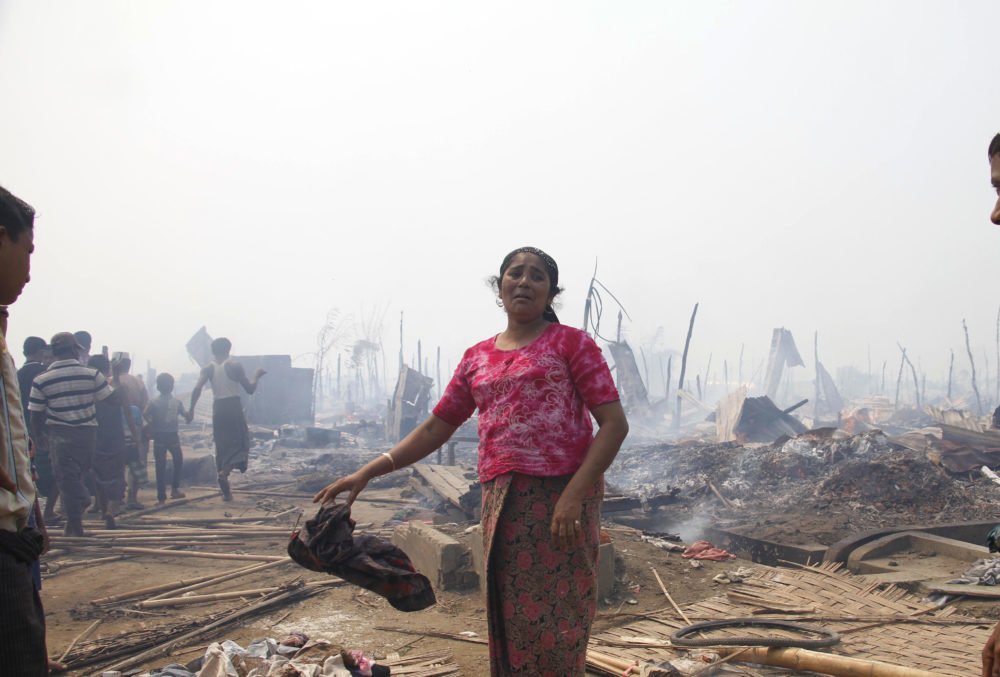
In October 2016, following lethal attacks on police outposts by armed Rohingya in northern Rakhine State, the Myanmar army launched a military crackdown targeting the community as a whole. Amnesty International has documented wide-ranging human rights violations against the Rohingya including unlawful killings, arbitrary arrests, the rape and sexual assault of women and girls and the burning of more than 1,200 buildings, including schools and mosques. At the time, Amnesty International concluded that these actions may amount to crimes against humanity.

The recent violence

The latest wave of refugees into Bangladesh follows Myanmar’s military response to an attack by a Rohingya armed group on security forces posts on 25 August.

The military’s response has been unlawful and completely disproportionate, treating an entire population as an enemy. Reports from the ground have described deaths of civilians, along with entire villages burned to the ground.

Myanmar government has said at least 400 people have been killed so far, describing most of those killed as “terrorists.”

There have also been reports of violence by Rohingya armed groups against civilians including of other ethnic and religious minorities.

Who is responsible?

Myanmar’s military has carried out the bulk of these latest atrocities. It has considerable independence from the civilian government and is not accountable to civilian courts. Commanders of all ranks and soldiers therefore bear responsibility for any crimes they have committed during the current crisis.

The military have a history of human rights violations against the Rohingya and other ethnic and religious minorities in Myanmar.

However, Aung San Suu Kyi, Myanmar’s state counsellor, the country’s de facto leader, is failing to acknowledge the horrific reports of military abuses and to deescalate tensions.

Earlier this month her office accused aid workers in Myanmar of providing support to the Rohingya armed group prompting fears for their safety.

She has also failed to heed calls from the United Nations (UN) and world leaders to intervene to address the situation in Rakhine State.

Humanitarian catastrophe

According to the UN, almost 150,000 Rohingya fled to Bangladesh in the first two weeks of the crisis alone, and more are coming in.

People arriving are injured, hungry and traumatized and in urgent need of humanitarian assistance, including food, shelter and medical care. The Bangladesh authorities require urgent international assistance to help them support people in need.

Inside Myanmar around 27,000 people from other ethnic minorities have also been displaced in Rakhine State, and are being assisted by the Myanmar authorities.

The authorities have stopped vital supplies from the UN and other aid agencies of food, water and medicine to thousands of people – mostly Rohingya – stranded in the mountains of northern Rakhine State.

A large number of Rohingya relied on aid for their survival even before this latest violence. These restrictions have put tens of thousands of people at further risk and shown a callous disregard for human life.

The plight of the Rohingya: an open letter to Malcolm Turnbull

Imran Mohammad is a 23-year-old stateless Rohingya from Myanmar currently imprisoned on Manus Island. Here, together with other Rohingya people trapped on Manus, he writes an open letter to the Australian Government about the plight of the Rohingya.

The whole world is watching as tens of thousands of Rohingya people flee for their lives, escaping horrific violence and persecution. Since August, Myanmar soldiers have been indiscriminately killing Rohingya men, women, children and elderly people living in Arakan State, in the western part of Myanmar.

It is the experience of innocent Rohingya people to be oppressed and persecuted in their own home country. As such a boundless number have fled or become homeless and internally displaced.

Open letter to the Australian Government

To the Prime Minister of Australia, 

5 Sept 2017

We, the Rohingyans being held on Manus Island, are writing this to bring to your attention to the thousands of Rohingyans who have been slaughtered, burnt, decapitated, shot or buried alive in our home state of Arakan in Myanmar. Most of the villages are completely burnt and demolished and hundreds of innocent Rohingyan families are being displaced and are on the move. We don’t believe that they can continue for long as they have no food to eat, no water to drink and nowhere to go and they are receiving no help whatsoever.

They are hiding in the mountains trying to save their lives. Of those lucky enough to escape the Myanmar Army and their torture, rape and murder, many men, women and babies have died in the Naf river while trying to cross the border to Bangladesh. The lives of our relatives are in imminent danger because of ethnic cleansing and genocide.

We have been held here [Manus Island] for more than four years now, while our fathers, mothers, siblings, wives and children are dying at home. We are waking up to pictures and videos of the dead and dying every single day, the numbers of whom are increasing significantly. They are human beings and deserve to live in peace and safety and are in urgent need of our help.

We are imploring you to give us a chance to be resettled as soon as possible in a safe country where we can heal and rebuild our lives. We wish to help in saving our people and give our hands to other people in need. We are strongly determined to contribute and help to create a world which is a better place, for all the citizens of this earth.

The cave that we have been stuck in for over four years is beyond an ordinary person’s comprehension because their minds have never come across of the type of sufferings that we face on a daily basis on Manus Island. Each man’s story will draw a picture that you never thought you would see in your lifetime. We have been pushed into the depths of despair every single day and now we have reached the saturation point after more than four years of incarceration in this appallingly isolated setting.

We are stuck in Australia’s political limbo and it literally means we can’t do anything and can’t go anywhere. Despite seeking help and begging for safety from all the countries who are are part of the UNHCR 1951 Refugee Convention, and from all the humanitarian organisations, all they have said is they can’t do anything unless we are out of Australia’s grasp. We are still in Australia’s control. It is foolish to say that we are Papua New Guinea’s responsibility now as the detention centre is unconstitutional in this country and it has been proven again and again that it is Australia that is pulling the puppet strings. The system is full of corruption, greed and pure evil.

We have done everything with great respect that we have been instructed to do. Now the department of Homeland security from the US are currently on the island and conducting interviews. We don’t know if we will ever be resettled in the US but we are attending the interviews if we are called.

We have had more than enough of the psychological torture over the last four years and it has damaged every single one of us in a variety of ways. We are deteriorating physically even more now.

It has been more than four years now that we have been the victims of a grievous injustice and stuck in this isolation. We have been deprived of our basic human rights for years now. When will it be enough for the Australian government to give us the freedom which every human deserves on this earth?

Please let us taste our freedom, and allow us to live in safety and peace so that we can be the voice of voiceless people.

Signed, the Rohingya refugees on Manus Island

What’s it like to volunteer at the ICM?

Firstly, what is the ICM? Good question! At AIA (Amnesty International Australia) we love our acronyms! ICM stands for the International Council Meeting. This is the largest decision making forum at Amnesty International and was held in August this year in Rome.

I had the privilege of being able to volunteer at this important event. In my usual life, I am a Community Organiser for AIA, working with our action groups and activists in NSW. This year I’ve been on extended leave and happened to be in Europe at the same time, so I put my hand up for the ICM volunteer team to get an insight into how the big decisions are made.

What an incredible experience

Our diverse and fun volunteer team did our best to support the over 400 delegates from 80+ countries in the important discussions they were making about the future of our movement. Our Australian delegates already did a great summary of some of the discussions and decisions made, but what did volunteering look like?

On a practical level it meant registering attendees, making sure delegates and presenters had their needs met, assisting in sessions, counting votes for/against resolutions, ferrying microphones around and handing out headsets so that people could understand the different languages being spoken (there were also dozens of pro bono translators who were working hard to make sure people’s voices were heard and understood).

“Occupation militaire”

In one scenario it also involved me attempting to be a translator as a youth activist from Tunisia discussed our military occupation policy with an activist from Taiwan. My French is not bad — I can order a croissant — but military occupation discussions? I gave it a go… “Occupation militaire”. My French was also tested by my room-mate, Florence, an inspiring activist from Togo, who is passionate about women’s rights and would start speaking French to me in the morning before my brain was awake. But I did learn from her about the incredible human rights education programs that Amnesty runs in her country, which use theatre and community workshops to empower women.

Amnesty democracy in action

So apart from practicing my French and handing out headsets, what did I take from the ICM? My pride in our Amnesty movement was strengthened. It’s incredible to be a part of such a diverse and democratic, member-led movement. I was inspired by the knowledge, passion and commitment of the delegates in the room, especially our fantastic team from Australia (I’m biased). We were moved to do more by guest speakers from around the world at the forefront of human rights violations, including our very own colleagues in Turkey. And I made some great friendships with our volunteer team from Turkey, Austria, Cote D’Ivoire, USA, Sweden, Togo, Venezuela and more.

The big picture

We are involved in such a large and powerful movement for human rights. I would recommend you take the opportunity to get more involved in shaping the future of our movement. This was the last ICM, as the movement voted during this meeting to change our democracy model to an annual Global Assembly. So stay tuned to hear about volunteering opportunities there!

In the meantime, why not make sure that you’re a member of AIA and check out the Branch Committee in your state/territory. These are the elected representatives for your region who help motivate, coordinate and develop human rights activism. They empower and support our local activists and lead consultation on our vision, campaign priorities and policies. You can find more about each of our Branches here and be sure to attend their Annual General Meeting in May each year.

We are all Amnesty International, and together we can ensure that our organisation is relevant and effective in a world where we are needed now more than ever.