Philippines: Human rights must not be ignored during martial law

The Philippine government must ensure that human rights are protected during its campaign against militants in Mindanao, as martial law remains in place, Amnesty International said.

President Rodrigo Duterte on Friday extended martial law in the southern island of Mindanao first imposed on 23 May 2016, for a further six months, to 31 December 2017. Since 23 May, Philippines armed forces have battled against the Maute group, which has pledged allegiance to the armed group calling itself the Islamic State, in Marawi City, the capital of Lanao Del Sur province in northern Mindanao. The extension followed a vote by lawmakers at a special joint session in Congress.

“Amnesty International is seriously concerned about reports that the Philippines President Rodrigo Duterte gave troops an unequivocal license to kill civilians with impunity while fighting ISIS-aligned militants in Marawi earlier this year. Any extension of martial law must be exercised with caution and be proportionate to any alleged threat posed,” Amnesty International Australia Crisis Campaigns Coordinator, Diana Sayed said.

“The Australian Government, in its planned supply of surveillance airplanes to the effort, needs to make sure that it does not become complicit in the killing of civilians in Marawi.

“At a minimum, Australia should be leading calls on President Duterte to protect civilians and make sure that a proportionate response is taken to any alleged threat from extremist groups in Marawi.”

“At a minimum, Australia should be leading calls on President Duterte to protect civilians and make sure that a proportionate response is taken to any alleged threat from extremist groups in Marawi” – Diana Sayed

“Ongoing martial law in Mindanao must not mean that human rights take a back seat at a time when people need crucial protections more than ever. The Philippines armed forces must show the utmost restraint to ensure that civilians are safeguarded during operations in Marawi,” said James Gomez, Amnesty International’s Director of Southeast Asia and the Pacific.

Lawmakers should also take the lead in ensuring that the armed forces and state institutions are held accountable for their actions throughout the imposition of martial law.

While the total death toll from the fighting is still unknown, hundreds of people have been killed, including dozens of civilians trapped in areas of Marawi under Maute control.

“The continued imposition of martial law by an administration which has been involved in large-scale human rights violations is worrying, to say the least. The bloody abuses we have seen, especially against poor and marginalised people, during President Duterte’s ongoing ‘war on drugs’ must not be replicated in Mindanao,” said James Gomez.

“Any reports of human rights violations must be investigated and those responsible, irrespective of rank or status, held to account, regardless of what side they belong to. Impunity cannot become the norm.”

As fighting has continued in Marawi City, more than 200,000 people have been forced to flee their homes since the fighting began in May. While the government has set up displacement camps and funnelled in aid, there is a risk that with prolonged displacement, the humanitarian situation will worsen.

“The Philippines authorities’ efforts to provide aid to those displaced have been commendable, and must continue as people try to return to their homes and rebuild their lives. The government should frequently reassess the situation, so that martial law is repealed as soon as is possible. The government should also lift the suspension of the key right of habeas corpus, which may never be derogated from, even in times of emergency.”
South Sudan: Sexual violence ‘on a massive scale’ leaves thousands in mental distress amid raging conflict

Thousands of South Sudanese women and girls, and some men, who have been raped in ethnically-charged sexual attacks in the ongoing conflict are battling mental distress and stigma with nowhere to turn for help, Amnesty International revealed in a new report.

Do not remain silent”: Survivors of Sexual violence in South Sudan call for justice and reparations, reveals aggravated acts of sexual violence against thousands of people across the country since hostilities began in December 2013. The report is the result of a joint research project between Amnesty International and 10 South Sudanese human rights defenders who cannot be named due to fear of reprisals from the government of South Sudan.

Perpetrators come from both sides of the conflict, pitting the government forces of President Salva Kiir, a Dinka, against opposition forces of Riek Machar, a Nuer, and their respective allied armed groups.

“This is premeditated sexual violence on a massive scale. Women have been gang-raped, sexually assaulted with sticks and mutilated with knives,” said Muthoni Wanyeki, Amnesty International’s Regional Director for East Africa, the Horn and the Great Lakes.

“These indefensible acts have left the victims with debilitating and life-changing consequences, including physical injuries and psychological distress. Many survivors have also been shunned by their husbands and in-laws and stigmatised by the wider community.”

Amnesty International’s researchers interviewed 168 victims of sexual violence including 16 men, in cities, towns and villages across four states in South Sudan – Central Equatoria, Jonglei, Upper Nile and Unity – as well as in three refugee settlements in northern Uganda.

In some cases, the attackers killed the women after they had raped them. In one incident, the assailants mutilated a woman’s vagina with a knife after raping her because she had tried to resist. She died from her injuries four days later.

Civilian men have also been attacked. Some have been raped, others castrated or had their testicles pierced with needles. In one particularly gruesome case, four government soldiers inserted grass in a young man’s anal passage, set it on fire and watched him burn to death.

One survivor, Gatluok, who could not escape with others when government soldiers raided his village in Unity State in May 2015 told Amnesty International:

“Because of my blindness, I couldn’t run with the young men and so I was caught. They told me to choose if I wanted to be raped or be killed. I said I didn’t want to be killed and so they decided to rape me.”

“Some of the attacks appear designed to terrorise, degrade and shame the victims, and in some cases, to stop men from rival political groups from procreating,” said Muthoni Wanyeki.

Unending suffering

One of the women Amnesty International spoke to is now HIV+. Others are suffering from fistula and bowel incontinence. Some men have been rendered impotent.

Many victims said they were experiencing nightmares, loss of memory, lack of concentration, and had thought of revenge or suicide – all common symptoms of Post-Traumatic Stress Disorder.

Jokudu, a 19-year-old woman, was brutally raped by five government soldiers near Yei town in December 2016. She is now unable to control her urine and bleeds frequently.

Nyabake, 24, was gang-raped by government soldiers at a checkpoint in Juba in July 2016. She said she can no longer sleep for more than three hours a night because of nightmares. She said she always feels the soldiers are coming back.

Sukeji was gang-raped by three government soldiers in Kajo Keji in August 2016 in front of her two children. She said, “I do not want to remember but sometimes it just comes in my mind and I cry. Sometimes I wonder whether my children have this in their memory. When they grow up, what will they think of their mother?”

Nyagai, who was gang-raped by government soldiers in Juba in July 2016, lost her religious faith after her assault. She said she stopped going to church after she was raped and does not pray anymore. “Satan went through me the day I was raped,” she said.

Jacob, whose wife Aluel, was raped in front of him by fighters of the Sudan People’s Liberation Movement – In Opposition (SPLM-IO) – in Juba in July 2016, says he has contemplated suicide.

“The South Sudanese government must take deliberate measures to halt this epidemic of sexual violence, starting by sending a clear message of zero tolerance, immediately ordering an independent and effective investigation into the attacks that have taken place and ensuring that those responsible are held to account in fair trials” – Muthoni Wanyeki.

“The South Sudanese government must take deliberate measures to halt this epidemic of sexual violence, starting by sending a clear message of zero tolerance, immediately ordering an independent and effective investigation into the attacks that have taken place and ensuring that those responsible are held to account in fair trials,” said Muthoni Wanyeki.

“It must also deter sexual violence, including through removing suspects from the armed forces until allegations against them are independently verified or dismissed. Victims must be provided with justice, medical care and reparations,”

“Opposition forces must prohibit sexual violence in their ranks as well, put in place robust mechanisms to monitor the conduct of their fighters, and cooperate with all investigations and prosecutions of their members under international law.”

Politically and ethnically targeted

Many of the victims were targeted because of their ethnicity, which is increasingly conflated with political allegiance to either the government or the opposition.

In most cases Amnesty International documented, Dinka men attacked Nuer women and Nuer men attacked Dinka women. But there are also cases, as in Unity State, where pro-government Nuer men have raped Nuer women they consider pro-opposition. In other cases, government forces have targeted women from non-Nuer communities.

“They [government soldiers] were telling me that I should blame God for creating me a Nuer,” said 36-year-old Nyachah, who was raped by seven government soldiers in the capital Juba. Her attackers were dressed in Presidential Guard uniforms and spoke Dinka.

Nyaluit, who was raped by five government soldiers in December 2013 said: “They raped me because I am a Nuer woman… They were talking about what happened in Bor – that Dinka women and girls were raped and killed by Riek Machar’s ethnic group, the Nuer.”

James, a Dinka, was forced to watch as nine Nuer opposition fighters broke into his home and took turns gang-raping his wife, Acham, before killing her. “Don’t you know that Dinka and Nuer are fighting and that many Nuer were killed by Dinka in Juba?” the attackers told him.

* All victims’ names have been changed to protect their privacy and safety

Lesvos flash mob by refugees caught in net of EU-Turkey deal

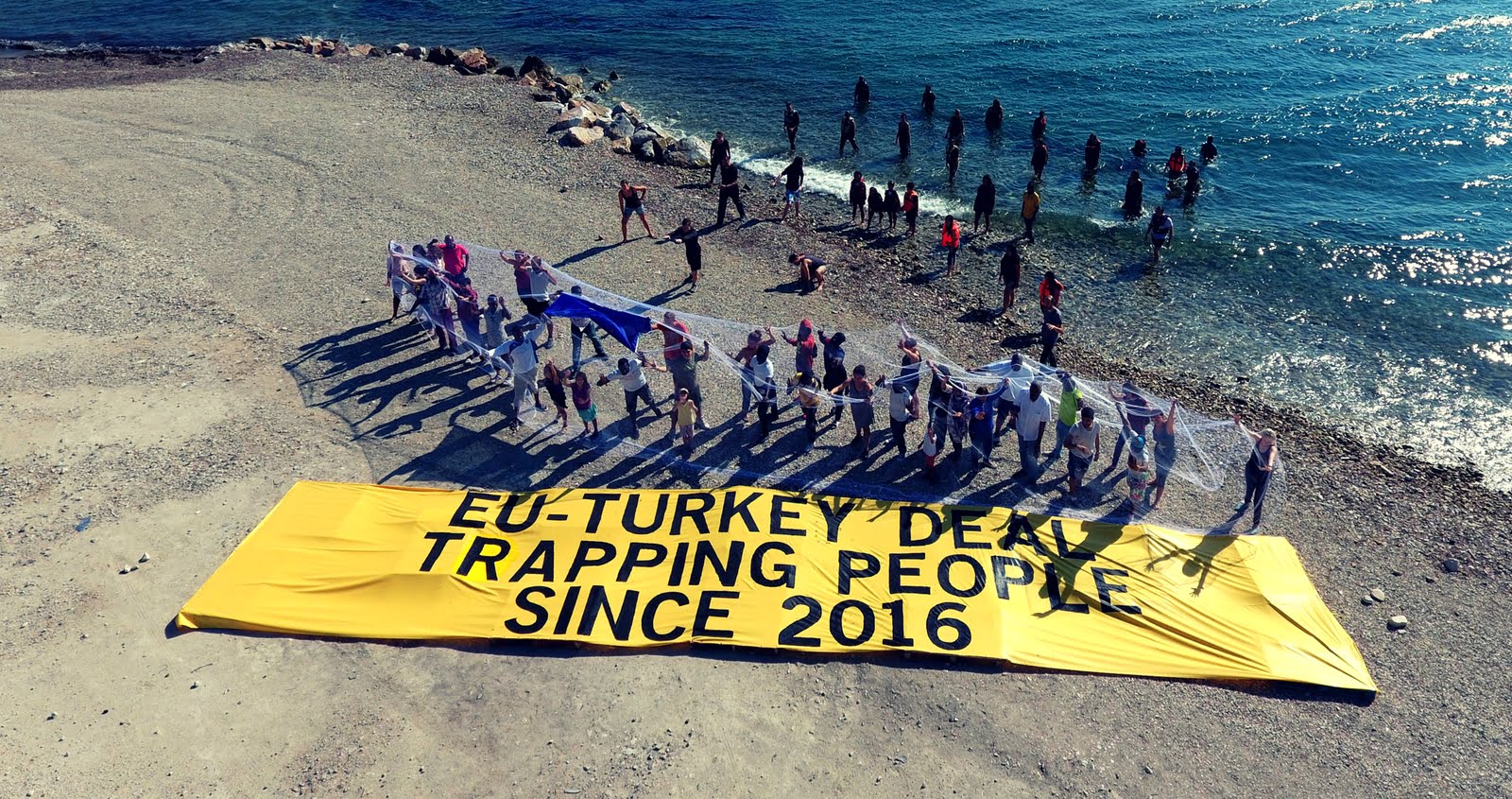
Refugees, Greek islanders and activists yesterday called on European leaders to heed their plight in a flash mob on a beach on the island of Lesvos symbolising the spirit of “refugees welcome”, organized by Amnesty International and Lesvos Solidarity.

The #ActionLesvos flash mob wrapped a giant fishing net with an EU flag on it around 60 refugees and activists to represent the situation of refugees and migrants trapped on the Greek islands by the EU-Turkey deal.

The flash mob comes after a week of protests in the nearby Moria camp and 10 days before the majority of the EU emergency funding for NGOs supporting refugees in Greece runs out.

“This is a protest against the EU-Turkey deal, which has been trapping people on Lesvos since 2016. Refugees are not criminals. We fled our countries because of hate and came to Europe to seek our freedom, but now we are stuck on the island. We have no option and no hope,” said Hamid Hamid, a refugee activist from Ghana, currently living in Greece, who is one of the activists taking part in the camp and came up with the concept.

European leaders must act

The protest called on European leaders to take responsibility for welcoming refugees, by moving them off the Greek islands to the mainland and then relocating them to other European countries.

“This action aims to open the heart of Europeans to the plight of refugees caught in the net of the EU-Turkey deal, which has been trapping refugees and migrants on Greek islands since 2016. Local people also took part in the flash mob because they too feel trapped by the situation and abandoned by the rest of Europe,” said Maria Serrano, Senior Campaigner at Amnesty International.

“The suffering refugees face in Europe is far from over. People need to know that the situation for refugees on Lesvos is dire, desperate and unsafe. With limited access to legal, medical, psychological and other support. Things are likely to get worse, not better, unless European governments change course and welcome refugees.”

Overcrowding, appalling conditions, anxiety

The flash mob was held on Kratigos beach, near Mytilene, the main town in Lesvos. The beach was a major landing point for thousands of refugees departing from Turkey in 2015 and early 2016.

In June 2017, 940 refugees and migrants arrived in Lesvos. More than 400 refugees arrived in the first two weeks of July alone. Under the EU-Turkey deal, authorities now prevent refugees and migrants who arrive on Greek islands from leaving, in order to return them to Turkey. This policy has resulted in increased overcrowding, appalling conditions, and mounting anxiety for refugees.

“Before the EU-Turkey deal, we were at least able to support refugees with the hope that all their difficulties and suffering will be over as they were able to cross the borders and arrive in the place they were heading to. Now people are desperate, and suffering more and more psychological problems as they have to wait on the islands to lodge their asylum claim in a lengthy and complex asylum procedure that leaves them in limbo for months,” said Efi Latsoudi from Lesvos Solidarity.

“After a week marred by mounting tensions in Moria camp, we wanted to send a clear message that responsibility lies at the doorstep of European leaders.”


#PuckHomophobia: Ice Hockey Pride Matches support LGBTIQ+ rights

The Melbourne Mustangs Ice Hockey team will don rainbow jerseys this Saturday, to challenge reigning premiers Newcastle Northstars in the first Australian Pride Ice Hockey Matches for LGBTQI+ rights.

All national Ice Hockey teams will play Pride Matches on the day. The Sydney Bears will be pitted against Melbourne Ice, and Adelaide Adrenaline will play ACT team CBR Brave.

The thrilling, high-contact matches are a partnership with Amnesty International, Proud 2 Play, and Team Melbourne.

“I’m proud to be part of a team that promotes equality for everyone,” said Damien Bright, Melbourne Mustangs Pride Game Ambassador.

“Our club is committed to supporting the LGBTIQ+ community and fighting homophobia. The match will showcase inclusivity in sport, and stand up for love and fairness.”

The games follow the success of AFL Pride rounds, and in the tradition of Ice Hockey Pride rounds in Canada, the world leaders in Ice Hockey.

Game day activities will focus on educating punters, and eradicating LGBTIQ+ discrimination and homophobic language from the game.

Victorian Commissioner for Gender and Sexuality, Ro Allen, will walk out on a red carpet over the ice to do the ceremonial Puck Drop.

They said, “For many people, sport is a key part of health and wellbeing and community involvement. However, sporting environments are not always welcoming or safe for LGBTI people. Events like today’s Pride game are a fantastic way to show the community that LGBTI inclusion in sport is valued and celebrated.”

Amnesty International Australia National Director Claire Mallinson, said, “Sport should be for everyone. This Pride Round makes the hockey rink a place of safety, inclusion and fun, where LGBTIQ+ people’s rights are protected.”

James Lolicato, CEO of Proud 2 Play, said, “The recent ‘Out on the Fields’ report found that 80% of participants believed that LGBTIQ+ people are not at all accepted or accepted a little in sporting culture. We need to do all we can to make sport a safer environment for all, no matter their gender or sexuality.”

Update: Refugee rights, child labour and individuals at risk

Get the latest update on what you have achieved for refugees, our progress toward ending child labour in palm oil production and recent developments for individuals at risk.

Good Friday Violence on Manus Island

The Department of Immigration and Border Protection has been held to account in parliament because activists demanded answers.

A couple of hours after the release of our report on the Good Friday violence on Manus Island, the PNG police admitted our findings to be true.

In the following week at Budget Estimates, Senators questioned the Immigration Department which then contradicted its earlier version of what happened during the shooting on Manus Island, revealing that nine people were injured and that many shots were fired into the refugee compound by PNG defence force personnel.

If you haven’t already, please sign and share our action calling on the Government to bring the people on Nauru and Manus Island to safety in Australia:

Bring Them Here

Ending child labour

Since we launched our first online action targeting big brand companies — like Nestle, Kellogg’s, Colgate-Palmolive and Unilever — over 10 local groups have run stalls all around the country outside their local supermarket and supporters have taken over 25,000 actions.

It’s time to take the pressure up a level by focusing on three of their biggest clients in Australia – Woolworths, Coles and Aldi. If you haven’t already please take and share the latest online action.

Individuals at risk

Chelsea Manning, who was sentenced to 35 years in a US prison after disclosing classified information, walked free in May instead of in 2045.

Amnesty supporters around the world are now taking action to free Taner Kilic, AI Turkey Chair, Idil Eser AI Turkey Director and the #Istanbul10 after they were caught up in the Turkish government’s post-coup crackdown on dissent.

Please take action here

Amnesty activist: my fight for marriage equality

The majority of Australians are in favour of marriage equality (also referred to as same-sex marriage or gay marriage). Amnesty LGBTQI activist Hannah Wahlsten writes passionately about what she is doing to make it a reality.

When I first joined Amnesty International Australia to build groups on University campuses, I had no idea of the path it would take me on. Now, a few years on, I am one of many activists around Australia fighting for marriage equality.

Around the world

On 13 July Malta’s parliament voted for marriage equality, joining over 20 countries around the world in legalising same-sex marriage, including Canada (2005), France (2013), the United Kingdom (2013), Ireland and the United States (2015) and Taiwan and Germany (2017). Taiwan is the first country in Asia – and second in the Asia-Pacific region (behind New Zealand) – to pass marriage equality laws, making the ruling by Taiwan’s top court particularly historic.

Australia’s fight for marriage equality

LGBTQI activist Hannah. © Private

Although there has been a positive shift towards marriage equality around the world, the fight continues in Australia. The debate in Australia has steadily increased over the last 15 years, following a setback in 2004 when the government – led by then-Prime Minister John Howard – introduced an amendment to Australia’s Marriage Act, stipulating marriage to be a union between a man and a woman.

In the years since the changes to the Marriage Act were made, activists around Australia have not stopped fighting for marriage equality. In June 2007 a Galaxy Poll conducted on behalf of GetUp indicated a majority of Australians supported marriage. Since then support for marriage equality has risen, with a recent poll by Essential Report showing that 63% of the Australian public favour marriage equality.

So, where do things stand right now?

Our current government’s solution to marriage equality is an expensive plebiscite – a nationwide vote to gauge public feedback on a political proposal. Supporters of marriage equality have repeatedly stated a plebiscite would be a waste of money and because a plebiscite is not legally binding, the government would not have to write it into law – even if it showed a majority support for marriage equality. The government has repeatedly proposed a plebiscite, despite repeated calls from the Australian public and the LGBTQI community to hold a free vote and pass legislation in Parliament.

“I stand in cold weather, sometimes in the pouring with rain, attending rallies for marriage equality and trying – like many people before me – to make my voice heard”

But the good news is that we’ve had progress. Last week Liberal Senator Dean Smith revealed that he has prepared a private Senator’s bill to make marriage equality a reality for all Australians. This is the closest we’ve ever been to having the love and commitment of LGBTQI couples recognised in the same way as other Australians. Senator Smith will take his bill to the party room in the coming weeks to discuss.

Marriage equality and me

In 2013 my journey into the LGBTQI world began when I came out to my family as bisexual and was accepted by them. On my journey I have gained some amazing friends. I have also gained a new reality, a reality where social issues such as marriage equality are no longer just issues for politicians to debate or newspapers to write about. These issues directly impact my life and the lives of people I care about. When you are denied rights and protections granted to others automatically you can feel like a second-class citizen – like the world sees you as lesser than. This can lead to battles for your own mental health and to find ways to cope.

Becoming an activist and fighting for my community is one of the ways I cope. I spend hours organising events, collecting petition signatures and researching ways to connect with MPs. I stand in cold weather, sometimes in the pouring with rain, attending rallies for marriage equality and trying – like many people before me – to make my voice heard. I do all this so that one day me and my friends aren’t treated as second-class citizens and the only thing affecting whether we get married is our choice to do so or not.

I urge you to keep fighting, signing petitions, talking to your MPs, going to rallies and joining LGBTQI groups. By working together, we can achieve marriage equality in Australia.

Four years on: humane solutions to offshore detention exist but Government chooses abuse

On a day that marks four long years of the Australian Government’s deliberately abusive policies Amnesty International is pleading for an immediate plan to guarantee the safety of the two thousand people trapped on Nauru and Manus Island.

“For four years consecutive Australian governments have chosen to force people seeking safety to suffer in offshore detention,” said Graham Thom, Refugee Coordinator at Amnesty International.

“While the agreement with the USA may offer a lifeline for some, the Australian Government’s ‘solution’ is expecting other countries to clean up the mess it created by these cruel policies, and it won’t be enough to ensure safety for everyone.”

Vigils, organised by a diverse range of community organisations, are being held across the country, in every state and territory, as concerned Australians gather to highlight the ongoing plight of so many people who are now entering their fourth year of indefinite detention in the offshore camps.

Over the last four years the evidence has stacked up on the danger, abuse and suffering the Australian Government’s offshore detention regime is causing.

“For four years consecutive Australian governments have chosen to force people seeking safety suffer in offshore detention.”

Graham Thom, Refugee Coordinator at Amnesty International.

Enough is enough, the truth is out in plain sight, there have been multiple human tragedies, six people have died and report after report has highlighted the abuse, the self harm, the violence that is a daily reality for people trapped in offshore detention,” said Graham Thom.  

“The evidence is clear, the Australian Government has designed a deliberately abusive system, intended to harm people. Such a callous indifference to the safety and well-being of refugees cannot continue any longer.”

Marking the four year anniversary of then Prime Minister Kevin Rudd’s “Regional Resettlement Arrangement” with Papua New Guinea (PNG) Amnesty International is calling on the Australian government to take action immediately.

“What’s important to realise is that it doesn’t have to be this way, the Australian Government can choose to let people rebuild their lives in safety,” said Graham Thom.

“This is a time for common sense and compassion. The camps must be evacuated immediately, all those we have sent to Nauru and Manus must be taken to Australia, it’s the fairest and quickest way to prevent another tragedy.”

“The next step is for Australia to immediately invest humane solutions – that both reduce deaths at sea and eliminate abuse – one shouldn’t come at the expense of the other and it’s about time the Australian Government stops ignoring this.”

More information on the vigils can be found at communityrun.org, australianrefugeeactionnetwork.wordpress.com

Timeline: Four years of abuse

19 July 2013: Then Prime Minister Kevin Rudd announces a new “Regional Resettlement Arrangement” with Papua New Guinea (PNG) so Australia can buy its way out of its ethical responsibilities. From this day forward anyone seeking protection and safety in Australia who arrive by boat will be forcibly transferred to PNG for processing and, if they are found to be refugees, be permanently settled there.
19 July 2013: The announcement causes distress amongst the people warehoused in detention in Nauru with peaceful protests escalating into violence.
3 August 2013: The Australian Government signs a new memorandum of understanding with Nauru similar to its Regional Resettlement Arrangement with Papua New Guinea.
17 February 2014: 23-year-old Reza Berati is murdered, and over 60 others injured, some of them seriously, on Manus Island. Numerous witness reports state Reza Berati was attacked by a group of G4S staff and at least one local staff member employed by The Salvation Army. Several eyewitnesses reported that one attacker picked up a large rock and hit Reza Berati on the head with it several times.
5 September 2014: Hamid Khazaei, who was only 24 years old dies from a sepsis infection three weeks after he cut his foot at the detention centre on Manus Island. Inadequate medical care and delayed medical evacuation were later reported to have let to to Mr Khazaei’s death.
26 September 2014: The Australian and Cambodian governments sign a deal under which people on Nauru who are found to be refugees are to be resettled in Cambodia.  This second deal again allows Australia to buy its way out of its ethical responsibilities.
18 November 2014: Then Immigration Minister Scott Morrison announces that asylum seekers who have registered with the United Nations High Commissioner for Refugees in Indonesia after 1 July 2014 will no longer be able to be resettled under Australia’s humanitarian program.
5 December 2014: A bill passes both Houses providing the Immigration Minister with the power to detain people at sea (including outside Australia’s jurisdiction) and send them to other countries or vessels, even without the permission or knowledge of those countries.  
20 March 2015: The report from independent review into allegations of sexual abuse on Nauru is released detailing reports of women being raped and allegations of children being sexually assaulted.
20 March 2015: A boat carrying 46 Vietnamese asylum seekers is intercepted by Australia. Its passengers are held at sea for nearly a month and undergo “enhanced screening” before being returned to Vietnam on 18 April.
28 May 2015: Thousands of men, women and children seeking protection are abandoned at sea in what is now known as the Andaman Sea ‘boat crisis’. Regional governments eventually agree to allow the boats to land but then Prime Minister Tony Abbott’s callous response to Australia offering safety is “nope, nope, nope”.
4 June 2015: Nine months after the $55 million Cambodia deal, four refugees arrive in Phnom Penh from Nauru. All of these people subsequently choose to return to their countries of origin, despite the fact that all four were found to have well-founded fears of persecution.
1 July 2015: The Australian Border Force Act takes effect making it a crime punishable by two years’ imprisonment for medical professionals, educators and others contracted by the Australian Government to speak about what they see in offshore detention.
5 October 2015: The Nauruan Government announces that the Regional Processing Centre will operate under an open centre arrangement.
29 October 2015: Amnesty International Australia publishes a report revealing evidence that Australian officials paid boat crews to return people seeking asylum to Indonesia.
8 November 2015: Fazel Chegeni, an Iranian refugee detained in Christmas Island Detention Centre, is found dead after escaping the centre.
19 February 2016: Australia again rejects the standing offer from New Zealand to accept 150 people from Nauru or Manus Island, failing to provide sensible, durable solutions for the people trapped there.
21 February 2016: Baby Asha, a one-year old who was transferred along with her family from Nauru to Brisbane Lady Cilento Children’s hospital for medical treatment is released into community detention. This came after the doctors at the hospital refused to discharge Asha after the completion of her treatment, fearing she would be transferred back to Nauru.
23 March 2016: At the Ministerial Bali Process meeting a declaration was released (the Bali Declaration) which for the first time identified the need to provide protection to refugees in the region.
15 April 2016: A refugee in Nauru is convicted of attempted suicide, which was recognised as a crime in Nauru at the time.
26 April 2016: PNG’s Supreme Court rules that the transfer and detention of asylum seekers on Manus Island is illegal.
26 April 2016: Omid Masoumali, a refugee living in Nauru for three years sets himself on fire. After more than 24 hours he is medically evacuated to Australia where he dies in a hospital in Brisbane on Friday 29 April 2016.
2 May 2016: A young Somali refugee living in Nauru sets herself on fire. She is later flown to Australia by air ambulance suffering burns to 70% of her body.
5 May 2016: A boat with 12 Sri Lankan people seeking asylum who were intercepted by Australian authorities earlier in the week are screened at sea before being returned to Sri Lanka. They were reportedly arrested on arrival at Colombo airport.
10 May 2016: The Federal Court rules the Government must provide a woman, raped on Nauru, access to a safe and legal termination.
July 2016: Amnesty International’s Senior Director for research visits Nauru where she finds a system of deliberate abuse hidden behind wall of secrecy.
10 August 2016: The Guardian releases the Nauru files – thousands of leaked incident reports from Nauru detail assaults, sexual abuse and child abuse.
19 September: UN Global Summit for Refugees and Migrants in New York misses opportunity to find solutions to the global refugee crisis.
17 October 2016: In a new report Island of Despair’: Australia’s “processing” of refugees on Nauru Amnesty International find that the conditions to which refugees and people seeking asylum on Nauru are subjected amounts to torture.
30 October 2016: Immigration Minister Peter Dutton tries to introduce legislation to ensure anyone taken to Nauru and Manus and then resettled anywhere in the world, would never be able to come to Australia.
13 November 2016: The Government takes an extreme step in shirking responsibility by announcing an agreement with the United States for some of the refugees in offshore detention to be settled in the US via a process administered by the UNHCR.
25 November 2016: Malaysia begins work on a pilot scheme to allow refugees from Myanmar’s persecuted Rohingya minority to work in the country, which in turn reduces number of people forced to take dangerous journeys in search for a safe place to rebuild their lives.
24 December 2016: Faysal Ishak Ahmed collapses at the Manus detention centre. He dies on Christmas Eve.
31 December 2016: The Indonesian President issues a Presidential Decree for refugees which for the first time provides people seeking asylum and refugees in Indonesia with a more formal legal status.
14 April 2017: PNG Soldiers fire directly into the Manus Island detention centre putting lives at risk. 9 people are injured. No one is held accountable.  

Lebanon: Thousands at risk as Arsal security operation looms

Responding to a statement by Lebanon’s Prime Minister Saad al-Hariri announcing an imminent security operation in the outskirts of the town of Arsal, in northeast Lebanon, Lynn Maalouf, Middle-East Director of Research for Amnesty International said:

“It is of utmost importance for the Lebanese army and other sides involved in the fighting in Arsal to prioritise the protection of Lebanese residents as well as Syrian refugees in the area. They must refrain from using lethal force except when it is unavoidable for self-defence or defence of others against threats of death and serious injury. Thousands of lives are on the line.

“Syrian refugees in Arsal are living in extremely harsh conditions in packed tented settlements. The Lebanese army must ensure that the operation is carried out in a manner that protects the right to life and other human rights. Use of explosive weapons in these circumstances would be contrary to Lebanon’s obligations under international law and likely to lead to arbitrary deaths.

“The Lebanese army must facilitate the safe evacuation of residents from Arsal and allow unimpeded access for aid organisations and emergency medical services into the town. It must ensure that anyone detained in the operation is treated in accordance with international human rights law and standards.”

Background

In August 2014, fierce clashes erupted in Arsal between the Lebanese army and armed groups including the group calling itself Islamic State (IS) and Jabhat Al Nusra  after 36 Lebanese security personnel were abducted. As a result of the clashes 489 people were reportedly wounded and at least 59 people including 15 Arsal local residents and 44 Syrians were killed.

Lebanese border areas come under regular fire from Syria, where the armed group calling itself Islamic State (IS) continues to hold Lebanese soldiers and security officials that its forces abducted from Lebanon in 2014.

Turkey: Charging of activists, including Amnesty director, a crushing blow for rights

The charging of 10 human rights defenders on absurd terrorism-related grounds is an appalling affront to justice and a new low in Turkey’s post-coup crackdown, said Amnesty International after a judge remanded six of the Istanbul 10 in pre-trial prison custody today.

Amnesty International Turkey’s Director, Idil Eser who was among those remanded in custody, was detained alongside nine other human rights defenders on 5 July whilst attending a routine workshop. Four of them were released on bail in the past couple of hours but are still under investigation. All 10 are suspected of “committing crime in the name of a terrorist organisation without being a member”. The six who were remanded in custody join Amnesty International Turkey’s Chair, Taner Kiliç, behind bars.

“Turkish prosecutors have had 12 days to establish the obvious: that these 10 activists are innocent. The decision to charge them anyway shows that truth and justice have become total strangers in Turkey.  This is not a legitimate prosecution, this is a politically motivated persecution that charts a frightening future for rights in Turkey,” said Amnesty International’s Secretary General, Salil Shetty.

The bizarre accusations include attempts to link Idil Eser with three unrelated and opposing terrorist organisations through her work for Amnesty International. The prosecutor’s request that she be remanded in pre-trial prison custody references two campaigns by Amnesty International, neither of which were authored by Amnesty Turkey, one of which was conducted before she joined the organisation.

An accusation levelled against İlknur Üstün of the Women’s Coalition, who was released on bail, is that she requested funding from “an embassy” to support a project on “gender equality, participation in policy making and reporting.”

“Today we have learnt that standing up for human rights has become a crime in Turkey. This is a moment of truth, for Turkey and for the international community,” said Salil Shetty.

“Leaders around the world must stop biting their tongues and acting as if they can continue business as usual. They must bring pressure to bear on Turkish authorities to drop the investigation and to immediately and unconditionally release the rights defenders.”

Background

The ten human rights defenders detained are İdil Eser (Amnesty International), İlknur Üstün  (Women’s Coalition), Günal Kurşun (Human Rights Agenda Association), Nalan Erkem (Citizens Assembly), Nejat Taştan (Equal Rights Watch Association), Özlem Dalkıran (Citizens’ Assembly), Şeyhmuz Özbekli (lawyer), Veli Acu (Human Rights Agenda Association) Ali Gharavi (IT strategy consultant), Peter Steudtner (non-violence and wellbeing trainer).

Taner Kiliç was detained on 6 June. He was charged three days later with “membership of the Fethullah Gülen Terrorist Organisation” and remanded in pre-trial detention. Taner Kiliç has served on the board of Amnesty International Turkey for various periods since 2002 and has been Chair since 2014. During his decades of work for human rights organisations in Turkey he has consistently demonstrated an unswerving commitment to human rights.

Australia must exercise caution in expanding arms sales to Middle East

Responding to reports that Defence Industry Minister Christopher Pyne has said that he wants Australia to become a major arms exporter and use those exports to cement relationships with countries in volatile regions such as the Middle East, Amnesty International Australia’s Crisis Campaigns Coordinator Diana Sayed said,

“We are seriously concerned about indications that the Australian Government intends to become a major arms exporter to countries with such appalling human rights records.

“Australia held itself up as a leader in the successful negotiation of the Arms Trade Treaty. As a global arms control leader, it is deeply concerning that Australia would express an intention to expand arms exports to countries such as the United Arab Emirates, while they are part of a Saudi-led Coalition committing shocking abuses in Yemen.”

Australia is obliged under the Arms Trade Treaty not to authorise weapons transfers to countries where there is an overriding risk these weapons could be used to commit or facilitate serious violations of international human rights or humanitarian law.

“We urge the Australian Government to publicly report the exact nature of all arms transfers to the Kingdom of Saudi Arabia to date and to its allies in the war in Yemen, and cease the authorisation of any future arms transfers while there remains a substantial risk these arms will be used to fuel human rights abuses,” Diana Sayed said.

Background

While leading the military coalition fighting in Yemen, Saudi Arabia has committed gross and systematic violations of international humanitarian law including indiscriminate and disproportionate airstrikes that have killed and injured many civilians. It has repeatedly used internationally banned cluster munitions, including in civilian populated areas. The United Arab Emirates, which Mr Pyne mentions specifically as an arms export target, is a partner in the Saudi-led coalition.