NSW sexual abuse: allegations of detention child abuse pile up, Prime Minister must act

Two former juvenile justice officers have been charged over horrific historical child sex offences allegedly committed on children as young as 10 at Reiby Juvenile Justice Centre between 1996-2004. In response Roxanne Moore, Amnesty International’s Indigenous Rights Campaigner said:

“It is beyond belief that for the third time in just one week we are hearing distressing allegations of children being abused in youth detention, this time sexual abuse.”

Roxanne Moore, Amnesty International’s Indigenous Rights Campaigner

“It is beyond belief that for the third time in just one week we are hearing distressing allegations of children being abused in youth detention, this time sexual abuse.”

“Don Dale, Cleveland, Barwon, Bimberi and now Reiby – for the second day in a row Amnesty International is asking – how many more children have to suffer before the Government acts to overhaul Australia’s “injustice” system?”

“Prime Minister Malcolm Turnbull must immediately act, in partnership with Indigenous communities and organisations, to develop a national action plan on youth justice to focus on prevention by supporting children, their families and communities.”

Amnesty International has sought an assurance from the NSW Government that children in its care are treated in compliance with international legal obligations at all times. This includes ensuring that any child whose rights have been violated have access to an appropriate remedies.

Not just Don Dale: new Canberra child abuse allegations

The Prime Minister must urgently end the abuse of children in youth detention across Australia by focussing on prevention and rehabilitation, Amnesty International said as more serious allegations of mistreatment have emerged, this time in Canberra.

Former staff, government officials and detainees of Bimberi Youth Detention Centre have unveiled concerns in The Canberra Times about verbal racial abuse towards Aboriginal and Torres Strait Islander and other culturally diverse children, as well as incidents involving alleged physical abuse.

“There is a mountain of evidence right around Australia of children being abused and having their human rights violated in youth detention, which must be stopped.”

Roxanne Moore, Indigenous Rights Campaigner.

“There is a mountain of evidence right around Australia of children being abused and having their human rights violated in youth detention, which must be stopped,” said Roxanne Moore, Indigenous Rights Campaigner.

“This culture of abuse and secrecy is much bigger than the Northern Territory. The revelations of potential misuse of force, restraints and racial abuse of children in Canberra follow closely behind findings from a Queensland Independent Review just last week of children being hogtied, and deprived of food and medicine as punishment.”

Many of these children experiencing abuse behind bars are Indigenous children, who are 25 times more likely to be locked up.

“Don Dale, Cleveland, Barwon, Bimberi – how many more children have to suffer before Prime Minister Malcolm Turnbull takes action to overhaul Australia’s ‘injustice’ system?”

“Don Dale, Cleveland, Barwon, Bimberi – how many more children have to suffer before Prime Minister Malcolm Turnbull takes action to overhaul Australia’s ‘injustice’ system?” said Roxanne Moore.

The ACT Government has responded that the allegations are being investigated, and the ACT Human Rights Commission is currently undertaking several investigations into use of force and strip-searching practices, due to report later in 2017.

The revelations in Canberra come as the hearings of the Northern Territory Royal Commission into Youth Detention wrap up and just after the release of further disturbing findings from the Independent Review into Youth Detention in Queensland. There is also a Parliamentary Inquiry underway in Victoria and reports expected from oversight bodies in Western Australia, New South Wales and the Australian Capital Territory.

Communities have the answers

Dylan Voller, who was hooded and strapped to a chair in solitary confinement in Don Dale in the Northern Territory, last night appeared on ABC’s Q&A calling for Indigenous-led rehabilitation programs rather than detention. Dylan has been attending Bushmob, an Aboriginal organisation focussed on rehabilitating young people through work with animals and connection to culture.

“Why can’t we have more detainees from the juvenile centre to go there [to Bushmob] where they can work with horses and learn to build instead of sitting in a cell with no rehabilitation?” said Dylan Voller.

“Reports and inquiries dating back to the Royal Commission into Aboriginal Deaths in Custody in 1991 have highlighted that Government needs to listen to and fund Indigenous-led prevention and diversion programs,” said Roxanne Moore.

“Enough is enough, the need for change is clear, it’s time for Prime Minister Turnbull to overhaul the current system in favour of a national approach supporting and strengthening children, families and communities.”

One year later, Duterte remains a human rights nightmare

“I don’t care about human rights, you better believe me.”

We cannot say that we were not warned. During his campaign for the Philippine presidency, Rodrigo Duterte made his contempt for human rights and the rule of law glaringly apparent. He vowed to kill as many as 100,000 people – filling Manila Bay with so many bodies that the fish will “grow fat.”

Over the past year, since Duterte became President, thousands of people have been killed in the so-called war on drugs. Every morning, people in some of the country’s poorest neighbourhoods awake to find fresh bodies dumped in the streets, marked by bullet wounds. In some instances, signs are left on the bodies, denouncing the dead as “pushers.”

In his campaign against drugs, Duterte has incited people to take the law into their own hands and kill anyone suspected of being a user or a seller.

“If you know of any addicts,” he told a crowd of his supporters last year, “go ahead and kill them yourself.” Prone to profanity, Duterte makes no attempt to varnish his words or conceal his intent. “My order is shoot to kill you,” he warned alleged drug offenders. “I don’t care about human rights, you better believe me.”

The police, who are supposed to uphold the rule of law, have come to resemble a criminal enterprise. They avoid making arrests in favour of shooting suspects dead in cold blood. They manipulate police reports to make it seem the victim was resisting. Even in death, the victims are denied dignity. Evidence is planted in their homes and their possessions are stolen.

Bodies are casually dragged outside and dumped in the street. They have been abandoned in front of shops, by open sewers, or stacked, in the haunting words of Pulitzer-prize winning photographer Daniel Berehulak, “like firewood” in morgues. In many neighbourhoods, the police have entered a racket with busy funeral homes, which give them a cut for each corpse sent their way.

People who have bravely spoken out against the chilling disregard for human life have been demonized. Senator Leila de Lima, his most vocal critic, still languishes in detention.

He has threatened human rights activists with murder. “I will take all your heads off,” Duterte said in one of his menacing rants.

Few leaders have so brazenly taken pride in their assaults on human dignity. And yet, there have been no consequences for such behavior. Not only have there been no credible investigations into the mass killings in the Philippines, or accountability worthy of the name, but Duterte continues to strut on the world stage, his reputation somehow intact.

This year, the Association of South East Asian Nations (ASEAN) marks its 50th anniversary, with the Philippines at the helm of the regional organization. The other nine leaders, many of whom have questionable human rights track records of their own, have maintained a studious silence around the mass killings.

In May, according to a leaked transcript, Donald Trump even lavished praised on Duterte for how he has dealt with the Philippines’ drug problem. “I just wanted to congratulate you because I am hearing of the unbelievable job,” Trump said. This is in despite the U.S. State Department’s own annual human rights report’s description of the killings as “the chief human rights concern in the country” and it raising an alarm about “cases of apparent governmental disregard for human rights and due process.”

The clear danger is of the international community acquiescing to a ‘new normal’ where outrages against human dignity are indulged in the cynical pursuit of other aims. For Trump, any support that Duterte could offer him on defusing the North Korea crisis was enough to win his silence on human rights abuses. The cooperation has deepened since martial law was declared in southern Mindanao province, as the Philippine security forces battle the armed group known as Islamic State.

The government was so singularly focused on the violent campaign against drugs that it was taken by surprise when armed groups began seizing territory in Mindanao. When the authorities act outside the law, the consequences are felt widely. The result is an even more dangerous country – where the authorities violate the rule of law instead of upholding it, where armed groups become emboldened, and where the most vulnerable people suffer.

James Gomez is Amnesty International’s Director for Southeast Asia and the Pacific. This article originally appeared here.

7 shockingly sexist laws that still exist today

In May 2017, a bill aimed at decriminalising abortion in NSW was voted down by the Legislative Council. A similar bill failed to pass in Queensland last year. This means that right now — in a country that prides itself on championing gender equality — a woman can still be prosecuted for exercising her reproductive rights in two out of eight Australian states and territories.

Thanks to a set of ‘morality clauses’ from 19th-century English law, Australian women are left in a vulnerable state when it comes to legal rights and safe abortion access. Our politicians’ endorsement of such archaic laws may seem ludicrous, but a recent report published by nonprofit Equality Now shows anti-women laws are far from uncommon.

From legislations that forbid women from working at night, to loopholes that let sexual offenders go free by marrying their victims, here are seven shockingly sexist laws that still exist today.

1. In 37 states of the US, doctors are forced to hand out false information about abortion

Under a law known as ‘informed consent’, US clinics that provide abortion services in at least 37 states are required to give their patients state-authored brochures before the procedure. A recent study by Rutgers University found nearly one-third of the material in the brochures is medically inaccurate or misleading. Some of the false information includes linking abortion to increased risks of breast cancer, suicide and infertility, as well as specious claims that “foetuses feel pain during abortions”.

2. In Georgia, it’s legal to take pictures up a woman’s skirt

In 2016, a Georgia Court of Appeal ruled that using a mobile phone to take photos or videos without a woman’s consent is, in fact, legal. Judge Elizabeth Branch concluded that while the behaviour was lewd, the state’s voyeurism law only forbids non-consensual recordings if they “occur in any private place and out of public view.” In other words, since the grocery store is a “public space”, the victim’s body was deemed fair game.

3. In Northern Nigeria, a man is allowed to hit his wife for the purpose of “correcting” her

Intimate partner violence is permitted in Northern Nigeria, so long as a husband can prove that the beating is “for the purpose of correcting his wife” and does not result in “grievous bodily harm”. Alarmingly, the same clause defines “bodily harm” as injuries that leads to over 21 days of hospitalisation. Across the world, the Russian government has recently voted on a bill to decriminalise domestic abuse. The new law states first-time offenders will no longer face criminal charges, and repeated offenders will receive leniency so long as the abuse “happens no more than once a year”.

4. In Lebanon, rapists get to walk free if they marry their victims

Activists have called on the Lebanese government to repeal a law that allows rapists to walk free by marrying their victims. Under Article 522 of the Lebanese Penal Code, perpetrators can exploit a legal loophole that states once women are married, they are expected to “surrender their rights to bodily autonomy”. In April, Lebanese artist Mireille Honein hung wedding dresses on Beirut’s seafront to protest the anti-women legislation.

5. In Saudi Arabia, women still can’t  get a passport without a man’s approval

Saudi Arabia may have been elected to the UN women’s council and recently overturned a ban on women driving but it’s still unquestionably one of the worst nations for gender equality. To date, women in Saudi Arabia are still forbidden from obtaining a passport, marrying, and accessing certain government services without permission from a male guardian.

6. In Iran, a woman can be jailed for ignoring the country’s strict dress code

In 2016, an Iranian woman was arrested for posting a photo of herself without a hijab on Instagram. The arrest sparked renewed attention on Iran’s strict dress code, which requires women to wear a hijab in public, or risk facing fines and up to a two-month jail term. In recent years, a website called My Stealthy Freedom encourages Iranian women to post photos of their uncovered heads in protest of the law. The movement has since gained over 1 million Facebook followers and continues to be featured on international news outlets.

7. In Madagascar, women are not allowed to work at night

Women are banned from working at night in Madagascar, regardless of whether the work is “public, private, secular or religious”. According to a new report by the World Bank, they are also forbidden from handling and selling “printed literature, posters, drawings, engravings, paintings, emblems and images” — such trades are considered “contrary to morality”. Meanwhile, in Russia, women are prohibited from 456 types of work, and in Guinea, a married woman may only work if she is granted permission from her husband.

Media Awards expression of interest

Are you an Aboriginal or Torres Strait Islander sculpture artist with a passion for human rights? Do you believe in a free press and the ability of the Australian media to speak truth to power?

Amnesty International Australia is looking for an Indigenous artist to design and produce six trophies, which will be presented to the winners of the 2017 Media Awards at the awards ceremony on Wednesday 1 November.

ABOUT THE MEDIA AWARDS

Since 2014 the Amnesty International Australia Media Awards have been recognising excellence in reporting of human rights issues in the Australian media.

The 2016 trophies

The awards celebrate journalists who have gone the extra mile to reveal hidden abuses and encourage greater understanding of human rights in Australia and around the world.

Awards are presented in the following categories: Print/Online/Multimedia, Cartoon, Indigenous Issues Reporting, Photography, Radio and Television. You can see last year’s winners here.

The Awards night brings together a packed room of leading Australian journalists, media industry representatives and human rights advocates.

This year the awards ceremony will be held on 1 November 2017. The final trophies will be showcased on Amnesty’s social media channels, and possibly through media.

HOW TO SUBMIT:

Submit an expression of interest, detailing your design to media.awards@amnesty.org.au by Midnight 13 August 2017.

The expression of interest should be no more than two A4 pages and clearly convey your approach to the project and an illustration of the finished product .

TROPHY SPECIFICATIONS:

For the final product we need six trophies / sculptures produced, one identical trophy for each winner in the six categories. The six finished trophies should be as identical as possible.

  • The trophy should suggest the theme of freedom of expression / free press / speaking truth to power.
  • It should convey the serious nature of human rights whilst inspiring a feeling of hope.
  • Please detail what materials would be used in the production of the trophies.
  • Please include all relevant contact details.

Trophies must incorporate space for the winners’ names, the name of the media outlet, and the words ‘Amnesty International Australia Media Awards 2017.’

FEE:

The selected artist will be paid for their work. For more information please email media.awards@amnesty.org.au

TIMEFRAME:

  • Artist expressions of interest due: midnight AEST Sunday 13 August 2017
  • Artist selected: Friday 18 August 2017
  • Final product delivery: The selected artist would need to produce the six sculptures and have them delivered to Amnesty International in Sydney by 18 October 2017.

TERMS AND CONDITIONS

Acceptance of expressions of interest for the Amnesty International Australia Trophy Design is subject to the acceptance of these terms and conditions.

  • All expressions of interest must be received before 11.59pm AEST on Wed 13 August 2017. Expressions of interest received after this closing date will not be accepted.
  • Amnesty International Australia reserves the right to change the closing date. No responsibility is taken for expressions of interest that are lost, delayed, misdirected or incomplete or cannot be delivered or entered for any technical other reason.
  • The successful artist will be selected by representatives of Amnesty International Australia. Amnesty International Australia is not obliged to select any entry.
  • The selected design will be chosen based on how clearly it meets the specifications outlined above.
  • Amnesty International Australia reserves the right at any time and from time to time to modify or discontinue, temporarily or permanently, this expressions of interest process with or without prior notice.
  • Amnesty International Australia reserves the right at any time to change these terms and conditions.
  • Amnesty International Australia reserves the right to verify the validity of all expressions of interest and reserves the right to disqualify any entrant.
  • All personal data will be collected and stored in accordance with Amnesty International Australia’s Privacy Policy.

Amnesty International Australia Pty Ltd ACN 002 806 223 Level 1, 79 Myrtle Street Chippendale NSW 2008 Phone: 1300 300 920

USA: Refugee Ban Could Have Devastating Effect

The Trump administration may not recognise refugee resettlement agencies as having “bona fide relationship” for purposes of its refugee ban implementation.

The decision by the administration means tens of thousands of refugees from countries all over the world who were in the process of being resettled in the United States may not be able to come this fiscal year. Amnesty International USA’s senior director of campaigns Naureen Shah said:

“This policy is effectively a ban on many refugees and will have devastating effects for people in the process of being resettled. It will jeopardise the lives of the world’s most vulnerable people including people and families fleeing war, violence and torture.”

Amnesty International USA’s senior director of campaigns Naureen Shah

“This policy is effectively a ban on many refugees and will have devastating effects for people in the process of being resettled. It will jeopardise the lives of the world’s most vulnerable people including people and families fleeing war, violence and torture.

“Refugees are not a threat. They’re fleeing horrific violence, trying to rebuild their lives. They want the same safety and opportunities that any of us would want if we were in their shoes. They should not be disingenuously scapegoated under the guise of national security.

“It is also unconscionable and hypocritical for President Trump to double down on banning refugees while his administration threatens President Assad over chemical attacks. Clearly, in the administration’s view of Syria, the man responsible for war crimes is a completely separate issue from the people he’s inflicting them upon.”

Philippines: Duterte’s bloody and lawless year in power

Since assuming the presidency of the Philippines a year ago, Rodrigo Duterte and his administration have presided over a wide range of human rights violations, intimidated and imprisoned critics, and created a climate of lawlessness, Amnesty International said today.

Using the highest office in the country, Duterte has explicitly approved violence that has led to thousands of extrajudicial executions, in the government’s anti-drug campaign. This surpasses even the number of people killed during the murderous rule of Ferdinand Marcos from 1972-1981.

“Duterte came to power vowing to rid the Philippines of crime. Instead, people have been killed in the thousands by – or at the behest of – a police force that acts outside the law, on the orders of a President who has shown nothing but contempt for human rights and the people who stand up for them,” said James Gomez, Amnesty International’s Director for Southeast Asia and the Pacific.

“Duterte’s violent campaign has not ended crime or solved the problems associated with drugs. What it has done is turn the country into an even more dangerous place, further undermined the rule of law, and earned him notoriety as a leader responsible for the death of thousands of his own citizens.”

In February, Amnesty International published a damning investigation, “If You Are Poor, You Are Killed”, that documented how the police have come to resemble a criminal enterprise, killing mostly poor people suspected to be drug users and sellers, or paying others to kill them, while stealing the victims’ possessions, planting evidence and evading any accountability.

Amnesty International has noted with alarm how there has been no credible investigation into the widespread extrajudicial executions, which may amount to crimes against humanity. In response to Amnesty International’s report, the Philippines’ Justice Secretary chillingly said the people killed were “not humanity”.

The human rights organisation has noted with alarm how there has been no credible investigation into the widespread extrajudicial executions, which may amount to crimes against humanity. In response to Amnesty International’s report, the Philippines’ Justice Secretary chillingly said the people killed were “not humanity”.

In May, when the Philippines’ human rights record was put to scrutiny in the UN Human Rights Council’s Universal Periodic Review, more than 40 states raised concerns about the wave of extrajudicial executions and the government’s plans to revive the death penalty for drug-related offences – a violation of the Philippines’ obligations under international law.

Amnesty International is calling on the government to invite the UN Special Rapporteur on extrajudicial, summary and arbitrary executions to visit the country officially and for the Human Rights Council to initiate an UN-led investigation into the ‘war on drugs’.

A war on the poor

Duterte’s so-called war on drugs has overwhelmingly targeted people from the poorest neighbourhoods. In the slums of Filipino cities, bloodied bodies are casually discarded on the street, sometimes with a sign demonising them as “pushers”, suggesting that their actions made their fate inevitable.

The police have taken under-the-table payments to carry out the killings, working from lists of names drawn up by local officials. The police have also enlisted paid killers to do their dirty work for them.

Rather than hold police accountable, Duterte has promised to protect them, saying recently that he will not allow any soldier or police to go to prison, for “destroying the drug industry.” In a high-profile case of Mayor Rolando Espinosa Sr. of Albuera town, and his cell-mate, being shot dead while in police custody, charges against the police were downgraded from murder to homicide – no longer reflecting the gravity of the crime.

“The Duterte government has resisted accountability at every stage. There has been no credible investigation by the authorities and there has been no cooperation with the UN Special Rapporteur. The Prosecutor of the International Criminal Court may order a preliminary investigation into the mass killings. Given the rampant impunity, this may be the best option,” said James Gomez.

The death penalty

The Duterte government’s contempt for international human rights law is glaringly apparent in its attempt to re-introduce the death penalty for drug-related offences. The move would be unlawful as the Philippines is a state party to the Second Optional Protocol to the International Covenant on Civil and Political Rights. Executing people for drug-related offences is also a violation of international law.

“In a year when the Philippines chairs ASEAN, and should encourage other Member States to get rid of this cruel and irreversible punishment, Duterte is leading the region in the wrong direction, with grave consequences for people’s lives. The Philippines’ Senate must reject this attempt to set the country back and drop the death penalty bill once and for all,” said James Gomez.

Threats to human rights defenders

In the past year, President Duterte has also threatened to ‘kill’ human rights activists, and in a statement made at the Presidential Palace in May 2017, he threatened to ‘behead’ human rights advocates who criticised the country’s record. His biggest critic, Senator Leila de Lima, has been locked away in police detention.

“There is a danger of lawlessness spreading in the country. When human rights and the rule of law are cast aside, police become rogue and emboldened and ordinary people suffer. Security forces have a duty to abide by international law and standards. When they don’t, there is nothing differentiating them from the people they are supposed to be confronting,” said James Gomez.

Martial law

The government’s deadly anti-drug campaign, has also distracted it from other challenges in the country. On 23 May 2017, Duterte declared martial law on the southern island of Mindanao for a period of 60 days as the security forces were caught by surprise by armed groups that overran Marawi City. Under international law, emergency measures must be limited in scope, and duration, and cannot be another excuse to ignore human rights.

Philippines: Australia must not become complicit in killing of Marawi civilians

“Amnesty International Australia is seriously concerned about reports that the Philippines President Rodrigo Duterte has given troops an unequivocal license to kill civilians with impunity while fighting ISIS-aligned militants in Marawi,” Amnesty International Australia Crisis Campaigns Coordinator, Diana Sayed said today.

“The Australian Government, in its planned supply of surveillance airplanes to the effort, needs to make sure that it does not become complicit in the killing of civilians in Marawi.

“At a minimum, Australia should be leading calls on President Duterte to protect civilians and make sure that a proportionate response is taken to any alleged threat from extremist groups in Marawi.”

This week also marks the one-year anniversary of when President Duterte took office in the Philippines during which there has been an alarming human rights crisis sparked by his ‘War on Drugs’ that has reportedly killed thousands of suspected drug dealers, as well as an attempt to reintroduce the death penalty. 

Australia must never let this happen again

Australia urgently needs a national approach to stop abuse of children in youth detention, in light of new, horrific details about hog-tying and sedating children.

The latest revelations from Cleveland Youth Detention Centre in Townsville add to the litany of abuses of children in detention around Australia, including the Northern Territory’s Don Dale and Victoria’s Barwon prison.

The revelations were exposed in previously redacted sections of the Independent Review of Youth Detention report, released yesterday by the Queensland Government.

“These findings paint a grim picture of the abuse that children suffer – particularly Indigenous children – in Queensland’s youth detention,” said Roxanne Moore, Indigenous Rights Campaigner at Amnesty International Australia.

Many of the incidents related to Aboriginal and Torres Strait Islander children, who are 27 times more likely to be detained than non-Indigenous children in Queensland.  

Hog-tying violated international law

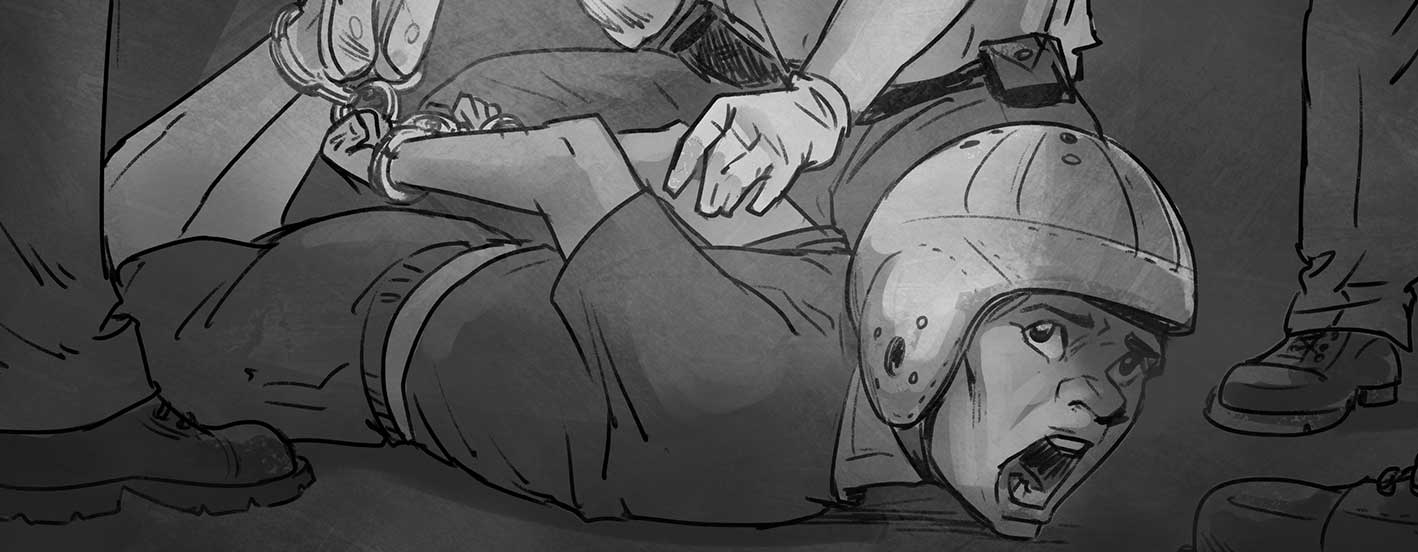
The report cites several instances in 2013 when Cleveland staff ‘hogtied’ children at risk of self harm, in order to sedate them.

In the hog-tie position, staff cuffed children’s hands and ankles while they lay on the floor. Their hands and feet were then linked together behind their back. Sometimes children were also put in a helmet.

“It’s sickening that successive Queensland Governments allowed detention staff to hog-tie then sedate vulnerable kids. It’s cruel, inhuman and degrading treatment, in violation of international law,” said Roxanne Moore.

“Three oversight bodies were made aware of this practice over several years, and all allowed it to continue. Queensland must make sure abuses never happen again, by immediately putting in place a completely independent Inspector of Custodial Services.”

“These violations add to the mountain of evidence of abuse of children in detention around Australia. It’s clear we need a Federal overhaul to protect all children in the justice system, and Prime Minister Turnbull must commit to a National Action Plan on Youth Justice,” said Roxanne Moore.

Other concerning findings include:

  • Excessive use of force, unnecessary use of solitary confinement, and broken complaint and investigative procedures, including missing CCTV footage.
  • Inappropriate use of restraints, including on an Indigenous boy who was held on the ground and handcuffed in front of Elders during NAIDOC Week celebrations.
  • Staff punished children’s behaviour by putting them in solitary confinement, using restraints, and depriving them of food, drink and prescribed medications.
  • A boy’s clothes were cut off with a knife and he was left naked in solitary confinement. The incident was found to be excessive use of force and breach the principles of the Youth Justice Act 1992 (Qld).
  • The “unfair, unjust and unreasonable” treatment of a 17-year-old in an adult prison, who was put in restraints and a helmet after repeatedly pressing an intercom button.

Urgent action needed

“This Review has confirmed the urgency for all 60 of the 17-year-olds in adult prisons to be transferred out immediately – there must be bipartisan commitment so these horrors don’t happen again,” said Roxanne Moore.

In a welcome move, the Queensland Government adopted all the Review’s recommendations, including prohibiting hog-tying. Amnesty International calls for the recommendations to be urgently implemented.

“The Queensland Government must commit to giving every one of these abused children the justice they deserve. All staff responsible for these violations must be held accountable,” said Roxanne Moore.

Myanmar’s forgotten war: Aung San Suu Kyi painfully silent on human rights violations

When Ngau Masar watched her husband Le Mei Tah speed off on his motorbike on the morning of 4 December 2016, little did she know she might never see him again.

Two weeks earlier, heavy fighting had prompted the family to flee to China from their village in northern Myanmar. When they returned, they joined thousands of others in makeshift camps near the border. Soldiers remained ubiquitous in the area’s villages, where some houses showed damage from airstrikes. There was no feed left for their farm animals, so Ngau Masar asked Le Mei Tah if he could go to a neighboring village to grind grain. That was the last she saw or heard of him. That day, he was one of two people disappeared by the Myanmar Army.

In northern Myanmar, tens of thousands of civilians, particularly from ethnic minorities, are caught up in a cycle of displacement and abuse. The conflict has been raging since 2011, garnering little attention outside the country.

It should be on the radar. In late May 2017, the Myanmar government hosted the second round of peace talks in nine months, known as the 21st Century Panglong Conference. Long-time democracy activist Aung San Suu Kyi, who came to power after historic elections in 2015, has prioritized reconciliation and ending the country’s long-running internal armed conflicts. But, during the same nine months, the army carried out military offensives in northern Myanmar that have often been marked by war crimes and other human rights violations against civilians.

Much of the heaviest fighting has been near the China border, in Myanmar’s Kachin and northern Shan States. There, the army and different ethnic armed groups have fought on and off for decades, linked to a broader struggle in Myanmar over governance, resource control, and ethnic minority rights. Over the course of three research missions between March and May 2017, we documented how the army has often failed to distinguish civilians from combatants—carrying out extrajudicial executions, torture, and indiscriminate shelling.

Ten days before Le Mei Tah’s disappearance, the Myanmar Army fought with an ethnic armed group near the village of Nam Hkye Ho. Most people fled as the fighting started, but some men stayed behind to watch over the village. When army soldiers entered, they rounded the men up.

Two witnesses I interviewed hid and watched as 18 men were marched off at gunpoint; then they heard gunfire. The witnesses fled to China, returning weeks later to find several shallow holes in the forest near the village. One told me:

“We dug in one hole. A woman recognized her husband’s keychain. Another one recognized a shoe. It looked like the bodies had been burned.”

The witnesses said the young men were farmers, not fighters.

Myanmar is changing fast, but the army doesn’t seem to be changing with it. What’s happening in northern Myanmar fits a broader pattern that goes back decades and continues to occur elsewhere in the country. Last year, assailants from the Rohingya ethnic minority attacked border outposts in Rakhine State. Myanmar’s security forces responded with “clearance operations,” sealing off the area and committing grave human rights violations against civilians that may amount to crimes against humanity.

Such crimes should come as little surprise. The Myanmar military operates free from independent oversight. Under Myanmar law, it has control over its own judicial processes. Soldiers almost never face credible investigation, much less prosecution, even for war crimes. The army also still controls the key government ministries of Defense, Border Affairs, and Home Affairs.

Ngau Masar told me that she wanted two things: justice for her husband and to find his body.

In the days after Le Mei Tah’s enforced disappearance, she had gone with a community leader and the wife of another victim to a military base, trying to find him. She believed, based on the commander’s responses, that they knew what happened to her husband, but wouldn’t tell her. Seven months on, she still doesn’t know.

While the military was responsible for most of the human rights violations we documented, they are not alone. Many people in northern Myanmar see the ethnic armed groups as their protectors, but these groups also commit serious abuses, including abductions and forced recruitment—sometimes of children. The army and some armed groups also lay landmines and similar weapons that are inherently indiscriminate. Dozens of civilians in northern Myanmar have been killed or maimed by such weapons this year alone.

Aung San Suu Kyi has been painfully silent on the major human rights violations in both northern Myanmar and Rakhine State. Her quasi-civilian government has, along with the military, restricted humanitarian access to the more than 98,000 people displaced by the conflict in northern Myanmar, in particular to the tens of thousands who live in areas controlled by ethnic armed groups. This has needlessly compounded the suffering of an already-vulnerable population.

The government and military should immediately end these humanitarian access restrictions, allowing aid to move freely to all parts of the country. They should also throw their full support behind the independent, international fact-finding mission recently established by the U.N. to look into recent human rights violations and abuses in Myanmar. At the moment, the government has rejected the investigation team’s mission and appears unlikely to allow access.

Reform of the military is unlikely to be easy. Many of Myanmar’s partners are pouring significant support into the country, including for the peace process. Donors like Norway, the European Union, and Japan need to demand tangible progress toward ending the culture of impunity.

If the peace process is to have any chance of success, respect for human rights and accountability for serious violations have to be at its center.

Matthew Wells is a Senior Crisis Adviser at Amnesty International and author of the report,“All the Civilians Suffer”: Conflict, Displacement, and Abuse in Northern Myanmar. This article was originally posted on Newsweek here.