Turkey’s journalists are under siege – You can help them like you helped us

By Peter Greste and Mohamed Fahmy

In prison, one of the greatest challenges is psychological. Even though conditions can be pretty terrible, as long as you have basic nutrition, clean water and shelter you can physically survive. But it is the sense of hopelessness and isolation that can be mentally crippling, and even fatal.

So when we learned, several months after our arrest, that a global campaign had been launched to free us, it made all the difference in the world.

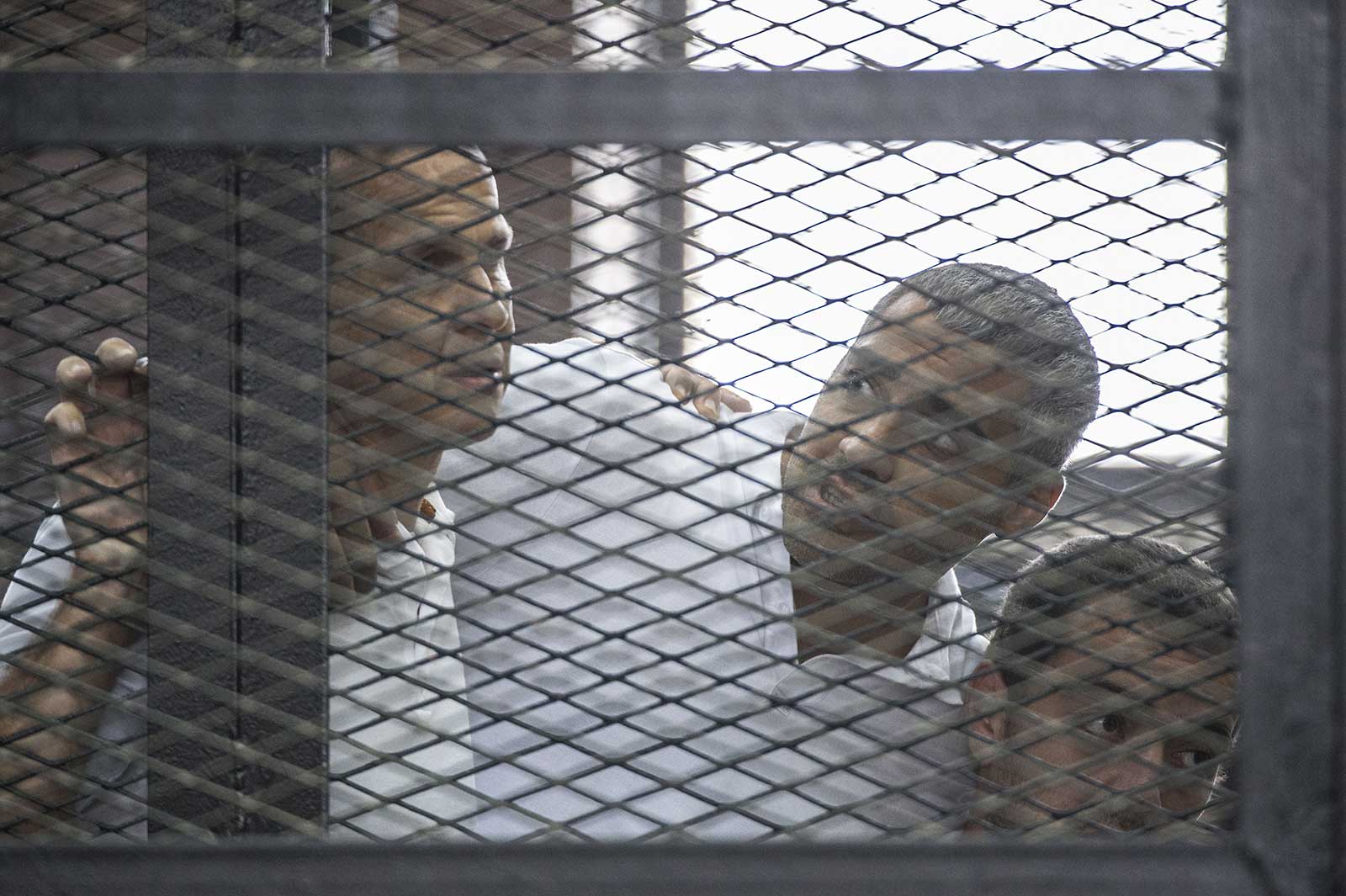
In 2013 we had been arrested in Egypt while working as journalists for Al Jazeera and charged with a string of politically motivated offences relating to our work. In those cold, dirty cells, with no idea what the future held, there was not much to be positive about, which is why it meant so much when the first snippets filtered through that the #FreeAJStaff campaign was getting world-wide traction.

Besides reminding us that we had not been forgotten, it made us realise we were part of a cause far bigger than ourselves. It helped give those long days meaning and lifted us when we were at our lowest. And, more importantly, ultimately the campaign also helped end our incarceration.

People around the world had come together in extraordinary numbers to call for our freedom because they recognised the injustice of what we were going through. They saw how we were jailed on trumped up charges, and they took a stand to support us. And it worked.

Now we urgently need to harness that energy once again.


A tragedy is slowly unfolding in Turkey. Independent journalism is being systematically stamped out. Prison doors are slamming, media outlets are being boarded up, and a disturbing silence is falling over what was once a vibrant and diverse media landscape.

Since the failed coup attempt in July 2016, President Recep Tayyip Erdoğan has launched a crackdown on freedom of expression so severe that independent journalism is in its death throes. At least 156 media outlets have been shut down and an estimated 2,500 journalists and other media workers have lost their jobs. Yonca Şık, whose husband, investigative journalist Ahmet, has been remanded in custody since December says “Ahmet’s imprisonment is a message to others: Speak out if you dare.”

All of these measures against independent journalism are painful to watch. But what hit closest to home are the stories of the more than 120 media workers arrested in the wake of the coup attempt and held in pre-trial detention.

In the initial shock following our own arrests in Egypt, we thought there had been a terrible mistake that would quickly be corrected. We could never have imagined that we would go on to spend hundreds of days in prison awaiting trial, in terrible conditions.

The Egyptian prisons where we languished were overflowing with many people who opposed or challenged the government. We understand all too well what it is like to be in Turkey’s prisons right now, and how our colleagues must be feeling.

When we weren’t crammed into cells with so many other men that we couldn’t sit down, we were in solitary confinement where we often feared losing our minds. The loneliness and boredom are hard to describe.

“A tragedy is slowly unfolding in Turkey. Independent journalism is being systematically stamped out”

Although the situation facing journalists jailed in Turkey may not be identical to ours, we understand their despair and frustration. What makes the situation in Turkey especially sinister is the fact that the Turkish government continues to deny that journalists are being jailed for their work. The stories and identities of these individuals are being erased. This is why it is so vital for those of us on the outside to take a stand on their behalf.

#FreeAJStaff started as a small Twitter campaign, but within weeks it had grown into a global movement. It brought out the best in social media: the urgency, the rolling momentum, the championing of a cause which might otherwise have been crushed. In the end, it achieved more than three billion impressions.

In the darkest moments of our incarceration – when we felt locked in a hopeless battle with the machinery of injustice, when we had forgotten what a sunset looked like – it sometimes felt like we had stopped existing. It would have been easy to fade away. What kept us going was the knowledge that we were on people’s minds.

The full realization of what that campaign meant to us in our time of need is why we are backing the #FreeTurkeyMedia campaign. We want all those journalists languishing behind bars in Turkey to know that we are with them. We want them to know that the days they spend there, however dreary, however frightening, are not in vain.

They are on the frontlines of freedom of expression – the public’s right to know and the importance of a free press in a functioning society, not just in Turkey but around the world.

“The public’s right to know and the importance of a free press in a functioning society, not just in Turkey but around the world”

Sometimes it is hard to appreciate something until it is taken away from you. But remember: a society where people do not have the right to report freely is a society at risk. Without independent journalism, there would be no free public debate; no holding of the powerful to account, no oversight or investigation into human rights abuses.

Detaining journalists has a chilling effect on everyone, making them afraid to speak out. So while #FreeTurkeyMedia is about getting journalists out of prison, it is also about creating a better future for human rights in Turkey and sending a clear message to those around the world who seek to silence free speech.

For more than 400 days behind bars in Egypt, we were fortified by the knowledge that people around the world were campaigning for our release. If it was right to speak out for us and demand #FreeAJStaff, it is right to speak up for all journalists jailed simply for doing the their jobs. That is why we have joined the call to #FreeTurkeyMedia.

This article first appeared in The Australian.

Indonesia: Palm oil workers must get justice

Amnesty International calls on the Indonesian government to fulfil its commitment to establish a Task Force to investigate abuses against workers in the country’s vast palm-oil industry.

An Amnesty International report revealed labour exploitation on Indonesian plantations owned by suppliers and subsidiaries of Wilmar International, the world’s largest palm oil trader.

The abuses documented included women forced to work long hours under threat of having their already meagre pay cut, children as young as eight doing hazardous and hard physical work, workers suffering injuries from toxic chemicals used in plantations, and workers enduring long days to try to meet extremely high targets.

“Four months have passed, but no action has been taken. The Indonesian government should immediately establish a task force to look into the abuses suffered by workers on palm oil plantations,” said Josef Benedict, Amnesty International’s Deputy Director for Southeast Asia and the Pacific.

“Palm oil is important to Indonesia’s economy and the workers who depend on the industry for their survival. When businesses fail to comply with international human rights standards, they pose a threat to the country’s image and its economic ambitions.”

Amnesty International has received alarming reports that Wilmar has used intimidation tactics against workers and trade union members in an attempt to get them to deny the organisation’s findings.

“Speaking out against labour exploitation is every worker’s right. The government should take all necessary steps to ensure that no workers or trade union members face reprisals from their employers,” said Josef Benedict.

While the Indonesian government has announced that it will set up a task force, it has failed to say who will head it, how it will function, and what will come of it.

“The Ministry of Manpower should make details of the taskforce public. No effective investigation into these abuses can emerge from an opaque process,” said Josef Benedict.

“Transparency is needed across the board, including greater numbers of inspectors to monitor breaches of labour laws and ensuring that information about inspections, investigations, prosecutions, convictions and other penalties imposed is publicly available.”

Amnesty International is also calling on the EU-based countries to make sure that domiciled companies – including many of Wilmar International’s European buyers – are meeting international standards when it comes to their purchasing practices.

Ahead of the meeting between the Council of Palm Oil Producing Countries and their EU counterparts this month, the human rights organisation is calling on the EU to ensure that imported palm oil is not linked to labour exploitation.

“Responsibility for ending labour abuses lies with everyone involved in the palm oil trade, where it is Wilmar International or the companies that buy from it. Human rights abuses cannot be ignored just because there is an intermediary involved,” said Josef Benedict.

Background

Wilmar’s Singapore office has stated that the issues raised by Amnesty International are being actively discussed by Wilmar Plantation Operations Management and that their investigation continues.

The company said it will continue with this process until it is able to address all the issues highlighted, and will publish its full findings. It also says that trade union signatures were provided voluntarily.

Wilmar’s public response, however, seems to be at odds with their approach behind the scenes.

“Help bring my husband back” – One woman’s campaign to free her husband in Iran

By Vida Mehrannia

Iranian-born Swedish resident Dr Ahmadreza Djalali, a medical doctor and lecturer in disaster medicine, has been detained in Tehran’s Evin prison since his arrest on 25 April 2016. While in solitary confinement, he was subjected to intense interrogations, and forced under great emotional and psychological pressure to sign statements. He has been accused of being a spy for a “hostile government” and threatened with the death penalty.

Anyone who’s met Ahmadreza knows he is a kind and compassionate person who loves people. He is a conscientious and compassionate doctor who has put all of his effort into the health and welfare of others.

In the years that we have been together, he has always supported me and has been a wonderful father to our children.

The shock of his arrest

© Private

I was shocked when Ahmadreza was arrested. I didn’t even hear about it until four days later when his family in Iran told me. I thought that it was some kind of mistake and that he would be released. I didn’t hear from him until the next month, and, when he called, it was only for two minutes; I sensed that he was under intense psychological pressure.

In those first few months, I fell into a state of complete shock. I cried a lot and was an emotional wreck. I was unable to sleep at night or to even look after my two children.

Even now, a year on, I still haven’t come to terms with this separation from my husband. I think about him every second of the day and I spend every moment awaiting his return.

My son is five years old and he thinks that his father has gone to Iran for work. He keeps asking me when his father will come back home. When he gets upset, he crouches in a corner and asks for his father. My daughter is 14 and has always shared a very close bond with Ahmadreza. He always accompanied her to school in the mornings, but in the past year, she’s been coming and going to school alone. On her 14th birthday, she was devastated that her father was not by her side. She knows that he is in prison and is very worried about him.

Accusations by the Iranian authorities

Ahmadreza’s arrest came about as a result of the delusions of the Ministry of Intelligence. Ahmedreza’s work as a doctor in disaster medicine, his studies and teachings in Europe, and his residency in Sweden have been used by the Iranian security apparatus to suggest that he is a spy and has been acting against the national security of Iran. These are all claims that have been fabricated by Iran’s security apparatus.

For seven months after his arrest, Ahmadreza was denied access to a lawyer. The authorities have accused him of being a spy but have never even allowed his lawyers to review his case file in order to prepare their defence. In fact, they have so far rejected all three of his lawyers. Now he has to find yet another lawyer or else the court will appoint a state-approved one for him.

Health Problems

Ahmadreza went on hunger strike in December 2016 when his interrogators told him that he would face the death penalty if he refused to sign a statement “confessing” to being a spy for a “hostile government”. During his hunger strike, I found it difficult to eat as I kept thinking of him. I was worried that his health would fail. My daughter was beside herself with fear of what might happen to him.

“His hunger strike lasted three months and resulted in the severe deterioration of his health”

His hunger strike lasted three months and resulted in the severe deterioration of his health. He has lost 29 kilos and developed problems in his heart and kidneys, and has experienced gastro-intestinal bleeding. His hunger strike caused osteomalacia (soft bones) and he has been having problems with his legs, feet, and knees.

Pleading for Ahmadreza’s Release

I have written letters to Iran’s Supreme Leader, the President, and the Minister of Foreign Affairs, requesting my husband’s release but unfortunately none of them have responded. I have also sought help from the Swedish government, the European Parliament, and international human rights organizations to secure his release.

Several European officials have called for his release including the Prime Minister of Sweden, the foreign ministers of Belgium and Italy, the head of the European Parliament, and the EU’s High Representative of the European Union for Foreign Affairs and Security Policy.

My husband’s colleagues at the European universities where he has studied and taught, the Karolinska Institute in Sweden, the Università Degli Studi Del Piemonte Orientale in Italy, and the Vrije Universiteit Brussels in Belgium, have not hesitated to support him in every way they can, but we still need more help and more people to join our campaign.

A call for help

Ahmadreza has always been devoted to helping others; now he is wasting away in prison for nothing. I ask Amnesty International activists around the world to help bring my husband back to his wife and children, and to the academic world.

Please take another 2 minutes to take action for charity worker Nazanin, who is also currently being held in Evin prison.

Philippines ‘war on drugs’: ‘secret jail cell’ revealed

Following yesterday’s suspension of more than a dozen police officers and the announcement of an internal investigation into revelations that 12 people were detained illegally in a cramped “secret jail cell” in Manila on drugs-related charges, Champa Patel, Amnesty International’s Director for Southeast Asia and the Pacific, said:

“This is an alarming reminder of the depth of the human rights crisis sparked by President Duterte’s ‘war on drugs’. Prison overcrowding and secret jails with a risk of torture are just part of the wider problem, which has left up to 9,000 people dead in extrajudicial executions by police and vigilantes doing their dirty work.

“If the authorities are serious about investigating this incident, they must ensure those involved face effective criminal investigations and prosecutions, not just a slap on the wrist and time off work. Investigations should go right up the chain of command.

“Crucially, nobody should be under any illusions that the same police force that allowed thousands of killings to happen under its nose can be trusted to investigate itself now. There must be independent oversight of this and all investigations and a thorough review of all violations and abuses by police in the ‘war on drugs’.

In an interview, President Duterte told a reporter he thought it was ‘funny’ that Amnesty International was calling on his government to stop the killings. There is nothing funny about killing 9,000 people in cold blood in a climate of impunity.”

Background

According to media reports, Metro Manila police chief Supt. Oscar Albayalde relieved 13 police staff from their posts pending an investigation into the discovery of the secret jail “cell” behind a sliding bookcase in the capital’s Tondo police station.

A range of national and international human rights organizations have raised the alarm about thousands of killings and other serious abuses taking place amid President Duterte’s “war on drugs”.

In its January 2017 report “If you are poor you are killed,” Amnesty International detailed how the Philippines police have killed and paid others to kill thousands of alleged drug offenders in a wave of extrajudicial executions that may amount to crimes against humanity.

The detainees in Tondo police station have made deeply worrying allegations of torture – Amnesty International’s research has shown torture by police to be rife in the Philippines.

Where to next for marriage equality in Australia?

Amnesty supporters joined thousands of Australians, businesses and celebrities pushing our politicians to make marriage equality a reality in Australia. Activism Growth and Development Coordinator Belinda Lowe looks at what’s happening on Canberra’s Capital Hill in response.

Australian National University. © Private
A marriage equality activist at Australian National University. © Private

In March, Australians across the country sent letters of love to their senators calling on them to support marriage equality in parliament. Australian businesses also added their voices in support of marriage equality en masse in an open letter to the Prime Minister signed by the boss of Wesfarmers, ANZ, the Australian Business Council, Qantas and dozens of others.

We believed a bill on marriage equality would be brought to parliament for a vote in March, however this was overshadowed by heated debates over changes to section 18C of the Racial Discrimination Act and didn’t eventuate.

Immigration Minister Peter Dutton, who criticised corporate leaders on the open letter, is reported to be working behind the scenes to have marriage equality pushed over the line — saying that if not, it will be a distraction up until the next election.

We believe that Dutton’s comments and the broadening of support across the business community and state councils around Australia are an indication that marriage equality is almost inevitable in 2017. We’re closer than we’ve ever been before, and the ongoing stream of petitions, letters and phone calls from activists and everyday Australians to key decision-makers around the country will force our government to make marriage equality happen.

What can you do to help?

There’s plenty of work still to be done to get a bill on marriage equality across the line. We need to keep up the pressure on state and federal MPs to make sure they know that the people they represent care deeply about this issue. We need to keep sharing our stories about ourselves, friends, family and colleagues.

Two women with rainbows painted on their cheeks
© Cosmo Price

You can do this by sending an online letter of love to your Senator (if you haven’t already), sharing the action with friends on social media or hosting your very own, real-world, letter writing party!

Hosting a letter-writing party is a fun way to get together, share some delicious treats and keep marriage equality on the agenda of your local politician. Just download these letter writing resources, get a group of friends together and hand-write some personal letters to your MP. It’s super easy, and we’ve heard from politicians themselves that these letters have big impact.

Take action online

Hold your own event

Let us know how you go! Drop us an email at activism@amnesty.org.au.

New legislation threatens judicial independence in Egypt

If ratified by Egypt’s President Abdel Fattah al-Sisi, a new law would grant him powers to select the heads of judicial bodies, including the heads of the Court of Cassation, the State Council, the Administrative Prosecution Authority and the State Lawsuits Authority.

“This law has the potential to undermine the independence of the country’s already beleaguered judiciary and, if ratified by the President, could be a major setback for justice in Egypt. It would grant the Egyptian President the power to select the heads of country’s top judicial bodies and could weaken key checks and balances in an already unjust system,” said Najia Bounaim, North Africa Campaigns director at Amnesty International.

“Through this law, the state is seeking to further consolidate its grip on power and neuter two of the highest courts who have at times acted as a check on the executive.”

Previously, Egypt’s judicial councils had the power to appoint heads of the different branches of the justice system. The name of the selected candidate was then passed to the President who would issue a decree confirming the appointment as a formality – effectively, the final decision still rested with judicial councils. Under the proposed amendments the President will have the power to select the heads of judicial bodies from a pool of three senior judges nominated by their peers from the most seven senior members in each judicial body.

The bill was passed on 26 April after two thirds of parliament members voted in favour of the amendments.  Several judicial bodies, including the State Council, the Supreme Council of Judiciary and the State Lawsuits Authority, had formally registered their opposition in advance of the parliamentary vote.

After the amendments were passed, Egypt’s Judges Club issued a statement urging the President not to ratify the amendments and invited judges to an urgent general assembly on 5 May to protest against the amendments. The State Council Judges Club also issued a statement condemning the new law and sent a letter to the President urging him to refrain from accepting it on the basis that it undermines the independence of the judiciary and the principle of separation of powers.

Two of the highest courts in the country… will be particularly affected by the new law. They were considered by many in Egypt’s legal community as the last hope of keeping the injustice that has characterised the judiciary for years in check.

Two of the highest courts in the country, the Court of Cassation and the Supreme Administrative Court will be particularly affected by the new law. They were considered by many in Egypt’s legal community as the last hope of keeping the injustice that has characterised the judiciary for years in check.

The Court of Cassation has overturned a number of mass death penalty sentences on the grounds that courts of first instance failed to establish individual criminal responsibility and found their sole reliance on investigations conducted by the National Security Agency to be insufficient evidence.

The Supreme Administrative Court, which is responsible, among other things, for reviewing actions and policies of the executive authority in cases relating to human rights violations, has made several independent decisions in defiance of the government. In January 2017, it overturned a government agreement that granted ownership of two islands in the Red Sea to Saudi Arabia.

Since July 2013, the Egyptian authorities have taken several measures that have undermined the independence of the judiciary, seeking to transform courts into tools of repression against critics of the government. These measures have included holding trials and interrogations in locations controlled by the Ministry of Interior, such as prisons, police stations, police academies and security forces camps.

In 2014, the General Assembly of Cairo Appeal Courts also established special judicial chambers to try individuals involved in unauthorised protests or violence. These chambers have sentenced hundreds of individuals to death or life imprisonment through mass trials that failed to uphold even the minimum fair trial standards.

For years successive Egyptian governments have sought to interfere with the judiciary by promoting or disciplining members of the judicial authority. The Minister of Justice, who is a member of the executive authority, also enjoys broad powers to refer judges for disciplinary measures.

Over the past three years, a number of judges have faced disciplinary measures for peacefully criticising the government.

Over the past three years, a number of judges have faced disciplinary measures for peacefully criticising the government. Many judges were forced to retire after being accused of involvement in political activities, which is banned under article 73 of the Judicial Authority law.

Two judges, Hisham Raouf and Assem Abdelgabar, were referred to a disciplinary board in March 2017 by the Minister of Justice for participating with an Egyptian human rights group in a workshop to draft a law on torture. On 28 March 2016, a Supreme Disciplinary Board forced 32 judges into retirement after they signed a statement on 24 July 2013 opposing the overthrow of former president Mohamed Morsi.

Disciplinary measures against judges appear to have been applied in a discriminatory manner with those who have voiced opinions in favour of the government escaping punishment.


Hong Kong pro-democracy activists arrested

Police arrested nine people involved in Hong Kong’s pro-democracy movement on Thursday morning, April 27. They are reported to face charges of public disorder and unlawful assembly for their involvement in a largely peaceful protest last November against a central government ruling on Hong Kong’s Basic Law.

“The repeated use of vague charges against prominent figures in Hong Kong’s pro-democracy movement reeks of an orchestrated and retaliatory campaign by the authorities to punish those that advocate for democracy in Hong Kong,” said Mabel Au, Director of Amnesty International Hong Kong.

“The Hong Kong government should be protecting freedom of expression and peaceful assembly but instead it appears intent on intimidating people who are challenging the authorities. Arrests and prosecutions aimed at shutting down participation in peaceful protests must stop.”

Those arrested on Thursday were: Avery Ng Man-yuen, Dickson Chau Ka-faat, Chan Man-wai, Sammy Ip, Lo Tak-cheong Cheng Pui-lun, Derek Lam Shun-hin, Ivan Lam Long-yin and Chow Shu-wing.

The arrests come a day after two pro-independence former legislators, who were disqualified from office, were also arrested in the morning and charged with “illegal assembly” for attempting to force their way into a meeting of the Hong Kong legislature last November.


‘Art should create questions’: Hesam Fetrati

Iran-born visual artist Hesam Fetrati dreams of a ‘Shared Australia’. An Australia that welcomes refugees and asylum seekers rather than locking them up in detention and abolishes phrases like ‘illegal immigrant’ from its vernacular. Amnesty International Australia grabbed 10 minutes to chat with Hesam about the power of art in creating social change.

In his late 20s, Hesam left the “megacity” of Tehran and his job as a political cartoonist to complete his Masters and Doctorate degree in the comparatively-sleepy city of Brisbane. Hesam’s prize-winning works explore social and political themes, along with reflecting his own personal journey and experience with war. “Peace and hope are the two most important topics for me [in my work],” he says.

“Self-portrait” (selfˈpoːtrit) noun. a person’s portrait or description of himself… (?) :/

A post shared by Hesam Fetrati (@hesam_fetrati) on

Since his arrival in Australia, Hesam’s eyes were opened up to the appalling treatment by the Australian government of refugees and asylum seekers. His artwork started exploring these themes and he has teamed up with ARTillery and Amnesty International to create the graffiti work ‘Shared Australia’, to help to raise awareness.

“I have chosen stencil art/graffiti [for this piece], because this technique contains the concept of protest. Also, this technique is ‘illegal’ same as ‘illegal’ immigrants,” he says.

‘Shared Australia’

In the work ‘Shared Australia’ we see a little boy and his suitcase – the only possession he has in the world and a symbol of his displacement. He clings to a paper boat, which depicts the perilous journey that many asylum seekers undertake in order to reach safety.

The giant man with hat and dark suit is a stereotypical Australian politician. The tyrannous gatekeeper to the ‘golden’ shores of Australia. He holds the geographical map of Australia close to his chest and he refuses to share it with the asylum seeker. The word ‘Welcome’ is stencilled above ironically

“‘Shared Australia’ refers to the matter of displacement,” says Hesam. “I have chosen stereotypes and symbols to explain the issue.”

The piece also refers to the policies by the Australian government around refugees, he explains, and the way mainstream media portrays mainstream as a “mass group”, without any individuality. “I believe refugees are portrayed as not only voiceless, but as faceless,” says Hesam.

When asked what he hopes his artwork will inspire, he says: “If my audience thinks about the issue that I have addressed, this achievement is more than enough for me. I believe art should create questions.”

However, the impact of his work succeeds in more than just forming questions. “Last year I received a message from a girl in London,” says Hesam. “She said: ‘As an African black girl who has grown up in France and lives in London, life was not easy for me. But I found my story in your work’. It was very emotional and proud moment for me.”

“Art, itself, cannot change the world

Art can educate

Art can create questions

Art can help people to seek the answers

We. People can create change”

Hesam Fetrati

You can print out your own copies of Hesam’s ‘Shared Australia’ poster and put them up in your neighbourhood (legally please!). Find out more at www.artisourartillery.com.

New leaders join Team Amnesty

We’re excited to welcome Paige and Peter to the Amnesty board, and Alison and Dermot to our Senior Leadership team. Meet them here.

A big welcome to our two new board members, Paige Garland and Peter Kempster.

Paige is the new director/Regional Representative for Queensland/Northern NSW. She has over 20 years management and leadership expertise in the community sector. Paige is a proud Amnesty activist.

Peter joins the board as a director. He is an experienced director, and former CEO, with skills in financial and risk governance. He is a passionate supporter of human rights.

We’re also excited to share that Alison Gibbins and Dermot Ryan have been recruited to AIA’s Senior Leadership Team.

Alison Gibbins is joining us in the newly created role of Deputy National Director. She has over 20 years’ experience as a non-profit and public sector executive, including in social change campaigning, organisational strategy, communications and program management, with a focus on environmental issues.

With the rise of intolerance across the world, we need to recommit to basic principles of human rights. For me, it’s the right time to work for an organisation that stands up for those values.”

Alison Gibbins, Amnesty’s new Deputy National Director

Alison has always been interested in the overlap between human rights and the environment as the two are so closely interrelated. On joining Amnesty, Alison said, “With the rise of intolerance across the world, we need to recommit to basic principles of human rights. For me, it’s the right time to work for an organisation that stands up for those values.”

Dermot Ryan has joined us as our new Head of External Affairs and National Director’s Office. He comes to us from the Transport Workers Union where he was Chief of Staff, and he has significant experience advising on media relations and lobbying for social change organisations.

Dermot has been a long time human rights advocate including campaigning against apartheid in South Africa, for Sexual and Reproductive Rights and Marriage Equality in Ireland and for workers rights here in Australia.

Please join us in making Paige, Peter, Alison and Dermot welcome at Amnesty.

Read more about our senior leadership team

Is modern-day activism lazy or just smarter?

As someone who wouldn’t have called herself an activist before last year, Kate Taylor never imagined she would be rallying 10,000 protesters to march for women’s rights on Donald Trump’s inauguration day in January.

The law student first heard about the Women’s March on Washington through a friend who was working in the US. Inspired by the movement and angered by Trump’s sexist rhetoric, Kate decided to organise a sister march in Sydney. “When I started the Facebook page, I thought I’d get 50 people signing up,” she told Amnesty.

Before long, she was contacted by US expats Rebecca Turnbow and Mindy Freiband — who co-founded their own solidarity event in Sydney and invited her to join forces. From that, the core team of Sydney Women’s March was born.

‘Social media helped us find each other’

Digital activism is often dismissed by cynics as a lazy alternative to traditional, blood-and-sweat protests. But recent movements, like the worldwide Women’s March, have proven the effectiveness of a well-organised, digital-first campaign.

“Social media helped us find each other,” says Kate, “It’s incredible to suddenly have access to a brains trust of thousands of women all trying to work towards similar goals.”

For Kate and her team, what started as an online push soon “mushroomed” into a well-oiled organisation run by over 70 volunteers. Having successfully staged one of the biggest mass protests in Sydney, the group now uses its social media network to organise large-scale feminist events, including the March in the Park on 29 April, which aims to promote bodily autonomy and women’s health and safety.

“Our social media reach helps us identify people who are like-minded,” says Kate, “It’s about taking that anger, concern and unrest and turning it into positive action.”

‘Democracy is a slow and lumbering beast’

“One thing that the internet has done is condensing time, space and identity,” says Dr Max Halupka of the Institute for Governance and Policy Analysis, University of Canberra.

In other words, technology has allowed more people to add their voices to social causes with much greater ease and urgency. Halupka calls this ‘connective action’ — the social shares, retweets, and storytelling that put difficult issues back in the public consciousness, ultimately challenging the broader political narrative.

“Democracy is a slow and lumbering beast,” says Dr Halupka, “But technology speeds the process along by opening up ways in which people can engage in politics”

Dr Max Halupka

Examples of this include shining a light on racial injustices using the hashtags #Ferguson and #BlackLivesMatter, exposing the cruelty of Trump’s #MuslimBan, acknowledging Indigenous Australian dispossession with #ChangeTheDate, and sharing stories of everyday racism under #FreedomOfSpeech — a movement that contributed to the Senate rejecting potentially damaging changes to Section 18C of the Racial Discrimination Act.

“Democracy is a slow and lumbering beast,” says Dr Halupka, “But technology speeds the process along by opening up ways in which people can engage in politics.”

“People argue these new forms of activism don’t do anything — perhaps in a vacuum they don’t. But when taken together, they are cogs in a larger participatory machine. They help galvanise and create narratives.”

Beyond the feel-good click

So how exactly do we harness the power of our voices online? Change.org Director Nathan Elvery thinks it’s all about knowing when to turn those social moments into specific actions.

“Hashtags are a great way to capture a mood…But what’s critical for tangible change is to capture those moments and transform them into ongoing action — and petitions are a useful tool to do this.”

Nearly 4.4 million people now use change.org to start online petitions, and a victory is declared every 48 hours.

But despite its popularity, there’s a misconception that signing a petition, like sharing a social post, is little more than a feel-good gesture. What sceptics don’t realise, says Elvery, is that a petition is only the first step in a long and often complex political battle.

Elvery cites Catholic priest Paul Kelly’s push to abolish the ‘gay panic’ murder defence in Queensland, which was used by people accused of murder to downgrade their conviction to manslaughter, due to an unwanted sexual advance.

The petition collected 290,000 signatures on change.org and was finally won last month, after a five-year campaign — a result that wouldn’t have been possible without large-scale online support.   

When a signature saves lives

In countries where the local media is suppressed, online actions are crucial to protecting someone who is at immediate threat of bodily harm.

“For someone at risk of torture, the fact that authorities in that country know that 100,000 people around the world are aware of it and are watching them makes a difference,” says Amnesty International Australia Activism Manager, Chris Holley.  

“It’s really important, at this point in time in particular, that people defend the idea of human rights — it says we’re not going to allow fear to turn us inwards”

Chris Holley

Through organisations like Amnesty International, technology affords us an opportunity to campaign for the clemency of death row prisoners, demand an end to the inhumane treatment of refugees like Loghman Sawari — all with the click of a button.

“We don’t see online and offline as being completely separate things. And people often do both,” says Holley. Together with the research and groundwork done by advocacy staff, any signatures given or emails sent then become part of a larger lobbying effort.

Given the rise of the populist movement in the western world, Holley thinks it’s more important than ever to stay engaged. “It’s really important, at this point in time in particular, that people defend the idea of human rights — it says we’re not going to allow fear to turn us inwards.”

And if recent wins like The Women’s March have shown us anything thing, it’s that there is no better time for resistance than now.