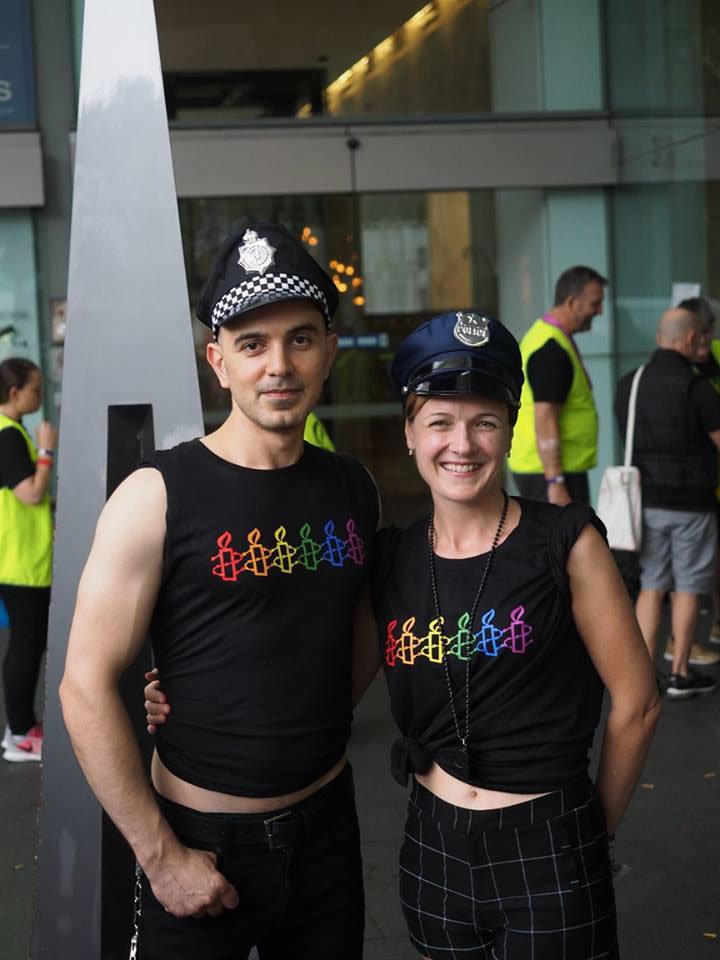
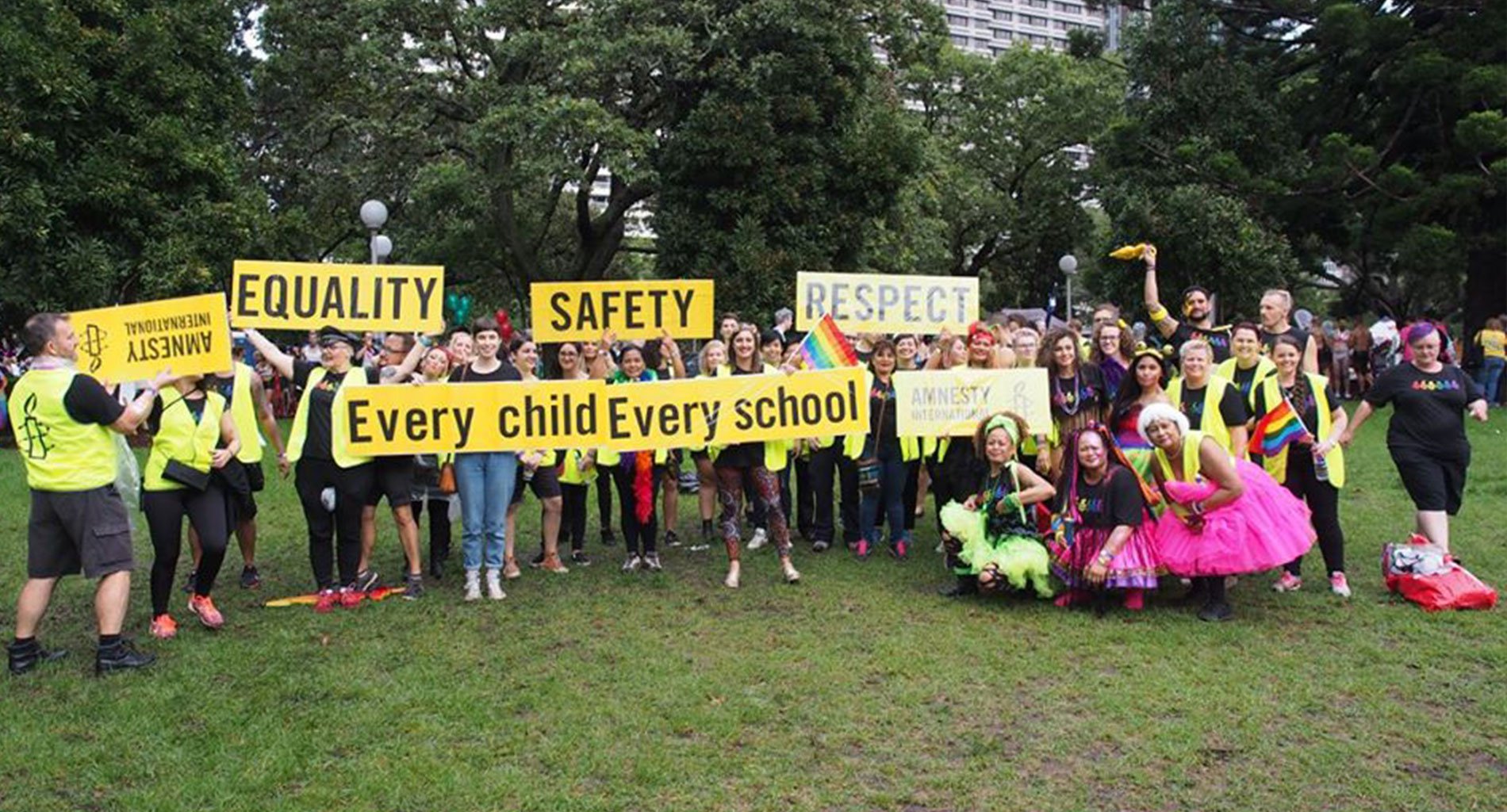
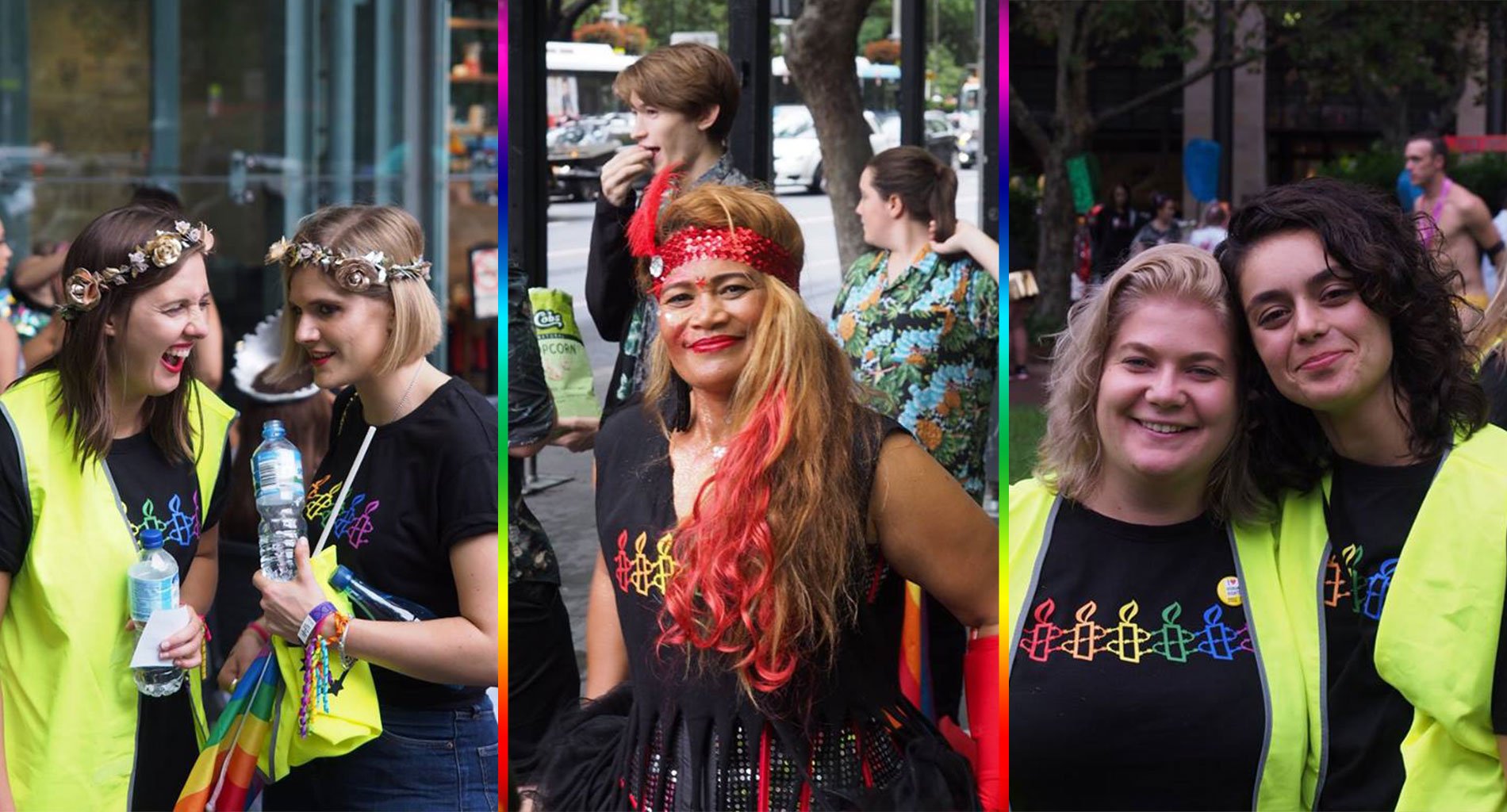
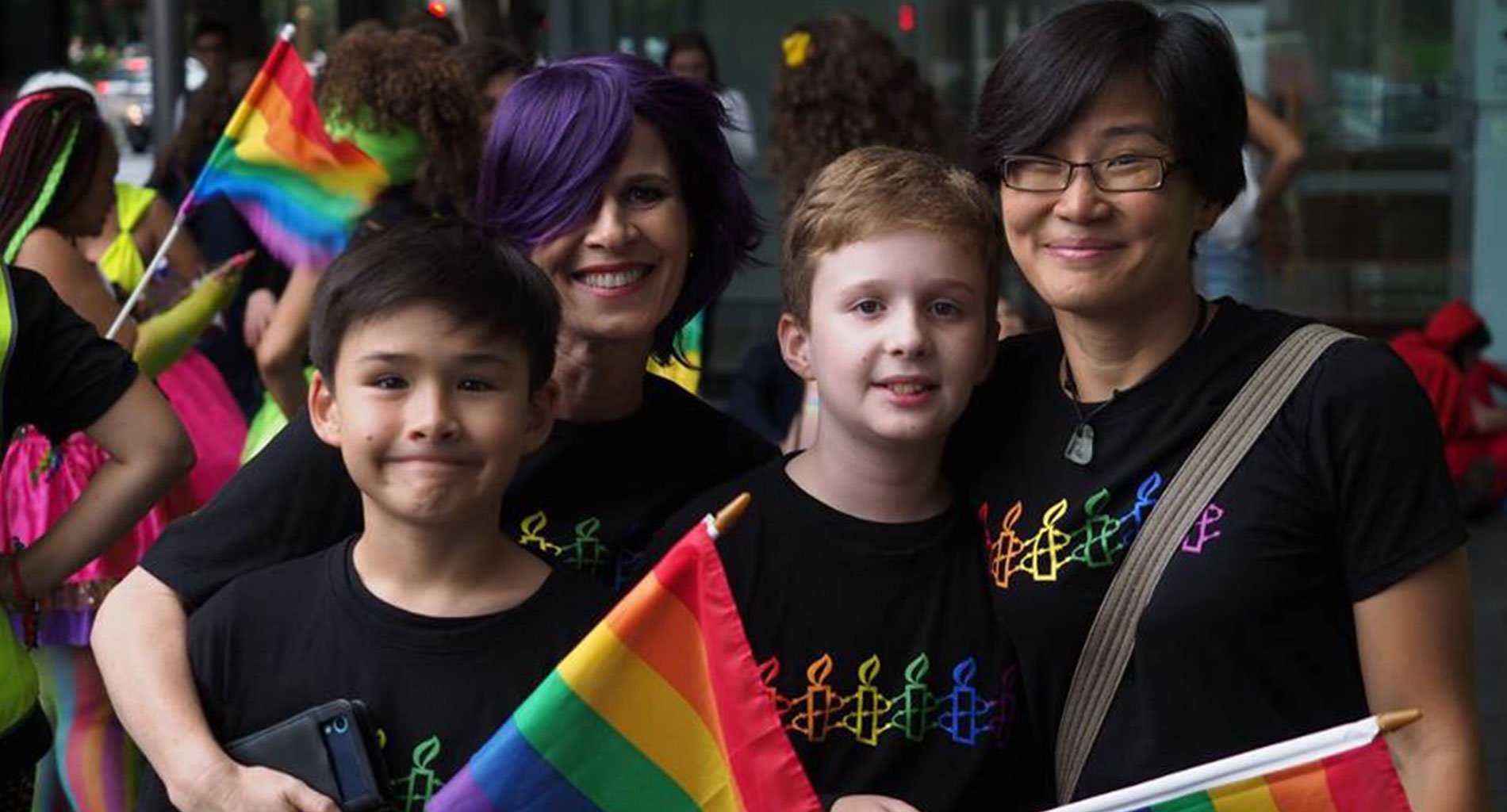
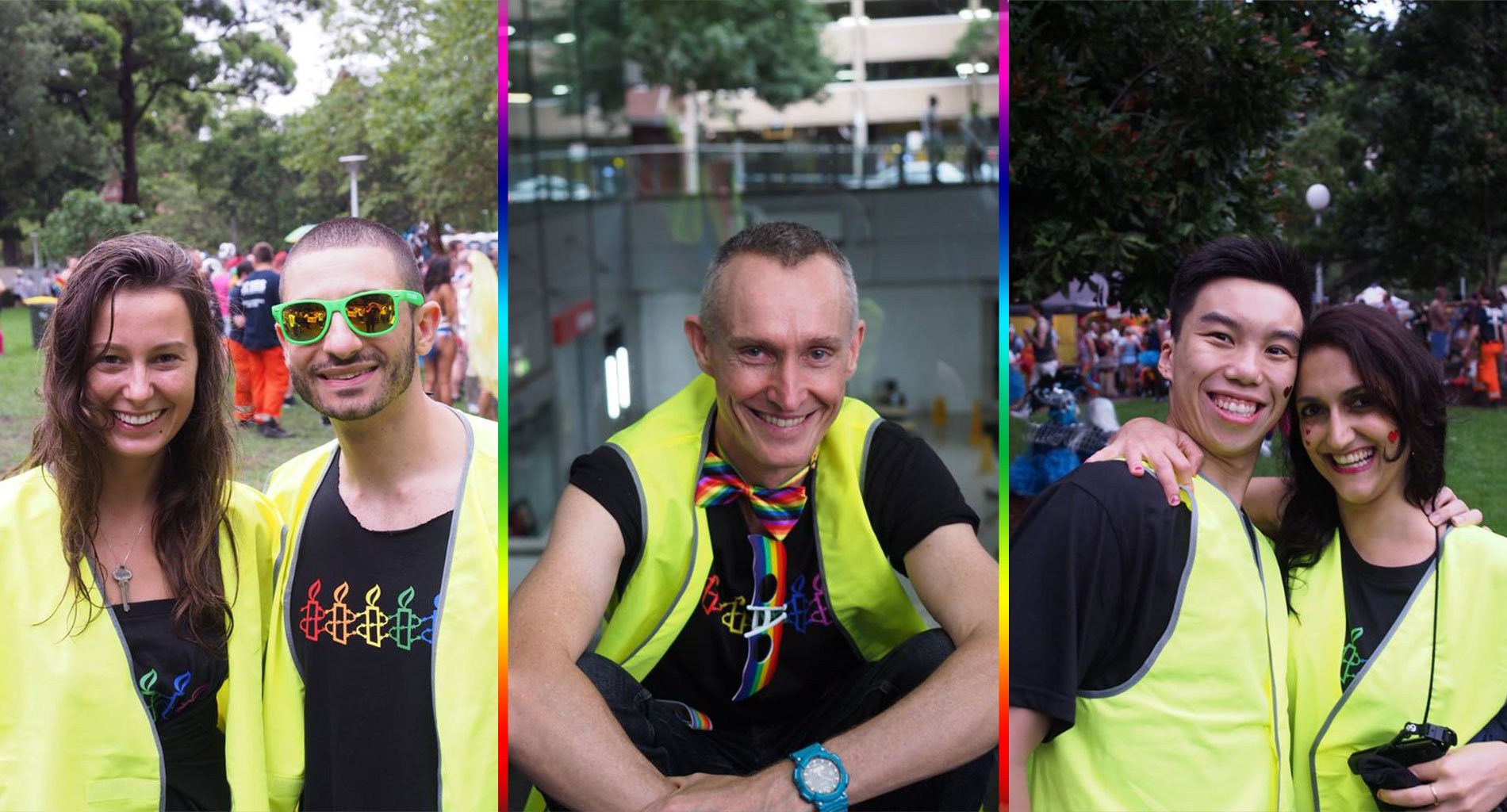
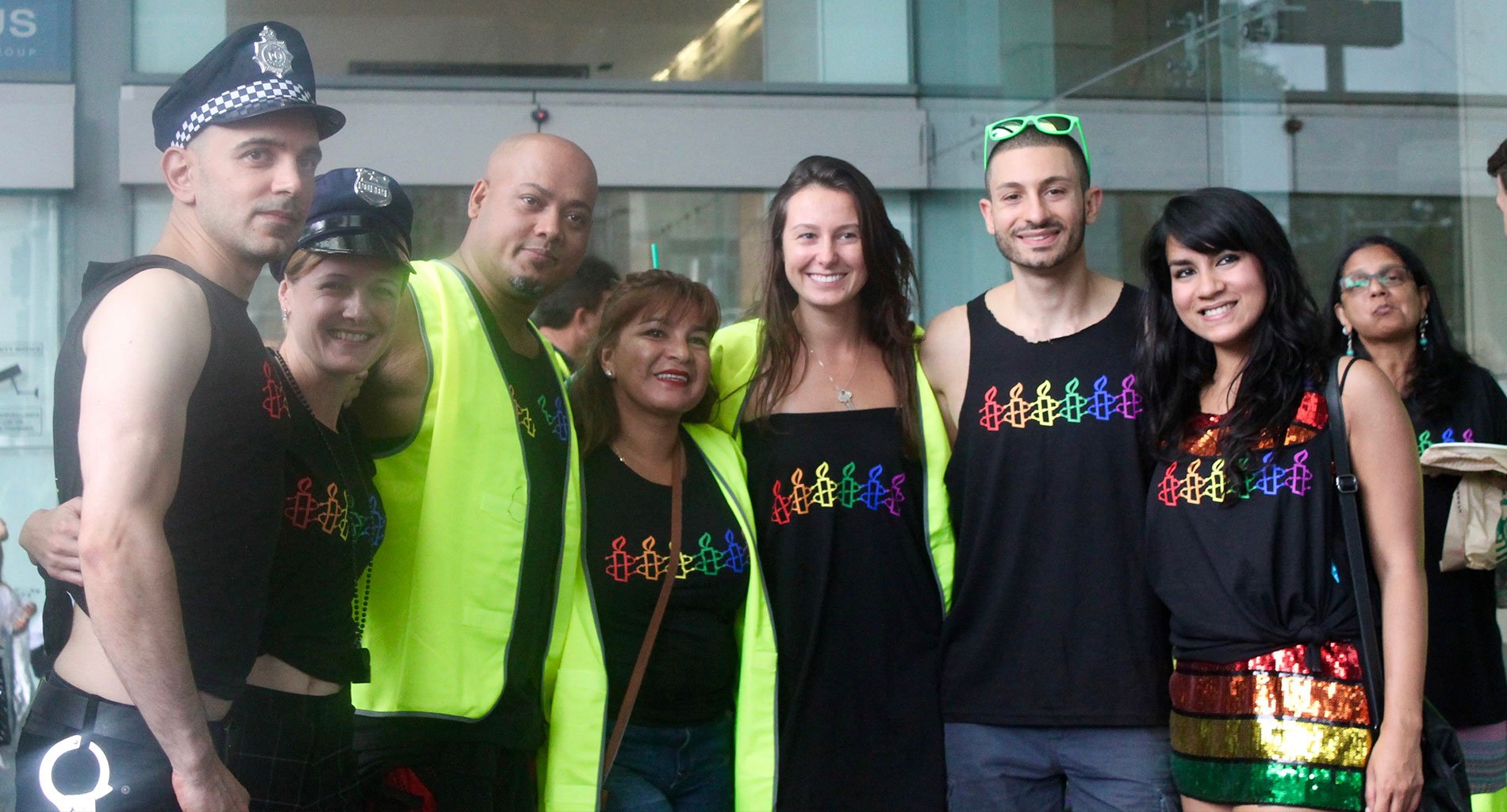
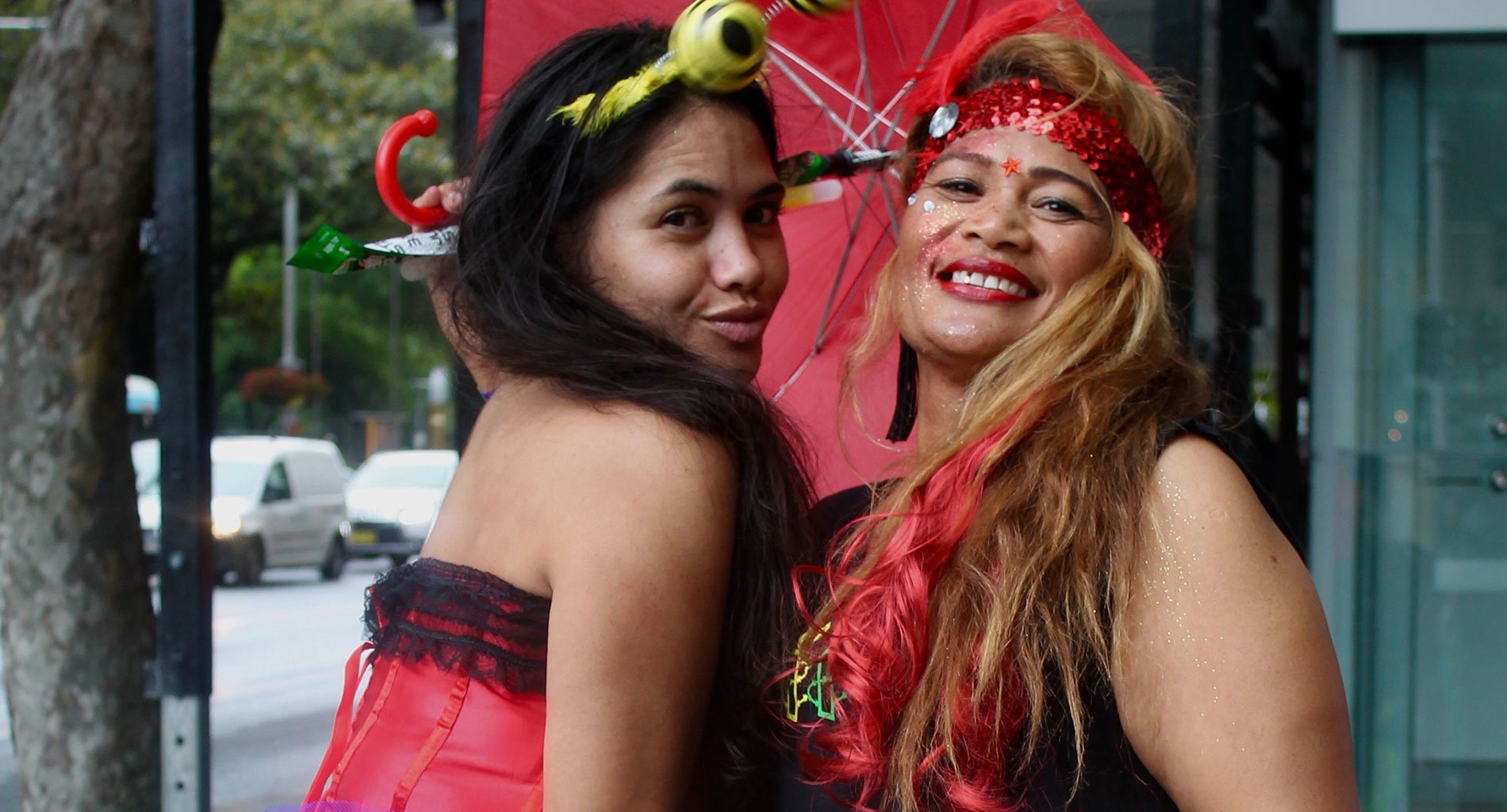
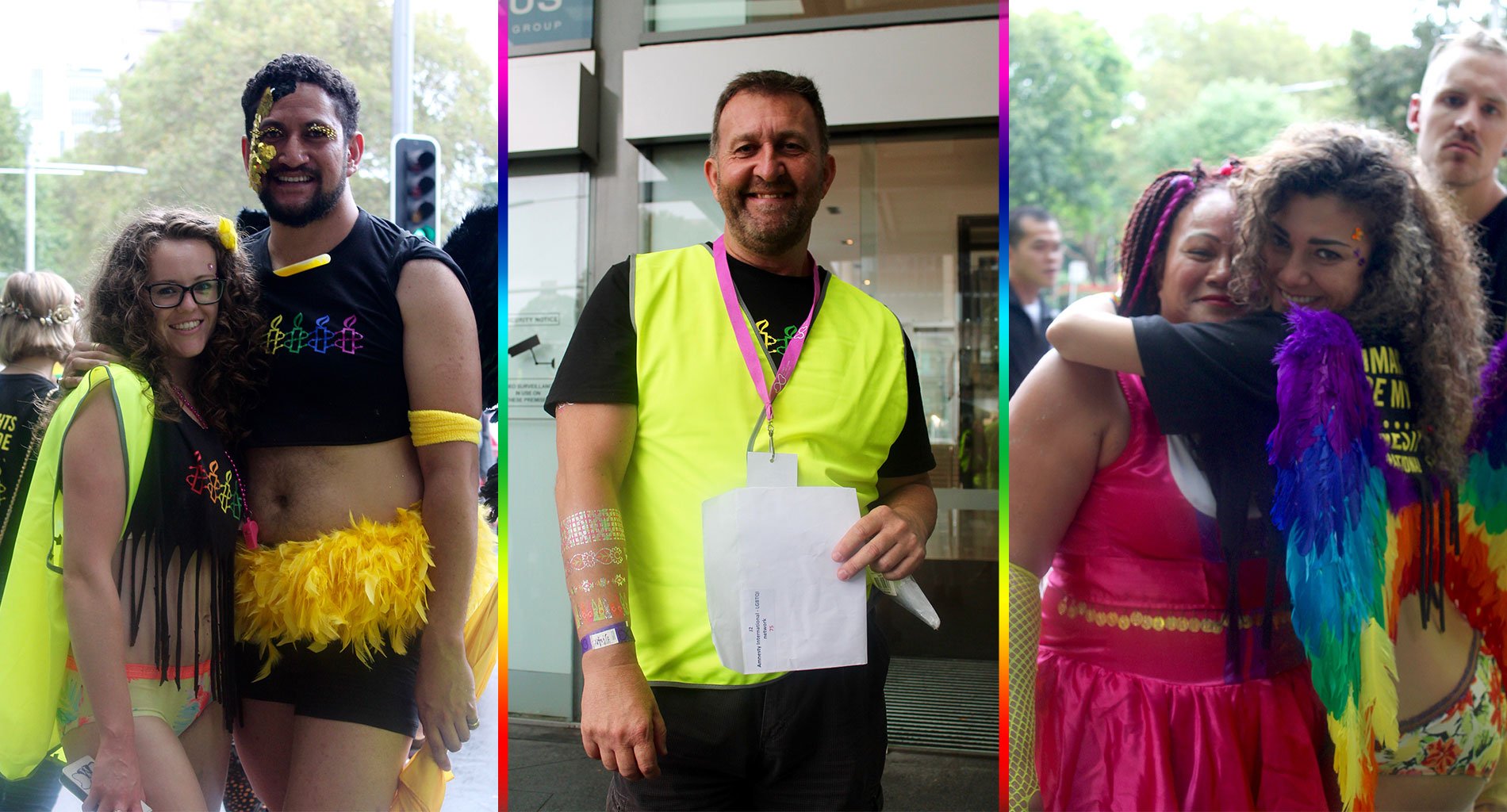
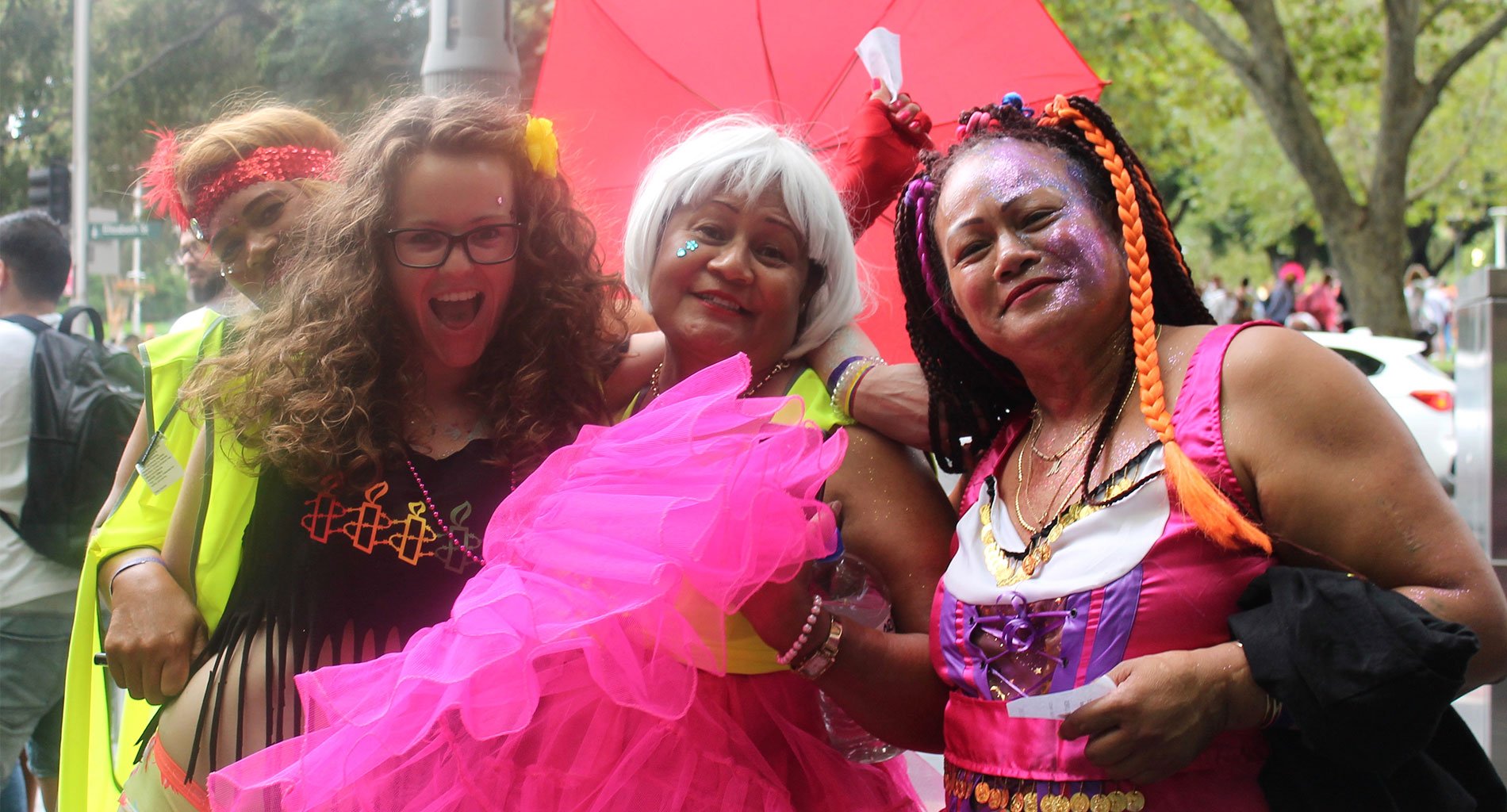
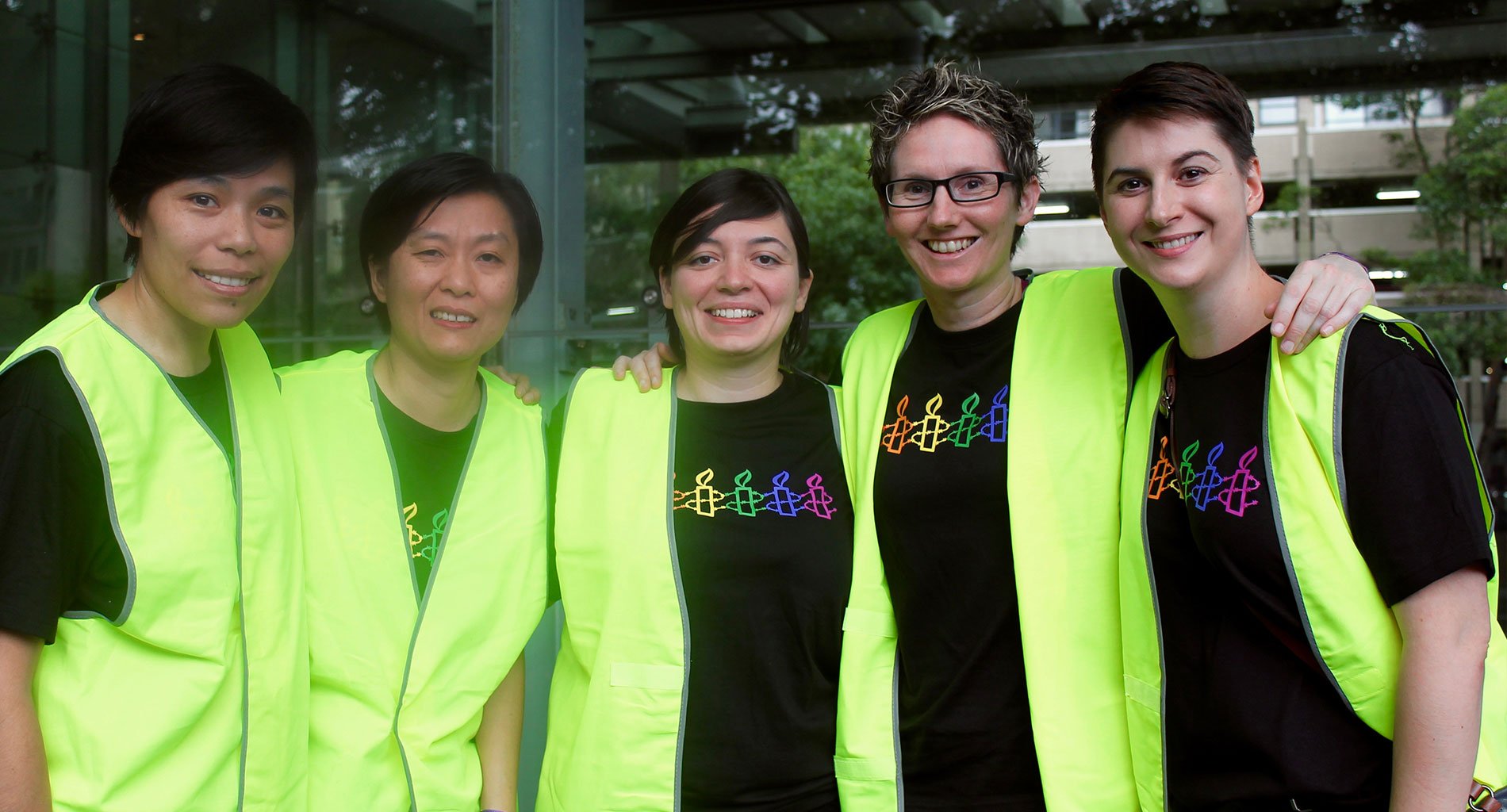
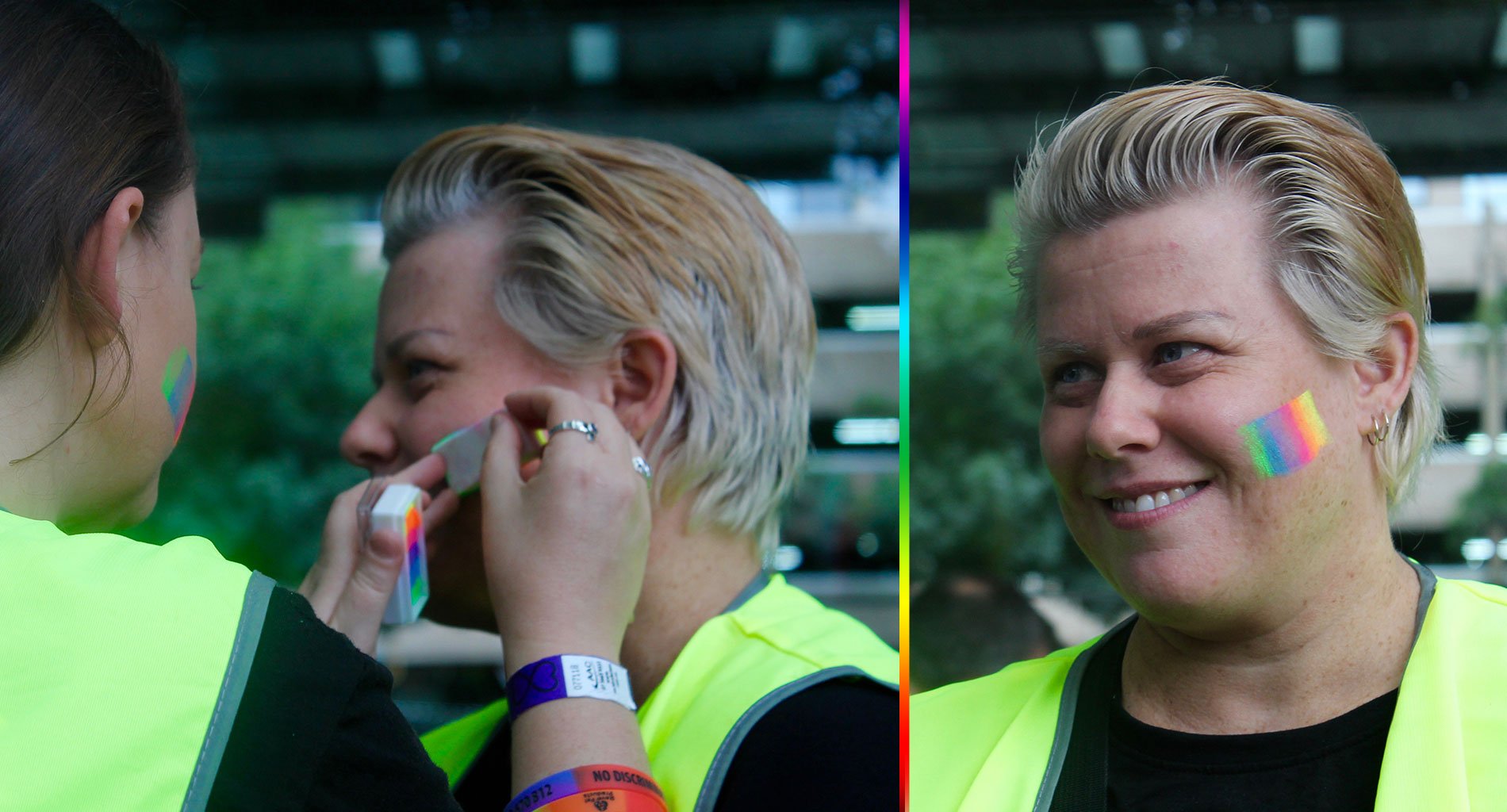
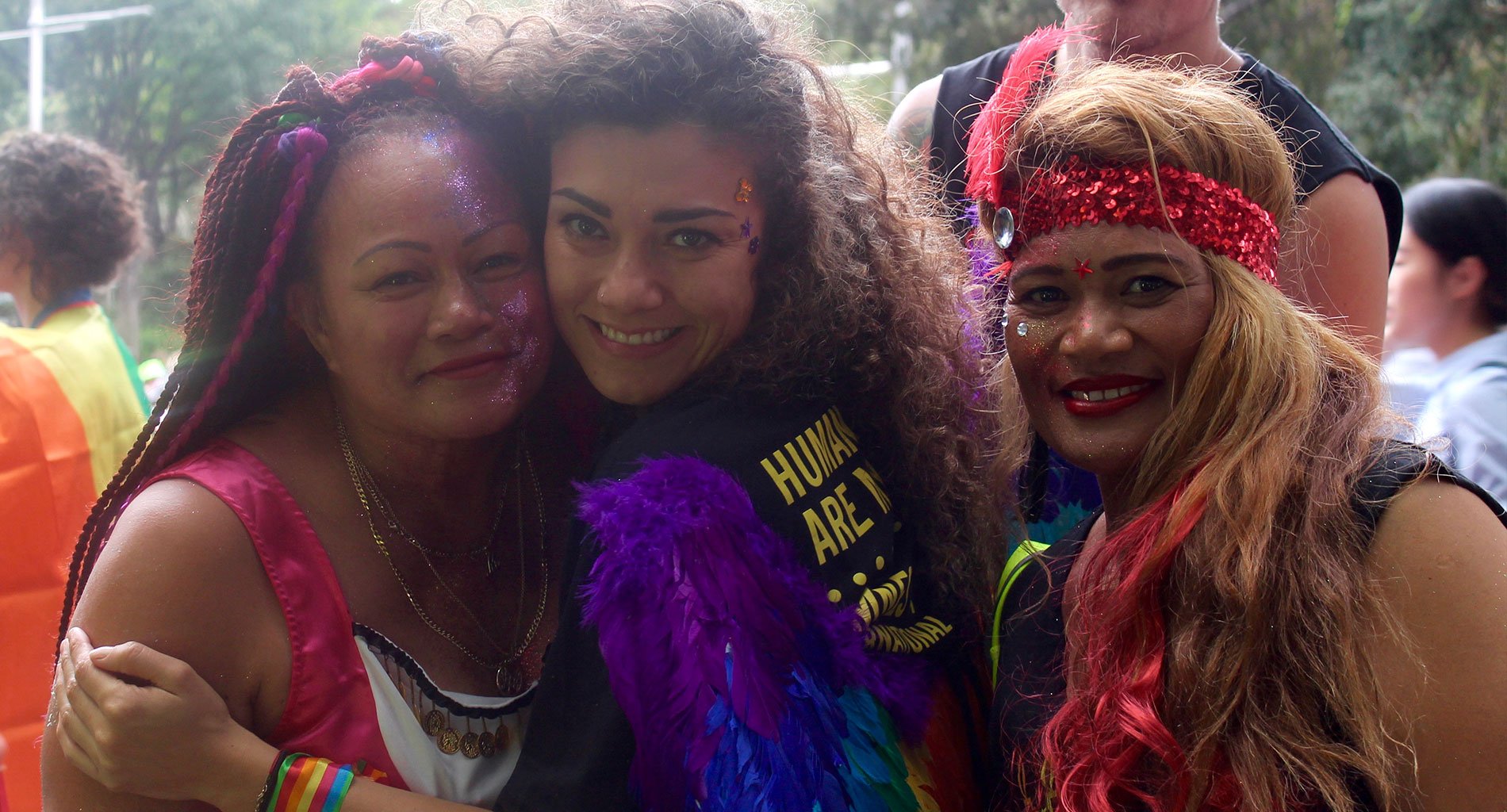
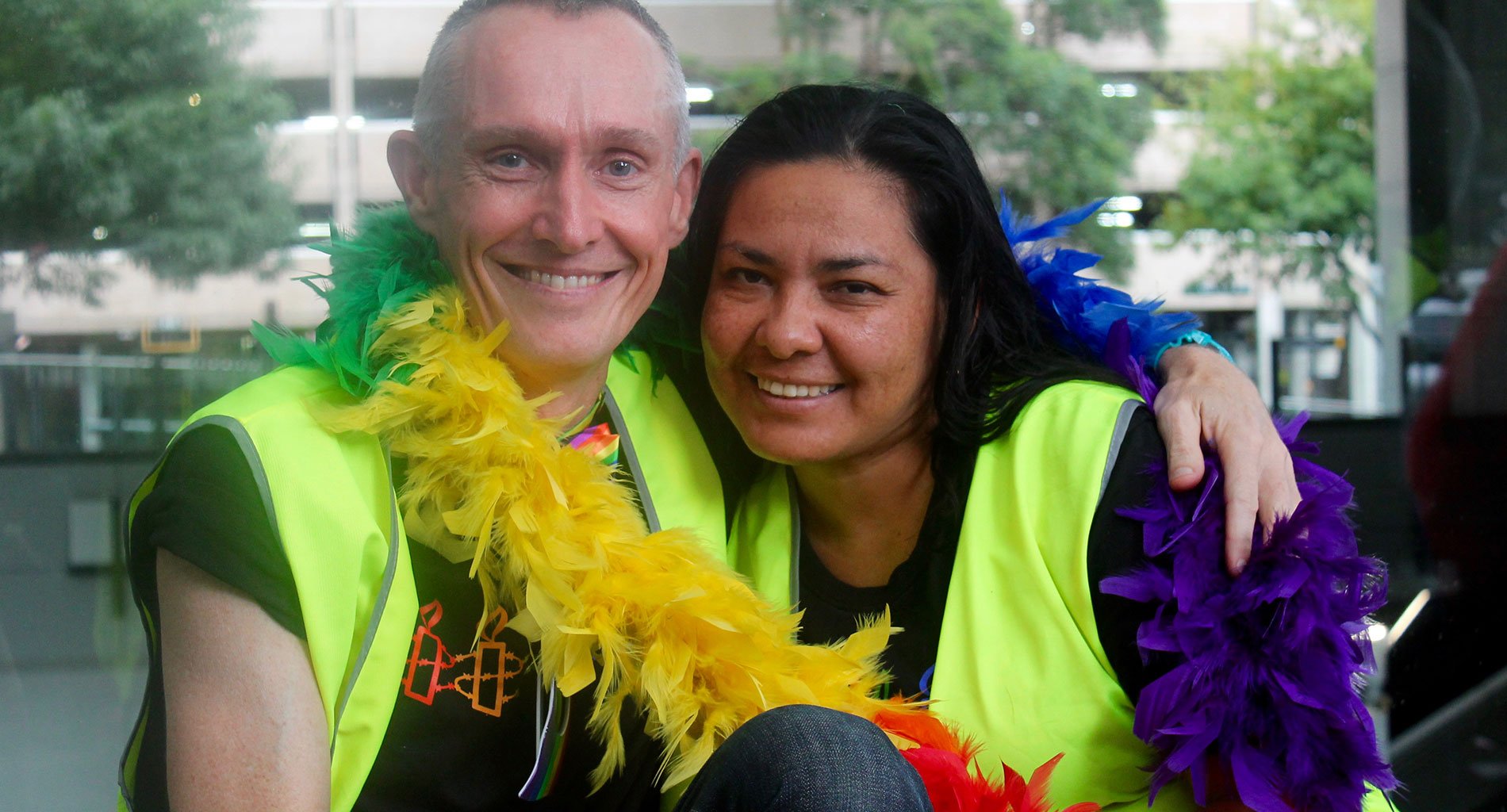
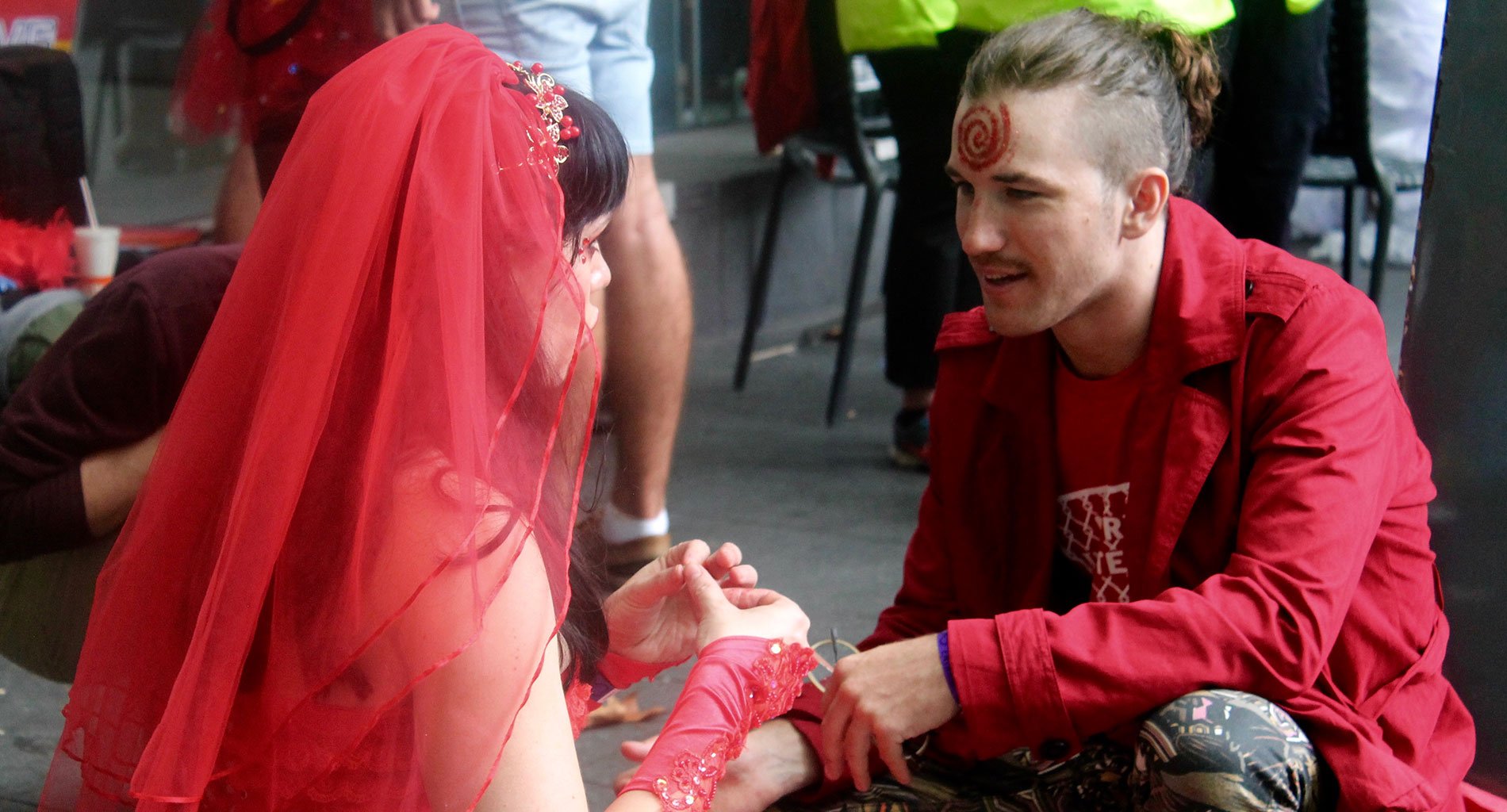
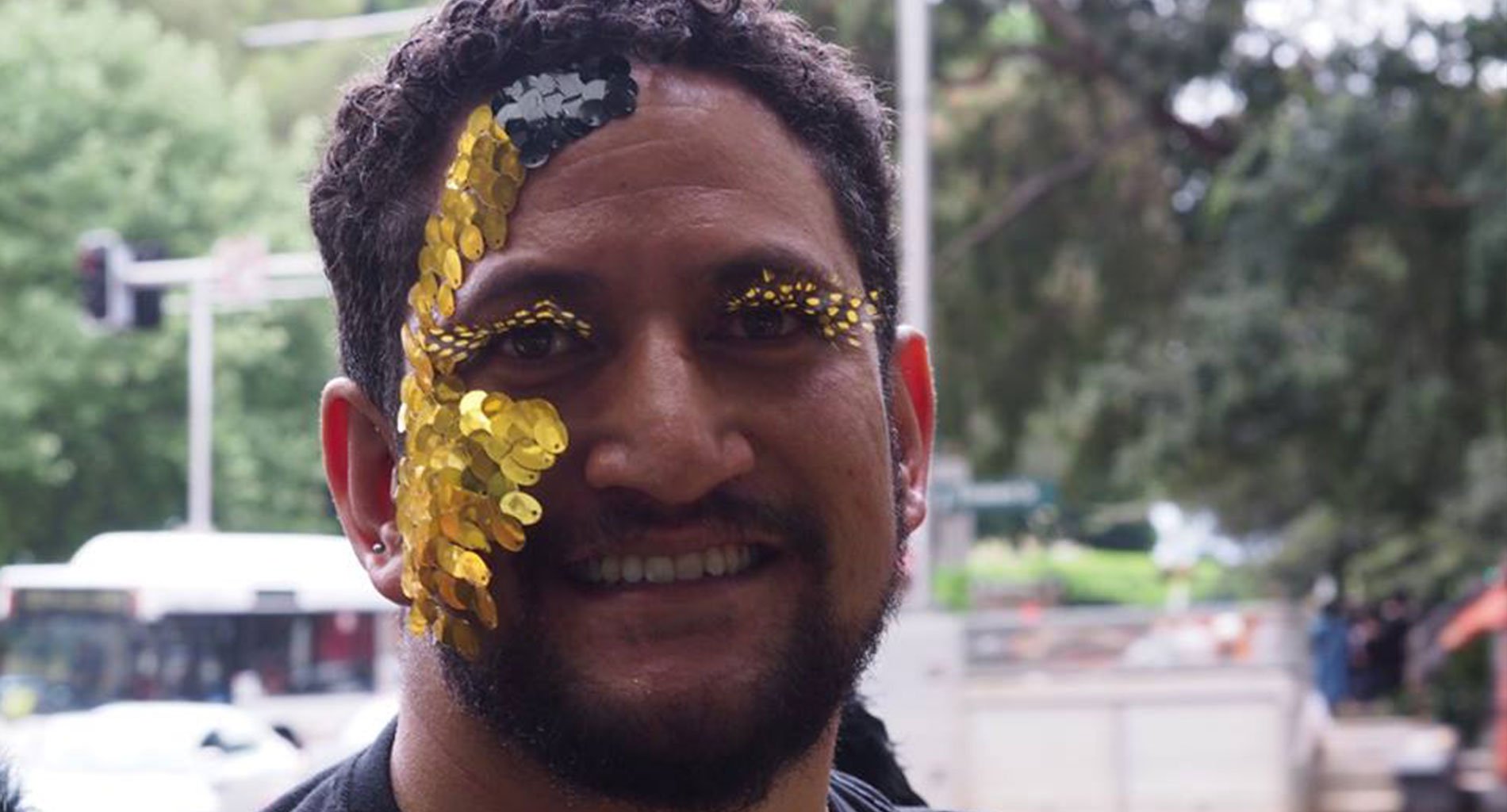
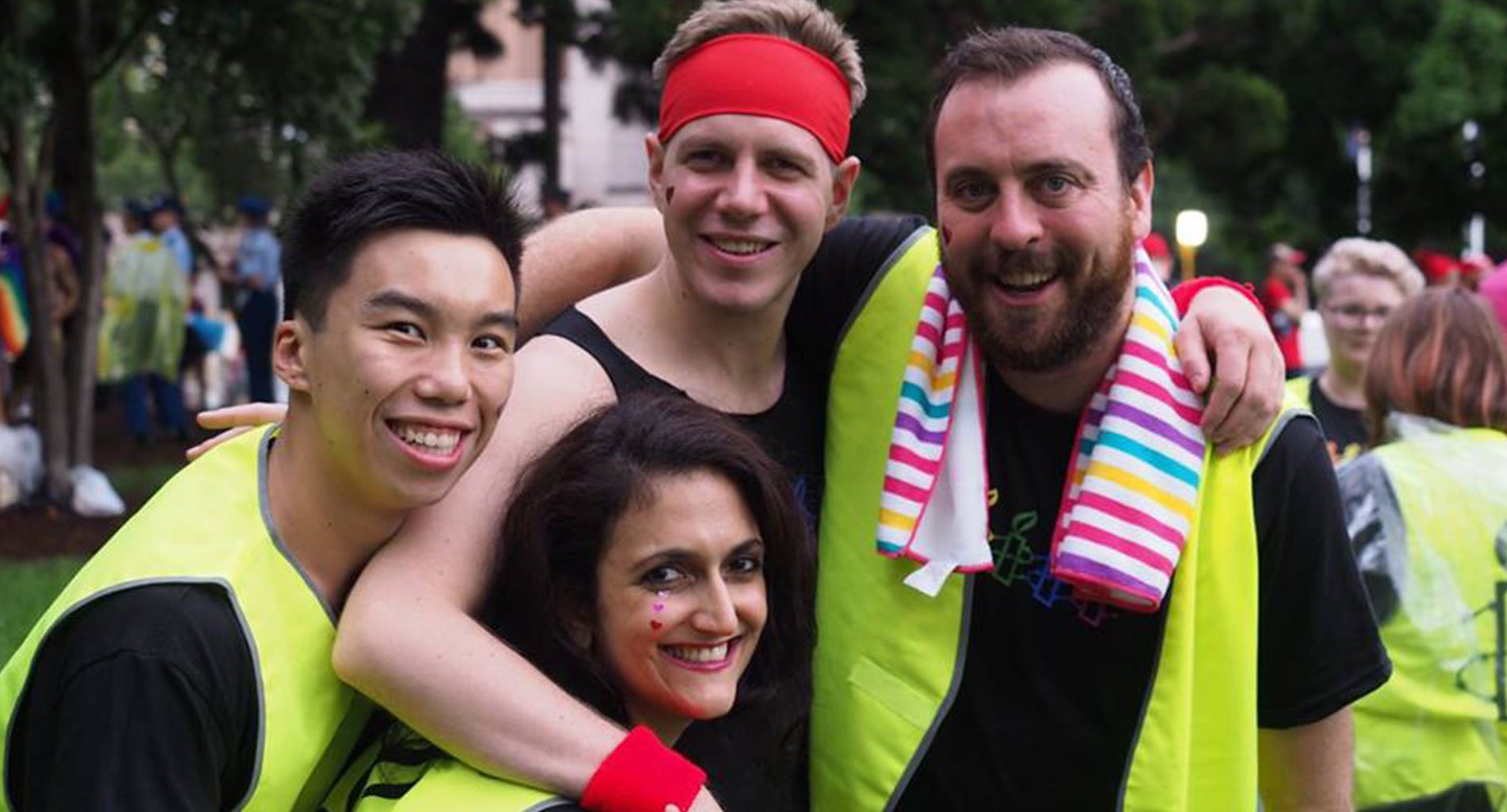
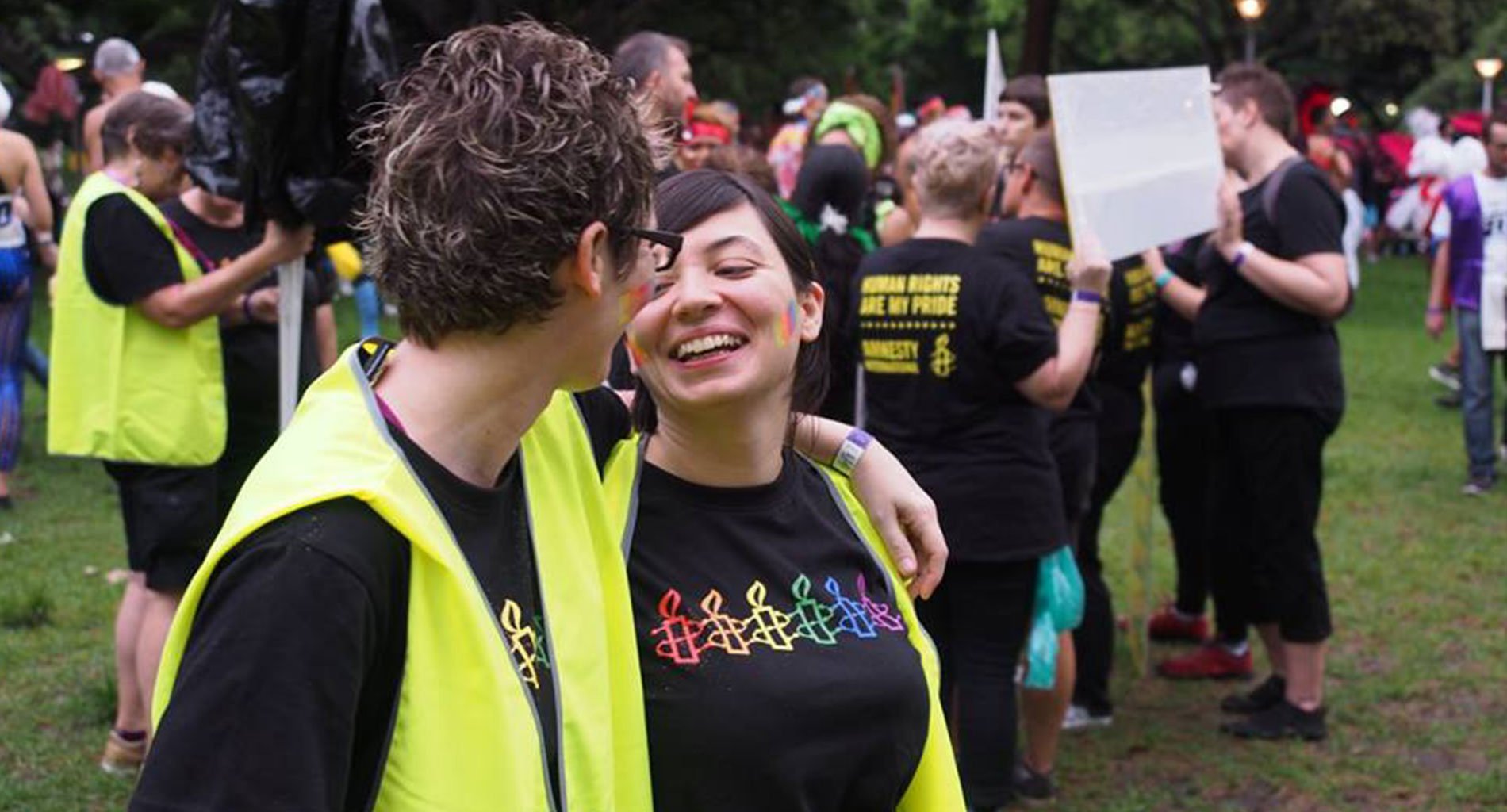
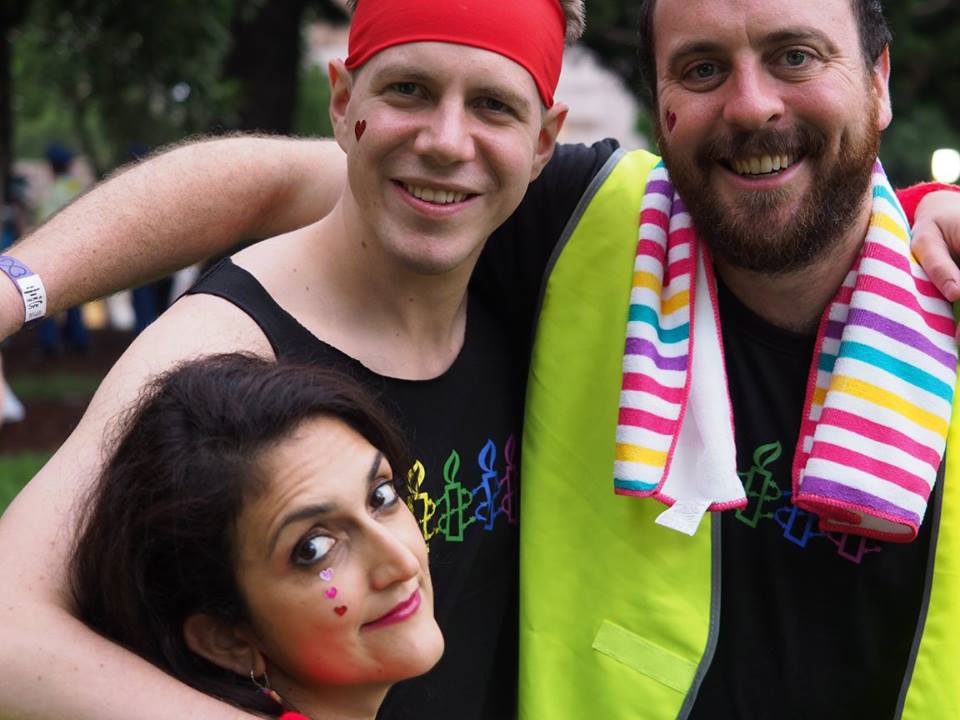
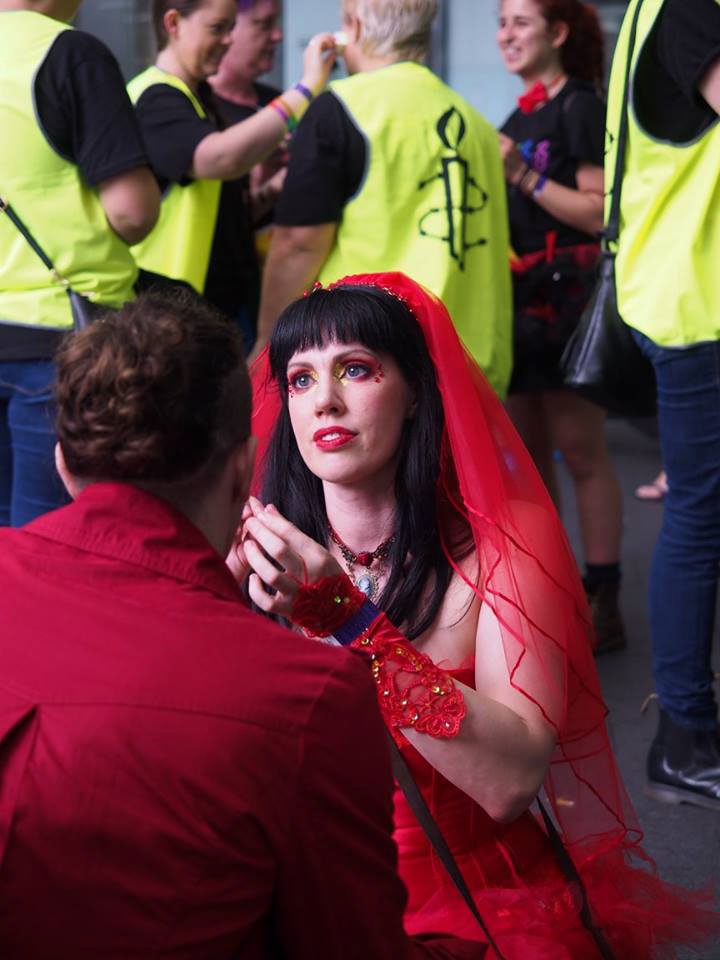
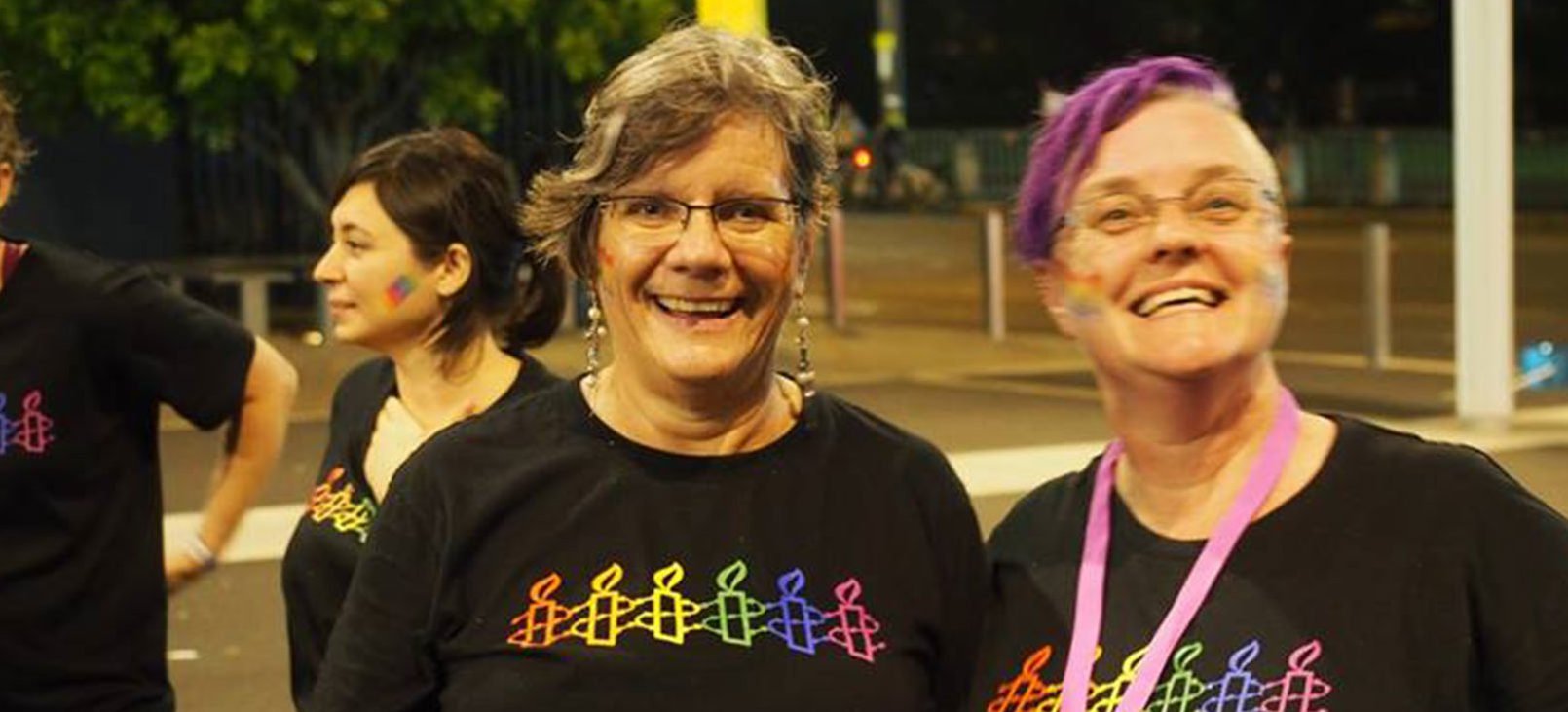
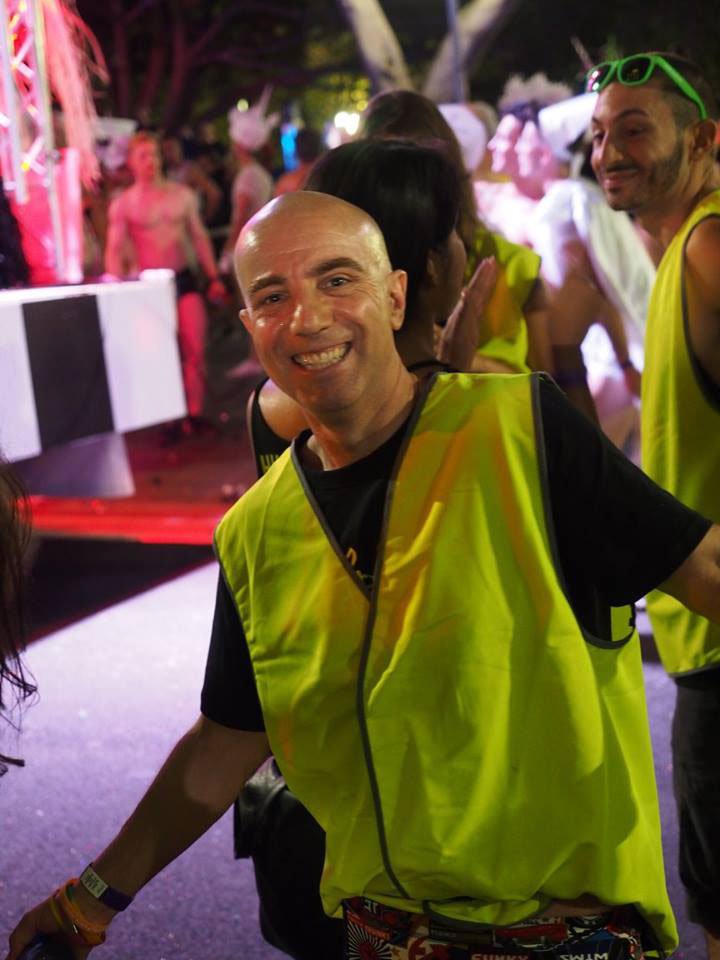
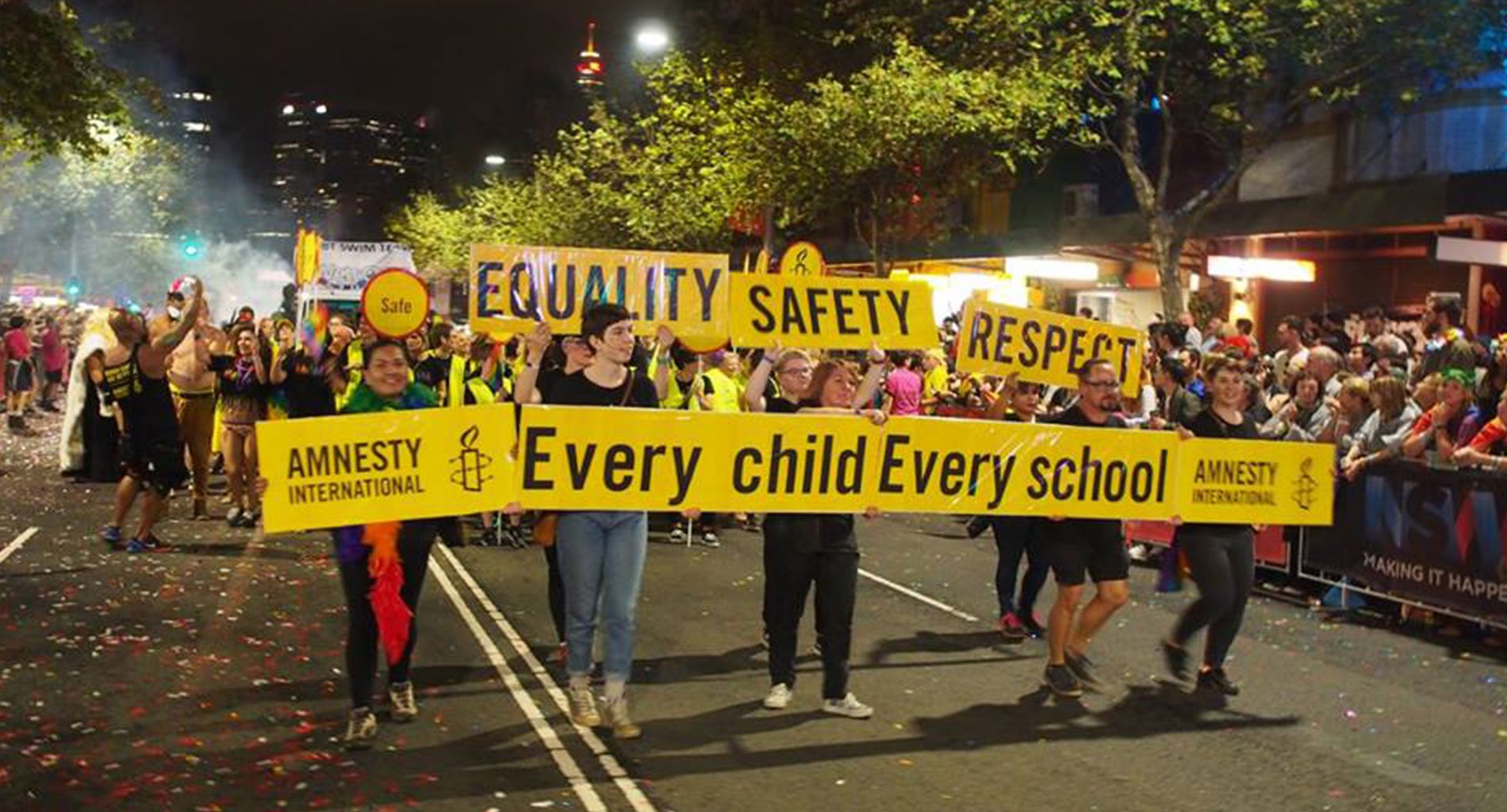
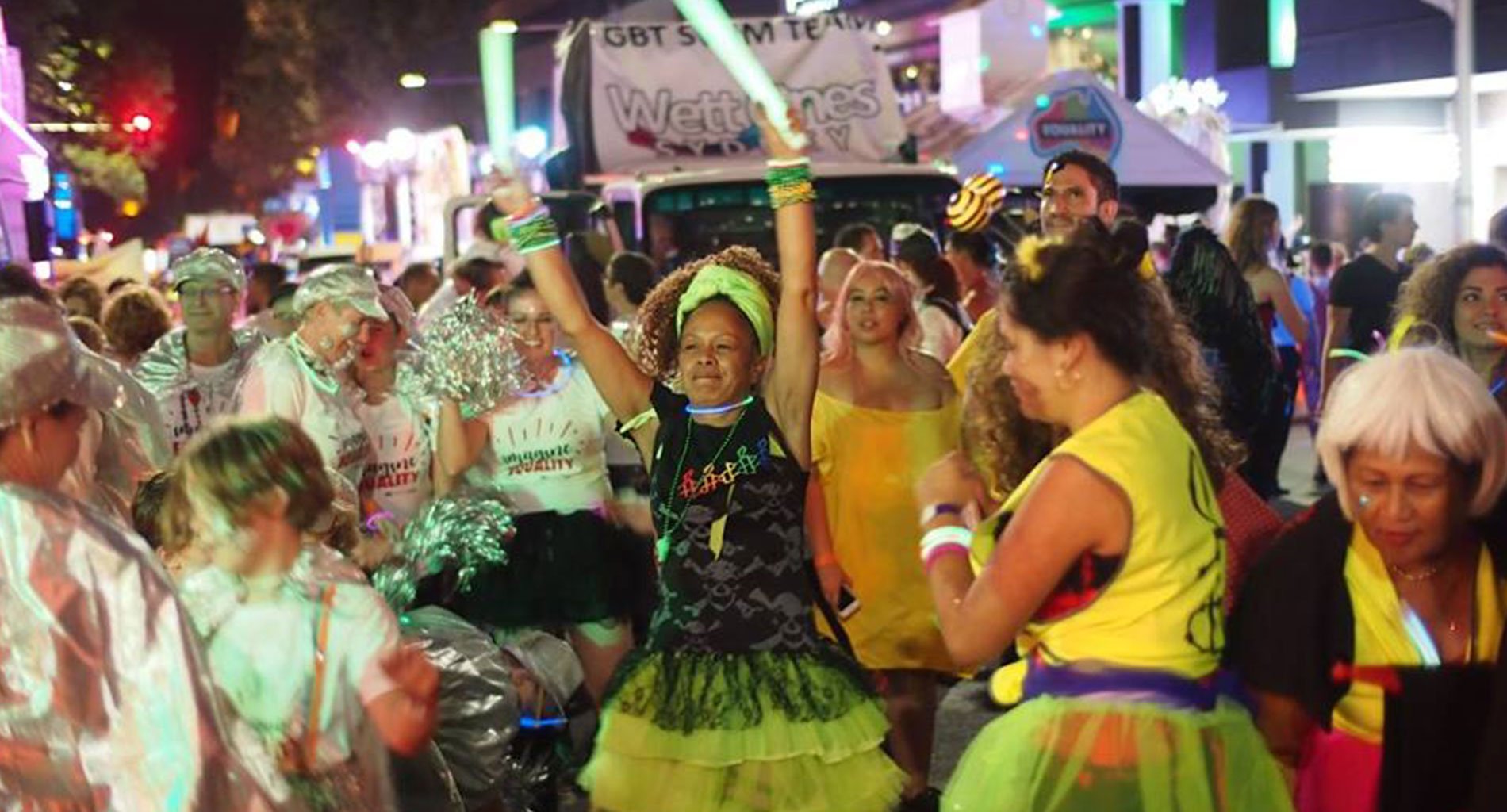
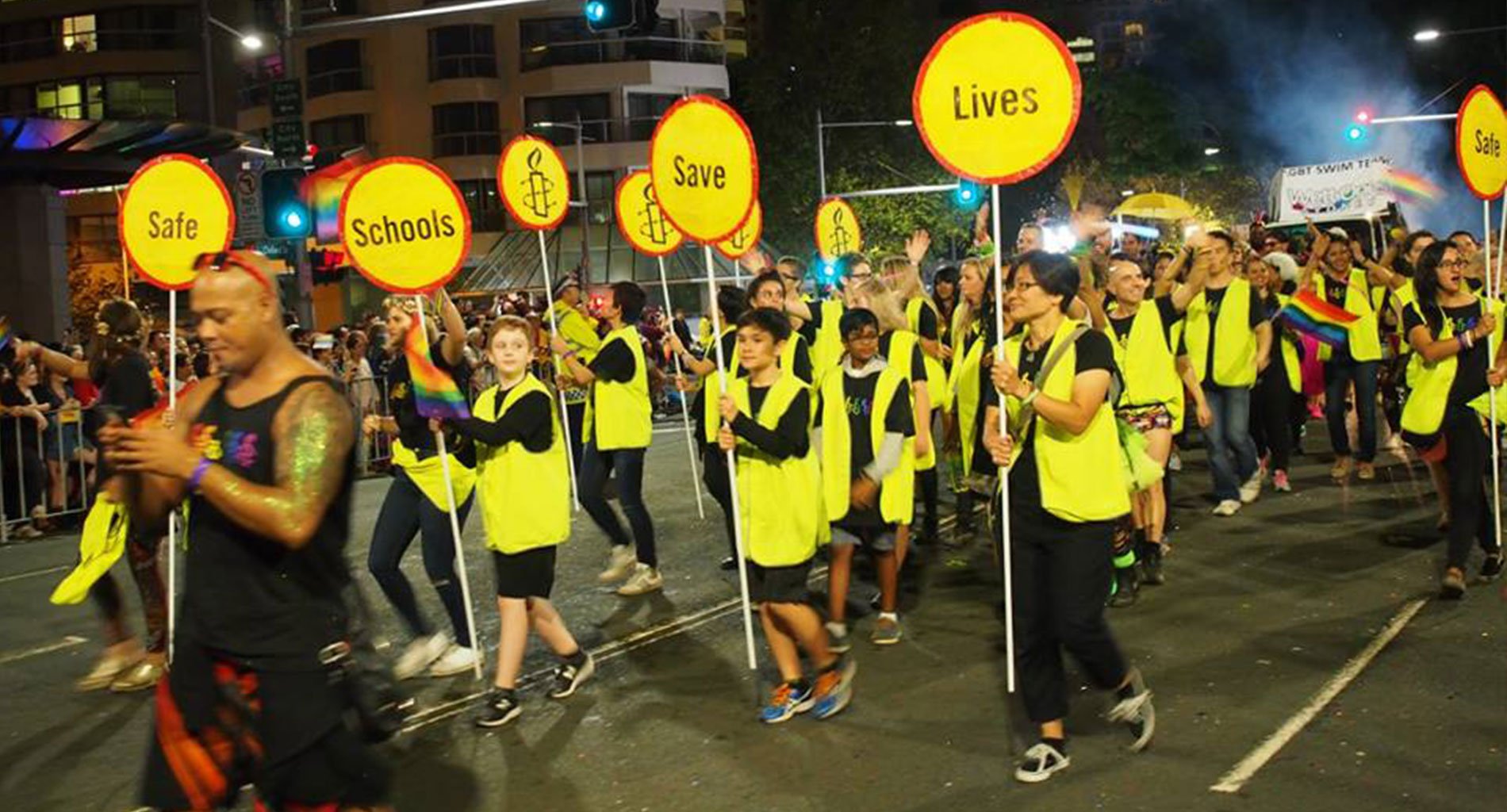
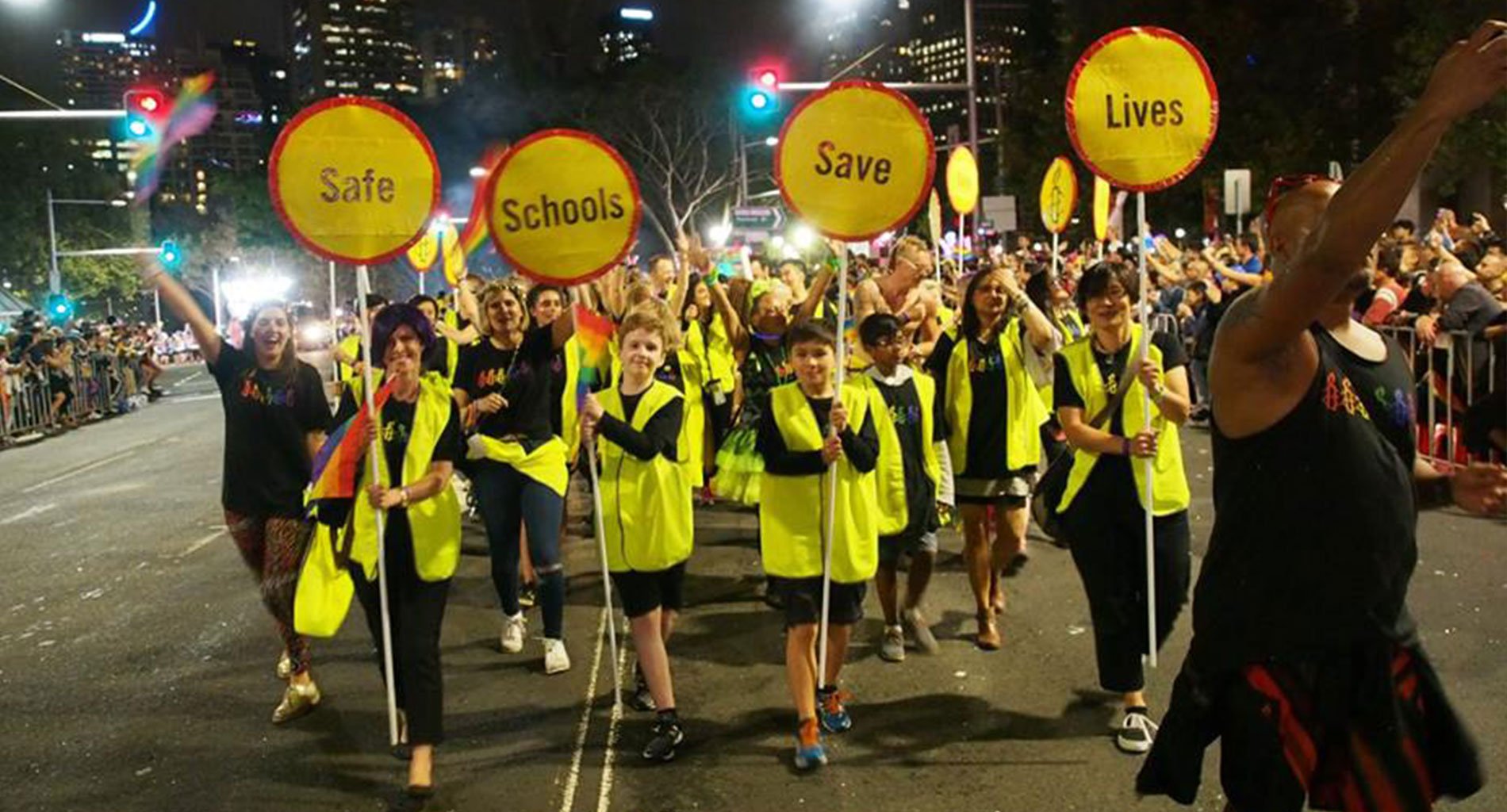
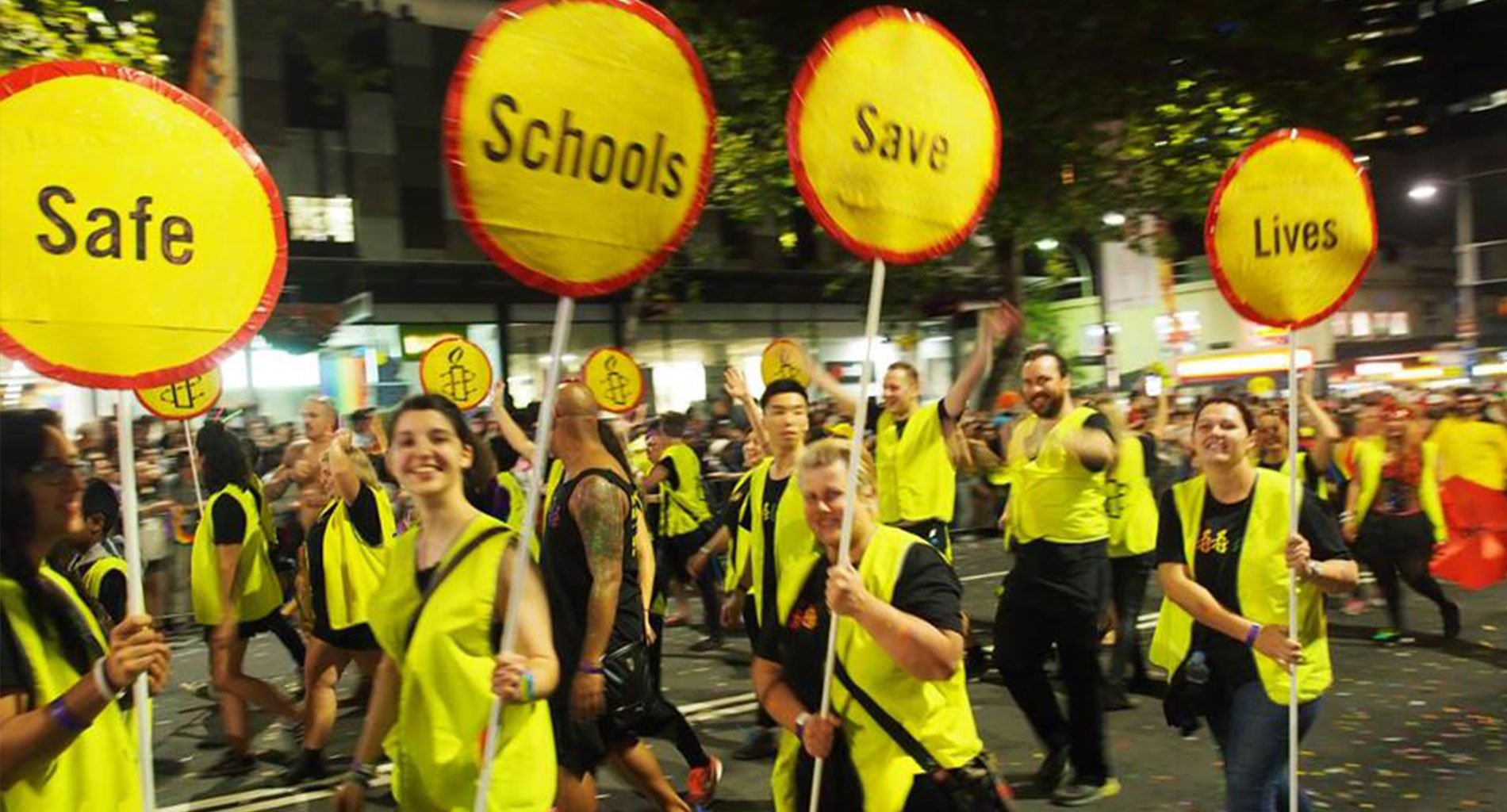
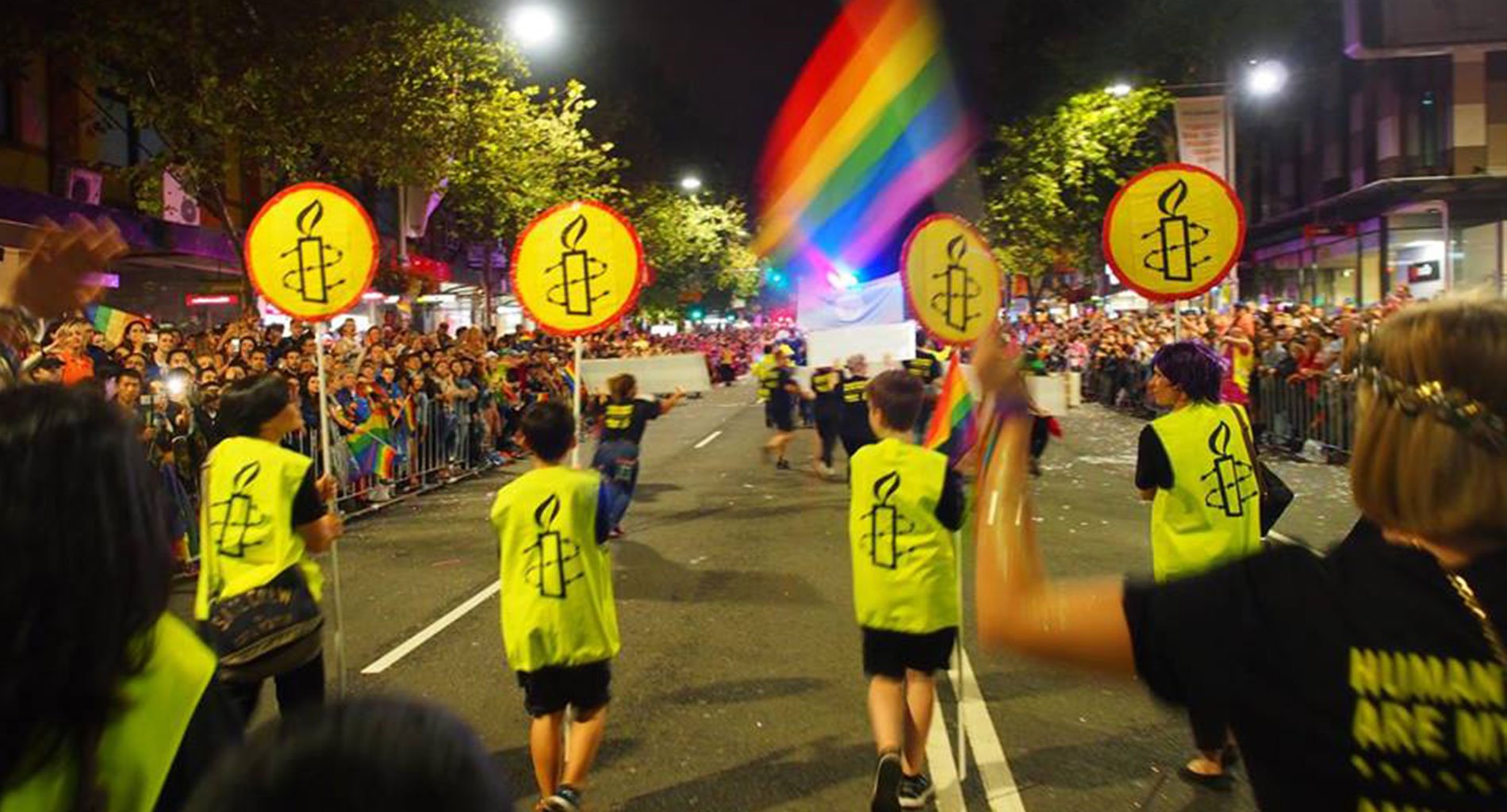
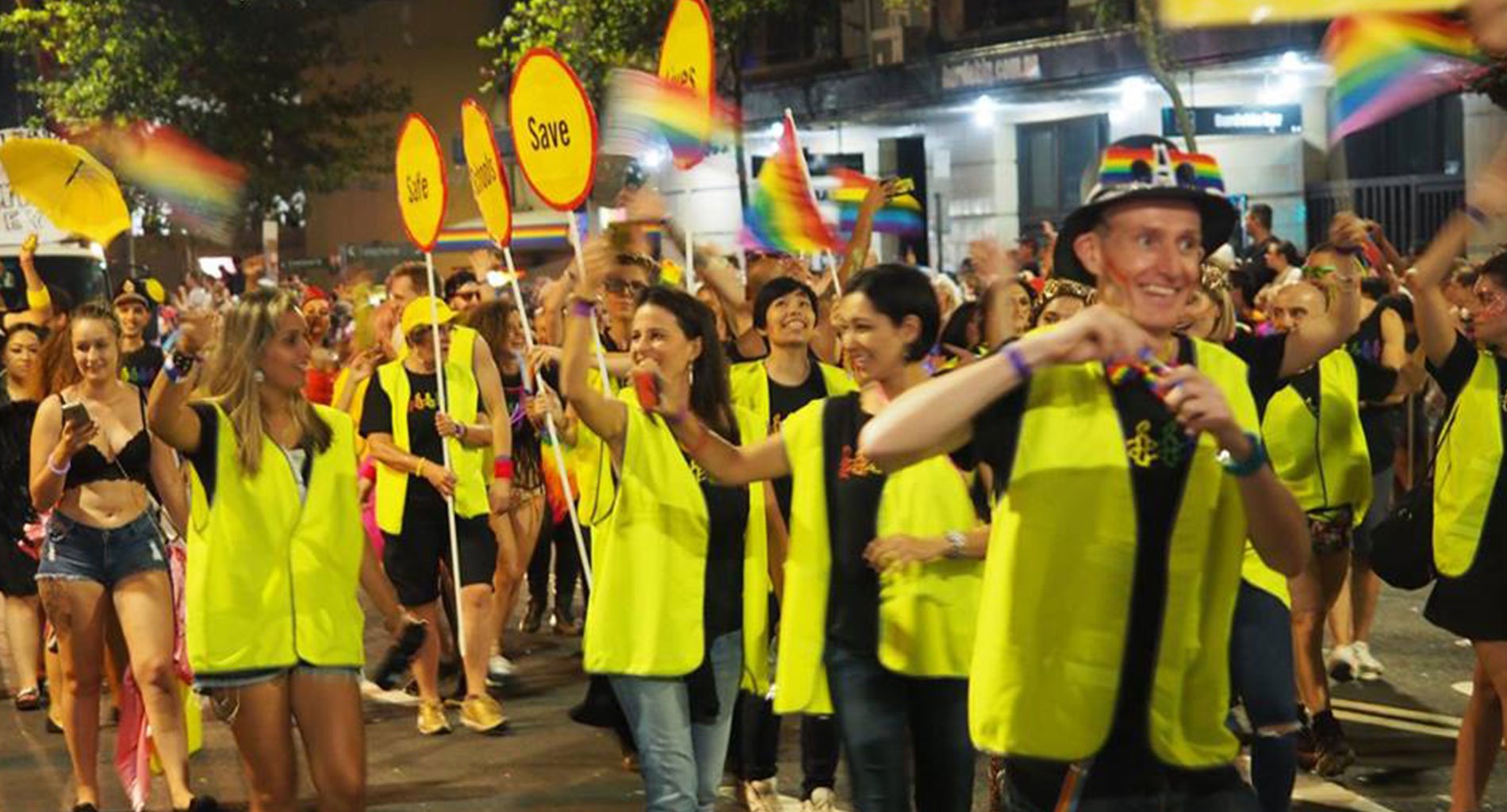
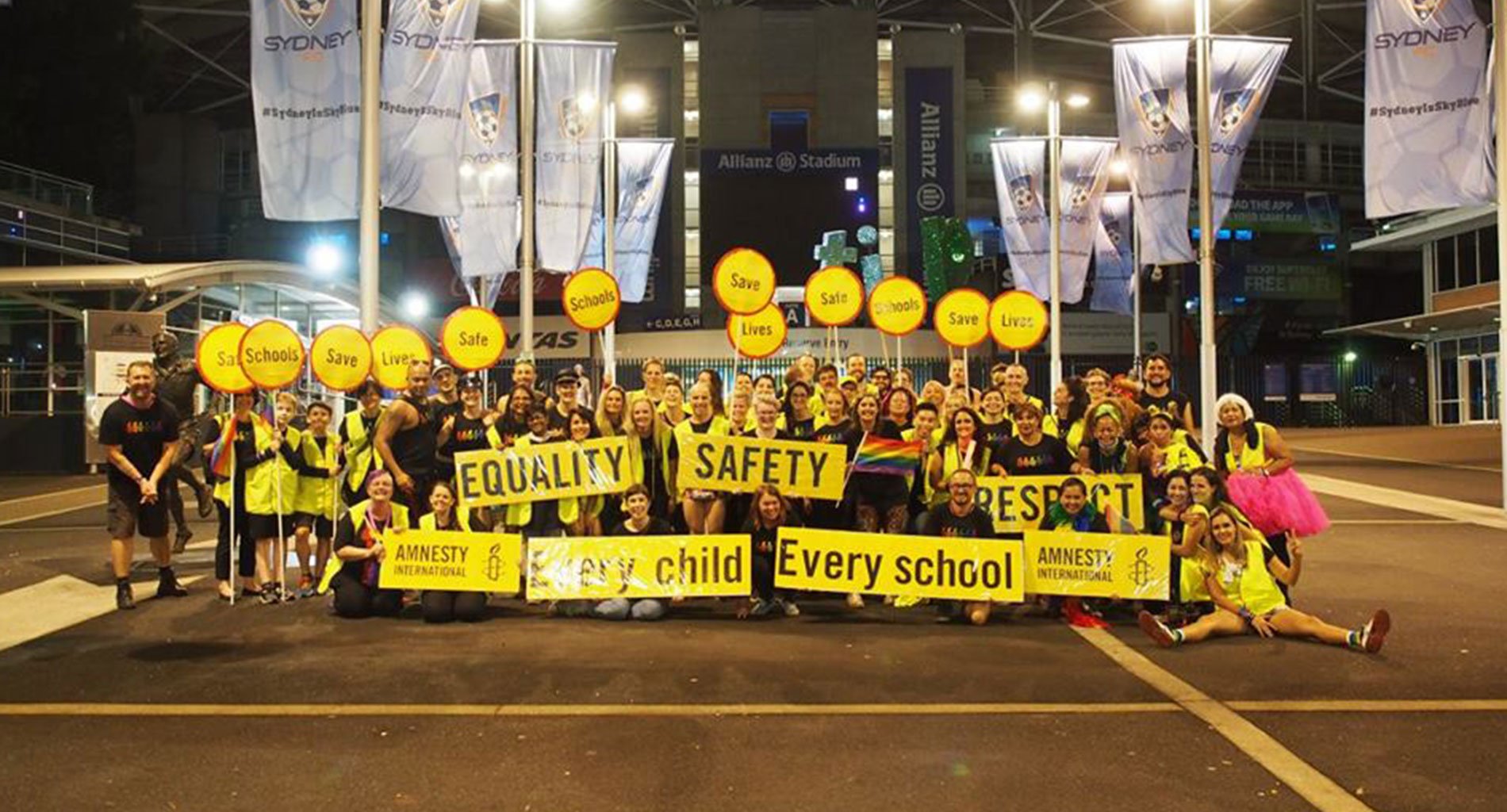
The LGBTQI network is still shaking off the glitter from the parade that brought the Mardi Gras season to a close. As always, a whole bunch of people worked really hard to make the day a success. Call on your Senator to make marriage equality a reality, and use the arrow below to scroll through our Mardi Gras photo gallery.
UPDATE: The Senate is set to vote this week on proposed changes to the Racial Discrimination Act. Any amendment to section 18C will give license to more racism in Australia and will only amplify the horrific experiences of racism shown below.
There’s still time to stop this happening. Share these stories and tweet at key Federal leaders Nick Xenophon, Jacqui Lambie, Richard Di Natale and Bill Shorten telling them you support them to block these damaging changes:
Today the Australian Government introduced a Bill to water down the Racial Discrimination Act — a law that’s in place to make sure that everyone in Australia is protected from harmful racism.
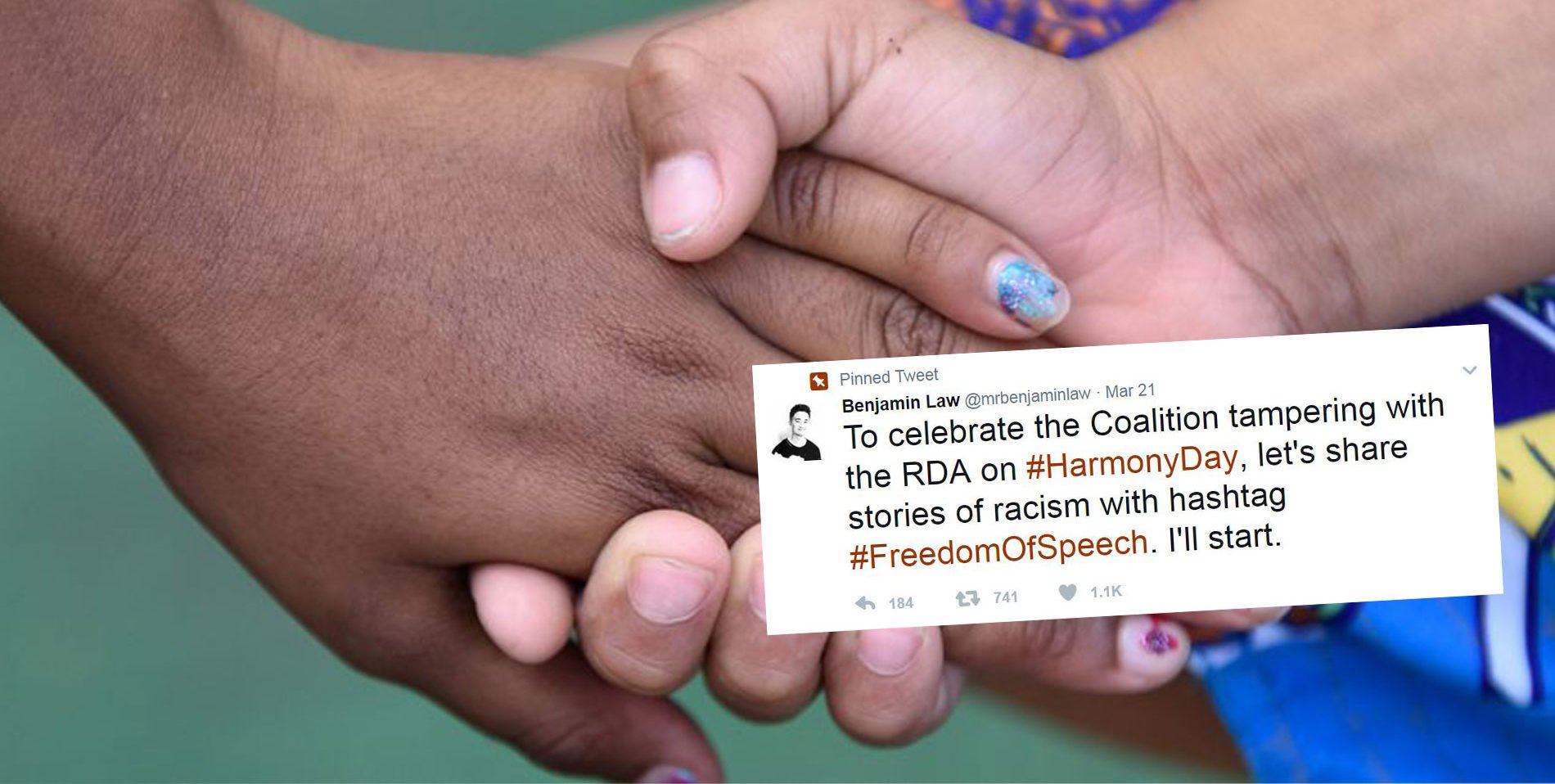
If passed, the changes could weaken the legal protections that we have against racism. In response, Benjamin Law took to Twitter to protest the changes, and thousands joined him to share their experiences of racism with the hashtag #FreedomofSpeech.
Here are some of the most powerful tweets we’ve seen so far. Warning: some of these stories might shock you.
1. The one that kicked it all off
At the age of 10, I was at the local pool as a group of white boys held my head underwater, laughing at me for being Asian. #FreedomOfSpeech
Again, there’s still time to stop this happening! Share these stories and tweet at key Federal leaders Nick Xenophon, Jacqui Lambie, Richard Di Natale and Bill Shorten telling them you support them to block these damaging changes:
And to all the sad, odd folks who tweeted race-hate to me and everyone else today, I’ve said it once, and I’ll say it again: pic.twitter.com/0zJG8w8NbM
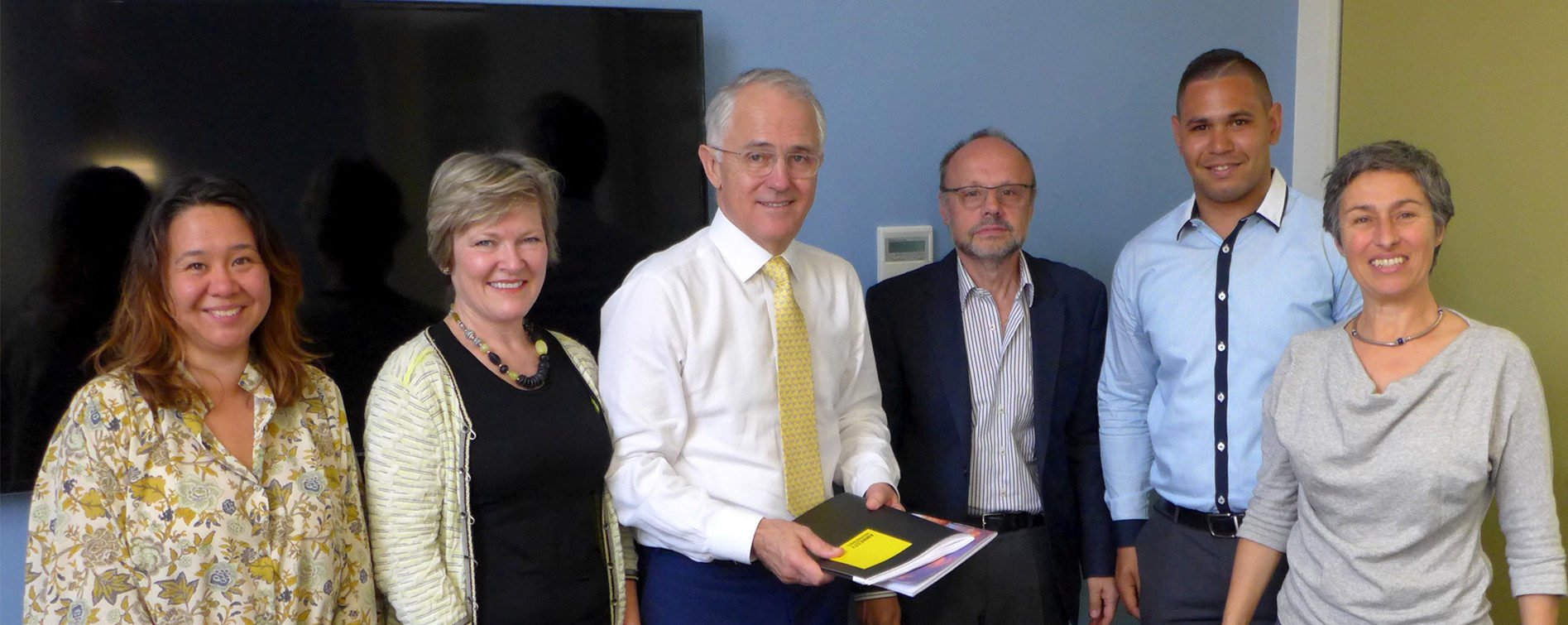
Today the Government, who say they are committed to freedom of speech, have gagged the Aboriginal Legal Services and have failed to hear from any Indigenous people about a bill to change the Racial Discrimination Act.
In response Tammy Solonec, Indigenous Rights Manager at Amnesty International said:
“This flies in the face of Prime Minister Malcolm Turnbull’s promise to “do things with Aboriginal people and not to them” and his recent commitment to the Redfern Statement to meaningfully engage with Indigenous communities about decisions affecting their lives.”
“This act of silencing denies Indigenous people freedom of speech, participation in democracy and does not enable free, prior and informed consent. This is disrespectful to the First Peoples of this country.”
Tammy Solonec, Indigenous Rights Manager
“This act of silencing denies Indigenous people freedom of speech, participation in democracy and does not enable free, prior and informed consent. This is disrespectful to the First Peoples of this country.
“Any amendment to the Racial Discrimination Act gives a green light to racism which deeply impacts on our communities – our mental health, our participation in education and employment, and our physical safety. It is imperative that Aboriginal and Torres Strait Islander people are part of this conversation.
“It is completely unacceptable to silence Indigenous people especially while the Special Rapporteur on Rights of Indigenous Peoples is currently in Australia, and in light of Australia’s upcoming Committee on the Elimination of Racial Discrimination (CERD) review and bid for a Human Rights Council seat, both scheduled this year.”
Amnesty International speaks to a Syrian refugee in Lebanon who fled the war with her family for safety, only to be faced with poverty and uncertainty.
Six years of crisis in Syria, which began in March 2011, have been marred by horror and bloodshed. More than 20 percent of the Syrian population now live as refugees outside of their own country. This is the story of one of those people.
Maria* and her family left their hometown of Hama, Syria for Lebanon 18 months after the war broke out in 2011.
They initially tried to hide in the country’s capital of Damascus, but that only lasted a few months before the fighting spiralled out of control.
“We held out as much as we could, none of us wanted to leave our homes and loved ones. I had a job I loved, my sister was still finishing her university degree … but it was getting too dangerous for us to stay,” she says.
“All of a sudden Christians and Muslims were turning on each other like never before, and women especially were being targeted — it was not safe for us anymore.”
Six years later, the violence in Syria has created 4.9m refugees, mostly women and children, who have desperately taken refuge in neighbouring countries like Jordan, Turkey, and Lebanon.
“I had a job I loved, my sister was still finishing her university degree … but it was getting too dangerous for us to stay.”
In Lebanon, Maria has managed to find a low-paying job to make ends meet, but for how long, no one knows.
According to the latest Amnesty International Annual Report, Syrian refugees in Lebanon face difficulties obtaining or renewing residency permits which would allow them to work, exposing them to a constant risk of arrest, detention and even forcible return to Syria. And according to a 2016 study by UNHCR, 70 percent of Syrian refugee households in Lebanon live below the poverty line. More than 50 percent live in substandard conditions in overcrowded buildings.
A recent report by the Freedom Fund also found that refugees in Lebanon are increasingly falling prey to slavery, child labour and sexual exploitation in a desperate bid to make ends meet.
Despite these conditions, Maria is grateful to have escaped the devastation they left behind in Syria. “I’m very grateful for the opportunity to be living and working here. I appreciate the efforts of the Lebanese people,” she says.
“But UNHCR is overwhelmed, and we are placing too much for a burden on Lebanon as it is. How long until it cracks under the pressure?”
Despite being severely under-resourced, Lebanon currently hosts over 1 million Syrian refugees. Job opportunities are scarce. Access to health and education services is extremely limited, and in most cases, non-existent for refugees.
“…UNHCR is overwhelmed, and we are placing too much for a burden on Lebanon as it is. How long until it cracks under the pressure?”
Maria’s eyes sparkle as she mentions visiting cousins in Australia. As though just the thought of Australia could inspire enough hope to help her deal with the situation she was in.
When other less resourced countries such as Lebanon and Turkey are able to provide a safe haven for hundreds of thousands of Syrians fleeing war and violence, Australia is more than capable of creating a new life for those whose lives have been utterly destroyed by war.
Amnesty believes it is well within Australia’s reach to provide at least 30,000 places per year to refugees like Maria, who can only dream of an improvement to her situation.
Amnesty International Australia provides support and guidance to refugees fleeing from devastation in countries such as Syria.
LGBTQI activist Lizzi Price was recently shocked to come face-to-face with the very hatred and bigotry she fights against – in her local supermarket. Here she shares her story.
Last Saturday afternoon saw me happy but tired after a marvelous International Women’s Day rally, so it took a while to summon the energy to go get some groceries. Meandering through the supermarket aisles, I was distracted by the rainbow design on a man’s shirt. It’s stereotypical, but I love anything rainbow.
To give some context: I identify as lesbian – my hair is purple, short and undercut and I was wearing my parade T-shirt (rainbow Amnesty candles on the front, “Human Rights are My Pride” on the back). There was no mistaking I’m part of the LGBTQI community.
Realising I had started to read the many words on the back of his shirt, I said, “Oh sorry, just reading your shirt”. As those words left my mouth, I realised what I was reading.
This man appeared completely comfortable with wearing a T-shirt – in public – that denied our LGBTQ identities, blamed us for the decline of Western civilisation (yes it really said that) and amongst many other things, labelled us ‘perverts’.
This man had the audacity to confidently wear his hateful T-shirt to the shops.
The last few weeks, with the buzz of Mardi Gras, a little rainbow atmosphere of hope has formed around me. Staring at his T-shirt now, I felt a fire rip through several layers of that hope. I was stunned. What do you say to that level of hatred? Something lame apparently: “Oh it appears our views are opposite”. He shrugged and I stood: body frozen, mind whirling.
“This man appeared completely comfortable with wearing a T-shirt that denied our LGBTQ identities, blamed us for the decline of Western civilisation and amongst many other things, labelled us ‘perverts’”
It’s hard to describe the shock of going to buy toilet paper and coming face-to-face with someone who happily announces to the world they believe you to be perverted. It was like a punch I didn’t see coming. I think I scanned the shop with my gaydar to check no one else was being impacted, only to realise he may wear that T-shirt everywhere.
What do you do in this situation? Confront him? Take a photo of his T-shirt and check the hate speech laws later? Scream? Cry? I fear all those things would probably just embolden him to his cause. I was still processing what to do when he left the shop.
I am more fortunate than many I know, my everyday life usually happens without being presented with such obvious hatred. I know some trans folks, some First Nations people and some who wear hijab, experience this regularly and perhaps I just glimpsed into their world. For me this is where my LGBTQI community throws me a lifeline because together we can challenge the hatred. We have a place to speak out against such hurtful words. We have Mardi Gras.
Mardi Gras: Creating somewhere to be proud
The past month has seen many, many people in the LGBTQI community working endless hours in our own time to create events, art, fun, education, connections, teams, floats and space for a community, somewhere to belong. We’re creating somewhere to be proud and accepted for who we are and somewhere we can find the solidarity to keep fighting for equal rights and full citizenship in our own country. This is what we do every Mardi Gras season – we claim the space to be who we are, we find each other and in a myriad of ways, we fight for equality for ourselves and others.
“I know some trans folks, some First Nations people, some who wear hijab, experience this [hatred] regularly and perhaps I just glimpsed into their world”
This year our float message was: “Equality, Safety, Respect: Every Child, Every School”. This idea came in response to the alarming levels of bullying towards LGBTQI children and young people in school and the profound impact that has on their wellbeing and their ability to access their right to an education.
The float got a fantastic response, but it was the young people in the crowd that will stay in my memory. So many were literally jumping and screaming with excitement and joy to see Amnesty supporting their right to safe education. I wish these kids didn’t have to be surprised by support. I wish it was the norm for all LGBTQI kids to be supported in school and for the Australian community to expect as much from schools.
Of course, I love glitter and I love rainbows but they are not the point. Mardi Gras started as a protest march. It was born out of the discrimination, persecution and violence our community experiences, brought to life by our resilience and feistiness as a way of surviving. Mardi Gras is a celebration, too, but while there are still people down the shops wearing T-shirts declaring us perverted, Mardi Gras will continue to be our way of fighting back, it will remain a protest.
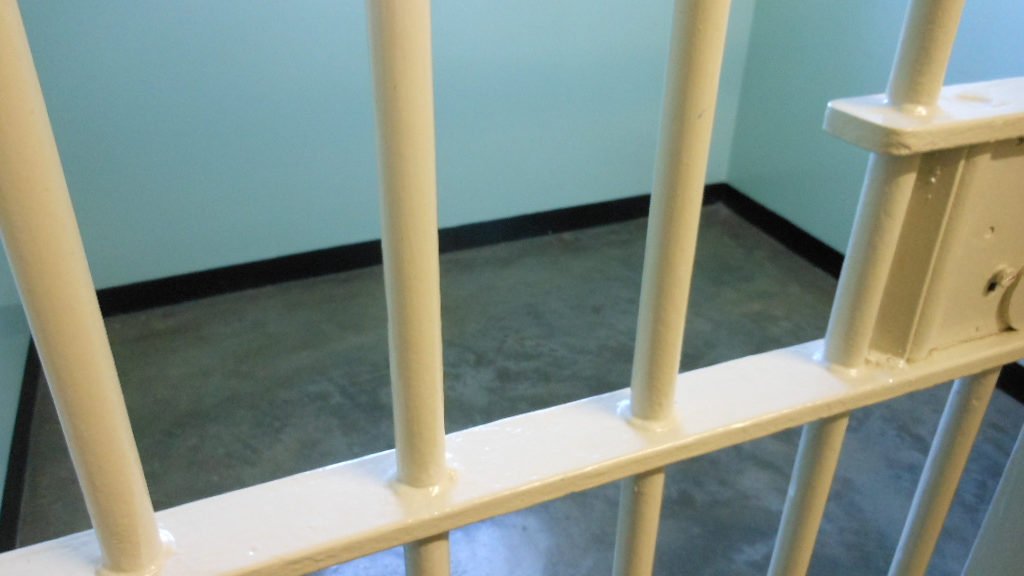
Victorian Premier Daniel Andrews must end the abuse of children and young people, including children being held in solitary confinement in cells with no toilets. The abuse was revealed this morning in a report by the Commission for Children and Young People into the use of isolation, separation and lock downs of children in Victoria’s youth detention centres.
The report highlights disturbing practices at Victoria’s Parksville and Malmsbury youth detention centres and at Barwon adult prison, where children are being held despite the Supreme Court of Victoria’s finding that this breaches Victoria’s human rights charter.
The harrowing findings describe ‘children and young people enclosed alone between four walls with limited access to fresh air, human interaction, stimulation, psychological support and, in some circumstances, basic sanitation.’
The report finds that isolation, separation and lockdown of children are increasingly being used, sometimes for 24 hours or more, in breach of the United Nations Rules for the Protection of Juveniles Deprived of their Liberty (Havana Rules).
Solitary confinement on Premier Andrews’ watch
“Isolation for more than 22 hours without meaningful human contact is solitary confinement and is absolutely prohibited for children under international law. Yet, on Premier Andrews’ watch, on more than 20 occasions children have been locked in isolation for almost every hour of the day and night. Premier Andrews must end this abuse immediately,” said Julian Cleary, Indigenous Rights Campaigner at Amnesty International Australia.
“This report’s findings about conditions of isolation are horrific, with some isolated children forced to relieve themselves in rooms that have no toilets,” said Julian Cleary.
The report also finds that many children who present with mental health issues or at of risk of self-harm are being isolated without adequate access to health staff, education or visitors.
Victoria following the dark path of Don Dale
“The parallels with what occurred at Don Dale are striking. People across the country and the world have been shocked at the abuses of children in Don Dale – and yet the Andrews’ Government has not learned from the horrors there. At the same time as the Northern Territory Royal Commission is airing sickening allegations of systemic abuse in that youth justice system, Premier Andrews is taking Victoria down the same dark path” said Julian Cleary.
Today’s report finds there were more than 50 instances when units were locked down for over 36 hours, forcing all children to remain confined in their cells or units. This is happening more frequently and more unpredictably due to staff shortages.
“It is hardly surprising that there have been tensions at Victoria’s youth justice centres if already traumatised children are being treated this way,” said Julian Cleary.
Aboriginal children traumatised
The report also finds that Aboriginal children are being isolated at disproportionate rates. Koori children make up less than two per cent of the population in Victoria and 16 per cent of children at Malmsbury, yet they make 30 per cent of all children kept in isolation.
Victorian Aboriginal Legal Service (VALS) informed the inquiry that isolation, separation and lockdowns re-traumatise Koori children and young people, who struggle with being removed from country, family and community.
VALS told the inquiry that the incarceration of children and young people is “completely adverse to the nature of Aboriginal and Torres Strait Islander cultural practices, and only serves to further contribute to the breakdown and decimation of cultural practices that began with the onset of colonisation.”
“This should be a wake up call to Premier Andrews that he needs to genuinely work in partnership with the Koori community, to heed the recommendations of the Royal Commission into Aboriginal Deaths in Custody and to invest in local solutions to keep Aboriginal children out of Victoria’s youth justice system,” said Julian Cleary.
United Nations scrutiny
Amnesty International is calling on the Victorian Government to urgently increase investment in ensuring that detention of children is a last resort; remove children from Barwon adult prison; end the use of solitary confinement and excessive lockdowns; and implement the recommendations of the Children’s Commissioner’s report.
Today’s report launch coincides with a visit by the UN Special Rapporteur on the Rights of Indigenous Peoples, Ms Victoria Tauli-Corpuz, who is travelling around the country scrutinising Australia’s dismal record on Indigenous people’s rights.
“The eyes of the United Nations will turn on Victorian Indigenous rights practices when the Special Rapporteur arrives in the state on Tuesday, and she surely will be dismayed by these abuses of children,” said Julian Cleary.
21 March marks the International Day for the Elimination of Racial Discrimination and Harmony Day here in Australia. On this day committed to building a world of equality and dignity, Amnesty International Australia chats with star of Effie – The Virgin Bride, Mary Coustas to discuss Australia’s damaged global reputation.
Since British colonisation, Australia has had a troubled relationship with race. From the initial act of declaring the country to be terra nullius (or uninhabited), to the stolen generations of Aboriginal and Torres Strait Islander children removed from their families, there are many examples of institutional racism in Australia’s history.
Today, despite the multicultural make-up of Australian society – 28 per cent of Australia’s population was born overseas, according to 2016 data from theAustralian Bureau of Statistics – there is still a lingering worldwide perception that Australians are a bunch of racists. This view was reinforced when US-based British comedian John Oliver visited our shores anddescribed Australia as “one of the most comfortably racist places I’ve ever been in”.
In 2017, is this still a fair assessment of our country?
Logie Award-winning writer and performer Mary Coustas, best known for playing a stereotypical Greek-Australian in Acropolis Now, believes it’s fair to describe Australia as racist. “It’s not everywhere, but it’s there,” she says. “You expect better from us, you expect that we would have learnt from what happened in the past but unfortunately we haven’t.
“Anyone who feels overwhelmed by the presence of cultures they don’t have a personal connection to can look to blame whatever target is obvious. And the people that stand out are the ones who look different.”
Coustas first rose to prominence in the late 1980s with Wogs out of Work, a stage show that shone a light on Australia’s melting pot of cultures and reclaimed the word ‘wog’ from a racist insult to a badge of pride. She’s currently on tour with her one-woman show, Effie – The Virgin Bride, reprising her famous character from the original show.
She says she has personally experienced racism in the past, but not so much since becoming a public figure. “If it does happen, it hurts as much as the first time because it catches me off-guard,” she says.
Coustas believes racism in Australia has intensified in the 30 years since Wogs out of Work hit the stage. “Because of what’s happening around the world and the perceived threat of terrorism, it’s dialed up racism as people come to lazy and convenient conclusions,” she says.
“It comes in waves and everyone gets a ride on the racism train. It started with the Greeks and Italians and Lebanese, it went to Asians and now it’s focused on Muslims.”
Anti-Muslim sentiment more prominent
Islamophobia is certainly more prominent than it used to be.Research by Western Sydney University’s Challenging Racism Program, highlighted in a recent SBS documentary, Is Australia Racist?, found anti-Muslim sentiment to be the most pronounced prejudice in Australian society today. In 1998, three percent of Australia’s population had negative views towards Muslims; now that proportion is 32 percent. More worryingly, 77 percent of Muslim women have experienced racism on public transport or the street.
Academic, journalist and TV presenter Waleed Aly, a Muslim Australian, hasspoken out against racism in Australia in the past, arguing that the “polite racism of the educated middle class” is more dangerous than the extreme racist tirades on public transport occasionally captured on video.
Indigenous journalist Stan Grant is another prominent critic of racism in Australian society, grabbing headlines last year with aspeech in which he argued that the “Australian dream is rooted in racism”. In onearticle published in The Guardian, Grant wrote: “Australians are proud of their tolerance yet can be perplexed when challenged on race, their response often defensive.”
Certainly in the field of sport, racism has been a long-standing complex problem. In recent times, Indigenous former AFL player and 2014 Australian of the Year Adam Goodes experienced booing and racist taunts for a number of years before quitting the game in 2015.
“There are serious consequences for those experiencing racism, including poor physical and mental health,” says Roxanne Moore, Amnesty International Australia’s Indigenous Rights Campaigner. “To tackle racism, Australia must fulfill its international obligations to protect against racial hatred, to promote understanding and harmony between cultures.”
“Australians are proud of their tolerance yet can be perplexed when challenged on race, their response often defensive”
Stan Grant
Among all this evidence of racism, however, there is also counter-evidence that the majority of Australians celebrate the benefits of multiculturalism and inclusion. An annualsurvey of Australians’ attitudes to race and multiculturalism by the Scanlon Foundation and Monash University has consistently found that the bulk of Aussies believe that multiculturalism is good for the country – ranging from 83 percent to 86 percent in the surveys between 2013 and 2016.
Similarly, a majority of the population thinks migrants should be able to hang on to their cultural customs and traditions with only a minority (28 percent) believing that ‘it is best if all people forget their different ethnic and cultural backgrounds as soon as possible’. Instead, 66 percent agreed with the proposition that ‘we should do more to learn about the customs and heritage of different ethnic and cultural groups in this country’.
Increasingly, there is also a growing awareness of Australia’s treatment of Indigenous people, and the groundswell of calls to change the date of Australia Day from 26 January – the day Aboriginal and Torres Strait Islander people were dispossessed – to one all Australians can join in celebrating. One date circulated earlier this year by comedian Jordan Raskopoulos in a popular spoofvideo is May 8 – also pronounced ‘Maaate’.
In Coustas’ words: “I’m concerned, but I’m not pessimistic. Culturally, we have access to the world in our own communities. Ninety-five percent of the time it works brilliantly.”
By Andrea Sophocleous. Find out how you can get involved in Harmony Day at www.harmony.gov.au
Prime Minister Turnbull must demonstrate to the United Nations his commitment to Indigenous peoples’ rights, said Amnesty International, as the watchful eye of the UN falls on Australia’s dismal Indigenous rights record – just seven months before the vote on whether Australia secures a Human Rights Council seat.
The UN Special Rapporteur on the Rights of Indigenous Peoples, Ms Victoria Tauli-Corpuz, has landed in Australia for a two-week investigation of issues affecting Aboriginal and Torres Strait Islander Peoples. These include soaring Indigenous incarceration rates that see Indigenous children locked up 24 times more than non-Indigenous children, abuses in detention and Indigenous deaths in custody.
Amnesty International is urging Prime Minister Malcolm Turnbull to seize the opportunity of increased UN scrutiny, and commit to a national action plan to end the overrepresentation of Indigenous children in the youth justice system and switch to an approach for children based on prevention and rehabilitation.
“The Special Rapporteur’s visit comes at a time we’re hearing harrowing allegations from young people brutalised by the youth justice systems in the Northern Territory and Victoria,” said Tammy Solonec, Indigenous Rights Manager at Amnesty International Australia.
Abuse, trauma all over Australia
In recent days, allegations from Northern Territory Royal Commission hearings included guards choking or kicking children or threatening to have them raped by other men. The Commission heard evidence from a male guard who held down a teenage girl while her clothes were forcibly removed. Another boy was allegedly denied treatment for a broken collarbone, and later held in isolation for up to three days after being told his mother had died.
Meanwhile, the Victorian parliamentary Inquiry into Youth Justice Centres on Friday reportedly heard allegations of children having limbs broken due their restraints, and being held in isolation for 23 hours a day.
In Queensland, the government still has not released the findings of a review into that state’s youth detention system, where Amnesty International last year uncovered appalling abuse, such as children being stripped naked with a knife, held in solitary confinement, and being threatened by a guard dog.
PM Turnbull needs national action plan
“We have heard allegations of abuse and trauma in youth detention in every state and territory. This is not just a Victorian issue, a NT issue or a Queensland issue – this is an Australian issue, and Prime Minister Turnbull must show Federal leadership in setting a national action plan to address it,” said Tammy Solonec.
Amnesty International has found that successive Australian governments have failed dismally on several of the recommendations made by the previous Special Rapporteur, James Anaya, on his visit almost nine years ago.
In 2009 Mr Anaya recommended the Australian Government immediately address the disproportionate number of Aboriginal and Torres Strait people in custody. He also recommended that particular attention be paid to women, children, deaths in custody and the proper resourcing of Aboriginal and Torres Strait Islander legal services.
Australia could show global leadership
“Despite this, the overrepresentation of Aboriginal and Torres Strait Islander people in detention has continued to rise, and preventable deaths in custody have continued. Meanwhile, the Aboriginal and Torres Strait Islander Legal Services, Aboriginal Family Violence Prevention Legal Services and Community Legal Centres continue to face funding cuts,” said Tammy Solonec.
“Amnesty International urges Prime Minister Turnbull to create this national plan in genuine partnership with Aboriginal and Torres Strait Islander leaders, experts and organisations, who have a wealth of knowledge about how to end the overrepresentation of Indigenous kids in the justice system”.
By drawing on this knowledge, Australia would be uniquely placed to show global leadership on this issue.
Background
Australia is competing against France and Spain for the a coveted spot on the 47 member Human Rights Council. The election will be decided by a vote at the UN General Assembly in New York in October. If successful, Australia’s term on the Council will run from 2018-2020.
Candidates for election to the Human Rights Council must demonstrate their contribution to the promotion and protection of human rights as part of their candidature (UN resolution 60/251) .
“When I close my eyes, all I see is being with my father again,” Alan Mohamed told me when I met him for the first time in a refugee camp near Athens last July. He and his sister Gyan, who have both suffered from muscular dystrophy since birth, thought that moment might never come.
But, on Thursday night in Hanover, Germany, against all the odds and after a journey that saw them cross four borders and spend the past year stranded in Greece, their family was finally reunited.
Their emotional reunion is the culmination of a seemingly impossible journey that they started together as a family in Syria in the summer of 2014.
Back then, Alan and Gyan, who use wheelchairs, lived in Al-Hakasah, with their parents, two sisters and brother. With the armed group that calls itself Islamic State closing in on the town, the family had no choice but to flee.
After three failed attempts at crossing the border into Turkey, each time being shot at by police, the family eventually managed to reach Iraq. They stayed there for a year and a half before the approach of IS again forced them to escape. From there their father carried on with one of his daughters, and was able to reach Germany.
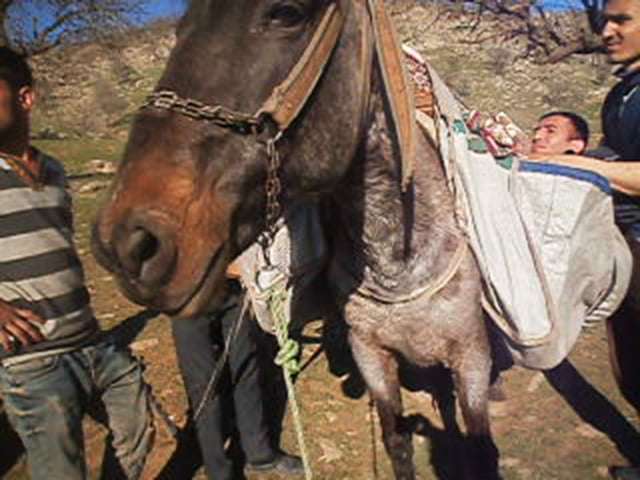
The rest of the family once again attempted to travel to Turkey, but this time via mountainous terrain completely impassable by a wheelchair user. In February last year, Alan and Gyan made the journey strapped onto either side of a horse, which was led by their younger sister. Meanwhile, their heavy wheelchairs were pushed up the steep, unpaved paths by their mother and brother.
‘It is like a miracle’
When I met Alan that summer, he told me: “It was a very difficult journey, for ‘normal people’ it is very difficult. But for disabled people it is like a miracle because all the borders between the two countries [Iraq and Turkey] are mountains.”
Having reached Turkey, the family paid $750 each to a people smuggler for passage to Greece with 60 other people crammed aboard a tiny, inflatable vessel. Alan and Gyan had to leave the wheelchairs behind as the smugglers wanted to use the space to fit more people in.
“Every time I looked around I saw babies and children crying… My mother became faint and at one point my sister told me she could not go on any more”
A short time into the perilous crossing, the boat’s engine gave out and they were left adrift in Turkish waters for around four hours. “It was terrifying,” recalls Alan. “Every time I looked around I saw babies and children crying… My mother became faint and at one point my sister told me she could not go on any more.”
After some passengers eventually succeeded in restarting the engine, they managed to reach Greek waters, where they were rescued by the Greek coast guard. The family were then transferred to the island of Chios, where Alan and Gyan were given wheelchairs.
Their arrival on the island, on 12 March, came just days before the EU-Turkey deal came into effect. This meant that the borders of other European countries were now closed and hopes of a reunion with their father and sister in Germany appeared remote.
The family were made to board a ferry to the mainland and from there were taken by bus to Ritsona refugee camp. Situated on an abandoned military base in the middle of a forest, life in the camp was challenging. The sandy, uneven ground made it particularly hard for Alan and Gyan to get around and the food was so poor that much of it was discarded, attracting wild boars.
Following their first interview with the Greek Asylum Office, at the end of September 2016, the family were moved from Ritsona camp to a hotel in Khorithos an hour north of Athens with the support of the UN High Commission for Refugees.
Then, a week ago they received the news they had been waiting for. On a visit to the asylum office they were told to go home and pack their bags for a flight to Munich and last Thursday night they were reunited with their father and sister at a centre for refugees outside Hanover.
A new life
Alan and Gyan are now ready to settle into their new life in Germany. They are already learning the language and they are aware of the challenges of living in a different country. But they also know how lucky they are, and still think of others languishing in camps in Greece aafter an unforgiving winter.
“I feel very sad for all my friends and all the refugees I have left behind. There are children and babies there and they are in a very bad situation. Please don’t forget them”
“I hope they find a solution for the people who are stuck in the islands… some of them died because of the snow a few weeks ago. It’s very difficult for them. I saw the photos of the people in the islands and it was very painful for me to see them in tents under the snow,” Alan told me.
In 2015 the EU committed to relocate 66,400 people from Greece within two years. As of 10 March, only 9,925 have travelled to other European countries with the relocation program so far. Clearly, Europe can and must do more to accept refugees from Greece through relocation, family reunification or humanitarian visas.
To many, these are mere statistics. But to Alan and Gyan, they include their friends and compatriots. Happily, Alan no longer has to close his eyes to imagine being with his father but as he told me once: “I feel very sad for all my friends and all the refugees I have left behind. There are children and babies there and they are in a very bad situation. Please don’t forget them.”
Your generous gift can help refugees like Gyan and Alan.
The EU-Turkey deal which has resulted in the suffering of thousands of refugees and migrants is a stain on the collective conscience of Europe, said Amnesty International on the first anniversary of the agreement.
The deal aimed at returning asylum-seekers back to Turkey on the premise that Turkey is safe for them, has failed on its own terms but left thousands exposed to squalid and unsafe conditions on Greek islands.
“Today marks a dark day in the history of refugee protection: one in which Europe’s leaders attempted to buy themselves out of their international obligations, heedless of the cost in human misery.”
John Dalhuisen, Amnesty International’s Director for Europe.
“Today marks a dark day in the history of refugee protection: one in which Europe’s leaders attempted to buy themselves out of their international obligations, heedless of the cost in human misery,” said John Dalhuisen, Amnesty International’s Director for Europe.
“A year ago, the Greek islands were transformed into de facto holding pens, as Europe’s shores went from being sites of sanctuary into places of peril. One year on, thousands remain stranded in a dangerous, desperate and seemingly endless limbo.”
“A year ago, the Greek islands were transformed into de facto holding pens, as Europe’s shores went from being sites of sanctuary into places of peril. One year on, thousands remain stranded in a dangerous, desperate and seemingly endless limbo.”
The majority of asylum seekers in the camps are not allowed to leave the islands. They are corralled in overcrowded, squalid conditions and at times, have been victims of violent hate crimes. Five refugees on Lesvos, including a child, have died as a result of circumstances strongly linked with these conditions.
Although European leaders maintain the fiction that Turkey is a safe third country for refugees and asylum seekers, Greek courts have so far blocked the return of Syrian asylum-seekers to Turkey on this basis.
Amnesty International has nonetheless documented how some Syrian asylum-seekers have been forcibly returned to Turkey without having access to asylum and without being able to appeal against their return, in breach of international law. Others have ‘voluntarily’ returned to Turkey because of the misery on the Greek islands.
The anniversary of the deal coincides with a deadline for lawyers to submit additional evidence on a case being considered by Greece’s highest administrative court which will determine whether Turkey can be considered a “safe country” for refugees.
The case involves “Noori”, a 21 year old asylum seeker, who has been unlawfully detained for more than six months after his asylum claim was declared inadmissible by Greek courts on the basis that Turkey is a ‘safe third country’ for him. Depending on the court’s decision, he could be immediately sent back to Turkey. The verdict, expected within the month, could set a precedent and could open the floodgates for further returns.
Instead of trying to return asylum seekers and refugees to Turkey, where they do not have effective protection, the EU should be working with the Greek authorities to urgently transfer asylum-seekers to mainland Greece for their cases to be processed. European governments should provide asylum seekers with access to relocation or other safe and legal ways to other European countries such as family reunification or humanitarian visas.
Despite its manifest failures and flagrant breaches of international law, the EU-Turkey deal has been touted by some European leaders as a model that could be replicated in agreements with other countries.
The fact that European leaders are heralding as a success a deal which has caused such immeasurable suffering exposes the fact that the EU-Turkey deal has nothing to do with the protection of refugees and everything to do with keeping them out of Europe,” said John Dalhuisen.
“The EU-Turkey deal is a stain on the collective conscience of Europe. As it enters its second year it should not be seen as being a blueprint for other deals, but rather a blueprint for despair for thousands of desperate people who have fled war and conflict in search of sanctuary.”