On human rights, Australia faces a stark choice

Don Dale youth detention centre. Manus. Nauru. Many Australians visited these places in 2016, if only in their imagination.

In reality, a small number of people witnessed firsthand what was happening – or worse, lived through it. Even fewer spoke up about it, but their courage made the difference. Horrors committed every day and long kept out of sight were exposed for everyone to see. It was a wakeup call for Australia as we were named and shamed across the world.

This week, Amnesty International releases its global state of human rights report for 2016. And what a year it was.

Among those on the list are all-too familiar offenders such as North Korea, China, Myanmar,  Russia, Saudi Arabia, Sudan and of course Syria. Torture, the use of outlawed weapons such as cluster bombs and chemicals, rape used as a weapon of war, unlawful arrests and detention; and government sanctioned murders of civilians are all sadly documented by Amnesty in our report.

The report documents war crimes committed in at least 23 countries, 22 countries where people were killed for peacefully standing up for human rights and 36 countries forcibly returned people to danger, including Australia.

“In the US, an election campaign marked by discriminatory, misogynist and xenophobic rhetoric, triggered serious concerns about the strength of future US commitments to human rights”

2016 was a year marked by crisis and division, as well as the continued erosion of liberties perpetrated under the guise of state security and countering terrorism. In France, heavy-handed security measures under the prolonged state of emergency included thousands of house searches, as well as travel bans and detentions. In the United Kingdom, a new surveillance law granted significantly increased powers to intelligence and other agencies to invade people’s privacy on a massive scale.

More ominously, politicians seized on fear, stereotyping and nationalist slogans to win votes in the United States, United Kingdom and across Europe. A spike in hate crimes was reported following the UK referendum on European Union membership. In the US, an election campaign marked by discriminatory, misogynist and xenophobic rhetoric, triggered serious concerns about the strength of future US commitments to human rights. Events since the arrival of the Trump administration have further raised the alarm: We can take nothing for granted.  

On home soil

Meanwhile in Australia, it was the year in which abuses long carried out in secret were  brought out in the open. The harrowing images of abuse in the Northern Territory’s Don Dale juvenile detention facility resulted in Australia being named and shamed around the world.

The publishing of the ‘Nauru files’ and Amnesty International’s research brought global attention to Australia’s abusive policy of offshore detention for refugees and people seeking asylum – a policy the Government implicitly acknowledged to be untenable when it announced an agreement with the United States to resettle some of the people warehoused on Nauru and Manus Island.  

These stories crash-landed in public not because the Government wanted people to know about them, but because a few brave people – journalists, former contractors, refugees and children held in detention – spoke up against injustice, often at great risk to themselves.

To its credit, the Government has responded with a commitment to addressing the failures of the youth detention system, which locks up Indigenous kids at a rate 24 times higher than non-Indigenous kids, and to finding solutions to the plight of those stuck on Manus and Nauru.

Also promising is the recent announcement that Australia will finally ratify the Optional Protocol on the Convention Against Torture (OPCAT), which will allow independent inspection of places of detention and act to prevent future abuses.

“The poisonous ‘us vs them’ rallying cries that many politicians have used to gain popular support are fuelling a global backlash against human rights and weakening efforts to address mass atrocities”

Against this progress, however, runs the heavy global current of intolerance, scapegoating and authoritarianism that has swept through democratic societies in the past year. There are undeniably serious grievances driving this trend, but the poisonous ‘us vs them’ rallying cries that many politicians have used to gain popular support are fuelling a global backlash against human rights and weakening efforts to address mass atrocities.

As rhetoric becomes reality, it is more urgent than ever that we stand up against injustice and abuse. In the United States, President Trump has indicated he plans to reintroduce torture practices like waterboarding and to reopen CIA ‘black-site’ prisons. He has also issued executive orders that halt refugee resettlement and attempt to prevent people from majority-Muslim countries from entering the United States.

In response to these outrageous affronts to human rights and basic decency, what has our government said? Nothing.

Silence in the face of bullying and abuse is as good as consent.

Australia is hoping this year to win a seat on the UN Human Rights Council. This is an opportunity for our government to be consistent in terms of human rights and show the leadership that the world needs. We have been a leader in the past – we helped write the Universal Declaration of Human Rights, and we need to show that leadership once more.

Last year over 40 countries passed legislation to protect and defend human rights. They said no to torture, no to the death penalty, no to child marriage, and yes to protecting the most vulnerable in the community.

And ordinary people courageously stood up to protect human rights. People like Australian whistleblower Sandra Bartlett shone a light on the abuses on Nauru and nurse Nurse Khaled Naanaa from Syria saved hundreds of lives. They took a stand to ensure that everyone, everywhere has a fair go, equality, justice and dignity.

Now is the time for our leaders to show the same courage.
Queensland must shine light into youth detention to stop abuse of children


The Queensland Government must encourage transparency in youth detention centres and police watchhouses, when it establishes the new independent inspectorate of correctional services.


In a positive move, Queensland last week agreed to establish an independent inspectorate for adult prisons, but has not committed to giving the inspector access to all places of detention – including the centres where brutal abuses of children were exposed last year.


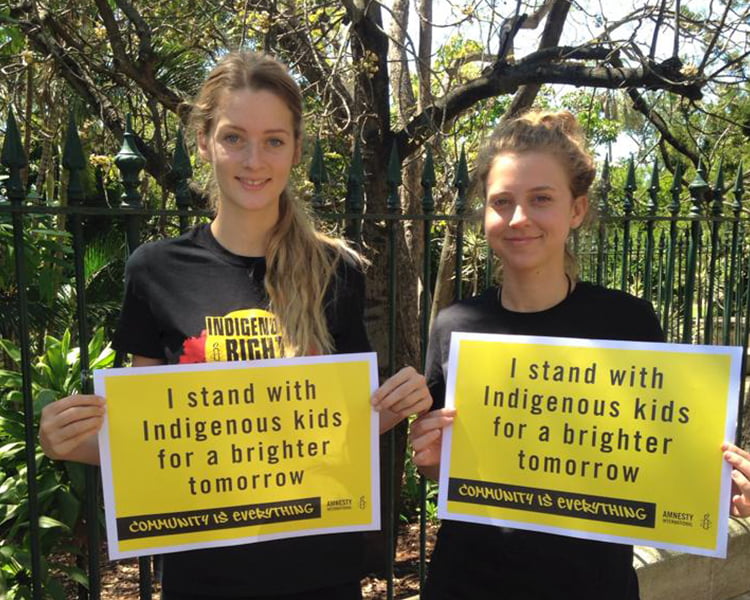
Aboriginal and Torres Strait Islander children bear the brunt of this abuse, being 22 times more likely to be locked up in Queensland than non-Indigenous children.


Shine a light


“The decision to set up an independent inspector of prisons is a welcome step. The inspector must shine a light into all the dark places in Queensland where people are locked up, especially children. It’s the only way to ensure the abuses of children in Cleveland and Brisbane youth detention centres never happen again,” said Roxanne Moore, Indigenous Rights Campaigner.


Establishing the Independent Inspectorate in Queensland is a step towards complying with the Optional Protocol on the UN Convention against Torture, which Australia is due to ratify later this year.


Dogs, knives, solitary confinement.


Last year Amnesty International revealed shocking treatment of children in Queensland’s youth detention centres, including the use of a dog to intimidate an Indigenous girl; a boy being forcibly stripped naked with a knife; solitary confinement; and harsh use of restraints.


The exposé sparked an independent review into youth detention, which handed its findings to the Government in December, but they still have not been publicly released.


“It has been three months since the Youth Detention Review gave its findings to the Government. It’s time for a public response from the Queensland Attorney-General with a plan for how to protect children behind bars,” urged Roxanne Moore.

‘I woke up feeling like a bit of migration’

Warning: Satire ahead!

I’m a refugee, aka illegal immigrant, national security threat, halal snack packer and recreational queue jumper.

In the spirit of Operation Sovereign Borders’ transparency, and because the Wi-Fi connection is just that good here in Nauru, I thought I’d give blogging a whirl.

My story begun when I woke up one morning feeling like a bit of migration. Somalia is a wonderful country – barely any rain, great for budgeting, and always a bit of exciting armed conflict going on. But as P-Diddy says, gotta mix it up to keep things s’up.

So, after putting my place on Arbnb, checking the pooch into Mogadishu’s finest kennel and packing my resort wear, it was off to the port for the next boat to Australia. Even with e-tickets and online check-ins nowadays, airports are a drag. Plus, nothing quite beats a covert crowded, and possible capsizing, boat ride. What a thrill!

After a few fun leaks, men, women and children overboard, and D&Ms with our captain donned in budgie smugglers, we were in sight of southern shores, boundless plains and Bondi icebergs.

Sadly, some overly pushy navy boats meant we had to take a slight detour, which is why I’ve now been in a correctional processing centre for the last two years. I’m grateful for having the time to marvel in this tropical humidity and make full use of the five star open-air facilities on offer, but the suspenseful joys of indefinite detention only last so long.

So, after fabricating some abuse stories and hunger striking for funsies, I’m expecting to get fast tracked into Australia any day now. Things I’m psyched for include:

  •  Joining all my cronies (ie the millions upon millions of other illegal immigrants) on shore.
  • Taking any and every Australian job I can find, despite being illiterate and innumerate. Updating my LinkedIn as we speak!
  •  Living it up on Centrelink fraud.  Golden soil indeed.
  • Using BeatTheQ. All day, everyday.

So if you see me round town , be sure to give a holla. You’ll recognise me, right?

This satirical piece is by Anthea Burton, a runner up in the Amnesty International Blogging Competition. She is a lawyer with a Law/Arts (Media and Communications) degree from the University of Sydney.

Annual Report 2016-2017: State of the World’s Human Rights

  • Blame, hate and fear at centre of global political trends
  • Abuses exposed in Australia, urgent reforms needed
  • As Australia bids for membership of UN Human Rights Council, consistent leadership is needed

REPORt: state of the
world’s human rights

The courage to expose and speak out about human rights abuses has become more important than ever, with politicians around the globe pushing agendas based on a narrative of blame, hate and fear.

This is the key message of Amnesty International’s global State of the World’s Human Rights Annual report released today, which provides a comprehensive analysis of global human rights trends over the past year, covering 159 countries, including Australia.

“2016 was a year marked globally by hateful rhetoric and fear driven politics,” said Claire Mallinson, National Director at Amnesty International Australia.

“Many governments and politicians shamelessly blamed the world’s most vulnerable people – including refugees, minorities and migrants – for economic hardships, and in doing so encouraged a rise in discrimination and hate crimes, particularly in Europe and the USA.”

“While world leaders should have been working together to protect people caught up in conflict and respond proactively to the global refugee crisis, they turned their backs instead.

“But globally and in Australia, ordinary heroes are countering this fearmongering, showing true courage in protecting values we all hold dear of fairness, freedom and justice.

Refugees arriving by boat in Lesvos. © Amnesty International/Olga Stefatou

“Be it abuse survivors and whistleblowers in Australia and on Manus Island and Nauru; civil rights activists in the USA; or the so-called ‘clown of Aleppo’, a young man who chose to remain in the city to bring comfort and joy to children amidst the bombardment by government forces – these individuals have taken a stand against oppression.”

Given the rising risk of fearmongering politics Amnesty International called on all Australian politicians to demonstrate true commitment to human rights fundamentals such as equality and freedom from discrimination.

Abuses exposed in Australia

Australia is condemned in the report for its justice system failing Indigenous people, particularly children who are detained at 24 times the rate of non-Indigenous children.

It is also criticised for its continued abuse of people seeking safety and the warehousing of vulnerable people in offshore detention, as well as the failure to legislate for marriage equality.

“The Australian Government can no longer deny what’s going on in our name,” said Claire Mallinson.

In Australia, 2016 was a year whistleblowers, the media and abuse survivors put the cruel treatment of Indigenous children in detention and people seeking asylum on the global agenda.

The further exposure of abuses at the Northern Territory’s Don Dale juvenile detention facility forced the hand of Government, which called a Royal Commission the morning after the abuses aired. Additionally, by announcing an agreement with the USA to resettle some people warehoused on Nauru and Manus Island, the Government finally acknowledged that Australia’s offshore processing policy is untenable.

“While there have been signs of progress, we must all hold our Government to account and demand that 2017 is the year the Government follows through in putting an end to these abuses and ensuring they never happen again,” said Claire Mallinson.

Refugees Welcome March in London on 17 September 2016. © Amnesty International
© Amnesty International

Complacency is not an option – we need consistent leadership

In 2016 it was the world’s most vulnerable people who suffered when weak global leaders refused to speak out against other countries’ human rights abuses.

Even states that once claimed to champion human rights abroad were too busy in 2016 rolling back rights at home to hold others to account.

“In 2016 we saw a live stream of horror from Aleppo, thousands of people killed by the police in the Philippines’ ‘war on drugs’, use of chemical weapons and hundreds of villages burned in Darfur, but the silence from the international community was deafening,” said Claire Mallinson.

Amnesty International is calling on the Australian Government to see 2017 as an opportunity to step up and protect and defend human rights – not only here but around the world.

“As Australia bids for membership of the United Nations Human Rights Council this year, Amnesty International is calling on our leaders to lift their game, call out hateful actions, and live up to values of decency and a fair go for all,” said Claire Mallinson.

Call on Australia to help offer safety to
30,000 people in need of urgent protection

“If Australia is serious about being a human rights leader, it must lead with consistency. Our Government can’t be saying one thing on the one hand and commit to some human rights agendas such as global abolition of the death penalty, while carrying out policies of deliberate abuse and staying shamefully silent in the face of atrocities on the other.”

This Kurdish family are among tens of thousands are among an estimated half a million people forced out of their homes as a result of a brutal crackdown by Turkish authorities in south-eastern Turkey. © Guy Martin/Panos

Australia has made a proud commitment over the last 40 years to refugee resettlement, a non-discriminatory migration program and a strong policy of multiculturalism. But these aspects of human rights leadership do not excuse Australia for the system of abuse it has subjected people in offshore detention to.

The Australian Government has recently taken the welcome step to prevent torture in places of detention under Australian jurisdiction, through ratifying the Optional Protocol on the Convention Against Torture.

“But this positive move will ring hollow if Australia does not stand up to our allies when they promote torture. Our Government has remained shamefully silent in response to President Trump’s indications he plans to reintroduce torture practices like waterboarding and reopen CIA black-site prisons,” said Claire Mallinson.

Australia has also refrained from condemning President Trump’s executive orders to halt refugee resettlement and discriminatory attempts to prevent people from seven majority-Muslim countries from entering the United States.

“The Australian Government must be resolute in protecting human rights. Now is the time for our leaders to live up to our values of freedom and a fair go for all,” said Claire Mallinson.

full annual report: 2016-17 State
of the world’s human rights

The human rights violators’ playbook: responding to an Amnesty report

When Amnesty International released a report documenting the mass hanging of thousands of prisoners in Syria’s Saydnaya Prison, the Syrian government was put on the back foot. President Bashar al-Assad himself responded, calling our report “childish” and “fake news”. He even laughed as he said he didn’t know what went on in Saydnaya as he was “in the Presidential Palace”.

The Syrian government is not the first to have its cage rattled by our research.

To coincide with the launch of our 2016/17 Annual Report, let’s look at five tactics for responding to an Amnesty International (AI) report, tried and tested in the past year by human rights violators from around the world:

1 Question our impartiality

Hungarian Government Spokesperson Zoltán Kovács responded to an AI opinion piece about the plight of the Roma in Hungary by accusing us of bias against the government’s immigration policy:

“As a strident critic of this government’s firm stance against illegal immigration, Amnesty International is not interested in a balanced discussion.”

“Amnesty’s principled and impartial approach to human rights research has spoken for itself and continues to be a key agent of change when it comes to protecting the powerless…”

In response to Amnesty’s report documenting the use of chemical weapons in Darfur by the Sudanese government, Sudan’s ambassador to the UK Mohamed Eltom said:

“We don’t think [AI] is a credible organisation”, and accused us of having fabricated other stories about Sudan. Eltom accused us of having an “agenda” – but was unable to explain what it was. Sudan’s envoy to the UN also said that the report was “concocted mainly by a reckless adventurous staffer”.

2  Deny – no need to say why

Some of the authorities implicated in our reports opt for flat-out denial. Asked if treatment of refugees forcibly sent to the remote Pacific island of Nauru amounted to torture, Prime Minister Malcolm Turnbull replied:

“Well, I reject that claim totally, it is … absolutely false…That allegation, that accusation, is rejected by the government.” He did not elaborate.

In September 2016 we delivered a petition to the government of the Dominican Republic, urging them to end the statelessness crisis facing thousands of people of Haitian descent in the country. President Danilo Medina’s response to journalists was: “I don’t know, I don’t know, I don’t know what their basis to say that are. They lack information.”

Accusing Amnesty of lying is a good way of slamming the door on the conversation. See the Myanmar Foreign Ministry’s response to a report on Myanmar’s appalling treatment of its Muslim Rohingya minority:

“It is most sad and unfortunate that […] Amnesty International has also based their report on unsubstantiated allegations, made up photos and made up captions”.

3  Whataboutery

One of the oldest tricks in the book. President Assad’s first response to questions about Saydnaya was to deflect attention elsewhere. When the US interviewer suggested that human rights violations might hamper chances for cooperating between the US and Syria, Assad tried to shift the focus to the relationship between the USA and Saudi Arabia: “I will ask you, how could you have this close, very close relation and team relation with Saudi Arabia?”

Assad’s sleight of hand was quickly called out by the interviewer, who pointed out that human rights violations by Saudi Arabia were not the question at hand.

4 Just attack Amnesty

Going a step further than accusing Amnesty International of bias, the Nigerian military chose to respond to our reports that it had shot unarmed Biafran independence protesters with elaborate insults:

“For umpteenth times, the Nigerian Army has informed the public about the heinous intent of this Non-Governmental Organisation which is never relenting in dabbling into our national security in manners that obliterate objectivity, fairness and simple logic.”

“Accusing Amnesty of lying is a good way of slamming the door on the conversation”

Russian Ministry of Foreign Affairs Spokesperson Maria Zackarova responded to our recent Saydnaya report with wild conjecture about Amnesty’s aims, accusing us of “purposeful provocation, which aims to add fuel to the fire of the subsiding intra-Syrian conflict… and make the Syrians hate each other more.”

Meanwhile Philippines President Rodrigo Duterte called Amnesty International “so naive and so stupid” when we highlighted thousands of extrajudicial killings that have taken place under his administration.

5 Shut us down

If all else fails, outright censorship could do the trick.

In September 2016, Thai officials threatened to arrest Amnesty staff who were preparing to launch a report highlighting the routine use of torture and other ill-treatment by state authorities.

A press conference to mark the launch was canceled after Ministry of Labor officials said the business visas Amnesty staff had did not accord them public speaking privileges, and threatened to charge them should they speak. The attempt to silence us was unsuccessful, only serving to demonstrate the Thai authorities’ contempt for freedom of expression.

For every government who slams our reports with denials, conjecture and conspiracy theories, there are millions of people around the world who speak out in our defense. For more than five decades, Amnesty’s principled and impartial approach to human rights research has spoken for itself and continues to be a key agent of change when it comes to protecting the powerless against some of the worst abuses on the planet.

By Anna Neistat, Amnesty International’s Senior Director for Research.

Read our annual report 

Denied refuge and murdered in Auschwitz – the human cost of refugee bans

By Mireille Juchau

A young woman packs a suitcase for a new life on the other side of the world. She is no longer a citizen of the country of her birth, she cannot marry the man she loves and her father is in hiding, in fear for his life. She travels through Europe, staying briefly in a London refugee shelter, then boards a boat to Australia. On deck, she takes out the cyanide capsule her doctor had administered. Her parents, who were forced to stay behind, will carry their capsules at all times. Her aunt received a deportation notice the year before. She preferred to die by her own hand and swallowed her cyanide in her Babelsberg flat. The young woman throws hers into the ocean, somewhere between Liverpool and Sydney.

“Some poor fish,” she will later say, “belly up because of me.” She liked telling this story of her arrival, even though it was bittersweet. By the time she told it, the story was no straightforward tale of escape. It was bound up with trauma and survivor guilt, with grief for those she’d left behind.

This young refugee, fleeing Hitler’s Berlin in 1939, was my German-Jewish grandmother, Gerda. She survived, but her parents – Else and Friedrich Nathan – did not. In December 1939, the Australian government rejected an application to accept them as refugees. In 1941 Else and Friedrich were deported to Theresienstadt concentration camp and in October 1944, murdered in Auschwitz.

Else Nathan, with my grandmother Gerda in 1917. © Private

I tell my children some of this story. When they’re older, I’ll tell them more. But I sometimes wonder, why tell it to anyone else? We know – after the genocides in Rwanda, Angola, Iraq and Syria, the persecution of the Yazidis and the Rohingya Muslims – that speaking about such events doesn’t prevent them reoccurring. What needs to be said about this history that will change the world we live in today?

Russian journalist Masha Gessen says, “what is the use?” is the “question of helplessness”. She reminds us, “Peaceful protest is as important a democratic institution as are elections… It is important to exercise all rights regularly, but especially when they are threatened.”

In Australia, most of us have the liberty to speak out against racism and persecution. We have the freedom to protest injustice, to ask that human rights be upheld, to hold a mirror to government policies and show their impact on individual lives.

“We humanize what is going on in the world and in ourselves only by speaking of it,” wrote Jewish philosopher and refugee, Hannah Arendt. The danger of not hearing from the victims of persecution, Arendt observed, is that we only see what the perpetrators wish us to, through their “distorted eyes”.

When US President Donald Trump announced his plan to restrict immigration, I posted the rejection letter received by my grandmother from the Australian government in 1939, on social media. I shared it in white heat, in anger and dismay. I wanted to show what could happen today to people fleeing persecution, genocide and racism, but I was totally unprepared for the overwhelming response.

The post has now been shared more than 2000 times. Perhaps this historical document showed more than even a photograph could how fragile are the lives of those caught between two powers. It showed the human cost of a restrictive immigration policy. This banal letter, from the Department of the Interior, in coolly bureaucratic language, had consigned two persecuted people to suffering and death.

The papers I have about my Jewish family are a private part of a painful family history. But they’re also part of Australia’s history, a history that in turn connects us to the world. They lead me to wonder: what documents being typed by governments today are we not allowed to see?

“When US President Donald Trump announced his plan to restrict immigration, I posted the rejection letter received by my grandmother on social media. I shared it in white heat, in anger and dismay”

Recently, I joined the Good Neighbour Project, which helps newly arrived asylum seekers to settle in Sydney. During training we’re asked to pack an imaginary suitcase with twenty items before immediately fleeing our country. When we’re told we can no longer carry so much we cheerfully discard hand sanitizer and underclothes, holding fast to Ventolin inhalers, passports and cash. But by the time we reach our theoretical destinations we’ve each lost nearly everything to border guards and water damage at sea.

With such acts of imagination we cross the border into the lives of others, we hold another’s reality in mind. I had an eerie feeling as I “packed”. What had my great grandparents packed before deportation? What had they chosen? What did they leave? Whose bags are being packed or emptied right now in the nations Trump proposes to ban, in Syria, Iran, Iraq, Yemen, Libya, Somalia and Sudan?

And whose names are being typed on a form by a government that is turning away from the world’s most needy people?


Mireille Juchau is an award-winning author. Her latest novel, ‘The World Without Us’ is published by Bloomsbury. You can hear more of her grandmother’s story on ABC Radio National’s Conversations.

Trump’s border wall will lock refugees in a life of violence and fear

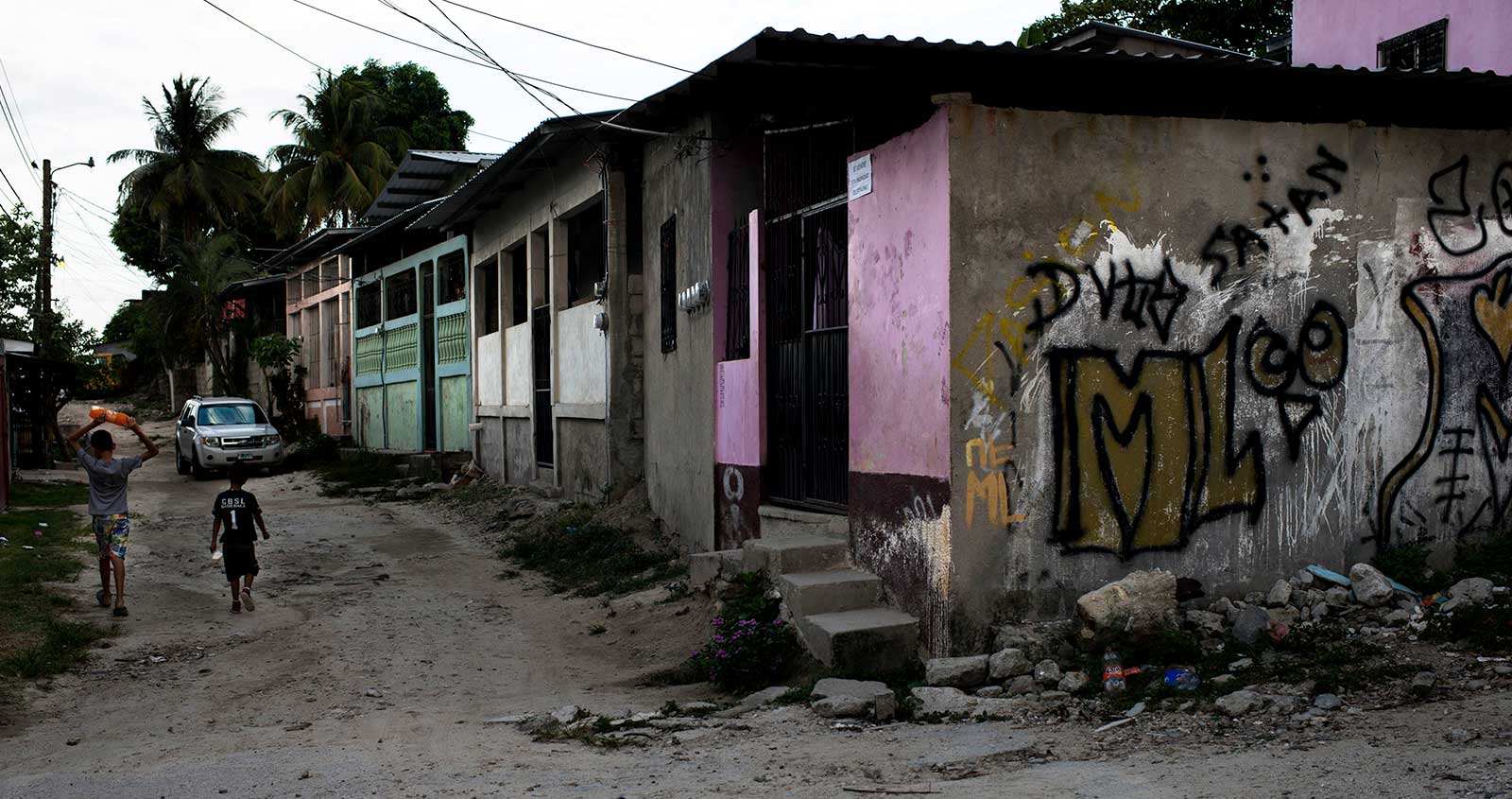
The image of a dozen children playing behind a tall metal fence, surrounded by armed guards, says it all – in one of the world’s most dangerous barrios, even playtime happens under security lockdown.

The newly built park is located in the Rivera Hernández neighbourhood of San Pedro Sula, Honduras. It’s one of the deadliest areas of the most dangerous city in one of the most dangerous countries on earth.

We drive past the park in a small car, with our windows rolled down. The driver, a young man who was born a few blocks from where we are going, says local gang members need to see us – they are not too keen on visits from outsiders.

Seven rival gangs operate in the Rivera Hernández District. They control each of the 39 neighbourhoods that make up the area and the lives of the 150,000 men, women and children who live there.

Graffiti on several walls shows how the territory is divided, and warns residents of the consequences of stepping out of line.

Everyone who lives here knows the ground rules: do not hang out with members of a rival gang, do not speak out against the gang that controls your area, do not refuse to join your neighbourhood’s gang or to become the “girlfriend” of one of the leaders, pay the “taxes” imposed by the gang.

The penalty for breaking the rules? Death.

Forensic teams working at a crime scene in Honduras. © Amnesty Internacional/Encarni Pindado

Camila, a 22-year-old teacher, moved to the Rivera Hernández as a teenager, after his father found a job in a local factory. Growing up in the area was tough.

“Lots of good people live in the Rivera Hernández – hard workers who want to make things better, but there are also many gang members and military who do not protect us,” she said.

“Here you can´t walk around freely. At any point there can be a shootout where young people are killed by gang members or soldiers who are often colluding with the gangs.

“For the children it’s like living in a prison, because they are scared. In schools there are many gang members who harass and scare the children. They force you to be their girlfriend and if you complain, no one does anything, out of fear. There are many teachers who were forced to leave their schools, even the country, because the gangs were threatening them.”

Nothing to do but run

Camila now works at “Step by Step,” a local organisation founded in 2002 to tutor local schoolchildren in a safe environment.

The building is an oasis of calm amid the violence on the other side of the tall brick walls. Several groups of boys and girls, aged between six and 16, study, work on their homework, read and participate in discussions about how to build a safer Honduras.

“I joined the programme when I was nine years old. It changed my life because then I didn’t have a place to go when my parents were working. Here they teach you things and they provide a safe place. When I finished studying, I stayed on to help others,” says Camila.

But, impressive though it is, the project sometimes feels like a Band-aid amidst the violence and terror that dominates the lives of thousands on the other side of these walls.

“Many children here have histories of violence, many have seen their relatives being murdered”

Camilla

With a murder rate topped only by Syria’s, and a government that does little to protect the targets of such violence, Honduras has become a virtual war zone, leaving most people, particularly teenagers, with little option but to flee and seek asylum abroad.

“Many children here have histories of violence, many have seen their relatives being murdered. If they file a report, the police do nothing and many do not file reports because they know the police sell information to the gangs.

“Here you have to keep quiet because if you talk, you might be gone the next day. [In Step by Step] we help them to get ahead, but for many, the only option is to leave the country,” Camila explains.

And people have been leaving the country, in growing numbers.

According to the United Nations Refugee Agency, the number of asylum applications made around the world by people from El Salvador, Honduras and Guatemala increased by nearly 600 percent between 2010 and 2015.

In 2015, 48,000 people from these countries requested asylum abroad, double the number in 2014.

But instead of providing the protection these people are entitled to under international law, Mexico and the USA – where most flee to – have been increasingly pushing them back to the same mortal danger they were trying to escape from.

Between 2010 and 2015 alone, there was a 145 percent increase in the number of deportations from Mexico to Honduras.

Once back in their countries, refugees find themselves alone, without any form of meaningful protection from the government, facing the same gangs that terrorized them for years.

A game changer?

Since taking office last month, US President Trump has failed to make any reference to the hundreds of thousands of refugees from Central America who travel through Mexico to the USA in search for safety. But his vision of a US-Mexico border wall and other policies are likely to have lethal consequences for many seeking a path out of the deadly violence endemic to their Central American homelands.

As part of a raft of Executive Orders he signed in his first week at the White House, President Trump has made it exponentially more difficult for those fleeing extreme violence to find a safe place to call home – including by halting the Central American Minors scheme, set up by President Obama in 2014 to help children from violence-torn countries such as Honduras and El Salvador.

By shutting the door to refugees, Trump is effectively condemning them to a life of terror and violence.

Failing to take action to protect refugees is not going to stop people from embarking on these dangerous journeys, it will just put them at heightened risk – pushing them to repeatedly attempt the perilous journey in search of safety.

“We hear many stories of kids who are deported from Mexico and the USA only to be abused or killed. Most of the ones who are deported start the journey again and again as soon as they arrive, they have no other choice,” Camila says.

Names have been changed to protect the safety of those interviewed.

This story was originally published in the International Business Times


Turnbull must push for end to illegal Israeli settlements during Netanyahu meeting

Prime Minister Malcolm Turnbull must use his meeting with Israeli Prime Minister Benjamin Netanyahu to clarify that the Australian Government opposes the construction of Israeli settlements in the Occupied Palestinian Territories.

Prime Minister Netanyahu has arrived in Sydney, after meeting US President Donald Trump last week.

So far this year Israel has authorised more than 6,200 new illegal settlement homes in the occupied West Bank, including 719 in East Jerusalem.

“When meeting Prime Minister Netanyahu, Prime Minister Turnbull must make clear that his government will not tolerate the unlawful construction of Israeli settlements in the West Bank, including in East Jerusalem. These settlements are a flagrant violation of international law and amount to a war crime,” said Steph Cousins, Advocacy and External Affairs Manager at Amnesty International Australia.

“Illegal settlements on Palestinian land have been a hallmark of Israel’s 50-year-long occupation. By continuing with its settlement policy Israel is also brazenly breaching multiple UN Security Council Resolutions, including the most recent resolution passed in December calling for an end to settlement activities in the Occupied West Bank.

“We were disappointed when Australia spoke out against last year’s UN Security Council Resolution, one of the only countries to do so,” Steph Cousins said.

However since then Foreign Minister Julie Bishop has expressed concern about the escalation of settlement expansion and called on both Israeli and Palestinian sides to “avoid unilateral actions that diminish the prospects of a negotiated two-state solution”.

“Now we urge Prime Minister Turnbull to seize this unique opportunity to demonstrate to Israel that it cannot continue trampling over the rights of the occupied Palestinian population”, said Steph Cousins.

Background Information:

Amnesty International has published a background briefing document for journalists highlighting the devastating impact that settlements continue to have on the lives of 2.9 million Palestinians in the West Bank including East Jerusalem.

January 28: One Day in Fremantle

In a brave move in support of the #changethedate movement, in August 2016 the Fremantle Council voted to cancel Australia Day fireworks usually held on 26 January in sensitivity to Aboriginal and Torres Strait Islander people. Instead, along with a group of traditional owners they organised One Day in Fremantle, an alternative, inclusive festival on 28 January 2017.

Noongar Elder Richard Walley OAM. © Tammy Solonec

This decision met backlash from various local businesses, as well as the Western Australian and Federal governments but the Council stood strong, with overwhelming support from Aboriginal and Torres strait Islander communities. The decision helped garner increased media attention and conversations about changing the date of Australia Day and was a resounding success with over 15,000 in attendance.

The day started with a healing ceremony at the RoundHouse, the first building in the Swan River Colony – a prison for Indigenous men. The ceremony also focused on Wadjemup or Rottnest Island, a now holiday island off the coast of Perth, that was a prison for Aboriginal men for almost a century.

Noongar leader Richard Walley was one of the Elders involved. At the ceremony he explained, “We are not anti-Australian, we are standing today to release the spirit of our ancestors”.

Amnesty International’s Indigenous Rights Manager Tammy Solonec, and a team of activists and staff from the Western Australian office attended the day in support.

Reflections

“One Day in Freo was a fantastic event, the best Australia Day celebration I’ve ever been to,” said Tammy.

“I spent all day in Freo, starting with the incredibly moving Healing Ceremony in the morning..  So many thoughtful touches to the day made it special, like when all the performers sang Paul Kelly’s, “From Little Things Big Things Grow”.

It was wonderful to have a strong Amnesty presence at the event and to have Amnesty’s support for this movement – thank you to everyone who stood in solidarity with us this year. I know many around the country and our ancestors were standing with us on what was and always will be a very historic day,” said Tammy.

Amnesty International WA staff and activists. © Private

Riley Buchanan, Convenor of the WA Crisis Group, was one of the Amnesty activists who attended. She has shared her reflections with us below:

One Day was just that: one day in a struggle for rights, recognition and reconciliation spanning centuries, with so many steps backward and forward and not always in that order. But the significance of this one day was incalculable. There is something particularly joyful about knowing one single day, or the idea that brought it into being, will resonate for much longer than 24 hours.

Freo’s Esplanade was crowded with families and friends of a swathe of cultures, truly representative of our country’s diversity and many stories. There were picnic rugs and eskies as far as the eye could see. There were 15,000 people. There was a sense of collective recognition that ‘this is important’. There was music and dancing.

There were so many children, some undoubtedly too young to remember being there but may one day reflect on One Day as the inception of a future reality that we can’t yet properly imagine.

There was the transformation of conditions of impossibility into profound possibility.

There was Fremantle: welcoming, innovative, altruistic.

There was community. There was honesty about our history. There was a desire for change and an unsaid yet somehow mutually understood perception that we can make it happen.  

In the ongoing, fierce, creative and urgent struggle for Indigenous rights in this country, One Day might be regarded as superficial, and in a way it is. It is a single day in a centuries-long fight, and the many struggles Aboriginal people face today remain.

The resonance of One Day is incalculable, which is to say unknowable but also infinite in possibility. It is in that space of uncertainty where there is the most room to act, for the most change to occur. “

Do you have an activism story you would like to share with the Amnesty community? Find out how you can submit stories, photos, videos and more.

3 days + 25 leaders = Inspiration

This January, I got to spend a weekend with 25 of our lead NSW activists. We came together just outside of the Sydney CBD to discuss the 2020 Vision and how the NSW Famnesty is going to get there.

NSW runs 3-4 Social Change Labs a year but we found that we had some amazing leaders who had come to them for years. We needed a new space to bounce around ideas, solve problems and plan for big things.

And big things are coming!

We have some ambitious goals to achieve by 2020. Together, we need to grow our movement in 90% of federal electorates and empower 1000 leaders across Australia. We will only be stronger if we have a diverse movement of people behind us.

So, where to start?

We kicked off the leaders weekend with some theatre. The activists created statues to represent what Organising means to them, and some truly profound art was made. Lots of snowflake models, listening, interconnected networks, lifting up others, succession planning and inspiring fist pumps. ✊

We were able to explore the range of different Organising practices out there and look at where exactly Amnesty NSW fits on this spectrum. As part of this, we were able to do a video conference with Jason Mogus from Vancouver who talked through his Networked Change report which evaluates the strategies and practices of successful 21st century campaigns. So interesting!

If we rely on the two staff members in the region, we can only achieve so much. I very much see these 25 organisers and other lead activists that I get to work with on a daily basis as my peers. I am so grateful and privileged to do this work everyday but my aim is to do myself out of a job. I want to develop leaders who will develop other leaders until I am not needed anymore. That’s what this weekend was all about.

Where we’re heading

We worked to come up with the core components of organising in NSW. Five teams were created to focus on these various elements:

  • Training Organisers: How we can improve our training resources and train more leaders.
  • Strategy and Campaign Organisers: Evaluate successful campaign tactics, share resources and strategies better across the region.
  • Growth Organisers: Increase our presence in the community, provide clearer, more diverse and more supportive entry pathways into Amnesty.
  • Communications: Break down silos across the region by streamlining communications.
  • Area Organisers: Improve our support of action groups by having Organisers who directly empower 3-4 groups in the same area.

For the rest of the weekend, these groups confirmed their strategies for 2017. We are restructuring our region so that leaders are designing and delivering plans to achieve our shared goals – not just within their group, but across the state.

NSW Leaders Retreat, January 2017. © Private

The weekend wrapped up with some reflections on how to work more efficiently and to ensure that our activism is sustainable. The 25 leaders who attended give so much to Amnesty on top of study, work, family commitments and – somewhere – a personal life. We need to make sure that we look after each other, that we make sustainable plans, that we say no to things and that we feel motivated by our work.

On a personal note, I feel so very motivated by these people. What an honour it is to know them, to work with them and to call them my friends. Amnesty NSW is a culmination of their energy, skills, ideas, experience, passion and organising. Because of them 2017, is going to be a great year and Famnesty NSW will be bigger and better than ever.

Amanda Atlee
One of the many NSW Organisers