We wanted to tell you about our latest Digital Decoders project that you can get involved with.
Last year our Decode Darfur project mobilised over 28,000 digital volunteers from 147 countries who volunteered their time online to help us map remote and vulnerable villages in Darfur covering an area of 326,000 square kilometers. That is an area larger than Norway!
Now, we are ready for the next phase where we aim to find villages which have been attacked, burned down or destroyed. Your contribution will help Amnesty International build evidence demonstrating that civilians have been systematically attacked and show the international community that it has ignored Darfur for too long.
How it works: In this project we ask you to compare two images of the same area of Darfur before and after a possible attack. We’d like you to identify significant changes in the buildings over time.
You can get involved straight away. You don’t have to do it all in one go – in fact if you can do a bit whenever you’ve got a few spare minutes over the next few weeks that will help us massively. All you need is an internet connection and a computer or a mobile phone.
[Amnesty International’s written statement to the 34th session of the United Nations Human Rights Council, 27 February-24 March 2017]
One year after the National League for Democracy (NLD)-led government took office, the deterioration in the human rights situation in Myanmar requires immediate and urgent action from the United Nations Human Rights Council (the Council).
In Rakhine State, state security forces have responded to attacks by armed groups on police posts with a campaign of violence against the Rohingya civilian population, which may amount to crimes against humanity. In northern Myanmar fighting between the Army and armed ethnic groups has escalated leading to fresh violations of international humanitarian and human rights law against the ethnic civilian population. The UN Office for the Coordination of Humanitarian Affairs (UNOCHA) estimates over 100,000 people have been displaced in Rakhine State and northern Myanmar in the last five months. The limited space for freedom of expression nationwide has closed down even further following a surge of “online defamation” cases.
The international community cannot adopt a “wait and see” attitude in the face of increasing violations. The continuing power of the military to violate rights with impunity and the unwillingness or inability of the new administration to counter discrimination and impunity require immediate action. The Council should adopt a strengthened resolution on the human rights situation in Myanmar under agenda item 4, extending the mandate of the Special Rapporteur and requesting her to provide more regular reporting to the Council on the resolution’s implementation, including on meeting the reform benchmarks requested by HRC Resolution 31/24. It should also mandate an independent international investigation into human rights violations and possible crimes against humanity committed in Rakhine State since October 2016, to avoid impunity, ensure justice to victims and survivors and identify causes of violence.
GRAVE VIOLATIONS IN RAKHINE STATE
The Myanmar security forces have engaged in a deliberate and indiscriminate campaign of violence against the Rohingya in northern Rakhine State after attacks by armed groups on border police posts killed nine police officers on 9 October. Amnesty International and the UN Office of the High Commissioner on Human rights (OHCHR) have chronicled extensive human rights violations by the security forces, including unlawful killings, arbitrary arrests, enforced disappearances, rape and other crimes of sexual violence, other forms of torture and ill-treatment, destruction of property and denial of humanitarian access. According to UNOCHA, the violence has displaced over 92,000 Rohingya, 69,000 of whom have fled to Bangladesh. Evidence collected by Amnesty International and OHCHR suggests these violations may be widespread and systematic and therefore may amount to crimes against humanity.
The international community cannot adopt a “wait and see” attitude in the face of increasing violations. The continuing power of the military to violate rights with impunity and the unwillingness or inability of the new administration to counter discrimination and impunity require immediate action.
The authorities have largely responded to allegations of human rights violations with denials, while barring independent journalists and human rights monitors from freely accessing the area. On 1 December the President established a commission to probe the 9 October attacks and their aftermath. This commission is neither independent nor credible: it is comprised of former and current government and security forces officials and has allowed the broadcast of interviews with eyewitnesses and possible victims on state media thereby compromising their anonymity and confidentiality. In its interim report the commission claimed to have found insufficient evidence of abuse. Its final report, due initially to be published on 31 January, has been postponed indefinitely.
We note the establishment of the Rakhine State Advisory Commission led by Mr. Kofi Annan, but stress that it is not mandated to investigate human rights violations, and is limited to making recommendations to secure “peace and prosperity” in Rakhine State.
Amnesty International recalls that crimes against humanity are crimes of such serious magnitude that they affect humanity as a whole. We consider that the gravity of the violations in Rakhine State and the government’s ongoing failure to independently and effectively investigate them justify the ongoing involvement of the international community in investigating them.
It should be stressed that the recent violence takes place against decades of persecution of the Rohingya and discrimination against ethnic Rakhines and other minorities in Myanmar. Failure to investigate the violence adequately will send a message that security forces can commit such crimes with impunity; this will undermine efforts to tackle wider concerns in Rakhine State and beyond.
DETERIORATING SITUATION IN KACHIN AND NORTHERN SHAN STATES
While fighting between the army and armed ethnic groups has been ongoing for several years, there has been an alarming escalation in the conflict in recent months, following co-ordinated attacks in November on security outposts by the Brotherhood of the Northern Alliance, a new coalition of four armed ethnic groups.
The army responded with intensified attacks, including airstrikes and shelling, killing and injuring civilians. Entire camps of displaced people were virtually emptied following nearby air strikes. Some of these people have now been displaced several times. Reports of abuses committed by both government and ethnic armed groups continue to be received, including arbitrary arrests, torture and other ill-treatment, forced labour and use of landmines.
Failure to investigate the violence adequately will send a message that security forces can commit such crimes with impunity; this will undermine efforts to tackle wider concerns in Rakhine State and beyond.
The authorities have increased their restrictions on humanitarian assistance to displaced communities. Since April 2016 UN and humanitarian agencies have not been able to deliver aid to civilians displaced in non-government controlled areas. In a statement in January, the Special Rapporteur noted that humanitarian access is worse now than at any point in the last few years.
RESTRICTIONS ON FREEDOM OF EXPRESSION AND RISKS TO HRDs
Scores of prisoners of conscience have been released since Myanmar was last reviewed by the Council, but prisoners of conscience continue to be jailed. There has been a surge in the number of people investigated for “online defamation” under the vaguely worded 2013 Telecommunications Law, with individuals being arrested and charged for Facebook posts critical of the authorities. Early efforts to repeal and amend repressive laws appear to have stalled and the law reform process has been marked by a lack of transparency and consultation.
There are continued reports of intimidation, harassment and surveillance of human rights defenders (HRDs), lawyers and journalists. The assassination of prominent lawyer U Ko Ni in January shocked the human rights community, and represented an appalling reminder of the risks faced by those who advocate for human rights and tolerance. In her latest statement, the Special Rapporteur also highlighted concerns about reprisals for those who speak against human rights abuses.
RECOMMENDATIONS:
Amnesty International recommends the Council:
Extends the mandate of the Special Rapporteur and urges the government to co-operate fully with her, including by granting full and unfettered access to all parts of the country;
Requests the Special Rapporteur to present an oral update to the Council at its 35th session, in addition to the regular progress report to the UNGA at its 72nd session and annual report to the Council at its 36th session; and
Establishes an independent international investigation into human rights violations and possible crimes against humanity committed in Rakhine State since 9 October, to avoid impunity, ensure justice to victims and survivors and identify causes of violence.
Amnesty International recommends that the Council calls on the Government of Myanmar to:
Immediately cease all violations of international human rights law and ensure that the Myanmar armed forces adhere to international humanitarian and human rights law;
Provide humanitarian organizations with sustained and unimpeded access to populations in need of assistance, particularly in Rakhine, Kachin and Shan States;
End all discrimination in law, policy and practice against ethnic and religious minorities, and ensure Rohingya have equal access to citizenship rights;
Condemn all incitement to racial or religious hatred and take concrete steps to end it;
Release immediately and unconditionally all prisoners of conscience and drop charges against all those facing criminal proceedings solely for the peaceful exercise of their human rights;
Repeal or amend all laws that violate the human rights to freedom of expression, peaceful assembly and association, in compliance with international human rights law and standards. Pending the amendment of these laws, ensure that no one is arrested, detained or charged under their provisions;
Ensure HRDs, journalists and activists can carry out their peaceful work without fear of reprisal;
Ensure all those responsible for human rights violations and abuses – including those with command responsibility – are brought to justice in fair proceedings, without the imposition of the death penalty, and that victims can access effective remedies;
Ratify and implement international human rights treaties, in particular the International Covenant on Civil and Political Rights and the International Covenant on Economic, Social and Cultural Rights; and
Facilitate the establishment of an OHCHR country office, able to operate throughout Myanmar with a full mandate to promote and protect human rights.
Amnesty International has received information that the King of Malaysia has commuted the death sentence imposed on Nigerian national Osariakhi Ernest Obayangbon (aka Michael Phillips).
Obayangbon, who was sentenced to the mandatory death sentence for murder in 2000, was scheduled to be executed in the early hours of 14 March 2014. Amnesty was notified just over 24 hours beforehand and immediately began campaigning to stop the execution.
Obyangbon was diagnosed with schizophrenia before his appeal in 2007 and despite international law prohibiting the imposition of mandatory death sentences on those with mental disabilities, his sentence remained.
Amnesty had grave concerns that his ability to make use of legal and clemency avenues available to him was seriously undermined by his mental health condition.
Amnesty International, along with other human rights groups, mobilised activists worldwide in Obyangbon’s support.
A life spared
Thanks to the efforts of Amnesty’s supporters, the execution was stopped at the last second on the 14 March 2014, and now, his death sentence has been commuted to a life in prison.
“He had already been on the way to the execution chamber when the call came in for it to be halted”, said Shamini Darshni Kaliemuthu, Executive Director at Amnesty International Malaysia.
“Without your organisation, we would have been in grief and sorrow and we would have been devastated. I definitely would not have been able to send my children to school and wouldn’t be smiling back to them today”
Curtis Obayangbon
“Thank you for taking those Urgent Actions, for your lobbying efforts, and for every other action that you took to stop this cruelty and save a man’s life.”
Amnesty International Malaysia received a letter from Curtis, Osariakhi’s brother, saying thank you for saving his brother’s life.
When in 2014 Osariakhi was to be put to death, we cried to you at Amnesty International and even though time was against us, you did not give up. You put together a team from that moment that I contacted you and together with Hazel in London and your team in Malaysia, my brother’s life was saved. And you did not only save Osariakhi’s life, you restored hope to the family whose lives would have been shattered and meaningless had the execution been carried out. You did not relent after that, rather, you continued to champion the campaign for the abolition of Death sentence. The result of that effort is what we celebrate today; the commutation of his death sentence to life imprisonment.
The voice of the people is the voice of God. Your organisation have spoken against death sentence and God has granted it to Osariakhi and it will be so the world over. Without your organisation, we would have been in grief and sorrow and we would have been devastated. I definitely would not have been able to send my children to school and wouldn’t be smiling back to them today. Thank God that Amnesty International exist so that Osariakhi and others in similar situation might live. By this victory, you have sounded the dead bell on death sentence and you have reminded those in authority that only God can create and take live, not humans. Above all, you achieved this feat without collecting a dime from us for your good work!
On behalf of Osariakhi, we wish to thank you once again for restoring hope to the hopeless and thank you for those many phone calls at odd hours which you never refused to take. We are very proud of you and your organisation and may you continue to grow from strength to strength.
All the best,
Curtis Obayangbon
(From the family).
Amnesty International opposes the death penalty unconditionally. It is the ultimate cruel, inhuman and degrading punishment. Please take action below to stop The Philippines from re-introducing the death penalty.
What would you do, if you belonged to a community that was facing discrimination and even genocide, and the country of your birth had no laws to protect you or your children? Would you stay, waiting to be killed whilst you buried your loved ones?
The Hazaras are one such community that are mostly Shia and face persecution by Sunni Majorities in Afghanistan. Some migrated to Baluchistan, now Pakistan, however, in both countries they continue to face discrimination and I believe, genocide to this day. One of the deadliest attacks on the community took place in 2013, when a series of violent bombs killed hundreds of Hazaras in Quetta.
I met Mohammad Ali, a Hazara who came from Karachi, Pakistan to Western Australia by boat in 2013. I asked Ali if he had been afraid of the long perilous journey. “The danger of the sea was nothing compared to the danger of living in Pakistan,” he said. “At least the sea gave me hope of making it to safety”. After a pause he continued: “My father said he did not want to bury me as he did his brother who was killed in the bomb attacks. He begged me to leave. I did not want to, here I am alone, but I am safe, my parents sleep better knowing that.”
“Refugees don’t want your job or welfare; they just want safety”
In Quetta, Ali worked in his family business. In Perth he struggled to set up his own. Today he mortgages a house, and is saving money for a lawyer, to bring his wife to Perth.
The right to refuge
The Hazaras are not the only ones needing refuge. Across the globe right now, millions of people from all cultures and faiths are fleeing their countries of birth due to a rise not just in wars, but intolerance and brutality.
To many people, a refugee is someone to be feared. Bigoted politicians, who use fear as campaign strategy are often guilty of capitalising on this sentiment. People fear that a refugee wants to steal their jobs and welfare, or commit an act of terrorism. This is far from the truth. They leave jobs and businesses, their loved ones and families only because they want to survive. No matter what their skin color or religion, everyone has the right to live. Refugees don’t want your job or welfare; they just want safety.
“Hate will not heal this planet; only Love can do that”
Mainstream media talks about ‘the refugee crisis’, but this is so much more than that. The real crisis is our increased intolerance for our own human kind. We are not born to hate. We have been conditioned to discriminate against people from different faiths, skin color or ethnicity.
We have evolved technologically, creating weapons to kill on a large scale, and in doing so, have lost our some of our compassion and respect for each other.
Leaders such as Trump speak of closing off borders because we’ve closed off our hearts to the pain and suffering of our fellow human. We want our Governments to protect us, but instead Governments use our tax money to open detention centers and wage wars, none of which protects us or solves the global crisis.
Humanity’s crisis can come to an end, if we replace the hate and fear in our own hearts with love, and teach our children to do the same. When we are able to give the refugees, such as Mohammad Ali refuge in our hearts first, humanity will begin to heal. Hate will not heal this planet; only Love can do that and bring peace, if that is what we wish for our children.
Natasha De Sousa is a runner up in the Amnesty International Blogging Competition. Born and Raised as a minority in Pakistan, Natasha has been a radical, a rebel, an activist, filmmaker, actor, writer, animal communicator and an ardent student of metaphysics. She dreams of a world where humans live in harmony and respect for each other.
Australia’s leading Aboriginal and Torres Strait Islander peak bodies will today demand a new relationship with government as they deliver the historic Redfern Statement direct to the Prime Minister at Parliament House.
In the lead-up to today’s 9th Closing the Gap Report to Parliament, the leaders will call on the Prime Minister to support the historic Redfern Statement, a road map to better address the appalling disadvantage gap between Australia’s First Peoples and non-Indigenous Australians by working with them as genuine partners.
National Congress of Australia’s First People’s co-chair Mr Rod Little comments:
“After 25 years, eight Federal election cycles, seven Prime Ministers, eight Ministers for Indigenous Affairs, 400 recommendations, and countless policies, policy changes, reports, funding promises and funding cuts it’s time to draw a line in the sand.
“We need a new relationship that respects and harnesses our expertise, and guarantees us a seat at the table as equal partners when governments are making decisions about our lives.”
The Redfern Statement was released during last year’s Federal Election campaign on 9 June by Aboriginal and Torres Strait Islander leaders from health, justice, children and families, disability, and family violence prevention sectors.
The statement calls for changes across these sectors through structured engagement with Aboriginal and Torres Strait Islander people, and is supported by more than 30 major mainstream organisations including Amnesty International, the Australian Medical Association and Law Council.
National Congress of Australia’s First People’s Co-chair Dr Jackie Huggins said Aboriginal and Torres Strait Islander organisations have worked with our people on the ground for decades and have shown they have solutions.
Dr Huggins said:
“Aboriginal Community Controlled Health Organisations deliver 2.5 million episodes of care a year in their local communities – and are the only health and leadership models making inroads on Close the Gap targets.
“Our teachers, education professionals and family violence experts are delivering real results on the ground in their communities every single day – despite chronic underfunding and an ad hoc policy approach based on three year election cycles.
“Today we are seeking a new relationship, a genuine partnership and a commitment to ongoing structured engagement.”
In the lead-up to Valentine’s Day, you demanded that all Australians be allowed to have their love recognised, or if you didn’t, it takes 2 minutes! To inspire your joint activism this month (because what’s more romantic than that, right?), we’ve rounded up a list of seven inspirational couples working together to champion human rights.
It’s been over two years since blogger Raif Badawi was publicly flogged in Saudi Arabia for exercising his right to freedom of expression. During that time, activists worldwide – including over 37,000 Australians – have demanded his release from prison and condemned the brutal torture.
The loudest voice in the fight for justice is his wife, human rights defenderEnsaf Haidar. Ensaf fled with their children to Canada in 2014 following his arrest and transformed her tiny flat into a campaign office for Raif’s release. Ensaf told The Telegraph, “I was very proud of him, I was pushing him to do it, I believe in free speech too. And all of this has taught me to be stronger and more responsible – I never thought I would have to be solely responsible for three children.”
2. David and Emma Pocock
David Pockock really has it all, a beautiful partner, a successful career in rugby and a strong moral compass, *swoon*. The Wallabies flanker uses his high profile for good and not evil – to speak out about important human rights issues, such as racial and gender equality and LGBTQI rights.
David and his partner Emma, also a prolific activist, are also big advocates of marriage equality and even though they were married in 2010, they refuse to sign the legal documents until all Australians have the same right. “I think for us it’s something we don’t really want to be part of, if all of our friends don’t have that same opportunity if they want to get married,” he told SBS.
3. George and Amal Alamuddin Clooney
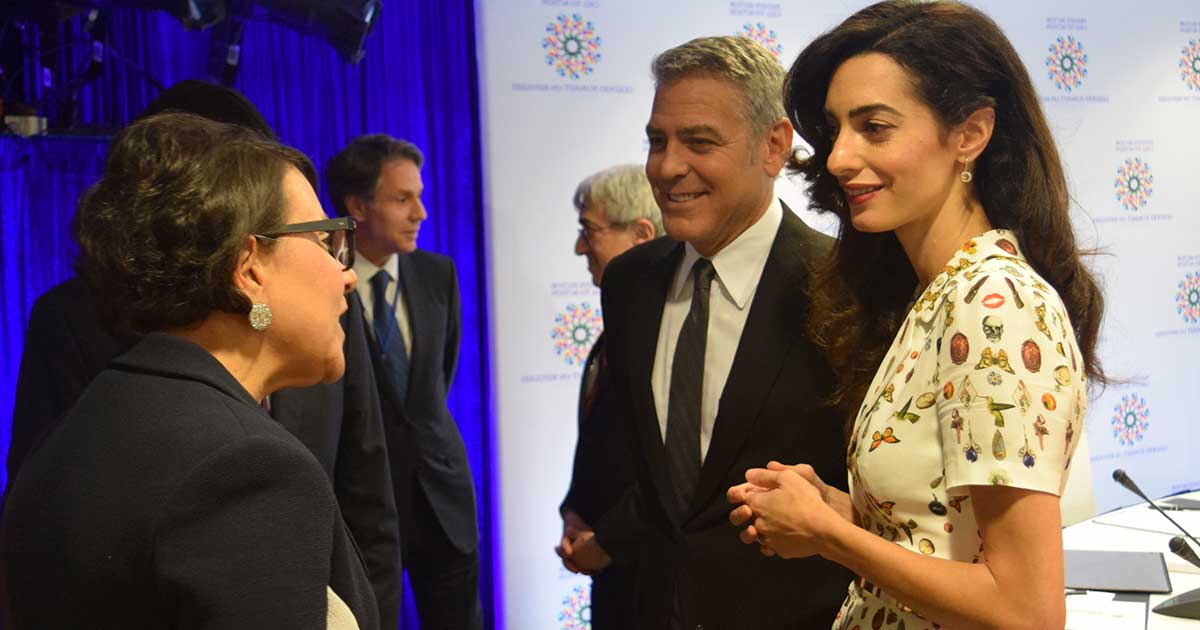
New York magazine branded The Clooneys the closest thing the US has to royalty, and we’re pretty happy that these two champions of human rights aren’t leaving the spotlight anytime soon – particularly with the recent announcement of two more Clooneys to be added to the clan. Amal, a Lebanese-British human rights lawyer and activist has handled many high-profile cases in her illustrious career, including Ukranian prime minister Yulia Tymoshenko and WikiLeaks editor-in-chief Julian Assange.
Good looks, talent and charm aren’t the only strings to George’s bow, he also founded Not On Our Watch with his Ocean’s 11 co-stars Don Cheadle, Matt Damon, and Brad Pitt, and producer Jerry Weintraub, which has a goal of ending the genocide in Sudan. Following their highly-publicised wedding, the couple donated proceeds from the sale of the official photos to various human rights charities.
4. Ellen De Generes and Portia De Rossi
When it comes to power couples, you can’t get much more influential than Talk-show Queen Ellen De Generes and Australian actress Portia De Rossi. Both strong advocates of marriage equality, Ellen recently opened up to People magazine, saying of her marriage to Portia: “There’s no best part. It’s everything. I can’t imagine not being married. I have my best friend, the person I want to spend time with more than anybody else in the world.”
"Love is a meeting of two souls fully accepting the dark and the light within each other." pic.twitter.com/g6gRvFsbNP
The couple are not only incredibly adorable (see above!), but also donate millions to a raft of charity organisations, which landed Ellen with the crown of “favorite humanitarian” at the People’s Choice Awards in 2016.
5. Sunny Jacobs and Peter Pringle
Peter Pringle and Sunny Jacobs don’t have your typical ‘boy meets girl’ love story. The couple, who married in 2012, share the tragic history of facing death row for the murder of two police officers – Sunny in Florida and Peter in Dublin. Both were eventually cleared of the crimes they were charged with and released, but not after losing over a decade of their lives in prison.
The two met in 1998 when Sunny was campaigning against the death penalty for Amnesty in Ireland. Peter sat in the front row, entranced. The two were eventually to come together and dedicate their lives to human rights. “Life has turned out beautifully,” Peter told The Guardian. “Sure, it’s not without its difficulties. We have no money. But we do good work. We are at peace. And we have a great life together. We look forward, and we live in the moment.”
6. Waleed Aly and Susan Carland
When asked how she feels about being dubbed the ‘Muslim power couple’, Dr Susan Carland told SBS: “It’s bizarre, we’re not even remotely powerful!” But Susan and her husband, lawyer and talk-showhost Waleed Aly are as influential as they come. In 2015, Susan started a campaign to expose Islamophobia online and turn it into a “force for good” by donating $1 to charity for every hateful tweet she received.
A photo posted by Susan Carland (@susancarland) on
Her hubby of 15 years, Waleed Aly uses the rather large platform of The Project to speak out about important human rights issues such as refugee rights, domestic violence and racism. Now there’s a couple we’d like to have at a dinner party!
7. Mildred and Richard Loving
Richard and Mildred Loving, who inspired the 2016 film Loving, starring Joel Edgerton and Ruth Negga, were an interracial couple married in Washington D.C. in 1958. They were arrested five weeks later in Virginia, where their union was not legal, and forced to leave or be jailed. In 1967, Mildred wrote a letter to U.S. Attorney General Robert. F. Kennedy, who referred her to the American Civil Liberties Union. The couple, who were assigned a junior lawyer, found themselves in a legal battle that made it all the way to the Supreme Court. In a huge victory for equal rights, judges voted unanimously in the couple’s favour. *Plot spoiler* Tragically, eight years after their marriage, Richard died in a car accident.
On the 40th anniversary of the ruling, Mildred said in a statement, “I am still not a political person, but I am proud that Richard’s and my name is on a court case that can help reinforce the love, the commitment, the fairness, and the family that so many people, black or white, young or old, gay or straight seek in life. I support the freedom to marry for all. That’s what Loving, and loving, are all about.”
Responding to news that Loghman Sawari, an Iranian refugee who fled Papua New Guinea to escape the cruel and inhumane treatment of refugees, has been remanded in custody, Amnesty International said:
“Loghman Sawari has suffered enough,” said Kate Schuetze, Amnesty International’s Pacific Researcher.
“Amnesty International holds grave concerns for his physical and mental well-being and is calling for Papua New Guinea to immediately and unconditionally release him and drop all criminal charges against him. Loghman Sawari must receive appropriate medical care, psychological support and have his essential needs for food and adequate housing met.
“Loghman Sawari has suffered enough,” said Kate Schuetze, Amnesty International’s Pacific Researcher.
“His case is extreme, and he simply cannot be left to languish in despair in Papua New Guinea.”
Kate Schuetze, Amnesty International’s Pacific Researcher
“Following that, the Australian Government must step up and immediately bring him to safety here in Australia. His case is extreme, and he simply cannot be left to languish in despair in Papua New Guinea.”
The court is scheduled to give a decision on bail on Tuesday 14 February.
Amnesty International has issued a global Urgent Action on Loghman’s case calling on supporters around the world to speak up on his situation.
Background
Loghman Sawari was unlawfully detained in August 2013 (then 17 years old), and held for around three years at the Australian-run detention centre for adult males on Manus Island, Papua New Guinea while his refugee claim was being processed.
Loghman Sawari flew to Fiji on around 24 January 2017, allegedly on false identity documents, seeking to escape the cruel, inhumane and degrading treatment he suffered in PNG, including beatings, imprisonment, living on the street and lacking access to health care.
Seeking asylum should never be criminalised, regardless of a person’s means of arrival. By imposing criminal charges on Loghman Sawari, PNG authorities are breaching their obligations to uphold the Refugee Convention.
On 3 February, he was forcibly returned to PNG without due process and held incommunicado for 30 hours.
Loghman Sawari is allegedly charged with using false information to obtain a passport, a criminal offence which carries a fine of up to 10,000 PNG Kina and up to six months imprisonment.
A historic court ruling has blocked the Kenyan government’s unilateral decision to shut the world’s largest refugee camp.
In his ruling, Justice JM Mativo said the government’s orders to shut down Dadaab were discriminatory and amounted to collective. He also described the orders as excessive, arbitrary and disproportionate.
The High Court ruling came in response to a petition by two Kenyan human rights organisations: Kenya National Commission on Human Rights and Kituo Cha Sheria, supported by Amnesty International, which challenged the constitutionality of the government’s directive to shut down Dadaab and the Department of Refugee Affairs.
‘Humanitarian grounds’
The camp was initially due to be closed on 30 November 2016, but the government announced a six-month delay on ‘humanitarian grounds’.
Dadaab’s closure would effectively have left more than 260,000 Somali refugees with nowhere else to go. Most of those who spoke to Amnesty International for a report published in November 2016 accused Kenyan government officials of coercing them to return to Somalia against their will.
Muthoni Wanyeki, Amnesty International’s Regional Director for East Africa, the Horn and the Great Lakes, said:
“Today is a historic day for more than a quarter of a million refugees who were at risk of being forcefully returned to Somalia, where they would have been at serious risk of human rights abuses. This ruling reaffirms Kenya’s constitutional and international legal obligation to protect people who seek safety from harm and persecution.
Stopping the imminent closure of Dadaab refugee camp is an essential first step in respecting and protecting refugee rights in Kenya. Now Kenya and the international community must work towards finding alternative solutions for refugees including local integration options.”
Amnesty International welcomes the Australian Government’s announcement today that it will finally ratify the Optional Protocol to the Convention Against Torture (OPCAT), which it signed in 2009 but had not committed to implementing until today.
Ratification is an important step towards ensuring respect for the rights and dignity of all people held in detention under Australian jurisdiction and oversight, and that they are not subject to torture or other forms of mistreatment.
In making the announcement, Attorney General George Brandis said, “Torture and other forms of ill treatment have no place in Australia.”
Amnesty International wholeheartedly agrees with this statement.
It is a disgrace that the horrors exposed last year in Don Dale Youth Detention Centre – which were a major catalyst for the decision – were permitted to happen. Similar human rights abuses against children have subsequently been uncovered in detention centres in Queensland and in Victoria. These are precisely the kind of abuses that could have been prevented had OPCAT been implemented already.
“This is a great achievement and it belongs to all of you, as human rights defenders that have demanded action to stop torture and abuse. After many years of campaigning Australia is set to take real steps to prevent torture and ill treatment in places of detention,” Claire Mallinson, Amnesty International Australia’s National Director.
“This is a great achievement and it belongs to all of you, as human rights defenders that have demanded action to stop torture and abuse”
Claire Mallinson
“This would not have happened without the courage of young people like Dylan Voller who spoke out in the hope that no child will ever again have to suffer the abuse, the ill treatment, and the torture that they endured.
“Now we need to work together to make sure this decision will fully protect children and adults in detention – both here in Australia and in Australian facilities offshore.”
Amnesty International urges the Government to implement this decision as soon as possible, in collaboration with the states and territories and all relevant parties, including the Australian Human Rights Commission.
While ratification is officially planned for December, design and implementation of a national preventative mechanism against torture and mistreatment in detention must start today.
Having campaigned for many years for ratification of OPCAT in Australia, Amnesty International celebrates this event as a historical milestone in the country’s commitment to upholding and protecting human rights.
After President Vladimir Putin signed a legal reform that decriminalizes some forms of domestic violence, Anna Kirey, Deputy Director for Campaigns for Russia and Eurasia at Amnesty International, said:
“While the Russian government claims this reform will ‘protect family values’, in reality it rides roughshod over women’s rights. It is a sickening attempt to further trivialize domestic violence, an issue the Russian government has long attempted to downplay. Far too often, victims find they cannot rely on the law for protection and their abusers are let off the hook, with only a tiny fraction imprisoned for their actions.
“Russian authorities must scrap this abusive legislation and put together a comprehensive package of measures to address the vast scale of domestic violence in Russia once and for all.”
Anna Kirey, Deputy Director for Campaigns for Russia and EurasiA
“In the more than a decade since Amnesty International’s last report on rampant domestic violence in Russia, the authorities have failed to implement a single measure to enhance protection and services for the victims.
“Russia is far behind global developments to protect victims of domestic violence, having very scarce measures in place such as government-funded shelters, effective practices of protection orders or police officers trained in how to respond to reports about abuse and protect victims.
“Russian authorities must scrap this abusive legislation and put together a comprehensive package of measures to address the vast scale of domestic violence in Russia once and for all.”
Russia is a state party to the Convention on the Elimination of all Forms of Discrimination against Women (CEDAW). The UN’s CEDAW Committee has specifically criticized Russia for its failure to take actions to address domestic violence.