10 December: W4R Global Day of Action

Join activists around the world this Human Rights Day for a 24 hour letter writing marathon on Twitter and Instagram.

Write for Rights is one of the world’s largest human rights events and on Human Rights Day we want the world to see how far and wide the campaign reaches, and all the great work we do to change lives.

On 10 December we will be using Twitter and Instagram to show that people all over the world are writing letters for those whose rights have been abused. You can find more information on Write for Rights cases under the heading Resources .

Globally, there are a core group of activists taking part during every hour of the day through every time zone. Amnesty’s International Secretariat Twitter account (@AmnestyOnline) will retweet and quote these actions (you must use the hashtag #W4R16) to capture the wave of activity as it travels across the 24-hour cycle.

When:

Amnesty activists across the world, and all timezones, will be on Twitter and Instagram at midday (local time). This means in  Australia our time slot across all time zones is midday your time.

When: Saturday 10 December

Time: 12 pm (midday – your time)

Where:

Twitter and Instagram from your Write for Rights event

Your event can be as simple as you at home writing some letters at midday, at a coffee shop with friends writing letters, or as big as a community event. If your event is earlier in the day, or later in the day, that’s fine too. It’s more important that you take part.

Here are the three easy steps to take part:

  1. Take a photo of your letters

Please take photos of letters– it can be lots of letters, one whole letter, or you can highlight one powerful sentence, or a drawing, or anything that shows it is personal. 

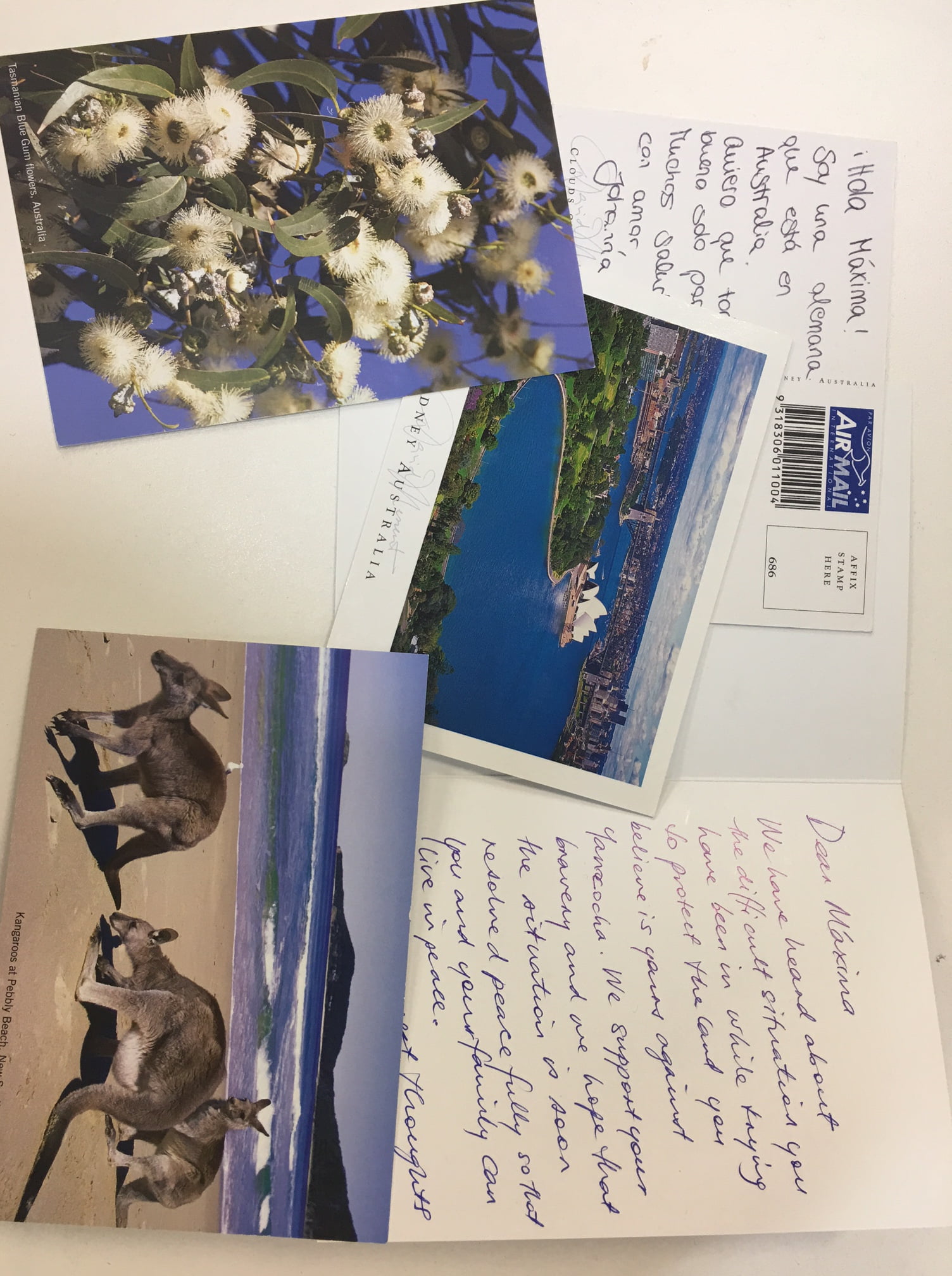
Close up of a W4R letter


  1. Upload the photo to Twitter and/or Instagram

Upload the photo. If you want to Tweet without an image, that is fine too – just drop the first three words “My letter for/to” in the sample tweets below. Make sure you use the two important hashtags.

  1. Post your message using the hashtags #W4R16 and #W4ROz

Use one of the relevant sample messages below. These are just suggestions as you can write your own messages.

Make sure to use the Write for Rights global hashtag #W4R16 so that Amnesty’s global Twitter account can find it and retweet it.

Please also use the hashtag #W4ROz  so we know it’s coming from you.  Each tweet that goes to a government target e.g. @PR_Paul_Biya for Cameroon, will be counted as an action. The tweet will go to the Australian action tally, which feeds into the global action counter.

Please have your location services switched on. Because this is all being done in real time, right around the world, it makes it more exciting and  helps to show that Write for Rights is really global!

Sample messages and targets

Below are sample Twitter and/or Instagram messages for each case we are working for. You are encouraged to write your own too :

Cameroon: Fomusoh Ivo Feh

Target: President Paul Biya – @PR_Paul_Biya

Sample message:

My letter for #FomusohIvoFeh, jailed for 10 years for texting a joke in #Cameroon. @PR_Paul_Biya: Free him now! #W4R16 #W4ROz

Canada: Indigenous people of the Peace River

Target: Prime Minister Justin Trudeau – @JustinTrudeau

Sample message:

My letter to stand #WithThePeaceRiver @JustinTrudeau #HonourTreaty8 protect Indigenous lands from destruction #NoSiteC #W4R16 #W4ROz

China: Ilham Tohti

Target: the Chinese President does not have a Twitter account, so we ask that you include #China and #XiJinping

Sample message:

My letter to #FreeIlhamTohti jailed for life for his writings & lectures in #China. #XiJinping must release Ilham now! #W4R16 #W4ROz

Egypt: Shawkan

Target:  Minister of Interior Magdy Abde el-Ghaffar – @moiegy

Sample message:
My letter for photojournalist @ShawkanZeid facing #deathpenalty in #Egypt for taking photos @moiegy free him now! #W4R16 #W4ROz

Indonesia: Johan Teterissa

Target:  President Joko Widodo – @jokowi

Sample message:

My letter for teacher #JohanTeterissa 15 years in jail for waving a flag! @jokowi #FreeJohan & #POCs in #Indonesia #W4R16 #W4ROz

Malawi: Annie Alfred

Target: President Arthur Peter Mutharika – @APMutharika

Sample message:
My letter demanding @APMutharika #StopTheKilling of people like Annie Alfred with #albinism #Malawi #W4R16 #W4ROz

Peru: Maxima Acuna

Target: Minister of Interior Carlos Basombrío – @CarlosBasombrio or/and @MininterPeru

Sample message:
My letter to @MininterPeru demanding he protect #HRD Máxima Acuña from threats! #JusticiaParaMaxima #W4R16 #W4ROz

Turkey: Eren Keskin
Target:  Minister of Justice Bekir Bozdağ – @bybekirbozdag

Sample message:

My letter for #HRD @KeskinEren1 facing jail for speaking out. @bybekirbozdag – protect #FreedomOfExpression! #W4R16 #W4ROz

USA: Edward Snowden

Target:  President Obama – @POTUS

Sample message:

My letter for @snowden to say #ThankYouEd for exposing global mass surveillance – @POTUS #PardonSnowden #W4R16 #W4ROz

That’s it! Thanks for all your efforts. Looking forward to seeing you on Twitter and Instagram!

Refugees in urgent need of protection from sexual violence

There is an urgent need for governments around the world to provide better protection for women and girls, lesbian, gay, bisexual, transgender and intersex (LGBTI) refugees, who face appalling levels of sexual and gender based violence at every stage of their journeys.

“Imagine living in a refugee camp where you are too scared to go the toilet, or being subjected to sexual harassment on a daily basis in your host community because of your gender or identity.”

Catherine Murphy, Acting Director of the Gender, Sexuality and Identity Programme at Amnesty International.

“Imagine living in a refugee camp where you are too scared to go the toilet, or being subjected to sexual harassment on a daily basis in your host community because of your gender or identity. This is the terrifying reality for hundreds of thousands of women and girls and LGBTI refugees around the world, and the shameful inaction of wealthy governments is prolonging it,” said Catherine Murphy, Acting Director of the Gender, Sexuality and Identity Programme at Amnesty International.

“To mark the beginning of the annual 16 Days of Activism against Gender Based Violence, we are urging governments around the world to implement their legal obligations to eliminate gender based violence. This means taking targeted measures like ensuring that police provide a safe and confidential environment for refugees to report incidents of gender based violence.

“It is also vital that governments around the world do more to share responsibility for protecting refugees by significantly increasing the number of resettlement places made available for refugees most in need of protection. The poverty and insecurity in which many refugees find themselves in countries like Lebanon and Libya heightens the risk of sexual exploitation and gender based violence.”

The annual 16 Days of Activism against Gender Based violence, which launched today, is a global campaign, coordinated by the Center for Women’s Global Leadership, to raise awareness about violence against women and girls, and is an opportunity to show international solidarity in the fight to end violence against women.

Hazardous journeys

Refugees and migrants in transit are at high risk of abuse, including violence and human trafficking. Women, girls and LGBTI individuals face specific threats such as sexual harassment, rape and other forms of gender based violence, underscoring the urgent need for safe and legal routes.

In 2016 women refugees and migrants from sub-Saharan Africa who had passed through Libya told Amnesty International that rape was so commonplace along the smuggling routes that they took contraceptive pills whilst travelling to avoid becoming pregnant as a result of it.

Gender based violence is also increasingly becoming a “push” factor for women and LGTBI individuals, forcing them to flee their places of origin and seek protection in other countries.

Patricia* [pseudonym] a 32-year-old trans woman, told Amnesty International about the harassment and persecution she experienced in El Salvador:

“Police officers followed me around, extorting money from me, harassing me and beating me up. They said they did not like me because of ‘who I am’.”

Patricia* [pseudonym] a 32-year-old trans woman

“Police officers followed me around, extorting money from me, harassing me and beating me up. They said they did not like me because of ‘who I am’. I was threatened by gangs as well – each month they charged me ‘rent’ but I was not able to pay it all. I believe I was threatened because of discrimination or homophobia, because of who I am. I had thought about going to the authorities but I realized that they were the same people who were harassing me.”

Fearing for her safety, Patricia decided to travel to Mexico, but was deported after several months, during which time she was beaten and robbed twice.

Amnesty International has highlighted how women and girls and LGBTI refugees from Central America’s Northern Triangle countries (Guatemala, El Salvador and Honduras) fleeing high levels of violence are at risk of gender-based violence both in their countries of origin and while in transit. Host countries like Mexico are not offering them adequate protection: in 2015 98% of people from Central America detained by Mexican authorities as irregular migrants were sent back to their countries of origin.

Lack of legal protections

All over the world, refugee women and girls without regular papers find they are faced with a stark choice between letting crimes committed against them go unreported, or reporting the crime and risking detention, deportation, and penalisation, for lacking valid residence permits.

Maryam* [pseudonym], a Syrian woman from Homs who arrived in Lebanon in 2013, told Amnesty International that police officers would often stop by the house she rented with female relatives, threatening to imprison them if they did not “go out” with the police officers. She said:

“Harassment of [refugee women] is a very big problem in Lebanon, whether I’m single or married, I’m always harassed. It’s why we’re afraid for our children. I have a daughter who is 16 and I’m afraid to send her even to the closest shop.”

Maryam* [pseudonym], a Syrian woman from Homs who arrived in Lebanon in 2013

“Harassment of [refugee women] is a very big problem in Lebanon, whether I’m single or married, I’m always harassed. It’s why we’re afraid for our children. I have a daughter who is 16 and I’m afraid to send her even to the closest shop.”

Solidarity with the Yezidi women in Greece

This year Amnesty International is calling on its supporters to send messages of solidarity to a group of Yezidi women from Northern Iraq who were forced to flee in August 2014 when the armed group calling itself Islamic State (IS) swept through the region in a systematic campaign of ethnic cleansing. They were left stranded in Greece in dire conditions.

For more than five months the women stayed in Nea Kavala camp where conditions are appalling with poor lighting, a lack of safe or separate toilets and showers, and no mechanisms to report sexual harassment. They felt very unsafe and formed a ‘protection circle’ to look after each other in the absence of any state protection in the camp. The women have since moved to another camp.

“Greece and other countries hosting refugees must act urgently to improve the reception conditions of refugees stranded in the country, including adequate measures to ensure the safety of refugee women and girls,” said Catherine Murphy.

“At an absolute minimum, this means ensuring that safe, toilet facilities and sleeping areas are provided for women and girls, and LGBTI refugees, as well as ensuring access to services and healthcare for those who have suffered gender based violence.”

Background

Gender based violence is violence committed against a person because of their gender. This includes violence against women and girls but also violence targeted towards individuals on the basis of their real or perceived sexual orientation or gender identity/expression and also men who may be targeted due to discriminatory attitudes about what constitutes ‘masculinity’.

2015 was a record-breaking year for forced displacement. Approximately 10.5 million women and girl refugees were recorded at the end of the year.

Bangladesh pushes back Rohingya refugees

  • Rohingya refugees and asylum-seekers being detained and forcibly returned
  • Lack of water, food and medical care
  • Both governments preventing thousands from accessing aid
  • Harrowing details of Myanmar military attacks on villages

As the Myanmar authorities are subjecting the Rohingya Muslim minority to collective punishment, thousands of refugees who have made it across the border to Bangladesh in desperate need of humanitarian assistance are being forcibly pushed back in flagrant violation of international law.

“Trapped between these cruel fates, their desperate need for food, water and medical care is not being addressed.”

Champa Patel, Amnesty International’s South Asia Director.

“The Rohingya are being squeezed by the callous actions of both the Myanmar and Bangladesh authorities. Fleeing collective punishment in Myanmar, they are being pushed back by the Bangladeshi authorities. Trapped between these cruel fates, their desperate need for food, water and medical care is not being addressed,” said Champa Patel, Amnesty International’s South Asia Director.

The Rohingya are fleeing a policy of collective punishment in Myanmar’s Northern Rakhine state, where security forces are mounting indiscriminate reprisal attacks in response to a 9 October assault on three border posts that killed nine members of the border police.

Speaking to members of the Rohingya community on the ground in Bangladesh and in interviews with those still in Myanmar, Amnesty International has heard accounts of Myanmar’s security forces, led by the military, firing at villagers from helicopter gunships, torching hundreds of homes, carrying out arbitrary arrests, and raping women and girls.

Across the Naf river that divides Bangladesh and Myanmar, Rohingya refugees and asylum-seekers are forced into hiding and are suffering a severe lack of food and medical care, Amnesty International found in Bangladesh’s Cox’s Bazar district.

Forcible returns

The Bangladeshi authorities have cracked down on the flow of Rohingya refugees and asylum-seekers from Myanmar. Over the past week, the Bangladesh Border Guards have detained and forcibly returned hundreds.

The move is a violation of the principle of non-refoulement – an absolute prohibition under international law on forcibly returning people to a country or place where they would be at real risk of serious human rights violations.

The Bangladeshi authorities have also sealed their border with Myanmar and fortified it with the deployment of the Bangladesh Border Guards and coast guard forces. Since 1992, the Bangladesh government has a policy of denying Rohingya refugee status.

On 22 November, Amnesty International witnessed groups of Rohingya crossing the border close to Whaikyang, a village by the Naf river in Bangladesh. They looked weary and emaciated, the signs of a gruelling journey evident on their faces.

They told Amnesty International that they had arrived in Bangladesh the night before, waiting until sunrise on a nearby island to evade Bangladeshi officials.

Several thousand Rohingya refugees and asylum-seekers are believed to have recently crossed into Bangladesh. They are spread out across villages, refugee camps and slums, making the true number impossible to determine. At least 2,000 people have made the journey across the Naf river since 21 November, with more set to arrive over successive days.

Some of them told Amnesty International they had paid smugglers to take them across. Others confessed to bribing Bangladesh Border Guards or other Bangladeshis to help them elude interception at the border.

“The Bangladeshi government must not add to the suffering of Rohingya. They should be recognised and protected as refugees fleeing persecution, not punished for who they are.”

Champa Patel.

“The Bangladeshi government must not add to the suffering of Rohingya. They should be recognized and protected as refugees fleeing persecution, not punished for who they are,” said Champa Patel.

Inhuman and degrading conditions

The bulk of the Rohingya who successfully reached Bangladesh have sought shelter in makeshift camps across the Cox’s Bazar where earlier waves of refugees and asylum-seekers settled.

Water and food are scarce. Aid workers in the area told Amnesty International that even before the most recent arrivals, the camp dwellers were already suffering severe malnutrition.

The latest arrivals have put an enormous strain on Rohingya refugees and asylum-seekers already based in Bangladesh who have opened their small and cramped homes to them.

One man living in the Kutupalong makeshift refugee camp told Amnesty International:

“I am the only breadwinner in my family. We are seven people, but some family members arrived from Myanmar last week so now we are 15 people living in the same small hut. We did not have any food this morning. I only own two longyis [traditional garment] – I gave one to my cousin, I am wearing the only clothes I own.”

A 40-year-old woman, who said she had fled to Bangladesh after the Myanmar army killed her husband and one of her sons, was not able to find shelter in the camp for herself and her two young children.

“We are sleeping outside in the mud. My son is two years old and is crying all the time, he is very cold in the mornings. Still, compared to Myanmar, Bangladesh seems like heaven to me.”

40-year-old woman who had fled to Bangladesh

“We are sleeping outside in the mud,” she said. “My son is two years old and is crying all the time, he is very cold in the mornings. Still, compared to Myanmar, Bangladesh seems like heaven to me.”

Many of those arriving are in extremely poor health and in need of medical attention. Reliable sources confirmed to Amnesty International that several people have crossed the border bearing untreated bullet wounds. But the Rohingya said that they did not seek medical attention from the few clinics in the area, out of fear of being detained and deported.

While many Bangladeshi people have welcomed and offered assistance to the new arrivals, the Rohingya are preyed upon by local thieves.

“When we crossed the border, some local people attacked and looted us. They took everything we had,” said one 16-year-old girl, who paid people smugglers to take her into Bangladesh on 21 November.

“Relying on the generosity of Bangladeshis already in poverty and long-term refugees is not sustainable. The thousands who have crossed the border desperately need help. Bangladeshi authorities must immediately allow aid groups unfettered access to those fleeing the escalating persecution in Myanmar,” said Champa Patel.

Collective punishment in Rakhine state

Since the 9 October attack on border police posts, Amnesty International and other rights organizations have received reports of a litany of human rights violations carried out by the Myanmar army in North Rakhine State during security operations. The UN estimates that 30,000 people have been displaced from their homes.

“The response of the army to attacks on security forces six weeks ago went far beyond what was necessary and proportional. Instead of investigating and arresting specific suspects, the army carried out operations amounting to collective punishment,” said Champa Patel.

“By targeting individuals clearly not involved in such attacks, whole families and whole villages, these operations appear to target Rohingya collectively on the basis of their ethnicity and religion.”

The Myanmar government has denied all allegations of human rights violations by its military, but at the same time has blocked access to humanitarian aid and effectively barred independent journalists and human rights monitors from entering the area.

“The Myanmar government’s accounts lack credibility. If it has nothing to hide, it should open access to independent observers, including human rights monitors, aid workers and journalists,” said Champa Patel.

Members of the Rohingya community, both in Bangladesh and Myanmar described in harrowing detail the actions of the Myanmar army, including arbitrary arrests, unlawful killings, and the torching of villages.

“These and other accounts of human rights violations must immediately be investigated in a genuinely independent impartial and efficient way. The only real solution, both in the short and long terms, lies in respect for the human rights of Rohingyas in Myanmar. Long-term, entrenched and systemic discrimination against Rohingya must end.”

Testimonies

A Rohingya villager in Myanmar told Amnesty International how security forces approached his village, firing guns in the air, creating a panic: “Then they shot at people who were fleeing. They surrounded the village and started going from house to house. They were verbally abusing the people. They were threatening to rape the women saying ‘We are going to rape your kalar women’.”

“Kalar” or “foreigner” is a racial epithet used against the Rohingya community.

A woman who spoke to Amnesty International from Myanmar described how her two sons were arbitrarily arrested by security forces: “It was early in the morning, the military surrounded our house, while some came in and forced me and my children to go outside. They tied my two sons up. They tied their hands behind their backs, and they were beaten badly. The military kicked them in the chest. I saw it myself. I was crying so loudly. When I cried, they [the military] pointed a gun at me. My children were begging the military not to hit them. They were beaten for around 30 minutes before being taken away.”

She hasn’t seen or heard from them since.

A 38-year-old man, who spoke to Amnesty International in Bangladesh after arriving on 22 November, said: “My sister and brother were both kidnapped by the army. I saw with my own eyes how the military burned down our village, and how soldiers raped women and girls.”

A 44-year-old woman said she witnessed how the army arrested and handcuffed young men in her village, shot them dead and pushed them into mass graves. She also said the army used hand-held rocket launchers, echoing reports from several other eyewitnesses about the use of such weapons and actions.

Another man, 58, told Amnesty International in Bangladesh he fled across the border after helicopter gunships opened fire on his and surrounding villages: “We saw helicopters firing on the village. We ran into the forest to save our lives.”


Background: Rohingya in Bangladesh

Rohingya refugees and asylum-seekers have arrived into Bangladesh from Myanmar in waves since at least the 1970s. There are some 33,000 registered Rohingya refugees living in Cox’s Bazar’s two camps, Kutupalong and Nayapara.

The Bangladesh government has since 1992 refused to grant refugee status to Rohingya arriving from Myanmar.  An estimated 300,000-500,000 undocumented Rohingya are living in Bangladesh, spread out in the two makeshift camps close to Kutupalong and Leda, as well as villages and towns across the southeast of the country.

With no legal protections, the undocumented Rohingya are extremely vulnerable to exploitation and abuse. Limited employment opportunities means that many are forced into the drug trade or human trafficking to earn an income. Incidents of rape and other sexual violence against undocumented Rohingya women are frequent, since they are considered “easy targets” who cannot report crimes to police for fear of being arrested themselves.

The Bangladesh government has recently completed a census of the undocumented Rohingya people but has not made the results public yet. The government says the census will lead to better access to services and to granting basic legal status to the undocumented Rohingya.
The great shame of Australia: When will violence against women stop?

On International Day for the Elimination of Violence against Women, one woman shared her story of domestic abuse.

“If you go out tonight, I’ll hit you in places where people won’t see the bruises,” Rebecca’s* husband said to her calmly.

This was a man the 30-year-old Sydney-sider had once considered funny, charming and handsome – so charming, in fact, that after a brief courtship Rebecca decided to marry him.

“When we met I was at an impetuous stage in life,” she reflects. “He was my first real love so I was a little starry eyed.”

But it wasn’t long before charm was replaced with a systematic campaign of abuse. After their marriage, David* became very controlling. He monitored their finances, forbidding her to spend any money, and slowly isolated Rebecca from her close family and friends.

Verbal abuse became a daily practice and physical violence was administered, often when Rebecca made the simplest mistakes.

“He would fly into a rage, break things, and hit me on my legs and stomach,” she says. “I had to call the police on a number of occasions.”

“I felt I couldn’t tell anyone. I soon developed depression and experienced prolonged periods of panic attacks”

On one instance when Rebecca threatened to leave, David held her at knife point. On the last occasion – which spurred her on to seek help – he threatened to take his own life.

“He would threaten to kill me or anyone I cared about if I left,” she says. “I felt completely trapped and felt I couldn’t tell anyone. I soon developed depression and experienced prolonged periods of panic attacks.”

Rebecca’s is sadly the story of many women and the physiological and physical effects can be devastating.

The statistics are alarming

According to the Australian Bureau of Statistics (ABS), one in three women above the age of 15 has experienced physical violence. A further one in five have experienced sexual violence, with 36 per cent claiming that the violence was inflicted from someone they knew.

More shockingly, according to the Australian Institute of Criminology, of the the 479 homicides occurring between 2010–2012, 187 were classified as domestic homicides.  

Statistics such as these, along with extensive campaigning on behalf of Amnesty International Australia, spurred the Australian Government to initiate The National Plan to Reduce Violence against Women and their Children 2010-2022 (The National Plan) in 2010. So why is violence against women, as Prime Minister Turnbull refers to it, still “one of the great shames of Australia”?

America’s President-elect Donald Trump boasted that women allow his sexual advances, without hesitation, due to his stardom

Hannah Harborow, Campaigns Manager at Amnesty International Australia says that our global culture of inequality is partly to blame. A culture in which men and women aren’t given equal rights, and where tolerance towards violence against women is ignored rather than challenged.

The rise of Trump and the world’s neo-masculine culture

Research conducted by the Australian Institute revealed that 87 per cent of the women surveyed had experienced at least one form of verbal or physical street harassment. The majority had also changed their behavior in the last 12 months in order to ensure their own safety.

By surveying the world’s current political and social landscape, it becomes apparent that this culture is widespread and is disseminated by the strong voices of opinion leaders who relish in promoting the sexualisation and subjugation of women.

Cases such as “neo-masculinist” pick-up-artist Daryush “RooshV” Valizadeh promoting extreme anti-feminist views, such as the legalisation of rape if it occurs on private property and more recently, America’s President-elect Donald Trump boasting that women allow his sexual advances, without hesitation, due to his stardom.

These harmful and influential voices help to normalise a culture where violence towards women is allowed to continue.

What needs to happen?

Libby Davies, CEO White Ribbon Australia, says that while the National Plan has provided a framework for tackling the issue, a lot more needs to be done to eradicate violence towards women.

“We need to fight to stop the violence before it occurs,” she says. “We can always put the ambulance at the bottom of the cliff but that’s not going to provide the level of cultural change we need so that women no longer have to live in fear.”

To do so, Ms Davies feels that the devalued role of women needs to be addressed on both a societal and institutional level.

“It’s reaching out to schools, workplaces and reconstructing that mindset,” she says. “Those that engage with our program soon become aware of the types of behaviours that disrespect women.”

Hannah says we must also keep the pressure on our government. “We must campaign to end discrimination against women in the justice system and support comprehensive services for anyone at risk of violence so they have somewhere safe to go to,” she says.

Rebecca, who did finally seek help after two years of abuse, feels that we need to create an environment where women feel safe enough to ask for help.

“We need to let these women know that they can go to their families, their loved ones, or an domestic violence organisation, and that they will get the support they need.”

Find out more about the work of Amnesty International Australia in preventing violence against women and our Gender and Sexuality campaign.


This blog does not necessarily reflect the views of Amnesty International Australia.

*Names have been changed

New #JustJustice book should be top of PM Turnbull’s reading list

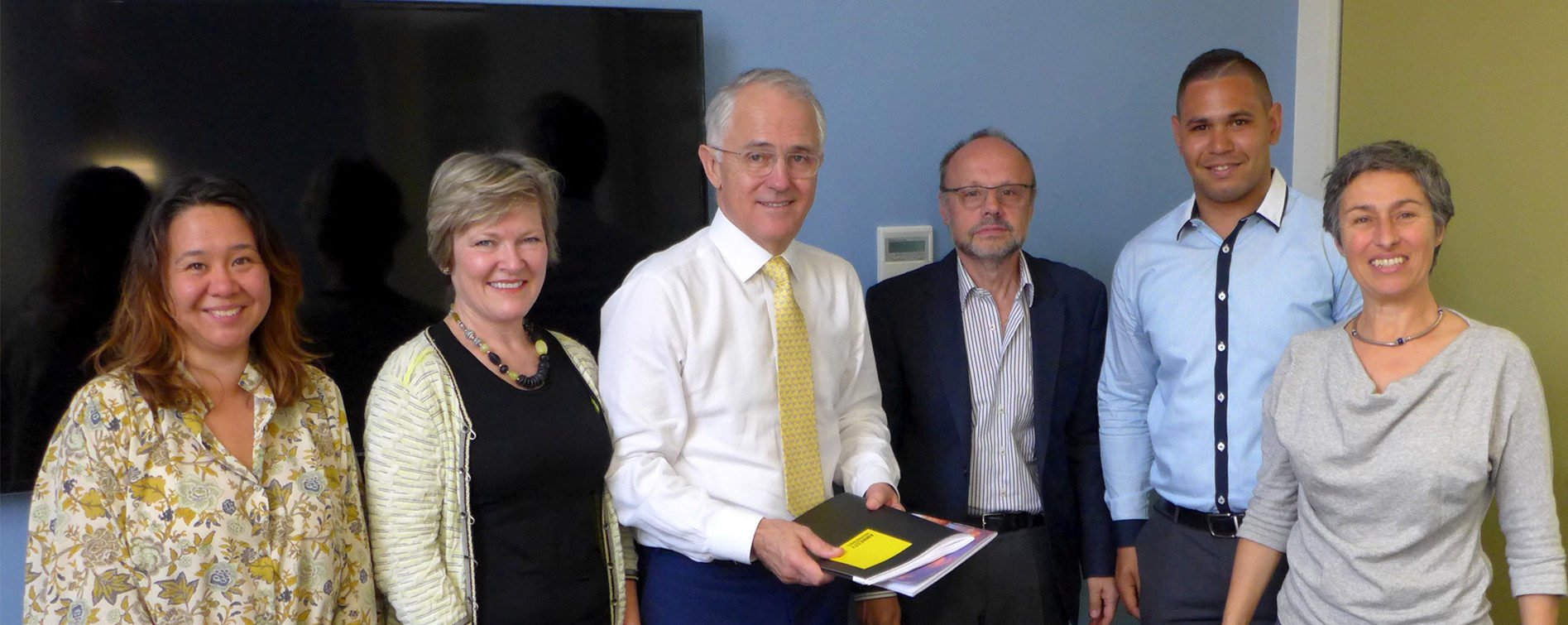
The Federal Government must make good on its promise to listen to, and work with, Aboriginal and Torres Strait Islander people, including engaging with the solutions put forward in the forthcoming #JustJustice essay collection.

The book includes more than 90 articles on solutions to protect the rights of Australia’s First Peoples. These include pieces by Amnesty’s Indigenous Rights Campaigners Roxanne Moore and Julian Cleary, who offer solutions to the stark overrepresentation of Indigenous children in detention.

‘Lock-em-up’ punitive approach has failed


In the book, Noongar woman Roxanne Moore decries the solitary confinement, teargassing and use of dogs against children in the Don Dale Detention Centre. She lays out how Australia has breached international human rights law by detaining Indigenous children at astronomical rates, and through the harsh treatment and conditions endured by children in detention.

#JustJustice articles by Julian Cleary also condemn the detention centre, and call for funding to be shifted into youth services and programs to keep kids out of detention in the first place. He writes that the ‘lock-em-up’ punitive approach has failed to heal trauma in Indigenous people in detention, and argues that Indigenous kids respond best to Indigenous role models.

He acknowledges the vital work of Indigenous people and organisations around the country – from rapper Briggs in NSW, to the Darwin-based Larrakia Night Patrol and the Victorian Aboriginal Legal Service.

Amnesty International research has found that Governments’ best chance to reduce offending and lower Indigenous incarceration rates is to fund prevention and diversion programs led by Indigenous communities. Indigenous-led, therapeutic programs best connect with Indigenous people, helping them to heal their trauma and deal with the life problems that lead to offending in the first place.

Listen, understand.


In a statement last week, Indigenous Affairs Minister Nigel Scullion expressed the Federal Government’s commitment to “genuine partnership” with First Peoples. He stated the Government’s determination “to listen and to understand to ensure we get it right.”

“This #JustJustice collection represents one opportunity for the Federal Government to listen and to understand,” said Roxanne Moore.

“Across the country we’re seeing unacceptable rates of Indigenous children being separated from their families and locked up. At the same time, Indigenous people also experience violence at far higher rates than the non-Indigenous population. This is not just a Northern Territory injustice – it is nationwide and Prime Minister Turnbull must seek national solutions.

“We call on Mr Turnbull to work with all States and Territories in developing a national plan to address the twin issues of high rates of Indigenous incarceration and experience of violence. We hope to see positive outcomes from the COAG meeting next month, where Mr Turnbull has pledged to put Indigenous incarceration on the agenda.”

UN: Intensify scrutiny of Russia’s role in Syria

Ahead of a visit to Moscow by the incoming United Nations Secretary-General, António Guterres, on 24 and 25 November, Jane Connors, Amnesty International’s Director of International Advocacy said:

“The incoming Secretary-General must ensure the UN system intensifies its scrutiny of Russia’s responsibility for violations of international law in the conflict in Syria.”

“António Guterres must use this visit to press the Russian authorities to end unlawful attacks in Syria – including the pattern of airstrikes that appear deliberately to target hospitals and medical facilities in flagrant violation of international humanitarian law. He also must call on the Russian authorities to stop assisting Syrian government forces and their allies to commit war crimes and crimes against humanity.

“Russia should use its influence to ensure Syrian authorities end unlawful attacks on civilians, release arbitrarily detained people, end the use of torture and enforced disappearance and allow unfettered humanitarian access.”

“In the past five years, Russia has repeatedly used its Security Council veto to block efforts to refer the situation in Syria to the International Criminal Court. By calling on the Council’s five permanent members – including Russia – to refrain from using the veto to prevent implementation of initiatives aimed at ending mass atrocities, António Guterres would send a strong message that as Secretary-General he will demand that the UN take effective action to uphold human rights and protect civilians in conflict.”

Background

Amnesty International has documented an apparently deliberate pattern of airstrikes by Syrian and Russian forces attacking hospitals and other civilian objects in Syria. Next week, the organization will release new research and testimony from the aftermath of recent attacks in Aleppo.

In previous attacks on eastern Aleppo documented by Amnesty International, Syrian government forces, supported by Russia, have shamelessly flouted international humanitarian law by launching unlawful attacks killing and injuring civilians, including by using internationally banned weapons such as cluster munitions.

Yemen: Hospitals under attack

Anti-Huthi forces in Yemen’s southern city of Ta’iz are leading a campaign of harassment and intimidation against hospital staff and are endangering civilians by stationing fighters and military positions near medical facilities.

During a visit to Ta’iz earlier this month, the organization’s researchers interviewed 15 doctors, and other hospital staff, who described how members of anti-Huthi armed forces regularly harassed, detained or even threatened to kill them over the past six months.

“There is compelling evidence to suggest that anti-Huthi forces have waged a campaign of fear and intimidation against medical professionals in Ta’iz. By positioning fighters and military positions near medical facilities they have compromised the safety of hospitals and flouted their obligation to protect civilians under international law,” said Philip Luther, Research and Advocacy Director for the Middle East and North Africa at Amnesty International.

“There can be no excuse for harassing medical staff or preventing doctors from carrying out their life-saving work. Attacks targeting health professionals or medical facilities are prohibited by international humanitarian law and can constitute war crimes.”

Philip Luther, Research and Advocacy Director for the Middle East and North Africa

Anti-Huthi forces, also known as Popular Resistance Forces, are allied with Yemeni President Abd Rabbu Mansour Hadi and the Saudi Arabia-led military coalition.

Hospitals shut down

In at least three cases hospitals were shut down because of threats against staff. In the latest incident, on Monday 21 November, one faction of anti-Huthi forces raided and shut down al-Thawra hospital, the biggest public hospital in Ta’iz, apparently in retaliation for hospital staff providing emergency medical treatment to three injured Huthi fighters.

According to eyewitnesses three armed men stormed an office at the hospital and threatened to kill medical staff if it was not shut down immediately. They also tried to drag the two surviving Huthi fighters out of the hospital’s intensive care and recovery units, but were prevented by medical staff. The third Huthi fighter had died while receiving treatment. The hospital is now only partially functioning, providing only limited emergency services and dialysis, despite a renewal in heavy fighting since the first week of November.

“It is a fundamental rule of international humanitarian law that the wounded – whether civilians or fighters – must be collected and cared for. It is outrageous and unacceptable that anti-Huthi forces are retaliating against medical staff for performing their duties,” said Philip Luther.

Medical staff threatened

Several of the doctors told Amnesty International that the lawlessness that has engulfed Ta’iz has created a security vacuum exposing them to greater risks from anti-Huthi forces who are trying to exert control at the hospitals.

One administrative staff member described the anti-Huthi forces as “the de facto authority”. He said that they often came to the hospital asking for fighters with war wounds to be treated. Doctors told Amnesty International that if anti-Huthi fighters were turned away due to lack of capacity at the hospital in some cases they turned violent or abusive. In other cases, medical staff said that doctors were forced to carry out their work at gunpoint.

According to one doctor from al-Jamhouri hospital who spoke to Amnesty International, one man opened fire inside the hospital compound after being told his son, an anti-Huthi fighter with a minor leg injury, did not require emergency care and could be treated by a nurse. His violent outburst injured hospital staff and killed a patient.

Hospital staff also said armed men refused to leave weapons outside and routinely caused trouble inside, verbally abusing doctors and having physical fights with medical staff.

“Hundreds of times [anti-Huthi fighters] threatened us and interfered with the hospital’s administration and our decision-making. When we stand up to them, they threaten us with being killed,” said an administrative worker who was detained by gunmen along with another doctor, after trying to stop them from interfering in hospital affairs.

Staff at al-Thawra hospital also said that anti-Huthi forces diverted electricity for their own personal use, disrupting power to crucial services.

In other instances fighters demanded medicines and supplies, and confiscated equipment from hospitals.

Setting up military positions near hospitals

Staff at al-Thawra hospital told Amnesty International that fighters set up defensive positions, including by parking tanks around the hospital compound ignoring pleas by staff and local authorities not to do so. This has put hospital buildings, staff and patients at serious risk amid retaliatory fire from Huthi forces.

Al-Thawra’s director said the hospital guards were unable to stand up to members of the armed forces:

“There are dozens of armed men in the hospital. Am I running a hospital or a battalion?… The armed men will create any problem with you outside the hospital if you refuse them.”

Director of al-Thawra hospital, the biggest public hospital in Ta’iz

One doctor who used to live and work in the hospital until July said fighters would launch attacks from next to the hospital at least twice a week on average. This in turn would result in fierce retaliatory attacks by Huthi forces on and around the hospital.

On 28 September, a mortar fired by Huthi forces stuck the hospital, damaging its solar panels, water tanks and pipes, which led to it temporarily suspending surgical operations

A doctor at al-Jamhouri Hospital also told Amnesty International:

“No weapons are fired from [inside] our location… There are three gates to the hospital – they have armed guards there. Inside the hospital they have people but they are not armed… The guards outside have arms and grenades.”

He also said that in early November a mortar attack hit the roof of the hospital and broke through one floor of the hospital.

“There was only 12 metres between where it fell and where we work,” he said, adding that up to 50 staff were present in the area at the time.

“By positioning fighters and military vehicles in and around medical facilities in Ta’iz, anti-Huthi forces are endangering civilians and hospital staff, flouting a fundamental principle of international humanitarian law,” said Philip Luther.

“All parties to the conflict must cease attacks that fail to discriminate between military targets and civilians. They must stop using artillery and mortars in the vicinity of civilian areas, and they must do everything feasible to avoid locating military objectives near densely populated areas, particularly hospitals and medical facilities.”

Amnesty International has repeatedly called for a comprehensive arms embargo on arms transfers that could be used by any of the warring parties in Yemen. Anti-Huthi forces are backed by the Saudi Arabia-led military coalition, which has been armed by the UK and USA.

The organization is also calling on the Yemeni authorities to enhance security at medical facilities and protect staff and patients from attack.

Background

The failure to protect hospitals and civilian infrastructure has emerged as a consistent pattern during the conflict in Yemen. During 2015 Amnesty International witnessed fighters from both sides launching attacks from within or near hospitals and in a July 2015 visit surveyed damage to al-Thawra hospital due to Huthi shelling.

Under international humanitarian law, medical facilities enjoy special protection from attacks and should not be used for military purposes or targeted by parties to the conflict. They remain protected unless they are used outside their humanitarian function to commit harmful acts to enemy.

Treating wounded soldiers or fighters is part of the humanitarian function of a hospital and medical facilities may never be attacked for doing so. Even if a hospital is being misused to launch attacks at the enemy, a warning must be issued giving a reasonable time limit and an attack may not proceed unless such a warning has gone unheeded.

Amnesty International has documented unlawful attacks, including war crimes, by all parties to the conflict in Yemen. During its visit to eastern parts of Ta’iz in November 2016, researchers spoke to witnesses – including medical staff – and victims from one attack launched by anti-Huthi forces in early October that hit a local market called Sofitel in Huthi-controlled areas. The attack on the Sofitel Market killed at least three civilians and injured four others.

Defending global human rights in the Trump era

By Salil Shetty, Amnesty International’s Secretary General

That which unites us is always greater than that which divides us. Yet, around the world, the forces of division seem to be gathering momentum. Walls rising up along borders, hatred and fear welling up within and between populations, repressive laws assailing basic freedoms.

The US election results, the latest development in this deeply troubling trend, caused global shockwaves. After campaigning with a constant refrain of misogyny and xenophobia, Donald J. Trump will be the next US President. Since the election, the world has been coming to terms with this fact, though its implications have yet to be fathomed fully.

For human rights activists in particular, who already find themselves embattled and “undesirable” in many countries, it raises the stakes immensely that the President-elect of one of the world’s most powerful nations put forward a political platform that championed hate, threatening to disavow many basic human rights protections.

It also drives home the message that the global human rights movement needs to seek common ground with those who feel so disenfranchised that they find political expression by lashing out against others – often the most vulnerable – in their communities and countries.

Many of their fears and concerns have valid roots and leaders can help to allay those concerns by responding with policies that ensure human rights, equality and dignity for all, rather than seeking to divide.

Watched with horror by many around the world, the Trump campaign was framed as “people vs. establishment”, but it became an echo chamber for a society’s fear and anger.

The world has been there many times before. We have seen how divisive rhetoric leads down an ugly road – dissenting voices are criminalized and those who are disadvantaged bear the brunt of vicious harassment, discrimination and violence.

“Watched with horror by many around the world, the Trump campaign was framed as ‘people vs. establishment’, but it became an echo chamber for a society’s fear and anger”

President Obama’s rhetoric often soared way above the reality of his policymaking, and masked continuing and sometimes worsening human rights violations by the USA, both home and abroad. They included increasing the arms sale to Saudi Arabia, despite evidence that such arms have been used to commit gross and systematic human rights violations in Yemen, and an expansion of the CIA’s almost totally unaccountable campaign of drone strikes.

We do not yet know how President-elect Trump’s own brand of international relations will affect the already precarious situation of human rights globally, but, if his poisonous rhetoric in the campaign translates into policy, the implications will be grave and far-reaching.

Trump’s triumph will undoubtedly embolden leaders around the world who rely on fear-mongering, whether they are already in power or running for office.

Counter-terrorism and national security

On counter-terrorism and national security, Trump’s rhetoric has been very dangerous. If his campaign promises are anything to go by, his administration seems likely to weaken the US stance on established norms, such as the prohibition on torture. Meanwhile it threatens to continue or expand current overreaches, such as the sprawling, illegal mass surveillance programmes which came to light under the Obama administration.

If Trump’s policy choices match his sexist statements, it will be terrible news for women’s rights, and the xenophobia and racism he has espoused portend very badly for the treatment of migrants and minorities. We can expect a rollback on refugee resettlement into the USA, increasing the pressure on poor countries who already host the overwhelming majority of the world’s refugees.

“Trump’s triumph will undoubtedly embolden leaders around the world who rely on fear-mongering, whether they are already in power or running for office”

His anti-Muslim rhetoric risks emboldening hatemongers and fuelling attacks and discrimination, both in the USA and beyond. This could have a deeply damaging ripple effect on members of many religious minorities. It could also serve as a recruitment tool for armed groups that exploit such divisions for their own purposes.

And a likely US retreat from the global human rights system could further weaken crucial international safeguards that also protect people in the USA.

It is a bleak outlook

But the future does not have to be like this. In our work around the world, we have seen how even people facing great adversity can come together, dialogue, and mobilise to bring about positive change rooted in human rights.

“Fear and hate do not have to win the day – they can be a catalyst for change. And it is heartening that the majority of people in the USA and around the world support equality, dignity, freedom for all people”

Fear and hate do not have to win the day – they can be a catalyst for change. And it is heartening that the majority of people in the USA and around the world support equality, dignity, freedom for all people – the core values underpinning human rights. Those values are far too precious to discard; their protection far too fragile to take for granted.

Stopping hate and fear in their tracks will not be easy. But the guiding principles of conscience and human rights have proven to be powerful motivators in the past. As the great civil rights leader, the Rev. Martin Luther King, Jr., said: “The arc of the moral universe is long, but it bends towards justice.”

Thanks to the determined struggle of human rights activism through the decades has made leaps forward, often in the face of great adversity. We need to keep up the fight. For those of us who care deeply about freedom and human rights, seeking common ground that heals the divisions is now the defining challenge of our time.

Become a member today

Winners of the 2016 Amnesty International Australia Media Awards announced

Tonight Amnesty International announced the winners of the 2016 Amnesty International Media Awards, recognising excellence in reporting on human rights issues in the Australian media over the past year.

The winners of this year’s award categories are:

Photography

The winner of the Photography category is Andrew Quilty for his photo essay, ‘The Man on the Operating Table’ published on ABC Foreign Correspondent.

Judges

Mags King, Fairfax
John Donegan, Racing Victoria
Daniel Berehulak, Photojournalist

Radio

Sophie McNeill and Fouad Abu Gosh are the winners of the radio category for their piece, ‘Voices from Inside Besieged Syria’, produced for ABC Radio National.

Judges

Adam Shirley, 666 ABC Canberra
Angela Catterns AM, Broadcaster, Writer, Podcaster
Madonna King, Journalist and Author

Cartoon

The winner of the Cartoon category is Glen Le Lievre for his piece ‘Door’ published in The Sydney Morning Herald.

Judges

Fiona Katauskas, Cartoonist and Illustrator
Cathy Wilcox, Fairfax
Robert Phiddian, Flinders University

Print/Online

The winner of the Print/Online category is Jess Hill for her story ‘Suffer the Children: Trouble in the Family Court’, edited by Nick Feik for The Monthly.

Judges

Jewel Topsfield, Fairfax
Karen Barlow, Huffington Post Australia
Patrick Keneally, The Guardian Australia

Indigenous Reporting

The winner of the Indigenous Reporting category is Sarah Dingle’s story for ABC Background Briefing ‘WA’s Stolen Wages Shame’.

Judges

Phillipa McDermott, ABC
Catherine Liddle, NITV
Rudi Maxwell, Koori Mail

Television

The winner of the Television category is Sarah Ferguson, Nial Fulton & Ivan O’Mahoney for their documentary ‘Hitting Home’, In Films for the ABC.

Judges

Julia Baird, ABC
David Speers, Sky News Australia
Hugh Riminton, Ten Eyewitness News

Congratulations

“Amnesty International congratulates all of the winners of the 2016 Media Awards for their exceptional human rights reporting and recognises the critical role journalists, photographers and cartoonists play in exposing human rights abuses,” said National Director, Claire Mallinson.

The six winners received an exquisite sculptural piece inspired by Amnesty International’s iconic flame, created by Sydney artist Cesar Cueva, director of ‘Courtesy of the Artist’.

The Award ceremony took place at Golden Age Cinema in Surry Hills, Sydney. See all of the Award finalists.

UN General Assembly: Support moratorium on death penalty

On 17 November 2016 the Third Committee of the UN General Assembly (UNGA) will consider and vote upon a draft resolution on a moratorium on the use of the death penalty.

This is the sixth draft resolution on this topic to be proposed for consideration by the Committee, under the leadership of the delegations of Argentina and Mongolia. Amnesty International renews its calls on all UN Member States to vote in favour of the draft resolution and support initiatives towards an executions-free world.

UNGA resolutions are non-binding tools which carry considerable moral and political weight. The adoption, with increased cross-regional support, of the first five resolutions on a moratorium on the use of the death penalty has generated momentum for initiatives and debates on the death penalty and resulted in several countries progressing their journeys towards abolition of this punishment.

The countries that still carry out executions remain an isolated minority, with only 11 countries known to have done so every year in the past five years.

Most recently, four countries – Fiji, Madagascar, Republic of Congo and Suriname − abolished the death penalty in 2015, and two others have repealed laws allowing for this punishment this year, Nauru and Guinea. A total of 141 countries are now abolitionist in law or practice. In 2015, 169 (88%) of the 193 UN Member States were executions-free. The countries that still carry out executions remain an isolated minority, with only 11 countries known to have done so every year in the past five years.

Yet the opportunity that this year’s resolution offers to UN member states to renew their commitment to the promotion and protection of human rights associated with the death penalty could not be more timely. Fifty years ago the UNGA adopted the International Covenant on Civil and Political Rights, which sets out clear prohibitions on the use of the death penalty and establishes the abolition of this punishment as the ultimate goal to be achieved in countries that still retain it. While the international community has since adopted several other instruments to ensure protection of the rights of those facing the death penalty, Amnesty International continues to document violations of these prohibitions in virtually all countries that resort to the use of this punishment.

In still too many cases people were arbitrarily deprived of their lives in executions carried out after grossly unfair trials, often based on forced “confessions” extracted through torture or other ill-treatment; persons who were below 18 years old at the time of the commission of the crime or who have a mental or intellectual disability are still facing the death penalty or have been executed; and applications for pardons or commutation, where such procedures exist, are not meaningfully considered or ever granted, among other concerns.

Another strong pronouncement by the UN main deliberative body in favour of a moratorium on the use of the death penalty would not only send a strong, supportive signal to those states that are already considering abolishing this punishment; but also reaffirm that human rights violations associated with the death penalty are not condoned.

Amnesty International opposes the death penalty unconditionally, in any cases and under any circumstances, as a violation of the right to life and the ultimate cruel, inhuman and degrading punishment. It is with this spirit that the organization continues to support the adoption of UNGA resolution on a moratorium on the use of the death penalty. Amnesty International renews its calls on all UN member states to vote in favour of the 2016 draft resolution on this topic, both at the Third Committee and when considered for final endorsement by the plenary session of the UNGA in December.