Historic win: 17-year-olds will be removed from adult prison in Queensland

Overturning five decades of injustice, the Queensland Parliament passed a Bill that will mean 17-year-olds are no longer held in adult prisons or tried as adults in the justice system.

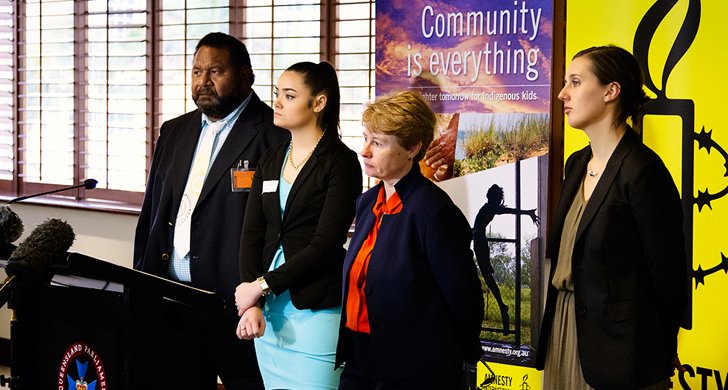
Queensland was the only state or territory in Australia to have this law, in conflict with children’s rights. Indigenous Rights Campaigner Roxanne Moore, reflects on this momentous occasion. 

Amnesty was on the ground 

We been campaigning for the removal of 17-year-olds from the adult justice system for many years.

Amnesty has put many submissions into parliamentary and government processes, written numerous letters to decision makers, held lobbying meetings and included recommendations for this change in two of our ‘Community is Everything’ research reports.

Many Queensland Amnesty activists have been meeting with their politicians and making calls to their offices. At least 22,00 Queenslanders emailed their politicians to call for this change.

We thank everyone who took action – you helped bring about this historic change that will create a brighter future for Queensland kids

In the week after the release of Amnesty’s report ‘Heads Held High: Keeping Queensland kids out of detention’  the Queensland Government announced its intention to introduce a Bill to end the treatment of 17-year-olds as adults in the justice system.

In the week of the vote, our activists were calling on their leaders to pledge their support for the Bill, and the Bill passed 43 to 41 votes.

We thank everyone who took action – you helped bring about this historic change that will create a brighter future for Queensland kids.

What next?

While this is a great step for children’s rights in Queensland, there is much more work to be done to make the justice system fair for all children.

When kids veer off-track, they should be with their communities, being supported to live to their fullest potential

The horrific conditions in Queensland youth detention that Amnesty International recently exposed show that detention is harmful for children. When kids veer off-track, they should be with their communities, being supported to live to their fullest potential.

Where human rights abuses happen in detention, we need to know about it. The perpetrators need to be held accountable through an independent and impartial investigation. That is why it is so important to have an independent inspector of prisons – a protection we’ll have if Australia signs the Optional Protocol on the Convention against Torture (OPCAT).

Call on Prime Minister Turnbull to ratify OPCAT now, so that these human rights abuses never happen to kids in detention again.

Read our full report on youth justice in QLD


Syria: Fears of civilian carnage in Aleppo

Fears for the safety of civilians in eastern and western Aleppo city are mounting amid the looming threat of a resumption and possible escalation of fighting and bombardment by Syrian government forces with Russian support and non-state armed groups once a humanitarian pause comes to an end on 4 November.

Media reports indicate that a fleet of Russian warships have made their way to Latakia on the Syrian coast in recent days indicating that Syrian and Russian forces are preparing a final bloody assault to seize control of the city.

“Given the track record of the forces fighting in Aleppo – particularly government forces – Amnesty International fears there will be very high civilian casualties as Syrian forces, supported by Russia, escalate attacks in order to seize control of the city.”

Samah Hadid , Deputy Director for Campaigns 

“Even in times of wars, there are fundamental rules that all parties must obey. Civilians must never be deliberately targeted. And armed forces must never indiscriminately bombard populated areas. Syrian government forces, with Russian support, have systematically violated international humanitarian law in eastern Aleppo and throughout Syria, unlawfully killing tens of thousands of civilians. And armed opposition groups have indiscriminately bombarded civilian areas in in western Aleppo and elsewhere. ”

“The scale of the devastation in eastern Aleppo in recent months has been chilling. Given the track record of the forces fighting in Aleppo – particularly government forces – Amnesty International fears there will be very high civilian casualties as Syrian forces, supported by Russia, escalate attacks in order to seize control of the city,” said Samah Hadid , Deputy Director for Campaigns at Amnesty International’s Beirut regional office.

“In previous attacks documented by Amnesty International on eastern Aleppo Syrian government forces, supported by Russia have shamelessly flouted international humanitarian law by launching unlawful attacks killing and injuring civilians and failing to take necessary precautions to ensure they are protected by using illegal weapons such as cluster munition. Civilians in western Aleppo city are also at risk from the repeated, unlawful use of imprecise explosive weapons by armed groups such as mortars and Katyusha rockets.”

“I know that it is a matter of time before hell is unleashed again. When they announce a humanitarian pause, my heart stops beating because I know what comes next: air strike attacks.”

Um Mohamad, A resident of Aleppo

Residents of eastern Aleppo have also expressed their fears to Amnesty International of the looming assault on the city. Um Mohamad said that she feared the pauses meant a greater attack was around the corner:

“I know that it is a matter of time before hell is unleashed again. When they announce a humanitarian pause, my heart stops beating because I know what comes next: air strike attacks.”

Another resident, Nizar, told the organization: “I am afraid that the offensive might be bloodier than the one before. There is nowhere to run or hide. The bombs Russia and the regime are using on us destroy entire buildings including the basement.”

“The temporary humanitarian pause announced by Russia is no substitute for unfettered and impartial humanitarian access and ensuring protection of civilians in the longer term when the airstrikes resume. Civilians wishing to evacuate must be allowed to do so without any restrictions by all parties to the conflict.”

Malaysia: Journalists at risk

The Malaysian authorities must immediately take steps to protect journalists at the respected news site Malaysiakini against intimidation and threats from vigilantes.

The so-called “Red Shirts” movement, has vowed to “tear down” the offices of Malaysiakini on Saturday and continues to mount aggressive demonstrations outside them.

“Everyone has a right to peaceful protest, but what the red-shirts are threatening is violence. They have a right to freedom of expression but they cannot use threat and violence to deny journalists that same right,” said Josef Benedict, Amnesty International’s Deputy Director for South East Asia and the Pacific.

“Everyone has a right to peaceful protest, but what the red-shirts are threatening is violence.”

Josef Benedict, Deputy Director for South East Asia and the Pacific

“The threats against Malaysiakini are the latest instance of the right to freedom of expression coming under attack in the country. The authorities have a human rights obligation  to protect journalists. They must be allowed to work freely and without fear of violent attacks.”

In October the “Red Shirts” assaulted three journalists from Malaysiakini and the Star covering a convoy organised by the Coalition for Clean and Fair Elections (Bersih 2.0) as well as members of the convoy.

Background

The so-called red-shirts, a pro-Malay group, says that it is demanding an explanation for a grant Malaysiakini received from the Open Society Foundations, a charitable organization founded by the philanthropist George Soros.

At a demonstration of around 100 people on 3 November, the group, led by Jamal Mohammed Yunos amassed outside Malaysiakini’s offices, chanting slogans, including “Merah, merah” (Red, red) and “Hancur Soros” (Destroy Soros).

Speaking to Malaysiakini’s journalists, who invited the red-shirts into their offices for coffee, Jamal Mohammed Yunos said that he will lead a larger rally of “at least 20,000 people” if the news site did not explain how it came to receive a grant from the Open Society Foundations.

“We will make sure part of this building will be runtuh,” he said, using the Malay word for “collapse” or “torn down”.

Malaysiakini ‘s general manager, K. Manohar has filed a police report against these threats today (4 November 2016) at the Petaling Jaya police district headquarters in the state of Selangor, requesting police to provide necessary personnel for protection.


Good news: 17-year-olds out of adult prisons

The Palaszczuk Government, with the support of three cross-bench Members, has today shown great leadership in protecting Queensland’s children. It has ensured the passage of a historic Bill to move 17-year-old children out of adult prisons and into the youth justice system.

Queensland has treated 17-year-old children as adults in the criminal justice system since 1965. It is currently the only state or territory in Australia to try 17-year-olds in the adult criminal justice system and hold them in adult prisons, in breach of international law.

But today, Queensland passed the Youth Justice and Other Legislation (Inclusion of 17-year-old Persons) Amendment Bill 2016. When it comes into effect in a year’s time, 17-year-old children will be transitioned into the youth justice system and moved out of adult prisons.

Read our full report on youth justice in QLD

Chance for rehabilitation

“Today, over five decades of injustice are coming to an end,” said Roxanne Moore, Indigenous Rights Campaigner at Amnesty International Australia.

Today, over five decades of injustice are coming to an end.

Roxanne Moore, Amnesty International Australia

“The Bill passed today recognises that 17 year-olds are children, and all children, no matter what offence they may have committed, should be given every possible opportunity for rehabilitation. They are far more likely to have this in the youth justice system.”

Children’s potential

As at 1 October, 40 children aged 17 were held in adult prisons, where Amnesty International research found they may not have access to education, or daily essentials like toothbrushes and soap.

The passing of this Bill means that the hopes, dreams and potential of 17-year-olds will no longer get wasted away behind adult prison bars in harsh conditions.

Roxanne moore, amnesty international australia

For years, Amnesty International joined community members, lawyers and advocacy organisations in urging Queensland to include all children in the youth justice system, in line with international law.

The UN Committee on the Rights of the Child has been calling on Queensland to make this move since 2005.

We released a report two months ago which, amongst other things, outlined the pressing need for 17-year-olds to be immediately transferred out of the adult criminal justice system. Shortly afterwards, the organisation welcomed the Queensland Government’s historic announcement that it would soon make this move.

Submission: Australia’s “processing” of refugees on Nauru

Amnesty welcomes the opportunity to provide a submission to the Legal and Constitutional Affairs References Committee inquiry into the serious allegations of abuse, self-harm and neglect of asylum seekers in relation to the Nauru Regional Processing Centre, and any like allegations in relation to the Manus Regional Processing Centre.

The Australian Government is choosing to subject women, men and children to an elaborate and cruel system of abuse with a policy that is intentionally designed to harm people, as highlighted in our new report: ‘Island of Despair’: Australia’s “processing” of refugees on Nauru‘.

Amnesty has used this report, released in October 2016, as the basis for our submission to the Australian Senate Legal and Constitutional Affairs References Committee inquiry into the ‘serious allegations of abuse, self-harm and neglect of asylum seekers in relation to the Nauru Regional Processing Centre, and any like allegations in relation to the Manus Regional Processing Centre’.

Based on months of research, including interviews with more than 100 people in Nauru and Australia, this report brings together further revelations of abuse with existing accounts to reveal the full scale of Australia’s system of deliberate cruelty. Amnesty has been documenting human rights abuses in Australia’s offshore processing centres for many years, and we have also provided the Committee with our previous research reports including:

The Senate inquiry is an important step forward in building the political momentum and will to end the policy of offshore processing and detention and permanently close the Refugee Processing Centres on Nauru and Manus Island.

Read the submission

Egypt: Lift abusive arbitrary travel bans

The Egyptian authorities should stop imposing travel bans to prevent human rights defenders from leaving the country and speaking out about Egypt’s appalling human rights record, Amnesty International and Human Rights Watch said after another prominent human rights lawyer was banned from travelling today.

The bans are part of a larger campaign to suppress independent, critical voices inside the country.

Early this morning, human rights defender Malek Adly was stopped from boarding a flight to France without any reasons given, as required by law, he said by phone. Since the armed forces ousted President Mohamed Morsy in July

“The Egyptian authorities are blatantly relying on open-ended arbitrary travel bans as a tactic to intimidate human rights defenders and hamper their work.”

Najia Bounaim, North Africa deputy regional director for campaigns

2013, the authorities have arbitrarily banned at least 12 other directors, founders and staff members of Egyptian non-governmental organizations (NGOs) from travelling abroad. Others who have been prevented from travelling outside the country include dozens of members of political parties, youth activists, bloggers, journalists and academics.

“The Egyptian authorities want to sever the connection between the Egyptian human rights movement and the outside world,” said Joe Stork, deputy Middle East and North Africa director at Human Rights Watch.

“The Egyptian government’s international supporters should insist on allowing the country’s human rights defenders to be heard.”

A violation to rights of freedom of movement and association

The authorities have imposed many of these travel bans arbitrarily or as part of an abusive criminal investigation into the registration and funding of NGOs. They are contrary to international human rights law and Egypt’s constitution, both of which protect the right of Egyptians to leave and enter their own country, blatantly violate the rights to freedom of movement and association, and stifle the right to freedom of expression.

Lawyer and human rights defender Malek Adly was arrested and ill-treated by Egyptian security forces on 5 May.
© Hossam el-Hamalawy

Under the International Covenant on Civil and Political Rights and the African Charter on Human and People’s Rights, both of which Egypt has ratified, everyone has the right to leave any country, including their own. Both treaties allow countries to impose restrictions on that right as long as they are provided by law and necessary and proportionate to protect national security, public order, public health or morals or the rights and freedoms of others.

The Egyptian constitution further guarantees the right to freedom of movement in Article 62. It states that a reasoned judicial order is required to impose such restrictions and, even then, this should only be for a specified period of time.

In many of the cases documented by Amnesty International and Human Rights Watch, airport authorities gave no reason for stopping the person from boarding a flight abroad and have refused to provide any formal documentation of the travel ban.

In some cases, officers of the Interior Ministry’s National Security Agency questioned the traveler, searched their luggage and phones, and seized their passport without justification. In others, the Office of the Public Prosecutor ordered the bans in relation to criminal investigations without informing the individual of the particular case or charges against them. In most cases, the people barred from travelling have not been told when or if the ban will end.

In three cases known to Amnesty International and Human Rights Watch, political and human rights activists who have challenged the arbitrary travel bans imposed on them in relation to the abusive criminal investigation into the funding and registration of their NGO have had their case rejected in court.

“The Egyptian authorities are blatantly relying on open-ended arbitrary travel bans as a tactic to intimidate human rights defenders and hamper their work, stifling their rights to freedom of expression and freedom of movement.” said Najia Bounaim, North Africa deputy regional director for campaigns at Amnesty International.

“All travel bans imposed on human rights defenders or political activists solely for peacefully exercising their rights should be immediately and unconditionally lifted.”

Egyptian authorities began cracking down on international and local nongovernmental organizations in 2011, when they opened an investigation into the groups’ registration and funding. Known as Case 173, the investigation culminated in a June 2013 ruling by a Cairo criminal court sentencing 43 foreign and Egyptian employees of international groups to prison sentences ranging between 1 and 5 years.

The court also ordered the closure of the international organisations in question: the International Republican Institute, the National Democratic Institute, Freedom House, the International Center for Journalists and the Konrad Adenauer Foundation.

Amnesty International and Human Rights Watch both condemned the ruling at the time and urged the authorities to respect the right to freedom of association and enable NGOs to carry out work in the country without hindrance.

Since late 2014, a new panel of investigative judges has increasingly targeted local human rights groups as part of Case 173.

Those affected by travel bans related to Case 173 also include Gamal Eid, director of the Arab Network for Human Rights Information; Hossam Bahgat, founder of the Egyptian Initiative for Personal Rights; Mohamed Zaree, Cairo office director of the Cairo Institution for Human Rights Information and Hoda Abdelwahab, executive director of the Arab Center for the Independence of the Judiciary and Legal Profession.

The authorities have also banned Mohamed Lotfy, executive director of the Egyptian Commission for Rights and Freedoms, from leaving the country. It is unclear whether this is related to Case 173 or another criminal investigation. In June 2015, Lotfy was prevented from boarding a flight to Germany, where he was due to speak at a parliament round table about the deteriorating human rights situation in Egypt.

President Abdelfattah al-Sisi began an official visit to Germany and met with Chancellor Angela Merkel the next day.

Iraq: Tribal militia tortured detainees

Militia fighters from the Sab’awi tribe have unlawfully detained, publicly humiliated and tortured or otherwise ill-treated men and boys in villages south-east of Mosul that were recaptured from the armed group calling itself the Islamic State (IS) in recent days.

The organization’s researchers on the ground in Iraq interviewed local officials and eyewitnesses including villagers who described how members of the Sab’awi Tribal Mobilization militia (Hashd al-‘Ashairi) carried out punitive revenge attacks. Residents suspected of having ties to IS were beaten with metal rods and given electric shocks. Some were tied to the bonnets of vehicles and paraded through the streets or placed in cages.

“There is strong evidence that Sab’awi tribal militia members have committed crimes under international law by torturing and otherwise ill-treating residents in Qati’ al Sab’awiin in revenge for crimes committed by IS,” said Lynn Maalouf, Deputy Director for Research at Amnesty International’s Beirut regional office.

“There is no doubt that IS fighters who are suspected of committing crimes must be held accountable in fair trials, but rounding up villagers and forcing them to endure public humiliation or other violations, including torture, is no way of securing justice, truth and reparation for victims of IS crimes.”

“There is strong evidence that Sab’awi tribal militia members have committed crimes under international law.”

Lynn Maalouf, Deputy Director for Research at Amnesty

Violations took place in al-Makuk, Tal al-Sha’eir, and Douizat al-Sufla – a group of villages located on the south-eastern bank of the river Tigris known as Qati’ al-Sab’awiin (Sector of the Sab’awi tribe). Eyewitnesses described how members of the Sab’awi Tribal Mobilization militia seized men and boys from the villages without a warrant.

One of the affected villages, al-Makuk, was retaken by Iraqi forces from IS on 20 October 2016. Eyewitnesses told Amnesty International that fighters from the Sab’awi tribe entered the village before the Iraqi army arrived but after IS fighters had retreated, so no armed confrontations took place. According to the residents, tribal militia fighters, who belong to the same tribe as the villagers, started rounding up men and older boys as soon as they arrived.

One witness described how six militia members (Hashd al-Ashairi) dragged “Ahmed” (whose name has been changed to protect his identity) into the courtyard of his house and accused his brother of being a Daeshi (Arabic colloquial term for a person affiliated with the IS) before brutally beating him in front of his wife and children.

“They kicked him to the ground and ‘tasered’ him three times. They punched him and beat him with the back of their Kalashnikovs, with metal rods, and even a rubber hose – the thick ones used for agriculture,” he said. The witness said

“Ahmed” was unable to stand after the beating.

“They had no commanders. Every fighter from the Hashd had his own personal revenge to take… They drove around the village with men strapped onto car bonnets shouting things like ‘come see the Daeshi who informed on me and my father’,” said two of the witnesses.

Some residents told Amnesty International that they believe that the tribal militia were motivated by revenge for relatives killed by IS, as well as longstanding enmities unrelated to the conflict.

“They had no commanders. Every fighter from the Hashd had his own personal revenge to take.”

Witnesses 

One woman said she saw militia members parading an IS suspect, who was believed to have been involved in an attempted bomb attack on a government official’s home, through the village on the bonnet of their vehicle.

“They called for everyone to come out and see the Daeshi… His face was bloody…I was too scared to look at his face’” she said.

Another witness, interviewed separately, corroborated the incident. He explained that militia men, accompanied by the security guards of the official who had been the target of the attack, beat the man on his face with cables.

All the witnesses interviewed described a disturbing scene in which seven men and boys, between the ages of 16 and 25, were placed in large poultry cages on display in the middle of a public roundabout. A Tribal Mobilization fighter asked each to walk out of the cage in turn saying to them: “What are you? Say you’re an animal, say you’re a donkey”, before beating them and forcing them into cars.

Witnesses also said that on 21 October, Tribal Mobilization members gathered dozens of men and older boys in a public square in al-Makuk and spent two hours calling out the names of the ‘wanted’. At least 14 boys and men whose names were called had their hands bound and were taken away.

Witnesses said that arrests by militia fighters were being carried out around the clock, even after a large convoy of Iraqi armed forces from the Ninewa Operations Command arrived on 22 October.

“Instead of being dragged through the streets, publicly harassed and taunted for being IS members, people suspected of committing human rights abuses should be referred to judicial authorities and if there is sufficient admissible evidence against them, tried according to international law,” said Lynn Maalouf.

“All detainees must be treated humanely and must be protected from torture and other ill-treatment. Only those legally sanctioned to detain and interrogate suspects must be allowed to do so.”

Some of those seized were held in a school in Sidawa, one of the villages in the Qati’ al-Sab’awiin, along with men and boys from other nearby villages. A group of detainees was handed over to the Iraqi armed forces on 30 October, bearing marks of torture, according to witnesses. Others are believed to still be held by the Tribal Mobilization fighters in unofficial detention facilities, including abandoned homes in villages in the Qita’ al-Sab’awiin.

“The authorities must rein in the tribal militia fighters responsible and bring them to justice.”

Lynn Maalouf

Amnesty International also received accounts of abuses carried out by the Firsan Jbour tribal militias targeting villagers from the al-Shora sub-district, south of Mosul. Witnesses told Amnesty International that on 26 October, militia fighters at checkpoints taunted them for belonging to Daesh, spat and threw rocks at them and threatened to kill or detain those with IS links as they were being transported to safer areas by Iraqi forces.

“They tried to grab us from the trucks. A few shouted that we should all be taken to be executed,” said one 17-year-old boy.

“Iraqi authorities have repeatedly failed to stop revenge attacks or investigate crimes by militias from the Popular Mobilization Units, who are also participating in the Mosul offensive. This has fostered a dangerous culture of impunity in which perpetrators of such attacks feel they have free rein to commit crimes and go unpunished,” said Lynn Maalouf.

“The authorities must rein in the tribal militia fighters responsible and bring them to justice, in order to prevent such crimes being repeated in the ongoing Mosul offensive. Those suspected of committing crimes must be removed from duty without delay.”

Background

Tribal Mobilization militias, composed of fighters from Sunni tribes have played an increasing role in the fight against IS and in securing their areas after they have been recaptured. While much less powerful than the Popular Mobilization Units (PMU), predominantly Shi’a militias, some tribes within the Tribal Mobilization have also received support from government authorities.

Amnesty International has previously documented war crimes and human rights violations including abductions, extrajudicial executions and other unlawful killings, torture and destruction of homes carried out by the Popular Mobilization Units.

Italy: Beatings and unlawful expulsions of refugees and migrants

The European Union’s pressure on Italy to “get tough” on refugees and migrants has led to unlawful expulsions and ill-treatment which in some cases may amount to torture, a new report from Amnesty International revealed today.

Beatings, electric shocks and sexual humiliation are among the numerous allegations of abuse documented in Hotspot Italy: How EU’s flagship approach leads to violations of refugee and migrant rights. The report demonstrates how the EU-sponsored ‘hotspot approach’ for processing refugees and migrants at the point of arrival is not only undermining their right to claim asylum but has fuelled appalling abuse.

“In their determination to reduce the onward movement of refugees and migrants to other member states, EU leaders have driven the Italian authorities to the limits – and beyond – of what is legal,” said Matteo de Bellis, Amnesty International’s Researcher on Italy.

“The result is that traumatized people, arriving in Italy after harrowing journeys, are being subjected to flawed assessments and in some instances appalling abuse at the hands of the police, as well as unlawful expulsions.”

“EU leaders have driven the Italian authorities to the limits – and beyond – of what is legal.”

Matteo de Bellis, Amnesty International’s Researcher on Italy

The hotspot approach was designed to identify and fingerprint new arrivals to front-line EU countries such as Italy, swiftly assess their protection needs and either process their asylum applications or return them to their country of origin. The report, based on interviews with more than 170 refugees and migrants, reveals serious failures at each of these stages.

In an ostensible effort to reduce the pressure on front-line states, such as Italy, the hotspot approach was twinned with a scheme to relocate asylum-seekers to other EU member states. However, the solidarity component of the hotspot approach has proven largely illusory: 1,200 people have been relocated from Italy so far, out of the 40,000 that had been promised, while more than 150,000 people have reached Italy by sea this year. Whilst the sea route is perilous, Italian authorities are leading efforts to rescue people in the Mediterranean.

Fingerprinting by force

The hotspot approach, introduced in 2015 on the recommendation of the European Commission, requires Italy to fingerprint all new arrivals. However, those wanting to claim asylum in other European countries – perhaps because they have relatives there – have a strong interest in avoiding being fingerprinted by Italian authorities, to avoid a risk of being sent back to Italy under the EU’s so-called Dublin system.

“They gave me electricity with a stick, many times on the left leg, then on right leg, chest and belly.”

A 16-year-old Sudanese boy from Darfur

Under pressure from EU governments and institutions, Italy has introduced coercive practices to obtain fingerprints. Amnesty International has received consistent accounts that arbitrary detention, intimidation and excessive physical force have been used to coerce newly arrived men, women and even children into fingerprinting. Of the 24 testimonies of ill-treatment collected by Amnesty International, 16 involve beatings. A 25-year-old woman from Eritrea described how she was slapped repeatedly in the face by a policeman until she agreed to be fingerprinted.

In several cases, refugees and migrants also claimed having being given electric shocks with stun batons. A 16-year-old boy from Darfur described his ill-treatment to Amnesty International: “They gave me electricity with a stick, many times on the left leg, then on right leg, chest and belly. I was too weak, I couldn’t resist and at that point they took both my hands and put them on the machine.”

Another 16-year-old boy and a 27-year-old man claimed police sexually humiliated them and inflicted pain to their genitals. The man told Amnesty International how police officers in Catania beat and electric shocked him before making him strip and using a pair of three-pronged pliers on him: “I was on a chair made of aluminium, with an opening on the seat. They held [my] shoulders and legs, took my testicles with the pliers, and pulled twice. I can’t say how painful it was.”

Whilst the behaviour of most police remains professional and the vast majority of fingerprinting takes place without incident, the findings of this report raise serious concerns and highlight the need for an independent review of current practices.

Screening

Under the hotspot approach, new arrivals in Italy are screened to separate asylum-seekers from those considered irregular migrants. This means that people, often exhausted and traumatized from their journeys and without access to adequate information or advice on asylum procedures, have to answer questions with potentially profound implications for their futures.

One 29-year-old Nigerian woman told Amnesty International “I don’t even know how we got here, I was crying…I saw so many police, I was scared…My mind was far, I couldn’t even remember the name of my parents.”

“The hotspot approach … is resulting in appalling violations of the rights of desperately vulnerable people for which the Italian authorities bear a direct responsibility, and Europe’s leaders a political one.”

Matteo de Bellis

Police are required to ask new arrivals to explain why they have come to Italy, rather than simply asking them if they intend to seek asylum. Since refugee status is not determined by the reasons why a person has entered a country but by the situation they would face if returned to their country of origin, this approach is fundamentally flawed.

On the basis of this extremely short interview, police officers who lack the appropriate training are in effect making a decision on the individual’s protection needs. Those not judged to have a claim for asylum are issued with expulsion orders – including through forced repatriation to their country of origin – that may expose them to serious human rights violations.

Expulsions

Under pressure from the EU, Italy has sought to increase the number of migrants it returns to their countries of origin. This has included negotiating readmission agreements with countries that have committed appalling atrocities.

One such Memorandum of Understanding (MoU) was signed between the Italian and Sudanese police authorities in August, allowing for a summary identification process that, in certain circumstances, may even take place in Sudan, after the expulsion has been carried out. Even if the identification takes place in Italy, it is so superficial, and so heavily delegated to Sudanese authorities, that it does not allow for an individualized determination that a person will not be at real risk of serious human rights violations upon return. This has already led to cases of unlawful expulsions.

On 24 August 2016, 40 people identified as Sudanese nationals were put on a plane to Khartoum from Italy. Amnesty International spoke to a 23-year-old man from Darfur who was on this flight and described how security forces were awaiting his arrival in Khartoum: “They took us to a special area in the airport. I saw one man beaten…We were interrogated one by one…Now I am afraid if the security is searching for me or if they find me, I don’t know what will happen to me.”

“The hotspot approach, designed in Brussels and executed in Italy, has increased, not decreased, the pressure on front-line states. It is resulting in appalling violations of the rights of desperately vulnerable people for which the Italian authorities bear a direct responsibility, and Europe’s leaders a political one,” said Matteo de Bellis.

“European nations may be able to remove people from their territory but they cannot remove their obligations under international law. Italian authorities must end violations and ensure that people are not sent back to countries where they are at risk of persecution or torture.”

Background

Amnesty International undertook four research missions to Italy in 2016, interviewing refugees and migrants and meeting authorities and NGOs in Rome, Palermo, Agrigento, Catania, Lampedusa, Taranto, Bari, Genoa, Ventimiglia, and Como. The research team conducted 174 interviews with refugees and migrants, and shorter conversations with many more.

Amnesty International has repeatedly sought clarifications and asked to discuss the concerns detailed in the report with the Minister of Interior. The organization has yet to receive an answer.
 

Russia: Amnesty International’s Moscow Office sealed


Staff at Amnesty International’s Moscow Office arrived at work this morning to find their office unexpectedly sealed with a notice from municipal authorities warning people not to enter.

In response to this development, John Dalhuisen, Amnesty International’s Europe Director, said:

“We do not know what prompted Moscow authorities to prevent our staff from accessing our offices – an unwelcome surprise for which we received no prior warning.

“Given the current climate for civil society work in Russia, there are clearly any number of plausible explanations, but it’s too early to draw any conclusions. We are working to resolve the situation as swiftly as possible and very much hope there is a simple administrative explanation for this setback to our work.

“We do not know what prompted Moscow authorities to prevent our staff from accessing our offices – an unwelcome surprise for which we received no prior warning.”

John Dalhuisen, Amnesty International’s Europe Director

“We are 100% confident that we fulfilled all our obligations as tenants.”

The short notice posted on the organization’s central Moscow office – which is rented directly from the city’s municipal authorities – said the building was “property of a city of the Russian Federation” and that nobody could enter without being accompanied by a municipal official. The locks and alarm system had been removed and the electricity supply appeared to have been cut off.

Amnesty International staff called the municipal authorities’ number listed on the notice in an attempt to resolve the situation, but there was no answer. They are currently seeking a meeting with municipal authorities.

The last six months are proof enough: it’s not just Don Dale

As the Royal Commission holds hearings across the Northern Territory, Indigenous Rights Campaigner Julian Cleary reflects on the reports of other children, all over Australia, who are being abused in the youth justice system.

I can’t forget the footage of two small boys cowering in their cells as guards pump teargas – a chemical weapon banned in warfare – into their tiny concrete box. They thought they were going to die in that cell.

Dylan Voller strapped to a chair in Don Dale Detention Centre
© ABC 4 Corners

The Guantanamo-like images of Dylan Voller shackled to a chair in a spit hood had people around the world asking, how could this happen in Australia?

But Aboriginal and Torres Strait Islander people and organisations, and other human rights advocates like Amnesty, are pointing to the evidence that, actually, this is far bigger than Don Dale.

Last month, the Royal Commission into Northern Territory’s youth detention centres began in Darwin, but abuse and neglect has been exposed in every state and territory in the last six months:

  • June: In South Australia, media reports emerge that children at Cavan Youth Detention Centre are self-harming and being locked down for extended periods because there are not enough staff. The prison authorities hold a crisis meeting.
  • July: In Victoria, media reports emerge that a child spent 10 days in solitary confinement – banned under international law for children. The Victorian Children’s Commissioner announces an inquiry into “isolation, separation and lockdowns” in Melbourne and Malmsbury.    
  • July: In Tasmania, police investigate an alleged assault against a child in Ashley Youth Detention Centre. The government responds by giving the Ombudsman greater inspection powers.
  • August: In Queensland, footage emerges of a 17-year-old boy in an adult prison being manhandled by seven prison guards. He is shackled, cuffed and forced into a mask. The Courier Mail make the story front page news. This and many other horrific cases over a number of years come to light. The Queensland Government launches an independent inquiry
  • August: In the Australian Capital Territory, police investigate an ‘incident’ at Bimberi Youth Detention Centre. The Department won’t reveal the nature of it. The ACT Human Rights Commissioner launches yet another inquiry.
  • September: In Western Australia reports emerge about disturbances and property damage at Banksia Hill Youth Detention Centre. The Inspector of Custodial Services launches an inquiry.
  • October: The Northern Territory Children’s Commission releases yet another report about a teenaged boy in NT youth detention being left naked for almost 11 hours.
  • October: The Sydney Morning Herald runs a front page story about children at Cobham Youth Detention Centre in Sydney being “locked alone in jail cells for 23 hours a day and [spending] their one hour of ‘recreation’ wearing handcuffs”.

Safeguards needed

It’s clear that the Federal Government must act immediately to end the abuse and torture of children in all our youth prisons.

There is a path to protect children throughout Australia from future harm in detention whether they be in Sydney, Adelaide, Townsville or Alice Springs. Our national government has the power to give independent inspectors access to all places of detention through the Optional Protocol to the Convention Against Torture.

Join the 40,000 people who are calling on the Prime Minister and Attorney-General to immediately ratify the Optional Protocol and protect children from harm, abuse and torture.