Russia: Torture allegations must be investigated

Russian authorities must immediately and unconditionally release Ildar Dadin, a peaceful street protester convicted for participation in “unauthorized” assemblies, and investigate his allegations of torture, Amnesty International said today. Ildar Dadin’s letter from prison was published by Meduza online newspaper on Tuesday.

“Ildar Dadin’s allegations of beatings, humiliation and rape threats are shocking, but unfortunately they are just the latest in a string of credible reports indicating that torture and other ill treatment are being widely used in the Russian penal system with impunity, with the aim of silencing any form of dissent,” said Sergei Nikitin, Director of Amnesty International Russia.

“No one should be in jail for peacefully expressing their opinion.”

Sergei Nikitin, Director of Amnesty International Russia

“We are urging Russian authorities to end the pattern of impunity for torture and other ill treatment and investigate Ildar Dadin’s appalling allegations. They must also immediately and unconditionally release Ildar Dadin, and provide him with full remedy for the injustice done to him. No one should be in jail for peacefully expressing their opinion.”

According to Ildar Dadin’s letter, when he arrived in Segezha prison colony on 11 September 2016 he was beaten four times by groups of 10 to 12 people in turn. The next day Ildar Dadin was hung up by handcuffs for half an hour, before his underpants were taken off and he was threatened with rape.

He writes in the letter that he was warned by a prison official: “You’ve been just lightly beaten. If I order it my officers will beat you much more severely. If you try to complain, you’ll be killed and buried outside the prison fence.” Ildar Dadin managed to dictate his letter during the last visit by his lawyer. His previous letters never reached their intended addresses as they were intercepted by the prison colony administration.

Background

Ildar Dadin was sentenced to three years’ imprisonment by a Moscow court for repeated anti-government street protests on 7 December 2015. He is the first person to be jailed using a repressive law introduced in 2014 which punishes repeated breaches of public assembly rules.

A first violation of the law is punishable by a fine or up to 15 days’ administrative detention. Three such violations within 180 days result are prosecuted as a criminal offence punishable by up to five years’ imprisonment. Amnesty International considers Ildar Dadin a prisoner of conscience.

Ildar Dadin’s first “violation” of the Russian restrictive legislation on public assemblies was peacefully protesting, as a single picketer, against the conviction of peaceful activists from the Bolotnaya demonstration of 7 May 2012 in Moscow, for which he was detained. He has since been either fined or detained four times for similar “offences”.

He has been under house arrest since 30 January 2015, when his last 15-day administrative detention sentence expired, and was only allowed to leave home to attend court hearings. He was taken into custody on the day of his sentencing in December 2015.

Pakistan: End crackdown on opposition protests

Pakistan’s authorities must immediately and unconditionally release hundreds of opposition activists, lift restrictions on their movement and take all appropriate measures to ensure that people are allowed to exercise their right to peaceful assembly.

Amnesty International’s calls come as Pakistan’s authorities have intensified their crackdown on supporters of Imran Khan’s Tehreek-e-Insaf party, including by using unnecessary and excessive force. The police fired tear gas and rubber bullets against protesters and detained hundreds in indiscriminate and arbitrary mass arrests.

Amnesty International has received credible reports that hundreds of people have been arrested under Section 144 of the Penal Code, a draconian colonial-era law that forbids the gathering of more than four people, and represents an undue restriction on the rights to freedom of expression and peaceful assembly.

“There is no justification for this repressive crackdown.”

Champa Patel, Amnesty International’s South Asia Director.

“There is no justification for this repressive crackdown. Pakistan’s constitution guarantees people the rights to freedom of assembly, expression and movement. The authorities should immediately and unconditionally release all the people arrested  solely for exercising their rights and allow them to protest peacefully,” said Champa Patel, Amnesty International’s South Asia Director.

Last week, the authorities imposed Section 144 of Pakistan’s penal code, which forbids the gathering of more than four people, across the cities of Islamabad and Rawalpindi.

“Section 144 is a draconian colonial-era law that clearly has no place in a rights-respecting society. It should never be used to unduly restrict the right to freedom of peaceful assembly and needs to be repealed,” said Champa Patel.

“If sporadic incidents of violence occur, the authorities should identify the responsible people. Using the violent acts of a few as a pretext to restrict or impede the rights of a majority is in clear violation of Pakistan’s obligations under international law.”

Opposition politician Imran Khan’s party members, including parliamentarians, have been arrested en route to Islamabad to mount a protest against the sitting government of Prime Minister Nawaz Sharif. The protests are expected to reach a climax on 2 November.

Amnesty International is further concerned by reports that journalists have been intimidated and threatened with violence by protestors demanding favourable coverage.

“Journalists and human rights defenders play an important role during protests. All media workers covering the protests should be allowed to do their jobs freely and without fear of attacks or intimidation,” said Champa Patel.

Syria: End unlawful attacks by armed opposition groups

The fierce offensive on western Aleppo city launched by armed opposition groups on 28 October has been marked by indiscriminate attacks on civilian areas that cannot be justified as a way to break the relentless siege that has sparked a humanitarian crisis in eastern Aleppo.

Up to 48 people including 17 children have been killed in civilian areas of government-controlled western Aleppo since the offensive began, according to the Syrian Observatory of Human Rights.

“The goal of breaking the siege on eastern Aleppo does not give armed opposition groups a license to flout the rules of international humanitarian law by bombarding civilian neighbourhoods in government-held areas without distinction,” said Samah Hadid, Deputy Director for Campaigns at Amnesty International’s Beirut regional office.

“The goal of breaking the siege on eastern Aleppo does not give armed opposition groups a license to flout the rules of international humanitarian law by bombarding civilian neighbourhoods in government-held areas without distinction.”

Samah Hadid, Amnesty International Deputy Director for Campaigns 

“Armed opposition groups have displayed a shocking disregard for civilian lives. Video footage shows they have used imprecise explosive weapons including mortars and Katyusha rockets, whose use in the vicinity of densely populated civilian areas flagrantly violates international humanitarian law. Armed opposition groups must endall attacks that fail to distinguish between military targets and civilians.”

On 30 October an alleged “toxic gas” attack took place in al-Hamdaniyeh and al-Assad areas of western Aleppo causing dozens of injuries according to the Syrian state news agency SANA.

“Chemical weapons are internationally banned and their use is a war crime. Such weapons cause immense suffering and health damage. Their use can never be justified and regardless of who is behind this attack all parties to the conflict must halt the use of all prohibited weapons of war,” said Samah Hadid.

Australian Government’s lifetime ban proposal callous and cruel

The Australian Government continues to punish and discriminate against how people seeking asylum travel to Australia, with its proposed lifetime ban on people entering the country if they arrive by boat.

In an announcement yesterday Prime Minister Malcolm Turnbull said that the Government would seek to rush through new laws that would prevent anyone who attempted to arrive in Australia by boat since 19 July, 2013, from ever setting foot in Australia.

“This is yet another layer of cruelty in Australia’s already deliberately abusive policy, and only causes further suffering to people who simply are looking for a safe place to rebuild their lives.”

Ming Yu Hah, Refugee Campaigner at Amnesty International Australia.

“This is yet another layer of cruelty in Australia’s already deliberately abusive policy, and only causes further suffering to people who simply are looking for a safe place to rebuild their lives,” said Ming Yu Hah, Refugee Campaigner at Amnesty International Australia.

“The Government has falsely presented this new legislation as necessary to close off “backdoor” entry to Australia before third country resettlement offers for some of the 2,000 people on Nauru and Manus Island are accepted by the Australian Government.”

Amnesty International is deeply concerned about what the proposed laws would mean for both those who do not receive offers from third countries for settlement and for families who are currently separated due to Australia’s abusive system.

“If the law is passed then this may mean that if some people are settled to a safe country, there may still be hundreds of men, women and children left to languish indefinitely on Nauru and Manus Island,” said Ming Yu Hah.

“Not only is the Government proposing to rush through such outrageous and unnecessary laws, they are discriminating against people seeking safety based on their mode of arrival, which is in clear breach of Australia’s obligations under international law.

“Instead of blatantly disregarding the Australian Government’s responsibility to provide safety and protection for people who need it, the quickest and fairest way to look after the 2000 men, women and children on Nauru and Manus Island is to bring them to Australia now to process their asylum claims and welcome refugees into our community.

“Instead of focusing on short-term punitive measures, the Government needs to commit adequate resources to an effective, human rights-based regional approach.”

Amnesty International is calling on the Australian Government to immediately invest in alternative solutions that both protect the human rights of people seeking asylum and prevent avoidable deaths – twin goals which should be the bedrock of any asylum seeker policy.

“There are humane solutions – that both reduce deaths at sea and eliminate abuse – one shouldn’t come at the expense of the other,” said Ming Yu Hah.

Humane alternatives exist which are based on the reality that unless there are safe, legal and timely ways to seek asylum, people in fear of their lives will be forced to seek out irregular migration routes. These policy options include developing cooperation arrangements with other countries in the Asia-Pacific region, expanding safe and legal pathways for those seeking asylum, and improving search and rescue capability.

“Instead of banning people from ever setting foot in Australia, even when they have been recognised as genuine refugees, what the Government should be looking at is the valuable skills and qualifications of many refugees and include them when allocating student, work and family reunion visas,” said Ming Yu Hah.

“In the year of record high levels of global displacement, the Government should also be shouldering its fair share and increase its humanitarian intake to a minimum of 30,000 people per year.”

Myanmar: reports mount of security forces’ abuse of Rakhine

We are calling for a prompt, thorough and impartial investigation into the conduct of Myanmar’s security forces in the restive Rakhine state for human rights violations committed during ongoing security operations in the region.

Amnesty International has received numerous reports that Myanmar’s security forces operating in the state – home to most of the country’s oppressed Rohingya minority – are alleged to be involved in extra-judicial executions, arbitrary arrests and detentions, destroying people’s homes and crimes involving sexual violence amongst other violations.

Ongoing restrictions on access to northern Rakhine State has made it extremely difficult to independently verify such claims.

“We have received a series of alarming reports concerning Myanmar’s security forces and their conduct against the backdrop of security operations in Rakhine state,” said Rafendi Djamin, Amnesty International’s Director for South East Asia and the Pacific.

“Rather than issuing blanket denials without looking into the matter, the Myanmar authorities should implement an independent and impartial investigation that establishes a credible verdict on their human rights record and bring all those suspected of criminal responsibility to justice in fair trials before ordinary civilian courts without recourse to death penalty.”

Secrecy

The call comes as the authorities continue to heavily restrict access to northern Rakhine state, preventing journalists and independent observers from verifying reports.

Local journalists who travelled to the affected Maungdaw area following the eruption of violence in Rakhine state on 9 October have told Amnesty International that the Myanmar military severely impeded their movements, including by sealing off many of the areas affected by “clearance operations”.

Foreign journalists also told the organization that their requests for access to northern Rakhine state have been denied on the grounds that security operations are ongoing and authorities cannot guarantee their safety.

UN and humanitarian access needed

“If Myanmar’s security forces are not involved in any human rights violations as the authorities claim, then they should have no trouble granting independent observers access so they can help establish the truth on the ground,” said Rafendi Djamin.

On 25 October, the local media reported that Presidential spokesperson Zaw Htay had rejected allegations that security forces had committed human rights violations, insisting they were just “accusations” and that “we haven’t done anything lawless”.

Amnesty International also reaffirms its call for the Myanmar authorities to grant unfettered access to the UN and international humanitarian organizations who have been unable to provide assistance to communities in need.

Both Rohingya and Rakhine communities have been displaced following 9 October.

Background

On 9 October unknown assailants attacked three police outposts in the north of Myanmar’s Rakhine State, killing nine Border Guard Police and seizing weapons and ammunition. Eight attackers were also killed. The authorities immediately initiated security operations to apprehend the alleged perpetrators.

Amnesty International recognizes that the Myanmar authorities have the duty and the right to maintain law and order, and to investigate and bring to justice to those suspected of responsibility for the 9 October attacks.

However, they must ensure that these investigations are conducted in a fair and transparent manner, in accordance with international law.

Rohingyas in northern Rakhine State have for decades faced severe restrictions on their movement, impacting severely on their ability to access healthcare, education and livelihood opportunities.

This ongoing repression has sparked many thousands of Rohingya to flee and seek asylum abroad in recent years.

Iraq: White phosphorus puts civilians at grave risk

The use of white phosphorus around the city of Mosul could pose a deadly risk to civilians fleeing the fighting in the coming days and weeks.


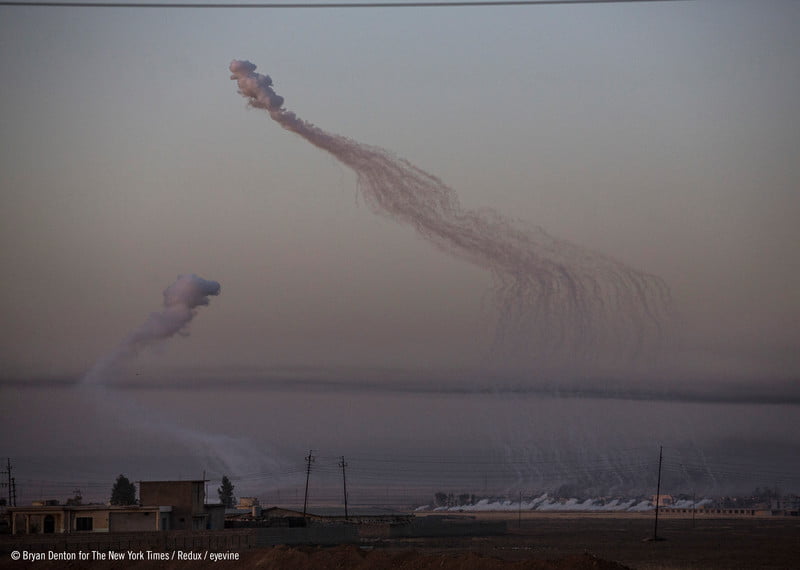
Amnesty International has received credible witness and photographic evidence of white phosphorus projectiles exploding in the air over an area north of the village of Karemlesh, about 20 kilometres east of Mosul.

White phosphorus is an incendiary substance which burns at extremely high temperatures upon exposure to air.

Horrific injuries

“White phosphorus can cause horrific injuries, burning deep into the muscle and bone. It is possible that some of it will only partially burn and could then reignite weeks after being deployed,” said Donatella Rovera, Senior Crisis Response Adviser at Amnesty International.


“This means that civilians who flee the fighting around Mosul or residents returning to check on their homes in Karemlesh in the coming days or weeks would be at risk of serious harm even though there may be few visible warning signs.”

Danger to civilians

Karemlesh has been depopulated since the predominately Assyrian population fled the armed group calling itself Islamic State (IS) in August 2014, but white phosphorus poses a clear and present danger to civilians fleeing Mosul towards Erbil who may pass through the contaminated area.


“We are urging Iraqi and coalition forces never to use white phosphorus in the vicinity of civilians. Even if civilians are not present at the time of its use, due to the residual risks they should not use airburst white phosphorus munitions unless it is absolutely necessary to achieve military objectives which cannot be accomplished through safer means.”


Photographs taken by a New York Times photographer on 20 October show white phosphorus munitions bursting near Karemlesh. Clashes between IS and Iraqi government forces were taking place in Hamdaniya (Qaraqosh), a few kilometres south of Karemlesh at the time.


The photographer told Amnesty International that he witnessed the same munitions being deployed at different times of the day, including four over a 15-minute period. It is not clear whether the projectiles were fired by Iraqi central government forces, Peshmerga forces of the Kurdistan Regional Government (KRG), or forces belonging to members of the US-led coalition.

Deaths in Gaza

The photographs show a dispersal pattern that appears consistent with the US-made 155-mm M825A1 projectile, which ejects 116 felt wedges containing white phosphorus over an area between 125 – 250 metres wide. Amnesty International documented its use in Gaza during Israel’s 2008-2009 Operation Cast Lead.


White phosphorus is most often used to create a dense smoke screen that can obscure the movement of troops from enemy forces, and to mark targets for further attack, although it is not yet clear why it was used in this case. While its use for such purposes is not prohibited, extreme caution is warranted whenever it is deployed. It should never be used in the vicinity of civilians.


If buried by soil or water, white phosphorus wedges can be temporarily extinguished, but they spontaneously reignite if they are uncovered, presenting a serious hazard for unsuspecting civilians who may accidentally uncover them as they walk through the affected area. White phosphorus should never be used as an anti-personnel weapon.


“It is absolutely imperative that the forces using white phosphorus publicize details of areas potentially contaminated by the substance, to minimize the risk of accidental harm to civilians,” said Donatella Rovera.


“Such information is also crucial for medical professionals operating in Iraq so that they are aware of the kind of injuries they are treating. Tragically we witnessed people dying in Gaza because doctors were not aware that their patients’ burns were caused by white phosphorus and were thus not able to dispense the right treatment, resulting in the wounds deteriorating.”

War crime

Residents of Mosul and surrounding areas under the control of the armed group calling itself Islamic State (IS), are facing huge risks as IS prevents them from leaving and they risk being caught in the cross fire as the battle to recapture the area continues. No effort should be spared to avoid exposing them to further risks.


Amnesty International has previously highlighted that white phosphorus is particularly prone to indiscriminate effects, and therefore its use in the vicinity of civilian concentrations constitutes an indiscriminate attack and can be a war crime.


NT Government appoints a Minister for Youth Justice

Some good news from the Northern Territory: The newly-elected NT Government has, for the first time, appointed a Minister for Youth Justice, marking a clear intention to consider the distinct needs of children in contact with the justice system.

Earlier this week they also introduced legislation to ban the use of the horrific chair used to restrain that shocked the country when Four Corners went to air.

The Bill specifies that the only ‘approved restraints’ under the Youth Justice Act are handcuffs, ankle cuffs and waist-restraining belts. The Commissioner of Correctional Services must consent to the use of the approved restraints.

The NT Government also committed to reviewing its Youth Justice Act to bring it in line with contemporary standards, and to consult extensively before doing so.

“We also look forward to the new NT government consulting with Aboriginal organisations about a contemporary Youth Justice Act. We hope to see a new approach of supporting Indigenous led-programs that help children thrive in their communities, rather than setting them up to fail in the quicksand of the justice system,” said Julian Cleary, Indigenous Rights Campaigner at Amnesty International Australia.

All of these steps are promising signs of a brighter tomorrow!

Submission: NT Royal Commission into the Protection and Detention of Children

Amnesty International welcomes the opportunity to provide this submission to the Royal Commission into the Protection and Detention of Children in the Northern Territory.

The ill treatment and abuse of children in youth detention facilities in the Northern Territory and other Australian jurisdictions requires a national spotlight and sustained government leadership to address the problem.

Amnesty has been closely monitoring issues related to the imprisonment of children in the Northern Territory since mid-2014, and we have raised concerns about the treatment of children in detention with the Northern Territory Government numerous times. This is part of a wider project Amnesty has been undertaking since 2013 to study and report on the disproportionate rates at which Aboriginal and Torres Strait Islander children are incarcerated across Australia.

The human rights abuses that occurred at Don Dale Youth Detention Centre and sparked this Royal Commission are a result of systemic policy failures at the Northern Territory and Federal Government levels. These failures require the focused attention this Royal Commission will bring.

Abuses Nation wide

Unfortunately these abuses are not isolated to the Northern Territory. In Amnesty’s research we have identified serious concerns about the treatment of children in youth detention facilities right across the country. Amnesty notes the importance of these abuses also being fully investigated, and to that end we note the importance of the review of youth detention currently taking place in Queensland.

It is also important for the Royal Commission to consider the wider context in which these abuses have taken place. The over-representation of Indigenous young people in detention in Australia is a national crisis. Between July 2014 and June 2015, Indigenous young people were 24 times more likely to be in detention than their non-Indigenous peers across Australia. In the Northern Territory during the same year, Indigenous young people made up an average of 95 per cent of all young people in detention despite comprising 45 per cent of the Territory’s population aged between 10 and 17. Amnesty International hopes the work of this Royal Commission will lead to an Australian Government-led strategy at the Council of Australian Governments to end this overrepresentation.

Action must be taken

Amnesty urges the Royal Commission – and both the Northern Territory and Australian governments – to develop policy responses which are not simply focussed on how human rights are respected in places of detention, important as that is. The question that also must be asked is how do we find solutions to prevent children from being detained in the first place?

Read the full submission and recommendations here.

Iraq: Fears for safety of civilians

Military operations to retake Mosul and the surrounding areas from the armed group calling itself Islamic State (IS) are endangering civilians who are being caught in the crossfire or in some cases being used as human shields by IS fighters.

The organization’s research team met with civilians displaced from their homes in villages north of Mosul in recent days who are now in Zelikan and Khazer camps, in areas controlled by the Kurdistan Regional Government (KRG), and conducted phone interviews with people still trapped under IS control, gathering fresh evidence pointing to civilian deaths and injuries during in recent days.

“IS’s utter disregard for the safety of civilians and their apparently deliberate use of human shields is putting people trapped in areas of active conflict at even greater risk, as Iraqi forces advance.”

Lynn Maalouf, Deputy Director for Research 

“With more than a million people believed to be still trapped in Mosul and its outskirts, the risks to civilians are sky high. IS’s utter disregard for the safety of civilians and their apparently deliberate use of human shields is putting people trapped in areas of active conflict at even greater risk, as Iraqi forces advance,” said Lynn Maalouf, Amnesty International’s Deputy Director for Research at the Beirut Regional Office.

“To avoid civilians getting caught up in a bloodbath, all parties to the conflict must take all feasible precautions to spare civilians.”

By 26 October, more than 10,500 people had been displaced since the launch of coalition military operations to retake Mosul, while up to 1.5 million people are believed to remain trapped in Mosul and its outskirts.

IS use of human shields

Some civilians who managed to flee the fighting or whose villages had been recaptured by government forces told Amnesty International that IS fighters had deliberately prevented them from fleeing areas of conflict. IS fighters had embedded themselves within the civilian population, taking up positions in residential areas and in some cases, forcing civilians to move to areas under their control.

“All parties to the conflict must take all feasible precautions to spare civilians.”

“Using civilians to shield yourself from attack is a war crime. But even in cases when IS fighters are holding civilians as human shields, this does not absolve Iraqi and coalition forces from the obligation to take their presence into account, take all feasible precautions to minimize harm to civilians, and avoid launching attacks that could cause disproportionate harm to civilians,” said Lynn Maalouf.

Civilians caught in the crossfire

Relatives told Amnesty International that a farmer and father of eight from the Tab Zawa village in Bashiqa district of Ninewa Governorate, northeast of Mosul, was at home with nine family members when he was fatally wounded during clashes between IS and government forces on 24 October. Since then the village has been retaken by Iraqi forces, including the elite Golden Brigade of the Counter Terrorism Service, who evacuated civilians and handed them over to the Kurdish forces.

On the same day, two young brothers, aged six and five years old, were wounded by shrapnel while at home in Tab Zawa village. Their father told Amnesty International that a fence struck by what he believed to be a rocket collapsed on him and his two sons as they ran outside to a shelter they had dug in the garden:

“My two boys were hit, and we couldn’t even take them to any hospital or clinic because fighting raged on. We just tried to stop the bleeding and clean the wounds. On the following morning, they were transported in ambulances to a hospital in Erbil, and my oldest son had an operation on his back.”

“All parties should avoid the use of unguided rockets, artillery, mortars and other explosive weapons with wide area effects in the vicinity of concentrations of civilians. Attacks that appear likely to be disproportionate or otherwise indiscriminate should be postponed or cancelled,” said Lynn Maalouf.

“My two boys were hit, and we couldn’t even take them to any hospital or clinic because fighting raged on.” A farmer and father of eight from Tab Zawa village

Residents of Tab Zawa told Amnesty International that IS fighters used both vacant and occupied villagers’ homes and rooftops to carry out their attacks.

Civilians in the villages of Dirij and Chanchi, in Bashika district, were also caught in crossfire. A man who fled from Dirij told Amnesty International that his 17-year-old-brother sustained a gunshot wound to the leg while at home during clashes between IS and Peshmerga (Kurdish armed forces) on 22 October.

“IS fighters were based in our neighbour’s house and fired from there. After my brother was shot, we remained trapped inside the house while fighting was ongoing, and just tried to stop the bleeding… After two days, he was losing consciousness and could no longer control his body movements. We took the opportunity of an airstrike on Daesh [Arabic acronym for IS] and ran for our lives carrying him, until we met the Peshmerga. He is in the hospital in Dohuk now,” he said.

Mohamed (not his real name), a farmer from Chanchi village, told Amnesty International that he lost his wife and another 13-year-old relative on 23 October during clashes between IS and Peshmerga forces. He said IS fighters prevented them from leaving the area.

Some 70 people had gathered in one house at the northern edge of the village when mortars struck at about 1pm, according to witnesses. The 13-year-old boy died immediately as a result of head wounds and three children, aged between four and 13, were injured.

“My wife was hit just under her ribcage and, as time passed, she complained about sharp pain and her bleeding increased, until all her clothes were covered in blood. We were trapped inside as fighting wore on. She died right there and I couldn’t do anything to save her. We had asked Daesh to let us leave even in the direction of Mosul, but they refused. They shot at some of our neighbours who tried to escape”, he said.

In some cases, IS fighters forced civilians from villages south of Mosul to move to areas under their control as they retreated from Iraqi forces’ attacks. Local officials, activists and a resident of al-Qayyara district, who was able to speak to Amnesty International over the phone from an IS-controlled area, said that civilians were kept in schools, homes and other locations near IS fighters in Hamam Al-Alil after being forced to move from their homes further south.

Background

Civilians who managed to flee to areas controlled by the KRG since the start of military operations to retake Mosul and who are now sheltering in the Zelikan and Khazer are not permitted to leave the camps, except for medical treatment in cases of acute emergency. Even in such cases, no relatives are allowed to accompany the patients, including children. Such restrictions, along with the prohibition of the use of mobile phones by recent arrivals, even apply to those who have undergone security screening to determine whether they have links to IS. Kurdish authorities justify these restrictions on security grounds. Amnesty International has called on the Kurdish authorities on numerous occasions to lift all arbitrary and discriminatory restrictions on the freedom of movement of internally displaced people.
Indonesia: Criminalisation of consensual intimacy must end

Amnesty International and the Institute for Criminal Justice Reform (ICJR) are seriously concerned about the Aceh Islamic Criminal Code (Qanun Jinayat), which came into effect in the province a year ago. The code criminalizes consensual sexual relations and extends the use of caning as a punishment.

Our organizations call on the Indonesian authorities to adhere to their international human rights obligations to end the use of caning as a form of punishment, as well as repeal the provisions of the Aceh Islamic Criminal Code that violate international law.

Caning contravenes Indonesia’s Constitution and is in clear violation of international human rights law and standards. It constitutes a cruel, inhuman and degrading punishment and can amount to torture.

The 2014 bylaw introduced as criminal offences consensual intimacy or sexual activity for unmarried couples, consensual sex outside marriage and same-sex sexual relations. In some cases, the law provides for up to 200 lashes as a punishment.

On 17 October, seven men and six women were caned between nine and twenty-five times at Al Ikhlas Mosque in Gampong Keuramat village, Kuta Alam sub-district, in the Banda Aceh province of Indonesia for violating the Islamic bylaw prohibiting being alone with someone of the opposite sex who is not a marriage partner or relative (khalwat), and committing sexual intimacy outside marriage (ikhtilath). A pregnant woman who was sentenced to caning will not receive her punishment until after she has given birth to her child. Our organizations urge authorities in Aceh to quash her conviction and sentence immediately.

Caning contravenes Indonesia’s Constitution and is in clear violation of international human rights law and standards. It constitutes a cruel, inhuman and degrading punishment and can amount to torture, in violation of the UN Convention against Torture and other Cruel, Inhuman or Degrading Treatment or Punishment (UNCAT), and the International Covenant on Civil and Political Rights (ICCPR), to which Indonesia is a State Party.

Consensual sexual relationships must not be treated as a criminal offence, nor are they a crime against ‘morality’.

Amnesty International and ICJR are also concerned with the authorities’ over-emphasis on enacting punishments and making a ‘moral’ example of offenders through public caning. Caning can harm the physical and mental health, cause long-term pain or lead to permanent injuries. Canings in Aceh are always carried out in public, drawing large crowds and media attention. Those subject to such punishment may also experience psychological distress from pain, fear and humiliation. Authorities in Aceh and Indonesia must take practical steps to put an end to corporal punishment and to repeal provisions of Acehnese bylaw permitting its use in the penal system.

Further, consensual sexual relationships must not be treated as a criminal offence, nor are they a crime against ‘morality’. The UN Human Rights Committee and other expert human rights bodies have raised concerns about laws criminalizing ‘adultery’ or other consensual sexual relations outside marriage, because they violate the right to privacy. Our organizations call for authorities in Indonesia to repeal provisions criminalizing consensual sex and intimacy outside marriage.

Background

The Aceh Islamic Criminal Code, a provincial bylaw based on Shari’a (Islamic law), was passed by the Aceh parliament (DPRA) on 27 September 2014 and entered into force on 23 October 2015. It includes caning of up to 100 lashes as a punishment for same-sex sexual relations, premarital sex and other sexual relations outside marriage (“adultery” or zina), consumption of alcohol (khamar), gambling (maisir), “being alone with someone of the opposite sex who is not a marriage partner or relative” (khalwat), committing sexual intimacy outside marriage (ikhtilath), sexual abuse, rape, accusing a person of adultery without providing four witnesses, and intimacy between unmarried couples.

Aceh province is the only Indonesian province that enforces Shari’a law. In 2016 alone, have been at least 100 cases of caning carried out in 2016. At the end of 2015, there had been at least 108 cases. The Aceh Islamic Criminal Code applies only to Muslims in Aceh province, however, non-Muslims can also be convicted for offences in the bylaw not currently covered within the Indonesian Criminal Code. In April 2016, a Christian woman in Aceh was caned 28 times for selling alcohol – the first non-Muslim punished by caning under Shari’a law.

In 2013, the Human Rights Committee, the expert body which monitors states’ compliance with the International Covenant on Civil and Political Rights (ICCPR), called on Indonesia to take practical steps to put an end to corporal punishment and to repeal the provisions of the Acehnese law permitting its use in the penal system.