Continued fighting in South Sudan must not derail justice for crimes committed during the deadly conflict that began in December 2013, said Amnesty International and FIDH in a joint briefing published today.
The organisations are calling on the African Union (AU) Commission and the South Sudan government to urgently establish the proposed Hybrid Court for South Sudan (HCSS).
“Justice must not be delayed any further. Fresh violations should give added impetus to efforts to form the Hybrid Court.” Netsanet Belay, Amnesty International Africa Director for Research and Advocacy
“Thousands have been killed, women raped, entire villages destroyed, and humanitarian personnel attacked. But as world attention has focused on ending the fighting, accountability for violations that could amount to war crimes and crimes against humanity has been put on the back burner,” said Netsanet Belay, Amnesty International’s Africa Director for Research and Advocacy.
“Justice must not be delayed any further. Fresh violations should give added impetus to efforts to form the Hybrid Court.”
The peace agreement signed by both parties in August 2015 provides for the formation of the court to investigate and prosecute those bearing criminal responsibility for the atrocities, but little progress has been made towards setting it up.
The Hybrid Court – which will combine elements of both domestic and international law and be composed of personnel from South Sudan and abroad – currently represents the most viable option for ensuring accountability for crimes committed during the conflict, as well as for deterring further abuses.
In the briefing, the organisations make 17 recommendations to ensure the court effectively achieves accountability in accordance with international fair trial standards. The priorities include:
Establishing an investigative branch to ensure evidence is collected and preserved in an appropriate manner;
Establishing an independent victims and witness protection unit;
Ensuring that victims’ rights to participate in the proceedings are guaranteed, the inclusion of South Sudanese judges and staff on the court and exclusion of the death penalty as a possible sentence.
They also recommend that if security concerns prevent the court from being based in South Sudan, it should at least be located within the region.
“Atrocities endured by civilians in South Sudan, which the African Union has documented, must not go unpunished. The establishment of the Hybrid Court is necessary, not only to address human rights violations and abuses and crimes under international law, but also as a pillar to achieving sustainable peace,” said Arnold Tsunga, FIDH Vice President.
“The AU should build on its experience of the recent trial of former Chadian President Hissène Habré in Senegal to set up the Hybrid Court for South Sudan.”
The report’s key recommendations on the Hybrid Court’s makeup reflect best practices of other hybrid and ad hoc tribunals, as well as international legal standards.
Since parliament returned after the election, we’ve been in touch with both new and returned politicians on a raft of our campaign issues. In particular, a focus has been to ensure the great steps taken in the last parliament when it comes to Australia’s role in the global death penalty abolition movement do not fall by the wayside.
To that end, we’ve managed to re-form both the Amnesty International Parliamentary Group (AIPG) and Australian Parliamentarians Against the Death Penalty. Both are important, cross-party groups of MPs who discuss and advocate for human rights both within our parliament and with parliamentary colleagues overseas.
World Day Against the Death Penalty
10 October is World Day Against the Death Penalty, which gave us a great opportunity to make our voice heard in Canberra. Claire Mallinson convened a meeting of the Parliamentary Group where she briefed them on the latest developments in the death penalty around the world and noted which countries Amnesty is watching in particular when it comes to capital punishment. MPs and Senators were especially keen to hear an update on the situation in Pakistan and Japan, and discussed writing to the Japanese Ambassador regarding 13 men at risk of execution.
In the evening, members of both the Parliamentary Group and the Death Penalty group came together in a moment of solidarity. Members from across party lines came together to light an Amnesty candle to reflect on the fact that on any one night there are thousands of people around the world on death row awaiting their fate. Members committed to taking a principled, dedicated approach to ending the death penalty everywhere.
So what’s next?
We expect to see twin motions passed by both the House and the Senate soon re-committing the Australian Parliament to taking a strong abolitionist stance over the next three years.
We’ll keep you updated about how you can take action. In the meantime, please sign the petition below for the 13 men at urgent risk of being executed.
Next week, Amnesty’s global head of research is coming to Australia to shine a light on the abuses occurring in the Government’s offshore processing of refugees.
Meet Amnesty’s global head of research, Dr Anna Neistat
Anna Neistat leads Amnesty’s research globally and has conducted over 60 investigations into human rights abuses, mainly in conflict areas. This July, she quietly visited Nauru to expose the deliberate system of abuse of people seeking asylum that the Australian Government has set up on Nauru. She is visiting us from Paris for just over a week.
Come along to one of the below events to listen to her findings in Nauru and other conflict zones.
Thu 20th Oct: Internal AI Australia meeting, including staff, Board/Branch members and AIA activists. There are limited seats in each Amnesty action centre, so get in quick!
Friday 21st Oct: Get inspired at a Courageous Conversations evening in Melbourne to hear about Anna’s experiences and ask any burning questions. We’ll also be live streaming this on the day via Facebook page at 5pm AEST (no recording).
Global launch of full report into Australia’s processing of refugees on Nauru
On 2 August, we released our initial investigation findings which found intentional abuse by governments of people seeking asylum, hidden behind a deliberate wall of secrecy.
On Monday 17th October at 8.30pm AEST, we will launch the full report of our investigation into Australia’s processing of refugees on Nauru. This is an important report that supports the many findings over the years of patterns of violations and unfair treatment of people seeking refuge in Australia. Keep an eye out in the news and on social media! In late October you will find summaries of the report on our website that you can use in your campaigning.
If you haven’t already, please check out these useful tools for you and your action group’s campaigning for refugee rights:
Global Amnesty movement joins campaign to improve Australia’s refugee policy
In mid September this year, Amnesty began a new global campaign called “I Welcome” calling on governments to welcome refugees and to do more to share responsibility to take care of refugees. The global campaign runs until end of 2018 and Australia is one of several target countries.
Whilst Amnesty Australia has been working to protect and advance refuge rights for over 25 years, we need the global Amnesty movement to help step up pressure on the Australian government to change its refugee policy and treat fairly thousands of people seeking refuge in Australia.
On 4 October, we released our overview of the refugees around the world – Australia was a key mention.
In November, there will be an Amnesty Global Week of Action and you’ll receive more information in the next Leader bulletin. Additionally, over coming months, specific Amnesty offices in countries that influence Australia will be lobbying their governments and increasing media coverage of Australia’s abusive treatment of refugees.
After months of tireless emailing and calling, in October Amnesty’s Eastern suburbs action group met with Prime Minister Malcolm Turnbull to discuss Indigenous kids being sent to prison.
The Eastern Suburbs group alongside youth worker, Just Reinvest ambassador and all-roundAmnesty friend, Keenan Mundine, met with the Prime Minister Malcolm Turnbull on 7 October. The group were able to request a meeting with Malcolm Turnbull as they are local constituents in his electorate. Together the Amnesty group handed over our 16,000+ petition calling on the Australian Government to set targets to reduce the numbers of Indigenous people in prison.
Malcolm in the middle: the Prime Minister says he is on board for creating a fairer Australia for Indigenous kids. Love the yellow tie, Malcolm!
How did the conversation go?
This was a powerful moment in our Community is Everything campaign, which aims to end the over-representation of Indigenous kids in prisons.
Not only did Mr Turnbull support and endorse our call upon the states and territories to take action, he supported Indigenous-led solutions, pointing out that we need to work with Aboriginal people, not for them.
The Eastern Suburbs group reiterated that it’s not just the responsibility of the states but that in fact national leadership is required from the Prime Minister to address this issue.
With this meeting we are one step closer to seeing the Australian Government work with the states, territories and Indigenous organisations to close the gap.
In one meeting, the Eastern Suburbs Action Group gave you, the thousands of Amnesty supporters, the opportunity to hold a key decision-maker to account.
Lessons for other action groups
If you want that meeting, being (politely!) determined will help you get it.
The Eastern suburbs group had to be really persistent to secure a meeting with their local member Malcolm, and at times they felt discouraged; however, after campaigning in their local community since 1978, these activists are no strangers to hard work!
Groups working in partnership with Indigenous people is vital.
Having Koori man Keenan Mundine at the meeting to share his own experiences while growing up really helped make their meeting powerful.
What’s next over the next few months?
Amnesty’s action groups right across Australia will continue to work in partnership with Aboriginal people in putting pressure on our government to support Indigenous-led community programs, instead of sending kids into prison.
Amnesty International will be giving evidence and writing a submission to the NT Royal Commission. We will closely monitor the findings and ensure that these are implemented not just in the Northern Territory but around the country.
The Iranian authorities must urgently halt their plans to execute Zeinab Sekaanvand, a 22-year-old Iranian-Kurdish woman who was arrested when she was just 17 years old and convicted of the murder of her husband after a grossly unfair trial.
She is due to be executed by hanging as soon as 13 October.
“This is an extremely disturbing case. Not only was Zeinab Sekaanvand under 18 years of age at the time of the crime, she was also denied access to a lawyer and says she was tortured after her arrest by male police officers through beatings all over her body,” said Philip Luther, Research and Advocacy Director for the Middle East and North Africa at Amnesty International.
“Iran’s continued use of the death penalty against juvenile offenders displays the authorities’ contempt even for commitments they themselves have signed up to. The Iranian authorities must immediately quash Zeinab Sekaanvand’s conviction and grant her a fair retrial without recourse to the death penalty, and in accordance with principles of juvenile justice.”
Zeinab Sekaanvand was 17 years old when she was arrested in February 2012 for the murder of her husband, whom she had married at the age of 15. She was held in the police station for the next 20 days where she has said she was beaten by male police officers. She “confessed” to them that she stabbed her husband after he had subjected her to months of physical and verbal abuse and had repeatedly refused her requests for divorce.
“This is an extremely disturbing case. Not only was Zeinab Sekaanvand under 18 years of age at the time of the crime, she was also denied access to a lawyer and says she was tortured after her arrest by male police officers through beatings all over her body.”
Philip Luther, Research and Advocacy Director for the Middle East and North Africa
Her trial was grossly unfair. She was denied access to a lawyer during her entire pre-trial detention period and only met her state-appointed lawyer for the first time at her final trial session on 18 October 2014. It was at this session that she retracted “confessions” that she had made earlier when she had no access to legal representation.
She told the court that her husband’s brother, who she said had raped her several times, was responsible for the murder and had coerced her into “confessing”, promising that he would pardon her (under Islamic law, murder victims’ relatives have the power to pardon the offender and accept financial compensation instead). This statement was ignored by the court, which instead relied heavily on “confessions” she had made without a lawyer present, to reach its verdict.
Subsequently, on 22 October 2014, Branch 2 of the Criminal Court of West Azerbaijan Province sentenced Zeinab Sekaanvand to death under qesas (“retribution in kind”), a conviction and sentence which were later upheld by Branch 7 of the Supreme Court of Iran.
The courts failed to apply juvenile sentencing guidelines from Iran’s 2013 Islamic Penal Code and order a forensic report to assess her “mental growth and maturity” at the time of the crime. Additionally, they failed to inform her that she could submit an “application for retrial” (e’adeyeh-e dadresi) based on Article 91 of the Penal Code.
Iran’s Penal Code falls woefully short of safeguards required for juvenile offenders under international human rights law, and even those limited safeguards that do exist, such as informing juvenile offenders of their right to apply for a retrial, are often not implemented by the authorities.
Background
As a state party to the Convention on the Rights of the Child and the International Covenant on Civil and Political Rights, Iran is legally obliged to treat everyone under the age of 18 as a child and ensure that they are never subject to the death penalty nor to life imprisonment without possibility of release.
International law, including the Convention on the Rights of the Child, absolutely prohibits the use of the death penalty for crimes committed by persons when the defendant was below 18 years of age.
Under Iranian law, those convicted of murder and sentenced to qesas have no right to seek pardon or commutation of their death sentence from the State, as is required by Article 6(4) of the International Covenant on Civil and Political Rights.
Amnesty International opposes the death penalty in all cases without exception, and calls on the Iranian authorities to establish an official moratorium on executions with a view to abolishing the death penalty.
‘Australia’s Shame’: Caro Meldrum-Hanna, ABC Four Corners
‘Hitting Home’: Sarah Ferguson, Nial Fulton, Ivan O’Mahoney, In Films Pty Ltd & ABC
‘Bad Blood’: Geoff Thompson, ABC Four Corners
Radio
‘The Extra Mile’: Bridget Brennan, ABC Background Briefing
‘The news “It’s a girl”, still unwelcome in some cultures in Australia’: Pallavi Jain, SBS Radio
‘Sis we’ve got your back’: Bronwyn Adcock, ABC Background Briefing
‘Voices from inside besieged Syria’: Sophie McNeill, Fouad Abu Gosh (prod.), ABC Radio National
Cartoon
‘Door’: Glen Le Lievre, Sydney Morning Herald
‘The long road to Rome’: David Pope, The Canberra Times
‘Wolves Everywhere’: Christopher Downes, The Mercury
These quality submissions were chosen from a field of entries that covered a wide range of issues in Australia and all around the world. Among them were powerful and eye-opening stories of family violence, youth justice, #Blacklivesmatter, press freedom and the effects of the wars in Afghanistan, Syria and elsewhere, including the plight of refugees seeking safety in Australia and overseas.
The judges noted the high quality of reporting and production among the entries, and excellent coverage not just of well-known subjects, but also of previously hidden human rights issues.
“The media awards bring attention to the many ways human rights matter to people’s lives every day,” said Karen Trentini, Amnesty International Australia’s Media Manager.
“They celebrate the courage of those enduring human rights abuses, as well as acknowledge the courage and tenacity of the journalists who choose to cover difficult stories, often requiring extraordinary perseverance to bring the full detail of an abuse to light.”
Winners will be announced at an awards ceremony in Sydney on 21 November.
Reports about the resumption of humanitarian aid to 75,000 refugees stranded in a remote, arid area along the Jordanian-Syrian border called “the berm” are a long-awaited glimmer of hope that should be followed by a sustainable, long-term solution.
The news comes as the UN and the Jordanian authorities continue negotiations to open a humanitarian lifeline to the Syrians who have been stranded there since the Jordanian authorities sealed the border following an armed attack in June. Since then the refugees have endured hellish conditions with no aid except one delivery, made by crane in August.
“News that humanitarian assistance will be resumed to tens of thousands of refugees stranded at the berm comes as a welcome relief. However, we are worried by reports that aid will be lobbed across the border by crane or that refugees will be coerced, either directly or indirectly, to move to areas where they may be at risk of attack in order to receive it.
“Unfettered humanitarian access and a managed multi-sector humanitarian response in line with international standards is what is urgently required,” said Audrey Gaughran, Director of Global Issues and Research at Amnesty International.
Tens of thousands of refugees have fled bloodshed in Syria only to suffer for months on end in utterly inhumane conditions at the berm. Aid organizations must have unfettered access to provide food aid, lifesaving medical treatment and other support. Anything less is just a band aid that will do little in the long run.
“Tens of thousands of refugees have fled bloodshed in Syria only to suffer for months on end in utterly inhumane conditions at the berm. Aid organizations must have unfettered access to provide food aid, lifesaving medical treatment and other support. Anything less is just a band aid that will do little in the long run.
“A more sustainable long-term fix to the crisis at the berm is needed. A real and meaningful solution would be for Jordan, with the support of the international community, to provide the stranded refugees with safety and sanctuary from the brutal conflict in Syria. This includes allowing refugees into the country, while carrying out the necessary security checks in line with international law and standards.
A more sustainable long-term fix to the crisis at the berm is needed.
“The international community must also share responsibility with Jordan by providing significantly more resettlement places to alleviate the pressure on Jordan as one of the largest refugee-hosting countries in the world.”
Opening his last General Assembly debate on Sept. 20, U.N. Secretary-General Ban Ki-moon bemoaned the blocking of essential action in the Security Council that has marred his time in office: “Is it fair for any one country to wield such disproportionate power and hold the world hostage on so many important issues?”
This will be a major challenge waiting for Ban’s newly-appointed successor, Antonio Guterres. Guterres will be judged, among other things, on his ability to stand up to human-rights violations committed by, or tacitly accepted by, the major powers. He faces an immediate need to confront a U.N. Security Council that has for too long failed to deal with major conflicts, even when states or armed groups commit horrific crimes against civilians.
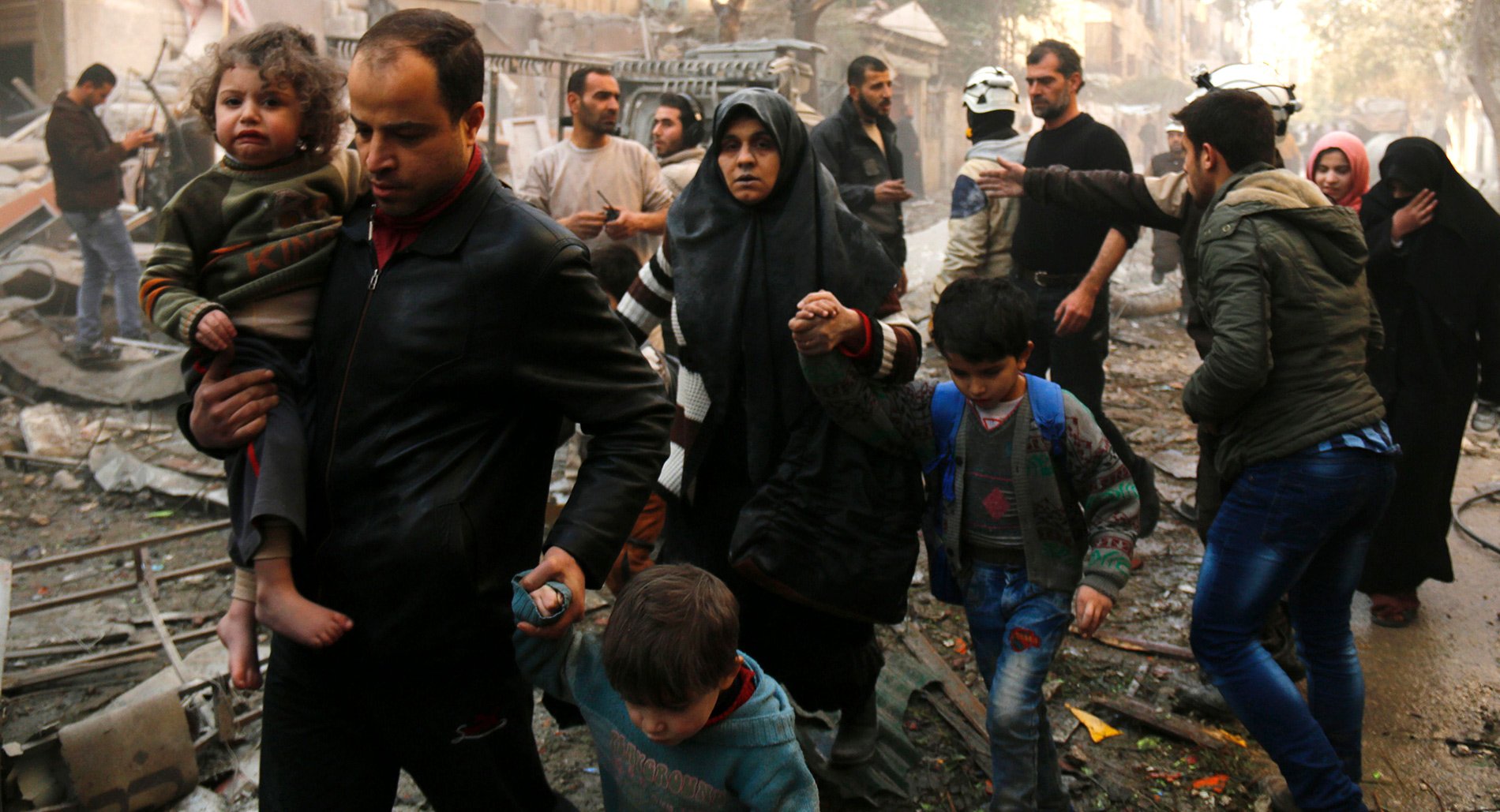
The Security Council’s impotence has been most exposed in Syria. War crimes are becoming routine, with even hospitals and U.N. aid convoys now treated as targets. In Aleppo, relentless bombing is causing bloodshed and human suffering on a mass scale.
From the very start of this conflict more than five years ago, Russia and China have vetoed or blocked any Security Council action that could bring relief to Syria’s civilians or bring perpetrators of abuses in Syria to account. China and Russia only actually wielded the veto on Syria four times (out of eight total vetoes this decade), but its threat alone now has the power to deter states from drafting thorny resolutions. The Security Council is now hostage to a “silent veto.” This year there have been no vetoes because of this self-censorship.
The Security Council has been reduced to a dysfunctional instrument of political posturing between Russia, the U.S. and their respective allies. Last week’s emergency meeting on Syria descended into scenes reminiscent of the Cold War with ambassadors of France, the U.K. and U.S. walking out of a session when the Syrian ambassador started speaking. Even with U.N. Special Envoy for Syria Staffan de Mistura warning that Aleppo may be completely destroyed by the end of the year, negotiations around France’s new draft resolution are overshadowed by the “silent veto.”
As it became clear that Russia’s veto power meant that action on Syria was still unlikely, U.N. High Commissioner for Human Rights Zeid Ra’ad Al Hussein, said that horrific scenes from Aleppo required proposals to limit the use of the veto. The people of Aleppo, indeed all of us, deserve better.
The Security Council’s impotence has been most exposed in Syria. War crimes are becoming routine, with even hospitals and U.N. aid convoys now treated as targets.
Russia and China are not the only abusers of the veto system. After Russia, the U.S. has used its veto power the most, most recently in 2011 to block a resolution condemning continued settlement activity by Israel in the Occupied Palestinian Territories. The U.S.’s “silent veto” made futile any hopes of passing a resolution during the 2014 conflict in Gaza in which more than 2,000 Palestinians, most of them civilians, died. U.K. and U.S. support for Saudi Arabia-led military coalition in Yemen also makes Security Council action on that conflict unlikely.
And last month, Amnesty International released evidence that Sudanese government forces used chemical weapons to kill and maim hundreds of civilians, including children, in Darfur scores of times in 2016. We are calling for a special session of the Security Council to address this urgently.
But with the “silent veto” all powerful, that is unlikely to happen.
The paralysis is enabling ever more brutal and unlawful conflict. In the last two years, we have seen more chemical attacks by states in war zones like Sudan and Syria than at any stage in the quarter-century since the Gulf War.
The deadlock at the U.N. is now so bad that reforming the veto alone is no longer enough. We need an end to the self-censorship where urgent issues never even get to a vote, let alone a Security Council resolution.
That said, the deadlock will continue until the five permanent Security Council members renounce their veto rights in situations of genocide and other mass atrocities. This would give the U.N. more scope to take action to protect civilians when lives are at grave risk and send a powerful signal to perpetrators that the world will not sit idly by while mass atrocities take place. Without the veto, it would be impossible to block U.N. action over the violence in Syria. “Never again” would mean just that.
In the last two years, we have seen more chemical attacks by states in war zones like Sudan and Syria than at any stage in the quarter-century since the Gulf War.
Two initiatives to restrain the use of the veto are gathering momentum. One, led by France and Mexico, is supported by 99 states so far. The other, led by Liechtenstein on behalf of a group of 27 mainly small countries, has been adopted by 112 states, including two permanent Security Council members, France and the UK.
While the success of these initiatives depends on China, Russia and the U.S. voluntarily restraining their use of the veto, the best chance of that happening is if other states put sustained international pressure on them to stop putting national interests ahead of protecting human rights, and human lives.
The arrival of a new U.N. leader ready to challenge powerful member states from day one could add important momentum to the campaign for reform.
The U.N. Secretary-General has the potential to wield great moral authority on the world stage. He could use it to bring major pressure to bear on recalcitrant states who commit, or block action to stop, abuses.
Guterres must use the Secretary-General’s prerogative to put vital issues before the Security Council. As a former U.N. High Commissioner for Refugees, Guterres knows the importance of reacting to a humanitarian crisis fast, even if it means grasping a political nettle. Too often world leaders have disregarded clear signs of looming disaster leading preventable loss of life.
He can also keep human rights and humanitarian principles front and centre in the debate, rather than sacrificial lambs on the altar of realpolitik.
If Guterres is ready to shine a powerful spotlight on the most divisive problems facing the international community, there may yet be hope for the U.N., and the people of Aleppo.
On 10 October, as people around the world mark the World Day Against the Death Penalty, we reiterate our position that there is no convincing evidence that the death penalty has a unique deterrent effect on crime, including for drug-related crimes.
This is a join position shared with ELSAM (Institute for Policy Research and Advocacy), HRWG (Human Rights Working Group), ICJR (Institute for Criminal Justice Reform), Imparsial, LBH Masyarakat (Community Legal Aid Institute) and PKNI (Indonesian Drug User Network) .
The death penalty violates the right to life, as recognized in the Universal Declaration of Human Rights and is the ultimate cruel, inhuman and degrading punishment.
Our organizations are deeply concerned that – despite the fact that research findings made by NGOs and the National Commission on Human Rights (Komnas HAM) have pointed to systemic flaws in the administration of justice in Indonesia and violations of the right to a fair trial and other international safeguards that must be observed in all death penalty cases – the Indonesian government still carried out executions of four men on 29 July 2016 for drug-related offenses.
Three of the prisoners had appeals pending when they were executed. On the same day the Indonesian authorities also gave a last minute stay of execution for 10 other prisoners to allow them to review their cases after facing a national and international outcry.
We are also concerned that many others currently facing execution may not have had legal assistance to enable them to file appeals for further judicial reviews. We urge the authorities to extend the review of death penalty cases to all those currently under sentence of death. International law sets out key safeguards guaranteeing protection of the rights of those facing the death penalty that must be observed in all cases.
These include the right to a fair trial; the right not to be subjected to torture or to other cruel, inhuman or degrading treatment or punishment; and the right to apply for clemency or pardon of a death sentence. Further, drug-related offences do not meet the threshold of the “most serious crimes” to which the use of the death penalty must be restricted under the International Covenant on Civil and Political Rights, a treaty Indonesia acceded to in 2006.
The continued use of the death penalty in Indonesia may also undermine efforts by the Indonesian government to protect its citizens from being subjected to judicial execution in other countries. Our organizations oppose the death penalty unconditionally, in all cases without exception, regardless of the nature or circumstances of the crime, the guilt, innocence or other characteristics of the individual, or the method used by the state to carry out the execution.
As of today…
140 countries are abolitionist in law or practice. Four more countries – Fiji, Madagascar, Republic of Congo and Suriname- became abolitionist for all crimes in 2015 alone and the Parliament of Mongolia adopted a new Criminal Code at the end of last year, effective from 2017, removing the death penalty as a possible form of punishment under the laws of the country. Nauru became the 103rd abolitionist country this year. The continued use of the death penalty in Indonesia has not only set the country against its international obligations, but also against the global trend towards abolition of this ultimate cruel, inhuman and degrading punishment.
Our organizations renew our calls on the government of Indonesia to establish a moratorium on executions as a first step towards abolition of the death penalty. We also call on the authorities to ensure that, pending full abolition, they immediately establish an independent and impartial body, or mandate an existing one, to review all death penalty cases, with a view to commuting the death sentences or to offer a retrial that fully complies with international fair trial standards and which does not resort to the death penalty.
Background
The death penalty has been a part of Indonesia’s legal system since before the country’s independence in 1945, and can be imposed for a broad range of crimes. However it is usually imposed for murder with deliberate intent and premeditation; drug-related crimes (producing, processing, extracting, converting or making available narcotics); and terrorism-related offences.
There have been 18 executions – which all for drug trafficking offences – carried out under the administration of President Joko ‘Jokowi’ Widodo, who took office in October 2014. Under Susilo Bambang Yudhoyono, who was President of Indonesia from 2004 to 2014, there were 21 executions.
In December 2014, when newly-appointed, President Widodo publicly stated that he would not grant clemency to any individuals who had been sentenced to death for drug-related crimes, undermining their right to seek pardon or commutation of their death sentence. To date, at least 175 people remain under sentence of death in Indonesia for murder, drug-related crimes and terrorism-related crimes.
A new draft Criminal Code was submitted to lawmakers by the government in March 2015. It includes provisions that would allow for a death sentence to be commuted to life imprisonment (set at 20 years) in certain, limited, circumstances. Furthermore, if the request for clemency is denied and the death penalty is not carried out after 10 years, the President can commute the death sentence to life imprisonment. The draft law is currently being deliberated in the House of Representatives.
100 days after Rodrigo Duterte became president of the Philippines, a wave of unlawful killings has already claimed more than 3,000 lives, shattering progress on human rights in the country.
“Rodrigo Duterte’s first 100 days as president have been marked by state-sanctioned violence on a truly shocking scale. His brutal crackdown on those allegedly involved in drug crimes has led to carnage on the streets and the obliteration of key human rights, including the right to life and to due process,” said Rafendi Djamin, Director of Southeast Asia and the Pacific at Amnesty International.
“Since he was elected, President Duterte has actively created a climate where anyone can kill, or be killed, in the name of the ‘war on drugs’.”
Rafendi Djamin, Amnesty International Director of Southeast Asia and the Pacific
“Since he was elected, President Duterte has actively created a climate where anyone can kill, or be killed, in the name of the ‘war on drugs’. This mass killing must end immediately and all those responsible, at all levels of command, must be brought to justice.”
President Duterte has promised to kill tens of thousands – and on one occasion millions – of people involved in the drugs trade. He has actively encouraged the killing of drug addicts themselves, as well as offering huge bounties to those who turn in drug lords, dead or alive. The ensuing bloodshed has affected bystanders as well as alleged criminals, including a five-year-old girl who was shot to death by two men on motorbikes and many others killed in cases of “mistaken identity”.
Many of the killings have been carried out by unknown assailants and there are credible reports of police complicity in these deaths.
Amnesty International is calling for a senate inquiry into extrajudicial killings which was suspended on 3 October to continue, and for independent, impartial and transparent investigations – free from the influence of the police – into all killings which have taken place since 30 June 2016.
President Rodrigo Duterte
Killing with Impunity
Amnesty International has repeatedly warned that President Duterte’s calls have given police, vigilante groups and the general population a free reign to kill with impunity. He has issued and publicised ‘kill lists’ – names of people allegedly associated with using or trading drugs – and suggested that murder by police or civilian actors will go unpunished.
These lists name officials including judges, members of Congress, police and military officers, as being involved in the drugs trade, often without evidence. Amnesty International is deeply concerned that the lives of all the people on these lists are in immediate danger.
“The Philippine authorities have a duty to protect people, not expose them as targets. Recent reports that special teams of police are undertaking extrajudicial executions of those suspected of using or selling drugs is deeply alarming. Justice will never be achieved by death squads,” said Rafendi Djamin.
“We are calling on the Philippines authorities to step back from the brink by ending all unlawful killings and all incitement to violence and hatred. If President Duterte is really serious about tackling crime, he should address its root causes, like widespread poverty and unemployment.”
Background
Philippine Police Chief Ronald dela Rosa told senators that as of 20 September, over 1,500 people had been killed in police operations against illegal drugs, while there were over 2,000 murders by unknown assailants that are under investigation. The total number of killings is now suspected to be well over 3500 – at least 33 a day since Rodrigo Duterte came to power.
President Duterte has alleged that the Philippines is becoming a “narco-state” in order to justify the so-called war on drugs. There is little evidence to show this is true. The Philippines has a low prevalence rate of drug users, compared to the global average, according to the United Nations Office on Drugs and Crime (UNODC).
UNODC has found that counter-narcotic operations based on the use of force heighten the associated risks and harms of using drugs, and increase the levels of violence, human rights violations and abuses, without decreasing the incidence of drug use.