Iran: Writer facing imminent imprisonment for story about stoning

Iranian authorities must immediately repeal the conviction and sentence of Golrokh Ebrahimi Iraee, a writer and human rights activist who is due to begin serving six years in prison on charges including “insulting Islamic sanctities” through the writing of an unpublished story about the horrific practice of stoning.

“The charges against Golrokh Ebrahimi Iraee are ludicrous. She is facing years behind bars simply for writing a story, and one which was not even published – she is effectively being punished for using her imagination,” said Philip Luther, Research and Advocacy Director for the Middle East and North Africa at Amnesty International.

“Instead of imprisoning a young woman for peacefully exercising her human rights by expressing her opposition to stoning, the Iranian authorities should focus on abolishing this punishment, which amounts to torture. It is appalling that Iran continues to allow the use of stoning, and justifies it in the name of protecting morality.”

On 4 October Golrokh Ebrahimi Iraee received a threatening phone call from the Centre for the Implementation of Sentences ordering her to present herself to Evin Prison to begin serving her six-year prison sentence for “insulting Islamic sanctities” and “spreading propaganda against the system”.

“The charges against Golrokh Ebrahimi Iraee are ludicrous. She is facing years behind bars simply for writing a story, and one which was not even published – she is effectively being punished for using her imagination.”

Philip Luther, Research and Advocacy Director for the Middle East and North Africa

The first charge, for which Golrokh Ebrahimi Iraee has received five years in prison, was imposed primarily in response to an unpublished fictional story that she had written. The story describes the emotional reaction of a young woman who watches the film The Stoning of Soraya M – which tells the true story of a young woman stoned to death for adultery – and becomes so enraged that she burns a copy of the Qur’an.

The story was discovered by authorities on 6 September 2014 whenGolrokh Ebrahimi Iraee was arrested together with her husband Arash Sadeghi at his workplace in Tehran by men believed to be Revolutionary Guards. The men showed no arrest warrant but took the couple to their house where they searched their possessions and seized items, including their laptops, notebooks and some CDs.

They then transferred Arash Sadeghi, a human rights activist, to Tehran’s Evin Prison and Golrokh Ebrahimi Iraee to a secret detention place. She was kept there for the night and then transferred to a section of Evin Prison that is under the control of the Revolutionary Guards. She was held there for 20 days, without access to her family, a lawyer or a court. She was in solitary confinement for the first three days.

Golrokh Ebrahimi Iraee has said that during her periods of detention she was subjected to long hours of interrogations while blindfolded and facing a wall, and that interrogators repeatedly told her that she could face execution for “insulting Islam”. She could also clearly hear interrogators threatening and verbally abusing her husband in the next cell, adding to her distress. Arash Sadeghi has since said that he was tortured while in custody – his interrogators kicked him, punched him in the head, slapped him and choked him.

Golrokh Ebrahimi Iraee was tried in two brief sessions by a Revolutionary Court in Tehran, and had no legal representation at the trial. The first lawyer she appointed was put under pressure to withdraw from the case, and the second was barred from reading her court case and representing her. She was not given the chance to speak in her own defence, because the first session was focused on her husband’s activism, and at the second she was in hospital recovering from major surgery and could not be present. She provided the court with her medical records, but her request to adjourn the hearing was rejected.

“Golrokh Ebrahimi Iraee’s ‘trial’ was farcical. She was denied the right to a defence and her sentence was a foregone conclusion. This is just the latest example of the Iranian authorities’ utter contempt for justice and human rights,” said Philip Luther.

“We are urging the authorities to immediately quash Golrokh Ebrahimi Iraee’s conviction and that of her husband Aresh Sadeghi, who has been behind bars since June for peacefully exercising his rights to freedom of expression and association. The Iranian government is on the verge of stamping out a whole generation of young activists with its ruthless and repressive tactics.”

Afghanistan: Severe shortages of food and medicine in Kunduz

The Afghan government and Taliban forces should urgently facilitate swift and unimpeded passage of humanitarian relief into Kunduz, where thousands of civilians are trapped in increasingly dire conditions.

Amnesty International has interviewed medical workers and civilians stuck in Kunduz amid fighting after the Taliban launched an assault on 3 October. Kunduz residents have described grim scenes as food and water supplies have been exhausted and electricity was cut. The city’s civilian hospital has run out of medical supplies and sustained rocket and gunfire attacks on 5 October.

“Civilians in Kunduz are once again at a precipice, and time is running out.”

Champa Patel, South Asia Director at Amnesty International

“Civilians in Kunduz are once again at a precipice, and time is running out. Unless all parties to the conflict permit a humanitarian corridor to allow vital aid in and people to flee, we could soon be looking at a devastating humanitarian crisis,” said Champa Patel, South Asia Director at Amnesty International.

“International humanitarian law clearly prohibits launching attacks against, or from, civilian areas – those suspected of criminal responsibility must be brought to justice in fair trials.”


Testimonies from Kunduz

One civilian woman in Kunduz described the Taliban’s indiscriminate attacks in the city:

“[The] Taliban are shelling indiscriminately and some of the rockets have landed in civilian areas, and two hit the courtyard of the Kunduz hospital. People are not able to take their injured to the hospital or bury the dead bodies because of the ongoing fierce fighting in the city and there is no ambulance service to take the casualties to the hospitals.”

A doctor at Kunduz civilian hospital complained that medical supplies were running low and that Taliban fighters were harassing medical workers: “The Taliban are calling [the hospital] and asking doctors to provide them with medical equipment or threatening them, [ordering them] to come to the front line and treat their wounded soldiers.”  

The hospital is understaffed and has run out of medical supplies and food for patients. Most hospital staff members haven’t slept for several nights, he said. Another female doctor reported that since the conflict started the Kunduz hospital treated more than 200 people wounded in the conflict, some were released from the hospital while the majority had to be hospitalized due to the seriousness of their injuries.

Another doctor also told Amnesty International that, due to the shortages and the constant barrage against the hospital, most non-conflict related patients as well as some wounded people were taken to the neighbouring provinces by their families. But it is unknown whether they managed to escape, as all the roads out of the city are either blocked or under siege.

One civilian family told Amnesty International their brother had been injured on Tuesday night by a Taliban rocket attack, but they haven’t been able to take him to hospital because of the heavy fighting. Meanwhile the family has run out of food and the shops are all closed.

Displacement crisis

The fresh fighting has also sparked another wave of civilians fleeing Kunduz, adding to some 1.2 million internally displaced people already in dire need of humanitarian assistance across the country. According to the Governor’s Office in neighbouring Takhar province, thousands of civilians who fled Kunduz have poured into the province in the past two days and the government will do what it can to assist them, but there is a severe lack of resources.

“International assistance should be granted on the basis of necessity rather than political expediency aimed at absolving EU governments of their obligation to asylum seekers.”Champa Patel

A major international donor conference wrapped up in Brussels on 5 October, with US$15.2 billion in new pledges of aid over the next four years. But part of the deal hinged on the Afghan government accepting asylum seekers returned from the European Union.

“Fifteen years into the current Afghan conflict, more than a million internally displaced people and thousands of civilians currently under attack in Kunduz and elsewhere are in dire need of this increased humanitarian aid. International assistance should be granted on the basis of necessity rather than political expediency aimed at absolving EU governments of their obligation to asylum seekers,” said Champa Patel.

Syria: Renewed calls for Khalil Ma’touq’s release on 4th anniversary of detention

On October 2, 2012, the two men are believed to have been arrested at a government-operated checkpoint on their way from Ma’touq’s home in the Damascus suburb of Sahnaya to his office in Damascus.  Despite repeated requests for information to the public prosecutor’s office in Damascus in 2012 and 2013 by family and colleagues, Syrian authorities have denied that they arrested the men.

Despite these denials, individuals released from the government’s custody in 2015 have informed Ma’touq’s family that while in detention they spotted him in various government-operated detention facilities, including State Security Branch 285 and Military Intelligence Branch 235 in Damascus. Since then, the family has not received any information on his whereabouts.

Detention centers operated by the Syrian government’s security forces are appalling, with rampant torture and inhumane conditions, in which many thousands of detainees have died since 2011. Former detainees at Branch 235, where Ma’touq was reported to have been seen in 2015, said that they were held in poor conditions in crowded cells with inadequate access to food, water and hygienic facilities. One detainee,who cannot be identified for security reasons, told that approximately five men from his cell died each day as a consequence of torture or disease.

Thousands of people have been detained or disappeared since the beginning of the conflict in Syria. Many of them are peaceful activists, humanitarians and journalists.

The organizations expressed grave concern that being held in such conditions may place Ma’touq’s life at risk. Ma’touq suffers from advanced lung disease, for which he requires appropriate medication and medical care, but which it is feared he has not received according to some local reports.

It is not clear why the men were arrested, but it is likely related to Ma’touq’s longstanding work as a human rights lawyer specializing in defending political prisoners. He is also the director of the Syrian Center for Legal Studies and Research.

Ma’touq and Thatha have not been released despite calls by human rights activists and organizations to end the practices of enforced disappearances and torture and other ill-treatment in detention facilities in Syria. UN Security Council Resolution 2139 of February 2014 demanded the release of all those arbitrarily detained, a call reiterated by a UN Security Council Presidential Statement on August 17, 2015.

Thousands of people have been detained or disappeared since the beginning of the conflict in Syria. Many of them are peaceful activists, humanitarians and journalists.

An enforced disappearance occurs when someone is deprived of their liberty by agents of the state or those acting with its acquiescence, followed by a refusal to acknowledge the deprivation of liberty or by concealment of the fate or whereabouts of the disappeared person.

The Syrian authorities should heed these calls without further delay and immediately and unconditionally release Ma’touq and Thatha, as well as all others detained solely for the peaceful exercise of their human rights. The UN Security Council should ensure the effective and immediate implementation of UN Resolution 2139.

The undersigned organizations also call on the USA and Russia to pressure the Syrian government – and all other parties to the conflict who have detention facilities in Syria – to grant independent international monitors unhindered access to all persons deprived of their liberty.

List of signatories:

  1. Amnesty International (AI)
  2. Arab Foundation for Development and Citizenship
  3. Arabic Network for Human Rights Information (ANHRI)
  4. Bahrain Center for Human Rights (BCHR)
  5. English PEN
  6. EuroMed Rights (EMHRN)
  7. Front Line Defenders (FLD)
  8. Gulf Centre for Human Rights (GCHR)
  9. Human Rights Watch (HRW)
  10. Initiative Association for the Defense of Freedoms and Human Rights in Algeria
  11. International Federation for Human Rights (FIDH), within the framework of the Observatory for the Protection of Human Rights Defenders
  12. International Service for Human Rights (ISHR)
  13. Iraqi Association for the Defence of Journalists’ Rights (IJRDA)
  14. Lawyers for Lawyers
  15. Lawyer’s Rights Watch Canada (LRWC)
  16. Maharat Foundation
  17. Metro Centre to Defend Journalists in Iraqi Kurdistan
  18. Nadim Center for Rehabilitation of Victims of Violence
  19. PAX
  20. PEN International
  21. Sisters’ Arab Forum for Human Rights (SAF)
  22. SKeyes Center for Media and Cultural Freedom
  23. Syrian Center for Legal Studies and Research
  24. Syrian Center for Media and Freedom of Expression (SCM)
  25. Syria Justice & Accountability Center (SJAC)
  26. Syrian Network for Human Rights (SNHR)
  27. Syrians for Truth and Justice (STJ)
  28. Tunisian Association for the Defense of university values
  29. Vigilance Association for Democracy & the Civil State in Tunisia
  30. Vivarta
  31. World Organisation Against Torture (OMCT), within the framework of the Observatory for the Protection of Human Rights Defenders

Closure of Kashmir newspaper a setback to free speech

The order, passed by the District Magistrate of Srinagar and served to the publication on 2 October, states that the newspaper “contains such material and content which tends to incite acts of violence and disturb public peace and tranquillity”.

The newspaper has extensively covered the violence in Kashmir in recent months, and reports of human rights violations by security forces. The Kashmir Editors Guild (KEG) has described the ban as “against the spirit of democracy and freedom of press”.

“The District Magistrate’s order does not specifically mention any news items in Kashmir Reader that incited violence,” said Aakar Patel, Executive Director, Amnesty International India. “This vaguely-worded shutdown order suggests that the newspaper is being targeted for its reporting.”

“The government has a duty to respect the freedom of the press, and the right of people to receive information. It cannot shut down a newspaper simply for being critical of the government.”
Aakar Patel, Executive Director, Amnesty International India

“The media plays a crucial role in reporting human rights abuses. The government has a duty to respect the freedom of the press, and the right of people to receive information. It cannot shut down a newspaper simply for being critical of the government.”

Under international human rights law, any restrictions on the right to freedom of expression on the ground of public order must be demonstrably necessary and proportionate.

The UN Human Rights Committee, which monitors the implementation of the International Covenant on Civil and Political Rights – to which India is a state party – has said: “The free communication of information and ideas about public and political issues between citizens, candidates and elected representatives is essential. This implies a free press and other media able to comment on public issues without censorship or restraint and to inform public opinion.”

In July, the state government shut down the publication of local newspapers in Kashmir for three days on vague grounds.

Rich nations’ self-interest means refugee crisis set to get worse, not better

Wealthy countries have shown a complete absence of leadership and responsibility, leaving just 10 countries, which account for less than 2.5% of world GDP, to take in 56% of the world’s refugees, said Amnesty International in a comprehensive assessment of the global refugee crisis.

The report Tackling the global refugee crisis: From shirking to sharing responsibility documents the precarious situation faced by many of the world’s 21 million refugees. While many in Greece, Iraq, on the island of Nauru, or at the border of Syria and Jordan are in dire need of a home, others in Kenya and Pakistan are facing growing harassment from governments.

The report sets out a fair and practical solution to the crisis based on a system that uses relevant, objective criteria to show the fair share every state in the world should take in in order to find a home for 10% of the world’s refugees every year.

“Just 10 of the world’s 193 countries host more than half its refugees. A small number of countries have been left to do far too much just because they are neighbours to a crisis. That situation is inherently unsustainable, exposing the millions fleeing war and persecution in countries like Syria, South Sudan, Afghanistan, and Iraq to intolerable misery and suffering,” said Amnesty International Secretary General Salil Shetty.

“It is time for leaders to enter into a serious, constructive debate about how our societies are going to help people forced to leave their homes by war and persecution.”

Amnesty International Secretary General Salil Shetty

“It is time for leaders to enter into a serious, constructive debate about how our societies are going to help people forced to leave their homes by war and persecution. They need to explain why the world can bail out banks, develop new technologies and fight wars, but cannot find safe homes for 21 million refugees, just 0.3% of the world’s population.

“If states work together, and share the responsibility, we can ensure that people who have had to flee their homes and countries, through no fault of their own, can rebuild their lives in safety elsewhere. If we don’t act people will die, from drowning, from preventable diseases in wretched camps or detention centres, or from being forced back into the conflict zones they are fleeing.”

Refugees across the world in dire need

The report underlines the urgent need for governments to increase significantly the number of refugees they take in, documenting the plight of refugees on all continents:

Sent back to conflict zones and human rights violations

  • Growing numbers of refugees in Pakistan and Iran are fleeing Afghanistan in the face of an intensifying conflict. Afghan refugees in Pakistan face increasing harassment from the authorities, who have already forced more than 10,000 to return to their war-torn country.
  • In Kenya, refugees living in the Dadaab camp are facing pressure to return to Somalia. The government wants to reduce the size of the refugee camp’s population by 150,000 people by the end of 2016. More than 20,000 Somali refugees have returned to Somalia from Dadaab.
  • More than 75,000 refugees fleeing Syria are currently trapped at the border with Jordan in a narrow stretch of desert known as the berm.

Kept in dire conditions

  • In Southeast Asia, Rohingya refugees and asylum seekers from Myanmar live in constant fear of arrest, detention, persecution and in some cases refoulement. In detention centres in Malaysia the Rohingya and other refugees and asylum-seekers endure a range of harsh conditions, including overcrowding, and are at risk of disease, physical and sexual abuse, and even death due to lack of proper medical care.
  • The report accuses some EU countries and Australia of using “systemic human rights violations and abuse as a policy tool” to keep people out. In July 2016, Amnesty International found that the 1,200 women, men and children living on Australia’s offshore detention centre on Nauru suffer severe abuse, inhumane treatment, and neglect.
  • The EU is pursuing dodgy deals to limit flows of refugees and migrants with Libya and Sudan, amongst others. Refugees suffer widespread abuses in immigration detention centres where they are held unlawfully, without access to lawyers, following their interception by the Libyan coastguard or detention by armed groups and security officers. The security forces Sudan uses to control migration have been associated with human rights abuses in Darfur.

Forced to take dangerous journeys

  • From January 2014 to June 2015, UNHCR recorded 1,100 deaths at sea in Southeast Asia, mostly of Rohingya refugees, although the number of deaths is likely to be much higher.
  • In 2015 more than one million refugees and migrants reached Europe by sea, with almost 4,000 feared drowned. More than 3,500 fatalities have already died in the first nine months of 2016.
  • In 2016 women refugees from sub-Saharan Africa who had passed through Libya told Amnesty International that rape was so commonplace along the smuggling routes that they took contraceptive pills before travelling to avoid becoming pregnant as a result of it. Refugees and migrants have reported that people smugglers hold them captive to extort a ransom from their families. They are kept in deplorable and often squalid conditions, deprived of food and water and beaten.
  • Refugees and asylum-seekers fleeing growing violence in Central America’s Northern Triangle have faced kidnappings, extortion, sexual assault and killings during the journey through Mexico towards the US border.

“The refugee crisis is not limited to the Mediterranean. All over the world refugees lives are at risk, crammed into packed boats, living in abject conditions and at risk of exploitation, or taking dangerous journeys where they are at the mercy of smugglers and armed groups. World leaders must work out a fair system to share the responsibility for helping them,” said Salil Shetty.

Countries neighbouring conflicts left to shoulder vast majority of world’s refugees

The report says that unequal sharing of responsibility is exacerbating the global refugee crisis and the many problems faced by refugees. It calls on all countries to accept a fair proportion of the world’s refugees, based on objective criteria that reflect their capacity to host refugees.

The report says a basic common-sense system for assessing countries’ capacity to host refugees, based on criteria like wealth, population and unemployment, would make it clear which countries are failing to do their fair share.

The report highlights the stark contrast in the number of refugees from Syria taken in by its neighbours and by other countries with similar populations.

  • For example, the UK has taken in fewer than 8000 Syrians since 2011, while Jordan – with a population almost 10 times smaller than the UK and just 1.2% of its GDP – hosts more than 655,000 refugees from Syria.
  • Lebanon, with a population of 4.5 million, a land mass of 10,000km2 and a GDP per capita of US$10,000, hosts over 1.1 million refugees from Syria , while New Zealand with the same population but a land mass of 268,000km2 and a GDP per capita of US$42,000 has only taken in 250 refugees from Syria to date.
  • Ireland, with a population of 4.6m, a land mass seven times bigger than Lebanon and an economy five times larger, has so far only welcomed 758 refugees from Syria.

The report shows how the richest countries in the world could take a fairer share of the current world population of vulnerable refugees. For example, using the criteria of population size, national wealth and unemployment rate, then New Zealand would take in 3,466. These are eminently manageable numbers, when contrasted against the 1.1 million UNHCR-mandate refugees in Lebanon, with its similar population.

“The problem is not the global number of refugees, it is that many of the world’s wealthiest nations host the fewest and do the least,” said Salil Shetty.

“If every one of the wealthiest countries in the world were to take in refugees in proportion to their size, wealth and unemployment rate, finding a home for more of the world’s refugees would be an eminently solvable challenge. All that is missing is cooperation and political will.”

More governments must show leadership

The report cites Canada as an example of how, with leadership and vision, states can resettle large numbers of refugees in a timely manner.

Canada has resettled nearly 30,000 Syrian refugees since November 2015. Slightly more than half were sponsored by the Canadian government, with close to 11,000 others arriving through private sponsorship arrangements. As of late August 2016, an additional 18,000 Syrians’ applications were being processed – mainly in Lebanon, Jordan and Turkey.

Today only around 30 countries run some kind of refugee resettlement programme, and the number of places offered annually falls far short of the needs identified by the UN. If this increased to 60 or 90, it would make a significant impact on the crisis, the report said.

To encourage more countries to take effective action, Amnesty International is calling for a new mechanism for resettling vulnerable refugees and a new global transfer mechanism for acute situations like the Syrian conflict, so that neighbouring countries would no longer be overwhelmed when large numbers of people flee for their lives.

“The world cannot go on leaving host countries overwhelmed because they are next to a crisis country with no support from the rest of the world. While a small number of countries host millions of refugees, many countries provide nothing at all,” said Salil Shetty.

“World leaders have completely failed to agree a plan to protect the world’s 21 million refugees. But where leaders fail, people of good conscience must increase the pressure on governments to show some humanity towards people whose only difference is that they have been forced to flee their home.”
Afghanistan: Civilian lives at grave risk amid Taliban assault on Kunduz

Taliban fighters have exposed civilians to attacks, demonstrating the Taliban’s utter disregard for civilians’ right to life.

Responding to the news that Taliban fighters have launched a coordinated attack on the city of Kunduz in Afghanistan, Champa Patel, Amnesty International’s South Asia Director, said:

“Civilians in Kunduz have woken up this morning to find themselves once again caught up in a storm of appalling violence. It is extremely worrying that Taliban fighters are exposing residents to attacks and sweeping them into a raging war, which has already cost them so much.

“Needlessly endangering civilians by launching attacks from their midst is prohibited under international law, and demonstrates the Taliban’s utter disregard for civilian safety and right to life.

“All parties to the conflict must take all feasible precautions to protect civilians, including media and humanitarian workers, and ensure they are protected amid this renewed violence in Kunduz. Civilians must never be used as human shields.”

Run Melbourne for human rights

A big thanks to all our Team Amnesty runners who participated in Run Melbourne 2016! Want to participate in Run Melbourne 2017 and run to defend human rights?

When: Saturday 23 & Sunday 24 July 2016
Where: Federation Square, Melbourne

If you’re up for the challenge, you can join the 5km, 10km, or the half-marathon. There is even a 3km run for kids!

Your first donation of $50 can help us collect testimonies from survivors and families affected by human rights violations. We rely on contributions from people like you. Amnesty does not accept funding from governments or political organisations. This financial independence means we are free to campaign with objectivity and impartiality and to defend human rights worldwide.

We’ll send you a welcome pack to help kick start your fundraising.

How to get involved

Getting involved is easy! All you need to do is:

  • Register with Team Amnesty on the Run Melbourne website and choose Amnesty International on page two of the registration process.
  • Then you can go ahead and set up your own fundraising page, by visiting the Team Amnesty page (we’ll have a link for this shortly!) and registering for free.
  • If you have any questions, give our Events and Fundraising Team a call on (02) 8396 7668 or email us at supporter@amnesty.org.au.

2017 is set to be our biggest year at Run Melbourne yet, and we can’t wait to see the Team Amnesty runners standing out in the crowd while standing up for human rights.

We look forward to having you on the team!

Turkey: Arrest warrants for 42 journalists a brazen attack on press freedom

Responding to news that Turkish authorities have issued arrest warrants for 42 journalists, Amnesty International issued the following quote:

“This is the latest alarming development in what is increasingly becoming a brazen purge based on political affiliation,” said Gauri van Gulik, Amnesty International’s Deputy Director for Europe.

“By rounding up journalists the government is failing to make a distinction between criminal acts and legitimate criticism. Rather than stifling press freedom and intimidating journalists into silence it is vital that Turkish authorities allow the media to do their work and end this draconian clampdown on freedom of expression.”

“Rather than stifling press freedom and intimidating journalists into silence it is vital that Turkish authorities allow the media to do their work and end this draconian clampdown on freedom of expression.” Gauri van Gulik, Amnesty International

Background

On 24 July, Amnesty International revealed that it has gathered credible evidence that detainees in Turkey are being subjected to beatings and torture, including rape, in official and unofficial detention centres.

Amnesty International also learned that the authorities arbitrarily blocked access to news websites in the days following the coup attempt as well as revoking the licenses of other media houses. Dozens of individual journalists have also had their press cards cancelled.

“The limits are where you place them”: Justice King on helping Indigenous kids succeed

At just 18 years old, mental health campaigner and Waayni woman Justice King has made a big difference for young people in her hometown of Mt Isa, Queensland. After her own experience with mental-health issues, she started three mental health campaigns in her community, and for this received 2016’s Queensland Young Achiever Award.

Here she talks about why community support and culture are so important for young people.

What issues are young people in Mt Isa facing?

Young people in Mt Isa can get in trouble with the justice system because there’s a very large disconnection of culture. And there’s problems that go with that like mental health issues and domestic violence. Often we just settle for what we can get our hands on – drugs, alcohol or trouble – whatever we can get our mind off what’s in our head.

I grew up when we were told that we Indigenous people wouldn’t become much. I could have easily gone two ways. I could have said, “yeah they are right, I’m not going to go very far”… but I was stronger than that. I had a sense of culture, I had a family that supported me. As long as I know who I am, where I’m from, what I’ve done, it doesn’t matter what anyone tells me.

Can you tell us about kids and culture in Mt Isa?

Being a young Indigenous person, I strongly believe that culture and identity are imperative for us to grow and develop. Being connected with my culture is what makes me, me. It helps me figure out who I am and where I want to go in life.

“Being connected with my culture is what makes me, me. It helps me figure out who I am and where I want to go in life.”

There is a significant under-representation of culture in this town. Some kids want to get in touch with their culture but they can’t. We are always told you have to keep in touch with your culture. But how can you do that when you never were?

Wikipedia doesn’t tell me much about my Waanyi culture. I don’t have any language. My cousin has a lot of language and hearing her speak it made my heart ache because I couldn’t have that.

How can young people get back in touch with their culture?

The only true way for young Indigenous people to reconnect with their culture is if it is taught and encouraged by family. You can’t just bring in a random group of people to put forward teachings of our culture, no matter how much they may think they know about it.

Indigenous culture is easily one of the most complicated and diverse cultures out there. Every tribe has different stories, different legends and different ancestors. You can’t just pick up a book and expect that what you read about one tribe will be the same for the next – particularly when there are no books to start with.

Indigenous Australian culture is rapidly becoming withdrawn. As a young person I feel it is my duty to reach out and learn about my culture so I can pass it on. I would encourage any young person who knows their tribal elders to reach out and grasp that chance with both hands. It’s up to us young people to keep our cultures thriving.

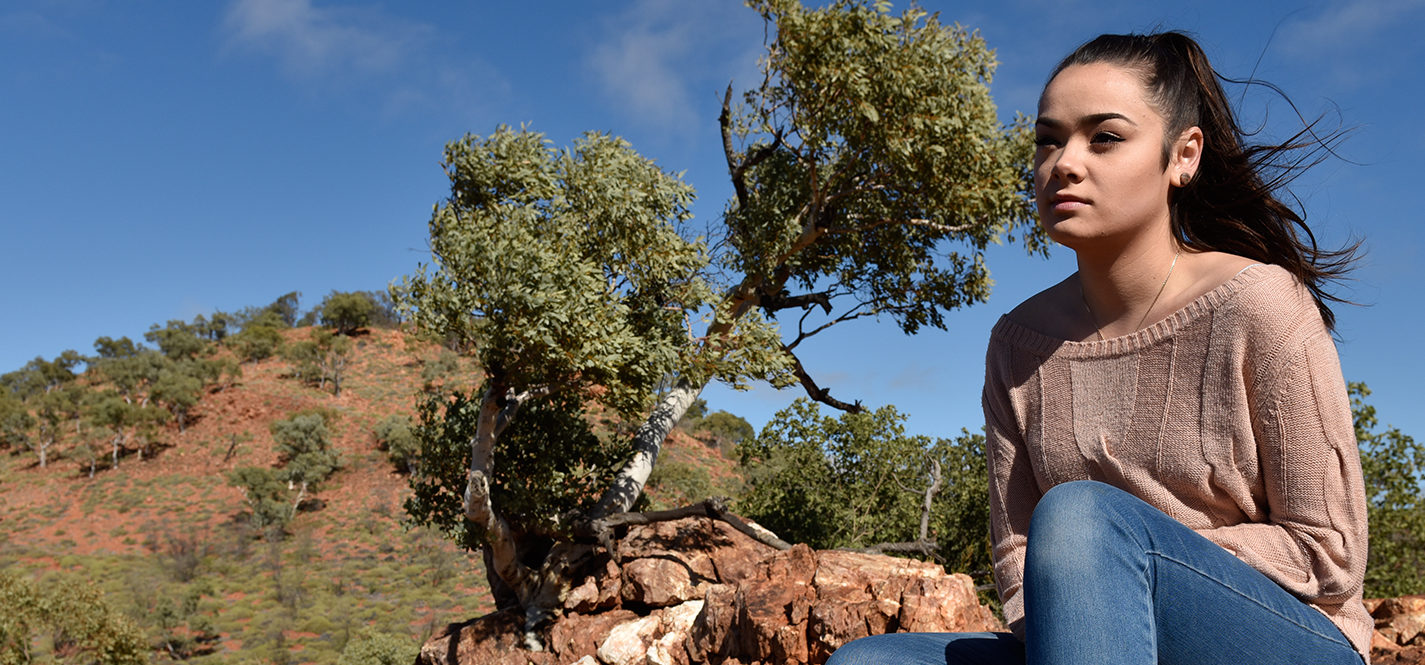
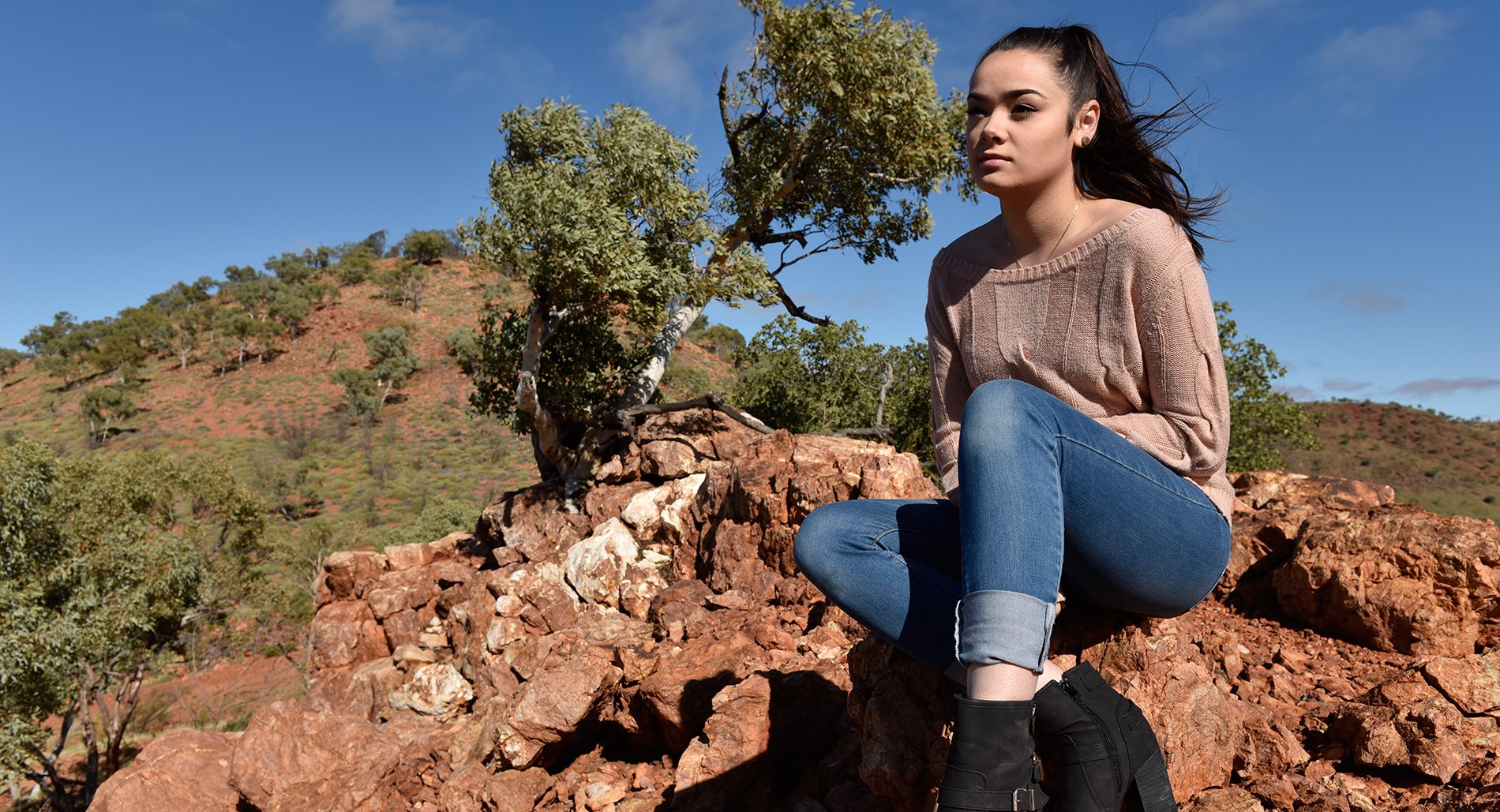
Justice King, a young Indigenous advocate, sits on an escarpment of orange rock
© Wayne Quilliam / AI

Who has helped you be proud of your identity?

My dad. When I went through my mental illness phase I felt like I was alone, but he was someone I could go to, and still is. I’m really lucky. That’s why I work so hard because I know a lot of kids don’t have that.

We [my brother and I] also spent a lot of time with my grandparents when we were younger, and that helped me understand my Indigenous culture.

What are the police like around here?

Last night I finished work and I was waiting for my dad. I was talking on my phone and a patrol car drove by. If I wasn’t on the phone they probably would have come over and said, “What are you doing?” It got me thinking, what fears do other kids have?

What do you think is important for the future?

I want to see a change in the vision of mental health. I want to be able to know that my future children and their future children can stand up and say, “I’m not feeling too well, can I talk to you?” I want them to be able to access facilities that help them deal and know that they are not different if they suffer from mental illness.

I want there to be a lot more Indigenous people in the future standing up and saying “I’m capable and I can go places” – because we all can.

It doesn’t matter what race you are, what gender you are. Everyone’s human. You can go as far as you want to. The limits are where you place them.

Justice King

Cambodia: Election official sentenced for criticising court

Responding to the sentencing of Ny Chakrya, a senior election official and the former head of monitoring for rights group Adhoc, to six months in prison on Thursday, Amnesty International said:

“Today’s conviction of Ny Chakrya is a brazen assault on the right to freedom of expression, which protects criticism of officials, including judicial officials. The ongoing misuse of the judicial system to harass civil society and political opposition continues unabated with the government trampling over rights in an effort to silence dissent.”

Rafendi Djamin, Amnesty International’s Director for South East Asia and the Pacific.