UN Refugee Summit talks end in abject failure

World leaders have wasted a critical opportunity to tackle the global refugee crisis, after talks for a new UN refugee deal ended falling far short of expectations.

Late last night, the United Nations (UN) member states meeting in New York finalized a watered-down outcome document for adoption at a UN Summit meant to tackle the refugee crisis on 19 September. The Global Compact on Refugees proposed by UN Secretary-General Ban Ki-moon is not included and will now not be agreed before 2018.

“Faced with the worst refugee crisis in 70 years, world leaders have failed to the bear the weight of responsibility,” said Charlotte Phillips, advisor on Refugee and Migrants’ Rights at Amnesty International.

“Faced with the worst refugee crisis in 70 years, world leaders have failed to the bear the weight of responsibility.”

Charlotte Phillips, Amnesty International

“The Refugee Summit was a historic opportunity to find a desperately-needed global solution to the refugee crisis. Instead, world leaders delayed any chance of a deal until 2018, procrastinating over crucial decisions even as refugees drown at sea and languish in camps with no hope for the future.

“But failure to agree a deal does not let governments off the hook. States cannot continue to abdicate their responsibility to help people fleeing war and persecution.”

OPCAT: 5 things you need to know

In response to the horrific treatment of children at Don Dale and concerns raised about other youth prisons, Indigenous and human rights advocates are calling for Australia to ratify the Optional Protocol on the Convention Against Torture (OPCAT).

Julian Cleary, Indigenous Rights Campaigner from Amnesty International breaks down what OPCAT actually is and why it is important.

1. What is CAT?

CAT is the Convention against Torture and Other Cruel, Inhuman or Degrading Treatment or Punishment. It’s a human rights treaty that Australia has signed and agreed to be bound by (i.e ratified).

CAT defines torture as any act by a public official that intentionally inflicts severe mental or physical pain or suffering on a person.

CAT requires Australia to take legislative, judicial and other measures to prevent acts of torture in any territory under its jurisdiction. Acts like the Guantanamo-style treatment of children we saw at Don Dale.

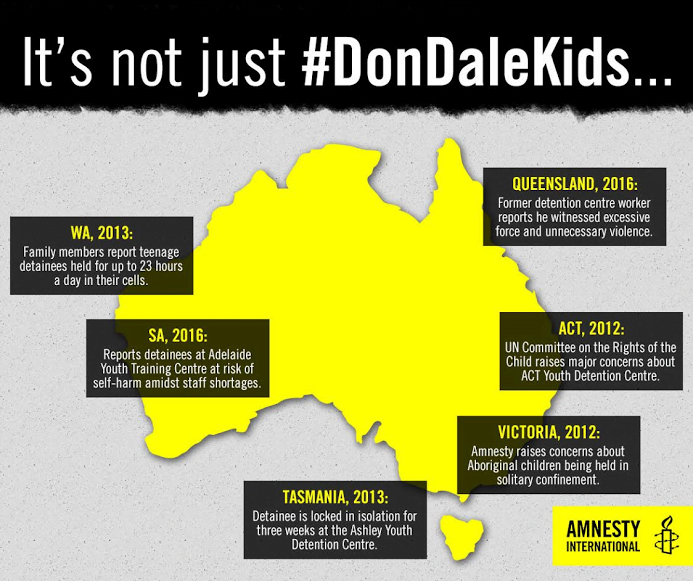
Infographic about youth detention center concerns
© Amnesty International

There is a Committee against Torture that considers whether Australia is honouring the obligations we have agreed to be bound by under CAT. The meeting of that Committee about Australia was in December 2014.

In November 2014, Amnesty wrote to the Committee against Torture outlining concerns about the tear gassing and treatment of children at Don Dale and raising other concerns about conditions of youth detention for boys and girls in the NT and other states.

In its report on Australia, the CAT Committee said that it had been made aware that “overrepresentation of Indigenous people in prisons has a serious impact on Indigenous young people and Indigenous women”. The Committee recommended that Australia increase its efforts to “address the overrepresentation of Indigenous people in prisons, in particular its underlying causes”.

The Committee also said that Australia should strengthen its efforts to bring the conditions of detention into line with international standards. To achieve this, the CAT Committee recommended that Australia become a party to the Optional Protocol to the Convention Against Torture (OPCAT) as soon as possible.

2. What’s OPCAT?

OPCAT is a way for Australia to strengthen its commitment to stamp out torture, and cruel, inhuman or degrading treatment in youth prisons and other places of detention. OPCAT requires countries that ratify it to set up a system of unannounced and unrestricted visits to all places of detention by independent national and international monitoring bodies.

OPCAT is a way for Australia to strengthen its commitment to stamp out torture, and cruel, inhuman or degrading treatment in youth prisons and other places of detention.

By ratifying OPCAT Australia would be required to set up an independent body or bodies with financial independence and the power to access all places of detention in all states and territories (the National Preventative Mechanism/s). It would also permit the UN Subcommittee on the Prevention of Torture to visit any place of detention in Australia.

In November 2015, Australia’s human rights record was reviewed by other countries at the United Nations. In recognition that our current systems are not up to scratch, 27 countries said Australia should get on with ratifying OPCAT. These recommendations were made due to concerns about conditions in youth detention centres, prisons and immigration detention in Australia.

In November 2014, Amnesty wrote to the Committee against Torture outlining concerns about the tear gassing and treatment of children at Don Dale.

In response to concerns raised by a number of countries and NGOs about conditions of youth detention, the Australian Government claimed that:

“Juvenile justice centres in Australia provide secure and safe care of young people who are sentenced to custody or who are remanded pending the finalisation of their court matter”.

The Australian government has said that it is “actively considering” the ratification of OPCAT, but has failed to do so.

3. Why is ratifying different to signing and why is it important?

Signing a human rights treaty demonstrates a broad intention to comply with it, but this is not binding. Australia signed OPCAT back in 2009, but has failed to ratify it for seven years.

By ratifying OPCAT the Australian Government would be required to consult nationally and work with the states and territories to set up an OPCAT compliant National Preventative Mechanism (or Mechanisms) within a year.

4. What would this mean for kids in detention?

Ratifying OPCAT would ensure that youth detention centres and police lock-ups are subject to much stronger independent oversight and monitoring to stop abuse of children in the justice system throughout Australia.

As well as conducting visits to these facilities, the National Preventative Mechanism would be able to

  • conduct confidential interviews with children in detention;
  • review and comment on laws and policies (like restraint chairs and spit hooding)
  • make recommendations to improve the treatment and conditions of children in detention; and,
  • maintain contact with the UN Subcommittee on the Prevention of Torture.

At the moment, no agency in any Australian state or territory monitors youth detention facilities and police lock-ups in a way that fully complies with OPCAT. Surprisingly, given its shocking record on locking up Indigenous children, Western Australia probably has the strongest system of independent oversight in place.

After some disturbing incidents in 2013, including extended lock-down of children in detention and the transfer of children to the adult prison, inspections and reports by the Office of the Inspector of Custodial Services (OICS) have led to big improvements in youth detention conditions in Western Australia (though the OICS notes that there is still some way to go).

Importantly though, the OICS does not have the power to access police stations or lock-ups, which is a major gap. This would need to change under OPCAT.

5. Should kids even be in detention in the first place?

The short answer is no. Only as a last resort and all other alternatives need to be considered and tried first. But this is not the reality right now, especially for Aboriginal and Torres Strait Islander children.

Like countless reports before it, Amnesty’s research highlights how Aboriginal and Torres Strait Islander children are more likely to be charged rather than cautioned, more likely to be arrested than summonsed, more likely to be refused bail and held in custody awaiting trial and more likely to be sentenced to detention.

Our research reports outline some of the issues in the youth justice system and recommendations for what needs to change at the Federal level and in Western Australia. A similar piece of work in Queensland is currently being put together.

Jarrad Oakley Nicholls: ‘Our young generation are our strength and our future’

August 4 is 2016 National Aboriginal & Torres Strait Islander Children’s Day, a day where Aboriginal and Torres Strait Islander families to celebrate the strengths and culture of their children. We chatted to AFL footballer Jarrad Oakley Nicholls about his important work as a mentor for Indigenous kids.

Tell us about yourself

I was raised in the northern suburbs of Perth on Noongar land; my mum is a Yamatji woman and my dad is Koori. I always wanted to be a professional AFL player, and at 17 I was drafted for the Richmond Tigers. During my career I’ve also played for the West Coast Eagles.

Tell us about the Wirrpanda Foundation

The Foundation helps Aboriginal kids finish school, improve their health and lifestyle choices, and to study further or enter the workforce. Indigenous mentors deliver the Wirrpanda Foundation’s programs and together we’ve reached over 30,000 Aboriginal people.

How do you work with Aboriginal kids?

At the Wirrpanda Foundation I’ve got a number of roles, mainly in employment. I’m the Kwinana (in Perth) office manager, and we run a few programs both for the younger ages and also to assist Indigenous people in finding employment. We encourage the whole family to get in and use our services.

With the younger boys and girls it’s all about getting them engaged with school if they’re not currently, or finding another avenue where they can work out what they want in the future.

What’s some of the best things about your work?

The guys that first come in, they really show that shame factor, sort of head down. After a while you see their personal pride lifting and they can actually see something they want to strive for, whether that’s employment, training or making a happy and supportive environment for their kids.

I really enjoy working with the Aboriginal and Torres Strait Islander people, and I’m proud about my culture. I want to help in any way I can and support any of our mob to strive for the best they can be. We [the mentors] can see it but it’s about making sure that they can see it too.

“I really enjoy working with the Aboriginal and Torres Strait Islander people, and I’m proud about my culture. I want to help in any way I can and support any of our mob to strive for the best they can be.” Jarrad Oakley Nicholls

What are the challenges kids face?

The issues that I faced growing up, and that my mother faced growing up… still generation after generation, they are still here.

It’s sad to say but a lot of our families, especially the boys, think you’re not a man until you’ve gone to jail. We need to show them other paths.

The kids, they’re our future … we really need to put a lot of our time into these younger kids; get into their heads and talk about the positive role models in their lives.

“The kids, they’re our future … we really need to put a lot of our time into these younger kids; get into their heads and talk about the positive role models in their lives.” JARRAD OAKLEY NICHOLLS

What does the future look like?

We don’t want our programs around for the next 10 or 20 years. We want to see our participants functioning without programs like ours. Basically we want to work ourselves out of a job!

I think we really need to change the perception of everyone, because our young generation are our strength and our future, and they’re the ones that are going to be taking along our culture, but also, they could be the next leaders.

For more information about Children’s Day visit http://aboriginalchildrensday.com.au/

Iran: Hanging of teenager shows authorities’ disregard for international law

A teenager has been executed in Iran after being convicted of the rape of another boy, the first confirmed execution of a juvenile in the country this year.

Amnesty International has been carrying out extensive research into the situation of juvenile offenders on death row in Iran, and found that Hassan Afshar, 19, was hanged in Arak’s Prison in Markazi Province on 18 July, after being convicted of “lavat-e be onf” (forced male to male anal intercourse) in early 2015. The execution went ahead even though the Office of the Head of the Judiciary had promised his family that they would review the case on 15 September 2016.

“Iran has proved that its sickening enthusiasm for putting juveniles to death, in contravention of international law, knows no bounds. Hassan Afshar was a 17-year-old high school student when he was arrested. He had no access to a lawyer and the judiciary rushed through the investigation and prosecution, convicting and sentencing him to death within two months of his arrest as though they could not execute him quickly enough,” said Magdalena Mughrabi, Deputy Middle East and North Africa Programme Director at Amnesty International

“Iran has proved that its sickening enthusiasm for putting juveniles to death, in contravention of international law, knows no bounds.”

Magdalena Mughrabi, Amnesty International

“In a cruel stroke of irony, officials did not inform Hassan Afshar of his death sentence for around seven months while he was held in a juvenile detention facility because they did not want to cause him distress – and yet astonishingly were still prepared to execute him. With this execution, Iranian authorities have demonstrated once again their callous disregard for human rights.”

Just days after Hassan Afshar was executed, the authorities scheduled Alireza Tajiki, another youth who was under 18 at the time of his alleged offence, for execution. The implementation of his death sentence, which had been scheduled to take place on 3 August was, however, postponed yesterday following public pressure.

“While we welcome the stay of execution for Alireza Tajiki, his life has been saved for the moment because of public pressure and not because the Iranian authorities are seriously considering stopping the horrendous practice of executing juveniles. This is illustrated by the fact that just two weeks ago Hassan Afshar was hanged in anonymity – publicity should not make the difference between life and death,” said Magdalena Mughrabi.

“While we welcome the stay of execution for Alireza Tajiki, his life has been saved for the moment because of public pressure and not because the Iranian authorities are seriously considering stopping the horrendous practice of executing juveniles.”

MAGDALENA MUGHRABI, AMNESTY INTERNATIONAL

For the 160 individuals who remain on death row in prisons across Iran for crimes allegedly committed when they were under 18, the news of yet another juvenile execution will come as a terrifying blow.

“Any one of these youths could be next in line for execution. The torment that Iran’s flawed juvenile justice system has inflicted on them will not end until the Iranian authorities commute their death sentences and amend Iran’s Penal Code to abolish the use of death penalty for all crimes committed under 18 years of age, as immediate first steps towards full abolition of this punishment,” said Magdalena Mughrabi.

Hassan Afshar was arrested in December 2014 after the authorities received a complaint accusing him and two other youths of forcing a teenage boy to have sexual intercourse with them. Hassan Afshar maintained that the sexual acts were consensual and that the complainant’s son had willingly engaged in same-sex sexual activities before.

While authorities must always investigate allegations of rape and, where sufficient admissible evidence is found, prosecute those responsible in fair trials, rape does not fall into the category of offences for which the death penalty can be imposed under international law. Furthermore, the existence of laws in Iran that criminalize consensual male to male sexual intercourse with the death penalty means that if the intercourse in this case had been deemed consensual, the teenager who accused Hassan Afshar of rape would himself have been sentenced to death. The criminalization of same-sex sexual activity between consenting adults violates international human rights law.

While authorities must always investigate allegations of rape and, where sufficient admissible evidence is found, prosecute those responsible in fair trials, rape does not fall into the category of offences for which the death penalty can be imposed under international law.

The Supreme Court initially overturned the sentence due to incomplete investigations but ultimately upheld it in March 2016.

Background

Male individuals who engage in same-sex anal intercourse face different punishments under Iranian criminal law depending on whether they are the “active” or “passive” partners and whether their conduct is characterized as consensual or non-consensual. If the conduct is deemed consensual, the “passive” partner of same-sex anal conduct shall be sentenced to the death penalty. The “active” partner, however, is sentenced to death only if he is married or if he is not a Muslim and the “passive” partner is a Muslim. If the intercourse is deemed non-consensual, the “active” partner receives the death penalty but the “passive” partner is exempted from punishment and treated as a victim. This legal framework risks creating a situation where willing “recipients” of anal intercourse may feel compelled, when targeted by the authorities, to characterize their consensual sexual activity as rape in order to avoid the death penalty.

International law, including the Convention on the Rights of the Child to which Iran is a state party, absolutely prohibits the use of death penalty for crimes committed when the defendant was below 18 years of age.

International law restricts the application of the death penalty to the “most serious crimes”, which refers to intentional killing. Amnesty International opposes the death penalty unconditionally, for all cases and under any circumstances.

Australian Government’s secretive system of deliberate abuse on Nauru

The Australian Government is forcing 1,200 men, women and children seeking safety in Australia to live in abhorrent conditions in Nauru.

Despite the wall of secrecy built by the Australian & Nauruan Governments, Human Rights Watch and Amnesty conducted a 12 day investigation in July inside Nauru to uncover the truth behind the treatment of these people searching for protection and freedom.

Dr. Anna Neistat, Senior Director for Research at Amnesty International, who conducted Amnesty’s investigation, revealed that the Australian Government has “designed a system of deliberate abuse” in Nauru, to deter people who are seeking safety that arrive by boat.

“It is essentially like an open-air prison for these refugees & people seeking asylum”.

“I’ve conducted over 60 investigations into human rights abuses in countries like Afghanistan, Syria, Zimbabwe, China but few other countries go to such lengths to deliberately inflict suffering on people searching for safety and freedom. I was not expecting this kind of shocking abuse.”

Anna Neistat

“Australia’s atrocious treatment of the refugees on Nauru over the past three years has taken an enormous toll on their well-being,” said Michael Bochenek, Senior Counsel on Children’s Rights at Human Rights Watch, who conducted the investigation on the island for the organisation.

84 refugees and people seeking asylum were interviewed including twenty-nine women, forty-six men, five girls and four boys. Several personnel from service providers were also interviewed, despite risking prosecution for providing information.

A wall of secrecy

 “The extent of the secrecy relating to the Australian Government’s operations on Nauru is one of the most shocking features. In 15 years I have never encountered this level of government cover-up. The contractual gagging of service providers was unprecedented. It without doubt enables – and encourages – an abusive situation” said Amnesty’s Anna Neistat.

Service providers and others who work on the island face criminal charges under Australia’s Border Force Act if they speak out about what they see.

The Nauru Government has banned Facebook and enacted vaguely worded laws against threats to public order that legal experts fear could be used to criminalise protests by refugees and asylum seekers. Journalists in particular face severe restrictions on entry and UN officials have also been denied entry.

Medical care & mental health

Refugees and people seeking asylum on Nauru – most of whom the Australian government has held there for three years – are routinely neglected and at times denied medical care by IHMS, the main health services company hired by the Australian Government.

Some of its staff have publicly condemned the appalling treatment of refugees on Nauru, raising concerns about the company’s operations there.

Parents were particularly critical of services available to women during pregnancy and childbirth and said that newborns suffered from persistent infections and other medical conditions.

Refugees and asylum seekers suffering psychological trauma and severe mental health conditions do not receive adequate support or treatment.

Refugees and asylum seekers interviewed said that since being transferred to Nauru that many had begun to repeatedly self-harm, cutting their hands or banging their heads against the wall, did not speak to anybody for months, did not recognize their relatives, and stayed in bed for weeks, refusing to go outside or take showers.

“People here don’t have a real life. We are just surviving. We are dead souls in living bodies. We are just husks. We don’t have any hope or motivation.”

A women interviewed on Nauru

Children have begun to wet their beds, suffered from nightmares, and and in some instances had stopped speaking to people outside of their immediate families.

Adults and children spoke openly of having wanted to end their lives.

Amnesty’s Anna Neistat said, “I have never seen such mental anguish amongst people – even in some of the bloodiest conflicts I have not seen this. Words are not enough to convey how bad it really is there.”

Attacks, sexual violence, and impunity

The physical safety of those held on Nauru is a serious concern with every refugee and asylum seeker interviewed reporting intimidation, harassment, or violence directed at them or family members by Nauruans acting alone or in groups. They said the assailants cursed and spat on them, threw bottles and stones, swerved vehicles in their direction as they walked or rode on motorbikes, or broke their windows or destroyed other property.

Every woman interviewed said she could not go out alone.

Six women described sexual assault or harassment, including groping, touching, explicit threats, demands for sex, and attempted rape. Every woman interviewed said she could not go out alone.

Children who attend local schools described frequent bullying and harassment from Nauruan students, who tell them to go back to their home countries. Many have stopped attending classes altogether.

As a result, interviewees said they were afraid to leave their accommodations, particularly at night.

Interviewees said that Nauruan police disregard their complaints and sometimes discourage them from filing reports. Several refugees provided Human Rights Watch and Amnesty International with copies of reports they filed with local police following the attacks, saying that police had done nothing to investigate or apprehend the attackers, even if the victims were able to identify them.

Corporate responsibility for abuse

These businesses are profiting from an abusive context, and based on Amnesty International and Human Rights Watch’s investigations on the island, some are directly responsible for serious abuse and the failure to provide appropriate medical care.

Australia’s operations on Nauru rely on private companies and service providers. These service providers face penalties if they speak out, and some staff members have taken a considerable risk to do so to expose the conditions on the island.

Amnesty International and Human Rights Watch sought comment from the two key companies contracted by the Australian Government to provide services for its Nauru operation, Broadspectrum, the company that runs the Regional Processing Centre, and IHMS, the main medical services provider.

Broadspectrum responded to Amnesty International and Human Rights Watch’s summary of findings that it “firmly rejected” any suggestion that the company did not respect human rights. IHMS stated that its role was to deliver services, and not to engage in Australian Government policy, and “strongly refuted” the allegations put to it by Amnesty International and Human Rights Watch.

Amnesty International and Human Rights Watch believe that these companies’ ongoing involvement in the Australian Government-run centre on Nauru amounts to complicity in violations of the rights of refugees and asylum seekers. These businesses are profiting from an abusive context, and based on Amnesty International and Human Rights Watch’s investigations on the island, some are directly responsible for serious abuse and the failure to provide appropriate medical care.

Australian Government’s abusive and secretive system must end

The Australian Government has violated the rights to be free from torture and other ill-treatment, and from arbitrary detention, as well as other fundamental protections, Human Rights Watch and Amnesty International said.

The Australian Human Rights Commission (AHRC), the Office of the United Nations High Commissioner for Refugees (UNHCR), a Senate Select Committee, and a government-appointed independent expert have each highlighted these abuses, and called on the government to end them.

 Amnesty International calls on the Australian Government to immediately:
  • Settle all the people assessed to be refugees in Australia.
  • Assess all people applying for refugee status in the Australian community.
  • Close the Regional Processing Centre on Nauru.

Read the full press release from Amnesty International and Human Rights watch to find out more.

Syria: Fatal airstrike on maternity hospital a potential war crime

An aerial attack which struck and partially destroyed a maternity hospital in rural Idlib province, north-western Syria, yesterday afternoon appears to be part of a despicable pattern of unlawful attacks deliberately targeting medical facilities.

The number of casualties in the attack is not yet clear, but a spokesperson from Save the Children, which supports the hospital, told media there were at least two fatalities. It is unclear who carried out the attack, but it was in an area under the control of armed groups where Syrian and Russian armed forces had been launching airstrikes.

Deliberate attacks

“Deliberate attacks on hospitals and medical facilities are serious violations of the laws of war and can never be justified. Hospitals, which have special protection under international humanitarian law, should be safe places for mothers, new-born infants and medical workers – even in the midst of a brutal prolonged conflict,” said Philip Luther, Middle East and North Africa Programme Director at Amnesty International.

“Deliberate attacks on hospitals and medical facilities are serious violations of the laws of war and can never be justified.”

Philip Luther, Amnesty International

Photos and video footage taken in the aftermath of the attack showed part of the hospital in ruins, with rubble strewn both inside and outside the building. Other photos taken around the time of the airstrike showed new-born babies in incubators. According to Save the Children, it is the area’s only maternity hospital, delivering around 700 babies a month.

Paediatric hospital hit twice in 12 hours

The attack comes after four hospitals and a blood bank in eastern Aleppo city were struck in aerial attacks on 23-24 July. According to UNICEF, one of them, a paediatric hospital, was hit twice in less than 12 hours.

The latest attacks appear to fit into a pattern documented by Amnesty International of apparently deliberate attacks on Syrian hospitals and medical infrastructure by Syrian and Russian armed forces, which seems to be part of their military strategy. Deliberately attacking medical facilities can amount to a war crime. Indiscriminate attacks, which fail to distinguish between civilian buildings, such as hospitals, and military targets are prohibited and can also constitute war crimes.

Indiscriminate attacks, which fail to distinguish between civilian buildings, such as hospitals, and military targets are prohibited and can also constitute war crimes.

“Syria and Russia must end attacks on hospitals and medical facilities. All such attacks must be investigated and those responsible for serious violations of the laws of war must be brought to justice,” said Philip Luther.

The NGO, Physicians for Human Rights, has been tracking attacks on health care workers and infrastructure in the Syrian conflict. Before the assault, the group had already documented 373 attacks on medical facilities, with 750 personnel killed, the vast majority of them carried out by Syrian government forces and their allies.

We must not wait for a Royal Commission to protect children in youth detention

No one could have watched Monday’s ABC’s Four Corners without a sense of horror. Distressing is an understatement as I sat and watched a crying, distraught child seized by his neck, forced to the ground, manhandled, stripped naked by three grown men and left alone in a cell. It made me sick.

Amnesty International welcomed Prime Minister Malcolm Turnbull’s announcement of a Royal Commission into the conditions in Northern Territory youth detention. Officials must be held responsible for the horrific abuses carried out.

Yet as distressing as the Four Corners footage was, none of the allegations were new. All levels of government in Australia have known for years about the treatment of children in youth detention in the Northern Territory. What’s more, allegations have not only been made in the NT, but in every state and territory in the last five years.

All levels of government in Australia have known for years about the treatment of children in youth detention in the Northern Territory. What’s more, allegations have not only been made in the NT, but in every state and territory in the last five years.

A Royal Commission is extremely important, but the federal government doesn’t need to wait for an inquiry to tell it what it already knows – that The Northern Territory Government has failed to protect children under its care. Children in NT youth detention remain at risk and they need access to immediate care and support.

The time for a national independent oversight mechanism for Australia’s system of detention is long overdue. What we have seen take place at the Don Dale youth detention centre is the inevitable result of the Federal and State and Territory governments passing the buck and turning a blind eye to abuse.

What we have seen take place at the Don Dale youth detention centre is the inevitable result of the Federal and State and Territory governments passing the buck and turning a blind eye to abuse.

So what can they do?

During a press conference in Parliament House on Tuesday afternoon, Indigenous Affairs Minister Nigel Scullion lamented the lack of transparency in Australia’s detention system. In essence, he was citing the lack of transparency as a reason for ignorance. Speaking of the Don Dale facility, Senator Scullion said:

“This is a closed shop. It’s a prison. Nothing is transparent … We need to find ways to make this transparent.”

“This is a closed shop. It’s a prison. Nothing is transparent … We need to find ways to make this transparent.”

The Minister is right.

The Federal Government should establish or assign a body with powers to independently monitoring all places of detention Australia-wide, and the ability to report on the treatment in our places of detention.

In fact, to kick this can down the road and wait for the Royal Commission’s recommendations would be negligent.

The ironic thing is the government actually has the perfect instrument to make things transparent, and it’s sitting on the Cabinet table right now.

The ironic thing is the government actually has the perfect instrument to make things transparent, and it’s sitting on the Cabinet table right now.

It’s called the Optional Protocol to the Convention Against Torture (OPCAT). Back in 2009, the then-Rudd government signed OPCAT. Yet we never ratified it – made it official. Ratifying OPCAT would mean Australia is compelled to ensure independent monitoring of places of detention – including youth detention facilities. It would also open up Australia’s youth detention regime to international scrutiny, ensuring our leaders are held accountable for their actions towards children in detention.

Yet it’s been sitting in the top drawer for seven years.

‘Active consideration’ is not good enough

Back in March, when Australia’s human rights record – including our treatment of people in detention – was being scrutinised by the United Nations, the federal government told the United Nations that OPCAT was under “active consideration.”

So, don’t believe our leaders when they say they’re in favour of independent oversight of detention facilities. The easiest means for them to act is sitting right before them, ready to be put into action.

If Prime Minister Turnbull is serious about ensuring the sort of abuse we saw on Four Corners does not happen again, he can act at his next Cabinet meeting.

Syria: Safe passage for civilians will not avert humanitarian catastrophe in Aleppo city

Unfettered and impartial humanitarian assistance is urgently needed to alleviate the suffering of thousands of civilians in Aleppo city on the verge of running out of food and other essential supplies today.

This morning Russia’s Defence Minister announced it was coordinating a “humanitarian operation” with safe corridors set up to allow civilians and fighters who lay down their arms to leave Aleppo city, and food and first aid points established outside the city. However, many civilians may be sceptical of the Syrian government’s promises of safety and might choose not to leave for fear of reprisals. The city’s only aid supply route, Castello Road, has been cut off by Syrian government sniper fire and heavy shelling since 7 July.

“For years the Syrian government has blocked crucial aid from reaching besieged civilians while subjecting them to the horrors of daily shelling and air strikes, using starvation as a weapon of war and deliberately causing unbearable suffering to those living in opposition-held areas,” said Philip Luther, Director of the Middle East and North Africa Programme.

“For years the Syrian government has blocked crucial aid from reaching besieged civilians while subjecting them to the horrors of daily shelling and air strikes, using starvation as a weapon of war and deliberately causing unbearable suffering to those living in opposition-held areas.”

Philip Luther, Amnesty International Australia

“Providing safe routes for those civilians who wish to flee Aleppo city will not avert a humanitarian catastrophe. It is not a substitute for allowing impartial humanitarian relief for civilians who remain in opposition-held areas of the city or other besieged areas, many of whom will be sceptical about government promises.”

Russia’s promises are also likely to be viewed with suspicion by some civilians in Aleppo as its government has carried out unlawful air strikes in opposition-held areas, including possible war crimes, and consistently failed to use its influence with the Syrian government to end widespread human rights violations.

“Providing safe routes for those civilians who wish to flee Aleppo city will not avert a humanitarian catastrophe.”

Philip Luther

Five local humanitarian organizations told Amnesty International that food reserves in the Aleppo could run out in as little as two weeks’ time, putting civilian lives at risk.

UN humanitarian chief Stephen O’Brien has also warned that food in Aleppo city is expected to run out by mid-August, adding that between 200,000 and 300,000 people are at risk.

Attacks on homes, hospitals and medical facilities in and around Aleppo city by Syrian government forces have also intensified in recent days.

Amnesty International spoke to residents trapped inside Aleppo city as well as 10 doctors and several humanitarian organizations in Syria and Turkey. The testimony gathered paints a deeply desperate picture of what has unfolded over the past 20 days.

‘Road of death’

A humanitarian worker told Amnesty International that Castello Road is now under 24-hour surveillance by the Syrian government and forces of the

Autonomous Administration, led by the Syrian Kurdish political party Partiya Yekîtiya Demokrat (PYD).

“Anything that moves on the road is attacked,” the humanitarian worker said.

“Anything that moves on the road is attacked.”

humanitarian aid worker

Even in the days before the road was cut off two trucks transporting enough food aid to feed 400 families were attacked.

“All of the items were destroyed. These families rely on aid provided by us. What will these families do when the food reserves are fully depleted?” he said.

A former resident of Aleppo city told Amnesty International how he and his family made a harrowing escape risking their lives to cross Castello Road to travel to Turkey eight days ago.

“These families rely on aid provided by us. What will these families do when the food reserves are fully depleted?”

humanitarian aid worker

“My family and I could not bear the sound of warplanes and explosions any more so we decided to leave the city at dawn. The ‘road of death’ [Castello Road] is approximately 500 metres long… The taxi driving a family in front of us was hit by an air strike. The car burst into flames… we couldn’t stop to check if anyone survived. On the way, I saw five human bodies rotting on the side of the road,” he said.

“Hala” (name changed for security reasons), a resident of Aleppo city, told Amnesty International that prices inside the city have doubled in recent days.

“The price of basic food such as sugar and bulghur wheat have doubled. One kilo of sugar now costs around US$13. I cannot afford to buy the very few vegetables available.”

“One kilo of sugar now costs around US$13. I cannot afford to buy the very few vegetables available.”

a resident of aleppo city

“Hussam”, a resident of Aleppo city and father of two boys, told Amnesty International: “Each morning, my eldest son and I start our day by going to bakeries to find bread. The supply barely meets 30% of the people’s needs. Most of the days we either come back with one loaf of bread or empty-handed.”

Relentless air strikes

Life in the city has been made even worse by the relentless air strikes and heavy shelling by Syrian government forces. Residents of Aleppo city and doctors told Amnesty International that the city, in particular al-Sakhour, al-Shaar and al-Fardous neighbourhoods, have sustained daily aerial attacks over the past 10 days.

“Maen”, a resident of Aleppo city, said: “We wake up to the sound of the bombing and we sleep after burying people who were killed.”

“We wake up to the sound of the bombing and we sleep after burying people who were killed.”

“Maen”, a resident of Aleppo

He described how he witnessed an air strike near his home in Bab al-Hadid neighbourhood, a residential district of the Old City of Aleppo on 19 July, which destroyed six homes.

“I ran through the smoke to reach the site of the attack. I saw one pregnant woman and her infant boy killed and a nine-year-old girl was also killed. The scene was horrific. Twenty minutes later I heard the sound of a warplane again. We warned people to evacuate the area as quickly as possible. I was able to hide before another strike targeted the exact same place. [Afterwards] I ran back to the site to find a woman whose leg had been instantly severed; her injured daughter of around 12 years old was beside her,” “Maen” said.

The shrapnel from the attack sprayed across a 200m-wide radius, he said, adding that he believed it was a cluster munition attack because he saw the bomb split in the sky and then create a series of small explosions. Cluster munitions are banned under international law and the use of these inherently indiscriminate weapons violates international humanitarian law. Seven hospitals and medical facilities in Aleppo were attacked by air strikes in the space of 10 days, according to local doctors. Only three hospitals in the city are still functioning and able to provide emergency medical care to injured civilians.

Doctor Abdel Basset, a doctor inside Syria, told Amnesty International that air strikes had damaged two warehouses and partially destroyed medical and food supplies.

A Syrian doctor monitoring the situation from Turkey warned that medical supplies will also soon run out.

“The medical supplies will not last more than two months if the frequency and scale of the strikes continue at the same rate. Some of the injured people are dying from their wounds while waiting in line due to a shortage of staff and lack of functioning hospitals,” he said.

“The medical supplies will not last more than two months if the frequency and scale of the strikes continue at the same rate.”

doctor abdel basset

Doctors, humanitarian workers and residents of Aleppo city have told Amnesty International that the deadliest attacks have occurred on populated residential neighbourhoods inside the city far away from front lines and military objectives. International humanitarian law prohibits attacks on civilians and civilian objects, including hospitals and other medical facilities, and the starvation of the civilian population as a method of warfare.

“The Syrian government and its allies have shown an appalling disregard for international humanitarian law and have shamelessly flouted every human rights provision of UN Security Council resolutions adopted on Syria. For its part, the UN Security Council has failed to prioritize the protection of civilians from these horrific violations,” said Philip Luther.

“The Syrian government and its allies have shown an appalling disregard for international humanitarian law and have shamelessly flouted every human rights provision of UN Security Council resolutions adopted on Syria.”

Philip luther, amnesty international

“All states involved in talks on Syria in Geneva, in particular Russia, the Syrian government’s ally, must exert the utmost pressure on them to end their relentless attacks on civilians and civilian objects and allow unhindered access for aid.”

Background

According to the Syrian Network for Human Rights, 99 civilians, including 25 children, 16 women and 58 men, were killed in Aleppo city between 10 July and 23 July by Syrian government forces. Out of the total number of casualties, 14 were recorded as killed on the Castello Road.

In February 2016, Amnesty International published a press release, Syrian and Russian forces targeting hospitals as a strategy of war, which documented what appeared to be the deliberate and systematic targeting of hospitals and other medical facilities by the Syrian and Russian forces.

In May 2015, Amnesty International released a report, ‘Death everywhere’: War crimes and human rights abuses in Aleppo, which documented relentless barrel bomb attacks and other attacks on civilians by the Syrian government forces in Aleppo.

Names appearing in quotation marks have been changed to protect people’s identities.
Turkey: Intensified crackdown on media increases atmosphere of fear

As Turkey enters its second week of a three month state of emergency, the ongoing crackdown on civil society and the assault on media freedom has reached disturbing and unprecedented levels.

Arrest warrants have been issued for 89 journalists, more than 40 have already been detained and others are in hiding. A second emergency decree passed on 27 July has resulted in the shutdown of 131 media outlets.

“Rounding up journalists and shutting down media houses is the latest assault on a media already weakened by years of government repression. The passing of this second emergency decree leaves little room for doubt that the authorities are intent on silencing criticism without regard to international law,” said Amnesty International’s Deputy Europe Director, Fotis Filipou.

“Even under a state of emergency, restrictions must be necessary, proportionate and for a legitimate purpose. The provisions of the two emergency decrees passed this week fail all three of these tests and fly in the face of the government’s claim that they are upholding rights and the rule of law.”

The second decree follows the first, passed on the July 23, which increased the pre-charge detention period to 30 days. Amnesty International revealed credible reports of widespread ill-treatment and torture of detainees. Lawyers have been denied access to detainees in violation of law.

“The authorities must bring to justice those responsible for unlawful killings and other human rights abuses during the coup attempt. But this must be done in a manner that respects the right to fair trial, the prohibition of torture and other human rights. The intenstified crackdown on freedom of the press does not serve this purpose and is unlawful,” said Fotis Filipou.

“We reiterate our call for Turkish authorities to end ill-treatment and torture of those being detained and allow international monitors to visit all detainees in the places they are being held.”

Indonesia: Deplorable executions must not be compounded

Reacting to the announcement that at least four people – Fredi Budiman, Humphrey Jefferson Ejike, Michael Titus Igweh, and Seck Osmane – have been executed by the Indonesian authorities, Amnesty International has this statement.

“The execution of at least four people tonight by the Indonesian authorities is a deplorable act that violates international law. Any executions that are still to take place must be halted immediately. The injustice already done cannot be reversed, but there is still hope that it won’t be compounded,” said Rafendi Djamin, Amnesty International’s Director for South East Asia and the Pacific.