“330 deaths later: our justice system terrifies me”

In the 25 years since the Royal Commission Into Aboriginal Deaths in Custody (RCIADIC), more than 330 Indigenous people have died in custody. It’s proof that our justice system doesn’t care about me, my children and the hundreds of thousands of Aboriginal and Torres Strait Islander people, writes Kelly Briggs.

A man died alone in a cell from head injuries

At 7.30pm on a balmy night in 1980, police officers, unable to rouse a man on a sidewalk, dragged him unconscious into the back of a police van. The officers assumed he was too drunk to be woken.

They drove him to the station and dragged him into a holding cell. They then left him unchecked until 5am, when they found him dead.

The doctor called to assess the man concluded he had died during the night of a subdural haematoma, which is usually the result of a serious head injury. While this man was imprisoned and dying – his brain rapidly filling with blood and compressing tissue – police officers assumed he was too drunk to wake.

A woman’s cries of agony were ignored

One hot January morning in 1984, police officers encountered an allegedly intoxicated woman at an intersection. They asked her questions and her replies were incoherent. She could not stand so they carried her into the car.

Records show this woman entered the watchhouse at 7.10am. At around 10am, a man in another cell banged on the door to tell staff that the woman was moaning and rolling around in pain, and that she needed medical attention. Nothing was done.

A short time later an officer noticed the imprisoned woman had defecated on her blanket and moved to the floor. The officer called out to her and she moaned. Still, nothing was deemed amiss.

At 2.25pm a friend of the woman came to bail her out but after failing to wake her, was told to come back later.

The officer went back to the woman’s cell; he could not find a pulse. She was dead on a cold concrete floor, beside a blanket covered in her own faeces.

The cause of death was ruled as a hemorrhage from an ovarian cyst, consequent of advanced liver disease. The pain from a ruptured ovarian cyst is described as a sword rammed through your back, repeatedly.

Two women holding signs stating "we say no to W.A mandatory sentencing laws" and "unpaid fines should not be a death sentence"
Protesters outside the inquest into the death in custody of Miss Dhu in Perth, March 2016. © Amnesty International

A sick man is dismissed from hospital to die in a cell

At 5am on a Saturday morning in 1984, a man awoke and told his nephew his chest was feeling crook. He was picked up by family members and taken to hospital.

The doctor who attended the sick man prescribed aspirin and rest until he “looked” well. The nurse charged with overseeing the patient stated she saw him as a drunk with a hangover and wanted to be rid of him as soon as possible.

In evidence to the Commission, the nurse admitted that he was still complaining of pain when he was discharged, and was unable to give any satisfactory explanation for letting a very sick man leave. The nurse said she tried to reach family members to come and pick him up – however, only the police were contacted.

The patient was arrested for drunkenness and 27 hours later, he was dead. The coroner’s report stated he had died from lobar pneumonia. It is easily diagnosed, either with a stethoscope or a chest X-ray.

This case was hindered by the fact the arresting officer claimed all documents relating to the case were stolen from his car. No charges of hindering an investigation or neglect were ever brought against the officer or hospital staff.

25 years on, and armed with 339 recommendations from RCIADIC, are we any better at stopping preventable deaths in custody?

Kelly Briggs

25 years later, we’re still dying in custody

These are just three of the 99 Aboriginal deaths between 1 January 1980 and 31 May 1989, which became the subject of the the Royal Commission into Aboriginal Deaths in Custody (RCIADIC). Its findings were handed down in 1991 and much to the surprise of many, no criminal charges were filed against any police officers. Not even one charge of criminal neglect.

But 25 years on, and armed with 339 recommendations from RCIADIC, are we any better at stopping preventable deaths in custody?

To this day, most states have only adopted some of the recommendations, with no states or territories implementing them all.

Since RCIADIC, over 330 Aboriginal people have died in custody. Today Aboriginals are jailed at an even higher rate than when the RCIADIC commenced. These are damning statistics for our judiciary system, which has chosen to ignore its very own recommendations.

Only in the last six months, a young Aboriginal woman in Western Australia lost her life in custody, writhing in agony on a cold jailhouse floor. Another entirely preventable death – a parent’s worst nightmare.

Numerous studies have shown that people believe black people do not feel pain in the same way as white people do. There is a very real empathy gap when Aboriginal people display signs of pain as opposed to white people.

In the past year the Northern Territory has introduced paperless arrest laws, which fly in the face of RCIADIC’s recommendations.. There has already been at least one death in custody in the Northern Territory as a result of arrests for incredibly minor infractions.

Since RCIADIC, over 330 Aboriginal people have died in custody. Today Aboriginals are jailed at an even higher rate than when the RCIADIC commenced.

Kelly Briggs

My takeaways

When I look past my anger I feel deep sorrow – sorrow that this country for over 220 years has not valued Aboriginal lives. If it did, this article would not have to be written.

When I look past my anger I feel deep sorrow – sorrow that this country for over 220 years has not valued Aboriginal lives. If it did, this article would not have to be written.

I would not lie in bed fearing for my family members that are imprisoned, that the next time I see them will be at their funerals. I wouldn’t be terrified that my own children will one day make a mistake that puts them in a harmful judicial system.

This country must do better. Conversations are taking place but there must be a sense of urgency because as it stands, Aboriginal people are still dying entirely preventable deaths while incarcerated.

Kelly Briggs is an award-winning writer and social commentator. A Gomeroi woman living in Moree in rural NSW, Kelly brings a deep personal and political perspective to her work illuminating the determinants of the social and emotional wellbeing of Aboriginal and Torres Strait Islander people.

Follow her on Twitter: @TheKooriWoman

This blog entry does not necessarily represent the position or opinion of Amnesty International Australia

For more stories like this, download Just Justice (13MB)
Four Indigenous heroes to look out for in 2016

Loved Beyonce’s political stance at the Super Bowl? Laughed out loud at Nakkiah Lui’s Black Comedy? It’s exciting to see the push for black and Indigenous rights creeping into the mainstream. Here’s a few other home-grown young Indigenous heroes who are totally nailing it for progress — ‘like’ them before everyone else does.

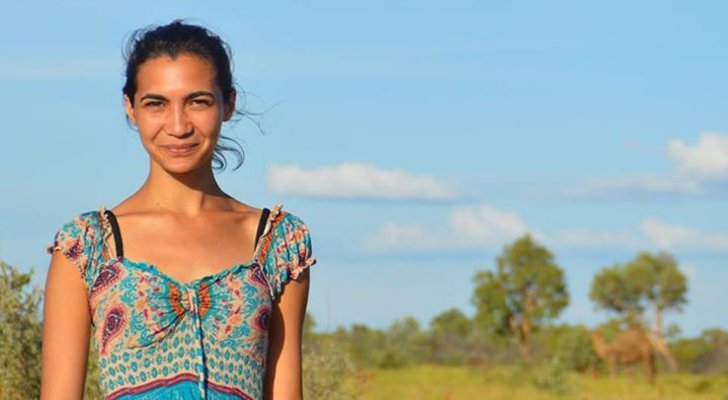
Rachael Hocking

Woman standing with trees in background
Rachel Hocking

Rachael was born in Melbourne but grew up all over Australia; her grandmother’s country is in the Tanami Desert, and she identifies as a Warlpiri woman.

As a journalist for NITV, Rachael reports on the disproportionate rate of domestic violence among Indigenous Australians, black feminism, land rights and the mental health of young people. “I try to write about anything that affects black Australia…I also love a good yarn that highlights the strength and achievement of our mob.”

Coming up in 2016

“I’ll be keeping a close eye on how the government actually spends its investment in domestic violence measures for Indigenous women and communities, and a bunch of other features which I look forward to seeing on NITV’s new program, The Point.”

Follow Rachael on Twitter

Joe Williams

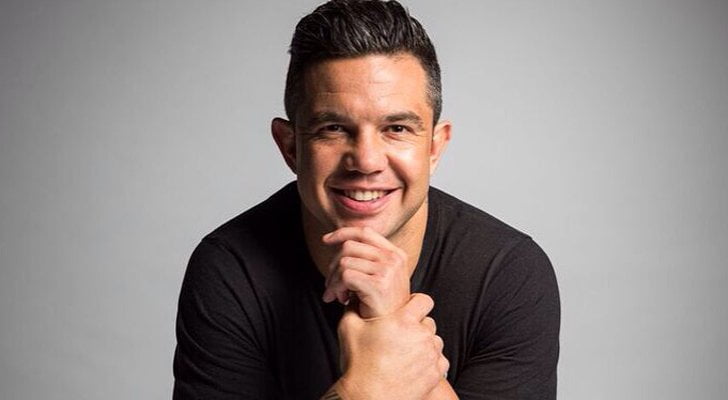
Man smiling
Joe Williams

Joe is a Wiradjuri Aboriginal man born in Cowra and raised in Wagga Wagga NSW. Joe’s main passion is mental health and he is a huge champion for Aboriginal equality: “Seeing an advancement in racial equality will, I believe, reduce incarceration rates and increase health and life expectancy.”

Coming up in 2016

“I am currently part of the filming of a global documentary called ‘Suicide:The Ripple Effect’, brought to life by American suicide prevention campaigner Kevin Hines. It shares experiences of suicide and what people are doing for suicide prevention. And, I will continue to visit schools and communities across Australia to educate people on managing mental health.”

Follow Joe on Twitter

Justice King

Woman smiling on white background
Justice King

Justice King hails from Mount Isa, Queensland, and is a proud Waanyi woman. Justice focuses on mental health, safety and equity rights: “These are basic human rights and areas where, I believe, many Indigenous people are disadvantaged. It is my passion to teach other young people the importance of fighting for rights, to path the way for our younger generations.”

Coming up in 2016

“I am heading to university mid-year to study law. I hope to take part in the 2016 Queensland Youth Parliament and see where that takes me. And l hope that my peers can see my enthusiasm for better change and that it inspires them too.”

Dameyon Bonson

Black and white photo of man on white background
Dameyon Bonson

Originally from Darwin, Dameyon has Aboriginal (Mangarai), Torres Strait Islander (Mabuiag) and caucasian heritage. He lives on the lands of the Yawuru people in the West Kimberley.

Dameyon not only founded the Indigenous LGBTQI support group Black Rainbow Australia, he’s a member of the expert panel of the National Advisory Committee for the Aboriginal and Torres Strait Islander Suicide Prevention Evaluation Project (ATSISPEP) and is researching suicide prevention. “There is much that needs to be interrogated when it comes to Indigenous suicide.”

Coming up in 2016

“I’m continuing on the expert panel for ATSISPEP and advising on the the first ever National Aboriginal and Torres Strait Islander Suicide Prevention Conference to be held this May. Also I’m attending the UN Permanent Forum for Indigenous Peoples in New York. Hopefully, I’ll successfully lobby for an international consortium to discuss how sexual orientation, gender identity and intersex rights are enacted within Indigenous Peoples’ rights.”

Follow Dameyon on Twitter

Good news: Myanmar activist Phyoe Phyoe Aung released

Phyoe Phyoe Aung, a student activist from Myanmar jailed for helping to organise a student protest, has been released. Her freedom is a huge victory for human rights and human rights defenders.

What happened?

Phyoe Phyoe Aung is a young activist and Secretary General of one of Myanmar’s largest student unions. On 10 March 2015, she and 50 other students were arrested by police for their peaceful demonstrations against an education law they believe limits freedom of education.

Phyoe Phyoe Aung was charged with a range of offences including taking part in an unlawful assembly and inciting the public to commit offences against the State. She faced up to nine years’ imprisonment. After eight months in hiding, her husband Lin Htet Naing was also arrested in November, 2015.

Finally, the demand for their freedom has been heard and, alongside many others, Phyoe Phyoe Aung and her husband now walk free.

“We are now looking forward to the release of all other prisoners of conscience – including those students who are facing charges in other courts. The new government must ensure that no prisoner of conscience is left in jail.”

Laura Haigh, Amnesty International

“Today’s release of most of the student protesters is a huge step forward for human rights in Myanmar, and we are delighted that these men and women will walk free. It sends a strong message about the new government’s intention to end the cycle of political arrest and detention in Myanmar,” said Laura Haigh, Amnesty International’s Myanmar Researcher.

“We are now looking forward to the release of all other prisoners of conscience – including those students who are facing charges in other courts. The new government must ensure that no prisoner of conscience is left in jail.”

Freedom of expression in Myanmar

Since the start of 2014, authorities have increasingly stifled peaceful activism and countless journalists, human rights defenders, students, and labour and land activists have been threatened, harassed and jailed for nothing but peacefully speaking their minds.

Authorities have been using the law to bring charges against groups of people participating in a protest. They have also used politically-motivated detention and imprisonment to weaken dissident movements.

Myanmar’s new government will take office with a historic opportunity to change its course on human rights and break away from its use of deeply repressive laws.

How did Amnesty respond?

Amnesty International has campaigned heavily for Phyoe Phyoe Aung’s release since her arrest. As well as being the subject of an Urgent Action which was sent out globally, Phyoe Phyoe Aung also featured as one of our 2015 Write for Rights cases.

In Australia, almost 30,000 people signed our online petitions calling in Myanmar’s then-President Thein Sein to release Phyoe Phyoe Aung. Countless more took action offline.

We would like to thank everyone who took action on behalf of Phyoe Phyoe Aung – your efforts are greatly appreciated.

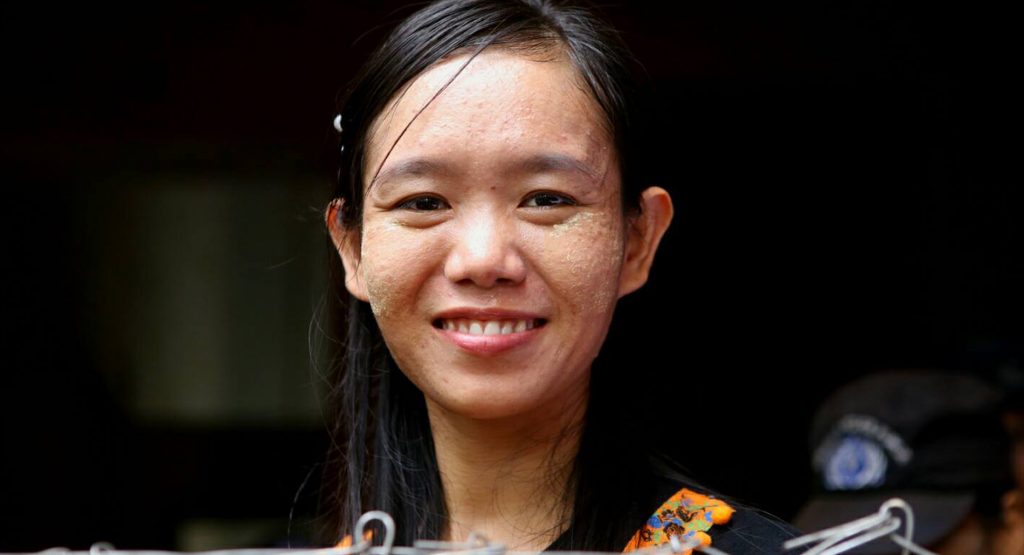
Phyoe Phyoe Aung smiling
Phyoe Phyoe Aung at a court hearing in May 2015. © Private

What needs to happen next?

While this is a step in the right direction, the government of Myanmar must release all remaining prisoners of conscience and ensure wholesale reform so that the country can end the cycle of discrimination, politically-motivated arrests and imprisonment, and other human rights abuses once and for all.

Phyoe Phyoe Aung and other human rights defenders are vital to shaping the country’s future – it’s crucial that the government works to create space in civil society for them to operate freely.

With the world’s attention on Myanmar, we will celebrate the release of the protesters but continue to challenge the Myanmar government to break away from the deeply repressive policies that for years have fueled arbitrary arrests and repression.

Read our 2015 Report: Going back to the old ways: a new generation of prisoners of conscience in Myanmar

Myanmar students’ release must pave way for end to repression

The release of dozens of student protesters in Myanmar is a step forward for human rights that should pave the way for the new government to release all remaining prisoners of conscience and amend or repeal all laws that fuel arbitrary arrests.

The Tharawaddy Court in Myanmar yesterday dropped charges against scores of students facing jail for largely peaceful protests in March 2015. The move came after the new government announced on 7 April that it would work to release all prisoners of conscience as soon as possible.

“This release of most of the student protesters is a huge step forward for human rights in Myanmar, and we are delighted that these men and women will walk free. It sends a strong message about the new government’s intention to end the cycle of political arrest and detention in Myanmar. We are now looking forward to the release of all other prisoners of conscience – including those students who are facing charges in other courts. The new government must ensure that no prisoner of conscience is left in jail,” said Laura Haigh, Amnesty International’s Myanmar Researcher.

“Of course, a prisoner release is only a first step – the NLD must also reform the country’s repressive legal framework, which has for too long been used to clamp down on dissent. As long as these laws remain on the books, human rights defenders and activists will remain at risk of being jailed simply for expressing their opinions. Thankfully, the NLD has acknowledged the need to repeal and amend repressive laws, and we are looking forward to seeing the government following up on this.

“The new administration must also aim to ensure support and rehabilitation for those released in today’s amnesty, along with the many others before them who were unjustly imprisoned.”

“We are now looking forward to the release of all other prisoners of conscience – including those students who are facing charges in other courts. The new government must ensure that no prisoner of conscience is left in jail.”

Laura Haigh, Amnesty International

Background

At least five student leaders who are facing charges in other courts remain in detention while they wait for the charges to be dropped. They are Phyoe Phyoe Aung, James (aka Lin Htet Naing), Nandar Sitt Aung, Kyaw Ko Ko and Myint Thwe Thit.

On 24 March 2016, Amnesty International published a report on political imprisonment in Myanmar which highlighted the worrying erosion of newly found freedoms of expression, association and peaceful assembly in the country since the start of 2014. Since then, hundreds of people have been arrested, charged, arbitrarily detained or imprisoned in politically motivated cases. They include student protesters, political activists, media workers, human rights defenders and, in particular, land and labour activists.

The report highlights how authorities have used both old and new laws to silence dissent, and how the use of these laws has been supported by a range of other tactics to keep human rights defenders and activists in detention or in prison for lengthy periods of time, creating a climate of fear among human rights defenders and other activists in the country.

Arrested, detained and tortured: the reality of Syrian oppression

In the lead up to the five-year anniversary of the start of the violent conflict in Syria, we spoke to Syrian human rights activist Bassam al-Ahmad about his experiences.

A man stands smiling with flowers in the background
Bassam al-Ahmad © Private

Arrested

I had been in my new job for fewer than six weeks when they came in and arrested everyone in the office and took us away.

It was 16 February 2012, and I had just started work at the Violations Documentation Centre (VDC) in Damascus – an independent not-for-profit organisation that records human rights abuses in Syria. I wasn’t blind to the dangers of the kind of work I was doing but I was young and naive and somehow I didn’t think it would happen to us. I thought I was untouchable.

I was known to the authorities already. When I moved to Damascus as a student, I started organising peaceful events at university like equal rights marches and workshops to discuss the ideas of Gandhi and Nelson Mandela. This didn’t go down very well with the authorities and it didn’t take them long to find me as I had used my real name on the posters. So the secret police already had a file on me.

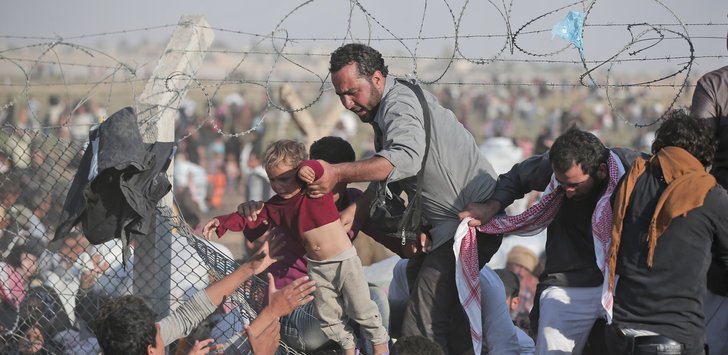
A man in a crowd lifts a child over a fence
A Syrian refugee carries a baby over the broken border fence into Turkey. © Press Association/AP Photo/Lefteris Pitarakis

Torture and overcrowding

At VDC, I was working with people I’d known for a long time – it was safer to only work with people you knew because the intelligence services had a habit of trying to infiltrate human rights organisations. We thought we were safe because of this. We were wrong.

For the first few days of our arrest, I thought we would be ok.

They took my whole office – nine men and six women – to an air base and we were questioned by air force intelligence but there was no torture. They kept us there for 25 days.

As the days dragged on we started to get frustrated – why were they keeping us so long without releasing us or putting us on trial? We knew our rights! We told them we were going to go on hunger strike if they didn’t let us out and that annoyed them so they handed us over to the 4th Armoured Division, a military unit headed by President Assad’s brother.

I was put in a small room with about 80 other people. It was so crowded, we had to sit down in shifts while the others stood up because there wasn’t enough room for us to all sit down on the floor at the same time.

Every now and then they would take a few people away to be tortured. When they came back – if they came back – there wasn’t even enough space for them to lie on the floor.

I was in there for 33 days.

Forced to flee

One day, out of the blue, they transferred me to a military court for trial and then I was sent to an ordinary prison for 20 days, where I had access to food, clean clothes and medicine. You know you’ve been in a bad place when an ordinary prison in Syria looks good.

When I was released, alongside two of my colleagues, we had been forcibly detained for 86 days. It turned out all our lawyer friends had been working to track us down the whole time we were in detention and they got us out on bail by telling the authorities we were not a flight risk and we would attend trial in Damascus.

I actually did attend trial twice until my family made me see sense: that there would be no good outcome for me, I would never get a fair trial. I fled to Antakya, a city in Turkey near the border with Syria.

I wasn’t a bad person – I wasn’t fighting for IS or the Assad regime – but they took me away anyway. For 86 days, my family had no idea where I was or whether I was dead or alive. Sometimes I didn’t know it myself.

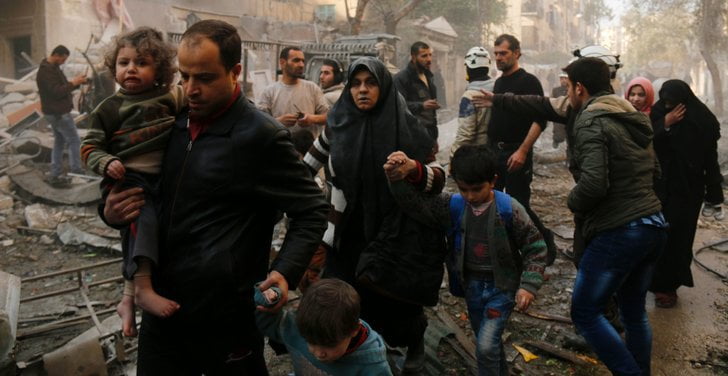
A line of men, women and children walk in a line through rubble
Syrians make their way through debris as they leave for a safer place following air strikes in the rebel-controlled side of the northern city of Aleppo on January 13, 2016. © AFP/Getty Images

Ordinary people fighting for their rights

I want to tell people in Australia about what is happening in Syria – to tell you the stories we document every single day at the VDC.

The people in these stories are just ordinary people – they were merely demanding dignity and fighting for their human rights – they just wanted the same things that everyone else wants the world over: freedom and the right to lead dignified lives free of fear. And for that, they were disappeared.

VDC is working closely with Amnesty International to record the human rights violations happening in Syria and to publicise them around the world. Just knowing that you know about what is happening to these people gives them hope and helps them stay strong.

It has been nearly five years since the war started in Syria and we need your help to help them.

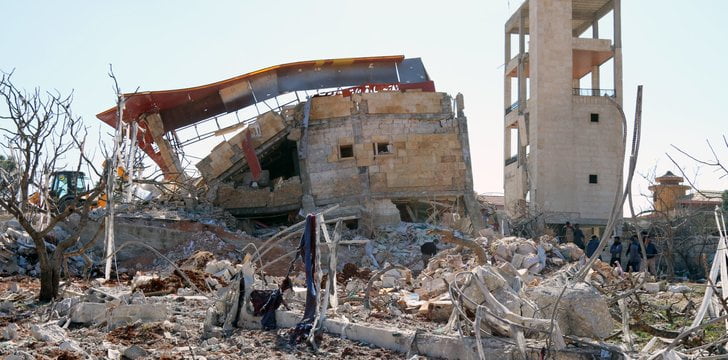
Rubble of a destroyed hospital
The rubble of a hospital supported by Doctors Without Borders (MSF) near Maaret al-Numan, in Syria’s northern province of Idlib, on February 15, 2016, after the building was hit by suspected Russian air strikes. © STRINGER/AFP/Getty Images

Bassam al-Ahmad is the Director of Research for the Syrian Violations Documentation Centre (VDC). Amnesty International has facilitated Bassam al-Ahmad’s visit to Australia to publicise the work VDC does and the atrocities being committed in Syria.

First published by The Drum.

Indigenous students reveal their aspirations

In March, Indigenous school students from across the country came together to inspire the next generation of Indigenous mathematicians, scientists and engineers – through a video game. We asked them to share their inspirations for the future.

Game On

The Australian Indigenous Mentoring Experience (AIME), the educational program that supports Indigenous students through high school and into university, teamed up with Google for the GAME ON workshop.

During GAME ON the students were mentored by game designers and computer engineers and at the end of the week they pitched their game idea to a judging panel.

This is the first time a maths and science video game was developed by Indigenous kids, for Indigenous kids. During the week we asked the students to discuss maths and science, video games, and their career aspirations for the future. Here’s what they had to say.

Baylee – Brisbane, QLD

“When I finish school I want to be a dog handler in the police force. What did I learn from my mentor at AIME? I learnt heaps! Maths and science? They’re life skills that you simply need to know!”

Tyson – Melton, VIC

“I like basketball, skating and hanging out with my mates. I like playing video games on Xbox. Some of my favourite games are Halo Wars, COD and Gears of War.

After school I’d love to come to AIME as a mentor. If that doesn’t work out, I’ll become a carpenter to build cupboards. Maths is important because you need your maths in every job, especially dealing with money and also if you want to build stuff – you have to learn measurements to work with wood. So they’re really important for my career.”

Jemma – Rockhampton, QLD

“At AIME we learnt about how we could make maths and science more fun. When I grow up I want to be a mechanic or a marine biologist.

Maths and science are basically the two major things you need in life. I’m going to need them for whatever I do. I think we should inspire Indigenous kids to get into these subjects because that’s the most important thing in life”.

Shakayla – Perth, WA

“My hobbies… well I like sport! I play AFL, rugby, cricket, basketball. Sometimes I play games as well, mostly on my phone, games like Colour Switch, Minecraft, Geometry Dash.

After school I want to be a hairdresser, forensic scientist or an architect. Maths and science are the main things you need in your life to understand everything.”

Christian – Coolum Beach, QLD

“I play soccer, and video games. In the future, I want to be a game designer. At AIME, we learned how to speak to people and not to come off in the wrong way. Maths and science helps you when you grow up – getting a job and getting into uni mainly.

You can learn a lot through games, so playing them isn’t a bad thing. For example, if you play minecraft you can learn about the earth and minerals, just like for geography class. You learn from playing that game.”

Molly – Hastings, VIC

“When I went to AIME I really enjoyed the company of the other people and how nice they were. I play mobile games, Xbox and Wii.

My mum and my Nan are painters – my mother does it casually but my Nan sells her art. I like to paint landscapes and the natural world. Doing art makes me feel happy. I’m not sure what I want to do after school but I want to be an AIME mentor because it looks like a lot of fun.”

Juan – Kalgoorlie, WA

“I like to play basketball. When I’m not playing basketball, I play video games. When I finish school I want to get a job as a carpenter so I can build myself a house. I think maths and science are important because I’ll need them in my career like measuring the length of a building.

My advice to kids in the AIME program would be to do the best that you can in school so that you can get jobs later on in life”.

Progress!

This month the Queensland Government will present a Bill to help reduce the impact of our failing justice system on kids.

Australia takes first step to address world refugee crisis

The Australian Government has stepped up to save the lives of 12,000 more people escaping the conflict in Syria.

Worst refugee crisis since WWII

This is just the first step needed, as world leaders, including Australia, look to address the worst refugee crisis since WWII.

“Thousands more people will now have the chance to live safe and happy lives and make positive contributions to the diverse Australian community,” said Dr Graham Thom, Refugee Coordinator, Amnesty International Australia. “It is a positive demonstration of leadership which hopefully other developed countries will follow.”

Intake should be increased to 20,000

“But there’s no reason this number can’t be increased to 20,000 people, in addition to the current humanitarian intake of 13,750. Those individuals resettled must be prioritised on the basis of their vulnerability and in full consultation with the UNHCR.

“The Prime Minister has so far failed to put a time frame on the placements. The urgency of this crisis means these people must be resettled within a year or less. For refugees languishing in Jordan, Lebanon and Turkey, certainty and safety needs to happen now, because as the UN has stated, funding for basic food and necessities is running out.

Less than 1% of refugees are resettled through UNHCR program

“Less than one per cent of the world’s refugees are resettled through the UNHCR’s resettlement program and Australia resettles a small proportion of that one per cent, leaving the rest of the world to deal with the other 99 per cent.

Currently Lebanon hosts approximately 1.2 million refugees from Syria – around one in five people in the country. Jordan hosts about 650,000 refugees from Syria – 10% of the population. Turkey hosts 1.9 million refugees from Syria – more than any other country worldwide.

“Today’s announcement recognises this discrepancy and seeks to secure Australia’s place as a generous and prosperous country with a humanitarian heart.

Australia joining US-led military strikes in Syria

The announcement has been made alongside the decision for Australia to join US-led military strikes in Syria, targeting the Islamic State (IS).

“It is important that Australia enters this agreement ensuring it adheres to international law, including the protection of civilians during the conflict.

Less than one per cent of the world’s refugees are resettled through the UNHCR’s resettlement program and Australia resettles a small proportion of that one per cent, leaving the rest of the world to deal with the other 99 per cent.

“Any military action taken by Australia in Syria must ensure all possible steps are taken to avoid civilian casualties and air strikes are only directed at military targets.

Refugees must be allowed to join our communities

“While we welcome today’s news about the extra refugee places, it must be remembered that the few Syrians who have made it to our shores have now been languishing at the Australian-run detention centre on Manus Island for over two years.

“If the government is to be consistent in its approach, it must also give them refugee protection and allow them to be a part of the Australian community, to begin new lives, free from fear and persecution.”

Write for Rights: 3.7 million thank yous

Every year, Amnesty supporters across the globe write millions of letters on behalf of people whose basic human rights are being attacked.

During late 2015 and early 2016, our supporters around the world wrote an astonishing 3.7 million letters, messages, emails and tweets as part of our global letter-writing marathon, Write for Rights.

Success

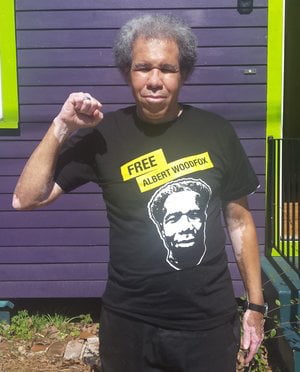
In February 2016, one of our recent Write for Rights cases, Albert Woodfox, was finally released – 44 years after he was first placed in solitary confinement in the USA. More than 240,000 of you around the world demanded his release and sent him messages of support.

He told us: “Your messages from beyond the prison walls have become an enormous source of strength for me. I would like to thank all of the members of Amnesty International and its supporters for all of the wonderful work they are doing on our behalf.”

Man standing with fist raised in front of house
Albert Woodfox was released on his 69th birthday after spending more than four decades in solitary confinement.  © AI USA/Jasmine Heiss

It doesn’t end there. More than half a million of you also took action to protect girls and young women in Burkina Faso – and it worked! The Ministry of Justice there affirmed the government’s commitment to eradicating early and forced marriage, and said they had felt compelled to do so after “receiving letters, emails and correspondence from people all over the world”.

Support and solidarity

We know that your handwritten postcards, letters and messages of support and solidarity have also been a huge comfort to people going through incredibly tough situations.

For example, we visited Yecenia Armenta, who is in jail in Mexico after being beaten and raped into “confessing” to her husband’s murder. We passed on more than 8,000 of your letters and messages: “When I receive all these letters saying that I’m not alone, it makes me feel great. And I think: ‘Yes, it’s true, I’m not alone. They really are supporting me.’ It’s exciting to think that there are people who still care about the rights of other people – and they don’t even know me.”

We also spoke to Phyoe Phyoe Aung, a student leader currently jailed in Myanmar for her role in largely peaceful protests: “Receiving letters gives me real inspiration for what we are doing. I have begun to notice that the world is watching and cheering us – we are not alone. I thank everyone very much for their support. Although we cannot see the results from the government yet, it can influence their mindset.”

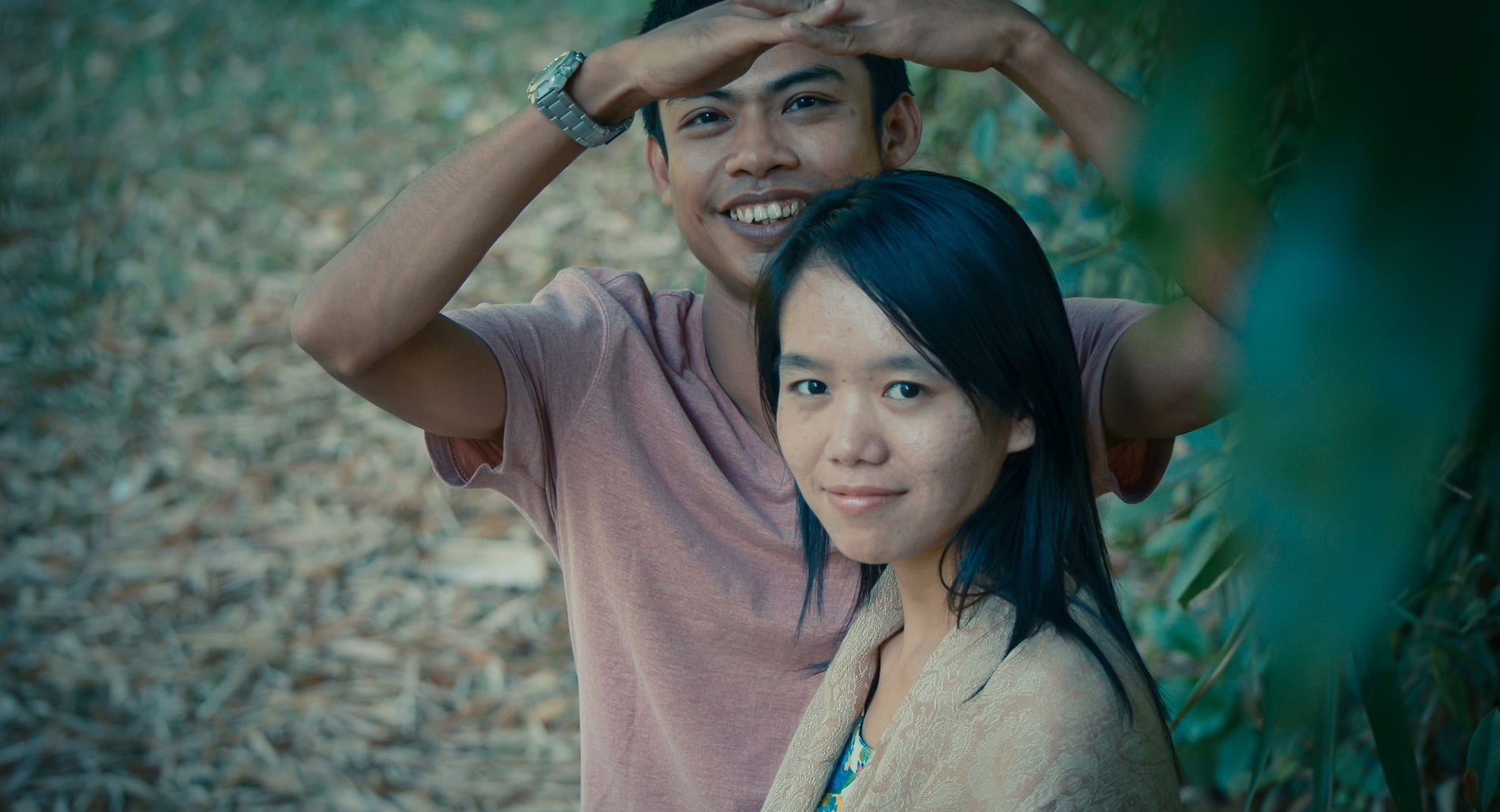
Phyoe Phyoe Aung and her partner Lin Htet Naing
© Private

How did Australia help?

In Australia alone, almost 90,000 letters, emails and tweets were sent in relation to six people, including Albert Woodfox and Phyoe Phyoe Aung.

Our day in Parliament

Receiving letters gives me real inspiration for what we are doing. I have begun to notice that the world is watching and cheering us – we are not alone.

Phyoe Phyoe Aung, a student activist who was jailed in Myanmar

We took Write for Rights to the Australian Parliament and encouraged over 130 MPs and Senators to get involved. Our Government Relations team received confirmations from several politicians who wrote letters for this year’s Write for Rights.

Write for Rights challenge

For the first time ever, the Asia Pacific combined it’s activist power for the Write for Rights campaign. Australian action groups joined fellow activists from Thailand, Nepal, Malaysia, the Philippines and Taiwan to campaign for Zunar, a cartoonist facing jail time for tweeting in Malaysia and other Write for Rights cases.

As part of events all around Australia, our groups in Parramatta and Mount Druitt ran a seven-day Write for Rights challenge, encouraging supporters to write a letter for one of our cases every day for one week.

Street Art for Rights

Internationally renowned street artists E.L.K., Kaff-eine and Adnate used their passion and creativity to make and celebrate human rights change for women around the world.

In Sydney and Melbourne these artists created two stunning murals of women who have featured in the campaigns this year and in the past.

E.L.K. worked on a stunning mural of Teodora in Bondi Junction, Sydney.

Thank you

Write for Rights is not simply about creating change in one month. The power of Write for Rights is in starting that initial pressure, which, over months and even years, eventually yields success.

Together, we can show the world that pens and keyboards are mightier than the sword.

Bali Process: A small step for human rights

Amnesty International welcomes Australia’s commitment to a joint regional approach to creating safe and legal pathways for people seeking asylum. However, Australia must do more to support the region through a more targeted approach to resettlement.

Safety of refugees must be a priority

Amnesty International had called on all 45 countries taking part in the high level meeting in Indonesia, including Australia, to make the safety of refugees and migrants an absolute priority.

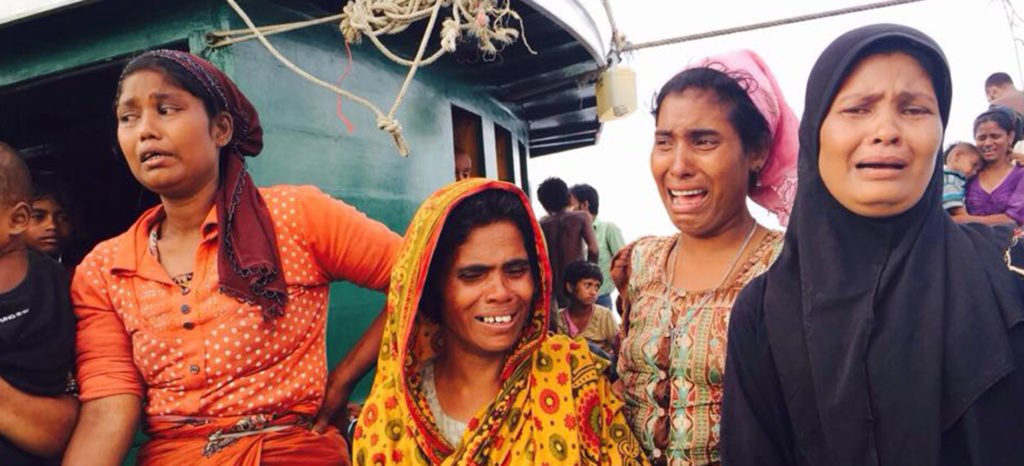
This year’s Bali Process meeting comes in the aftermath of the refugee crisis that erupted in Southeast Asia in May 2015. This crisis saw thousands of people from Myanmar and Bangladesh stranded in rickety boats, pushed back from safety on shore, trafficked into forced labour, or killed at sea.

“Last year’s push-back of boats in the Bay of Bengal and the Andaman Sea illustrated the disastrous consequences of ignoring the plight of people who have to resort to dangerous routes to escape serious threats to their lives,” said Tirana Hassan, Amnesty International’s Crisis Response Director.

“Last year’s push-back of boats in the Bay of Bengal and the Andaman Sea illustrated the disastrous consequences of ignoring the plight of people who have to resort to dangerous routes to escape serious threats to their lives.”

Tirana Hassan, Amnesty International

“While Amnesty International welcomes the Bali Process Ministerial Declaration as a step in the right direction, we are calling on the Australian government to show real leadership in the region and commit to increasing its humanitarian resettlement quota to at least 30,000 places per year from the current 13,750.

Four distressed women on a stranded boat
© Thapanee Ietsrichai. Four distressed women on a stranded boat.

Australia can do more

“As one of the wealthiest countries in the world on a per capita basis, Australia clearly has the capacity to do more. We should not expect poor countries in the region to shoulder the responsibility”.

Malaysia currently hosts 150,000 refugees and asylum seekers, Thailand hosts 130,000 and Indonesia hosts 13,000.

Rohingya refugees and asylum seekers make up a significant proportion of these people. Australia refuses to resettle refugees from Indonesia who have arrived after July 2014 and has not resettled Rohingya for many years.

An effective regional approach to protecting refugees requires all countries in the Asia Pacific to provide a recognised legal status to those seeking protection. This status would ensure access to basic rights, such as work and education. Greater collaboration and commitment from resettlement countries is also needed to provide permanent solutions for particularly vulnerable refugees in the region.

“Australia should reverse its policy of not resettling refugees from Indonesia who have arrived after July 2014 as this harsh deterrent strategy has resulted in vulnerable people being left in limbo for years without the right to work or get an education,” said Tirana Hassan.

“It is also counterproductive: without the option of resettlement refugees in Indonesia are inevitably forced to consider irregular migration options”.

Amnesty International continues to call for Australia to set an example in the region by ending its policy of pushing back boats carrying vulnerable people seeking asylum – a strategy which is contrary to international law.

Bearing witness: My life in crisis response

Amnesty International’s Crisis Response Director Tirana Hassan has spent the last ten years living and working in conflict zones. Here she describes the events that have shaped her life.

Witnessing horrific events

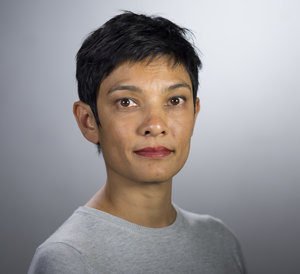
Headshot of woman
Tirana Hassan, Amnesty International’s Crisis Response director. © Amnesty International

I have spent most of the last decade living and working in conflict zones and witnessing horrific events that can fundamentally change a person, but the event that changed the course of my life was quite ordinary.

In 2001, I attended a legal conference in South Australia where Eric Vardalis, one of the lawyers for asylum seekers trapped on the Tampa, talked about how he became involved in that seminal turning point for refugee protection in Australia. He said he had watched with horror the situation unfolding on TV and he went to bed saying to himself “I’m sure someone else will do something about this”.

The next day he woke up and thought “but what if they don’t?”

He picked up the phone and started calling around, by a combination of sleuthing and sheer determination he managed to get through and speak to the asylum seekers on The Tampa. His account, and particularly that thought “What if they don’t?” stayed with me and I realised I couldn’t assume others would do something about human rights.

Humanitarian work

I spent the next 18 months working with a committed group of pro-bono lawyers representing asylum seekers in the now defunct Woomera detention centre. There were hundreds of people from Iraq, Afghanistan and Iran living there in the most appalling conditions. They told me countless heartbreaking stories of families left behind and terrible persecution. I found myself on a path that took me to the countries that had caused these people to flee.

I spent 10 years in emergency humanitarian work, specialising in the protection of children and women affected by armed conflicts in Africa and Asia. However, I gradually realised I was still on the tail end of the crisis. I wasn’t the one picking up the telephone, I was picking up the pieces afterwards.

Protection shouldn’t be a retrospective concept. I believe that working in crisis response as I now do – bearing witness, being on the ground and forcing action and accountability in real time – can prevent further violations from happening.

Working for Amnesty

I joined Amnesty International as the organisation’s crisis response director last year. My team and I are there to document what happens on the ground and to bring it to the world’s attention: to give the victims a voice and, hopefully, to act as a powerful deterrent. Our job is to record the killings, the rapes, the abductions before the evidence of these violations disappear into the fog of war. We then take that evidence to those in power and those responsible to stop it happening again.

Our job is vital because history has shown us one consistent thing: if someone commits atrocities once with impunity, they will do it again and again.

Syrian conflict

Three weeks ago, I was at the border of Turkey and Syria, watching an exodus of innocent men, women and children from Northern Aleppo escaping unimaginable terror and listening to their stories. Parents described how Russian and Syrian regime airstrikes struck their neighbourhoods and how they rummaged desperately through the rubble in search of the children they had sat down for their evening meal only moments before. They told me how the jets then circled back and struck again as they and rescue workers pulled out the survivors.

Syria can feel overwhelming because of the enormity of the conflict: the sheer number of displaced, the confusing number of parties to the conflict, the seemingly indefatigable rising toll of people who have lost their lives. However, when Amnesty International’s researchers tell us another human rights activist in the country has been disappeared, when a doctor calls to tell us another hospital has been targeted in an airstrike, my team does not have the option to be overwhelmed.

Justice will come eventually

While it often feels like we can’t stop what’s happening in Syria just by documenting and being there, the reality is there are millions of people trapped within Syria, and millions displaced outside the country, and they rely on Amnesty International to stand with them and ensure that their voices are not forgotten and their lives are protected.

We are working in Syria to record what is happening for one very simple reason: one day this war will stop and then there needs to be justice.

There are very few clean hands in this conflict. The regime must stop the use of barrel bombs on civilian areas, the Russians must stop targeting schools and hospitals, the opposition forces must ensure the conduct of their fighting forces is in line with international humanitarian law. The laws of war are not a convenient buffet that warring factions can pick and choose from and Amnesty International is here to remind all parties of that fact.

Justice will come eventually but the suffering of millions of people cannot wait for solutions to happen down the track.

How we can help

There are meaningful things that can be done to help the Syrian people in the meantime.

Australia can use its voice much more effectively on the world stage to bring political pressure to bear on all parties to the conflict. This will require a much more ambitious and courageous diplomatic effort than Australia has produced so far.

Act now online

And while it may be difficult to protect people inside Syria, Australia can certainly protect them outside Syria. Australia can increase its humanitarian assistance to the 4.8 million refugees in countries bordering Syria, and make sure that the 12,000 Syrians it offered to resettle to Australia make it here without delay. This year Australia has only pledged $20 million to the international aid effort, and has so far resettled very few of its 12,000 refugee quota. That is not the kind of rapid and ambitious response we need to see.

We can’t just sit on our hands and wait for someone else, somewhere else in the world to ‘pick up the phone’ and do something. It’s time to act because we can. Find out how you can take action now.

Follow Tirana on Twitter.