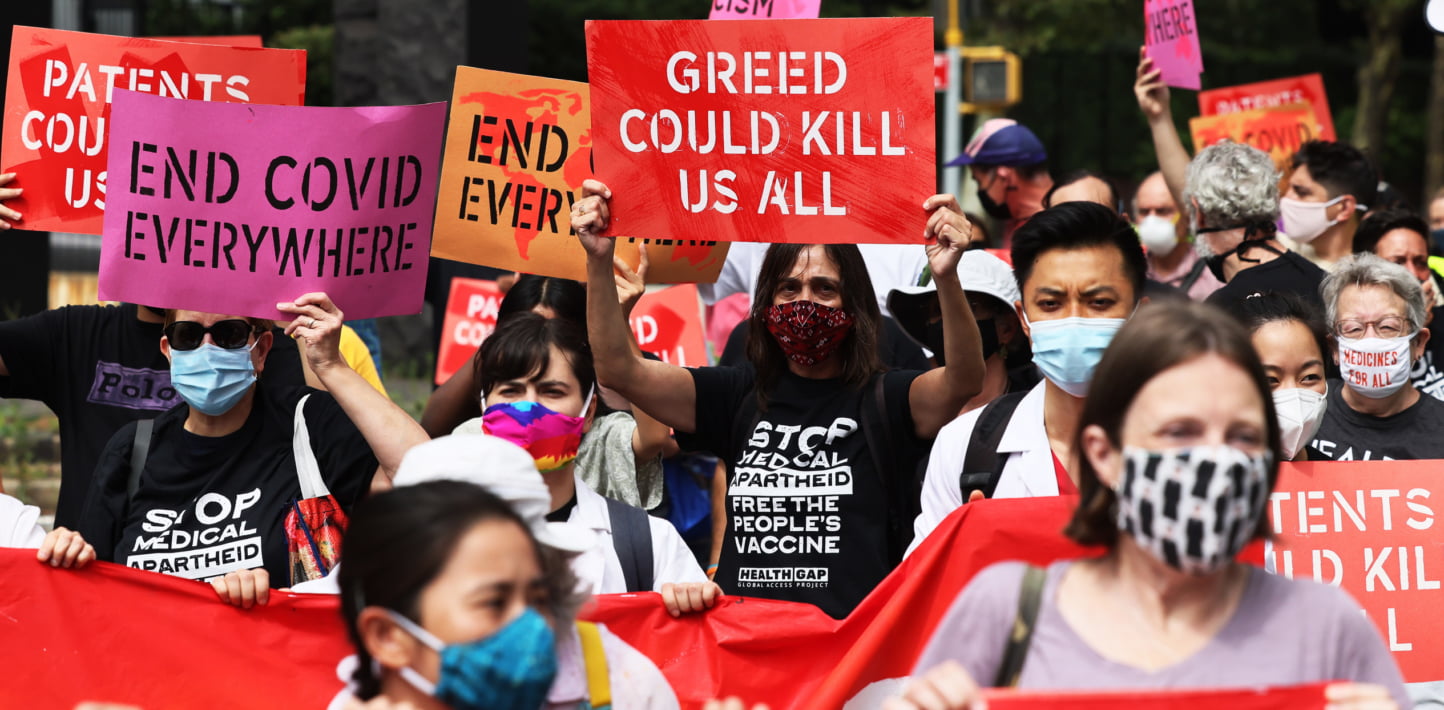
Responding to news that Pfizer reported $14 billion in third-quarter revenue for vaccines and is set to earn $36 billion from vaccine sales by the end of the year on the back of the Covid-19 vaccine roll-out, Patrick Wilcken, Amnesty International’s Head of Business and Human Rights, said:
“That Pfizer has been able to earn billions of dollars in revenue in the last three months alone, while failing to provide vaccines to billions of people, is a failure of catastrophic proportions. Not only has the vast majority of its vaccines gone to high and upper-middle-income countries but Pfizer has also consistently refused to waive its intellectual property rights and share vaccine technology, while at the same time benefitting from billions of dollars in government funding and advance orders from wealthy countries.
The apparently unquenchable thirst for profits of big pharmaceutical companies, like Pfizer, is fuelling an unprecedented human rights crisis. If left unchecked, the rights of billions of people around the world to life and to health will continue to be in jeopardy.
Patrick Wicken, Amnesty International’s Head of Business and Human Rights.
“The apparently unquenchable thirst for profits of big pharmaceutical companies, like Pfizer, is fuelling an unprecedented human rights crisis. If left unchecked, the rights of billions of people around the world to life and to health will continue to be in jeopardy.
“Amnesty International is supporting the World Health Organization’s target of vaccinating 40% of those in low and lower-middle-income countries by the end of 2021 with our 100 Day Countdown campaign. We only have 59 days until the end of the year. That’s 59 days for states to urgently redistribute hundreds of millions of surplus doses that they’re sitting on, and for vaccine developers to ensure that at least half the doses they produce go to these countries.
“It’s not too late for Pfizer and its big pharma competitors to do what’s right for humanity and fulfil their human rights obligations. At the end of the month, WTO members will meet in Geneva to discuss the TRIPS Waiver to temporarily lift intellectual property rights, which could expand the world’s manufacturing capacity of Covid-19 vaccines. Big pharma must stop lobbying against the waiver so that world production can be boosted and diversified, and every person on the planet can get a shot at these life-saving vaccines.”
Amnesty International’s 100 Day Countdown calls on states and pharmaceutical companies to share vaccines with low and lower-middle income countries – so that millions more people can be protected from Covid-19 in 2021. Act now!
The United Nations General Assembly has marked 2 November as the ‘International Day to End Impunity for Crimes against Journalists’. This landmark resolution condemns all attacks and violence against journalists and media workers.
Journalists around the globe face danger everyday. Journalists often face threats against their safety, including harassment, intimidation, arbitrary imprisonment, kidnappings and violent attacks. Murder is the most extreme method of media censorship.
Around the world, the perpetrators of these threats often go unaddressed, either through the obstruction of the judicial process by the powerful or as a result of legal systems not properly protecting journalists or recognising crimes for what they are – attacks on freedom of the press.
Amnesty supports the right to press freedom, and as part of that, the protection of journalists, by calling for governments to provide greater protections for journalists under threat.
Here are 7 cases you can support by taking action on today:
1. Call for the release of citizen journalist Zhang Zhan
Arresting journalists has long been a tactic of authoritarian governments looking to silence critical reporting. During Write for Rights this year, Amnesty supporters from all across the globe are writing letters calling for citizen journalist Zhang Zhan’s release.
Zhang Zhan, 37, disappeared in May 2020 after documenting the response of her government to the COVID-19 outbreak in Wuhan.
Previously a lawyer, Zhan travelled to Wuhan in February 2020 determined to get the truth out about how government officials had detained independent reporters and harassed families of COVID-19 patients.
Zhan has been locked up, tortured and shackled for months. Her crime? Reporting on COVID.
On a hunger strike since last year, Zhan is now so severely malnourished that her life is at risk – she weighs less than 40kg. Her mother is begging for her to eat, but Zhan is determined to protest her imprisonment and assert her innocence.
It has never been more urgent to act. Zhan helped others by exposing censored information about COVID. Now, we need to help save her life. Sign the urgent petition calling on the Chinese government to free Zhang immediately. With enough global outcry, we can show that the world is watching and pressure them to release her.
Janna Jihad, 15, is a human rights defender and journalist who lives in the small Palestinian village of Nabi Saleh, located in the occupied West Bank.
Like Zhang Zhan, Janna Jihad is a citizen journalist but she uses Facebook and YouTube to document the Israeli army’s oppressive and often deadly treatment of Palestinians. Janna Jihad is another of our Write for Rights cases which urgently requires your voice to call for action for their protection.
Janna used her mother’s phone to record and expose to the world the racist brutality her community experiences at the hands of Israeli forces. At 13, Janna was recognised as one of the youngest journalists in the world.
Today, Janna’s principled journalism has marked her out for harassment and death threats, but she won’t give up. Palestinian children are especially at risk of violence. Many have been killed and injured by Israeli forces.
I want to know what freedom means in my homeland, what justice and peace and equality means without facing systematic racism.
Janna Jihad, human rights defender and journalist
Stand up for Palestinian children. Sign the petition now calling on Israel to protect young Palestinians like Janna from harm. You can help children get the safety they need.
3. Take action against the Bangladesh Digital Security Act
Governments often introduce new policies, national security laws or media standards to block the operations of particular journalists or media outlets. These changes in law are mobilised as raids on homes and offices, arrests of individual journalists and the mistreatment of imprisoned journalists.
In Bangladesh, the Digital Security Act (DSA), a vague and overly broad law that criminalises legitimate forms of expression, has been increasingly used to stifle dissent on social media, websites, and other digital platforms with punishments that go up to life imprisonment.
The authorities have targeted critical voices under the pretext of containing false, offensive, derogatory, or defamatory information, and it is being deployed as a tool for repression.
Writer, Mushtaq Ahmed, was arrested under the DSA for criticizing the Bangladeshi government’s response to the COVID-19 pandemic on Facebook. Mushtaq died in prison in February this year, after languishing in pre-trial detention for more than ten months without a trial, solely for exercising his right to freedom of expression.
With your help we can put pressure on the Bangladeshi government, letting them know that the world is watching – and that we will not rest until the right to freedom of expression is protected.
4. Call for an end to the ongoing harassment and arrests of Maria Ressa
In June 2020, a Manila court convicted Maria Ressa and former journalist Reynaldo Santos of cyber libel. Both now face up to six years in prison, and have been ordered to pay nearly USD8000 in damages.
Ressa and Santos are being singled out for their critical reporting of the Duterte administration, including ongoing human rights violations in the Philippines.
Since President Duterte came into power in 2016, thousands of poor and marginalised people have been murdered by police and others in extrajudicial killings. Maria and her team at the media outlet Rappler have been tireless in their efforts to investigate and expose this campaign of violence, intimidation and repression — even risking their own safety and freedom to do so.
In February 2019, Maria was arrested and detained overnight on “cyber-libel” charges. In June 2020, she was convicted of these charges which Maria say is an “abuse of power” and “weaponization of the law”.
The ongoing harassment and arrest of Maria is a disturbing attempt to silence independent journalism in the Philippines.Maria was named a Nobel Prize laureate in 2021.
Join us in calling for the Department of Justice to quash the conviction end to politically-motivated prosecutions.
5. Demand the Chinese authorities release Yang Hengjun
Chinese-Australian writer Yang Hengjun has been detained by the Chinese authorities since January 2019. Yang, a prominent writer and blogger, has amassed a large following for his novels and his often outspoken commentary on Chinese public affairs.
The government has accused him of espionage. For over a year the authorities denied him access to lawyers and to his family. For months following his detention, no one saw or heard from Yang.
Following public pressure, he was finally allowed to meet with Australian consular staff and his lawyer.
Chinese-Australian writer Yang Hengjun has been detained by the Chinese authorities since January 2019. There are grave concerns that he is at risk of torture and other ill-treatment. Act now. 👇 https://t.co/BthdJE5oBI
— Amnesty International Australia 🕯 (@amnestyOz) July 20, 2020
There are grave concerns that he is at risk of torture and other ill-treatment. Yang, who was previously in good health, is now suffering from hypertension, kidney problems, tinnitus and memory loss.
After a closed trial in May 2021, there has still been no verdict published.
Akram, Abdelkhaleq, Hareth and Tawfiq were just doing their job when they were detained and charged with “spying” and “creating several websites on the internet and social media.”
Four journalists in Yemen have been sentenced to death on trumped-up charges following grossly unfair trials. Call on Yemen to quash these journalists' death sentence. https://t.co/loUFn67fe6
— Amnesty International Australia 🕯 (@amnestyOz) May 3, 2020
They have now been detained, alongside six other journalists, for five years. In December 2020 Amnesty International learned that Tawfiq al-Mansouri had been denied medical treatment while detained. Lynn Maalouf, Amnesty International’s Deputy Regional Director for the Middle East and North Africa, said:
He should never have been imprisoned in the first place, let alone sentenced to death.
Lynn Maalouf
“Pending his overdue release, al-Mansouri must immediately be granted access to the medical care he so desperately needs by doctors of his choosing. We further call on the Huthi de facto authorities to immediately quash the death sentences issued to the four journalists after an unfair trial, to drop all pending unfounded charges and to release them without delay.”
7. Show your support for Australian journalists by following the Amnesty International Australia Media Awards
The Amnesty International Australia Media Awards are held to recognise excellence in reporting of human rights issues in the Australian media, and celebrate the importance of a free press to democracy.
Each year the awards acknowledge those Australian media stories that have presented a fair and balanced report of a human rights issue, highlighted hidden abuses and encouraged an audience’s greater understanding of a human rights issue.
By following the awards you can support the hard work of Australian journalists as they challenge injustice.
Amnesty International and the Stop Killer Robots campaign today unveiled a social media filter which provides a terrifying glimpse of the future of war, policing and border control. Escape the Scan, a filter for Instagram and Facebook, is part of a major campaign calling for a new international law to ban autonomous weapons systems. It uses augmented reality (AR) technology to depict aspects of weapons systems that are already in development, such as facial recognition, movement sensors, and the ability to launch attacks on ‘targets’ without meaningful human control.
Several countries are investing heavily in the development of autonomous weapons, despite the devastating human rights implications of giving machines control over the use of force. In December, a group of UN experts will meet to decide whether to begin negotiating new international law on autonomy in weapons systems. Amnesty International and Stop Killer Robots have launched a petition calling on all governments to voice their support for negotiations.
“We are stumbling into a nightmare scenario, a world where drones and other advanced weapons can choose and attack targets without human control. This filter is designed to give people an idea of what killer robots could soon be capable of, and show why we must act urgently to maintain human control over the use of force,”
Verity Coyle, Amnesty International’s Senior Advisor on Military, Security and Policing.
“Allowing machines to make life-or-death decisions is an assault on human dignity, and will likely result in devastating violations of the laws of war and human rights. It will also intensify the digital dehumanisation of society, reducing people to data points to be processed. We need a robust, legally binding international treaty to stop the proliferation of killer robots – before it’s too late.”
Escape the Scan will be available from 2 November on Stop Killer Robots’ Instagram and Facebook pages.
A larger version of the filter will be on display as an interactive experience at Westfield Stratford City in London – one of the largest shopping centres in Europe – for two weeks from today.
Time to draw a line
“We have had a decade of talks on autonomous weapons at the United Nations, but these are being blocked by the same states that are developing the weapons,” said Ousman Noor of the Stop Killer Robots campaign.
“The UN Secretary General, the International Committee of the Red Cross, Nobel Prize Winners, thousands of scientists, roboticists and tech workers, are all calling for a legal treaty to prevent these weapons – governments need to draw a line against machines that can choose to kill.”
On 2 December 2021, the Group of Governmental Experts to the Convention on Conventional Weapons (CCW) will begin critical talks on whether to proceed with negotiations on a new treaty to address the threat posed by killer robots. So far 66 states have called for a new, legally binding framework on autonomy in weapons systems. But progress has been stalled by a small number of powerful states, including Russia, Israel and the US, who regard the creation of a new international law as premature.
The replacement of troops with machines will make the decision to go to war easier. What’s more, machines can’t make complex ethical choices within the context of unpredictable battlefield or real world scenarios; there is no substitute for human decision making. We have already seen how technologies like facial, emotion, gait and vocal recognition fail to recognize women, people of colour and persons with disabilities; and how they cause immense human rights harms even when they “work”. Employing these technologies on the battlefield, in law enforcement or border control would be disastrous.
Despite these concerns, countries including the US, China, Israel, South Korea, Russia, Australia, India, Turkey and the UK are investing heavily in the development of autonomous systems. For example, the UK is developing an unmanned drone which can fly in autonomous mode and identify a target within a programmed area. China is creating small drone “swarms” which could be programmed to attack anything that emits a body temperature, while Russia has built a robot tank which can be fitted with a machine gun or grenade launcher.
Stop Killer Robots is a global coalition of more than 180 international, regional, and national NGOs and academic partners working across 66 countries to ensure meaningful human control over the use of force through the development of new international law. Amnesty International is one of nine organizations on the coalition’s steering committee.
The Queensland Coroner has found that the death of refugee, Omid Masoumali, in 2016 could have been avoided with the right medical care, and that there needs to be greater certainty and expedition on resettlement for the remaining refugees still trapped on PNG and Nauru if such tragic events are to be avoided in the future.
Omid tragically died two days after setting himself alight on Nauru where he had been detained for more than three years as part of the Australian Government’s cruel offshore detention policy. That policy continues today with more than 230 people still stuck in Papua New Guinea and Nauru.
Omid, just 23 when he died, had been trying to reach Australia to seek asylum after fleeing Iran. Despite being given refugee status, Omid had no hope for future resettlement in Australia as the Government refused to accept anyone who tried to arrive by boat. After years in limbo the emotional toll tragically led to a desperate act.
Elham Arouni Hesari, Omid’s mothersaid: “My son loved Australia, but the way Australia rejected him and took his life will forever torture me. My son had serious burns and then internal bleeding. Why did they operate on him in a place that did not have adequate medical facilities to deal with his burns?”
Omid’s family said: “If our dearest Omid had been taken to a properly equipped hospital promptly, he could be alive now. Omid never had any psychological problems at home, but unfortunately Australia did not welcome him, and the harsh immigration system led him to take desperate measures. How is it possible that in Australia, a country with advanced medical facilities, a young man can die this way?
“We named our baby boy ‘Omid’, which means hope in Farsi, because we had beautiful dreams for him. Now all we have is the cold stone of his grave, where he died, lonely and innocent, in a foreign country. Australia has taken our hope, our Omid.”
Craig Foster, former Socceroo, sports TV presenter, and human rights advocate, said: “This case encapsulates the appalling harm that successive Australian governments have inflicted on thousands of refugees over the past eight and a half years. When every Australian watches the shocking images of Omid setting himself alight, please remember that he is a symbol of the suffering of thousands and think about all those who shamefully remain imprisoned.”
George Newhouse, Principal Solicitor, National Justice Project said: “Omid’s tragic death highlights the Australian government’s failure to properly care for asylum seekers and refugees left languishing indefinitely on Nauru and in PNG. Omid’s death should lead to significant reform of Australia’s inhumane and cruel off-shore immigration processing system. All remaining individuals in PNG and Nauru must be resettled as a matter of urgency. Any immigration detainees, whether on-shore or off-shore, must be provided with intensive psychological support and health and welfare services. The current system is a failure and is intensifying the cruelty, pain and anguish being suffered by men, women and children left on Nauru and in PNG and all those who remain in limbo in Australia.”
Graham Thom, Refugee Adviser for Amnesty International, said: “Years of neglect by the Australian government followed by an appalling medical response led to Omid’s death. It was totally avoidable. There are still more than 200 people trapped offshore on Nauru and PNG. They too are suffering. It’s time for the Australian Government to accept the New Zealand offer to resettle the refugees and get them to safety.”
Paul Power, CEO of Refugee Council of Australia said: “This inquiry has once again shown the irreparable damage that offshore processing continues to cause. As Australia plans to abandon the men it transferred to PNG, they are being pressured to relocate to Nauru. We know it is not a solution. The harrowing experience of Mr Masoumali and his wife revealed during this inquiry confirms this. The evidence is clear that Nauru cannot provide a supportive and safe environment for people who sought refugee protection and have been shipped against their will from one place to another for the past eight years.
“This offshore processing policy has caused so much suffering and has done untold damage to the nation’s reputation. In our name, the Australian Government has spent $9 billion on inflicting harm on people who sought our nation’s help. And eight years later, there is still no end in sight for the 1400 people who remain in limbo. This is a national disgrace.”
Dulce Munoz, National Convener for Mums4 Refugees, said: “The death of Omid Masoumali should be etched in the minds of every Australian. It is evident that his death was the result of deliberate cruelty and it is unforgivable.”
Jana Favero, Director of Advocacy and Campaigns at the Asylum Seeker Resource Centre (ASRC), said: “Today’s findings into the avoidable and tragic death of Omid confirm the failed policy that is offshore detention. For over eight years people who sought safety on our shores have been detained, denied a fair process and subjected to cruel and damaging treatment. Omid was in our care and we neglected him. An urgent solution is needed – detention release and permanent resettlement.”
Sudanese authorities must stop security forces from using unnecessary, including lethal, force against protesters opposed to the military takeover, withdraw the military from law-enforcement operations, and respect the right to freedom of peaceful assembly, said Amnesty International after it confirmed the killing of at least six protesters on 25 October. Further protests are expected on Saturday.
Security forces killed at least six men and wounded another 140 by shooting live rounds into multiple crowds of protesters in the capital Khartoum on 25 October.
“At least six men were shot dead in cold blood and hundreds injured, some critically, simply for exercising their right to peaceful assembly. This is unconscionable and must not be allowed to happen again,” said Deprose Muchena, Amnesty International’s Regional Director for East and Southern Africa.
“Sudan’s military leaders, led by General Abdel Fattah al-Burhan, must make no mistake about it: the world is watching and will not tolerate further bloodshed. They must order effective and independent investigations into Monday’s killings and ensure that anyone suspected of responsibility for arbitrary or abusive force is prosecuted in fair trials. They must also direct their security forces to desist from using such force at any future protests.”
The protests erupted in Khartoum and some provincial towns, including Madani in central Sudan and El-Fashir in Darfur, in response to General Abdel Fattah Al-Burhan’s announcement declaring a military takeover and a state of emergency across the country. The announcement came a few hours after the military detained Prime Minister Abdalla Hamdok and several of his ministers, with whom the military had shared power shortly after the overthrow of former president Omar al-Bashir.
Gamal Abdel Nasir, 23, was killed near the army headquarters in Khartoum with gunshot wounds to the eye and hand. His brother told Amnesty International: “I couldn’t even look at his body. His face was mutilated beyond recognition. He loved his country very much and he was my only brother.”
Muhammed Al-Sadiq Musa, 27, was also shot and killed outside the army headquarters. A close family member who was also at the protest told Amnesty International that he was shot and mortally injured when soldiers opened fire after a group of four or five protesters picked up rocks and hurled them in their direction.
Both Gamal and Mohammed were killed by security forces and in neither case would lethal force have been warranted.
“That’s the last time I saw him alive. When I arrived at the hospital the doctors had already pronounced him dead. I was asked to identify the body. I saw gunshot wounds, one in the right side of his neck and the other in the side of his right kidney.”
“We call on Sudan’s military leaders to ensure their security forces observe restraint, and respect and uphold the right to peaceful protest in line with the country’s own laws and international human rights standards,” said Deprose Muchena.
“They must also take steps to reverse all measures and actions that trample on human rights, including by releasing all those who have been arbitrarily detained since the military takeover and restoring full access to the internet which has been partially shut down for days now.”
The G20’s final statement on increasing global access to Covid-19 vaccines is woefully light on detail, Amnesty International said today. Following the release of the G20 Leader’s Declaration, which promises to “explore ways to accelerate global vaccination” and “advance toward” WHO’s goal of vaccinating 40% of every country’s population by the end of the year, Tamaryn Nelson, Amnesty International’s Advisor on Right to Health, said:
“G20 leaders seem to be saying all the right things – but after 5 million deaths, that’s not good enough. These vague promises are an affront to those who have died, and to everyone still living in fear of Covid-19.
“We need action, and we need it fast. Many G20 members have vast stocks of surplus vaccines which could end up simply going to waste. Amnesty found that 500 million doses could be made available immediately if these were redistributed to lower-income countries, yet redistribution did not even get a mention in this statement.
“With just two months left of this year, only a radical change in approach will close the shameful vaccine gap. If we continue down our current path, the end of the pandemic will remain a glimmer on the horizon.”
Amnesty International’s 100 Day Countdown calls on states and pharmaceutical companies to share vaccines with low and lower-middle income countries – so that millions more people can be protected from Covid-19 in 2021. Act now!
Two children were shot, one fatally, during a gunfight between armed groups and Indonesian security forces in Intan Jaya regency, Papua province
Local residents told Amnesty International they believed shots came from nearby military command post
Hundreds of residents fled to churches
The Indonesian government should promptly, thoroughly, independently, transparently and effectively investigate the death of one child and the injury to another after two children were shot amid a gunfight between armed groups and Indonesian security forces in Intan Jaya regency, Papua Province, said Amnesty International.
Amnesty International talked to seven persons about the recent gunfight in Intan Jaya regency. They said that one of the victims, a two-year-old child, died hours after the shooting. The sources also told Amnesty International that they believed the shots that struck the victims came from the direction of a nearby military command post.
“Authorities must conduct a prompt, thorough, independent, transparent and effective investigation into the shooting,” Amnesty International’s Indonesia Executive Director Usman Hamid said. “Anyone suspected to be responsible must be brought to justice in fair trial. Authorities must ensure access to justice and effective remedies for the victims and their families.”
Children caught up in gunfight
The two children were shot during a gunfight between Indonesian security forces and armed groups on the evening of 26 October 2021.
Local sources told Amnesty International that the victims were at home in a residential area near the Koramil (military command) post in Sugapa district when the shooting took place. The Koramil post is situated in an elevated area, while the houses are about 200 meters away on lower ground.
One of the victims, a two-year old child (NS), was hit in the stomach. Photos obtained by Amnesty International show a bullet wound in the child’s stomach. According to local sources, he died the following morning. The second victim, a six-year-old child, was shot in the back. Amnesty International obtained photos showing the injury.
The two children were reportedly brought to the local health unit immediately after being shot, but they did not receive medical treatment because no health workers were present. Local sources told Amnesty International that the six-year-old survivor is currently in hospital.
Local sources have expressed concern that Indonesian military forces may have entered the residential area to seek retribution after a soldier was injured in a shootout with an armed group in the area earlier on Tuesday. According to monitoring by Amnesty International, when a shootout between the military and Papuan armed groups results in military casualties, security forces often seek out members of armed groups in nearby residential areas, which often results in civilian deaths.
The Papuan police claimed on Wednesday that the two children were shot by an armed group while they were outside their homes.
The situation in Sugapa district remains tense. Local sources told Amnesty International that the gunfight between armed groups and Indonesian security forces started on Monday evening (25October) and continued on 29 October. As the conflict escalated, hundreds of villagers in Intan Jaya fled their homes to churches.
“The government should protect civilian lives, including children, during security operations and provide medical and humanitarian assistance to those affected,” said Richard Pearshouse, head of Crisis and Environment for Amnesty International.
The intensification of conflict in Intan Jaya
This incident is the most recent civilian casualty in a wider intensification of armed conflict in Intan Jaya over the last two years.
Since early October 2021, Sem Kobogau, a civilian resident in Sugapa district, has been missing. Local media reported that Sem Kobogau was arrested by four TNI members on 5 October 2021.
In September 2020, Rev. Yeremia Zanambani, a 68-year-old senior pastor in Intan Jaya, was allegedly shot, stabbed and killed by an Indonesian soldier. The National Commission on Human Rights’ investigations stated that members of the military were involved in the killing. The authorities have conducted an autopsy on his body, but are yet to announce the result. Yeremia’s family are demanding that the case be brought to Indonesia’s human rights court. A criminal investigation into the killing, however, has stalled for nearly a year.
“The increasing number of civilian casualties shows that the current approach is clearly ineffective in maintaining security in Papua,” said Usman. “We urge the government to reconsider its security tactics in Papua to end the cycle of violence that has caused so many civilian deaths.”
G20 leaders meeting in Rome must put aside greed and selfishness and ensure the fair global distribution of Covid-19 vaccines, said Amnesty International ahead of this year’s G20 Summit in Rome, Italy, which takes place from 30-31 October.
Last November, leaders of the world’s 20 biggest economies held their annual G20 Summit online, with a focus on ensuring Covid-19 vaccines would be made available to everyone. However, one year on, the most powerful countries have failed to protect the lives of millions of people, choosing to hoard vaccines, resulting in a predictable and utterly devastating vaccine scarcity for the rest of the world. Rich countries are sitting on an estimated 500 million doses right now.
Australia is among the countries buying up available vaccine doses at rates far greater than is required to fully vaccinate the population. There has been a lack of transparency around these deals to effectively hoard vaccines at the expense of less wealthy countries, including our Pacific neighbours. By the end of 2021, Australia will have nearly 20 million surplus Covid-19 vaccine doses.
Agnès Callamard, Secretary General of Amnesty International, said:
“The rollout of vaccines began last December – bringing hope to a world that had been crippled by Covid-19 and saving millions of lives. However, since the first vaccine was administered, the death toll has risen from 1.3 million people to nearly 5 million in 2021 due to gross inequality in access.
“The sheer selfishness and greed behind these deaths is unfathomable. While G20 countries enjoy vaccination rates of around 63%, only 10% of the population in low and lower-middle income countries have been able to get vaccinated. What have these leaders been doing for the past year but hoarding and actively contributing to vaccine scarcity along with Big Pharma? The millions of deaths show a staggering disregard for human life, a disturbing moral acceptance that profit trumps lives, and a blatant neglect of their global obligations.”
In 2020, G20 countries pre-ordered and bought the vast majority of Covid-19 vaccines before these vaccines had even been approved. Many countries stockpiled enough doses to be able to vaccinate their populations several times over. In 2021, they continue to hoard surplus doses, preferring to sit on them, rather than share them with those who need them most.
On 22 September 2021, Amnesty International launched a global campaign to demand that the World Health Organization’s target of vaccinating 40% of the population of low and lower-middle income countries is met by the end of the year. The 100 Day Countdown: 2 billion Covid-19 vaccines now! calls on governments with surplus stocks to redistribute these doses to other countries by the end of the year.
“While some countries have pledged to redistribute vaccines, many still haven’t provided a clear timeline– with some only committing to share vaccines by September next year,” said Agnès Callamard.
“Vaccines must be shared now. It’s in the best interests of everyone, especially if we want to ensure borders can reopen and our global economy can recover in a fair way. The clock is ticking. It’s time to take action now.”
Leading up to the G20, Amnesty International, together with members of the Peoples Vaccine Alliance, will be calling on G20 leaders to redistribute vaccines now, upping the pressure with a media stunt expected to be held in Rome, Italy, on 29 October.
One of its worst droughts in history claiming lives
Amnesty calls on the international community to ramp up relief efforts
World leaders must rapidly cut emissions to avert further climate-driven humanitarian crises and wealthy countries must provide substantially increased climate finance to developing countries, including compensation to affected communities
The global climate crisis has intensified a devastating drought in southern Madagascar, where catastrophic hunger has brought 1 million people to the brink of famine, Amnesty International said in a new report today. Madagascar is experiencing one of its worst droughts in history – a stark reminder that climate change is already causing great suffering and claiming lives.
In its report, “It will be too late to help us once we are dead”, Amnestydocuments the drought’s impact on the enjoyment of human rights for people in Madagascar’s “Deep South” region, where 91% of the population lives below the poverty line. The organization is urging the international community to take immediate action to tackle the climate crisis and protect people in countries like Madagascar which are acutely vulnerable to the effects of climate change.
“Madagascar is on the frontline of the climate crisis. For one million people, it means a drought of catastrophic proportion, and violations of their rights to life, health, food and water. It could mean dying of starvation. This is happening now. Current climate change projections indicate that droughts are expected to become more severe, disproportionately affecting people in developing countries. Ahead of the UN climate negotiations at COP26, this is a wake-up call for world leaders to stop dragging their feet on the climate crisis,” said Agnès Callamard, Secretary General of Amnesty International.
“The international community must immediately provide the people in Madagascar affected by the drought with increased humanitarian relief and additional funding for the losses and damages suffered. Going forward, countries that have contributed the most to climate change and those with the most available resources must also provide additional financial and technical support to help people in Madagascar to better adapt to the impacts of climate change, such as increasingly severe and prolonged droughts.”
Amnesty is also calling for all world leaders to take bold and concrete action to collectively cut carbon emissions by at least 45% from 2010 levels by 2030, and to reach zero before or by 2050, in line with scientific evidence.
Madagascar is among the countries most vulnerable to climate change. Scientific evidence shows that global climate change has likely contributed to higher temperatures and increasingly erratic rainfall in the country’s semi-arid Deep South, which has seen below average rainfall for five years in a row. The United Nations has said Madagascar is on the brink of experiencing the world’s first climate change famine.
The scale of the drought
The United Nations World Food Programme (WFP) and Food and Agriculture Organization (FAO) said in May that around 1.14 million people were facing high levels of acute food insecurity in the south, and that nearly 14,000 were in a state of ‘catastrophe’ – the highest type of food insecurity under the five-step scale of the Integrated Food Security Phase Classification (IPC). It is the first time it has been recorded since the IPC methodology was introduced in Madagascar in 2016.
According to the FAO, 95 percent of people facing acute food insecurity in southern Madagascar rely on crop farming, livestock and fishing. But below-average rainy seasons, over the past few years, have led to a severe reduction in staple food production, including rice and cassava, as well as declined livestock herd size and body conditions. The drought has also caused livestock deaths, further compounding cases of the disappearance of people’s livelihoods.
While there are no official statistics on deaths from the drought, which began in November 2020, Amnesty International interviewed several people from the Deep South who reported deaths in their communities due to hunger.
In March, Votsora, a farmer in his 50s, told Amnesty International that 10 people had died a month earlier in his village, and that five people from the same household had died of hunger in one day.
One woman also interviewed in March said she had lost two children to hunger. “They suffered from hunger…and they died. We hardly eat anything,” she said.
Another man said he lost two infant children: “One was one year and two months old, and the other was eight months old. They died a year ago…Because we were not eating anything.”
Human rights impacts
The drought poses an imminent threat to the right to life, as well as other rights, such as to health, water, sanitation and food of people in southern Madagascar.
As the crisis turns people’s lives upside down, many have had no option but to migrate to other areas in search of food.
Children are being robbed of their futures, as hunger forces many to drop out of school to seek work to support their families. Parents are also reluctant to send their children to school on an empty stomach.
The crisis is also placing a disproportionate burden on women and female-headed households, which often rely on agriculture for a living.
“We can no longer accept that the poorest, most marginalized groups in society are the ones paying the highest price for the actions and the failures of the world’s biggest emitters of carbon dioxide,” said Agnès Callamard.
“What’s worse is that droughts are expected to become increasingly severe in this part of Madagascar, which can only mean a continuing erosion of human rights protections. The international community must step up and ensure everyone can enjoy their right to a clean, healthy and sustainable environment, essential for the enjoyment of many other rights.”
Ahead of the COP26 climate conference, Amnesty International is calling on all countries to:
· Commit to ambitious and human rights-consistent emission reduction targets to keep us under a global 1.5°C global temperature rise.
· Commit to rapidly phasing out fossil fuelsrather than relying on offsetting measures that delay climate action and may negatively impact on human rights.
· Put in place a global mechanism to support people whose rights have been affected, with wealthy governments paying for the costs through new and additional funding not subject to repayments.
· Guarantee the rights to information and participation in climate-related decision-making for affected people at all levels.
In addition, Amnesty International is calling on wealthier countries to substantially increase their financial contributions for human rights-consistent emission reduction and climate adaptation measures in less wealthy countries.
Background
The south of Madagascar has experienced four consecutive droughts, which have wiped out harvests and hampered people’s access to food. The latest drought started in November 2020 and carried on to January 2021. The lean season, the period between planting and harvesting, arrived early this year, compounding the ongoing hunger faced by people in the south. The drought had a huge impact on the affected communities, exposing people to hunger, malnutrition and death.
According to the WFP’s latest Food Security and Nutrition Snapshot covering the April to September 2021 period, 1.14 million people from the Deep South of Madagascar were facing high levels of acute food insecurity.
For more information or to request an embargoed copy of the report, media assets or an interview please contact Amnesty International’s press office on:
Amnesty International has written to Foreign Affairs Minister Marise Payne, thanking her for Australia’s recent support on the Joint Statement on the Human Rights of Intersex Persons at the United Nations Human Rights Council.
This statement calls on member states to take concrete measures to combat harmful practises, violence and discrimination against intersex persons, develop policies in close consultations with those affected, ensure accountability, reverse discriminatory laws and provide victims with access to remedy.
However, the fight for Intersex rights does not end now. State and territory Governments must enact this statement by banning forced and coercive medical interventions on Intersex People in State and Territory law.
Amnesty has also written to Federal Health Minister Greg Hunt and all relevant State and Territory Health Ministers, urging them to implement Australia’s commitments.