11 ways to have an ethical wedding

Getting hitched? We take a look at ways you can celebrate your love without compromising your values.

1. Don’t accidentally buy blood diamonds
Adopt a zero tolerance policy to blood diamonds, like Tiffany and
Zoara.

Save the environment (and money) by shopping in antique stories
or (gasp!) on eBay.

Buy from Do Amore — for every ring sold, two people in the
developing word get clean water, FOR LIFE.

2. Trawl second-hand websites and stores

Most of us have better things to drop thousands of dollars on than a
dress we’ll wear once, right? Well! Save some cash AND help the
homeless by getting your frock from a charity shop such as Vinnies.

Other awesome “pre-loved” gowns can be found at I Do Gowns,
Savvy Brides and The Barefaced Bride.

3. Buy a Fairtrade dress

Stuck for dress that matches your values? Consider making a trip to
the US (um, see no. 10 on offsetting your carbon footprint).

Marcie Muehlke searched for a wedding dress matching her human
rights and environmental values but came up short. So, to help other
brides in the same boat she founded Celia Grace.

Her gorgeous dresses are Fairtrade and eco-friendly and for each
one sold, a water filter is donated to a family in need. Tingles!

4. Go eco with your invites

Wanna go eco but fancy sending something a little more special
than an email? Then visit Earth First for a huge list of eco-friendly
stationary suppliers in Australia.

Never used Etsy? DO IT NOW! You’ll find an endless supply of
wonderful handmade save-the-date cards and wedding invites.

5. Re-think the wedding gifts

If you’re a couple that has everything, consider setting up a registry that raises money for a worthy cause. Karma Currency is an online not-for-profit company that connects gift giving occasions with worthy charities.

Or you can cut out the middle man and ask your guests to donate to Amnesty International and help us fight for human rights around the world.

6. Do your guests a favour

Donate the money you were going to spend on bonbonniere
(wedding favours) because, let’s face it, no one really needs that
keychain with the cute photo of the two of you in it.

Or, if you really love the idea of giving your guests a gift to thank
them for celebrating with you, there is another option. Make a
donation in their name to Operation Smile, an amazing organisation
that provides free surgeries to repair cleft lip, cleft palate and other
facial deformities for children around the world.

7. Eat and drink ethically
Consider going vegan or vegetarian for the day. If that doesn’t
appeal to you, then just make sure your suppliers use local produce
and free range meat.

To cut down your carbon footprint even further, buy wine and beer
from the country you are marrying in. Oh, and consider buying
organic or Fairtrade.

And don’t forget to recycle those bottles!

8. Brighten someone’s day

To cut costs, opt for seasonal flowers as they’re likely to be cheaper
because of their abundance.

Other options include recycling your flowers or using artificial ones
which can be just as beautiful as the real thing!

For that extra feel-good feeling, you could give your beautiful
flowers to a local hospital or care home after your wedding day.

9. Over-ordered on the catering?

Your caterer should always ask whether you would like to keep the
leftover food from your wedding reception. If you don’t want it, the
food will either be given to the catering staff (fine) or thrown away
(not fine).

There are many people around Australia who don’t have enough to
eat and that’s where you come in. To avoid chucking out perfectly
edible (and probably expensive) food, arrange to donate your
yummy leftovers to a homeless shelter.

For tips on how to do this in your area, check out Give Now.

10. Be wary of paradise

Think carefully about into whose pocket your honeymoon dollars
are going. Often, those destinations we think of as paradise can be
hiding human rights abuses so do your research!

If you’re having your wedding somewhere exotic or guests are
flying long haul to party with you, start thinking about your carbon
footprint and visit the WWF to find out how to offset it.

Make your honeymoon a ‘staycation’. Whether you decide to help
out the cute Ningaloo turtles in WA or volunteer with Amnesty International in Sydney, an Australian honeymoon would undoubtedly be
special.

11. Here’s a wacky idea: don’t get married!
Make like David Pocock and Emma Palandri and don’t “officially” tie
the knot.

The pair had a wedding ceremony in 2010 but won’t sign on the
dotted line until marriage equality exists in Australia.

Despite around 65 per cent of the Australian population being in
support of marriage equality, same-sex couples are still fighting for
the right to have their love recognised in the eyes of the law.


Article by Katie Young, Online editor
Torture in 2014: 30 Years of Broken Promises

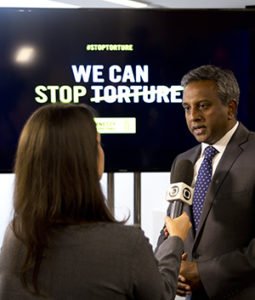
In 2014 Amnesty International launched its Global Stop Torture campaign to stop governments around the world from torturing people.

Torture is abhorrent. It is barbaric and inhumane. It can never be justified. It is wrong, self defeating and poisons the rile of law, replacing it with terror. No one is safe when governments allow its use.

The world’s governments recognised these fundamental truths when they adopted the Universal Declaration of Human Rights in 1948. This enshrined the basic rights of all of us, everywhere, to live free from torture, free from cruelty.

This right was later enshrined in a legally binding international agreement through an explicit prohibition against torture and other ill-treatment in the 1966 International Covenant on Civil and Political Rights. This was further built upon by the UN Convention Against Torture.

Despite these international laws many governments are betraying their responsibilities and torture is being used in countries across the globe.

Amnesty International has reported on torture and other ill-treatment in 141 countries and from every world region. While in some of these countries Amnesty International has only documented isolated and exceptional cases, in others torture is systematic.

Read our report Torture in 2014: 30 Years of Broken Promises to find out more.


Torture pervasive across Asia-Pacific

Torture is rife across the Asia-Pacific region, with China and North Korea among the worst offenders and a host of other governments betraying promises to stamp it out, Amnesty International said today as it launched its latest global campaign, “Stop Torture”.

Read our full report Torture in 2014: 30 Years of Broken Promises.

Quick facts
  • Amnesty International has reported on torture or other ill-treatment in 141 countries over the past five years.
  • New global survey of more than 21,000 people in 21 countries across every continent reveals fear of torture exists in all these countries.
  • Nearly half of respondents fear torture if taken into custody.
  • More than 80% want strong laws to protect them from torture.
  • More than a third believe torture can be justified.

Endemic

“Torture is a fact of life in countries across Asia. The problem isn’t limited to a few rogue states, but is endemic throughout the region,” said Richard Bennett, Amnesty International’s Asia-Pacific Director.

“Asian countries must stop paying lip service to their commitment to end torture. Signing up to the international treaties is important but not enough. It must be backed up with concrete action.”

Amnesty International launches its Stop Torture campaign in 2014
©Amnesty International

Campaign to Stop Torture

The two-year campaign, Stop Torture, launches with a new media briefing, Torture in 2014: 30 Years of Broken Promises, which provides an overview of the use of torture in the world today.

Amnesty International has reported on torture or other forms of ill-treatment in at least 141 countries from every region of the world over the past five years – virtually every country in which it works.

In a number of Asia-Pacific countries the use of torture and other cruel, inhuman or degrading treatment or punishment is routine – and accepted by many as a legitimate response to high levels of crime.

Torture in 23 Asia-Pacific countries

In 2014, thirty years after the UN adopted the 1984 Convention Against Torture – which commits all governments to combatting the abuse – Amnesty International observed at least 23 Asia-Pacific countries still torturing or ill-treating. Given the secretive nature of the abuse, the true number is likely to be higher.

Torture is used by governments against a range of individuals across Asia-Pacific. It is used to force confessions or to silence activists in countries such as China, India, Indonesia, Malaysia Pakistan, Sri Lanka and Viet Nam. Torture is used to extort money in places such as Myanmar and Nepal, where poor and marginalised people are unable to bribe their way out of being tortured.

High numbers at risk of torture

A worldwide Globescan survey commissioned alongside the briefing for the launch found nearly half (44%) of respondents – from 21 countries across every continent – fear they would be at risk of torture if taken into custody in their country.

The vast majority of people in Asia-Pacific believe there should be clear laws against torture, but in China and India almost three quarters of respondents (74%) felt torture was sometimes necessary – the highest numbers in any of the countries polled. In Indonesia, Pakistan and South Korea the majority of respondents feared they could be tortured if taken into custody.

Measures to end torture

“The shocking fact that so many people fear torture – in some countries the majority of those polled – should spur authorities across Asia-Pacific into meaningful action by taking concrete steps to eradicate this horrific human rights violation,” said Richard Bennett

Measures such as the criminalization of torture in national legislation, opening detention centres to independent monitors, and video recording interrogations have all led to a decrease in the use of torture in those countries taking their commitments under the Convention Against Torture seriously.

Very few countries in Asia-Pacific, however, have put in place effective mechanisms to prevent the use of torture, and others are failing to implement the mechanisms properly.

Across the region

Amnesty International has documented various forms of torture and other ill-treatment used in different countries across the Asia-Pacific region, ranging from North Korea’s brutal labour camps, to Australia’s off-shore processing centres for asylum seekers or Japan’s death rows – where prisoners are kept in isolation, sometimes for decades. Impunity for torturers and denial of justice and reparations to victims are the norm across the region.

Philippines

Justice is out of reach for most torture survivors in the Philippines. A secret detention facility was recently discovered where police officers abused detainees “for fun”. Police officers reportedly spun a ‘wheel of torture’ to decide how to torture prisoners. Media coverage led to an internal investigation and some officers being dismissed, but Amnesty International is calling for a thorough and impartial investigation which will lead to the prosecution in court of the officers involved. Most acts of police torture remain unreported and torture survivors continue to suffer in silence.

China

Torture and other ill-treatment are officially illegal in China, but in practice beatings, electrocutions, forced injection of drugs and the denial of medical treatment are regularly used to intimidate and punish dissidents or ordinary criminals. China last year announced the closure of its notorious “Re-education Through Labour” camps, but the change has been mostly cosmetic with authorities simply using new forms of detention to arbitrarily hold and torture dissidents.

Pakistan

In Pakistan torture is frequently practiced by police, intelligence services and the army, in particular in the conflict-ridden Tribal Areas or Balochistan. Amnesty International has received report of torture used on human rights defenders, lawyers and journalists among others. Reporter Ali Chishti is one such case – he was picked up on 30 August 2013 by a police mobile team and driven to a house where he was repeatedly beaten, before simply being dumped on the side of the road. He registered a complaint with police but no one has been brought to justice for his abduction or torture.

Sri Lanka

Authorities in Sri Lanka still routinely torture detainees. In 2012 at least five people died as a result of torture and police brutality; Sri Lanka’s National Human Rights Commission registered 86 complaints of torture in the first three months of 2013 alone. The government makes liberal use of a draconian anti-terror law to detain people arbitrarily for long periods.

Prevent and punish acts of torture

Amnesty International is calling on governments in Asia-Pacific to put in place protective mechanisms to prevent and punish torture – such as impartial medical examinations, prompt access to lawyers and courts, independent checks on places of detention, effective investigations of torture allegations, the prosecution of suspects and proper redress for victims.

“Thirty years after the adoption of the UN Convention against Torture, it is well overdue that governments in Asia Pacific stepped up to their responsibilities to stop torture. Systemic legal and practical safeguards to prevent and punish torture must be put in place and adhered to consistently across the region,” said Richard Bennett.

In brief: Racial Discrimination Act

Holocaust denial and racial abuse on public transport could be considered okay under proposed changes to Australia’s Racial Discrimination Act.

As public discussion around the proposals intensifies we explain what the RDA is and how the proposed changes might affect Australia.

What is the Racial Discrimination Act?

It’s pretty simple, really. The RDA is a law passed in 1975 by the Whitlam government to make sure everyone in Australia was treated equally and given the same opportunities - regardless of their background.

The Act was last updated in 1995 after three major national inquiries  –  the Royal Commission into Aboriginal Deaths in Custody – the National Inquiry into Racist Violence and the Australian Law Reform Commission Report into Multiculturalism and the Law  – found a strong link between racist conduct in public and racially-motivated violence.

At the core of the changes made in 1995 is Section 18C, which makes it unlawful for someone to “offend, insult or humiliate” a person based on the colour of their skin or their cultural background. It also provides recourse for victims of racism to make a complaint to the Australian Human Rights Commission (AHRC), which then tries to resolve the complaint before it goes to court. And the AHRC actually does this really well  – in 2015–16, only one complaint went to court, and in the past five years only three per cent of finalised complaints proceeded to court.

The lesser known Section 18D, brought in at the same time, exempts artistic works, academic and scientific debate and “fair and accurate” reporting of any events or matters of public interest made “reasonably” and in “good faith”.

Why does the RDA regularly make headlines?

Well, in 2014, for the first time in almost 20 years, the Australian Government announced its intentions to make changes to the Act, when Attorney-General George Brandis released draft changes to the RDA. Brandis argued the RDA amounted to “political censorship”, while the laws he proposed were “the strongest protections against racism that have ever appeared in any Commonwealth Act.”

Incidentally, when talking about his proposed changes to the RDA, Brandis claimed that Australians have “the right to be bigots”.

Critics of the RDA claimed that free speech in Australia is too heavily restricted, whilst those in support of the Act argued that the proposed changes would green light racism across the country.

Amnesty has made a submission supporting no changes to the RDA.

Okay, so what exactly are the changes?

Remember we talked about Section 18C? Well, it’s up for the chop.

The government is proposing to remove the text that makes it unlawful to do or say things that “offend”, “insult” or “humiliate” a person due to their race, ethnicity, colour, or immigration status. Instead, only doing or saying racist things that intimidate or “vilify” someone would be against the law.

But intimidate doesn’t have its normal meaning, it only means ‘fear of physical harm.’ And guess what? Vilify doesn’t have its normal meaning either, in the changes it only means inciting, or stirring up, others to be racially hateful. An obvious problem with this is the difficulty a racism victim could have in convincing authorities that they had, in fact, felt physically intimidated during an attack or that others were stirred up, or encouraged to join in the hatred.

Oh, and under the changes, whether a person was vilified or intimidated would be determined by the standards of ‘an ordinary reasonable member of the Australian community not by the standards of any particular group.’ Which means you can’t consider the particular history and situation of a cultural or ethnic group and how the use of certain slurs impacts them.

We also talked about 18D. For the last 20 years this has been one of the few protections of freedom of speech in Australian law. This will be gone. Under the draft proposal it will be okay to use racist “words, sounds, images and writing”, as long as it’s in the “public discussion of any political, social, cultural, religious, artistic, academic or scientific matter”.

Other sections to potentially be cut are 18B and 18E. These are about how authorities interpret an act that is done for more than one reason and employers needing to take steps to prevent racial abuse by their staff.

What impact would the changes have?

It is all little hard to be 100% clear about this. It would depend a bit on how courts interpret the changes and there are some state laws that deal with racial vilification (but, for example, there is nothing but the RDA in the Northern Territory). But let’s start with that last point. If racism is deemed fine in the context of so many spheres of public discussion, the proposed legislation send the message that racist speech, no matter how untrue or repulsive or harmful it may be.

Although freedom of expression is paramount in a democratic society, we still need laws that ensure free speech doesn’t cross the line and become hate speech. And there is every possibility that doing away with Section 18C and 18D would lead to hate speech being tolerated.

In real terms, the new legislation could also mean that an ordinary person sitting on a bus who is racially vilified by a stranger will no longer have an opportunity to have their complaint proceed under the RDA. Unless it has caused them to fear physical harm or has roused others to hatred in a way that ‘an ordinary reasonable Australian’ would recognise, there is no legal protection. Even though the psychological effect may be profound.

In its current form, the RDA balances our right to freedom of expression with our right to be protected from racist abuse. But if the changes are adopted, this balance could be tipped way off. Suddenly, we’re making it okay for someone to verbally attack another person on public transport for race reasons without legal ramifications unless it approaches violence. And for those of you fortunate to have never experienced or witnessed such attacks, watch these videos of a racist attack on an Asian couple on a Sydney bus and a foul-mouthed racist rant on a Melbourne train to see what it looks like.

The reality is that the proposed changes to the RDA will make our race hate laws so narrow that they will scarcely provide protection against racial hatred at all.

Everyone should be protected from abuse and intimidation based on race or ethnicity. It’s a human right and should be protected under the law. The government needs to safeguard against making our race hate laws so narrow they scarcely provide protection against racial hatred at all.

Article by Katie Young, Online Editor

Submission on the proposed amendments to Racial Discrimination Act

Amnesty International is concerned that the draft Freedom of Speech (Repeal of s. 18C) Bill 2014 (the draft Bill) fails to strike an appropriate balance between the right to free speech and the rights of others to freedom from racial discrimination and protection against racial hatred.

The draft Bill would repeal provisions of the Racial Discrimination Act 1975 (RDA) that provide essential recourse to culturally and linguistically diverse people and groups, including Aboriginal and Torres Strait Islanders, who continue to suffer racial abuse, vilification and the harmful long term psychological and health effects that result from it.

The current provisions are part of a framework for conciliation by the Human Rights Commission that focuses on resolving legitimate complaints in a non-adversarial manner. The current RDA provisions ensure a reasonable balance by exempting a broad range of expression that is made reasonably and in good faith. Such exemptions are provided for fair and accurate reporting of matters in the public interest and expression for genuine academic, artistic or scientific purposes.

The draft Bill defines racial vilification narrowly as “incitement to hatred.” Racial intimidation is also restrictively defined as fear of physical harm. Amnesty International considers that the limited scope of the proposed protections and breadth of exceptions under the draft Bill combine to breach Australia’s international obligations to protect individuals and groups from racial discrimination and hatred.

Contrary to the Attorney-General’s Media release of 25 March 2014 which accompanied the draft Bill, these laws will not strengthen the RDA’s protections against racism; they will weaken them significantly.

What does Amnesty International recommend?

  1. That the draft Bill not be introduced.
  2. That any future amendments to the RDA be drafted to conform to Australia’s international legal obligations.
  3. That if, contrary to recommendation 1, the draft Bill is introduced:
  • 3.1 the definition of vilification and intimation be broadened to reflect their ordinary meaning
  • 3.2. subsection 3 be repealed so that impact of an act on the victims group remains relevant when assessing what is reasonably likely to vilify or intimidate
  • 3.3. subsection 4 be amended to include a requirement of reasonableness and good faith for any exempt public discussion
  • 3.4. section 18E, relating to vicarious liability of employers, be retained as currently in force
  • 3.5. section 18B, which clarifies the treatment of an act done for more than one reason, be retained as currently in force.

Download the submission

To found out more, read the full submission: Submission to the Attorney-General’s Department on the proposed amendments to the Racial Discrimination Act 1975.


Promising moves to reduce youth incarceration rates

Amnesty International welcomes new moves by the Western Australian Government to address the growing number of young people being detained in the state, the majority being Aboriginal and Torres Strait Islander.

The State Government has announced a group of community members will form a Youth Justice Board (YJB) to help reduce youth incarceration rates.

The nine-member board will be Chaired by Corrective Services Commissioner James McMahon and one of its main focuses will be on people from Aboriginal and Torres Strait Islander backgrounds.

We’re heartened to hear of this new move to address youth incarceration and specifically, Aboriginal and Torres Strait Islander youth incarceration rates

Tammy Solonec, Indigenous Rights Manager

“In Australia, Aboriginal and Torres Strait Islander people make up just over 2 percent of the population but over 28 percent of Australia’s prison population.

“Over the last ten years, the imprisonment rate actually went up by 52 percent.

WA has the highest imprisonment rates

Western Australia currently has the highest Indigenous incarceration rates in Australia.

“In WA, an Indigenous person is 20 times more likely to be jailed than a non-Indigenous person – signalling a growing crisis.

“Recent figures from March 27 showed Aboriginal and Torres Strait Islander adults made up 39.6 percent of the adult prisoner population, and a staggering 81.7 percent of the juvenile custodial population in WA.

“Amnesty International is looking forward to working with the new Youth Justice Board to focus and promote diversionary measures that reduce the number of people being put in detention or jail.

“We hope Aboriginal and Torres Strait Islander communities and social services organisations will be widely consulted throughout this process.

All states must act

“Amnesty International calls on other jurisdictions around Australia to also introduce similar initiatives to address youth detention,” Tammy Solonec added.

The human rights organisation is currently conducting research into Aboriginal and Torres Strait Islander youth incarceration rates across Australia, comparing the measures being taken in all States and Territories to address these high rates.


Is 2014 a make-or-break year for Afghan women?

Could the results of Afghanistan’s presidential election see the return of the Taliban? And what would that mean for the future of Afghan women?

As 8 candidates battle it out in the Afghanistan presidential election*, women in the country are growing increasingly worried.

Combine an early withdrawal of international forces with the fact that many of those running for power are backed by warlords and fundamentalists who share the Taliban’s hardline views, then, for the women of Afghanistan at least, you’ve got a disaster in the making.

What’s life like for Afghan women right now?

While there have been some gains made since the Taliban was overthrown in 2001, life for women and girls in Afghanistan — particularly in rural areas — is still very difficult.

The few women who have actually been able to make the most of the new opportunities presented to them, such as education and employment, still continue to face inequality and danger at every turn.

Lora Hares, a mother and full time student from Kabul and currently living in Melbourne, worked as a gender specialist in Afghanistan, often received threats because of her work.

“My job was to empower women economically in the country’s rural areas. I received many death threats because working in the government or for an international organisation is very risky for a woman in Afghanistan.”

Lora worked on a national, government-led program with the aim of jump-starting private sector growth in rural Afghanistan. For Lora, this meant visiting women in rural areas to help them start making a living for themselves.

Typically, this was achieved by encouraging the women to form “saving groups” — a group of around 10 to 20 women who would club together to save money on a weekly basis. Each week they would meet and combine whatever they had managed to save — usually the equivalent of up to 50 cents. After doing this for three to six months, members of the group could then apply for a loan from the money saved and use it to start a small business.

“It can be hard for women in rural areas to get employment so with this money they are able to start a very small business using the skills they have. Some women buy a cow with their loan and use the milk to make dairy products like cheese and yoghurt to sell at market.”

However, many rural areas are now back under the control of the Taliban and their influence could continue to expand after the presidential elections, which would put an immediate stop to any dreams of financial independence for Afghan women.

At least girls are being educated now, right?

Yes and no.

According to the Afghan Ministry of Education, the enrolment of pupils has risen from 900,000 in 2001, with few girls, to 10.5 million pupils, of whom 42 per cent (4.4 million) are girls.

Although this is a great achievement, the vast majority of girls still leave school when they are between 12 and 14 years old, often due to family pressure, and the fact that it is deemed unacceptable for girls to be taught by a man unless women are present…but there’s a shortage of female teachers.

However, while the challenges currently faced by Afghan women and girls are huge, they are nothing compared to a return to the Taliban-era repression of old.

Wait a minute, is that a possibility?

A scary thought, but the answer is yes. The Taliban’s star could once again be on the rise.

In February this year, it was widely reported that President Karzai was having clandestine chats with the Taliban in an attempt to broker a peace deal before his term in office expires.

Plans to sign a security pact with the US, allowing some troops to remain in Afghanistan beyond 2014, were put on hold by Karzai whose condition for signing is that the US re-start peace talks with the Taliban. Whereas the Taliban have long said that getting rid of foreign troops is one of their main aims.

Lora is concerned that the situation is already getting worse for Afghan women.

“The process of peace talks with the Taliban has really worried a lot of women. The Taliban’s agenda towards women, prior to 2001, deprived women of all their basic human rights.

Women are really afraid about what might happen to them if the Taliban is reconciled into the future government and able to push for their anti-women agendas to be implemented.”

What would this mean for Afghan women?

In a nutshell: a complete decline in rights and return to the days of the Taliban’s extreme interpretation of the law.

Worryingly, we are beginning to see an impact on women’s rights in the country and there already seems to be a surge in the number of violent attacks against women.

Despite living in Australia, Lora closely follows the rise in violence against women in her home country.

“There was a 25 per cent increasein violence against women in Afghanistan in 2013 alone. When I heard the news about the woman whose husband cut off her nose and lips, I realised just how bad the situation is getting for women in Afghanistan.”

Once again, women are uncertain about their future in Afghanistan.

“International troops are leaving and the country is going into political transition with the elections. A lot of women are very worried about their future.”

So, will the Afghan people actually vote?

We won’t know until the day.

Casting a ballot involves hours of travelling and serious risks for many Afghans, including the increasing likelihood of attacks on polling stations by the Taliban who believe it is “the religious obligation of every Afghan to fulfil their duty by foiling the latest plot of the invaders that is guised in the garb of elections.”

So with little guarantee of personal safety, it’s unclear how many people will turn up to vote.

It is unlikely that women in rural areas will vote, so vice-presidential candidate Habiba Sarabi, the first woman to run for such a high office in Afghanistan, is appealing to young, urban and educated voters to prevent the possibility of power going to Islamist extremists.

What should happen next for Afghan women?

There are many brave women, like Lora, who will never give up fighting for the rights of women and girls in Afghanistan. And most will remain in Afghanistan, even if that means facing danger and persecution, to do so.

“Living in Afghanistan and being an Afghan woman myself, I am driven to improve the lives of women in my country. I want to make Afghanistan a better place for my daughter’s generation.”

The kind of work Lora does is vital in improving the rights of women and girls in Afghanistan but support for women’s rights need to exist in practice, everywhere. And serious changes must be made by those in power to ensure the economic growth of women.

Lora believes the rest of the world can help achieve this goal.

“There’s a lot the international community, including the Australian Government, can do for the women of Afghanistan. They can help to fund education for women and push the government in Afghanistan to take seriously the issues of Afghan women.”

*The Afghan presidential election takes place on Saturday 5 April 2014.

Article by Katie Young, Online Editor

Egypt’s struggle for power

Proud and ancient, Egypt is a country rich with history and culture, but standing at a crossroads between a free and bright future or repeating the mistakes of its past. Here we shed light on what is happening in Egypt and why.

Location, location, location

Okay, it’s slightly complicated. Type ‘Where is Egypt?’ into Google’s search bar and you’ll notice it appears in two lists: Middle East and Africa.

What does this mean? Well, geographically, Egypt is largely situated in the north-easternmost point of Africa; however, the part of the country known as the Sinai Peninsula borders Israel and the Gaza strip. In fact, its full name is the ‘Arab Republic of Egypt’ and its main language is Arabic.

It’s home to the Nile, the pyramids and some 80 million people. Although there are large communities of Coptic Christians living around the country, Egypt’s predominant religion is Islam.

What’s been going on the past 30-ish years?

For almost the whole of the 70s Egypt’s president was a guy called Anwar Sadat who held power for full decade before his in 1981.

His replacement was Hosni Mubarak, former Vice-President and deputy leader of the National Democratic Party. As a former military leader, Mubarak certainly didn’t find it difficult to get into power: he allegedly received 99.999 per cent of the votes in a national referendum and followed this up with 99.98 per cent of the votes almost 20 years later in the 1999 election.

The above figures are somewhat startling considering that during his time as President, Mubarak ruled with an iron fist. Civilians were subject to military trials, torture was rampant and political dissent was severely punished, particularly if members of the Muslim Brotherhood were involved.

Things got progressively worse during Mubarak’s presidency, with terrorist attacks like the tourist massacre at Luxor and the bomb attacks at Sharm al-Sheikh, and allegations of torture and illegal detention. By 2011 the Arab spring was gathering momentum and the Egyptian people spent 18 days carrying out mass protests against the regime, culminating in Mubarak’s resignation on 11 February that year. The next day Egyptians began celebrating a ‘new dawn’ for their country.

And then what happened?

Setting up shop after a revolution isn’t the easiest task. Egypt’s military body, the Supreme Council of the Armed Forces, stepped into the void left by Mubarak’s sudden departure, until a democratically elected government could take over.

Egypt was in the early stages of what would become an ongoing struggle for power.

At first the situation looked pretty good – anti-Mubarak protesters had even chanted ‘The army and the people, hand in hand!’ – but things went downhill fast.

Shortly after the military gained power, security forces began beating protesters in Cairo’s Tahrir Square who were calling for a quicker transition to a democratic government. The Muslim Brotherhood, which had rallied in Tahrir Square to unseat Mubarak, stayed largely quiet as the army and military police began locking up dissidents.

Eventually, the Egyptian army organised some elections to try and get things back on track. First up were the parliamentary elections in November 2011, and the Muslim Brotherhood pretty much swept the board, winning the majority of seats. The presidential elections began in May 2012, with the candidates being whittled down to two finalists: Mohammed Morsi, the Muslim Brotherhood’s candidate, and Ahmed Shafik, the last prime minister under Mubarak.

Morsi got the job and was sworn in as Egypt’s next president on 30 June, but not before the military shut down parliament and awarded itself sweeping new powers, watering down the power of the president in the process.

Morsi and the Muslim Brotherhood eventually ordered the army’s top generals to retire and basically pretended the power grab had never happened. In fact, in November 2012, Morsi granted himself more power, sparking further protests.

Was Morsi any good?

Well, to kick things off, according to the Nadim Centre for the Rehabilitation of Torture Victims, 34 deaths and 88 cases of torture occurred during the first 100 days of Morsi’s rule so it’s perhaps unsurprising he lasted only one year in power.

Morsi was also accused by his critics of failing to deliver in a number of basic ways, including concentrating too much power in the hands of the Muslim Brotherhood, mishandling the already-shaky economy, and failing to respond to calls for human rights and social justice to be upheld.

Ironically, despite being Egypt’s first democratically-elected leader, Morsi failed to rule in a democratic fashion. Not only did he crack down on free speech, frequently arresting journalists, but he also pushed through constitutional change granting him far-reaching powers which, it turns out, was a bit of a deal-breaker for the Egyptian people.

To cut a (very) long story short, after a turbulent year in power, punctuated by violence and anti-government protests, millions of people took to the streets of Cairo and other cities around the country on 1 July 2013, demanding the President’s resignation.

Two days later, Morsi was ousted, and the head of the Supreme Constitutional Court, Adly Mansour, stepped up as interim head of state.

Things are okay now though, right?

Far from it, actually.

After 30 years of repression, two major uprisings, military leadership and a former Muslim Brotherhood president in detention it would be an understatement to say tension still exists between rival groups in the country.

During August last year, shortly after Morsi was deposed, around 600 of his supporters were killed by Egyptian security forces during sit-ins in Rabaa al-Adawiya Square. Not a single member of the police or security forces has been charged with the deaths. And in a single shock ruling, the Egyptian authorities recently sentenced 528 alleged Morsi supporters to death, sending a clear message: fall in line or prepare to die.

To compound the devastating effects of violence, Egypt’s jails are fit to bursting, filled with around 16,000 political activists. And imprisonment is not just limited to pro-Morsi supporters and the Muslim Brotherhood, either. Three Al Jazeera journalists, Peter Greste, Mohamed Fahmy and Baher Mohamed, are facing lengthy prison sentences on trumped up terrorism charges and Ahmed Mahir, a liberal political activist and key organiser of the 2011 protests at Tahrir, faces jail for holding an ‘illegal demonstration’.

The international community is appalled at Egypt’s crass abuse of its justice system and every day, media workers and everyday folks around the globe call for Egypt to #FreeAJStaff.

What next for Egypt?

What happens next is really up to Egypt. The country is at a crossroads, with further elections due in 2014.

Each regime so far has committed serious human rights abuses and there is little point arguing about who was worse – the focus should now be on figuring out who’s going to fix the mess. It’s unclear whether Egypt will continue to be a country whose citizens live in fear, dissidents are executed and journalists do as they’re told, or whether future leaders will learn from the mistakes of the past.

Article written by Katie Young, Online Editor

Legal cuts a massive blow for Indigenous Australians

Amnesty International condemns a decision to cut funding to Aboriginal Legal Services, at a time when Indigenous incarceration rates continue to rise, in a major blow to ending Indigenous inequality.

The Federal Government has confirmed cuts to the National Aboriginal and Torres Strait Islander Legal Services (NATSILS), the national peak body for Aboriginal and Torres Strait Islander Legal Services (ATSILS).

Indigenous incarceration rising

“Aboriginal people make up just over 2 per cent of the population but over 28% of Australia’s prison population,” said Rodney Dillon, Amnesty International Australia’s Indigenous Rights Campaigner.

“These shocking figures are made up of my Aboriginal brothers and sisters in prisons around the country and we should be doing more to support them, not less.

“Over the last ten years, the Indigenous imprisonment rate actually went up by 52%.

“If you look at a State like Western Australia (WA), with the highest Indigenous incarceration rates in Australia – where an Indigenous person is 20 times more likely to be jailed than a non-Indigenous Australian – we’re facing a growing crisis.

Aboriginal services are key

“We could lose a generation of Indigenous Peoples lost to a life locked up.

“The Aboriginal Legal Service is a key part in helping to address these rates and offers support to those most in need of guidance,” Rodney Dillon added.

Amnesty International calls on the Federal Government to immediately reinstate funding to the national peak body and state based law reform and policy officers that make up NATSILS and ATSILS.

Government must support Aboriginal services

“The Government must show its commitment to improving Aboriginal health and social outcomes by committing more resources to reducing incarceration rates.

“Let’s support organisations like the Aboriginal Legal Service that are part of the solution, and not the problem, and reward a service that works tirelessly to support some of Australia’s most vulnerable people,” Rodney Dillon said.

Recognition for a tireless Indigenous Rights Campaigner

Amnesty International Campaigner and long-time Indigenous rights activist Rodney Dillon has been recognised for his tireless work at a presentation in Tasmania.

Rodney was awarded the Human Rights Individual Award at the Tasmanian Human Rights Awards which mark Human Rights Week.

He was presented with a framed copy of the award alongside other category recipients at a morning tea ceremony at Government House by the Governor of Tasmania, Peter Underwood AC.

Rodney Dillon was commended for ‘his lifelong commitment to promoting the human rights of Aboriginal people at a local, national and international level in areas as diverse as land and fishing rights; the repatriation of Aboriginal artefacts and remains; the Stolen Generations and commercial enterprise’.


I’m really honoured to receive such an award and I congratulate the other winners. This kind of recognition is significant not just for me, but my people. It shows not only that we deserve but that we are having our voices heard

Rodney Dillon

Rodney, a Tasmanian Aborigine (Palawa) is a former Aboriginal and Torres Strait Islander Commission (ATSIC) Commissioner and recipient of the NAIDOC male Person of the Year in 2006. A key focus of his role at ATSIC was ensuring more Indigenous voices were heard in the media. For six years he was on the board of the National Heritage Council, working on listing a national dreaming story, a project that continues today.

He instigated negotiations for the purchase of the Murrayfield sheep station on Bruny Island and this property was bought for $4 million by the Indigenous Land Council in 2001 for the use of Aboriginal people of Tasmania.

In one of his proudest achievements, the farm is now run as a commercial enterprise while preserving Aboriginal values (there are more than 200 artefact scatter sites on the farm).

“I’ll continue to work on giving a voice to people that have in the past been silenced.

“I thank those that nominated me and look forward to continuing my work as an Indigenous Rights advocate, currently working to see that State and Territory governments address the high rates of Indigenous incarceration around the country.

“I hope that any work I do in highlighting these kinds of issues leads to positive change and shows that Indigenous and non-Indigenous Australian’s can work together for a stronger future,” he added.