In 1974, at the age of 30, Herman Wallace was convicted of murder and imprisoned in solitary confinement at Louisiana State Penitentiary where he would spend the next 41 years.
His conviction was overturned in late September 2013 after it was ruled unconstitutional on the grounds that there was a “systematic exclusion of women” on the jury that indicted him.
Wallace passed away on 4 October 2013, just three days after his release. He was 71 years old.
Put yourself in his shoes
I turned 30 this year.
To me, 71 seems like light years away. 41 and a half years of living, with everything that this entails. I’ve never been big into planning, and trying to imagine what might happen in my life over the course of the next four decades is like trying, as a child, to imagine the blankness of eternity or the extent of the solar system.
Add to that the prospect of living those 15,000 days – give or take – alone in one room, with few distractions and no company, and I get one almighty headache.
Isolation
Picturing Herman as a young man, locked in a featureless, windowless 6-by-9-feet cell for 23 hours a day with no real human contact is difficult. I wonder how he felt each morning, waking from the oblivion of sleep to another day identical to all others. Once the fuss of his trial and subsequent appeals died down, how did he reconcile himself with the fact that isolation was now his life?
Weak evidence
Wallace was convicted, along with his friend Albert Woodfox, for the murder of prison guard Brent Miller. The two always maintained their innocence. In addition to a seemingly unfair trial by the Louisiana courts, the evidence against them was also weak, with no fingerprints belonging to the pair found at the scene.
What must it be like to watch yourself grow old in solitary confinement? And what if you were innocent? Looking down at your ageing hands and wondering what you would have used them for if things had been different. After how many years do you give up?
The Box
Solitary confinement – often referred to as ‘The box’ – can ruin a person in a matter of weeks, even days. Sometimes the damage is immediate and irreversible. Side effects can include panic, depression and even a nervous breakdown. It’s a wonder Wallace managed to hold onto his dignity – let alone his sanity.
Many people have faced – and still face – solitary confinement, and many are unable to cope with it the way Wallace did.
How did he do it? Well, for one, he kept busy. And he improvised.
To stay in shape, Wallace lifted weights made out of old newspapers. He read anything and everything and maintained a healthy interest in current affairs. Even locked up for 23 hours a day, the changing world beyond his cell didn’t pass Wallace by.
Perhaps most importantly, he never gave up hope. He replied to letters, worked on his appeal and continued to dream about life outside prison. He even took part in a documentary film called ‘Herman’s House’ in which an artist helped him create a dream house he hoped to live in someday.
Basically, he didn’t give up. He survived. He stuck it to an inhumane system that torments individuals for as long as possible.
Staying sane
Many people have faced – and still face – solitary confinement, and many are unable to cope with it the way Wallace did.
How did he do it? Well, for one, he kept busy. And he improvised.
To stay in shape, Wallace lifted weight made out of old newspapers. He read anything and everything and maintained a healthy interest in current affairs. Even locked up for 23 hours a day, the changing world beyond his cell didn’t pass Wallace by.
Perhaps most importantly, he never gave up hope. He replied to letters, worked on his appeal and continued to dream about life outside prison. He even took part in a documentary film called ‘Herman’s House’ in which an artist helped him create a dream house he hoped to live in someday.
Basically, he didn’t give up. He survived. He stuck it to an inhumane system designed to torment him for as long as possible and then tear him down to nothing.
Cruel and unusual
For me, it’s clear cut. Solitary confinement, like the death penalty and torture, is wrong. It’s cruel and it’s unusual. And it’s a common practice around the world.
Data revealed by a Bureau of Justice Statistics census in 2005 shows, at that time, 81,000 people were being held in solitary confinement in the US alone. The worldwide figure must be sky high.
Hope
In many ways, although his life’s trajectory was ultimately a sad one – compounded by the cruel irony of his death so soon after gaining freedom – Herman Wallace represents strength and hope. He showed us that the human spirit, though fallible, is tough to break.
His final words were not ones of hatred, revenge or self-pity; he simply said ‘I’m free, I’m free’.
Hearing a family member is in trouble is enough to make anyone want to do all they can to help. When it’s not just one family member, but many of them, you can understand how you’d feel helpless.
As a proud Palawa man from Tasmania, the work we’re doing looking at Indigenous incarceration gives me that heartbroken feeling but it has also made me want to do more to stop this pain being felt within my community.
Growing crisis
As a proud Palawa man from Tasmania, the work we’re doing looking at Indigenous incarceration gives me that heartbroken feeling but it has also made me want to do more to stop this pain being felt within my community.
To put things into perspective: Aboriginal people make up just over 2 per cent of the population but over 28 per cent of Australia’s prison population.
These shocking figures are made up of my Aboriginal brothers and sisters in prisons around the country.
The help I can offer, as one person, is minimal because the solutions aren’t simple. We’re looking into what’s working and what’s not to find ways to push governments to stop the current trend. That’s because over the last ten years, the Indigenous imprisonment rate actually went up by 52 per cent.
If you look at a State like Western Australia (WA), with the highest Indigenous incarceration rates in Australia – where an Indigenous person is 14 times more likely to be jailed than a non-Indigenous Australian – we’re facing a growing crisis in which we could lose a generation of Indigenous Peoples lost to a life locked up.
Kids in adult jail
Just last week I was in WA to meet with families and some of the kids that have been locked in an adult jail in Perth. These kids have been locked in their cells for up to 23 hours at a time whilst waiting to be moved back to a juvenile centre. This move has been delayed up to four times by the Department of Corrective Services, with staff shortage given as the reason.
Committing a crime and being sentenced for it is understandable; what’s not is treating kids like they’re adults and reducing education and recreation time when we’re supposed to be focusing on how we can help them get on the right track and stay out of jail.
I can’t see any good justification for treating children as young as 14 like this. To me, incarceration should be the last resort, especially for children.
Rodney Dillon
I spoke to one 15-year-old who spent seven months in Hakea Prison. He says he saw guards being abusive towards child inmates and he’s more angry now than when he went into the system. Children like this one are being failed by the system and are more likely to end up back in jail and become career criminals.
Indigenous deaths in custody
It’s heartbreaking to me that I write this in the lead up to a sad anniversary that should have marked the change that’s needed: the death of 16-year-old John Pat.
John Pat died in a police cell on the 28 September in 1983 at Roebourne police station in WA. He was found to have suffered a fractured skull, hemorrhage and bruising and tearing of the brain. In the 30 years since his death, there has been no independent investigation into what led to these kinds of injuries and no official apology to his family.
What now?
Since 1991, when the Royal Commission into Aboriginal Deaths in Custody made 339 recommendations aimed at addressing the high number of deaths like John Pat’s, the number of Aboriginal deaths in custody has increased.
How many more John Pats will it take for us to realise we need to ensure not only that the recommendations of the Royal Commission are carried out in every State and territory but that we start focusing how we can stop kids from entering jail in the first place.
It is my hope that working with State, territory and community leaders we will be able to end this vicious cycle that’s been unfolding for 30 years.
20 years of Amnesty International campaigning culminate in an Arms Trade Treaty that will protect human rights and potentially save millions of lives.
Let’s face it, the United Nations’ multilateral treaty process isn’t the most engaging nor is the treaty easily understood, so this week we wanted to give you a simple breakdown of what the treaty is and what it will mean for human rights.
What is “a multilateral Treaty”?
A multilateral treaty is an agreement between multiple countries about what they will and will not do when trading conventional weapons.
What do you mean when you say “we’ve achieved an Arms Trade Treaty”?
When people talk about achieving an Arms Trade Treaty they are referring to the UN General Assembly (sort of like the UN’s parliament) voting in favour of establishing the treaty. This happened last week with 155 yes votes, 3 no votes and 22 abstentions (not casting a vote either way).
So have all of those countries who voted “yes” signed the Treaty?
The treaty will open for signature after it has been deposited with the UN Secretary General in approximately one month.
All the countries that voted yes will not necessarily sign the treaty (though we hope they do). Countries like the US voted yes as a result of an executive decision by the President but may not sign the treaty because they need Senate approval that may not be forthcoming.
Many argue that this will make the treaty weak. It would undoubtedly be strengthened by key arms exporters like the US coming on board, but as we can see below there are a number of aspects to the treaty that will help save lives.
Articles 2, 3, and 4 outline what sorts of weapons the treaty covers, including battle tanks, attack helicopters, small and light weapons amongst others generally referred to as ‘conventional weapons’. Articles 3 and 4 ensure that ammunition and parts used with the conventional weapons listed in Article 2 are also covered by the treaty (this was a big topic of discussion during negotiations).
This treaty doesn’t cover landmines, cluster bombs or chemical weapons as there are separate international treaties for these types of weapons.
Practically this means that less weapons will end up in the hands of governments that have used them to commit war crimes or crimes against humanity. This prohibition will undoubtedly save thousand thousands of lives.
Export assessment
If an export of weapons isn’t prohibited under Article 6 (above) then Article 7 requires that governments assess the potential for weapons that are being transferred to commit serious human rights abuses and serious abuses of international humanitarian law (amongst other factors).
These abuses could include targeting civilians, torture, gender based violence, war crimes, crimes against humanity or genocide to name a few.
If there is a risk of abuse, then exporting countries must mitigate this risk. If there is an overriding risk then they must not authorize the transfer.
Just think of the impact this clause could have if a country knows that there is a risk that weapons will end up in the hands of child soldiers. Where there is a high risk that weapons could be used for war crimes, crimes against humanity or genocide, a country will not be allowed to authorize the transfer of weapons.
When does the Treaty take effect?
While the United Nations General Assembly has adopted this treaty, it will go to the Secretary General’s office to be opened for ratification. What this means is that individual governments will need to sign onto the treaty separately.
This is a reasonably lengthy process for countries to go through. Each country needs to follow its own processes of ratification (such as getting Senate approval in the US or Parliament pass legislation in Australia) and then lodge its ratification documents with the Secretary General.
This treaty will come into force three months after the 50th country ratifies (signs and lodges its paperwork with the UN Secretary General).
Amnesty lobbyists are preparing to pressure countries to ratify the treaty now and we are hopeful for the minimum number of ratifications over the coming months.
What happens when someone breaks the rules?
International law and treaties rely on the voluntary participation of countries. This treaty, like other international human rights instruments, will need to be enforced by you – by ordinary people holding governments to account.
Observing and responding when a transfer goes wrong or when abuses are committed will help to ensure that countries fulfill their treaty obligations. Similarly, organisations like Amnesty will continue to apply pressure in the same way — and where peace and security are threatened, the UN Security Council may intervene.
Article 14 outlines that countries must implement the Treaty in its national laws, but there is no enforcement mechanism if they do not.
Article 19 outlines that where a dispute exists between two countries (after negotiations, mediation, and conciliation) it can be referred for arbitration and decision.
Amnesty International condemns in the strongest possible terms the inhumane incarceration of a 16 year old Aboriginal boy, along with two 17 year olds, in solitary confinement at an adult maximum security prison in Victoria.
Early reports indicate the 16 year old Aboriginal boy was placed in the cell in Port Phillip Prison, for four months, after a child protection order was issued from the Department of Human Services (DHS).
Kids shouldn’t be in solitary confinement
The human rights organisation questions why any teenager should be confined to their cell for 22 hours each day and only allowed access to the recreation yard for 2 hours at a time in handcuffs.
“We are appalled by the reports and demand the Victorian Government and the Department of Justice investigate the circumstances immediately and reveal how many other children are subject to this same treatment,” said Monica Morgan, Indigenous Rights Campaign Manager.
Treatment must be condemned
The draconian and terrible treatment of these teenagers must be roundly condemned and those responsible held to account without delay. Amnesty International understands the 16 year old has been transferred to a Juvenile Justice Centre. The two 17 year olds remain incarcerated in the adult facility and the organisation demands they be removed immediately.
“It is beyond belief that over 21 years after the Royal Commission into Aboriginal deaths in custody this kind of abuse continues to happen. And that it happens to a child is painfully unjust and something that must never be allowed to be repeated,” she added.
Governments are bound by a range of obligations under international law specific to the treatment of children within the juvenile justice system.
“Amnesty International has long called for the massive over-representation of Aboriginals in the criminal justice system to be addressed as a matter of urgency. This case clearly reflects those concerns have yet to be dealt with, and even worse, that the abuse and disregard for the human rights of imprisoned Aboriginal adults now extends to Aboriginal children.”
Amnesty International Australia expresses solidarity with the community of Palm Island as they react to news the Queensland Government will pay the legal costs of the police officer acquitted over the manslaughter of Mulrunji Doomadgee.
Amnesty International’s Indigenous Rights Campaigner Rodney Dillon says he understands why the latest news reports have inflamed concerns at Palm Island.
“We stand alongside the residents of Palm Island in expressing hope, that at some stage, there is peace and a way forward for this community.
“We support the communities’ sentiment that the latest details about the case and the payment of Sergeant Hurley’s legal fees have opened old wounds.
“We stand alongside the residents of Palm Island in expressing hope, that at some stage, there is peace and a way forward for this community.
“We will continue to support the Island on its journey to reconcile the death of a much loved family member and friend”, said Mr Dillon.
There must be justice
Amnesty International has previously expressed outrage at the Queensland Police Service’s failure to secure justice for the death in custody, of Mr Doomadgee, who died in a police cell on the Island in 2004.
The Queensland Police Service last year rejected the Crime and Misconduct Commission’s recommendation to bring disciplinary action against the officers involved in the flawed investigation that followed Mr Doomadgee’s death.
In 2010 the Crime and Misconduct Commission found that investigations into Mr Doomadgee’s death were neither impartial nor thorough. Several inquests and legal proceedings have not resulted in accountability for Mr Doomadgee’s tragic death.
Since 2007, Amnesty International has provided comment to the Australian Government about major concerns regarding human rights violations occurring under the Northern Territory Emergency Response (NTER) and the subsequent policy modifications made since then.
Through the release of the discussion paper Stronger Futures the Hon Jenny Macklin MP has sought comment on the future of NTER policies and programs through the Stronger Futures Discussion paper.
The development of the Stronger Futures policy is a good opportunity for the Australian Government to renew its commitment to Aboriginal People in the Northern Territory in a way that respects human rights. The Stronger Futures discussion paper sets out eight proposed areas for future action. Amnesty International has focused its comments on the four key areas for future action of housing, health, education and governance.
Amnesty International stresses the need to incorporate homelands into any future policy developments. There needs to be a commitment from the Australian and Northern Territory Governments to ensure that these communities, which support approximately 35 percent of the Northern Territory Aboriginal population, are provided with long-term funding to maintain their viability.
United Nations Declaration on the Rights of Indigenous Peoples (DRIP)
The most significant human rights instrument for Indigenous Peoples is the United Nations Declaration on the Rights of Indigenous Peoples (DRIP). The declaration provides an authoritative framework for the full and effective protection and implementation of the rights of Indigenous Peoples.
The principles enshrined in this declaration need to be at the forefront of any policy development. As well as incorporating the declaration into law, policy and practice, the Australian Government needs to implement the recommendations from previous inquiries including from the Little Children are Sacred Report and the 1991 Royal Commission into Aboriginal Deaths in Custody. Indigenous justice issues and high incarceration rates seriously hamper any efforts to close the gap.
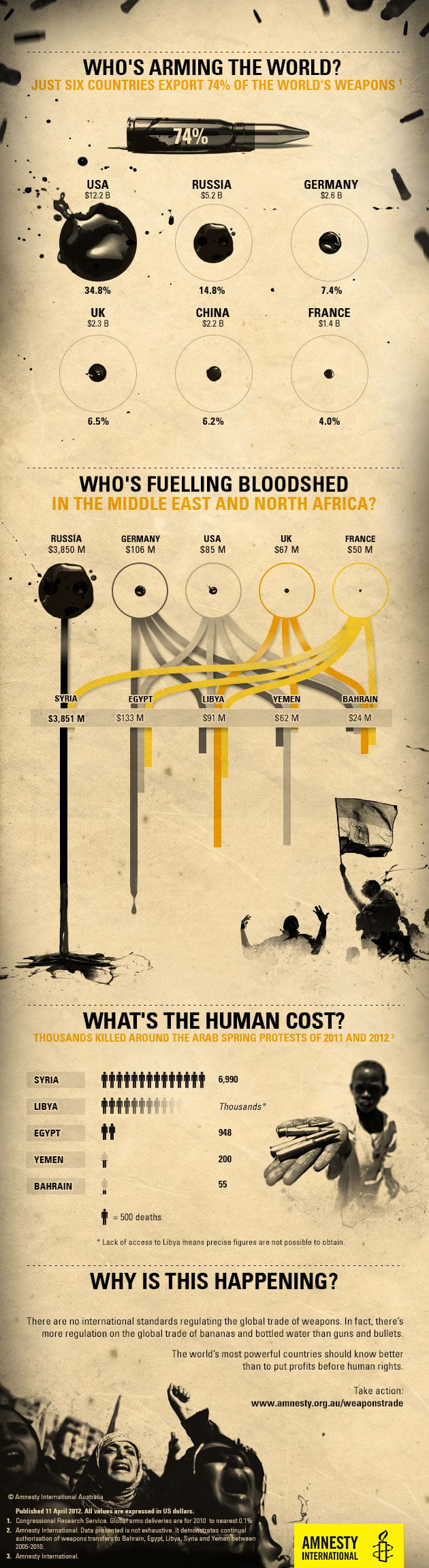
Did you know just six countries supply a whopping 74 percent of the world’s weapons?
Last year, when protestor throughout the Arab world demanded change, military forces in Egypt, Syria, Bahrain and beyond responded with deadly force, staining the streets with the blood of more than 8,000 people.
This could happen ebcuase countries including US, Russia, UK and France have been exporting bombs, bullets and other weapons into the region for years — putting their own multi-billion-dollar profits above the value of humans lives.
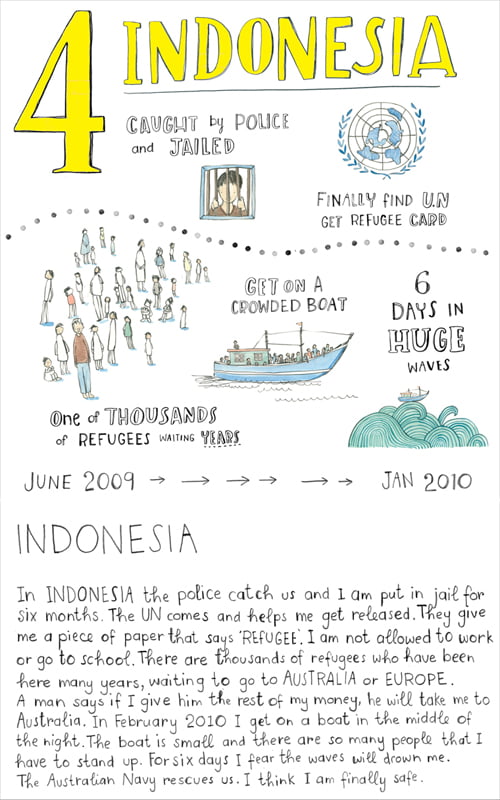
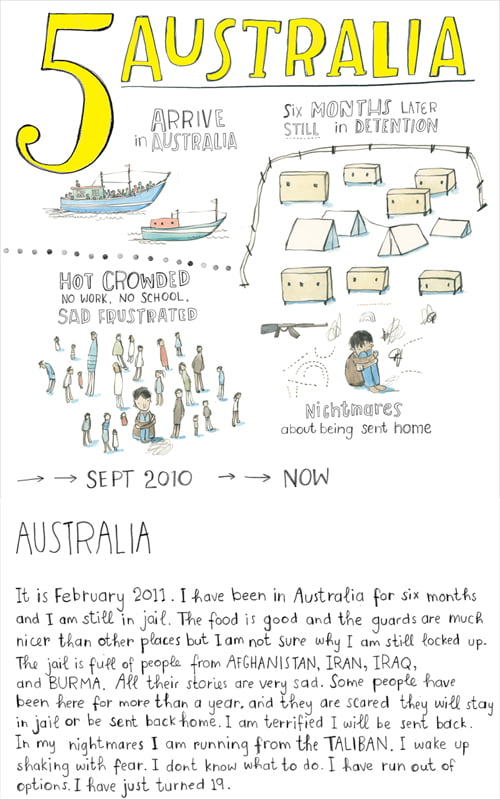
Alex Pagilaro, Refugee Campaign Coordinator for Amnesty International, helps to ensure the rights of people seeking asylum are protected in Australia. Here are her experiences of time in Australia’s detention centres.
Friday 27 January, 2012
Next Saturday I’ll be leaving my desk to spend two weeks visiting some of the most remote detention facilities in the country – Christmas Island, Curtin, Perth and Darwin. I’ll be meeting with officials and staff at the centres as well as speaking with external service providers, but most importantly I’ll be meeting with as many asylum seekers as possible.
Monday 6 February, 2012
Far from the barren wasteland of Amnesty’s last visit, trees, grass and shrubs now cover the compound. Detainees can now take excursions out of the centres and most we spoke to had been into the town at least once. Groups have been able to volunteer in town and help landscape the local nursing home, as well as an Aboriginal women’s association.
We spoke privately with detainees, and their comments about staff and facilities were overwhelmingly positive.
Less surprisingly, many that we spoke to had been detained for one to two years, sometimes more. For these men, it seemed that activities were meaningless in overcoming the extreme frustration and despair they experienced.
How do you maintain hope when, despite not committing any crime, you are denied your freedom for so long and no one can even tell you when your ordeal will end? As one young Afghan said:
“I am not a criminal, I am not a thief. So why do they lock me up for so long? They have no reason”.
We’ve had a whole day in Perth now, and I think I’ve washed off most of Curtin’s red dirt. But what is not so easy to get rid of are the faces of the men that I met up north, and the stories that they told me.
I met a young Afghan man who had been in detention for over two years. He placed a large bag of empty pill packets in front of me and explained that that he was too confused in the head to dial numbers on the phone, and had to beg other detainees to dial for him. He said:
“I feel like no one is helping me. They give me food, shampoo, clothes – everything I need except freedom. I just want to go outside.”
I met an Iranian who was consumed by nightmares of boats sinking, and had lost 18 kilos in detention. After three months he hadn’t even been interviewed by immigration officials yet.
I met an Afghan man who fled to Iran, where he was deported four times, so he went to Malaysia where he was locked up and beaten. He told me:
“If there were any options for us in Malaysia we wouldn’t have gone through with this.”
I met a Sri Lankan man whose eyes were dull, black pools of despair. He talked calmly of suicide, and explained that he has stopped calling his mother because the sadness in his voice caused her too much distress.
Nearly all of these men asked, with sad polite smiles on their faces: “Is there anything you can do to help me? Can you get us out of here?”
Friday 10 February, 2012
Here is a conversation I had with Mahdi, an Hazara Afghan refugee in detention.
Me: How long have you been detained in Australia?
Mahdi: 14 months in total. First Christmas Island, then Curtin for 10 months and now I’ve been in the Perth centre for more than 2 months.
Me: And what is the best and the worst thing about detention?
Mahdi: The best thing? You want a good thing? [Thinks for a long time] I’ve learnt a lot of lessons.
Me: Like English?
Mahdi: Hah. Like how people define humanity. I have seen the best and the worst types of people. I never expected an experience like this in a country like Australia.
Me: Is it better here [Perth] than Curtin?
Mahdi: Not really. I am still locked in. I suppose in Curtin I was busier because I helped other asylum seekers learn English and helped with translating their documents, and I had more friends. I wasn’t two metres away from guards all day every day, unlike here. But at least in Perth I can have visitors, that helps.
Me: How do you feel about Australia?
Mahdi: When I arrived I was really happy. The Navy treated us really kindly, they told us we were safe. They said when we were in Australia we would see that people are kind, they said Australians would help us.
But in Christmas Island I met people in detention who had been there for a very long time. I started to get worried. Then in Curtin I saw lots if people hurt themselves and try to suicide. I thought they were foolish, stupid. But after a while understood – no matter how smart you are that is just what detention does to you.
Me: You just got your refugee status, so what are your plans for the future?
Mahdi: I think I need to study a bit more so my IT degree is recognised in Australia. Then I just want to work, live a normal life.
*Name has been changed to protect the identity of the interviewee.
Monday 13 February, 2012
For a facility built to house asylum seekers, not prisoners, the detention centre on Christmas Island certainly feels a lot like a jail. It is a mass of fences, cages, and locked doors. There are just so many high, electrified fences with barbed wire and cameras on the top. As we walked around the compound our escort would use his security pass to swipe us into an area, and then close the door behind us. Suddenly we would be in a cage, in a cube of criss-crossed steel.
The more secure areas, the Red and White compounds, were even more confronting. Grey corridors echoed with the sound of heavy metal doors definitively clunking closed. A tiny peephole in these same doors looks into a small bare room where the door to the bathroom has been removed and there is a surveillance camera above the bed.
The main Blue, Green and Gold compounds -–where most asylum seekers are kept – are better. While still small and fenced in, they are more open and built around green lawn. However, it is clear that life is more restrictive than ever in the centre. In the past men have been free to come and go between the compounds, but now the doors and gates are locked, and men inside have to be signed out and go though at least two security doors to leave for medical appointments, interviews, to use the internet or just meet their friends in other parts of the complex.
It’s true these men are fed, given medical assistance, offered activities, and even excursions. And it’s also true that at least on Christmas Island asylum seekers are safe from the dangers in their home country. But this type of hyper-restrictive environment is simply not appropriate for long term imprisonment of people who have committed no crime.
As one local who regularly visits the men said:
“For the first little while their main concern is what they’ve fled from – the bullets, the war. But after about six months their anxiety and depression is focused around what our country is doing to them – locking them up with no reason, and no end point.”
How sad for Australia that we have created facilities that compete with the horrors of persecution in Afghanistan or Iran.
Tuesday 14 February, 2012
There are around 140 men on Christmas Island who have been in detention for over a year now. They’ve had hundreds of days with nothing to do but stare at the fences and worry about their family back home, about the outcome of their case, about their uncertain future and what could await them if they are returned home. And as they worry, they are enclosed in a small compound with other men equally upset and anxious.
The most damaging thing is that they have no idea when this ordeal will end, and no one can give them any answers.
One man showed me a Law and Society high school text book he had been reading and said, “So much talk of justice and fairness in this book. I do not think what is happening in this place matches what they are teaching the Australian children.”
Wednesday 15 February, 2012
Alex talks about her experience inspecting the extremely remote Christmas Island detention centre, located 2,600km northwest of Perth.
“It is really horrible to see that this detention centre – which really does create a whole lot of awful and serious mental health issues – then has to create a whole lot of harsh management regimes to control the behavior that is inevitable.”
Thursday 16 February, 2012
Today we spoke to dozens of asylum seekers at Christmas Island’s Phosphate Hill detention complex. Phosphate Hill is where families and children are detained.
In stark contrast to the desperately unhappy men we had met in the nearby detention centre, the families here were positive and hopeful for the future.
But detention is still a harsh environment. The centre is fairly small, and enclosed by a fence. Officers are everywhere. Children don’t really have anywhere to play. People must be escorted on their (fairly limited) excursions, and 24 hour security cameras are always watching.
So, why the upbeat atmosphere?
There is a simple answer. These families have been locked up for less than three months. They are still basking in the fact that, after fleeing violence and terror, they are finally safe. They still believe Australia will treat them fairly, and are focused on getting the chance to build a life here, to find jobs, to learn English, and to fit in at school.
But as I’ve seen too many times during this trip, much of the spirit I saw today will be lost after another three, six, or 12 months of indefinite detention. When these people are eventually released into the community, they will need time and help to regain the spark that long-term detention inevitably destroys.
In some ways the sunny atmosphere in Phosphate Hill was a welcome balm after the horrors of the past weeks. But, as I remember scenes from the day – the group of teenage girls shrieking with laughter at something an officer said; the three-year-old twins who grinned at me from behind their mother when I waved; and the gentle father who had lost one son, but was desperate for the chance to protect his remaining children – I am simply incredulous that we lock these people up, let alone for months or years.
Each year, the global trade in conventional arms carries an enormous human cost.
In July 2012, UN member states will be invited to the UN conference to negotiate an Arms Trade Treaty. Now is the time to ensure that the Treaty contains the highest possible common standards for the import, export and transfer of conventional arms.
Amnesty International prepared a briefing containing five personal stories in the context of human rights violation committed or facilitated using conventional arms in law enforcement or military operations.