Afghanistan: One year of the Taliban’s broken promises, draconian restrictions and violence

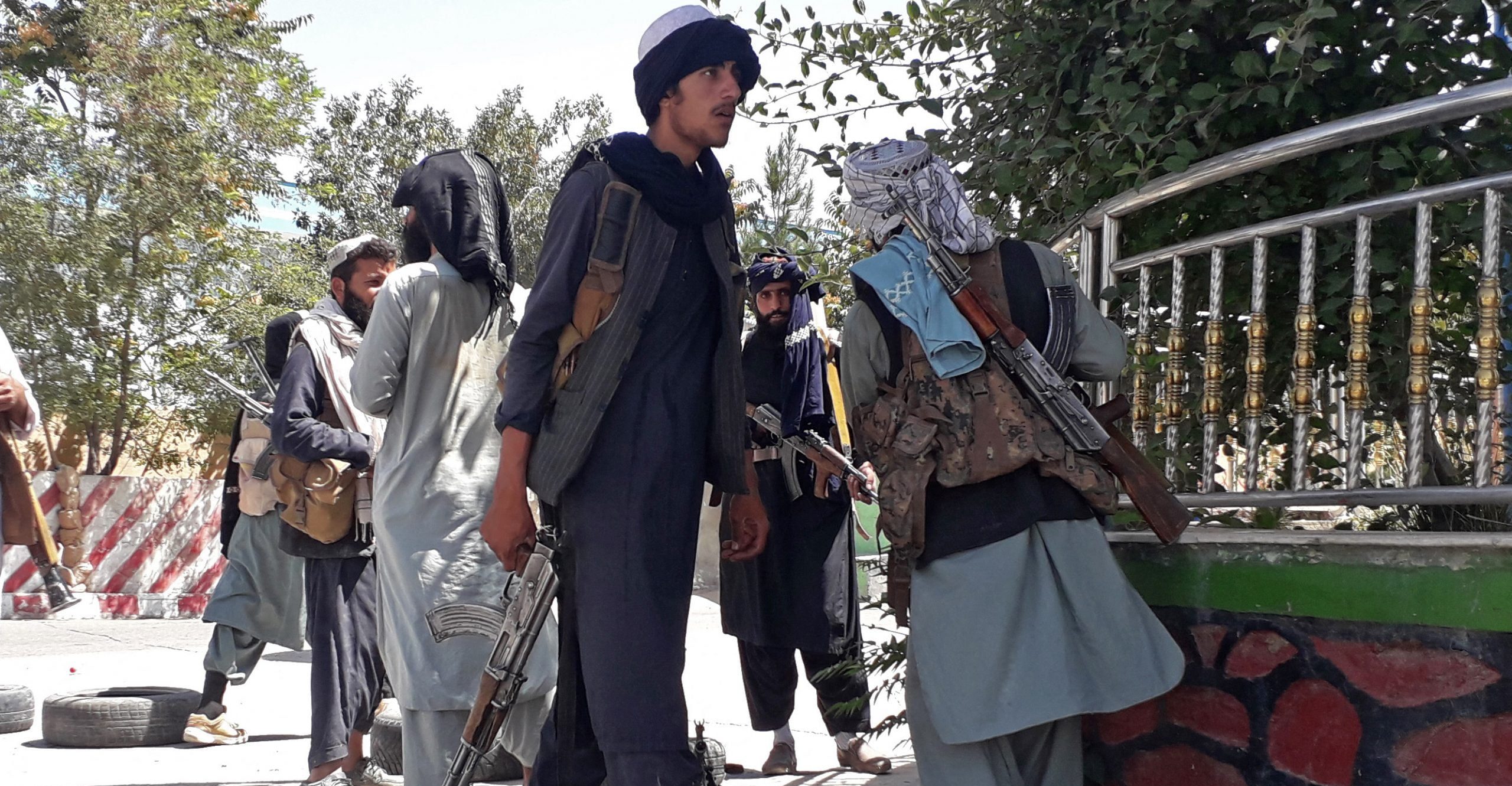
Since seizing control of Afghanistan a year ago, the Taliban have mounted a sustained attack on human rights, persecuting minority groups, violently clamping down on peaceful protests, suppressing women’s rights and using extrajudicial executions and disappearances to spread fear among Afghans, Amnesty International said in a new briefing today.

The briefing, The Rule of Taliban: A Year of Violence, Impunity and False Promises, documents gross human rights violations under a year of Taliban rule. It reveals widespread impunity for crimes such as torture, revenge killings and forced evictions of opponents of the Taliban, who initially promised to uphold women’s rights, press freedom and an amnesty for government officials.

“A year ago, the Taliban made public commitments to protect and promote human rights. Yet the speed with which they are dismantling 20 years of human rights gains is staggering. Any hopes of change have quickly evaporated as the Taliban seek to govern through violent repression with full impunity,” said Yamini Mishra, Amnesty International’s South Asia Regional Director.

“Arbitrary detentions, torture, disappearances, summary executions have returned as the order of the day. Women and girls have been stripped of their rights and face a bleak future, deprived of education or the possibility of taking part in public life.”

Amnesty International is calling on the Taliban to immediately stop committing gross human rights violations and crimes under international law. As Afghanistan’s de facto authorities, the Taliban must urgently restore, protect and promote the rights of Afghan people.

“To prevent Afghanistan’s human rights crisis from spiralling further, the international community must take meaningful action to hold the Taliban accountable for these crimes.”

YAMINI MISHRA, AMNESTY INTERNATIONAL’S SOUTH ASIA REGIONAL DIRECTOR

Freedom of expression & assembly

Amnesty International’s research details the use of excessive force by the Taliban’s security forces as they try to police a ban on peaceful protests. In several large cities, security forces dispelled peaceful protests by beating and shooting unarmed protesters.

One protester from Herat province told Amnesty International of the injuries inflicted by security forces: “I saw one man lying in a pool of blood in a ditch in the street; I believe he had been killed… My hand was fractured but I didn’t go to the hospital, fearing that I could be arrested for participating in the protests.”

The Taliban’s crackdown on freedom of expression has targeted human rights defenders and civil society activists, many of whom have been harassed, threatened, detained, and even killed as a direct result of their human rights work.

Press freedom has also come under attack. On 19 September 2021, the Government Media and Information Centre (GMIC) issued an order containing vague wording that forbids journalists from publishing stories ‘contrary to Islam’ or ‘insulting to national figures’.

In the past year, more than 80 journalists have been arrested and tortured for reporting on peaceful protests. One journalist told Amnesty International: “I was beaten and whipped so hard on my legs that I couldn’t stand… My family signed (a) document, promising that I would not speak out about what happened to me after my release; if I did, the Taliban would have the right to arrest my entire family.”

Arbitrary arrests, torture and ill-treatment

Since August 2021, there have been widespread reports of Taliban soldiers beating and torturing Afghans deemed to have broken Taliban edicts or accused of working with the former government.

Hundreds of civilians have been unlawfully detained. Many are beaten with rifle butts or whipped during arrest. Sahiba* (not her real name), a female protestor, told Amnesty International her body was covered in bruises after the Taliban security forces finished with her.

“There was no court, no charges and no due process; we were abducted from the streets, kept in a private jail for several days during which we had no access to our family, lawyer or any other official… Some of the women and girls who were with me in the same room never returned and none of us knew what happened to them,” Sahiba said.

Extrajudicial killings and enforced disappearances

Revenge killings, summary executions of alleged resistance fighters and other crimes reportedly committed since the Taliban takeover could amount to war crimes.

There have been hundreds of extra judicial killings, with bodies found with gunshot wounds or signs of torture. Dozens of people have been disappeared, their whereabouts still unknown, because of their work under the previous government or because they are suspected of being involved in resistance against the Taliban.

Torab Kakar, 34, told Amnesty International, that despite securing a “pardon letter” from the Taliban, his friend Jalal, who had served in the Afghan National Defence Security Forces (ANDSF), was taken away to an undisclosed location by the Taliban.

“The Taliban tied his hands behind him, blind-folded him and kept beating him while his wife and children, parents and younger siblings were crying and screaming.” When Jalal’s family looked for him, they were threatened by the local head of intelligence and warned to stop their search.

Persecution of ethnic and religious minorities

Within weeks of the Taliban taking power, reports emerged of non-Pashtun Afghans being forcibly evicted from their homes and farms, so that the Taliban could reward their followers with land taken from other groups, particularly Hazaras, Turkmen and Uzbeks.

Evictions were reported across the country, including in Balkh, Helmand, Daikundi, Kandahar and Uruzgan provinces, contributing to already huge numbers of internally displaced people. By June 2022, the United Nations estimated that the number of internally displaced Afghans had grown to more than 820,000.

On 30 August 2021, the Taliban unlawfully killed 13 ethnics Hazaras, including a 17-year-old girl, in Daikundi province. According to eyewitness testimony gathered by Amnesty International, the Taliban extrajudicially executed nine former members of the ANDSF who had surrendered — killings that appear to be war crimes.

Restrictions on women and girls

The Taliban have subjected women to increasing violence since they took power. Sometimes as a way of punishing their family members.

Lida, the wife of a former member of the Afghan security forces, was shot and killed by two armed Taliban men on a motorbike. The 22-year-old, who was eight months pregnant, was killed along with her two children aged two and four years old.

Dozens of women have been arrested and tortured for holding peaceful protests demanding their rights, amid mounting restrictions that have stripped away their freedoms.

The Taliban has clamped down on the right to education, blighting the prospects for millions of Afghan girls. When secondary schools reopened on 17 September 2021, the Taliban forbid girls above grade six to attend, claiming it was a temporary situation while they recruited more female teachers and ensured ‘appropriate’ conditions were put in place for gender segregated education. To date, none of these plans have been implemented.

Meena* (not her real name), a 29-year-old teacher from Kabul, told Amnesty International of her despair for her daughter’s future: “…we are repeating history… I look at my uniform, remembering the school days, students, and teachers but I am left with no choice but to stay home.”

“We must not just stand on the side-lines, watching as the human rights of a whole population collapses. A firm, meaningful and united international response is the only hope of ending the nightmare that Afghans have endured for a year now,” said Yamini Mishra.
Statement from Amnesty International Australia

Amnesty International Australia apologises for the pain and anger caused by the publication of an extended press release on August 4 2022 regarding the actions of the Ukrainian resistance to Russian invasion. 

We recognise that we should have set out framing and contextualization of the press release in more detail, including referring to the multiple violations and war crimes by the Russian military as part of the invasion of Ukraine, all of which we have thoroughly documented over the last six months and we continue to do.  This prevented us from achieving the human rights impact we had hoped for.

There may also have been issues with our legal analysis, as some critics have suggested. We further acknowledge, with much regret, that the process of preparing the report left some of our colleagues feeling that they were not consulted, were not sufficiently prepared or were not heard. We will learn and are committed to do better in the future. 

We actively encouraged the International Board of Amnesty International to promptly conduct an independent review of the process that led to the extended press release, including an independent legal review panel. The International Board has agreed.

We have also met with the Australian Ukrainian community and we have listened to and conveyed their concerns to our international colleagues. We continue to be in contact and it is very clear to us that the Ukrainian community wants to see accountability for these errors – a principle central to human rights – and a principle Amnesty International Australia strongly supports.

Our common mission at Amnesty is to protect and defend human rights, and this extended press release compromised our ability to do this.

Amnesty International Australia has joined with other sections to ask the International Board and the International Secretariat to initiate a thorough review of procedures for the preparation and publication of reports and communications, in order to strengthen cooperation so that the the results of a united voice are better and more effective to protect human rights. 

We must understand what went wrong and why and must capture those lessons to inform our work ahead. The Review will focus on the process and decisions in the lead up to publication of the release, including the research undertaken, process of preparing press release, the legal and policy analysis, the timing of its launch.  We will also review the power and other underlying organisational cultural dynamics. In summary what lessons should be learned to achieve greater human rights impact. The Review will be initiated within the next two weeks.

Protection of civilians has always been and will continue to be our primary concern. That is why, from very early in the conflict, we named and denounced Russia’s aggression against the people of Ukraine as an international crime, and in the past six months, Amnesty has published more than a dozen briefings and reports detailing those violations and war crimes.  We condemn Russia’s use of the press release to justify its illegal aggression. Since the start of the invasion in February, Amnesty International has categorically condemned Russia’s invasion of Ukraine as an unjustified act of aggression and a grave violation of international law.

We express our solidarity to our Amnesty Ukraine colleagues, human rights defenders, and civilians who remain at grave risk in Ukraine.

UN Security Council must prioritize accountability for Russian war crimes in Ukraine

A UN Security Council session due to take place today must urgently prioritize civilian protection and accountability for the litany of war crimes committed by Russian forces and call for an end to Russia’s aggression against Ukraine, Amnesty International said.

Russia requested the Security Council session, to focus on growing concerns over the militarization of a nuclear plant in Zaporizhzhia in southern Ukraine. The UN Secretary-General has warned that any damage to that or other nuclear plants could result in “catastrophic” consequences in the immediate vicinity and far beyond.

“The allegations we are receiving directly from Enerhodar, the town adjacent to the nuclear plant, speak volumes about the terrible impact Russia’s militarization of the plant and surrounding areas is having on civilians. Amnesty International is currently investigating these worrying reports and urges the Security Council to do the same,” said Agnès Callamard, Amnesty International’s Secretary General.

“The Council must also include accountability for the wide range of egregious Russian violations in the conflict to date.

“The imminent danger posed by the militarization of the Zaporizhzhia nuclear plant is and should be the key issue for the Security Council. It would appear that this militarization is part of a broader strategy by Russian forces to threaten civilians and put millions of people at great risk. We should also keep our attention on Russia’s abominable conduct, and the fact that during its six months of aggression against Ukraine its forces have endangered and killed many civilians. We should not allow the Russian authorities to avoid accountability.”

Since the invasion, Amnesty International has documented and reported on numerous violations by Russian forces, including indiscriminate attacks, use of banned cluster munitions, and extrajudicial executions. Many amount to war crimes, which the Security Council must condemn and pave the way for those responsible to be brought to justice.

“The UN Security Council’s unequivocal priority – with regard not just to Zaporizhzhia but across the entire conflict – must be to ensure civilians are protected,” said Agnès Callamard.

Background

Since Russia’s invasion of Ukraine in February, Amnesty International has spent months on the ground documenting Russian violations and war crimes. The organization has published more than a dozen press releases, briefings and reports condemning these acts and calling for accountability. The organization has also urged Ukrainian forces to take additional steps to protect civilians. As in all armed conflicts, Amnesty International calls on all parties to prioritize civilian protection and adhere to international humanitarian law.

More of Amnesty International’s work on the conflict can be found here.

Afghanistan: Taliban must immediately step-up measures to protect the Hazara Shia  communities

Responding to the series of attacks leading to about 120 deaths and injuries in areas dominated by Hazara Shia communities in west Kabul over the last few days, Zaman Sultani, Amnesty International’s regional researcher, said:

“The systematic attacks on the marginalised and persecuted Hazara Shia community in Afghanistan may amount to crimes against humanity and should be unequivocally condemned.

“In the last year there have been multiple attacks on the marginalised community with little to no action. It is essential that as de-facto authorities, the Taliban carry out an immediate, impartial and thorough investigation into the attacks, conducted in line with international law and standards. Those suspected of criminal responsibility for these crimes under international law and human rights violations should face justice in fair trials before ordinary civilian courts and without recourse to death penalty.

“The Taliban bear responsibility to take all necessary measures for the protection of civilians in Afghanistan and they must immediately step-up measures to ensure protection to all civilians in the country.”

Australian-Hazara diaspora community condemns attacks 

The Australian-Hazara community in Australia strongly condemns the terrorist attacks which took place last week in West Kabul, Afghanistan, an area home to predominately the Hazara-Shia population.

Sajjad Askary, Juris Doctor candidate and Australian-Hazara said:

“The consistent, systematic persecution of the Hazara people by Islamic State Khorasan-Province (ISKP) and other Islamists continues today because of their religious beliefs, ethnic identity, and dedication to democratic political institutions and human rights in Afghanistan. Islamist extremists target Hazara schools, maternity centres, sports centres, hospitals, wedding halls, and mosques. Hazaras are being targeted en-mass and on the streets in every corner of the country for decades. 

“Australia and the international community must recognise and prioritise the claims of Hazaras as needing refuge due to their well-founded fear of persecution for their religious beliefs, ethnic identity and their dedication to democratic political institutions and human rights in Afghanistan, and to continue the humanitarian protection of Hazara refugees. Hazaras have already contributed enormously to Australia, as entrepreneurs and community members. Hazara community efforts raised $160,000 for the bushfire relief in 2020, and the local community has a proud tradition of establishing successful businesses with no start-up funds.”

Sitarah Mohammadi, Australian-Hazara and Spokesperson of World Hazara Council, said

“We call on the Taliban to immediately reinstate the self-protection mechanisms to help the Hazara community protect itself in the short term and to devise a comprehensive security strategy for the Hazaras with inputs from within the community. We urge the UN and international community to take collective and robust action to intervene to prevent further attacks and protect the Hazara-Shia community. We call on the Taliban to stop blocking immediate help for the wounded, including blood donation and to ensure humane treatment of the families of the victims. We urge the Taliban to stop blocking media coverage of the security incidents. This is crucial for the flow of information, investigation of the attacks and assistance to the victims. 

“We urge international human rights organisations working in Afghanistan to clearly mention the identity of victims as ‘Hazara’ in their statements, and thoroughly and substantially investigate, map, document and report on these ongoing atrocities against the Hazara people. We urge the UN to adequately respond to the atrocities unfolding against the Hazara-Shia population in Afghanistan by implementing the Principle of Responsibility to Protect, which must be invoked in situations of mass atrocity crimes. We urge UN member states, including Australia to recognise ethnic and religious minorities such as the Hazara-Shias of Afghanistan, as groups in need of refugee protection due to their well-founded fear of persecution for their religion and ethnicity.”

Hayat Akbari, Australian-Hazara and Juris Doctor candidate said:

“Since the Taliban re-took over Afghanistan nearly a year ago, there has been a clear escalation of persecution and targeted attacks, and marginalisation as well as exclusion by the de facto Taliban regime against the Hazara and Shia community in Afghanistan. The Taliban have removed Ashura, the holy day for Shia Muslims, from the list of holidays in the calendar, which strongly indicate their unwillingness to include the Shia population of the country. It is important to note that the Taliban continue to deny the presence of ISKP in Afghanistan, despite the ongoing escalating attacks. 

“Further, marginalised and highly vulnerable groups such as Hazaras are unable to access aid due to discrimination by the de facto authorities, the Taliban. As Australia and other governments deliver aid in Afghanistan, we urge the Australian government to pressurise the Taliban through aid leverage and other channels, and to work alongside INGOs to employ local Hazara staff to ensure that marginalised communities are able access aid and other essential services.”

Background

On Friday, 5th August,  at least eight  people were killed and 18 injured in a blast in Kabul. The next day, on Saturday, 6th August a bomb exploded in a busy shopping street in Kabul killed eight people and injured at least 22 as reported in media.

On Sunday, 7th August the UN reported at least 120 people were killed and wounded resulting from the attacks to which responsibility was claimed by the Islamic State of Khurasan Province claimed.

After the Taliban takeover, such minority communities have no effective representation within the Taliban’s security or governance structure.Amnesty International has previously documented the targeted killing of ethnic Hazara community following the Taliban’s takeover of Afghanistan in 2021.

‘The new government gives me hope that the cruel limbo of temporary protection visas might end’

Amnesty International Australia Refugee Rights Campaigner Zaki Haidari, discusses his battle as a refugee living in Australia on a temporary protection visa, hoping that the new government will end the injustice.

Australia has given me refuge – but it’s conditional. I’ve been living here for the past decade, temporary visa to temporary visa, never certain of my future. This is the experience of 31,000 other refugees like me living on a brief lease of life.

After battling almost insurmountable obstacles to seek safety in Australia, living in this limbo with a temporary permit is extremely stressful, especially for people who are already living with a lot of trauma.

We fled our home country because we were persecuted there, but our persecution continues today in Australia.

Yet the federal election results have given people like me hope.

Refugees seeking asylum are forced to leave their home country, to find a safe place to survive and build a new life. They hope that they can feel safe and be reunited with their families and loved ones. But Australia’s refugee policies have punished us and tried to break us in many ways, by keeping refugees permanently on temporary visas and separated from their families.

Tragically, this brutal policy pushed people to the breaking point including one of my close friends who took his life last year.

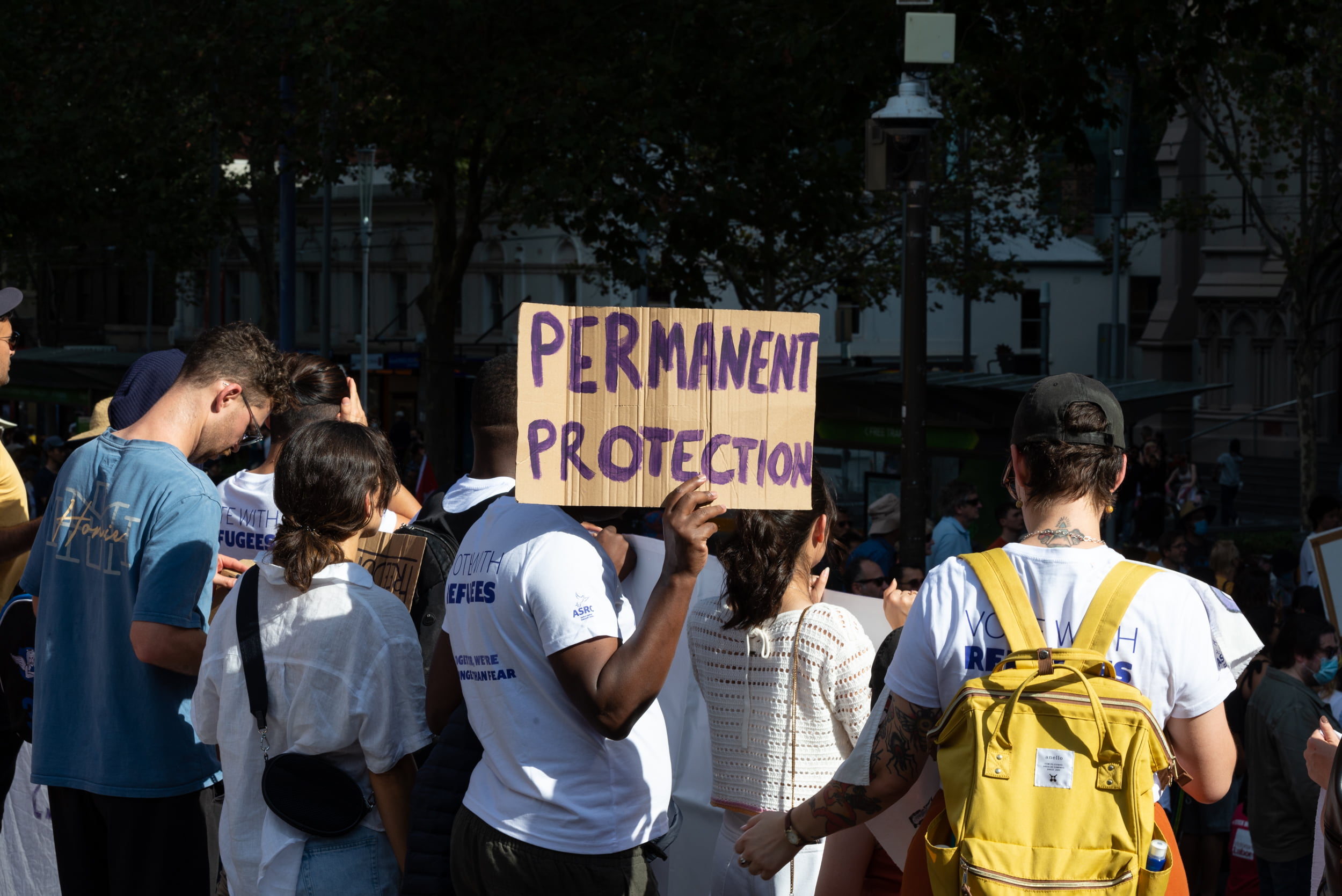
During the election campaign, the Labor party committed to abolishing temporary protection visas (TPV) and safe haven enterprise visas (SHEV) and grant refugees permanent visas.

Upon election victory, the Albanese government has created a sense of hope in the refugee community – hope that we will see an end to this constant emotional suffering and we can reunite with our loved ones.

The ALP has been in government for more than a month now but so far there has been no commitment to scrap these cruel measures as promised. I receive calls daily from friends and other refugees on TPVs and SHEVs, asking when they can apply for permanent visas, but more importantly when they might be able to see their families.

Due to this uncertainty, we have always felt second-class citizens in Australia.

We are deprived of the right to be reunited with our children, partners and loved ones. We don’t have the right to get loans to buy a house, to extend our businesses or to secure permanent employment because of our temporary visa status. We are not eligible to get fee-help to study leaving thousands of bright, young refugees without access to formal education and prospects for the future.

It is encouraging to see strong support in Australia for the abolition of TPVs.

The UNSW Sydney’s Kaldor Centre for international refugee law published a policy paper on Tuesday providing the government with expert advice on how it can shift temporary visas to permanent visas.

The tools and expertise are there, the Australian people have voted for it. We now need the Australian government to end this emotional suffering and give us hope to live peacefully and to rebuild our lives: enough is enough.

Amnesty is a movement of everyday people joining together to challenge injustice and defend human rights. For 60 years, we’ve been shining a light in the darkness to expose abuses, ensure accountability, change laws and improve lives.

By the end of 2025, Amnesty’s vision is to raise refugee and humanitarian intake numbers, increase community resettlement, secure the release of those incarcerated on- and off-shore and build safe pathways for refugees into Australia. Learn more about our refugee rights campaign work

This article was originally published in The Guardian.

Mental Health and Wellbeing at Amnesty

The mental health and wellbeing of Amnesty staff, volunteers and activists is a key factor in determining the long-term effectiveness and sustainability of our movement. 

By implementing wellbeing measures to complement other health and safety measures, we can ensure that we are all safe, healthy and engaged. Our Mental Health and Wellbeing Plan translates the vision we have for a healthy movement into actionable goals.

Themes and objectives

Amnesty’s Mental Health and Wellbeing Plan has four themes:

  • Accessible support tools and resources: To provide accessible tools and resources to support the mental health and wellbeing of all our staff, leadership and movement. 
  • Processes, policies and systems: To implement and communicate processes, policies and systems that support the mental health and wellbeing of our staff and movement.
  • Resilience building: To implement a regular plan of resilience building and of celebrating, rewarding and recognising our staff and movement. 
  • Training and capability building: To deliver tailored, regular and accessible training across the movement including to managers and people leaders, staff, the Activist Leadership Committees, the board and volunteers and activists.

What do we mean by mental health?

At Amnesty, mental health is an integral and essential component of overall health. It is a state of wellbeing in which every individual in our movement:

  • Realises their own abilities
  • Can cope with the normal stresses of life
  • Can work productively and fruitfully
  • Is able to make a contribution to their community

A mentally healthy movement is essential for  individual health, collective wellbeing and productivity.

What do we mean by wellbeing? 

Wellbeing relates to all aspects of life and work within Amnesty. It includes: 

  • The quality and safety of the physical environment
  • The mental health of individuals in our movement
  • How individuals feel, perceive and experience their work, their working environment and the organisation’s culture
  • The organisation of our work, teams, campaigns and activities

A mentally healthy movement is essential for  individual health, collective wellbeing and productivity.

A mentally healthy movement is one where:

  • Everyone (including managers, staffs, activists and volunteers) understand mental health and wellbeing and openly talk about it
  • Individuals in our movement  watch out for each other and ask each other if they’re okay
  • Leaders in our movement take ownership of collective resilience by supporting the ability of the movement to adapt, respond and recover from challenges, setbacks and unforeseen circumstance
  • Individuals in our movement are equipped with the knowledge about the things they can do to build resilience for challenging times
  • Individuals in our movement are encouraged to open up and seeking support during difficult times and a culture is built in which individuals feel comfortable to do so
  • Individuals in our movement with mental health concerns seek help early
  • Individuals in our movement with mental health concerns are supported

Myanmar: Detainees tortured to crush opposition to coup


● Beatings, gender-based violence and arbitrary arrests documented
● Myanmar must immediately free all those unjustly detained
● Profound psychological trauma experienced upon release

Authorities in Myanmar’s prisons and interrogation centres routinely subject people detained for resisting the 2021 military coup to torture and other cruel or degrading treatment, Amnesty International said today in a new briefing, more than a year and a half after the power grab shattered the country’s halting transition to civilian rule.

Based on 15 interviews carried out in March 2022 with former detainees, lawyers of prisoners and experts, as well as a review of over 100 news reports, the briefing, 15 Days Felt like 15 Years, documents the horrific experiences of individuals from the moment they are arrested, through their interrogation and imprisonment, and after their release.

Since the 1 February 2021 coup, Myanmar’s military has arrested more than 14,500 people and killed more than 2,000, according to the Assistance Association for Political Prisoners (AAPP).

From showing up without an arrest warrant and forcing confessions through torture or other ill-treatment, to enforceable disappearances, reprisals against relatives, and holding detainees incommunicado from family and legal counsel, military authorities flout the law at every stage of the arrest and detention process.

This was horrifically demonstrated in the unlawful execution of four men in July, including a prominent pro-democracy activist and former lawmaker, following their death sentences by a military court. The executions were the first to be carried out in more than 30 years. More than 70 people remain on death row in Myanmar while 41 have been sentenced to death in absentia, according to AAPP.

“Myanmar has stooped to unimaginable new lows in its vile and brutal treatment of detainees as part of an overall strategy intended to break their spirits and compel people to give up any resistance to the 2021 military coup,” said Amnesty International’s Secretary General Agnes Callamard.

“But it is having the opposite effect. The Myanmar people remain unbowed even after the litany of violations, including most recently the shameful and despicable executions of Kyaw Min Yu – also known as Ko Jimmy – Phyo Zeya Thaw, Hla Myo Aung and Aung Thura Zaw.”

“As a matter of urgency, Myanmar’s military must free thousands of people languishing in detention simply for exercising their rights, and let them return to their families. The United Nations Security Council must increase the pressure on the Myanmar military with a referral to the International Criminal Court, a global arms embargo and targeted sanctions.”

Tased and beaten
Amnesty’s research reveals how prison officials kicked and slapped detainees, and also beat them with rifle butts, electrical wires and branches of a palm tree.

Detainees allege they were psychologically tortured with death and rape threats to force confessions or extract information about anti-coup activities. One person was presented with a parcel delivery that contained a fake bomb.

Several former detainees interviewed by Amnesty International observed that other detainees had visible injuries on their bodies, including blood, broken limbs, and swollen faces.

“When they [the police] found us sleeping, they beat us. When they caught us sitting, they beat us…They pointed G3 rifles at our foreheads and threatened that they could kill us anytime,” said one student arrested in the central Magwe Region.

One woman heard security forces plunging the head of another detainee in a bucket of water and using a taser on the person several times during interrogation.

A student activist told Amnesty International that he saw police bang his friend’s head against the wall. Police also used a taser on his genitals and threatened to blow them up with a grenade.

Ma Kyu, who was arrested in Karenni State for protesting the coup, told Amnesty what a
police officer told her after she was detained: “We can just kill you after the arrest. We do not even need to put you in jail. We can simply shoot you.”

‘They took off my clothes’
Interrogators also committed sexual and gender-based crimes.

Saw Han Nway Oo is a transwoman who was arrested and detained in September 2021 by the military on suspicion of having attended self-defence training. She was taken to the Mandalay Palace interrogation centre, which has become notorious for reports of torture.

Over three days, she was interrogated at the palace centre and at a police station. She said the interrogators scratched her knees with sharp objects and sprayed methylated spirit over the bleeding wounds. She was not given food or water for three days.

“During the interrogation, whenever I used feminine pronouns for myself, they said you are gay, so you must like this and exposed their male genitals in front of me.”

They also looked at messages with her doctor and asked if she had had a sex-change operation. They then took off her clothes, looked at her naked body and mocked her.

Other LGBTI people also experienced thorough body checks of their private body parts to ‘‘ensure whether they are males or females,” according to one detainee. Humiliating and invasive body searches may constitute torture or other ill-treatment, particularly for transgender detainees.

Blindfolded and cut off
Arrests are typically conducted during the night. During these night raids, soldiers and police break down doors, beat residents, ransack houses, confiscate electronics such as phones and laptops, and occasionally take valuable items such as jewellery.

Protest leader Ma Win was arrested while travelling on a passenger bus in Mandalay Region. She was slapped in the face, handcuffed, blindfolded and driven to an unknown
location.

During an interrogation lasting more than 24 hours, security forces wearing heavy boots beat and kicked her and repeatedly threatened to kill her.

Lawyers who Amnesty International spoke to described facing difficulties when trying to discover their clients’ whereabouts. At times, they resorted to paying bribes to get basic information.

The prison facilities are crowded, with one person describing staying with 50 people in a cell meant for 10. Detainees also found dead insects and worms in their food.

Though the experience of detention has exacted a profound psychological toll on those who have survived it, many activists are determined to keep resisting.

“We will never give up,” Saw Han Nway Oo told Amnesty. “We are like phones, we will recharge once we run out of batteries.”

*Note to editors: Some names have been changed to pseudonyms in order to protect the identity of the person interviewed.

Report: Deadly Mariupol theatre strike in Ukraine ‘a clear war crime’ by Russian forces

An extensive investigation by Amnesty International has concluded that Russian military forces committed a war crime when they struck the Mariupol drama theatre in Ukraine in March, killing at least a dozen people and likely many more.

In a new report, ‘Children’: The Attack on the Donetsk Regional Academic Drama Theatre in Mariupol, Ukraine, the organization documents how the Russian military likely deliberately targeted the theatre despite knowing hundreds of civilians were sheltering there on 16 March, making the attack a clear war crime.

Amnesty International’s Crisis Response team interviewed numerous survivors and collected extensive digital evidence, concluding that the attack was almost certainly carried out by Russian fighter aircraft, which dropped two 500kg bombs that struck close to each other and detonated simultaneously.

“After months of rigorous investigation, analysis of satellite imagery, and interviews with dozens of witnesses, we concluded that the strike was a clear war crime committed by Russian forces, many people were injured and killed in this merciless attack. Their deaths were likely caused by Russian forces deliberately targeting Ukrainian civilians,” said Agnès Callamard, Amnesty International’s Secretary General.

“The International Criminal Court, and all others with jurisdiction over crimes committed during this conflict, must investigate this attack as a war crime. All those responsible must be held accountable for causing such death and destruction.”

Agnès Callamard, Amnesty International’s Secretary General

Amnesty International examined several alternative theories about who was responsible for the attack, and what weapons may have been used. Based on the available credible evidence, the investigation ultimately found that a deliberate air strike targeted at a civilian object was the most plausible explanation.

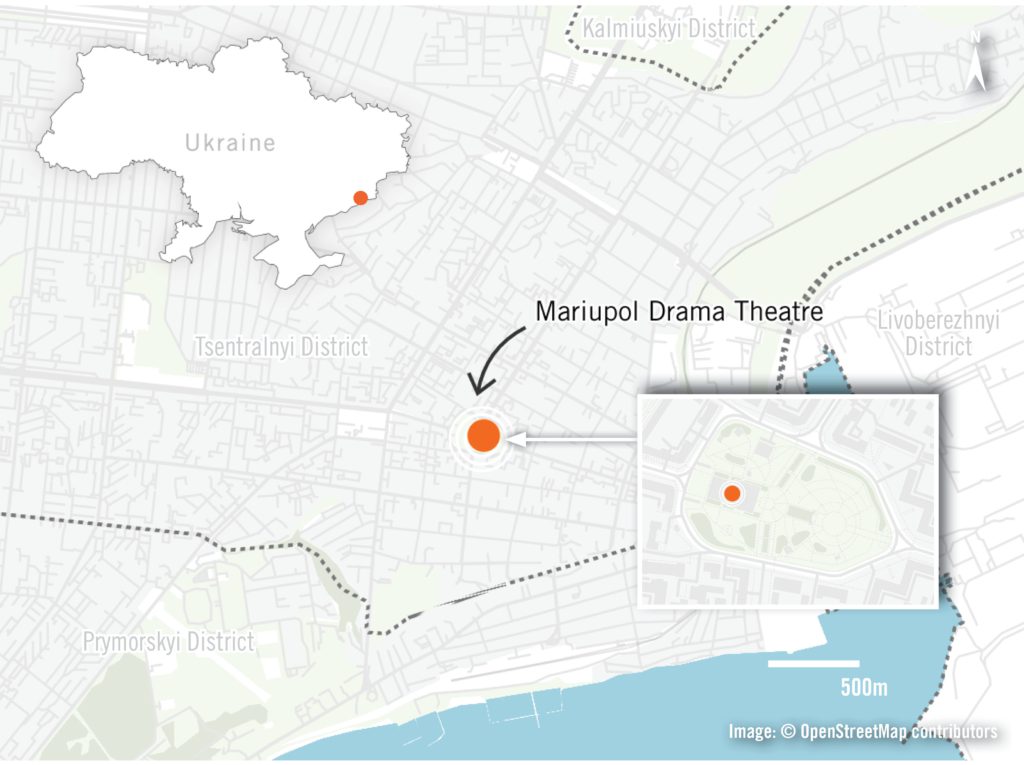
A map showing the location of the Mariupol Drama Theatre, along with a map of Ukraine depicting the location of Mariupol.

What happened at the Mariupol theatre?

Following the Russian invasion of Ukraine in late February 2022, civilians began fleeing their homes as cities and towns were targeted by military attacks. In besieged Mariupol in the Donetsk region, the theatre became a safe haven for civilians seeking shelter from fighting.

The theatre, in the city’s Tsentralnyi district, was a hub for the distribution of medicine, food and water, and a designated gathering point for people hoping to be evacuated via humanitarian corridors. The building was clearly recognizable as a civilian object, perhaps more so than any other location in the city.

Locals had also written the giant Cyrillic letters “Дети” – Russian for “children” – on forecourts on either side of the building, which would have been clearly visible to Russian pilots and also on satellite imagery.

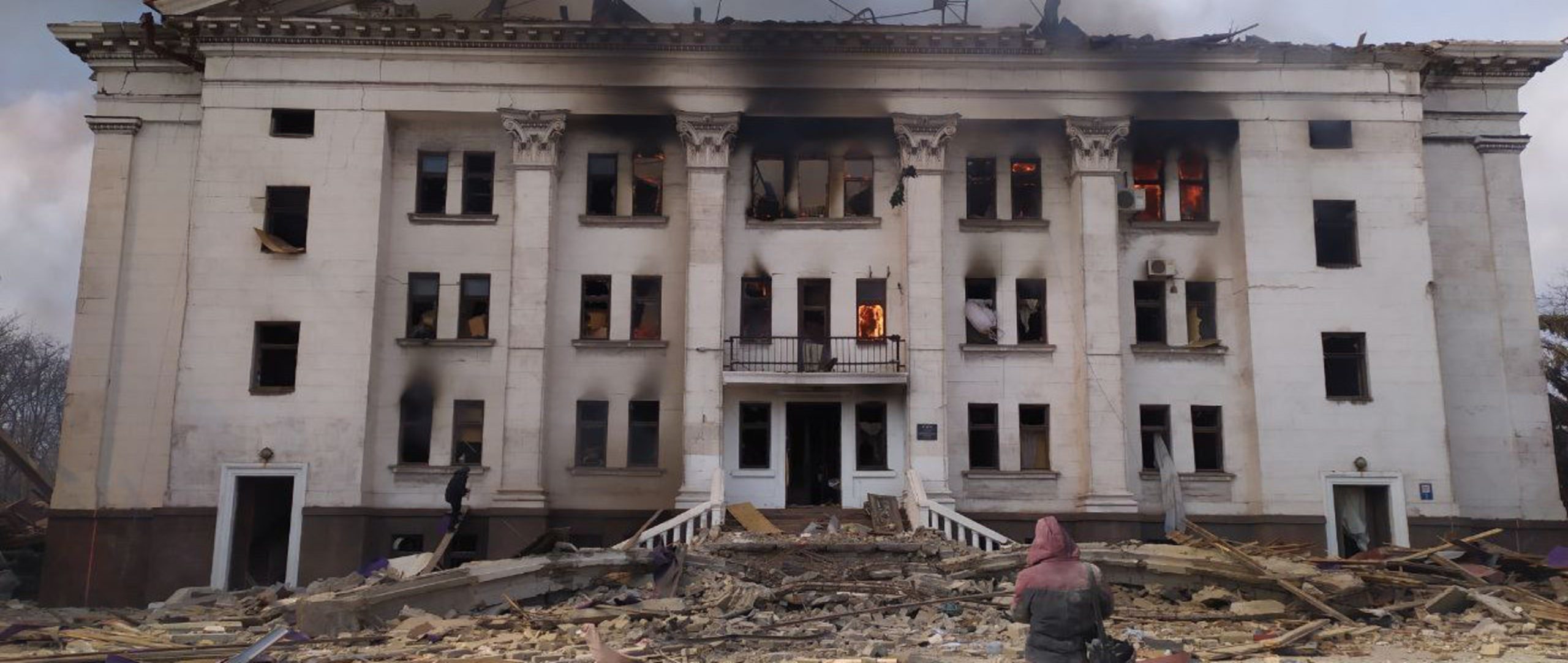
Nevertheless, Russian bombs struck the theatre shortly after 10 am on March 16th, producing a large explosion that caused the roof and huge portions of two main walls to collapse. At the time of the attack, hundreds of civilians were in and around the theatre.

“I was walking down the street leading to the drama theatre… I could hear the noise of a plane… but at that time I didn’t really pay attention … I saw the roof of the building explode… It jumped 20 metres and then collapsed… I couldn’t believe my eyes because the theatre was a sanctuary. ”

Grigoriy Golovniov, a 51-year-old entrepreneur

Amnesty International believes that at least a dozen people were killed by the strike and likely many more, and that many others were seriously injured. This estimate is lower than previous counts, reflecting the fact that large numbers of people had left the theatre during the two days prior to the attack, and most of those who remained were in the theatre’s basement and other areas that were protected from the full brunt of the blast.

When the bombs detonated, they destroyed the adjacent interior walls along the sides of the performance space, and then breached the exterior load-bearing walls, creating two main debris fields on the north-eastern and south-western sides of the building. Both debris fields are visible on satellite imagery taken just minutes after the strike.

The aftermath of the Mariupol theatre strike

In total, interviewees provided Amnesty International with the full names of four people who were killed: Mykhailo Hrebenetskyi, Lubov Svyrydova, Olena Kuznetsova, and Ihor Chystiakov. They also gave the forenames of three other people they believe were killed. Several survivors and other witnesses reported seeing dead bodies of people they could not identify, and it is likely that many fatalities remain unreported.

Yehven Hrebenetskyi found the body of his father Mykhailo inside the concert hall. Yehven told Amnesty International:

“There were many injured people… At first, I saw his [Mykhailo’s] arm. First, I saw a familiar hand. You know the hand of your loved ones. His face was covered with blood. His body was covered with bricks… I didn’t want my mom to see.”

Yehven Hrebenetskyi, son of Mykhailo and witness of the aftermath

Many other interviewees told Amnesty International they had seen bloodied bodies and dismembered body parts, including legs and hands, in the rubble of the devastated building following the strike.

Dmytro Symonenko was with Lubov Svyrydova moments before she died from her injuries. He told Amnesty International:

“She was severely injured. She managed to crawl from the rubble… she asked us to remember her name, because she felt she was dying.”

Dmytro Symonenko, a witness of the aftermath

Investigating the Mariupol theatre strike

Between March 16th and June 21st, Amnesty International gathered and analysed available credible evidence related to the attack on the theatre. This included 53 first-hand testimonies from survivors and witnesses of the attack and its aftermath, 28 of whom were inside or adjacent to the theatre at the time. Amnesty International also analysed satellite imagery and radar data from immediately before and shortly after the attack; authenticated photographic and video material provided by survivors and witnesses; and two sets of architectural plans of the theatre.

This was supported by an open-source investigation by Amnesty International’s Crisis Evidence Lab, who examined and verified 46 photos and videos of the strike that were shared on social media, as well as an additional 143 photos and videos that were privately shared with researchers.

Amnesty International’s ongoing documentation of violations of human rights and international humanitarian law committed during the war in Ukraine is available here.

Amnesty International’s Crisis Evidence Lab is an example of how we shine a light on great wrongs by exposing the facts others try to suppress. We are a global movement of 10 million people standing up for justice, freedom, and equality. Together, our voices challenge injustice and are powerful enough to change the world. Find out more about what we do and our crisis response work.

Afghanistan: Taliban destroying lives of women and girls – new report

The lives of women and girls in Afghanistan are being devastated by the Taliban’s crackdown on their human rights, according to an Amnesty International report, Death in Slow Motion: Women and Girls Under Taliban Rule. 

Since they took control of the country in August 2021, the Taliban have violated women’s and girls’ rights to education, work and free movement; decimated the system of protection and support for those fleeing domestic violence; detained women and girls for minor violations of discriminatory rules; and contributed to a surge in the rates of child, early and forced marriage in Afghanistan.

The report also reveals how women who peacefully protested against these oppressive rules have been threatened, arrested, detained, tortured, and forcibly disappeared.

“Less than one year after the Taliban’s takeover of Afghanistan, their draconian policies are depriving millions of women and girls of their right to lead safe, free and fulfilling lives,” said Agnès Callamard, Amnesty International’s Secretary General.

In Australia, Amnesty International’s Refugee Rights Campaigner, Zaki Haidari, said: “We want the Australian Government to urgently call on the Taliban to change course and to implement major policy changes to uphold the rights of women and girls.”

“The Australian Government, together with the international community, must impose consequences on the Taliban for their conduct, including targeted sanctions or travel bans applied through a UN Security Council Resolution, that could influence the Taliban without harming the Afghan people.”

Amnesty Refugee Rights Campaigner Zaki Haidari

Afghanistan-Australian Advocacy Network’s PhD Scholar and Research Officer, Sanam Ahmadzada, said: “It has been nearly a year since the Taliban forcibly came to power in Afghanistan and a year since girls were banned from school.

“Education is a fundamental human right, and Afghanistan is the only country where that right is taken away from girls. By keeping girls away from school, the Taliban are taking away stability in their lives today and limiting their opportunities tomorrow.

“Educated women have the power to transform and empower families, communities, and nations. International organisations must pressure the Taliban not to deny girls in Afghanistan this basic human right as it is the key to Afghanistan’s security, stability, and future,” said Ahmadzada.

Amnesty International is calling on the Taliban to implement major policy changes and measures to uphold the rights of women and girls. Governments and international organizations, including all UN member states and the UN Security Council, must urgently develop and implement a robust and coordinated strategy that pressures the Taliban to bring about these changes.

Amnesty International researchers visited Afghanistan in March 2022. The comprehensive investigation was conducted from September 2021 to June 2022, and includes interviews with 90 Afghan women and 11 girls, aged between 14 and 74 years old, living in 20 of Afghanistan’s 34 provinces.

Detention and torture of peaceful protesters 

Since seizing control of Afghanistan in August 2021, the Taliban have been the country’s de facto authorities. Despite initial public commitments to uphold the rights of women and girls, the Taliban introduced policies of systematic discrimination that violate their rights.

Women and girls across Afghanistan reacted to this crackdown with a wave of protests. In response, the Taliban targeted protesters with harassment and abuse, arbitrary arrest and detention, enforced disappearance, and physical and psychological torture.

Amnesty International interviewed one protester who was arrested and detained for several days in 2022. Describing her treatment in detention, she told Amnesty International: “[The Taliban guards] kept coming to my room and showing me pictures of my family. They kept repeating… ‘We can kill them, all of them, and you won’t be able to do anything… Don’t cry, don’t make a scene. After protesting, you should have expected days like this’.”

She also described being severely beaten: “They locked the door. They started screaming at me… [One Taliban member] said, ‘You nasty woman… America is not giving us the money because of you bitches’… Then he kicked me. It was so strong that my back was injured, and he kicked my chin too… I still feel the pain in my mouth. It hurts whenever I want to talk.”

Two women said that after photos were posted of a fellow protester’s injuries on social media, Taliban members developed a new strategy to prevent them from showing their injuries publicly.

One of the women told Amnesty International: “We were beaten on our breasts and between the legs. They did this to us so that we couldn’t show the world. A soldier who was walking next to me hit me in my breast, and he said, ‘I can kill you right now, and no one would say anything’. This happened every time we went out: we were insulted – physically, verbally, and emotionally.”

Detained protesters had inadequate access to food, water, ventilation, sanitary products and health care. To secure their release, the women were forced to sign agreements that they and their family members would neither protest again, nor speak publicly about their experiences in detention.

Arbitrary arrest and detention, including for ‘moral corruption’

According to four whistleblowers from Taliban-run detention centres, the Taliban has increasingly arrested and detained women and girls for minor violations of their discriminatory policies, such as the rule against appearing in public without a mahram [male chaperone] or with a man who does not qualify as a mahram. Those arrested are usually charged with the ambiguous ‘crime’ of ‘moral corruption’.

A prison staff member explained: “Sometimes they bring the boys and girls from the coffee shop… [Or] if they see a woman who is not with a mahram, she can be arrested… Before these kinds of cases were not in the prison… The numbers are increasing each month.”

One university student, who was detained in 2022, told Amnesty International that she was threatened and beaten after being arrested on charges related to the mahram restrictions.

She said that Taliban members “started giving me electric shocks… on my shoulder, face, neck, everywhere they could… They were calling me a prostitute [and] a bitch… The one holding the gun said, ‘I will kill you, and no one will be able to find your body’.”

The whistleblowers said that survivors of gender-based violence, who previously lived in shelters or who attempted to flee abuse after the Taliban’s takeover, are now being imprisoned in detention centres. One of the staff members said: “Some came by approaching the Taliban themselves, and asking, ‘Where is your shelter?’ [The Taliban] had no place, so they ended up in prison.”

These women and girls have been subjected to solitary confinement, beatings and other forms of torture, and forced to endure inhumane conditions, including overcrowding and inadequate access to food, water, and heating in winter months.

Child, early and forced marriage

According to Amnesty International’s research – corroborated by national and international organizations operating in Afghanistan, local activists and other experts – the rates of child, early and forced marriage in Afghanistan are surging under Taliban rule. The key causal factors for the increase include the economic and humanitarian crisis; the lack of educational and professional prospects for women and girls; families forcing women and girls to marry Taliban members; and Taliban members forcing women and girls to marry them.

Stephanie Sinclair, director of Too Young to Wed, an organization working on child, early and forced marriage, explained: “In Afghanistan, it’s a perfect storm for child marriage. You have a patriarchal government, war, poverty, drought, girls out of school – with all of these factors combined… we knew child marriage was going to go through the roof.”

Khorsheed*, a 35-year-old from a central province of Afghanistan, told Amnesty International that the economic crisis compelled her to marry off her 13-year-old daughter to a 30-year-old neighbour in September 2021, in exchange for a ‘bride price’ of 60,000 Afghanis (around US$670). She said that after her daughter’s marriage, she felt relieved and added: “She won’t be hungry anymore.”

Khorsheed said she was also considering marrying off her 10-year-old daughter, but was reluctant to do so, as she hoped this daughter might provide for the family in the future. She explained: “I wanted her to study more. She would be able to read and write, speak English, and earn… I have a hope that this daughter will become something, and she will support the family. Of course, if they don’t open the school, I will have to marry her off.”

Lack of access to education

The Taliban continue to block education for the vast majority of secondary school girls. Their scheduled return to school on 23 March 2022 was short-lived. Later the same day, the Taliban sent the girls home, citing a “technical issue” related to their uniforms. Four months later, the Taliban continues to deny girls’ access to education.

Fatima*, a 25-year-old high school teacher based in Nangarhar province, told Amnesty International: “These young girls just wanted to have a future, and now they don’t see any future ahead of them.”

At university level, the Taliban’s harassment of female students – as well as restrictions on students’ behaviour, dress and opportunities – has created an unsafe environment where female students are systematically disadvantaged. Many female students have now either stopped attending, or decided not to enrol in university at all.

Brishna*, a 21-year-old student at Kabul University, told Amnesty International: “[The] guards outside the university yell at us and say, ‘Fix your clothes, your scarf… Why are your feet visible?’… [The] head of our department came to our class and told us, ‘Be careful – we can only protect you when you are inside the faculty building… If Taliban members try to harm you or harass you, we won’t be able to stop them’.”

International community responsibility

Amnesty International is calling for international community to impose consequences on the Taliban for their conduct, such as targeted sanctions or travel bans applied through a UN Security Council Resolution, or employ other forms of leverage that can hold the Taliban accountable for their treatment of women and girls without harming the Afghan people.

“The Taliban are deliberately depriving millions of women and girls of their human rights, and subjecting them to systematic discrimination,” said Agnès Callamard.

“If the international community fails to act, it will be abandoning women and girls in Afghanistan, and undermining human rights everywhere.”

Good news: Russian activist Yulia Tsvetkova is free

On 15 July, Russian activist and artist Yulia Tsvetkova was acquitted of ‘pornography’ charges for posting her body-positive illustrations of women online.

Yulia is a women’s rights and LGBTQIA+ activist who faced up to six years in prison under Russia’s oppressive ‘gay propaganda’ laws.

What happened?

In November of 2019, Russian police raided the house of 28-year-old Yulia Tsvetkova. They labelled her a ‘lesbian, sex trainer and propagandist leader.’ All for posting her own body-positive illustrations of women’s genitalia online and for showing support for LGBTQIA+ families.

Yulia was detained and placed under house arrest from December 2019 until March 2020. She was fined 50,000 rubles (AU$1280) for being the administrator of an LGBTQIA+ Facebook page and 75,000 rubles (AU$1900) for posting a drawing of a same-sex couple with children.

Yulia was charged with ‘disseminating pornography.’ In Russia, this is a crime punishable by up to three years in prison. Yulia has been on trial since April 2022, but on July 15 she was acquitted of these charges.

LGBTQIA+ rights in Russia

Being a member or an ally of the LGBTQIA+ community in Russia can be dangerous. It is not uncommon for LGBTQIA+ people to face imprisonment, violence and torture at the hands of Russian authorities.

In 2013, Russian parliament backed a bill which outlawed ‘propaganda of homosexuality among minors.’ As Russian law does not define ‘homosexual propaganda’, this law can be applied arbitrarily at the discretion of the Russian government.

In Chechnya, a republic in the south of Russia, gay and lesbian people have been detained, tortured, beaten and even killed by local authorities. Since 2017, the Russian government has turned a blind eye to the horrific persecution on the lives of gay and lesbian people in Chechnya.

How did Amnesty respond?

After Yulia’s trial began in April 2021, Amnesty started a petition calling on Russian authorities to drop the charges against her. Amnesty supporters around the world took action. Over 17,000 people signed our petition and raised their voices against injustice, sparing Yulia from years in prison.

What’s next?

Everyone deserves the right to express themselves, no matter their gender or sexual orientation. Russia’s homophobic and misogynistic laws are placing innocent people in jail in a blatant violation of their human rights.

“The acquittal of Yulia Tsvetkova today marks a rare and welcome triumph of sanity and justice over remorseless repression. In a country where state-sponsored homophobia and misogyny are the norm, Tsvetkova’s trial was a landmark case.”

Marie Struthers, Amnesty International’s Director for Eastern Europe and Central Asia

People like Yulia who stand up for their own and others’ rights don’t deserve to be imprisoned. Amnesty will continue to challenge injustice against LGBTQIA+ people and women all over the world.