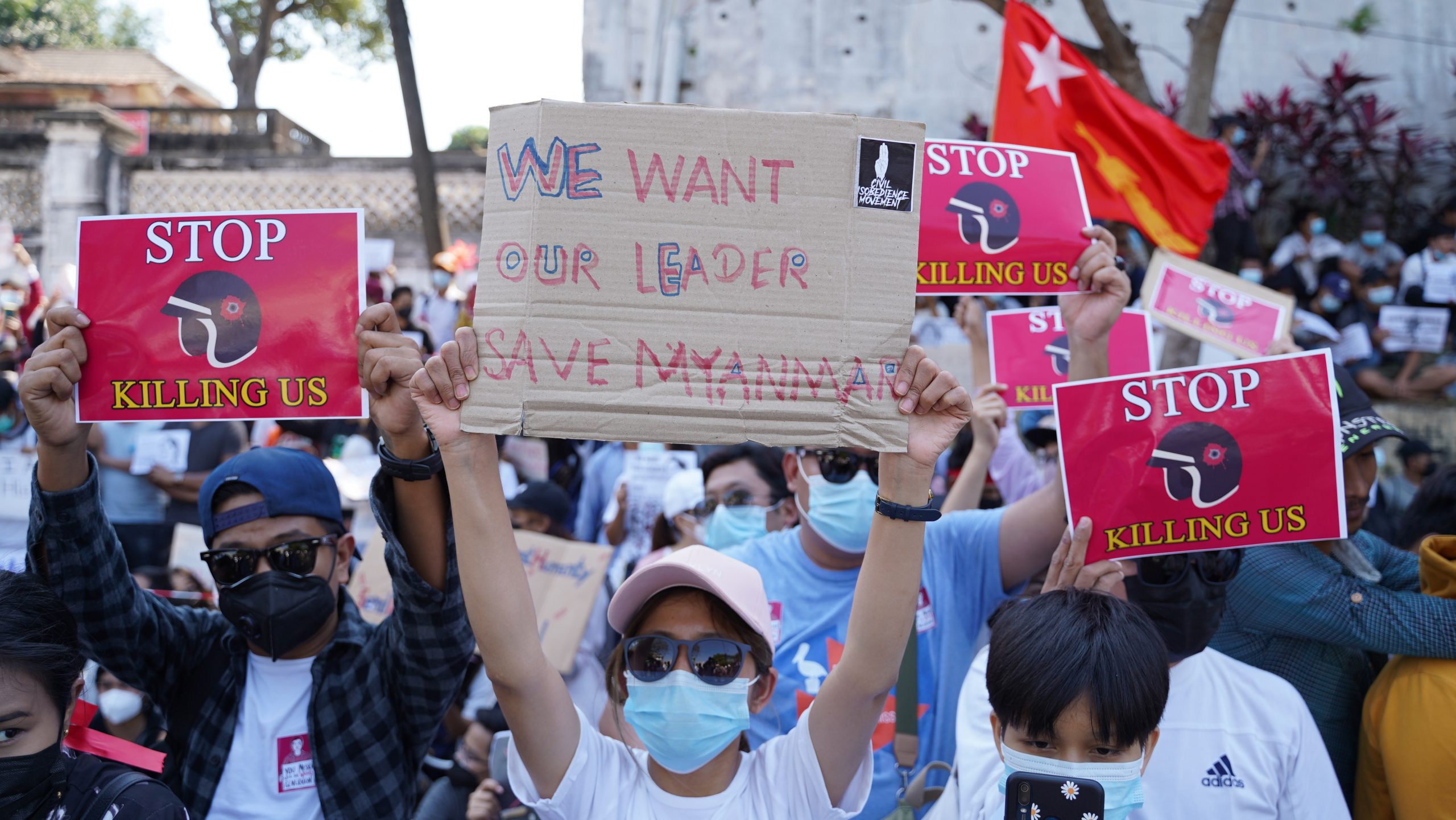
Myanmar: Vast arsenal and notorious troops deployed during nationwide ‘killing spree’ protest crackdown – new research

The Myanmar military is using increasingly lethal tactics and weapons normally seen on the battlefield against peaceful protesters and bystanders across the country, new research by Amnesty International has revealed.

By verifying more than 50 videos from the ongoing crackdown, Amnesty International’s Crisis Evidence Lab can confirm that security forces appear to be implementing planned, systematic strategies including the ramped-up use of lethal force. Many of the killings documented amount to extrajudicial executions.

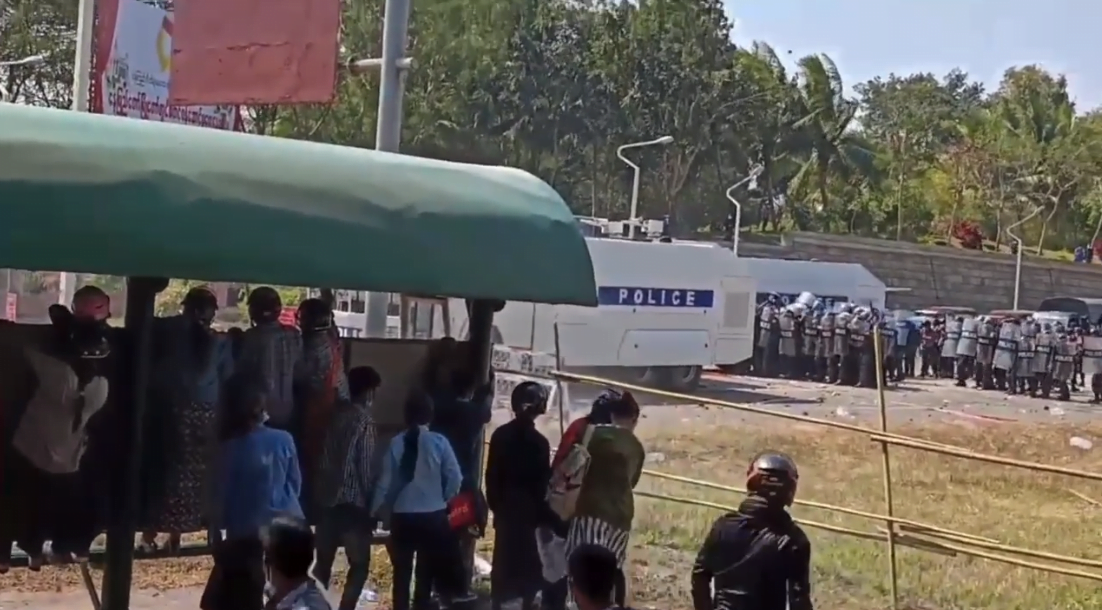
Footage clearly shows that Myanmar military troops – also known as the Tatmadaw – are increasingly armed with weapons that are only appropriate for the battlefield, not for policing actions. Officers are frequently seen engaging in reckless behavior, including the indiscriminate spraying of live ammunition in urban areas.

“These Myanmar military tactics are far from new, but their killing sprees have never before been livestreamed for the world to see,” said Joanne Mariner, Director of Crisis Response at Amnesty International.

“These are not the actions of overwhelmed, individual officers making poor decisions. These are unrepentant commanders already implicated in crimes against humanity, deploying their troops and murderous methods in the open.

“For years, ethnic minorities – including the Chin, Kachin, Karen, Rakhine, Rohingya, Shan, Ta’ang and more – have borne the brunt of horrific violence meted out by the Tatmadaw. Along with other rights groups, we have called on the UN Security Council to refer the situation in Myanmar to the International Criminal Court, and bring the Tatmadaw’s senior commanders, including Min Aung Hlaing, to justice. Instead the Security Council has done nothing, and today we see the same military units turn their fire on protestors.

“The military authorities must immediately cease their deadly onslaught, de-escalate the situation nationwide, and release all those arbitrarily detained.”

The 55 clips, filmed from 28 February to 8 March, were recorded by members of the public and local media in cities including Dawei, Mandalay, Mawlamyine, Monywa, Myeik, Myitkyina and Yangon.

According to the UN Special Rapporteur on the situation of human rights in Myanmar, the death toll from the protests as of 4 March stands at 61. This official estimate excludes additional known casualties in recent days.

Planned, premeditated and sanctioned use of lethal force

Amnesty International has verified multiple clips showing lethal force is being used in a planned, premeditated and coordinated manner.

In one video taken in Sanchaung township in Yangon on 2 March, a commander can be seen standing over an officer operating a sniper rifle. The commander appears to be giving him orders to direct fire towards specific protesters.

In a disturbing clip from 3 Marchin North Okkalapa township, Yangon, officers are seen leading a man towards a larger group of security forces. The man appears to be in the group’s custody and offers no visible resistance, when an officer beside him suddenly shoots him. He immediately drops to the ground and is left on the road, apparently lifeless, for several seconds before officers then walk back and drag him away.

Two people were killed and several more injured in Myitkyina, Kachin State, on 8 March. In one verified clip, a group of people can be seen running from a thick cloud of smoke as gunshots sound in the distance. Panicked voices can be heard saying, “It burns so much” and “One person has died,” amid screams of shock as a person with a serious head injury is being carried away. Several apparently injured people are then seen being dragged away, leaving significant amounts of blood on the ground.

In another verified clip dated 28 February, a member of the military in Dawei is seen apparently lending his rifle to a police officer deployed alongside him. The officer crouches, takes aim and shoots, before a group of officers standing with them celebrate.

“Not only does this incident show a reckless disregard for human life, making sport of shooting live rounds at protesters, it also reveals deliberate coordination among security forces,” said Joanne Mariner.

Extensive military arsenal deployed

On 5 March, state-run media quoted military authorities as denying any role in fatalities, claiming that “unscrupulous persons [might be] behind these cases”.

However, Amnesty International has identified security forces armed with a variety of military firearms, including Chinese RPD light machine guns, as well as local MA-S sniper rifles, MA-1 semi-automatic rifles, Uzi-replica BA-93 and BA-94 submachine guns, and other arms manufactured in Myanmar. These weapons are completely inappropriate for use in policing protests. According to UN guidelines, security forces should refrain from the use of firearms unless there is an imminent threat of death or serious injury, and there is no suitable alternative available.

“The weaponry deployed by the Tatmadaw reveals a deliberate and dangerous escalation in tactics,” said Joanne Mariner.

“Not content with indiscriminately using less-lethal weapons, each new day shows an apparent order to deploy semi-automatic rifles, sniper rifles, and light machine guns in increasing numbers. Make no mistake, we are in a deadly new phase of the crisis.”

This deployment follows the excessive use of tear gas, water cannons, South Korean Dae Kwang DK-44 flashbang grenades and other contentious ‘crowd control’ methods, as well as incidents of egregious beatings at the hands of the security forces, such as in this verified clip filmed in Mandalay on 7 March.

Photos and videos also show that police have access to traditional less-lethal arms, including “pepperball” launchers, and shotguns loaded with rubber bullets manufactured by the Turkish company Zsr Patlayici Sanayi A.S., using cartridges from Franco-Italian company Cheddite.

Reckless and indiscriminate use of lethal weapons

Amnesty International has also verified footage of security forces using lethal weapons in ways that are reckless, indiscriminate, and very likely to cause fatal injuries.

Verified footage from1 March in Mawlamyine in Mon State shows security forces riding pick-up trucks while apparently indiscriminately firing live ammunition in multiple directions, including into people’s homes.

In a clip from Yangon’s Hledan township published on 28 February, the man recording the footage is peering over a balcony and describing the scene below, wherearmed forces personnel appear to be shooting teargas and ammunition directly at people in the street. Huddled with others on the balcony he continues to record the scene, when a group of officers at street level seem to spot him filming. A single shot can be heard before people on the balcony say “[someone has been] hit! Get inside [the apartment]!”. A woman on the balcony can then be seen lying with a head injury.

“As the death toll surges, the UN Security Council and the international community must move beyond words of concern and immediately act to halt violations and hold perpetrators accountable,” said Joanne Mariner.

Notorious military divisions deployed

Further analysis of photos and videos show that the military units involved in this lethal repression include the Yangon Command, Northwestern Command, and the 33rd, 77th and 101st Light Infantry Divisions (LID), often operating alongside – and sometimes lending their weapons to – police officers.

According to footage examined by Amnesty International, the 33rd LID is currently deployed in Mandalay, the 77th in Yangon, and the 101st in Monywa. All three cities have seen extreme instances of excessive force, including killings, by security forces in recent days.

Some of these military divisions are notorious for atrocities and serious human rights violations committed in Rakhine, Kachin, and northern Shan States. Amnesty International has implicated soldiers from the 33rd LID in war crimes in northern Shan State in 2016 and 2017, and in crimes against humanity against the Rohingya in Rakhine State in 2017.
NSW deaths in custody – when will someone be held accountable?

Responding to news that two Indigenous people died in custody in NSW in the past week, Amnesty International Australia Indigenous Rights Lead Nolan Hunter said:

“We’re coming up to the thirty year anniversary of the Royal Commission into Aboriginal Deaths In Custody (RCIADIC) and it feels as though very little has changed.

“For example, recommendation 165 called for the screening and removal of hanging points that could be used for self-harm; now nearly 30 years later, we hear of an Indigenous woman who used such a hanging point to tragically take her own life.”

“Here we have two tragic deaths in custody and the Corrective Services Commissioner Peter Severin claims the system can be accountable, while not making these tragedies public.

“There is an expression that the best disinfectant is sunshine, and we need to shine a light on the reason more than 400 Indigenous people have died in custody and no one has ever been held accountable.

“Where does the buck actually stop? If someone is being held in custody, someone has to be held accountable if they die. 

“Thirty years on from RCIADIC and there are still outstanding recommendations that haven’t been implemented. How long is it going to take?”

Myanmar: suspension of security assistance welcome, but more needs to be done to protect human rights

Amnesty International Australia today welcomed the suspension of security assistance with Myanmar in the wake of the military coup on February 1, and called for further targeted multilateral sanctions against senior officials.

“The Myanmar military has a well-documented history of violence and grave human rights violations. Amnesty commends he Australian government for finally suspending its ties with Myanmar’s security forces,” Amnesty International Australia National Director, Sam Klintworth said.

Following Amnesty International’s 2018 report detailing Myanmar’s atrocity crimes against the Rohingya, the Australian government imposed targeted sanctions against five military officers, omitting eight others, including Commander-in-Chief Min Aung Hlaing who were directly implicated by Amnesty in crimes against humanity.

“The international community must come together to impose multilateral, targeted sanctions against Min Aung Hlaing and other senior officials identified as being responsible for atrocities against all ethnic minorities, including the Rohingya people.”

“Without justice and accountability, Myanmar’s emboldened military will continue to trample human rights across the country. Today, the dignity and safety of everyone in Myanmar is in jeopardy,” Klintworth said.

Amnesty has consistently called for Australia to cease military ties with Myanmar since they were resumed in 2013, and instead focus on human rights training and accountability. 

Background

In a 2018 report, Amnesty International named Senior General Min Aung Hlaing among a group of senior military officers responsible for crimes against humanity committed during the ethnic cleansing of the Rohingya population in northern Rakhine State. Still under the command of Min Aung Hlaing, the military have committed serious human rights violations, including war crimes, in Chin, Kachin, Rakhine and Shan States. Amnesty uncovered evidence of indiscriminate air strikes that killed children, as well as torture and arbitrary detention.

The UN Fact-Finding Mission on Myanmar have called for Senior General Min Aung Hlaing to be investigated and prosecuted for genocide, crimes against humanity, and war crimes.

Facts regarding crimes against humanity by the Myanmar military:

  • More than 50 people, mostly protesters, have died and many more have been seriously injured since the military coup in a worrying escalation of tactics which Amnesty is concerned is a ‘shoot to kill’ policy employed by the military against its people. 
  • Nearly one million Rohingya refugees are living in camps in Bangladesh after they fled their homes in Myanmar due to the military’s crimes against humanity. Moreover, Rohingya people in Myanmar are still forced to live in a state of apartheid. Their freedom of movement and access to education, livelihood opportunities and healthcare are severely restricted. 
  • Crimes under international law committed by the Myanmar military in Rakhine State in 2016 and 2017 as part of its brutal persecution of the Rohingya, included killings, rape, torture, burning hundreds of villages and forcing hundreds to thousands of Rohingya into Bangladesh, are now the subject of International Criminal Court (ICC) and International Court of Justice (ICJ) proceedings. A UN Fact-Finding Mission has called for senior military officials to be investigated and prosecuted for genocide.
  • The Myanmar military continues to inflict extreme suffering on civilians in other ethnic minority areas as multiple conflicts in Rakhine, Chin, and Northern Shan States rage. There are some 300,000 individuals displaced in those areas and Kachin State due to armed conflict.

Thailand: Release peaceful critics and de-escalate tensions amid fresh wave of protests

  • Nearly one year after emergency decree, more than 380 protesters including 13 children face criminal charges while alleged protest leaders remain in detention
  • 61 people face charges for defamatory comments about the monarchy
  • More large-scale protests expected today


As protests in Thailand begin to intensify again, authorities must urgently de-escalate their current heavy-handed approach and stop trampling the human rights of peaceful protesters, said Amnesty International today.

Hundreds of peaceful protesters, including children, are facing criminal charges and several have been detained for weeks as large-scale protests are expected again today, Saturday 6 March 2021.

A resumption in mass protests began on Sunday, 28 February 2021, which was met with excessive use of force from the authorities including less-lethal weapons such as rubber bullets, batons, tear gas and water cannon laced with chemical irritants.

“The continued, frequent use of intimidation by the Thai authorities is a blatant assault on people’s rights to voice their opinions and peacefully protest. Nearly a year since the Thai government imposed an emergency decree in response to growing peaceful discontent across the country, the picture is harrowing: 383 individuals are facing trumped up criminal charges, including 13 children, simply for gathering and expressing themselves,” said Amnesty International’s Deputy Regional Director for Research, Emerlynne Gil.

“The Thai authorities have spent the past year in a new systematic campaign to repress people simply wishing to peacefully express their views.  We continue to urge the authorities to re-think their approach and instead resolve the situation by genuinely respecting human rights.

“It’s also shocking that authorities are repeatedly denying bail to prominent peaceful protesters detained since 9 February 2021, who face multiple criminal charges for voicing their opinions.

“Authorities must immediately drop politically-motivated charges against peaceful protesters, including children. They must release all those peaceful protesters and leaders still detained, effectively investigate the repeated instances of unnecessary and excessive use of force, and ensure these protests are policed according to international standards,” said Emerlynne Gil.

Heavy-handed response to last week’s protests

On Sunday 28 February, water cannon, batons, tear gas and rubber bullets were used against hundreds of protesters marching to the King’s Guard Battalion, current residence of Prime Minister Prayut Chan-O-Cha, in Bangkok. The Erawan Medical Centre reported 33 official injuries from the protest (23 officers and 10 protesters), while more than 100 protestors reported injuries.

A total of 23 people were reportedly arrested, including four children aged 15-16 years old and another four young people aged 18. Some were detained at the Border Patrol Police Region 1 Headquarters, Pathum Thani province.

At least 130 people have so far been detained without charge or judicial oversight at the facility between 13 October 2020 and 1 March 2021, according to Thai Lawyers for Human Rights (TLHR).

Alleged protest leaders denied bail as charges pile up

Since the Emergency Decree issued on 26 March 2020, hundreds of protesters face trumped-up criminal charges for their involvement in the peaceful protests which grew in scale throughout the past 12 months.

More than 380 people detained have been charged with provisions often used to criminalize peaceful protests, including sedition and assembly with threat of violence (Sections 116 and 215 of the Criminal Code, respectively), and violation of the ban on public assembly under the Emergency Decree and the Public Assembly Act.

Since November 2020, when authorities announced they would resume the use of lèse-majesté – or royal defamation – under Section 112 of the Criminal Code, 61 people have been charged, according to Thai Lawyers for Human Rights. They are facing up to 15 years in prison for the defamation charge.

Pro-democracy activists Arnon Nampa, Parit Chiwarak, Patiwat Saraiyaem and Somyot Prueksakasemsuk remain detained while facing lèse-majesté charges for their participation in two protests in 2020. Their bail applications have been denied since their arrest on 9 February.

Background

Under international human rights law and policing standards, law enforcement officers must as far as possible stop and isolate individuals responsible for violent acts but not hinder others who want to continue to protest peacefully. Police may use force as a last resort: only when absolutely necessary and to the extent required for the performance of their duty. The use of force should only be aimed at stopping violence, and exercised with utmost restraint with a view of minimizing injury and preserving the right to life.

Since the imposition of the Emergency Decree on 26 March 2020, officials have continuously detained and initiated criminal complaints against individuals engaged in peaceful protests and activities. Demonstrators have reported numerous incidents of harassment and intimidation by police officers solely for their involvement in peaceful protests, including ongoing student-led peaceful demonstrations calling for a new constitution, resignation of the government, monarchic reforms, and an end to harassment of the police opposition.

Exemption for Mardi Gras ‘take Over Oxford Street’ march welcome: same must be extended to all protest

Amnesty International Australia welcomes the decision by the NSW Health Minister, Brad Hazzard, to grant an exemption to allow a protest to go ahead along Sydney’s iconic Oxford Street on the same day as Mardi Gras.

Peaceful protest is a fundamental human right protected by international law and protest organisers have committed to enforcing social distancing, mask wearing, the use of hand sanitiser and COVID Safe Marshalls. 

The NSW government has failed to lift restrictions on the 500 people per protest threshold. 

This is in stark contrast to the move by the Government last week to allow up to 3000 people to attend community sport. Last weekend the State’s largest triathlon at Huskisson reported 5,000 people in attendance. 

Amnesty International campaigner, Joel MacKay, said: “Protesters have shown they are willing to comply with COVID-safe protocols including social distancing, and no community spread of COVID-19 has been recorded at a protest in NSW since the beginning of the pandemic,

“We welcome the Minister’s exemption which shows that we can balance our right to health, with the right to protest. The NSW government needs to change the COVID guidelines so that community groups don’t have to take the government to court just to be able to fulfil their right to peacefully protest

“Governments must ensure future COVID restrictions are proportionate to the threat posed by the pandemic at the time, and necessary to combat the pandemic.”

Myanmar: Signs of ‘shoot to kill’ strategy to quell opposition

Responding to reports of killings by Myanmar armed forces on 3 March 2021, the deadliest day since the 1 February coup, Amnesty International’s Deputy Regional Director for Research, Emerlynne Gil, said: 

“Everything points to troops adopting shoot to kill tactics to suppress the protests, and with silence from the military administration, there is a growing consensus that this has been authorized by the government.  

“Amnesty has previously implicated Senior General Min Aung Hlaing, the coup leader, in crimes against humanity. The harrowing scenes now unfolding across Myanmar shows mounting evidence of more textbook brutality under his command. Everything we know about the Tatmadaw’s command structure, and the absence of any calls for restraint from his office, raises questions that must be answered.

“For years, the Tatmadaw has acted with impunity in ethnic minority areas, but to see them deploy the same tactics on-camera, in cities, is an alarming new development.  

“We are seeing a surge in unlawful killings, including apparent extrajudicial executions, with no apparent attempt to rein in the use of lethal force. If anything, security forces appear increasingly brazen in their deployment of lethal weapons with each passing day. We are extremely alarmed by credible evidence of machine guns being fired in Yangon, the largest city, as well as military aircraft flying over protest sites in Yangon and Mandalay. 

“There is an acute and urgent need for a prompt, effective, independent and impartial investigation into shocking human rights violations across Myanmar, including the chain of command responsible for these egregious killings. The military leadership has calculated that they will get away with this. The international community needs to ensure that those calculations were wrong.” 

Background  

According to the most recent estimates from the Assistance Association for Political Prisoners Burma (AAPP-B), 22 people are confirmed to have been killed by security forces across Myanmar on 3 March 2021. Seventeen protesters were killed on 28 February 2021, bringing the total number of fatalities since the 1 February coup to at least 48. Local media sources reported a high number of gunshot wounds to the head and back as a leading cause of the killings. 

The UN Fact Finding Mission on Myanmar has previously called for Senior General Min Aung Hlaing, Myanmar’s military chief now in charge of the country, and other senior officials to be investigated and prosecuted for war crimes, crimes against humanity and genocide. 

Amnesty International research has previously shown how the deployment of specific infantry battalions by the military’s senior command resulted in some of the most egregious human rights violations by the Myanmar military. These same battalions have previously been identified at protest sites since the coup. 

Potential return of refugees and people seeking asylum to Nauru and PNG proof of policy failure

Today, the Federal Government confirmed the Minister for Home Affairs has chartered a flight to return refugees and asylum seekers to offshore detention on Nauru in a worrying development the Time For A Home coalition said highlighted the Government’s continued failure to provide a solution for the people it has held for 8 years. The statement was made during the hearing of a Federal Court case in which the plaintiffs – who are in detention in Australia – had sought release from detention or return to offshore detention in Nauru. 

In 2019, both Minister Peter Dutton and the Department of Home Affairs publicly stated that they were aiming for zero people in offshore detention, with the Department setting a date of early 2020. Yet more than a year later:

  • there are more than 200 people still held offshore; 
  • the Federal Government is holding almost 100 other people in detention in hotels and centres around Australia; and
  • hundreds more children, women and men are in the community in Australia but with no support and left on six month visas without any guidance on their futures. 

The Morrison Government does not have resettlement options for this group of people. In 2016, when there were more than 2,000 people held on Manus Island and Nauru, then Prime Minister Malcolm Turnbull announced a deal with the US to resettle up to 1,250 refugees. Five years later, Australian officials have said that the deal will end this year.  Since 2013, New Zealand has offered to take 150 refugees from the regional processing cohort each year. The Australian Government has never accepted the offer. 

The Time For A Home coalition said that the possibility of people being sent back to offshore detention – when the Government has publicly confirmed its aim to shut it down and without any proposal for the resettlement of those people – highlights the abject failure of the Morrison Government to plan for the end of this cruel policy.

David Burke, Legal Director, Human Rights Law Centre:

“It’s been years of policy failure from the Federal Government. After 8 long years people are desperate. Some may choose a return offshore over the hopelessness of hotel detention. Many others are terrified of the prospect of return to the devastating reality of life detained on remote islands. Enough is enough. The Morrison Government cannot wash its hands of the problem it has created. The Government must allow people to rebuild their lives in safety.” 

Jana Favero, Director Advocacy and Campaigns, Asylum Seeker Resource Centre:

“It is devastating that the Morrison Government has chartered a flight to return people offshore. The severe mental and physical health implications of people held offshore are well documented and known. Lawyers, doctors, human rights activists and caseworkers are united in rejecting returning people to an uncertain situation. The Government continues to fail people seeking asylum and refugees and this is another indication of a chaotic and haphazard approach to their policy failure over the past 8 years. The fair and humane solution is to urgently prioritise safe resettlement so people can rebuild their lives.”

Dr Graham Thom, Refugee Coordinator, Amnesty International Australia: 

“This move by the Government only highlights that after nearly 8 years, they still don’t have a solution to this humanitarian crisis. The Government is now forcing people to choose between detention offshore, where they face medical neglect, or hotel detention in Australia, where they are locked in rooms for up to 23 hours a day. It is time for this Government to fulfil its responsibilities and provide refugees with safe and permanent resettlement options so people can rebuild their lives.” 

Sarah Dale, Centre Director and Principal Solicitor, Refugee Advice and Casework Service (RACS):

“After 8 years of offshore detention, what refugees need is a safe place to live where they can rebuild their lives and recover. But the Government continues to fail them. They are left to suffer in limbo, be that offshore or onshore.

“This news is yet another example of the Government’s chaotic mismanagement and Australia’s hostile refugee policies. The way they continue to treat people seeking safety is appalling and we will keep calling for change until our Government remembers their humanity and finds a permanent resettlement pathway for all refugees.”

Submission: Inquiry into the Education Legislation Amendment (Parental Rights) Bill 2020 (NSW)

Amnesty International Australia has submitted to the New South Wales Legislative Council’s Portfolio Committee No.3 – Education’s inquiry into the Education Legislation Amendment (Parental Rights) Bill 2020.

If this bill was to be passed, trans and gender diverse children in New South Wales will be harmed.

Trans and gender diverse children and young people exist. They have a right to be respected, included and supported in school and to see themselves reflected in the curriculum. Similarly, individuals or groups of parents should not be in a position to significantly dictate curriculum to the detriment of students’ education.

Children should be taught differing views on issues such as climate change, Australian history, the experience of people with different religious beliefs or culture, and LGBTQIA+ people; and trans and gender diverse students should be given the support they need to thrive at school (without fear of teachers and staff being fired).

The committee should reject the bill. Amnesty International Australia has also made other related recommendations to the government in its submission.

Freedom from indefinite detention for 69 more people, but nearly a hundred still detained

The Time for a Home alliance of 140 organisations and community networks, welcomes the release of 25 Medevac refugees yesterday and 25 today from the Kangaroo Point Hotel Alternative Place of Detention (APOD) and Brisbane Immigration Transit Accommodation (BITA).

We can also confirm a family of four people will be transferred to Brisbane today from the Darwin Mercure Hotel APOD, where women and families still remain detained, and then released into the community Brisbane. While 15 recent medical transfers from Nauru are being released from Villawood in Sydney, today.

Last week the Time for a Home alliance handed over a petition with 36,923 signatures to 18 MPs from across Parliament calling on the Government to release all people transferred from Offshore Processing from detention and resettle them in a safe, permanent home by World Refugee Day, 20 June 2021. 

This week the Time For A Home Alliance is running a week of action with community events organised across Australia.

Sustained community pressure has now seen a total of 115 refugees released in five rounds from Melbourne and Brisbane detention centres since 20 January. 

The Minister for Home Affairs has provided no reason as to why close to 100 people are still detained while others are being released in small groups, with no notice to service organisations or people detained, no prior information or statements from the Government on what is happening.

Nor is there a resettlement solution for a permanent home for refugees, just more people on six month bridging visas without safety nets, forced to rely on charity to survive in the community. 

Thanush Selvarasa, human rights activist and recently released refugee said: “There are 25 more people released today in Brisbane, congratulations to all of them. I am so happy and full of relief that more of my brothers in detention in Brisbane have freedom.

 They came here like me for medical help and their freedom is the best treatment for them to get better. All of the men and women must be released and we all need to have a home, not six month bridging visas to live life on.”

Jana Favero, Director of Advocacy and Campaigns said: “These arbitrary, secretive and selective releases exacerbate deteriorating mental health of people in detention who are left with distressing uncertainty after 8 years of indefinite detention on and offshore. The Morrison Government must release all refugees who were transferred for medical treatment urgently, and find them a permanent home, so they can recover their health and start life again.”

Dr Graham Thom, Refugee Adviser at Amnesty International Australia, said: “While the release of more detainees from this cruel and arbitrary detention is obviously welcome, the Government must explain to the people of Australia why others still remain trapped both onshore and offshore. The suffering that many have now endured for eight years could be over in an instant if Home Affairs Minister, Peter Dutton, let them settle permanently in Australia or accepted the New Zealand offer that has been on the table since 2013.”

Sarah Dale, Centre Director and Principal Solicitor at the Refugee Advice and Casework Service (RACS) said: “The RACS team has spoken to people who are overwhelmed with emotion that they have been released, after years of detention and desperate conditions. Simultaneously there are many feeling overwhelmed as they remain held in detention, with no knowing what will happen to them or if they will ever get some sense of freedom.

We are seeing yet another unnecessarily arbitrary and sporadic process that continues to drastically impact people’s lives. The Government must release all refugees urgently.”

Marie Sellstrom, Committee Member at Rural Australians for Refugees said: “Rural Australians for Refugees are so delighted to see justice and freedom at long last for the men and women being released from indefinite detention. Many people seeking asylum and refugees are part of rural communities and we call on the Morrison Government to urgently release everyone, and take up New Zealand’s offer to resettle people or give them a permanent home in Australia.”

David Burke, Legal Director, Human Rights Law Centre said: “It is an incredible to watch men and women who have been arbitrarily detained finally walk to freedom. But these releases just show how unnecessary their detention was in the first place. More than 100 people remain in detention here and more than 200 offshore. Minister Dutton needs to immediately give these women and men a permanent home.

“These releases are only the first step. Giving people 6 month visas without any support isn’t a solution. Every child, woman and man who has suffered from this policy needs the stability of a permanent visa so they can rebuild their lives.”

Myanmar: Amid surging death toll, end use of lethal force immediately

Responding to the reports that 18 people were killed and many more wounded as police and military forces confronted peaceful protesters across Myanmar, Emerlynne Gil, Deputy Regional Director for Research of Amnesty International said:

“It is shocking and deeply alarming that the police and military responded with lethal force against entirely peaceful protesters, leading to a surge in fatalities yesterday.

“These protesters must be allowed to exercise the right to gather peacefully to express their opinion about the country’s current situation.

“The duty of all law enforcement, whether police and military, is to facilitate and protect peaceful assemblies. They must not harm protesters and must certainly not apply lethal force. Any measure they take to restrict these peaceful assemblies must be legitimate, proportionate, and necessary. 

“Amid this rapidly deteriorating situation, the Myanmar security forces must immediately cease the use of unnecessary force against peaceful protesters and release all those arbitrarily arrested.”

Background
According to media reports, 18 protesters were killed on 28 February as security forces used lethal weapons against peaceful protesters in mass assemblies across the country.

Following the military coup on 1 February 2021, people in Myanmar have been staging nationwide demonstrations, which have been overwhelmingly peaceful.

The UN Fact Finding Mission previously called for Senior General Min Aung Hlaing, Myanmar’s military chief now in charge of the country, and other senior officials to be investigated and prosecuted for war crimes, crimes against humanity and genocide.