Activists pay a heavy price for speaking up against the Chinese government’s human rights abuses. Amnesty International has documented the various types of harassment faced by Uyghurs living overseas as part of the Chinese government’s effort to silence dissent.
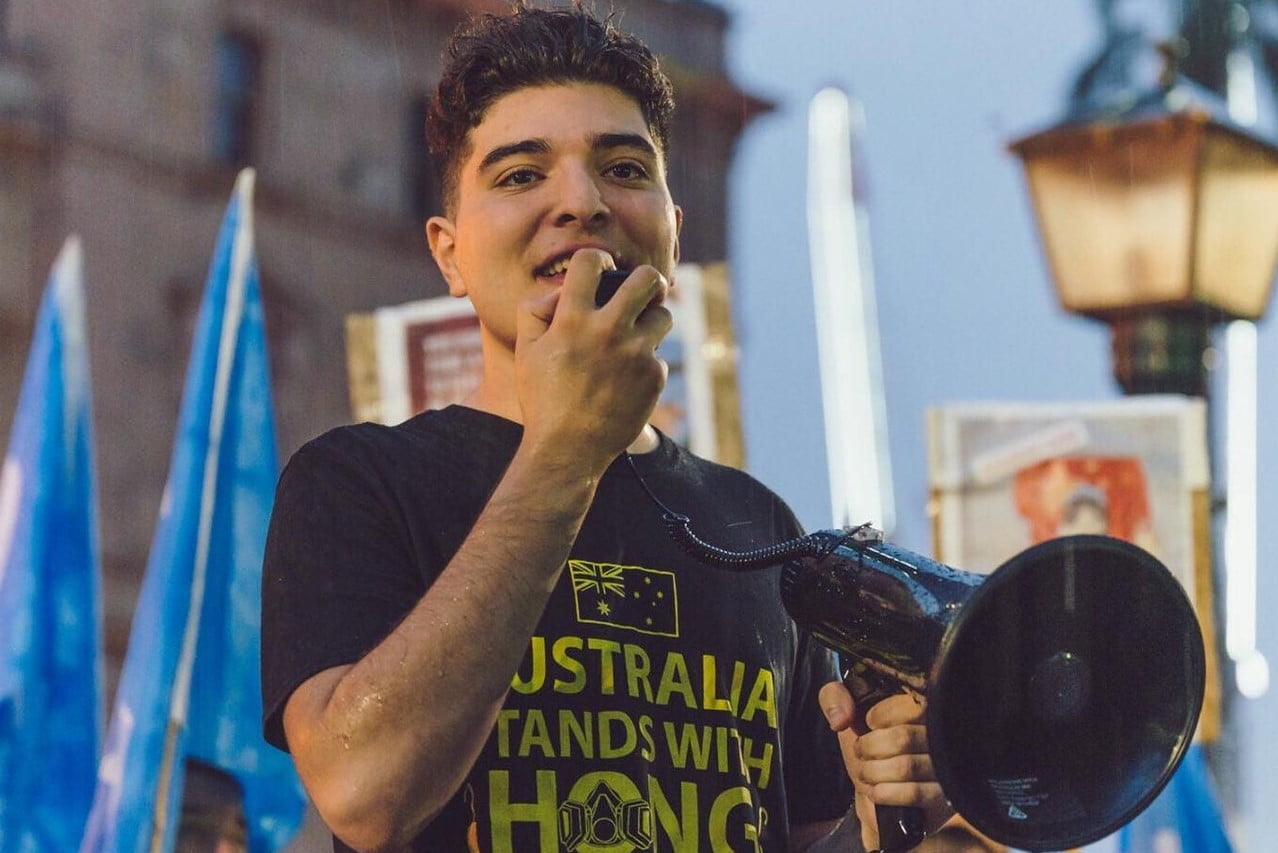
Amnesty International has written to Foreign Minister Senator Penny Wong about human rights activist Drew Pavlou, who was arrested by the Metropolitan Police in London last Thursday. He had staged a protest at the Chinese embassy when the Metropolitan Police arrested him over an alleged bomb threat sent to the embassy from an email under his name.
Framing peaceful protests as threats to national security and sending fake emails are common tactics used by the Chinese government against Uyghurs, Tibetans and Hong Kongers. Mr Pavlou believes the fake email address was designed to frame him for his activism. According to his lawyer, circumstantial evidence suggests his client is a victim of a set-up by the Chinese state.
Amnesty International is concerned about the well-being of the 23-year-old activist who has received many threatening messages since the news broke about the false bomb threat.
We urge the Australian government to offer Mr Pavlou every assistance for his safe return to Australia as quickly as possible and ensure his fundamental rights are protected, particularly given the claims made about how he was treated during the arrest and detention.
We also ask for a thorough investigation into the matter.
A two-day hearing in the Federal Court of Australia in Melbourne has closed today with dramatic revelations that question the legality of many immigration detention facilities in Australia.
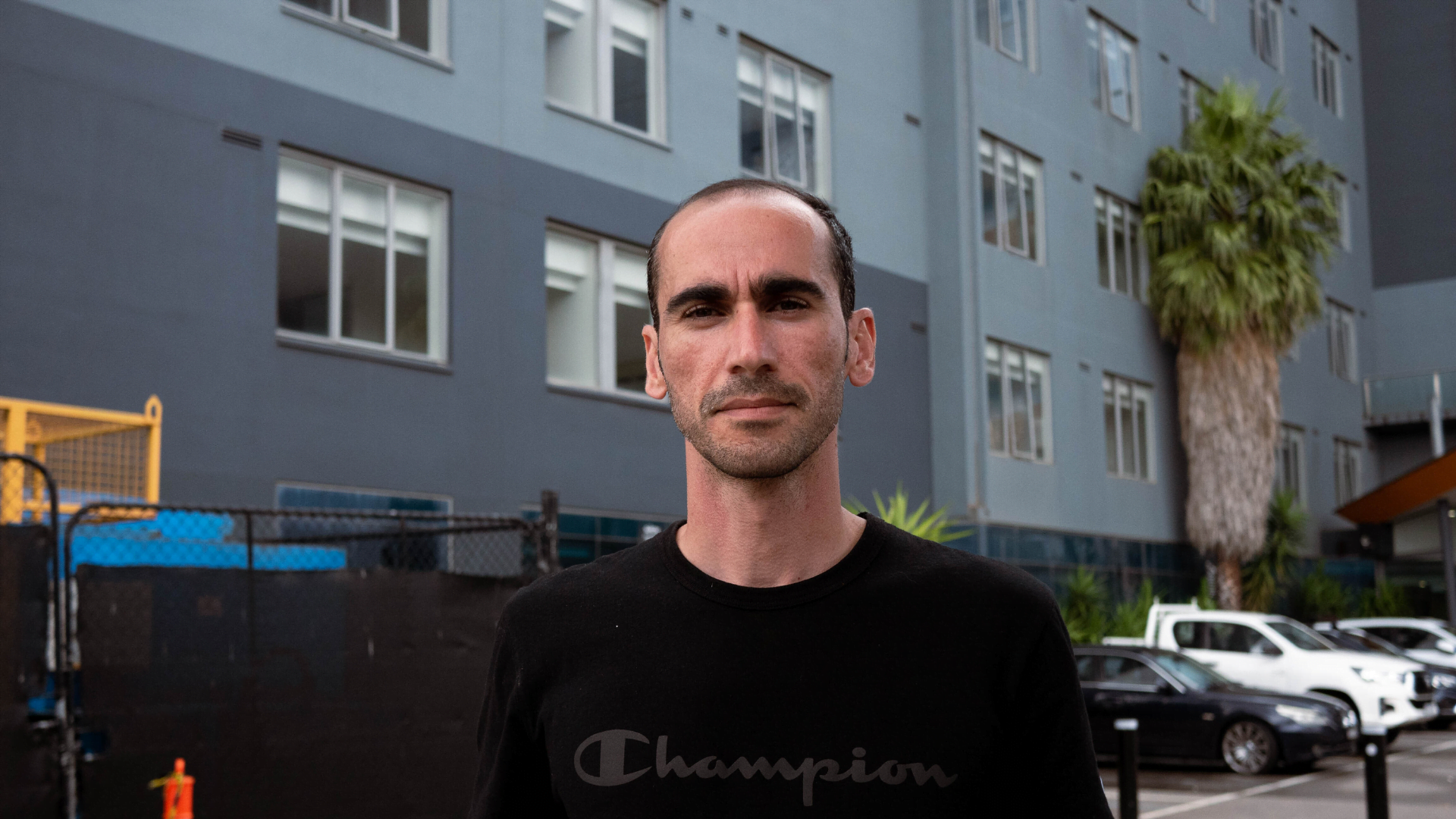
The case examined the legality of the Australian Government’s use of hotels as Alternative Places of Detention (APODs) to detain Mostafa Azimitabar (Moz) and hundreds of other refugees and asylum seekers.
During the hearing, Justice Murphy heard the argument that the Migration Act does not grant the Commonwealth the power to detain refugees and asylum seekers in hotels and, therefore, Moz’s detention for more than a year in the Mantra and the Park hotels was unlawful.
Moz said, “It was empowering to finally get my chance in court over recent days to challenge the Government that has treated me so cruelly. I want justice for my brutal treatment and although this legal matter attacks only one part of the issue, it is important that we fight their cruel policy on every front possible”.
The legal argument rests on the notion that the provisions within the Migration Act that the Government relied on to create APODs were contained within the definitions section of the Act and did not contain the required legal power. However, during the hearing it was revealed that the Government has relied on these same provisions to create other immigration detention facilities such as the Melbourne Immigration Transit Accommodation (MITA), Brisbane Immigration Transit Accommodation (BITA) and Adelaide Immigration Transit Accommodation (AITA).
Today’s dramatic revelation has significant potential implications. Because the MITA and other Immigration Transit Accommodation facilities have been established in the same way as the Mantra and Park Hotels, the legality of these immigration detention facilities are now at the centre of the judge’s deliberations.
“The question of legality of establishing many of Australia’s immigration detention facilities has huge implications for the brutal system of indefinite detention in Australia. If we are successful, thousands of people detained in Immigration Transit Accommodation will have been detained unlawfully.”
Tim O’Connor, Impact Director at Amnesty International Australia.
As of 31 March 2022, there were 258 people detained at the Melbourne Immigration Transit Accommodation, 101 people at Brisbane Immigration Transit Accommodation, 25 people at the Adelaide Immigration Transit Accommodation and 196 people in APODs on Christmas Island.
Background
Moz Azimitabar was detained offshore and in Australia for almost eight years. He is seeking compensation from the Australian Government for what he argues is his unlawful 14 month detention in two Melbourne-based hotels after he was transferred from Papua New Guinea to Australia in 2019 on medical grounds. He was released from the Park Hotel on a bridging visa on 21 January 2021. His time locked up in makeshift hotel APODs, where he was unable to go outside, exercise properly or open a window, compounded by six years trapped in offshore detention in Papua New Guinea, have taken a terrible physical and emotional toll.
The Myanmar military is committing war crimes by laying antipersonnel landmines on a massive scale in and around villages in Kayah (Karenni) State, Amnesty International said today after an on-the-ground investigation in conflict-affected parts of the state.
Antipersonnel landmines are inherently indiscriminate and their use is internationally banned. The landmines laid by the Myanmar military have killed and seriously injured civilians and will have significant long-term consequences, including on displaced people’s ability to return home and to farm their lands.
“The Myanmar military’s use of landmines is abhorrent and cruel. At a time when the world has overwhelmingly banned these inherently indiscriminate weapons, the military has placed them in people’s yards, homes, and even stairwells, as well as around a church,”
Matt Wells, Amnesty International’s Crisis Response Deputy Director – Thematic Issues.
“The world must urgently respond to the military’s atrocities against civilians across Myanmar. Countries around the world must cut off the flow of weapons to Myanmar and support all efforts to ensure those responsible for war crimes face justice.”
From 25 June to 8 July, Amnesty International researchers interviewed 43 people in Kayah State’s Demoso, Hpruso, and Loikaw Townships. These areas have been at the centre of fighting between the military and Karenni armed groups since May 2021, when conflict in Kayah State re-ignited following the military coup.
The organization interviewed landmine survivors and other witnesses, as well as health professionals who treated landmine injuries and people who had discovered and deactivated landmines in villages. It also visited several recently demined villages.
The Myanmar military is laying several types of landmines that it manufactures itself. These include the M-14, which typically blows off the victim’s foot at the ankle, and the more powerful MM-2, which often blows off the victim’s leg at the knee and causes injuries to other parts of the person’s body, with severe risk of death due to blood loss.
Antipersonnel landmines, including the M-14 and MM-2, are inherently indiscriminate and their use is banned under customary international humanitarian law, as well as the 1997 Mine Ban Treaty, which 164 states have joined. According to Landmine Monitor, Myanmar’s military is the only state armed forces confirmed to have used antipersonnel landmines in 2020-21.
Civilians killed and injured
Lu Reh, 62, and his family were displaced from Daw Thea village in Demoso Township in late February 2022 after a Myanmar military air strike killed two people in a neighbouring village. On 10 June, he and others returned to collect things from their property.
As he walked along a dirt path to collect jah fruit, Lu Reh stepped on a landmine that ripped off his right leg just below the knee, leaving the bone exposed at the calf. According to a witness and another person with direct knowledge of the incident, it also wounded his left leg and right hand and caused significant blood loss. Lu Reh died on the way to the hospital.
The Myanmar military has controlled that area since February 2022 and soldiers from the 66th Light Infantry Division (LID) have based themselves out of several nearby villages.
The Karenni Human Rights Group (KnHRG) has documented at least 20 civilians killed or seriously injured by landmines in Kayah State since June 2021. According to activists, local aid workers, and people without formal training who have tried to demine villages, the military’s use of landmines there has soared in recent months, especially as they retreat from certain areas.
In early April 2022, Rosie, 52, and her daughter Ma Thein Yar Lin, 17, were trying to return to their home in Loikaw town after being displaced by fighting in January. Rosie parked their motorbike near a rocky path, and Ma Thein Yar Lin walked a short distance away to go to the bathroom.
“I heard the explosion, then I looked and saw a lot of smoke,” Rosie recalled. “I heard my daughter yelling, ‘Mama, Mama,’ and I went to look and saw her lying on the ground.”
“I noticed that my daughter had no leg anymore… I went searching for [her leg], but the man who [was passing by and stopped] to help us said, ‘Stop! There will be another landmine. The most important thing is to stop the bleeding.’”
Ma Thein Yar Lin lost her right leg from the mid-calf down and had landmine fragments throughout her left leg. She now uses a wheelchair donated by a friend. She and her mother cannot return to their home partly because the house and bathroom are not accessible.
She told Amnesty International that she wants to continue her studies; she had reached Grade 11 before the Covid-19 pandemic and the coup stopped her schooling. She said she also wants to ensure her leg recovers so that she can be fitted with a quality prosthetic.
Attack on a church
On 27 June 2022, Amnesty International researchers visited St Matthew’s church in Daw Ngay Khu village in Hpruso Township. The military had planted at least eight landmines on church grounds in mid-June, when there was fighting in the area.
Amnesty International photographed areas where landmines had been removed, including along the main entrance path and behind the church. People involved in demining the church believed there were more landmines there that had yet to be discovered.
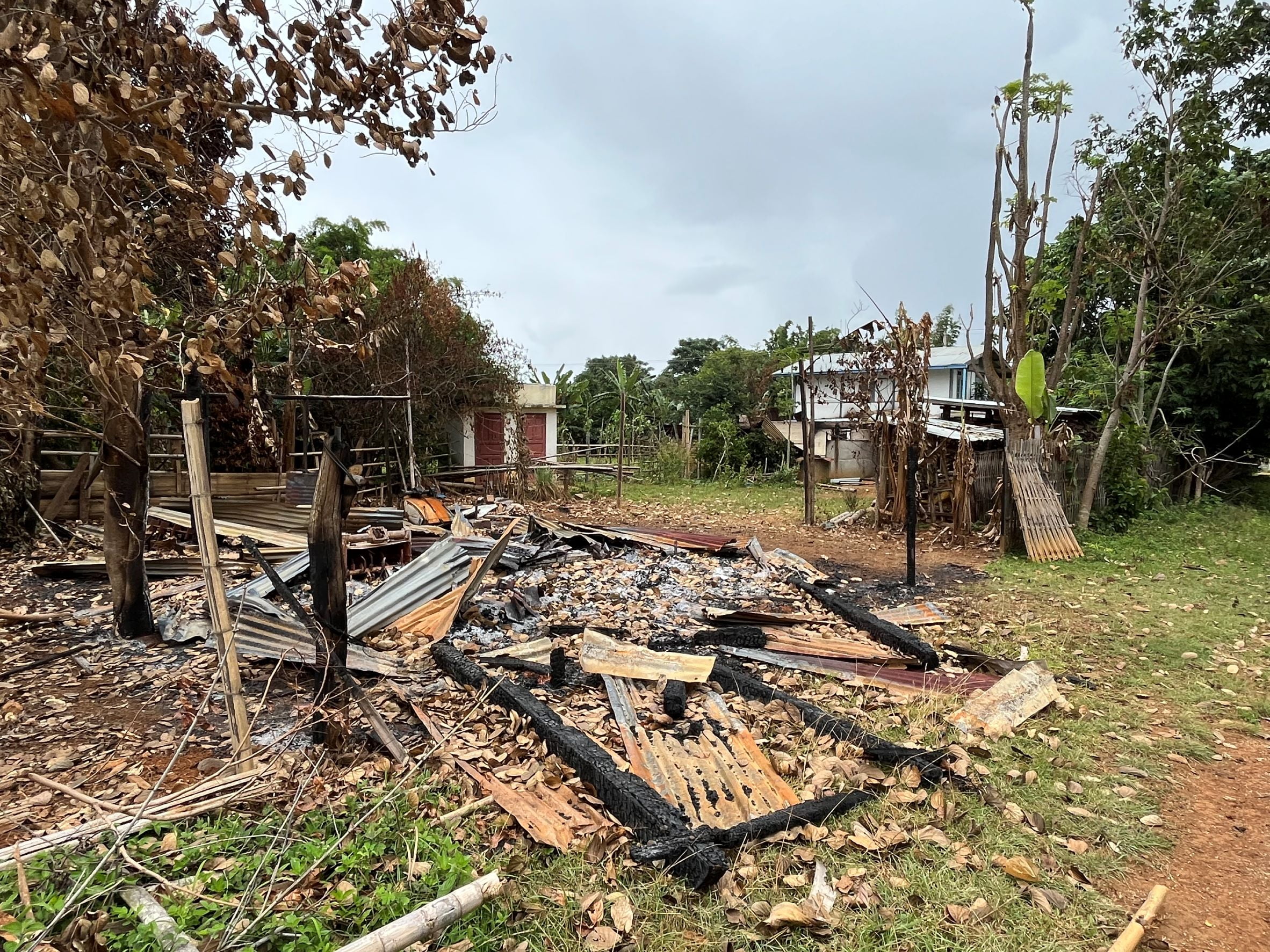
On the afternoon of 15 June, soldiers also burned down the church and the priest’s house next door. When Amnesty International researchers visited 12 days later, the grain stored in the priest’s house was still smouldering.
A 41-year-old woman from Daw Ngay Khu told Amnesty International: “That church was the centre of our village. We worried about our things [when the military started coming], so we brought them to the church to keep [them] there. We thought the Myanmar military would not attack the church, that it was a hallowed place.”
Researchers saw a discarded uniform of the 66th LID on the church grounds, along with bullet casings and a used round from a 40mm grenade launcher.
Amnesty International previously implicated the 66th LID in war crimes and likely crimes against humanity in Kayah State, in a report published in June 2022.
In addition to the church, Myanmar soldiers laid landmines in and near homes in Daw Ngay Khu village, according to six people who lived there as well as people who had demined parts of the village. Other areas of Daw Ngay Khu likely remain contaminated.
Widespread displacement and fear
Amnesty International received credible information that the Myanmar military has laid landmines in at least 20 villages in Hpruso, Demoso, and Loikaw Townships in recent months. There are likely many more contaminated villages across Kayah and southern Shan States.
The military appears to be systematically laying landmines near where it is based as well as in areas from which it retreats. The region along the main road between Moe Bye in southern Shan State and Hpruso town in Kayah State is particularly contaminated. The military systematically burned homes in the same area from February to April 2022, as Amnesty International reported previously.
Soldiers have placed landmines in people’s yards, at the entrance of homes, and outside toilets. In at least one documented case, soldiers boobytrapped a house stairwell with a trip-wire improvised explosive device (IED). They have also placed landmines on paths to rice fields, and credible evidence indicates that at least one civilian was seriously injured recently from stepping on a landmine when going to their field.
Displaced civilians across these areas of Kayah State told Amnesty International that fighters from ethnic armed groups had warned them about the military’s use of landmines in their villages and said they should not go back. The warnings have helped to limit civilian casualties so far, but many people are desperate to see their property and to work their fields during the planting season.
Paulina, 20, a teacher from Daw Ngay Khu village, said her house was damaged by a military mortar during fighting and that soldiers then based themselves in the village. She said:
“Last year we could move back and forth and get things from our village. But this year we dare not go back… We are worried about landmines, because they plant them anywhere.”
Limited demining is overwhelmingly being undertaken by members of armed groups, who do it by hand with only rudimentary equipment and without any professional training. Contamination remains widespread.
The threat to lives and livelihoods posed by landmine contamination remains an issue in other parts of Myanmar where the military has engaged in conflict with armed groups. In 2017, Amnesty International documentedseveralincidents of landmines injuring Rohingya women, men and children along the border of Myanmar’s Rakhine State and Bangladesh.
“The military’s depraved use of landmines in homes and villages will continue to have devastating effects on civilians in Kayah State for years to come. We know from bitter experience that civilian deaths and injuries will mount over time, and the widespread contamination is already blocking people from returning to their homes and farmland,” said Rawya Rageh, Senior Crisis Adviser at Amnesty International.
“Myanmar’s military leadership should immediately end its use of landmines and join the majority of the world in supporting the Mine Ban Treaty, which includes provisions for demining and victim assistance.
“There is an urgent need for a scaled-up humanitarian response that addresses rising food insecurity and ensures proper rehabilitative, psychosocial, and other needed care for landmine survivors, as well as adequate planning for and resourcing of post-conflict demining operations to clear contaminated areas.”
A two-day hearing in the Victorian Federal Court begins today to challenge the legality of the Australian Government’s use of hotels as Alternative Places of Detention (APODs) to detain Mostafa Azimitabar (Moz) and hundreds of other refugees and asylum seekers.
The hearing before Justice Murphy in Melbourne will argue that refugee Mostafa (Moz) Azimitabar’s detention in the Mantra Hotel for 13 months and then the Park Hotel was unlawful under the Migration Act as the Government does not have the legislative power to turn such hotels into APODs.
Moz Azimitabar was brought to mainland Australia from Australia’s brutal offshore detention regime in Papua New Guinea in November 2019 for medical treatment. He was a recognised refugee at the time.
“I am working with Amnesty and Marque Lawyers to hold the Government accountable for what they did to us in those hotel prisons. My treatment was immoral, unethical and illegal. I will not give up.”
Mostafa Azimitabar.
Michael Bradley, managing partner at Marque Lawyers, representing Azimitabar, said: “According to our reading of the Migration Act the Government does not have the power to establish and maintain detention centres in hotels and therefore Moz’s detention for more than a year in the Mantra and the Park hotels was unlawful.”
When detained in the Mantra and Park hotel APODs, Azimitabar was heavily guarded and often locked in his room for up to 23 hours a day, for nearly two years. He had no access to the outside world let alone the proper medical treatment he was brought to Australia to receive.
Tim O’Connor, Amnesty International Impact Director, said: “Amnesty is supporting this legal case against the Commonwealth of Australia because we believe Moz’s detention was unlawful and the deprivation of his liberty in this way has caused untold physical and psychological damage.”
“While there now has been a change in approach for the vast majority of people who were detained in this way, we want to see permanent changes under the Migration Act that will ensure this never happens again,” said O’Connor.
Azimitabar was released from detention in Australia on 21 January 2021. He is living and working in Sydney on a bridging visa for which he must reapply every six months. He is allowed to work but does not have the right to study.
The conditions of Azimitabar’s release continues to cause harm by trapping him in limbo, unable to study or move on with his life. Azimitabar is among 31,000 refugees in Australia forced to live in this way without a permanent resettlement solution.
“The Australian Government tries to limit my freedom, but they cannot limit my dreams. And so I will continue to fight for my freedom,” said Azimitabar.
Background
Moz Azimitabar was detained offshore and in Australia for almost eight years. He is seeking compensation from the Australian Government for what he argues is his unlawful 14 month detention in two Melbourne-based hotels after he was transferred from Papua New Guinea to Australia in 2019 on medical grounds. He was released from the Park Hotel on a bridging visa on 21 January 2021. His time locked up in makeshift hotel APODs, where he was unable to go outside, exercise properly or open a window, compounded by six years trapped in offshore detention in Papua New Guinea, have taken a terrible physical and emotional toll.
In a joint statement with Pacific Islands Students Fighting Climate Change, Greenpeace, 350 Pacific, Oxfam, Vanuatu Climate Action Network, Climate Action Network Pacific and Climate Action Network International, Amnesty has welcomed the support from Pacific leaders for an advisory opinion on climate change from the International Court of Justice (ICJ). In the statement, the alliance acknowledged that this first-step must be the catalyst for a global groundswell of support ahead of the UN General Assembly in September.
Led by the Vanuatu Government, and supported by a global alliance of civil society groups, representing more than 1,500 civil society organisations in 130 countries, the campaign for an ICJ advisory opinion is designed to provide an international legal framework for those experiencing the worst of the climate crisis to affect broad, accelerated change.
The campaign is in response to the human rights crisis caused by climate change, with hundreds of millions of people in vulnerable countries having their livelihoods, housing, food, water, sanitation, healthcare and the environment severely impacted.
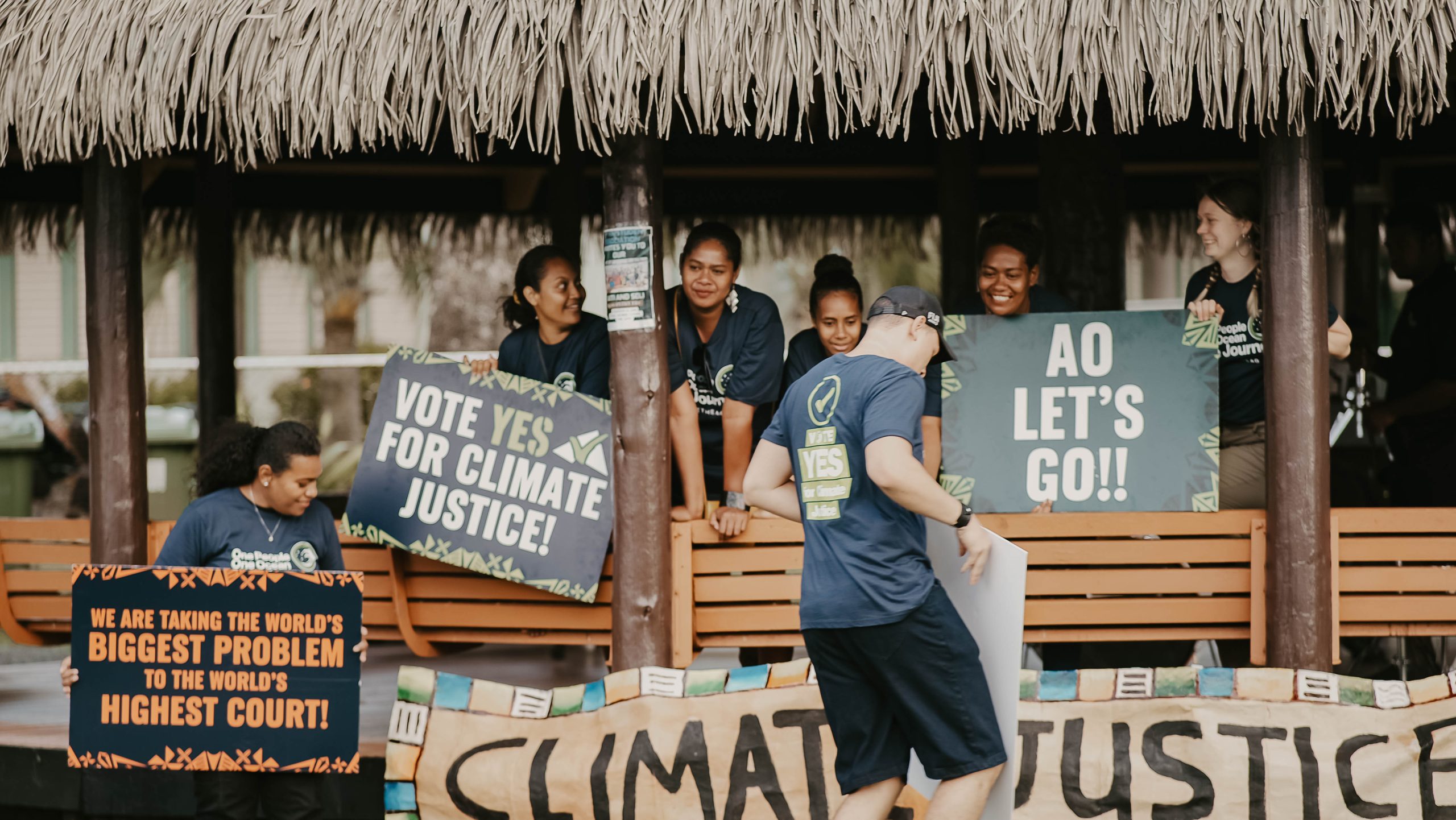
The decision to support the campaign comes following dedicated efforts from Pacific youth and civil society, who recently held a Pacific Solidarity Festival calling on Pacific leaders and family across Australia and New Zealand to back the cause.
Vishal Prasad, Pacific Islands Students Fighting Climate Change campaigner, said the endorsement from PIF leaders is a major step on the campaign’s voyage, which would help create a global groundswell.
“Pacific leaders have grasped the opportunity to help change the course of climate justice for the Pacific and around the world.
“The Advisory Opinion Campaign is well on the way to becoming a reality. We invite people from around the world to join us on this journey, because while this initiative started in the Pacific it is truly a global campaign. All countries in the United Nations will have the opportunity to vote for climate justice this year, but now is the crucial time for them to come out and show their support.
“This is a major step on our shared journey to link the impacts of climate change with our fundamental human rights, and welcome recognition from Pacific leaders of those rights. Pacific livelihoods, health, culture and the environment are at serious risk, and we are hopeful about having recourse to change the course through an advisory opinion.
“Supporting the campaign for an ICJ advisory opinion costs nothing, but means everything to nations hit hardest by the climate crisis. This is an idea whose time has come.
Steph Hodgins-May, Greenpeace Australia Pacific senior campaigner, said support for the ICJ advisory campaign is welcomed, but must be part of a broader effort from Australia to mitigate the impacts of climate change.
“Australia’s endorsement of the campaign for an advisory opinion on climate change from the ICJ is welcome, and demonstrates Australia is serious about both tackling the climate crisis, and strengthening its relationship with the Pacific.
“However, this endorsement cannot be viewed in isolation. To be a true Pacific family member, Australia must not only champion the journey towards climate justice through the campaign for an ICJ advisory opinion, but also pursue more ambitious climate action by committing to no new coal and gas projects.”
Rose Kulak, Amnesty International Australia campaigner, said that “By giving endorsement, Australia can now step up and be a global leader in creating support for the upcoming vote in the UN General Assembly. A majority vote is needed at the UN before the ICJ can provide its advisory opinion on the human rights impact of climate change. We need Australia to champion this on the world stage.
“Climate change is a human rights crisis of unprecedented proportions, affecting health, food, water, housing, livelihoods and life itself. It is a threat to not only individuals but to entire cultures and peoples. This support from Pacific leaders for an ICJ advisory opinion is a crucial step in shaping climate action from a much needed human rights perspective.”
Joseph Zane Sikulu, 350.org Pacific Managing Director said, “Time and again, Pacific Island leaders have shown the world what true climate leadership looks like.
“This endorsement of the campaign for an ICJ Advisory opinion is a welcome message that Pacific, New Zealand and Australian leaders want to be on the right side of history, and it must be backed up by action.”
“This voyage did not start here, nor does it end with this endorsement. We carry on the legacy of climate leaders from Tuvalu, Marshall Islands and Kiribati who fought for a target of 1.5°C to stay alive, and our canoe will not rest until we secure a safe and livable future. Now it is time for the rest of the world to follow suit.”
Ashwini Prabha, Board Chair of the Pacific Islands Climate Action Network said, “Supporting the ICJAO is a test for global solidarity on climate emergency in times of critical energy and geopolitical debates where many countries are expanding fossil fuels instead of phasing out, jeopardising our chances to remain below the 1.5 degree celsius threshold.
“All citizens around the world need their basic human rights protected and the ICJAO can ensure this recognition. Pacific civil society is counting on support from all regions around the globe in the months ahead culminating in a majority vote at the UN General Assembly in September in New York.”
I never had the language to describe how I felt within myself in terms of my gender or sexuality. Terms like non-binary, gender non-conforming, gender diverse were foreign to me until recently and once I learned what they meant I knew it was me. I never came out as non-binary, or queer for that matter – I just am and the people around me know that.
I am a Gunggari non binary femme, my pronouns are they/them and I make allowances for mob to call me sis.
There’s always been this expectation that if you exist anywhere on the non-binary spectrum you’ve gotta serve androgyny and that you can’t really be ENBY unless you’re wearing an oversized suit and slicked hair, I’m here to tell you that whilst that is absolutely my favourite lewk, non-binary people don’t owe you a single thing.
See, non-binary folks have existed without oversized suits for as long as time itself.
In every culture in the world, there exists people who don’t conform to western/White/colonial constructs of gender identity – you should learn about them, their histories, and the significance and sheer magic of non-binary people from all around the world at all points of history.
Each year, there’s this special day just for us where we acknowledge and respect and celebrate how deadly non-binary folks are, while simultaneously providing free labour and education on who we are and the complexities of our identities. There’s not enough representation of non-binary babes in our worlds, and while there’s certainly more now then ever before, there’s still so much to go to get what we deserve.
See, the fight for representation, for understanding, for justice for my fellow non-binary babes is about more than pronouns and dismantling the expectation of androgyny, it’s about love and care that is affirming and validating.
This Non-Binary people’s day, I urge you to love those in your life who fall outside the gender binary, because that kinda love is radical, and we deserve it.
Maggie Munn (they/them) is a Gunggari person and campaigner for Amnesty International Australia.
Mostafa (Moz) Azimitabar was detained offshore and in Australia for almost eight years. Now, Moz is taking the Government to court. To fight back in the face of such oppression takes great courage – and we stand with him.
Over the past 30 years, Amnesty has continued to monitor all forms of immigration detention – on mainland Australia and Christmas Island – as well as on Nauru and Papua New Guinea (PNG). We will continue to campaign tirelessly to challenge injustice and bring refugees and people seeking asylum to safety.
Australia’s offshore detention regime
Refugees in Australia’s care have been subjected to a cruel regime of indefinite detention. In 2013, the Rudd Government announced that no one arriving by boat would be resettled in Australia, even if they were recognised as a refugee. It declined New Zealand’s offer to resettle 150 refugees per year from offshore detention – an offer that has been on the table since 2013.
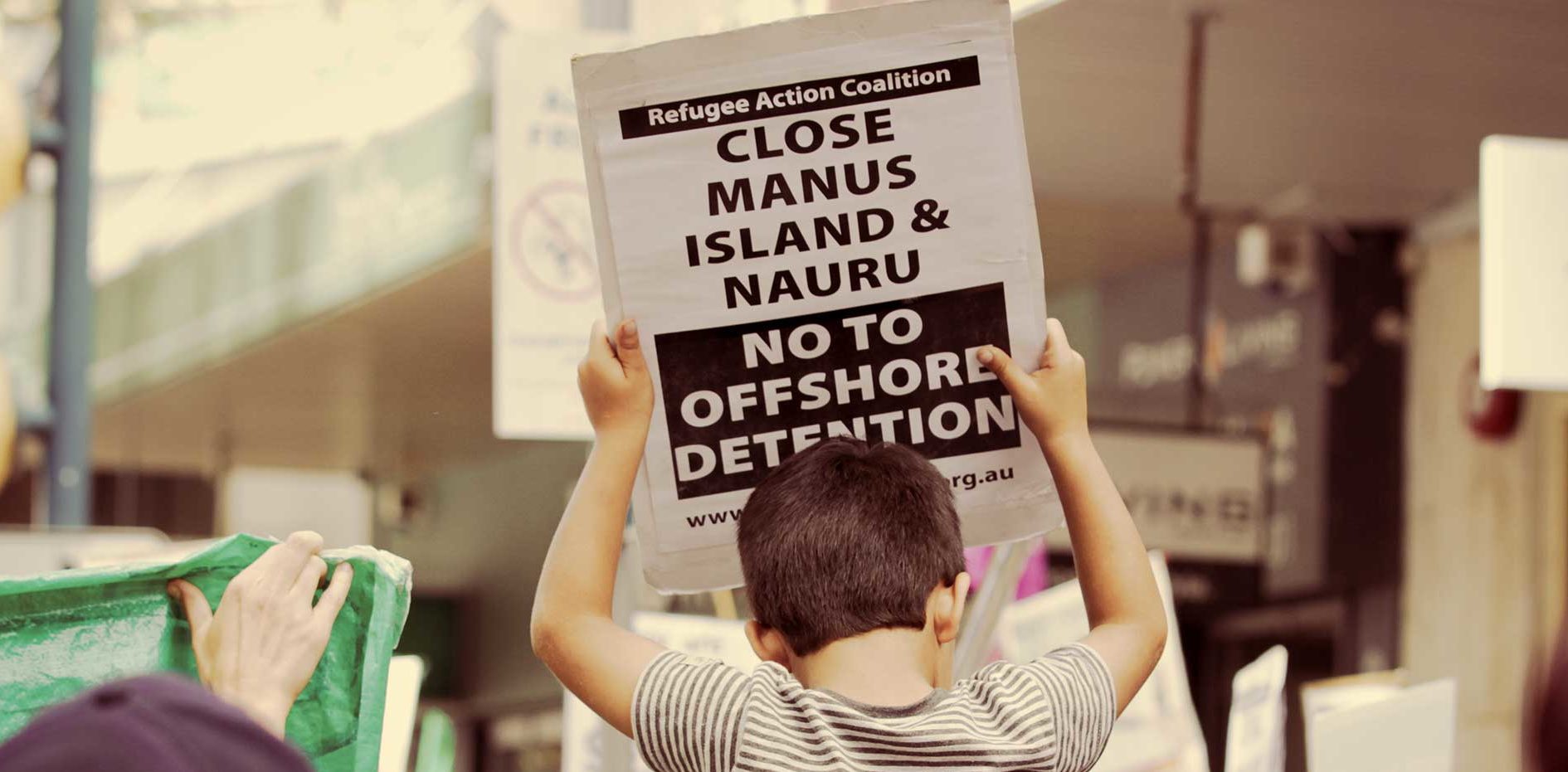
Australia takes in a very small portion of the world’s refugees. As of February 2022, 1,534 people who sought refuge in Australia were forcibly transferred to the detention facilities.
Thousands of refugees and people seeking asylum were trasnferred to Nauru and PNG, and kept in terrible conditions that caused untold psychological and physical torment. Here, they were detained for indefinite periods of time. 14 people have lost their lives as a result of Australia’s offshore detention policy.
Offshore processing has failed. The Government’s approach isolated and harmed people, rather than helping them. Beyond the reports of physical and sexual abuse, including of children; inadequate medical attention; suicides and attempted suicides; even a murder; the extinguishment of hope pushed people to the edge.
Refugee rights
Seeking asylum is a fundamental human right. Everyone has the right to life and liberty. Everyone has the right to freedom from fear. Everyone has the right to seek asylum from persecution.
Consecutive Australian Governments have attempted to expand the immigration detention regime, resulting in refugees being detained in conditions that amount to torture. The policies towards refugees and people seeking asylum have been consistently criticised by a number of United Nations (UN) Treaty Bodies.
The Australian Government has breached a number of laws and conventions, including:
The Universal Declaration of Human Rights – everyone has the right to seek asylum
The 1951 Convention Relating to the Status of Refugees (Refugee Convention) – protects the right to seek and enjoy asylum, a right afforded to children, men and women who have to flee persecution or other serious human rights violations
International Covenant on Civil and Political Rights – recognises the right to liberty and security of a person and prohibits arbitrary detention
Amnesty’s work and #GameOver
The rights of refugees and people seeking asylum has been an important area of work for Amnesty in which extensive research, reports and submissions have been published that deal with issues of mandatory and indefinite offshore detention centres.
In 2019, when Amnesty started the #GameOver campaign to establish precedents for safe, long-term and sustainable resettlement options for refugees, more than 600 people were still trapped offshore. Moz, as he has come to be known, was one of these people the Australian Government has treated so cruelly. Yet despite this torture and oppression he faced, he courageously continues to speak out.
Moz is a Kurdish refugee who fled his conflict-driven home out of fear for his life. Yet upon his arrival in Australia, he was sent to Manus Island where he was tortured and deprived of his fundamental human rights. He was Medevaced to Australia at the end of 2019 for urgent medical care and detained offshore for almost eight years. Amnesty supporters have stood with Moz and collectively called for change since the policy of offshore detention was implemented.
In March 2022, after nine long years, the Australian Government finally accepted New Zealand’s long-standing offer of resettling refugees trapped in limbo in Australia’s cruel offshore detention regime. The current deal will see 150 refugees per year for three years being resettled in New Zealand. This leaves a shortfall of approximately 500 people who will still require permanent resettlement solutions. The Government must commit to ensuring their safety.
Accepting the New Zealand offer is a small step to recovering Australia’s humanity by allowing refugees the opportunity to live in safety and restart their lives.
What are APODs?
Alternative Places of Detention (APODs) are a type of detention facility used in Australia. They include hotels that have been temporarily repurposed as places of detention. Many of those who were transferred to Australia from PNG and Nauru for urgent medical treatment were detained in APODs.
The use of APODs has meant refugees who were brought to Australia to receive urgent medical treatment have been forced to live out just another nightmare. Amnesty has received reports of people being locked in their rooms for up to 23 hours a day, for months on end, they’ve had nearly no access to the outside world, yet alone the proper medical treatment they were brought to Australia to receive.
Amnesty maintains that the use of APODs by the Australian Government is unlawful and a breach of Australia’s international human rights obligations. There is nothing ‘alternative’ to this form of detention. Many report conditions within APODs as far more restrictive than that of traditional detention centres.
According to the United Nations High Commissioner for Refugees’ ‘Revised Guidelines on Detention’, APODs do not fall within the parameters of ‘alternatives to detention’ and they should only ever be used for “very short periods of time and under exceptional circumstances.”
Because people didn’t stop raising their voices, over the last year, we’ve seen approximately 200 refugees and people seeking asylum released into the community from APODs, along with the Australian Government accepting New Zealand’s resettlement deal.
However, no reasoning has ever been provided as to the length of detention nor timing of releases. While some were granted freedom, others remain detained, reinforcing the arbitrary nature of this type of detention. There is also currently no prohibition against the future use of APODs, and for refugees and people seeking asylum once detained in APODs and now living in the community, the conditions of their release are simply unacceptable.
Amnesty has made a submission to the Australian Human Rights Commission’s inquiry into the use of Alternative Places of Detention (APODs).
Kurdish-Iranian refugee, Mostafa (Moz) Azimitabar, who was detained offshore and in Australia for almost eight years, is taking legal action against the Australian Government seeking compensation for his alleged unlawful 15 month detention in what he calls ‘the prison hotels’ – the Government calls these APODs.
The hearing will take place over three days, from 19 to 20 July 2022.
The case before the Federal Court will argue that Moz’s detention in the Mantra Hotel and then the Park Hotel where he was transferred to for medical care was unlawful under the Migration Act, as the Government does not have the legislative power to turn such hotels into detention centres in this way.
Moz’s time locked up in hotels, where he was unable to go outside, exercise properly or even open a window, compounded by six years trapped on PNG, have taken a significant physical and emotional toll. This went on for eight long and painful years.
“The conditions in the Mantra and Parks [APOD] prisons were much worse than you can imagine. I didn’t get any sunlight inside the room for 23 hours. There was no tranquillity, everything was a headache.”
Moz’s story of horror and abuse is one of thousands. As war currently tears families apart around the world, refugees are looking to Australia in search of a better future. Instead, they are met with trauma, abuse, and some of the cruellest and most punitive policies anywhere in the world. They haven’t found safety on our shores; they’ve found relentless horror.
If successful, this case will create a national precedent and draw a line in the sand concerning the expansion of the detention regime in Australia. If the court rules in Moz’s favour, the same legal argument applies to anyone who has been or is currently detained in an APOD. While Moz couldn’t seek relief on behalf of others through this case, the Government would need to apply the consequences of the court’s decision more broadly.
We are standing with Moz. Amnesty is assisting with this case because APODs are even worse than immigration detention centres – and also because we believe the manner in which these cruel centres were established is illegal.
How you can support
Send Moz a message of solidarity. Together, we can let Moz know that he is not alone – that there’s thousands of us who stand with him, and are thinking of him before he bravely takes the Australian government to court.
Read our submission to the Australian Human Rights Commission’s Inquiry Into the Use of Alternative Places of Detention.
Amnesty is a movement of everyday people joining together to challenge injustice and defend human rights. For 60 years, we’ve been shining a light in the darkness to expose abuses, ensure accountability, change laws and improve lives.
By the end of 2025, Amnesty’s vision is to raise refugee and humanitarian intake numbers, increase community resettlement, secure the release of those incarcerated on- and off-shore and build safe pathways for refugees into Australia. Learn more about our refugee rights campaign work.
Amnesty International Australia has made a submission to the Office of Alex Greenwich, Independent Member for Sydney, regarding a new Equality Bill for NSW.
The human rights of LGBTQIA+ people in NSW (or born in NSW) are not adequately protected by current NSW legislation and legal structures. This leads to discrimination, lack of access, impacts on wellbeing, inclusion, physical and mental health and serious human rights abuses. The NSW Government must take urgent action to address this situation.
In this context, Amnesty welcomes the creation of an Equality Bill for NSW and appreciates the work of Alex Greenwich and his team as well as the tireless efforts of the LGBTQIA+ community to advocate for equality, dignity, justice and freedom.
When ordinary people stand up for freedom, equality and justice, we move closer to a world where human rights are enjoyed by all —it’s a work in progress.
Thanks to Amnesty International Australia’s (AIA) supporters, we’ve achieved some incredible wins in the first half of 2022. Whether you help provide lifesaving relief, raise awareness, or put pressure on the governments in charge, every action you take is helping drive our nationwide advocacy campaigns.
In March 2022, the Australian Government accepted New Zealand’s long-standing offer of resettling refugees trapped in Australia’s cruel offshore detention regime.
In 2019, when we started the #GameOver campaign, more than 600 people were still trapped offshore. Today, there are just over 200 people still detained in Papua New Guinea and Nauru. With these announcements, these people – left in limbo offshore by the Australian Government’s brutal offshore detention policy – will now have the opportunity to restart their lives.
This is absolutely a historical moment in Australia. The power of people is stronger than politicians. The government couldn’t resist this powerful pressure. Our consistency made this happen.
Mostafa (Moz) Azimitabar, human rights activist and former refugee held in offshore detention
Accepting the New Zealand offer is a small step to recovering Australia’s humanity, and allowing refugees to live in safety and get on with their lives. Your compassion and persistence made this possible.
Remaining refugees released from APODs
In April 2022, the remaining refugees released from Alternative Places of Detention (APODs), including the notorious Park Hotel in Melbourne.
Approximately 200 refugees trapped offshore were transferred back to Australia for medical treatment. Here they were trapped again in run-down hotels, with no access to the outside world. Now, they are living within the community that called for their freedom. Now, our fight continues for a long-term solution.
Sponsorship program has been reformed
In the final days of 2021, we welcomed the announcement from Immigration Minister Hawke of an expanded and improved refugee sponsorship program that significantly reduces the costs of sponsorship for a family of four people, and a commitment for an increase in the program to 10,000 places, and increase in places to almost 6,000 over the next three years.
“After presenting the support of 40,000 Australians, from 40 communities and their local governments calling for a fairer refugee sponsorship program to our political leaders Amnesty welcomes the new pilot scheme and the improved CSP”.
Shankar Kasynathan, former AIA refugee campaigner
AIA’s My New Neighbour campaign, born in response to the world’s refugee crisis, was recognised by the Minister as a key factor in delivering this outcome. Community sponsorship – where everyday people in the community contribute towards the cost of resettling a refugee – enables families to rebuild their lives in safety.
Increased the refugee and humanitarian intake
Since 2020, Australia has reduced its annual humanitarian intake by 5,000 places each year. The intake is already at its lowest in decades. As world crises like Ukraine, Afghanistan and Myanmar escalate, Australia has the capacity to help.
As part of AIA’s responsive campaign work, our Amnesty researchers verified the Russian military’s violations of the laws of war and over 15,000 supporters called for Australia to welcome more Ukrainians seeking safety. Similarly, news articles about our research in Afghanistan, like this one, were seen over 260,000,000 times, and more than 42,000 people took action calling for Australia to provide safe passage to people fleeing the Taliban.
In March 2022, AIA campaigners stood alongside representatives of communities from Myanmar, Afghanistan, and Ukraine at Parliament house to urge for additional humanitarian places for people seeking safety.
Our supporters’ compassionate actions plus AIA’s advocacy with communities has been recognised by the Home Affairs and Immigration Ministers and resulted in:
2,000 additional places made available within the humanitarian intake for people fleeing from Myanmar’s humanitarian emergency due to the military junta’s consistent attacks on civilian areas;
16,500 places for people to be resettled from Afghanistan to meet the needs of people fleeing Afghanistan since the Taliban’s violent takeover in August 2021;
5,000 places for Ukrainians seeking refuge from the devastating outbreak of war in February 2022.
What’s next?
Join the call to hold the new Albanese Government to their promise to increase the Refugee and Humanitarian Program and ensure their promised reforms to the Community Sponsorship Program.
After months of campaigning, direct advocacy with key politicians and through working in coalition with Equality Australia and other LGBTQIA+, disability and health organisations, the Religious Discrimination Bill was shelved in February 2022.
The proposed Bill supposedly protected religious people from discrimination. In reality, it would give religious people the right to discriminate against others.
If the Religious Freedom Bill passes, doctors will be able to refuse health care to the LGBTQI community on the grounds of their religious belief. This will only end up pitting different rights, & people, against each other. It must be scrapped immediately https://t.co/uEnmfbWE8u
— Amnesty International Australia 🕯 (@amnestyOz) January 30, 2020
AIA worked with a broad coalition of rainbow partners tolobby against the passing of Latham’s discriminatory bill targeting LGBTQIA+ communities, falsely titled the NSW Religious Freedoms and Equality Bill. The brilliant submission drafted by the NSW Rainbow Group was a powerful advocacy tool in achieving this outcome.
What’s next?
Call on Prime Minister Albanese to implement a Human Rights Act so that basic human rights are never up for debate. A national-level protection will mean everyone’s rights are protected so that we may live with the dignity and respect we all deserve.
We will continue to fight to secure First Nations justice
In February 2022, AIA amplified evidence illustrating the use of spit hoods and other items labelled by Amnesty as Tools of Torture in the Northern Territory – in direct contravention of the recommendations of the recent Royal Commission.
AIA has been in contact with key political representatives and amplified the issue nationally through the media. We have joined calls from Aboriginal health and rights groups to end the use of spit hoods in detention and will continue to fight to secure justice alongside the First Nations community.
The world’s largest annual human rights event Write for Rights turned 20 years old in 2021. A total of 275,000 actions were taken by 103,000 people in Australia alone, to defend human rights and challenge the injustice of 10 individuals at risk cases around the world. Every year, real change happens because of these actions. Almost one year on, the campaign is already make an impact.
Iranian women’s rights activist Atena Daemi is free
In January 2021, Atena Daemi was released from prison in Iran after years of public pressure. Atena was locked up for five years under trumped-up charges, beaten, pepper-sprayed and forced into solitary confinement for her courageous advocacy to end the death penalty. We met with Members of Parliament about Atena’s imprisonment, 60 of whom wrote to the Iranian embassy calling for her release.
“I’d like to thank you for your empathy, solidarity, support and struggles all these years which have been by family’s moral support and my inspiration. I hope that we’ll achieve our first and last wish, which is freedom, public awareness and the realisation of human rights”
Atena Daemi
More than 22,000 Australians sent solidarity messages to Atena and campaigned for her release during Write for Rights 2018. Every signature counts. Together, we are powerful.
Poland has acquitted the three rainbow halo activists
In January 2022, Poland acquitted rainbow activists Elżbieta Podleśna, Joanna Gzyra-Iskandar and Anna Prus known as the ‘rainbow halo three’ after absurd charges were laid against them for offending religious beliefs when they arranged the Virgin Mary’s halo into a rainbow.
Amnesty supporters in Australia and internationally called for their acquittal.
Mexican-American mother Melissa’s execution has been halted
In April 2022, The Texas Court of Criminal Appeals stayed the execution of Melissa Lucio, two days before she was scheduled to be put to death. She has been convicted of the murder of her two year old daughter – an allegation she has always denied. Now, new expert evidence supports her innocence, concludes the allegations made against her are unscientific, and exposes the unfairness of her trial.
Her case inspired thousands of supporters to take action and demand a halt to her execution.
“I am grateful the court has given me the chance to live and prove my innocence”
Melissa Lucio
Egyptian researcher Ibrahim is released
In April 2022, housing rights researcher Ibrahim Ezz El-Din was released after nearly three years in detention as part of the worst crackdown on freedom of expression in Egypt’s recent history. After being forcibly disappeared for 167 days, Ibrahim finally ‘appeared’ after being brought to the courts in Cairo.
People power and pressure on the authorities has made a huge impact. We will continue fighting for the release of thousands of other human rights defenders jailed on politically motivated charges.
British-Iranian charity worker Nazanin is free
In March 2022, Nazanin Zagari-Ratcliffe was released after years of being unjustly imprisoned on trumped-up national security charges, a familiar tactic in Iran where she was detained. She was separated from her husband and daughter for six years.
More than 29,000 Australians took action for Nazanin, contributing to more than one million actions across the global Amnesty movement.
Together, we’ve campaigned for the freedom of more than 50,000 unjustly imprisoned people like Nazanin. Time and time again, we’ve proven that when we mobilise, we can make governments do the right thing.
Guatemalan Indigenous rights defender Bernardo Caal Xol is released
In March 2022, Bernardo Caal Xol was released from prison in Guatemala where he had been detained for speaking out against the destruction of rivers sacred to his people. As part of Write for Rights 2021, 21,000 Australians contributed to 511,000 global actions demanding his freedom. Bernardo was released and reunited with his family after more than four years of imprisonment.
“Amnesty International gave me hope of freedom and now I am free. I am now with my family, I am now with my daughters, and I am now with my partner. My mother has already cried with happiness to see me free. Thanks to each one of you, thanks to each one of you for spreading and sharing my letters.”
Bernardo Caal Xol
Magai’s child death penalty sentence in Sudan is commuted
In March 2022, Magai Nationg was released from prison. Magai was a 15-year-old secondary school student in Sudan when he was sentenced to death by hanging after being convicted of murder in Sudan, which he claims was an accident.
Magai grabbed global attention through Write for Rights 2019, where almost 18,000 Australians contributed to over 750,000 global actions calling for his death sentence to be commuted.
We will continue to monitor Magai’s case and campaign for the end of the death penalty, in South Sudan and around the world. Learn more about our End the death penalty campaign.
Amnesty International is a global movement of 10 million people standing up for justice, freedom and equality. Together, our voices challenge injustice and are powerful enough to change the world.
Amnesty International Australia is calling for refugees and people seeking asylum on Nauru to be urgently evacuated to Australia while they await resettlement processes owing to the deteriorating and unsafe living conditions on Nauru.
The COVID-19 outbreak on Nauru has spread to about 40 percent of the population and is causing untenable living conditions and suffering for the 112 refugees and people seeking asylum still awaiting resettlement solutions after nearly nine years of detention.
“People are distressed and now facing a terrible situation. They are running out of food with supermarkets in lockdown and they are struggling to access fresh water and medicines,” said Zaki Haidari, Refugee Rights Campaigner, Amnesty International Australia.
“This cruel and failed regime of offshore processing has put refugees into this horrible situation. It is time for Australia to step in and resolve this crisis.”
Zaki Haidari, Amnesty International Australia
Refugees on Nauru are under the Australian Government’s care but they have essentially been abandoned. The Australian Government must commit to ensuring the safety of all refugees trapped on Nauru in this escalating humanitarian crisis.
In light of this crisis, Amnesty is also calling on Prime Minister Albanese to use New Zealand Prime Minister Jacinda Adern’s current visit to Australia to push for an expedited and expanded resettlement deal, which was reached earlier this year under the Morrison Government.
“People were already suffering under this cruel regime, and the current crisis has only exacerbated that. Prime Minister Albanese talks a lot about doing things differently – well he has a great opportunity to do that right now,” said Elahe Zivardar, advisor to Amnesty International Australia who was detained on Nauru from 2013 to 2019.
“The Prime Minister needs to get people to safety and leverage his relationship with Prime Minister Ardern to speed up and expand the New Zealand resettlement process”
Elahe Zivardar, advisor to Amnesty International Australia
Background
Under the current arrangement, New Zealand would accept 450 refugees from Australia’s offshore detention regime over three years, leaving a shortfall of approximately 500 people who will still require permanent resettlement solutions.