Saudi Arabia: Release of women’s rights defender Loujain al-Hathloul long overdue

Responding to the news that the Saudi Arabian human rights defender Loujain al-Hathloul was released from prison earlier today, Amnesty International’s Deputy Director for the Middle East and North Africa, Lynn Maalouf said:

“Loujain al-Hathloul’s release after a harrowing ordeal in prison in Saudi Arabia — lasting nearly three years — is an incredible relief, but long overdue.

“Nothing can make up for the cruel treatment she has suffered, nor the injustice of her imprisonment. During her time in prison she was tortured and sexually harassed, held in solitary confinement and was denied access to her family for months at a time. Saudi Arabia’s authorities must ensure those responsible for her torture and other ill-treatment are brought to justice. They must also ensure she is not subjected to any further punitive measures such as a travel ban.

“Loujain al-Hathloul should never have been forced to spend a single second behind bars. She has been vindictively punished for bravely defending women’s rights in Saudi Arabia, and for exercising her right to freedom of expression.”

Background:

On 28 December 2020, Loujain al-Hathloul was sentenced to five years and eight months in prison  – partially suspended by two years and ten months – by the Specialized Criminal Court. She was charged with “spying with foreign parties” and “conspiring against the kingdom” for promoting women’s rights and calling for the end of the male guardianship system in Saudi Arabia.

Amnesty International is calling on the Saudi Arabian authorities to immediately and unconditionally release all human rights defenders and prisoners of conscience detained solely for demanding reforms and defending basic rights. Those imprisoned include Mohammed al-Bajadi, founding member of the Saudi Civil and Political Rights Association (ACPRA) and prominent human rights defender; and Salman al-Awda, a reformist cleric who faces a death sentence for expressing his opinion in a tweet.

Backtrack Boys Education Resources

BackTrack is a community based not-for-profit organisation helping young people who are having a hard time, get back on track.

The program works with young people that find themselves hanging around in parks, stealing for food, sleeping on the streets, and running into trouble with the police. These young people are on a path to getting caught up in the quicksand of the youth justice system. Through our research, Amnesty International knows that programs like BackTrack are needed to keep kids out of prison.

Most kids who go to prison, end up reoffending. BackTrack works to make sure this doesn’t happen. In the last ten years over 1000 kids have walked through the BackTrack Youth Work’s doors and in that same time the local crime rate has dropped by more than 38%.

BackTrack forms the basis of Backtrack Boys, an observational documentary, filmed over two years, follows boys in the program that Bernie Shakeshaft runs from a shed on the outskirts of Armidale. On the road, the boys find their voice and make great friendships but as the boy’s sleep under the stars at night the trauma is never too far away.

With their survival and futures at stake they must constantly step up, push themselves, support each other and some days can be hard. This inspiring coming of age story reveals the challenges and triumphs these boys face as they try to find their place in the world, and the dogs that help tame their wild ways.

There are several educational resources available to help engage young people with the film. BackTrack is also a supporter of the national #RaiseTheAge campaign.

Those detained by Myanmar military must be released immediately

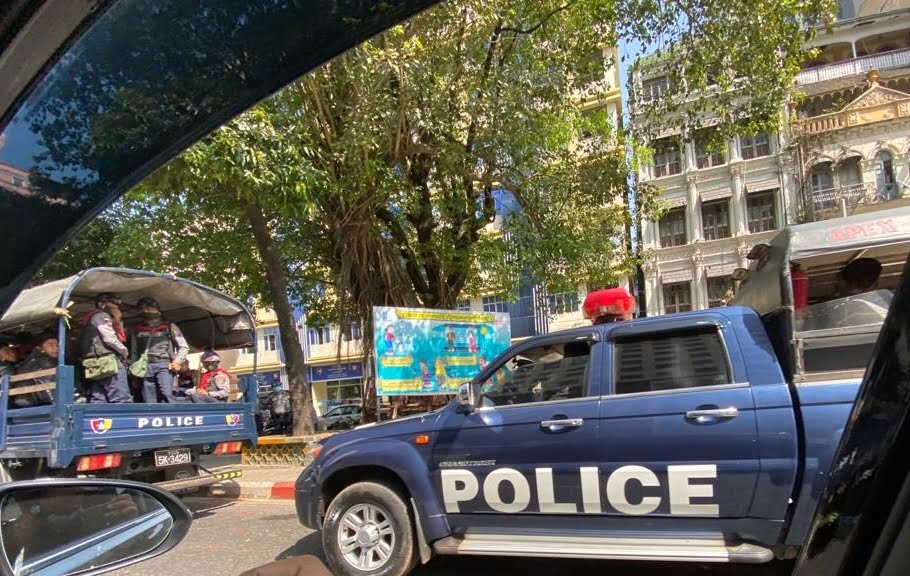
Commenting on the detention of numerous elected officials and others in Myanmar including Australian national Sean Turnell by the military junta, Amnesty International Australia Campaigner Tim O’Connor said:

“We’re aware of reports that an Australian citizen, Sean Turnell, has been detained in Myanmar.  

“We urge the Myanmar military to immediately acknowledge whether he is in custody and on what legal basis, and establish his whereabouts, as for those arbitrarily detained since the coup a week ago.  

“If Mr. Turnell is in state custody, we urge authorities to ensure that pending his release he is held in an official place of detention, has immediate access to independent lawyers, doctors and family members and is effectively protected against ill-treatment. 

“Like all others arrested since the 1 February coup, if he cannot be charged with a recognizable criminal offence under international law then he must be immediately released.

“Foreign nationals detained must be informed of their right and given all reasonable facilities to communicate with, and receive assistance from representatives, of their or an appropriate international organisation if they so desire. 

“Myanmar’s military coup so far has been an abject spectacle of arbitrary arrests and widespread telecommunications blackouts, all designed to bolster the rule of an emboldened, rights-abusing military.” 

Chinese authorities must ensure access to lawyer of choice, consular access for Cheng Lei

Commenting on confirmation that Australian journalist Cheng Lei has been formally arrested by Chinese authorities, Amnesty International Australia Individuals at Risk Campaigner Rose Kulak said:

“Cheng Lei should be released immediately and unconditionally unless there is sufficient credible and admissible evidence that she has committed an internationally recognised offence and is granted a fair trial in line with international standards.

“Pending her release, Chinese authorities must ensure that she has regular, unrestricted access to consular visits, is able to meet and communicate with family and lawyers of her choice and is not subjected to torture and other ill-treatment.

“She should be allowed prompt, regular and unrestricted access to medical care on request, or as necessary.”

Indonesian authorities must end cruel and inhuman punishment of LGBTQIA+ community

In the Indonesian province of Aceh, authorities conducted at least 60 public floggings against 254 LGBTQIA+ people in 2020, 52 of which were conducted after the COVID-19 outbreak started. We can’t stand by and allow the LGBTQIA+ community to be targeted like this.

On Thursday 28 January 2021, two men were flogged in public for allegedly participating in consensual same-sex relations. They were caned 77 times each.

International law prohibits torture and ‘cruel, inhuman, or degrading treatment or punishment’. The UN High Commissioner for Human Rights and the UN Human Rights Committee have made it clear that flogging amounts at the very least to cruel and inhuman punishment. No one deserves to be brutalised and humiliated in this way.

Amnesty International Australia has written to the Indonesian Ambassador to Australia calling on him to work towards ending these cruel and inhuman practices.

This isn’t just about the Indonesian government though. The Australia-Indonesia Comprehensive Strategic Partnership should be centred on human rights. Amnesty International Australia has forwarded the letter to the Ambassador to Minister Marise Payne, Shadow Minister Penny Wong and Senator Janet Rice, calling for Australia to also pressure Indonesia to act.

India protests explained

You may have heard about large scale protests by Indian farmers which have been going on for several months. Protests began on the outskirts of Delhi on November 26 when farmers from Punjab and Haryana states marched to the city and created a number of protest sites. The protests are in response to new farm laws proposed by the Indian government which farmers say will hurt them to the benefit of large corporations.

What are the law reforms?

The proposed laws loosen rules around the sale, pricing and storage of farm produce, which protesters argue will end guaranteed prices for their crops and weaken their bargaining power, making them vulnerable to the whims of big business.

Indian Prime Minister Narendra Modi has defended the reforms, arguing the farmers will benefit from increased investment in India’s agricultural sector.  However, the laws have been likened to a “death warrant” by unions.

What are the main human rights concerns?

While the protests have largely been peaceful, on January 26 there were incidents of violence when, following a pre-planned tractor rally, a convoy of tractors broke through barricades and converged on Delhi’s centre, where protesters clashed with police. Dozens of police officers were injured and a protester was killed in the ensuing demonstrations.

A peaceful assembly does not lose its peaceful character due to sporadic violence or unlawful behaviours of some individuals.  Where a small minority tries to turn a peaceful assembly into a violent one, police should ensure that those who are protesting peacefully are able to continue to do so, and not use the violent acts of a few as a pretext to restrict or impede the exercise of rights of a majority. 

Rather than investigating reports of violence against protesters and bringing suspected perpetrators to justice, the authorities have resorted to hindering access to protest sites, shutting down the internet, censoring social media and using draconian laws against protesters who have been peacefully voicing their opposition to the new laws for several months now. 

The Indian government responded by suspending mobile internet services in three areas around the capital and increasing measures of suppression for a number of the protest sites. Officers, paramilitary and drones have been deployed at three of the camps – Ghazipur, Tikri and Singhu – and layers of concrete barriers, trenches, barbed-wire fences and iron nails in the roads have been used to cut off entry and exit to the sites. Water and food supplies have also been disrupted. 

At least eight leading journalists and politicians have been charged with sedition after reporting on the farmers protests. They have been charged with misreporting, spreading disharmony and inciting riots via their tweets on Republic Day. 

Mandeep Punia, a freelance journalist for The Caravanwas arrested on the evening of 30 January, shortly after The Caravan published a story in which he reported that the ruling Bharatiya Janata Party had sent activists to attack the protesting farmers. Initially accused of obstructing the police, and then of violence, Mandeep Punia was detained for an initial period of 14 days without being allowed to see a lawyer but was later granted bail. 

On 1 February, hundreds of Indian Twitter accounts including those belonging to news websites, activists and actors were suspended for more than 12 hours after the government said users were posting content inciting violence due to their use of the hashtag #FarmersProtests. Twitter reversed its decision by the evening. 

However two days later, on 3 February, the Indian government served a notice on  Twitter to comply with an order to remove content and accounts related to hashtags linked to the farmers’ protest. The same day, many news media organizations reported that journalists’ access to the protest sites were being hindered by the police. 

The UN Office of the High Commissioner on Human Rights called on 5 February for the Indian authorities and protesters to exercise “maximum restraint”, adding that the rights to freedom of peaceful assembly and expression should be protected both offline and online. India is a  member of the Human Rights Council and a state party to the International Covenant on Civil and Political Rights (ICCPR).  

Amnesty urges bold action to clean up the battery industry

Ensuring clean and green battery supply chains must be a priority for businesses and governments during the post-pandemic recovery, Amnesty International said today. The organization has published a set of principles for ensuring that lithium-ion batteries, which power electric vehicles and many electronic devices, and which are essential for tackling climate change, are not linked to human rights abuses or environmental harm. 

Previous Amnesty research exposed how cobalt mined by children in the DRC could be entering the supply chains of some of the world’s biggest electronic and electric vehicle brands, while in South America, evidence points to lithium extraction posing risks to Indigenous peoples’ water resources and fragile ecosystems. Meanwhile the growing demand for “green” battery technologies poses new risks to the environment, including pollution of mining areas, damage to the ocean floor, and mounting waste due to inefficient design. 

“While technologies like electric vehicles are essential for shifting away from fossil fuels, the battery revolution carries its own risks for human rights and the planet. This is a critical moment to rethink the way our economies and industries operate – amid the nightmare of the pandemic, there is a chance to build a fairer and more sustainable future,” said Mark Dummett, Director of Amnesty International’s Global Issues Programme.

“We are calling on businesses at all stages of the battery supply chain to do their bit to ensure they are truly powering change. Human rights must be at the core of their operations – this might mean making supply chains more transparent, providing remedy where they have caused harm, or ensuring Indigenous communities are consulted on mining projects that affect them. 

“Governments also need to show leadership by supporting investments and energy solutions rooted in a just transition. Lack of respect for human rights should be a dealbreaker for any business involved in the battery industry – that means governments need to enforce environmental protection laws, investigate allegations of abuses, and make human rights due diligence a legal requirement.” 

Powering Change 

In Powering Change: Principles for Businesses and Governments in the Battery Value Chain, Amnesty International sets out key principles that governments and businesses should respect to avoid causing, contributing or being directly linked to human rights abuses and environmental harm. 

A number of other human rights and environmental organizations have signed up to the principles – a full list will be available on 1 February.

The principles apply to any businesses involved in the industry, including the finance sector, which is funding a vast expansion of green energy and battery technology through large “ESG” funds. 

Amnesty International calls on manufacturers to design batteries for maximum resource efficiency, including innovations to use fewer materials and minerals, and to work towards 100% safely recycled content in batteries. 

The briefing also highlights the dangers of seabed mining, and calls on businesses and governments to proactively support a moratorium on the practice.  

A recent Greenpeace report  warned that ocean floors are being “carved up” despite serious concerns about the impact of mining on marine ecosystems. Greenpeace found that mineral exploration of the deep sea, a global commons, has been monopolized by a small number of corporations, in the face of grave warnings from environmental scientists.  

Amnesty International also calls on governments and businesses to work with environmental rights defenders and Indigenous communities, ensuring they are consulted and properly informed about planned operations and potential risks.  

“Businesses should treat environmental and human rights defenders as allies, not opponents,” said Mark Dummett. 

“Putting corporate interests above protecting human rights and the environment has been the status quo for too long. The result is shocking global inequality, devastating climate change, and a seemingly endless stream of bad news about the future. It doesn’t have to be this way – we must ensure that new technologies put us all on a path to a better place.” 

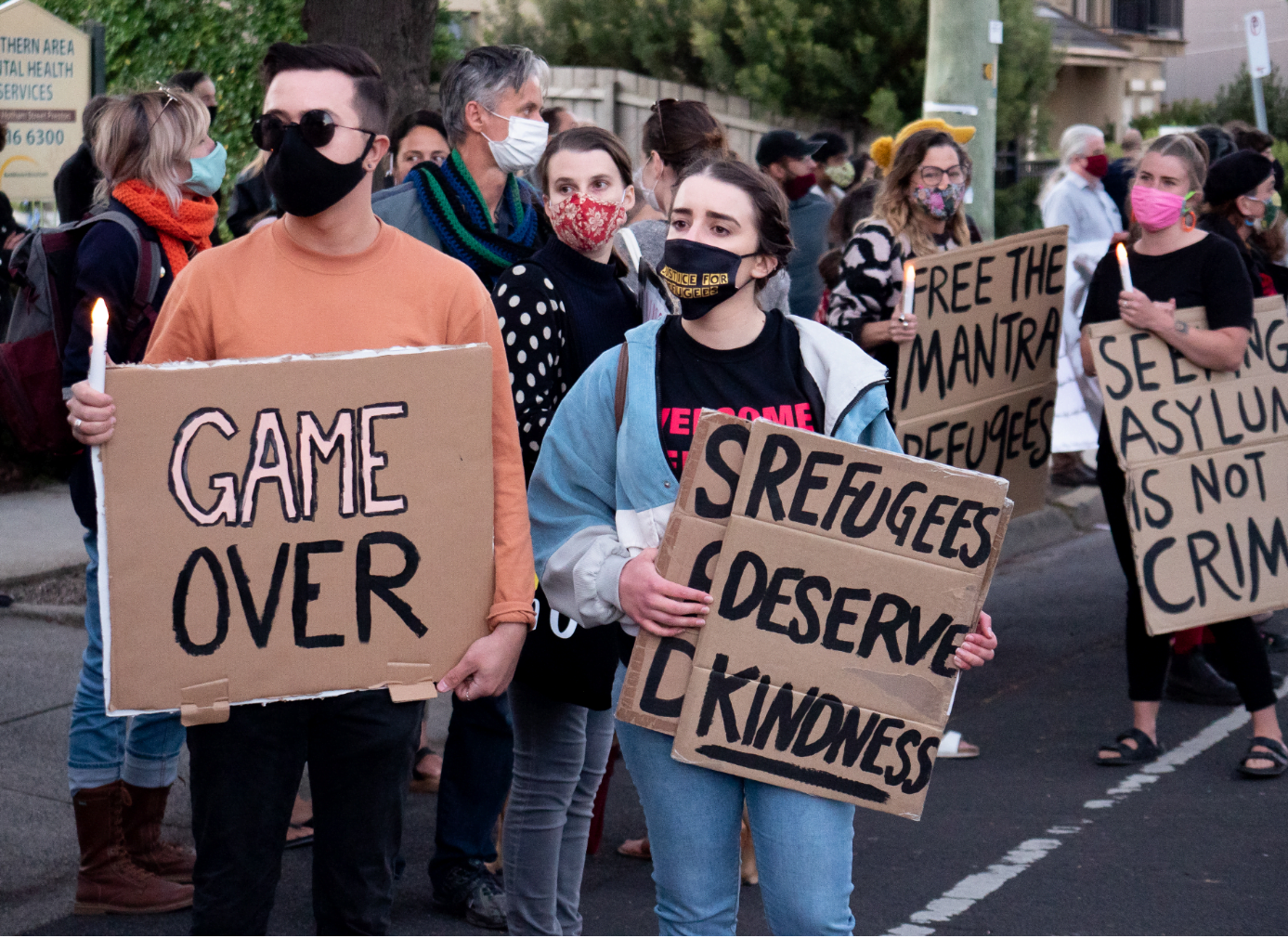
Activist Resources: GameOver

For almost eight years, the Australian Government has designed and maintained a deliberate system of abuse for thousands of adults and children who have fled their homes in search of safety.

In early 2021, we have seen progress with the release of refugees who have been detained in alternative places of detention. However, over 1000 people remain in transitory limbo because of Australia’s detention regime. More than 150 Medevaced refugees remain detained around Australia, with approximately 260 still trapped in PNG and Nauru.

Let’s make 2021 the year this changes and we commit as a country to never return to this cruel system of indefinite detention.

These people – doctors, musicians, athletes, and social workers – have been left without hope for more than seven years and many suffer trauma and illness every day because of their experiences in detention.

All people deserve safety and hope for a better future. Australians have an opportunity to come together as one to call ‘Game Over’ and get people to safety so they can rebuild their lives. There are solutions. 

For example – since 2013, the New Zealand Government has offered to resettle 150 refugees a year. If the Australian Government had accepted this offer, there would be no one left in detention.  

Amnesty International has been working with media personality and former Socceroo Craig Foster along with Sonny Bill Williams to advocate safe, sustainable alternatives for people trapped in PNG, Nauru and in detention around Australia

How can we win this campaign?

Together – Amnesty Action Groups, networks, activists, refugees with lived experience, partners and staff will demand safe pathways for people still held indefinitely offshore or in limbo on the mainland. We have two aims:

  1. Release refugees from detention immediately – end detention both on and offshore
  2. Ensure safe and permanent resettlement for people seeking asylum – including safety net support in the community

Our medium-term aim is for the federal government to accept the NZ offer for resettlement. We have already harnessed the opportunity of Scott Morrison’s visit to NZ in May. And we made sure that Game Over was all over socials, media and on the ground in Queenstown. But we need to keep the pressure on the Australian Government to accept the NZ offer.

What can I do?

Who in your community could join our unlikely allies group?

Map your community to identify who you could ask to show support for this campaign. Check out our activist training guide on Partnerships and Community Mapping or use this Community Mapping Template to get started.

Check with your existing network / action group – Are there people who have links to religious communities, sportspeople and/or artist networks in your area? What about leaders and/or members of ethnic communities? Or health professionals or teachers?

Consider what could be upcoming activities in the next few months where you could reach out to these communities and ask them to support this campaign.

Check out our Game Over resources for the toolkit, template letters and extra resources to reach out to sporting communities.

Mobilising Religious communities to show support

There are key dates coming up where we could reach out and mobilise religious communities to show support. Use local opportunities to speak to these networks about what is happening with refugees in this country. Ask for their support – sign the petition, ask them to write to your local MP, or to attend an upcoming webinar to learn more about our campaign.

Key dates coming up:

  • 15 – 21 March – Harmony Week
  • 21 Mar International Day for the Elimination of Racial Discrimination
  • 28 Mar – Palm Sunday. Theme – Justice and a Fair Go for Refugees. Attend rallies or services in your community and ask people to take action . Find out more here
  • May- Leaders forum in NZ 
  • 20-26 June – Refugee Week
  • 19 July – Eight Years Too Long
  • 28 July – 70 Year Anniversary of the Refugee Convention
  • Late August – 20 Year Anniversary of Tampa

Useful Resources and Contacts

For Palm Sunday Resources you will find everything you need on the Australian Refugee Action Network Website

Find all the resources you need to take action on the GameOver resources page including:

Join the National Refugee Network Facebook Group. The National Refugee Network meet on the third Thursday of the month.  

Keen to Learn More?

If you’ve ever wondered how Australia became one of the most hostile places on Earth for refugees, explore Temporary,  a new project from UNSW’s Kaldor Centre.  Temporary tracks the hopes of people living in limbo within our communities – through stories, art, and an eight-episode narrative podcast. This series will help you understand how people survive in spite of a system designed to keep them out. 

Useful upcoming training – see more on our Activism Planner

Contact national_refugee_network@amnesty.org.au for more information

Kirin pulls out of MEHL: a win for activists and human rights

Commenting on Kirin Holdings’ statement today that it would end its joint venture, Myanma Economic Public Company Limited (MEHL), with the Myanmar military, Amnesty International Australia Campaigner, Tim O’Connor said:

“We welcome that Kirin, which owns Australian and New Zealand brewing and beverage giant Lion, has finally divested from its MEHL joint venture with the Myanmar military. 

“This decision by Kirin to divest in Myanmar sends a clear message to all companies investing there. It was difficult to insulate the tentacles of the Myanmar military and its leaders from business before the coup. Following the coup this week, investors in Myanmar must be able to assure their consumers that the products they purchase are not tainted with the blood of innocent people.

“Three years ago, the world watched in horror as the Myanmar security forces, led by General Min Aung Hlaing committed widespread and systematic attack on the Rohingya population, including mass murder, rape and razed villages.

“Almost one million Rohingya people have fled their homes, escaping violence and persecution, to seek safety in Bangladesh. Rohingya people remaining in Myanmar continue to live in internment camps in apartheid conditions. The dividends that MEHL received through joint ventures with Kirin likely helped finance these atrocities.

“As we said when Aung San Suu Kyi’s government was returned at the election last year, there was nothing to stop the Myanmar military continuing to inflict human rights abuses with impunity as conflicts in Rakhine, Chin, and Northern Shan States rage. Civilians – including Rohingya, Shan and Chin ethnic women, men and children – are being killed, maimed or injured by indiscriminate airstrikes, shelling, crossfire and landmines.

“They will continue to commit human rights abuses unless the international community acts to impose multilateral sanctions on officials involved in this systemic violence.”

Universal access to vaccines a human right; time of Australia to step up in the Pacific

Amnesty International Australia welcomes the Federal Government’s announcement of an additional $200m to go towards the COVID-19 vaccine roll out in the Pacific in Timor-Leste, but is calling for the Minister for International Development and the Pacific, Senator Zed Seselja, to push for universal access, Amnesty International Australia campaigner, Joel MacKay said

“It is as though Australia doesn’t want our neighbours to be able to be vaccinated; there’s no plan for universal access for the region, we’re hoarding vaccines that we should be sharing, and we are blocking the TRIPS waiver proposal.

“Australia needs to be fighting against COVID-19 on behalf of every single person in the Pacific. We have a responsibility to our neighbours — Senator Seselja should, in partnership with COVAX and New Zealand, be aiming for universal access to the vaccine.

“Universal access to COVID-19 vaccines is a human right. Our rights to health and the right to the benefits of scientific progress demand universal access.

“Australia also has obligations under international law that call us to be striving for universal access. The government must combat the pandemic in a manner that supports other countries, such as by ensuring that no decision or unilateral measure obstructs access to essential goods.

“It is embarrassing that Australia is blocking the TRIPS waiver proposal that would allow more countries to manufacture and access COVID-19 health products, including vaccines. The Australian Government must stop blocking this important reform. 

Prime Minister Scott Morrison today announced that Australia had ordered another 10 million Pfizer vaccine doses. MacKay said:

“We know that Australia has ‘over-ordered’ COVID-19 vaccine doses. We have enough to support the Pacific, we now need a plan, worked out with our Pacific neighbours to ensure it happens.