Amnesty chief urges schools to let children take part in climate strikes

Amnesty International’s Secretary General, Kumi Naidoo, has written a personal plea to more than 30,000 schools around the world today urging them to allow children to take part in the unprecedented wave of global climate strikes planned for 20 and 27 September.

In a letter sent to school-heads and school-boards by Amnesty International’s national offices in Australia, Canada, Hungary, Spain, New Zealand and the UK, Kumi Naidoo said:

“I believe that the cause for which these children are fighting is of such historic significance that I am writing to you today with a request to neither prevent nor punish your pupils from taking part in the global days of strikes planned for 20 and 27 September.

Amnesty International Secretary General, Kumi Naidoo

“The climate emergency is the defining human rights issue for this generation of children. Its consequences will shape their lives in almost every way imaginable. The failure of most governments to act in the face of overwhelming scientific evidence is arguably the biggest inter-generational human rights violation in history.”

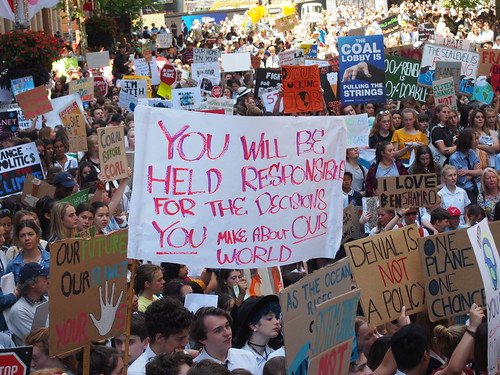
Youth activists from 115 countries plan to stage climate protests from September 20-27, with the main mobilisation day set for Friday 20 September. There are more than 2,400 events planned in 1,000 cities around the world.

In the letter, Kumi Naidoo requests school educators to remember that by taking part in the strikes, children are exercising their human rights to freedom of expression, peaceful assembly, and to have a say in decisions and matters that affect their lives.

He also shared his own personal experience of being expelled from school, aged 15, for organising an anti-apartheid protest at his school in Durban, South Africa:

“This setback redoubled my commitment to learning, and thankfully I was able to complete my studies and ultimately take up the role I have the honour of holding today. But I also had something that children of this generation do not have: the chance to imagine a future that is not overshadowed by the prospect of a climate emergency.

My experience also informed my strong belief that children should not be punished for speaking out about the great injustices of our age. In fact, when it has fallen on young people to show the leadership that many adults who hold great positions of power have failed to, it is not young people’s behaviour we should be questioning. It is ours.”

ENDS

NOTES TO EDITORS

The full text of the letter is below.

11th September 2019

To school leaders around the world,

My name is Kumi Naidoo and I am the Secretary General of Amnesty International, the world’s largest human rights organisation. I am writing to you today about what I believe to be the single most important issue facing our current generation of children and how you can play a key role in enabling them to take action.

As you will know well, the past year has seen an unprecedented wave of activism from children across the world in response to the climate emergency facing our planet. Inspired by the example of Greta Thunberg, more than a million young people from dozens of countries have joined the Fridays for Future movement and other youth-led groups, participating in demonstrations that have often meant skipping school.

The fact that children are missing classes to take part in this movement has, understandably, provoked strong reactions and concerns. I understand the pressures you face as school leaders in navigating this challenge. Indeed, Amnesty International has campaigned on the right of all children to receive a quality education.

But, I believe that the cause for which these children are fighting is of such historic significance that I am writing to you today with a request to neither prevent nor punish your pupils from taking part in the global days of strikes planned for 20 and 27 September.

The climate emergency is the defining human rights issue for this generation of children. Its consequences will shape their lives in almost every way imaginable. The failure of most governments to act in the face of overwhelming scientific evidence is arguably the biggest inter-generational human rights violation in history. 

Human rights exist to help us live together in freedom, justice and peace. But none of that is possible without a liveable planet.

The right to a healthy environment, including a safe climate, is essential for the enjoyment of so many other rights. It is a right that sadly, children today have been forced to take the lead in asserting.

By taking part in these protests, children are exercising their human rights to freedom of expression, peaceful assembly, and to have a say in decisions and matters that affect their lives. In doing so, they are teaching us all a valuable lesson: the importance of coming together to campaign for a better future.

Participants in the climate strike are human rights defenders. The Fridays for Future movement of schoolchildren have been named as winners of Amnesty International’s ‘Ambassador of Conscience’ award for 2019. Past awardees include Nelson Mandela, Malala Yousafzai, Ai Weiwei, Harry Belafonte, Joan Baez and Colin Kaepernick.

While watching these protests gather pace, I can’t help but be reminded of my own past. Aged 15, while at school in my native South Africa, I organised a protest against the apartheid system. I was expelled for this. It was a devastating moment for me. It was a very difficult moment for me and brought an overwhelming fear about how it might affect my future.

This setback redoubled my commitment to learning, and thankfully I was able to complete my studies and ultimately take up the role I have the honour of holding today. But I also had something that children of this generation do not have: the chance to imagine a future that is not overshadowed by the prospect of a climate emergency.

My experience also informed my strong belief that children should not be punished for speaking out about the great injustices of our age. In fact, when it has fallen on young people to show the leadership that many adults who hold great positions of power have failed to, it is not young people’s behaviour we should be questioning. It is ours.

Thank you for considering my plea and I hope that, working with students, parents and your staff, you will be able to support this critical moment in history.

With respect,

Kumi Naidoo

Secretary General         
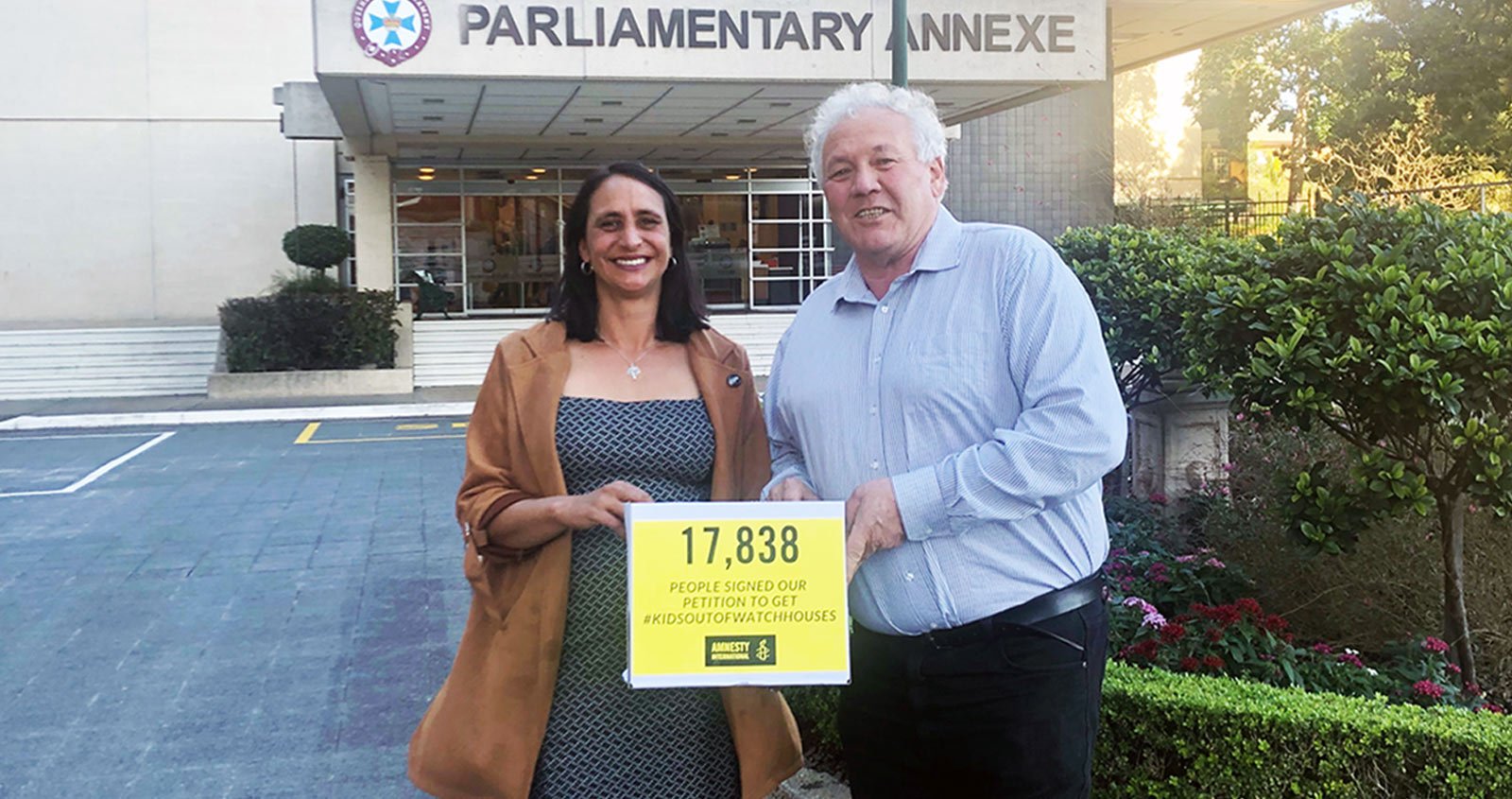
Good News: Queensland to better protect kids in the justice system

After thousands of human rights supporters spoke out, the Queensland Parliament has now reformed the Youth Justice Act to ensure that children spend as little time as possible in detention centres and harmful police watch houses.

On 22 August Queensland’s Parliament debated and passed Youth Justice and Other Legislation Amendment Bill 2019. In passing the bill, the Queensland Government has committed to ensuring that children are no longer held in harmful police watch houses for prolonged periods and will only be imprisoned by courts as a last resort.

This new law means that:

  • magistrates can only use detention as a last resort for young people
  • children must face court within 24 hours of being arrested
  • It is now easier to ‘bail’ children into safe and supportive environments.

What was happening in Queensland’s police watch houses?

Amnesty International had researched and documented more than 2,500 human rights violations occurring in the Brisbane City Watch House. This included:

  • Children being illegally held in watch houses for days, weeks and months 
  • Staff isolating kids to punish them
  • Children being held alongside adults 
  • Staff not providing children with adequate clothes, personal hygiene products, health and medical health care or access to adequate education.  

Amnesty and other organisations raised our concerns repeatedly with the Queensland Government. Then in May, ABC Four Corners exposed the abuse of kids in Brisbane City Watch House for all Australians to see.

How did Amnesty respond?

With the issue now firmly in the national media spotlight, Amnesty supporters, community advocates, like-minded organisations and Indigenous families all came together to demand the government act to get kids out of watch houses.

Families and communities courageously shared their stories of abuse and called out the shameful practice of keeping kids in police watch houses. 

Amnesty International supporters called, emailed and met with Queensland politicians to place pressure on the Queensland Government to address these violations.  More than 17,000 people signed an Amnesty petition to get kids out of watch houses, and over 2,500 people emailed and called the Minister.

Our collective pressure led to the Queensland government acting. On 17 July the Queensland Government announced that there were no children being held in Brisbane City Watch House.

Now, Queensland’s law changes will help ensure that children no longer face human rights abuses in police watch houses. 

“This is a win for all the young people and their families who have suffered through a broken system. The government can’t take back that suffering, but they can make sure it never happens again.

Joel Clark, Indigenous Rights Advocate at Amnesty International

What’s next?

Amnesty International Australia will continue to monitor the situation in watch houses across Queensland to ensure that this legislation is keeping kids out of harmful conditions.

We will now use the momentum from Queensland’s law changes to focus attention on another issue affecting children: Australian governments choosing to lock up 10-13 year old children, rather than supporting alternatives to prison such as tested community programs.

Children under 14 who are detained are more likely to repeat offend than if they had never been imprisoned. It is also significantly affects Indigenous children who continue to be woefully over-represented in the justice system.

Prison is simply no place for kids this young – it’s unhelpful, harmful and way behind the global standard. Governments must stop locking up 10-13 year old children and instead support community-led solutions that support kids to thrive.

If governments act to ensure 10-13 year-olds are not locked up, it will go a long way in ensuring children aren’t caught in the quicksand of the system in the first place.


Outsourcing responsibility: companies supplying arms to unlawful conflicts secure lucrative Australian Government contracts

A new report from Amnesty International has found that key global companies who have lucrative Australian government contracts also supply arms to the Saudi Arabia/UAE led coalition responsible for likely war crimes in the conflict in Yemen.

All of the companies examined in the report, Outsourcing Responsibility, have or have recently had multi-million dollar contracts with the Australian government, including Lockheed Martin, Airbus and Rolls Royce.

While the human rights obligations of states to regulate the international arms trade are now clearly defined under the Arms Trade Treaty and regional and domestic legislation, the crucial role of companies in the supply of military goods and services is often overlooked. 

Despite the often inherently dangerous nature of its business and products, the defence industry has not been the subject of the same level of scrutiny as other sectors – such as the extractive, agricultural, garment and tech industries. 

Amnesty International Australia has long called on the Australian government to be transparent about its own supply of arms to UAE and Saudi Arabia, and again calls on the Australian government to apply more rigorous standards to the companies that it awards millions of dollars of taxpayers money in contracts.

“Australia invested a lot of time and money for a place on the United Nations Human Rights Council – it would be gross hypocrisy for it to be advocating for human rights at an international level, without getting its own house in order,” Amnesty International Australia campaigner Nikita White said.

“Procurement processes for government contracts rightly ensure companies are compliant with a range of standards; having a framework for human rights  requiring defence companies to conduct human rights due diligence in their global operations, supply chains and in relation to the use of their products and services should be part of this process. 

“Governments can and should do more to stop companies from selling to parties who are complicit in human rights violations – for example, refusing to licence arms transfers to Saudi/UAE. 

“Australians deserve to know their money isn’t being spent with companies who supply regimes and militias with arms used to abuse fundamental human rights.”

Victorian Ombudsman calls for solitary confinement to be banned; the nation should listen

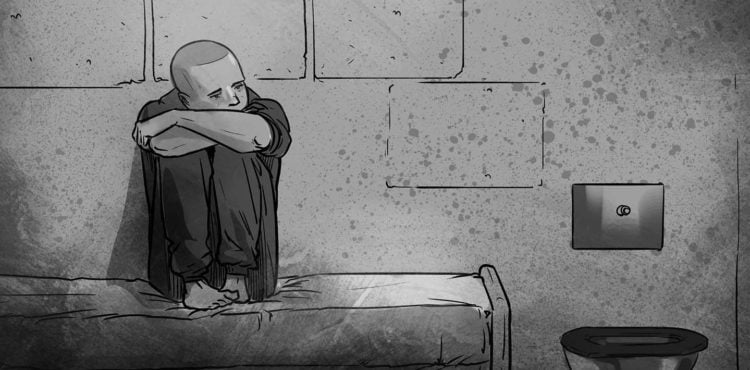
The Victorian Ombudsman Deborah Glass has recommended the state government prohibit solitary confinement. She said the practices were damaging, rather than rehabilitating, the children in the facilities.

In response, Amnesty International Indigenous Rights Manager Tammy Solonec said: 

“Locking kids up in a cell by themselves without human contact, without support, and without hope is irreparably damaging and against international standards – it must be banned immediately. 

“The Victorian Ombudsman joins the Western Australian Office of the Inspector of Custodial Services, and the Northern Territory Royal Commission in calling for this barbaric practice to be outlawed. The Northern Territory has legislated for it stop, but there are still reports of it being used, and the Western Australian Government has lumped the recommendation into a review that won’t be finished until mid-2020. 

“Every state and territory need to immediately take note of the Ombudsman’s report and apply it to their own youth justice system immediately.”

“Kids being harmed by being thrown into isolation or solitary confinement isn’t a Victorian problem, it’s an Australian embarrassment.

Federal Court decision welcome; now Minister Dutton must act to allow Tamil family to settle in Bilolea for good

Commenting on the decision of the Federal Court to extend an injunction to the Tamil family seeking to remain in their community, Amnesty International Australia’s Tim O’Connor said:

“We welcome the Federal Court granting an injunction to prevent Tharunicaa, and consequently her family receiving a short reprieve from their ongoing torment.

“The outpouring of support from the Australian community clearly shows many, many thousands of Australians want Kopika, Tharunicaa and their parents back in Minister Dutton’s home state of Queensland. 

Amnesty International Australia Campaigner, Tim OÇonnor

“We encourage Minister Dutton to listen to the community across Queensland and Australia, and act in the best interests of these young children by using his compassion to let them stay in Biloela.

“The reality is, Minister Dutton can, should he wish, secure the future of this young family with the stroke of a pen, as he has already done in more than 4000 cases since his tenure began.

“The extraordinary powers Minister Dutton has secured in his position as Home Affairs Minister and as the senior Minister in the department include the powers of Ministerial intervention, which specifically stipulate exceptional circumstances, including compassionate circumstances.”

Indonesia: Drop charges against lawyer for Papuan political activists

Responding to the East Java police’s decision to bring charges against human rights lawyer Veronica Koman, Amnesty International Indonesia’s Executive Director Usman Hamid said:

“Veronica Koman is a human rights defender who has provided legal aid to many Papuan political activists and documented human rights violations in Papua. She is now being persecuted for tweeting about a violent attack on a Papuan student’s dormitory on August 17, in which police fired tear gas.

“This is an appalling attack on the right to freedom of expression in Indonesia, and a brazen attempt to silence a brave activist. These charges are clearly intended to deter others from speaking out against human rights violations related to Papua.

“The charges against Veronica Koman must be immediately dropped. Authorities in Indonesia must also repeal or amend the draconian articles in the Criminal Code and the ITE Law, which are being used to criminalize the right to freedom of expression.”

In the past two years, Veronica Koman has faced harassment, intimidation and threats, including death and rape threats, for her work exposing allegations of human rights violations in Papua.

Police today charged Veronica Koman with “incitement” under provisions from the Electronic Information and Transaction (ITE Law), Article 160 of Indonesia’s Criminal Code and the Elimination of Racial and Ethnic Discrimination Law, for tweets which they said “hoax” news. Amnesty International has analyzed the tweets, which document human rights violations against Papuans, and concluded that charging Veronica Koman under these provisions represents a travesty and gross misuse of the law.

Background

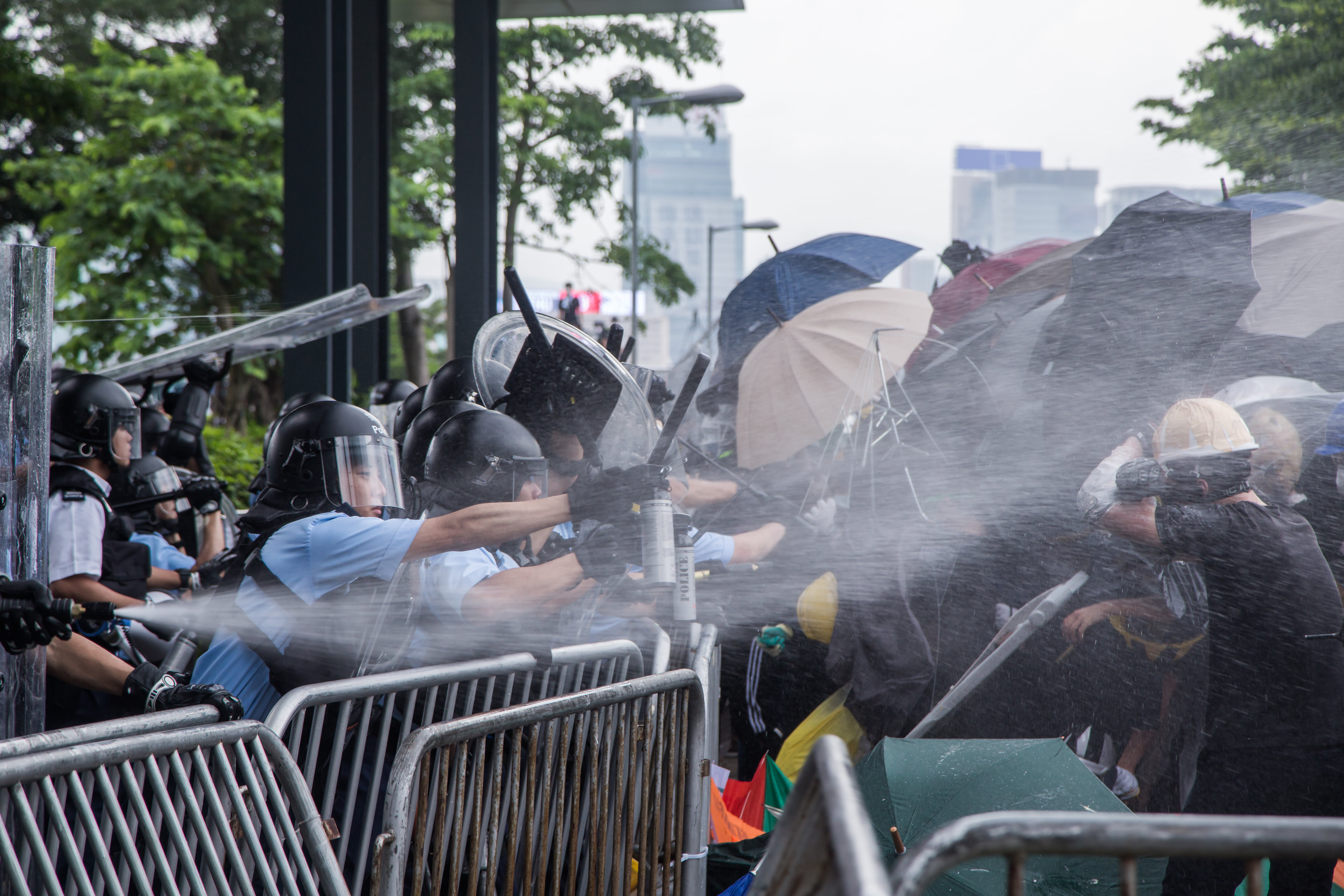
On August 17, a group of people from local organizations attacked a dormitory of Papuan students accusing them of destroying the national flag of Indonesia. They verbally attacked Papuan students and hurled racist insults at them. Some members of the military allegedly took part.  Instead of dispersing the crowd who had besieged the dormitory, the police also surrounded the building and asked the Papuan students to turn themselves in. The stand-off continued the following day, with police firing tear gas before arresting 43 Papuan students. The police took them in for questioning but released them the next day after finding no evidence that they had destroyed an Indonesian flag.

Hong Kong: Pro-democracy activists arrested in outrageous assault on freedom of expression

Responding to the arrests in Hong Kong of prominent pro-democracy activists Joshua Wong and Agnes Chow on Friday morning and independence activist Andy Chan on Thursday night, Man-kei Tam, Director of Amnesty International Hong Kong, said:

“The ludicrous dawn swoops by police to arrest Agnes Chow and Joshua Wong are an outrageous assault on the rights to freedom of expression and peaceful assembly. At the very least, they must be released on bail as soon as possible.

Man-kei Tam, Director of Amnesty International Hong Kong

“This past week, we have seen scare tactics straight out of Beijing’s playbook: pro-democracy protest organizers attacked by thugs, prominent activists arrested after being snatched from their homes and streets, and a major rally planned for Saturday banned.

“The authorities must end this concerted attack on the freedoms of expression and peaceful assembly. It is vital that the authorities send a clear message that people in Hong Kong can still enjoy these rights irrespective of their political beliefs.” 

Background  

On Friday morning, police arrested Joshua Wong and Agnes Chow of pro-democracy party Demosisto.  Police bundled Joshua Wong into an unmarked van as he walked to a metro station, according to Demosisto. He has been arrested on suspicion of inciting, organizing and taking part in an unlawful assembly, according to media reports.

Agnes Chow was arrested at her home for allegedly inciting and taking part in an unlawful assembly. The charges relate to a protest outside Hong Kong police headquarters on 21 June.

Andy Chan, convener of the Hong Kong National Party, was arrested on Thursday evening at Hong Kong Airport. He is being held on suspicion of rioting and assaulting a police officer. The Hong Kong government prohibited the operation of Hong Kong National Party in September 2018 “in the interests of national security” and public safety. 

On Thursday, Jimmy Sham, the organizer of the recent large-scale peaceful pro-democracy protests in Hong Kong, was attacked by masked men wielding a baseball bat and a large knife.

Police have banned a major rally planned for Saturday, which marks the fifth anniversary of Beijing rejecting genuine universal suffrage for the election of Hong Kong’s leader. An appeal by protest organizers against the ban was rejected on Friday.

Draft Religious Discrimination Bill ‘Taking Australia back to the Dark Ages’

In response to the release of the draft Religious Discrimination Bill today, Tim O’Connor, Campaigner at Amnesty International Australia said:

“Today’s draft religious discrimination bill is a licence for religious groups to use their beliefs to condemn and attack groups in the community. 

“Prime Minister Morrison should be ashamed of this piece of legislation, that takes Australia back to the dark ages by vilifying women, LGBTQI+ people, people of colour and others.”

Amnesty International Australia campaigner, Tim O’Connor

“This act was an opportunity for the government to protect all Australians, treat everyone equally and enshrine our rights in law. Instead, it allows people to be segregated and targeted by giving religious groups permission to discriminate at will. It is barbaric to allow active discrimination based purely on a persons sexuality or gender. 

“This is a total legislative failure. A religious freedom act could have been the right solution, but this falls woefully short of what is required and will not provide overarching human rights protections in Australia. 

“We should instead introduce a Human Rights Act that brings together the current spaghetti bowl of legislation, and ensures that both rights to freedom of religion and other fundamental rights are protected and appropriately balanced.

“Amnesty, and many other organisations such as religious institutions and community leaders firmly believe that a Human Rights Act is the best way to and to reconcile the various discrimination and human rights laws encompassing sex, race and religion.”

Science and raising the age of criminal responsibility

By Dr Meg Perkins, PhD MAPS

Most experts in the world agree that 10 years old is far too young to be held criminally responsible, and certainly far too young to be in prison.

This is my view as a psychologist, having studied the neurological issues related to children in prison. In short: if you understand how the brain works, it is clear that prison is no place for a child.

The science of brain development

The executive functioning of the brain is essentially the “captain of the ship”. It is situated in the frontal lobes, giving the orders to the rest of the brain and the body, regulating emotion and behaviour, organising and planning. It is the last part of the brain to mature and if it is severely impaired, developing very slowly or not at all, chaos reigns. The child acts on whim and impulse, is not able to consider the consequences of their actions, and struggles to understand cause and effect. The frontal lobes, in fact, do not develop efficient and mature executive function until the age of 25 years.

Despite this, Australia is detaining children as young as 10, who are scientifically incapable of properly regulating their behaviour, which results in a higher rate of re-offending than adults.

Almost 80 per cent of kids who commit crimes end up re-convicted in 10 years and are significantly less likely to finish school, or get a job. Instead, they are more likely to be stuck in a cycle of poverty and disadvantage. We must raise the age to break this cycle, and ensure kids are in communities where they can thrive.  

The research

In 2018, a study was published in the British Medical Journal showing that children in custody in Western Australia were more likely to be suffering from brain-based disabilities. Young people in Western Australia’s only youth prison, Banksia Hill Detention Centre, were assessed by a multidisciplinary team and a staggering 89 per cent were found to have at least one severe neurodevelopmental deficit, that is, dyslexia or similar learning disability, language disorder, attention deficit hyperactivity disorder, intellectual disability, executive function disorder, memory impairment or motor coordination disorder. “Severe” meant that 97 per cent of young people would have better skills.

The study also found that 65 per cent of the young people had at least three areas of severe cognitive deficit, and 36 per cent could be diagnosed with a Fetal Alcohol Spectrum Disorder (FASD) due to prenatal exposure to alcohol. There are, of course, many other causes for brain dysfunction, such as prenatal exposure to amphetamines or head injuries. The bottom line is that 65 per cent of these young people in custody appeared to have suffered widespread brain injury and were demonstrating pervasive brain dysfunction.

This brain dysfunction means that many of the 10-year-old children brought before the courts are likely to be functioning at a five or six-year-old level, and as they age, their functional level is not improving. When they reach the age of 14 years, their adaptive functioning (level of practical living skills) may still be at a five-year-old level and their thinking, reading, or language skills at a six-year-old level. This means that Australia is essentially having someone at a five or six-year-old level standing trial, having to defend their actions. Apart from this being very unfair – it is violating their rights to a fair trial.

This is my experience as a psychologist doing assessments for children being charged in the Children’s Court in New South Wales and Queensland. The most common disability in the Western Australian group was in academic achievement, then self-regulation and impulse control, and then language.

Many of the children I see do have FASD and they fit that profile. In addition, their practical living skills are almost always very poorly developed. They and their carers are clearly not getting the resources they need to survive in schools and the community, let alone thrive. 

Understanding brain dysfunction

Brain dysfunction does not always imply intellectual disability in the sense of “mental retardation”. An intelligent child with very poor language or literacy skills will be severely impaired as well, demonstrating inappropriate behaviour, and probably anger and frustration. A severe deficit in executive function can be misdiagnosed as Attention Deficit Hyperactivity Disorder (ADHD), which is not considered to be a disability in the sense of attracting extra help at school or support from the National Disability Insurance Scheme. 

The Diagnostic and Statistical Manual of Mental Disorder Fifth Edition (DSM-5) states that “Children with ADHD are significantly more likely than their peers without ADHD to develop conduct disorder in adolescence and antisocial personality disorder in adulthood, consequently increasing the likelihood for substance abuse disorders and incarceration”, yet they are entirely unsupported in our society.

Impacts at school

An inability to read or write is felt as shameful at school, causing behaviour intended to distract from the problem. Kids will say “I played up so that I didn’t have to read in class”. Rather than punishing these kids, we should be resourcing and equipping affected families and communities with the tools they need to identify and help with these difficulties.

When a child between the ages of 10 years and 14 years is offending, the likelihood that they have a brain-based disability is very high. Instead of putting that child through the criminal justice system (from which they will learn nothing as their offending is not the result of a rational decision or choice), we could be putting them through an assessment process and seeking ongoing appropriate support for disabilities they may have. 

If the age of criminal responsibility was raised to at least 14, society would be forced to address the issue of inappropriate child behaviour as a public health matter and not a criminal matter.

More support for kids and families

Many of the children I see are suffering from neurodevelopmental disorders, lack of recognition of their disabilities, lack of school and community support, and an almost total lack of appropriate supervision. If they are with their families, the parents may be unwell, suffering from mental health problems, substance abuse disorders, or cognitive impairments.

Sadly, many of these children are in the care of the state and are not supervised appropriately. In some settings, the police are called if a child throws a cup across the kitchen, and they are charged with malicious damage to property in order to satisfy insurance claims. The criminalisation of children in care is an issue we should all stand up against

I believe that the way to break this impasse, to pull down the edifice of juvenile justice and prevent young children becoming persistent offenders, is to raise the age of criminal responsibility to at least 14 years, and thus remove the possibility of calling police to manage a child’s behaviour.

Old people in dementia wards sometimes hit the nurses or throw their coffee cups, but we do not call the police. We call the doctor. This is because we know that the behaviour is caused by brain abnormality. The same is true of the children, 89 per cent of them, for example, in the Banksia Hill Youth Detention Centre.

Kids don’t act out for no reason. We need to address the underlying causal factors for their behaviour so we can create an environment for them to thrive. 

Latest figures prove locking up kids doesn’t work

In response to figures released by Australian Institute of Health and Welfare 2019. (Young people returning to sentenced youth justice supervision 2017–18) Joel Clark, Indigenous Rights Advocate said:

“The figures released today are yet more evidence that keeping kids locked up doesn’t work. It is shocking that four out of five kids released from sentenced detention are back inside again within twelve months, and is proof that the system is broken.

“We are setting these kids up for failure, especially Indigenous kids who are woefully over represented. Previous incarceration is among the most significant reasons that Indigenous people are out of the labour force. By keeping kids in prison we set them on the wrong path for the rest of their life.

“Instead of trapping these kids in the quicksand of the system, we must invest in keeping them out of jail in the first place. Programs that provide the care and support kids need to grow up strong and healthy, not behind bars, are the clear alternative for Indigenous children in the community. The government needs to support Indigenous leaders and ensure they get the funding they need to ensure a positive future for these kids.

“Australia is lagging far behind the rest of the world in locking up little children as young as 10 years old .Research shows that children’s brains are still developing, especially the parts that regulate judgement, decision-making and impulse control. Children are not able to foresee the consequences of any action, and cannot fully understand the criminal nature of their behaviour.

“The government must also immediately raise the minimum age of criminal responsibility to at least 14”.