Syria: Unprecedented investigation reveals US-led Coalition killed more than 1,600 civilians in Raqqa ‘death trap’

The US-led military Coalition must end almost two years of denial about the massive civilian death toll and destruction it unleashed in the Syrian city of Raqqa, Amnesty International and Airwars said today as they launched a new data project on the offensive to oust the armed group calling itself “Islamic State” (IS).

The interactive website, Rhetoric versus Reality: How the ‘most precise air campaign in history’ left Raqqa the most destroyed city in modern times, is the most comprehensive investigation into civilian deaths in a modern conflict. Collating almost two years of investigations, it gives a brutally vivid account of more than 1,600 civilian lives lost as a direct result of thousands of US, UK and French air strikes and tens of thousands of US artillery strikes in the Coalition’s military campaign in Raqqa from June to October 2017.

By the time the offensive began, the IS had ruled Raqqa for almost four years. It had perpetrated war crimes and crimes against humanity, torturing or killing anyone who dared oppose it. Amnesty International previously documented how IS used civilians as human shields, mined exit routes, set up checkpoints to restrict movement, and shot at those trying to flee.

“Thousands of civilians were killed or injured in the US-led Coalition’s offensive to rid Raqqa of IS, whose snipers and mines had turned the city into a death trap. Many of the air bombardments were inaccurate and tens of thousands of artillery strikes were indiscriminate, so it is no surprise they killed and injured many hundreds of civilians,” said Donatella Rovera, Senior Crisis Response Adviser at Amnesty International.

“Coalition forces razed Raqqa, but they cannot erase the truth. Amnesty International and Airwars call upon the Coalition forces to end their denial about the shocking scale of civilian deaths and destruction caused by their offensive in Raqqa.”

“The Coalition needs to fully investigate what went wrong at Raqqa and learn from those lessons, to prevent inflicting such tremendous suffering on civilians caught in future military operations,” said Chris Woods, Director of Airwars.


Cutting-edge research on the ground in Raqqa and from afar

Amnesty International and Airwars have collated and cross-referenced multiple data streams for this investigation.

On four visits since the battle was still raging, Amnesty International researchers spent a total of around two months on the ground in Raqqa, carrying out site investigations at more than 200 strike locations and interviewing more than 400 witnesses and survivors.

Amnesty International’s innovative “Strike Trackers” project also identified when each of the more than 11,000 destroyed buildings in Raqqa was hit. More than 3,000 digital activists in 124 countries took part, analyzing a total of more than 2 million satellite image frames. The organization’s Digital Verification Corps, based at six universities around the world, analyzed and authenticated video footage captured during the battle.

Airwars and Amnesty International researchers analyzed open-source evidence, both in real-time and after the battle – including thousands of social media posts and other material – to build a database of more than 1,600 civilians reportedly killed in Coalition strikes. The organizations have gathered names for more than 1,000 of the victims; Amnesty International has directly verified 641 of those on the ground in Raqqa, and there are very strong multiple source reports for the rest.

Both organizations have frequently shared their findings with the US-led military Coalition and with the US, UK and French governments. As a result, the Coalition has admitted responsibility for killing 159 civilians – around 10% of the total number reported – but it has routinely dismissed the remainder as “non-credible.” However, to date the Coalition has failed to adequately probe civilian casualty reports or to interview witnesses and survivors, admitting it does not carry out site investigations.


Bringing cases to life

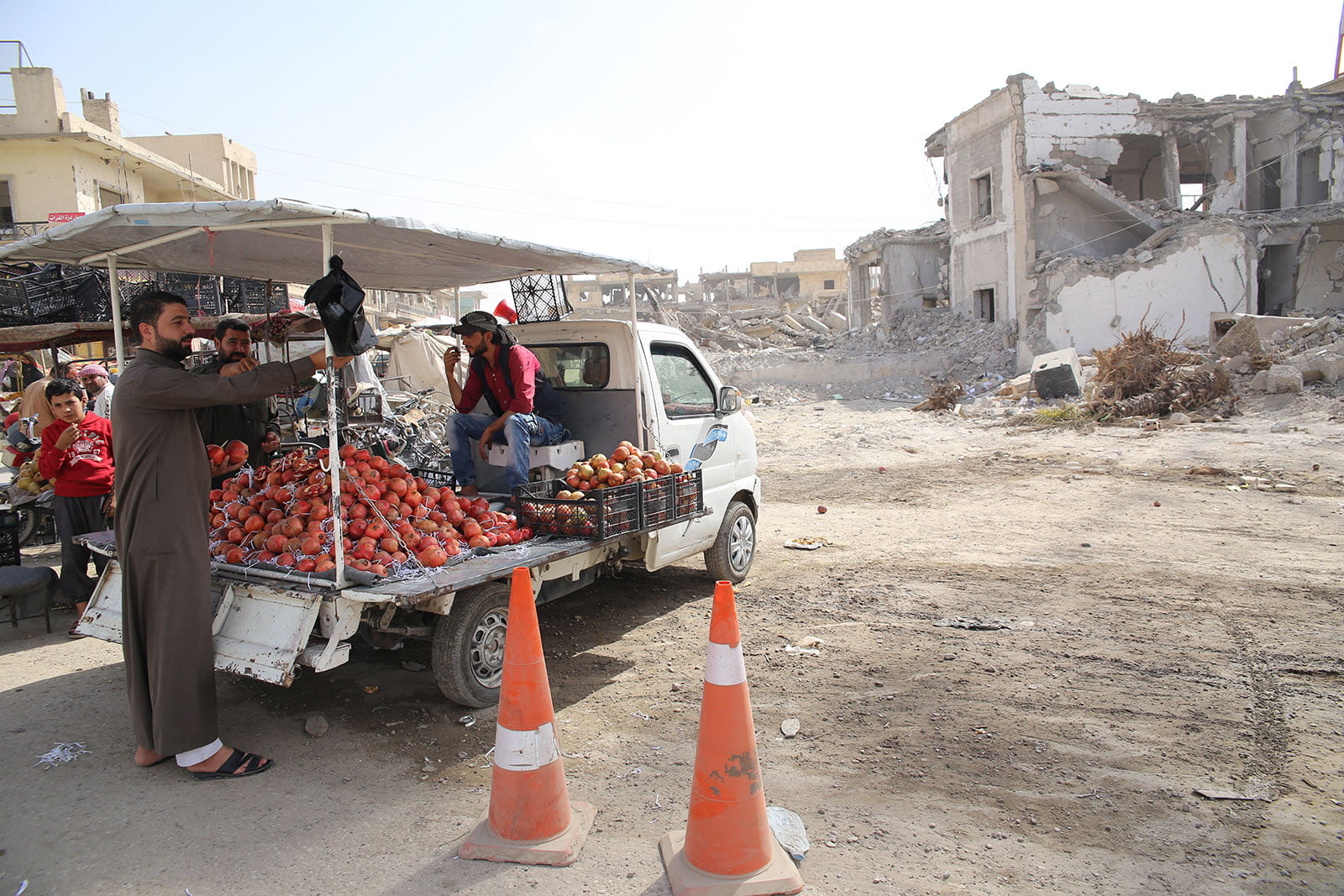
Rhetoric versus Reality brings to life the stories of families who lived and died in the war by taking users on a journey through the city; meeting survivors, hearing their testimonies and visiting their destroyed homes. From the bombed-out bridges spanning the Euphrates to the largely demolished old city near the central stadium, no neighbourhood was spared.

Developed with Holoscribe’s creative team, the interactive website combines  photographs, videos, 360-degree immersive experiences, satellite imagery, maps and data visualizations to highlight the cases and journeys of civilians caught under the Coalition’s bombardment. Users can also explore data on civilians who were killed, many of them after having fled from place to place across the city.


Entire city blocks flattened 

Raqqa’s soaring civilian death toll is unsurprising given the Coalition’s relentless barrage of munitions that were inaccurate to the point of being indiscriminate when used near civilians.

One US military official boasted about firing 30,000 artillery rounds during the campaign – the equivalent of a strike every six minutes, for four months straight – surpassing the amount of artillery used in any conflict since the Viet Nam war. With a margin of error of more than 100 metres, unguided artillery is notoriously imprecise and its use in populated areas constitutes indiscriminate attacks.

One of the first neighbourhoods to be targeted was Dara’iya, a low-rise, poorer district in western Raqqa.

In a ramshackle, half-destroyed house, Fatima, nine years old at the time, described how she lost three of her siblings and her mother, Aziza, when the Coalition rained volleys of artillery shells down on their neighbourhood on the morning of 10 June 2017. They were among 16 civilians killed on that street on that day alone. Fatima lost her right leg and her left leg was badly injured. She now uses a wheelchair donated by an NGO to get around and her only wish is to go to school.


Families wiped out in an instant

US, UK and French forces also launched thousands of air strikes into civilian neighbourhoods, scores of which resulted in mass civilian casualties.

In one tragic incident, a Coalition air strike destroyed an entire five-storey residential building near Maari school in the central Harat al-Badu neighbourhood in the early evening of 25 September 2017. Four families were sheltering in the basement at the time. Almost all of them – at least 32 civilians, including 20 children – were killed. A week later, a further 27 civilians – including many relatives of those killed in the earlier strike – were also killed when an air strike destroyed a nearby building.

“Planes were bombing and rockets were falling 24 hours a day, and there were IS snipers everywhere. You just couldn’t breathe,” one survivor of the 25 September strike, Ayat Mohammed Jasem, told a TV crew when she returned to her destroyed home more than a year later.

“I saw my son die, burnt in the rubble in front of me. I’ve lost everyone who was dear to me. My four children, my husband, my mother, my sister, my whole family. Wasn’t the goal to free the civilians? They were supposed to save us, to save our children.”


Time for accountability

Many of the cases documented by Amnesty International likely amount to violations of international humanitarian law and warrant further investigation.

Despite their best efforts, NGOs like Amnesty International and Airwars will never have the resources to investigate the full extent of civilian deaths and injuries in Raqqa. The organizations are urging US-led Coalition members to put in place an independent, impartial mechanism to effectively and promptly investigate reports of civilian harm, including violations of international humanitarian law, and make the findings public.

Coalition members who carried out the strikes, notably the USA, the UK and France, must be transparent about their tactics, specific means and methods of attack, choice of targets, and precautions taken in the planning and execution of their attacks.

Coalition members must create a fund to ensure that victims and their families receive full reparation and compensation.
New QLD Commissioner has the opportunity to effect real change in youth justice

In response the appointment of Katarina Carroll as Commissioner of the Queensland Police Service, Joel Clark, Amnesty International Indigenous Rights Advocate said:

“We welcome Commissioner Carroll to her recent appointment, and celebrate the fact that she will be Queensland’s first female Police Commissioner.

“With new leadership comes the opportunity for genuine change and reform. Commissioner Carroll can help make Queensland’s justice system a more just one, particularly for Indigenous children who are staggeringly over-represented.

“Amnesty calls on Commissioner Carroll to start by stopping children from being held overnight in police watchhouses. These facilities aren’t designed to detain children, and are harmful. Instead we should be investing in early intervention and prevention programs to keep kids out of prison.

“The Government must also work with the incoming Commissioner to find more appropriate and effective solutions to youth detention and reduce the number of children on remand.

“This can be achieved through supporting culturally appropriate, Indigenous community controlled bail accommodation and support services”.

Sri Lanka: Attacks another grim reminder of the need to tackle hate

Sri Lanka: Attacks another grim reminder of the need to tackle hate

The shocking Sunday morning  bombing attacks targeting churches and hotels in three cities in Sri Lanka resulting in more than 290 deaths and leaving more than 500 people injured, is yet another grim wake-up to the intolerance and hatred surging through societies across the world, Amnesty International said today.

“Amnesty International stands in complete solidarity with Sri Lanka in its time of grief and we extend our deepest sympathy to the victims, to their family, friends and communities. Our hearts go out to all the people of Sri Lanka and we call on the authorities to ensure truth and justice prevail to defeat this senseless violence.These horrific attacks are yet another reminder that all of us needs to take a unified stand against hatred,” said Kumi Naidoo, Amnesty International’s Secretary General.

Coming barely a month after the New Zealand attacks, which also shook the world, these attacks underscore the urgency for world leaders to recognise the enormity of the problem of attacks targeting people based on their identity, and begin to address it urgently. It is important for states to protect the human right to life, as well as to practice one’s religion in peace.

“Today it is worshipping Christians who are the victims, a few weeks ago it was Muslims in mosques. Plenty of other attacks have escaped the media glare. Too many minorities have endured violence, and leaders must stand up unambiguously for pluralist societies and the rights of minority communities,” said Kumi Naidoo.

Leaders must take full responsibility for their role in fuelling the demonisation of particular groups, and stop fanning flames with hate-filled rhetoric and policies based on aspects of people’s identities such as their faith and beliefs, or on their circumstances as seen with alienation of migrants and asylum seekers. In Sri Lanka, political and religious leadership should take a stand against hatred and will bring people together in solidarity at this tragic time.

Sri Lankans have suffered more than enough from violence. We urge the government to take decisive steps respectful with fair trial standards not only to hold accountable those responsible for Sunday’s attacks, but to develop a clear plan to promote unity in diversity,” said Kumi Naidoo.

Amnesty condemns Fraser Anning’s election tactics

Following reports today that an alt-right campaigner claiming to work for Senator Fraser Anning recommended stunts such as using “blackface” and burning the Islamic holy book the Qur’an as campaign tactics to gain a voice in the Australian Parliament, Amnesty International campaigner Shankar Kasynathan said:

“Prime Minister Scott Morrison and Opposition Leader Bill Shorten must take a firm stand on the kind of abhorrent hate speech and politicking that sees Fraser Anning’s supporters considering outrageous and racist behaviour like using blackface and burning the Qur’an as campaign tactics.

“The fact is that when our leaders speak in ways that vilify whole communities such as migrant and refugee communities, they normalise discrimination and embolden those who support it. Instead our leaders must denounce racial and ethnic hatred.

“Amnesty International Australia calls on Messers Morrison and Shorten to not only condemn this behaviour but to ensure there is no place for it in Australia’s Parliament.”

Iran: Release women’s rights defenders detained for peacefully protesting against forced veiling

Iranian authorities must stop harassing, arresting and imprisoning women’s rights defenders peacefully protesting against Iran’s degrading and discriminatory forced veiling laws, and release those detained on this basis immediately and unconditionally, said Amnesty International today.

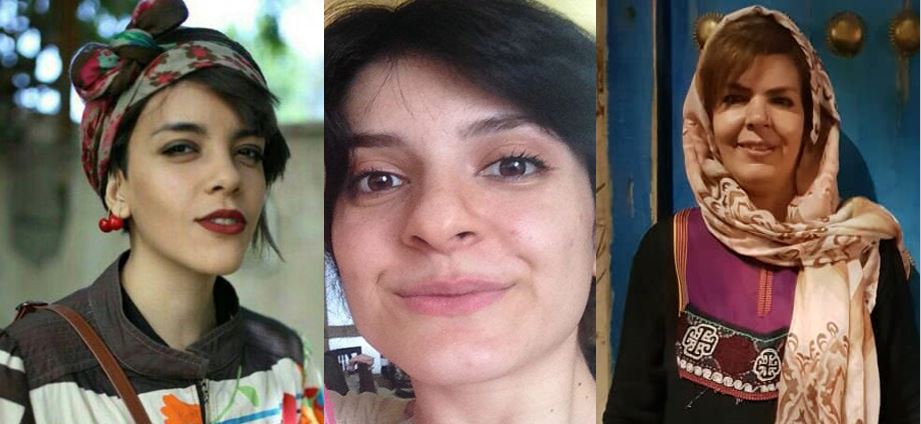
The organization has confirmed that two women’s rights defenders, Yasmin Aryani and Monireh Arabshahi, have been detained in the past week and that a third activist, Vida Movahedi, who has been detained since October 2018, was sentenced to one year in prison last month for peacefully protesting against forced veiling.

Iran’s intelligence and security bodies have also subjected several other women’s rights defenders to threatening telephone calls, warning them that they will be arrested if they continue to campaign against forced veiling. Some have been summoned for questioning and fear imminent arrest.

“Iran’s authorities appear to be lashing out in response to the increased defiance displayed by Iranian women and the growing peaceful popular movement against forced veiling laws in a bid to intimidate them into silence and submission,” said Magdalena Mughrabi, Deputy Middle East and North Africa Director at Amnesty International.

“The criminalization of women and girls for not wearing the veil is an extreme form of gender-based discrimination and cruel, inhuman and degrading treatment that deeply damages women’s dignity. Instead of persecuting and jailing women who are standing up to this outrageous injustice Iran’s authorities should immediately and unconditionally release all women’s rights defenders detained for their peaceful activism.”

 Arrested for peaceful protests

On 10 April, women’s rights defender Yasmin Aryani was arrested by security forces at her family home in Tehran and taken to an unknown location.

Yasmin Aryani’s mother, Monireh Arabshahi, was arrested the next day after she went to the Vozara detention centre in Tehran to enquire about her daughter’s whereabouts.

Amnesty International received information indicating that both women were arrested in relation to a video that went viral on International Women’s Day, in which Yasmin, Monireh and several other women’s rights defenders can be seen without their headscarves, distributing flowers to female passengers on a metro train in Tehran and discussing their hopes for women’s rights in Iran. In the video, Monireh Arabshahi says she hopes “the day will come when women are not forced to struggle” for their rights and Yasmin Aryani hands a flower to a woman wearing a hijab and says she hopes that one day they can walk side by side in the street “me without the hijab and you with the hijab”.

Both Yasmin Aryani and Monireh Arabshahi are believed to be facing charges that include “spreading propaganda against the system” and “inciting corruption and prostitution” in connection with this video.

Yasmin Aryani’s family did not hear from her until 15 April when she was allowed to make one brief telephone call. The authorities have so far refused to reveal her exact whereabouts, saying only that she is being detained in a “security” detention centre.

Monireh Arabshahi is being detained in Shahr-e Rey prison (also known as Gharchak) along with several hundred other women, in extremely overcrowded and unhygienic conditions, without access to safe drinking water, adequate food or medicine and fresh air.

On 14 April, the lawyer of another women’s rights defender, Vida Movahedi announced that she had been sentenced to one year in prison in March 2019 for her peaceful protests against forced veiling. She has been detained since 29 October 2018, when she staged a solo protest by standing, without a hijab, on top of a large dome structure in the middle of Tehran’s Enghelab (Revolution) Square and waving coloured balloons in her hands.

Vida Movahedi became known as the first “Girl of Revolution Street” after her first such protest in December 2017 when she climbed up onto a utility box on Enghelab (Revolution) Street, removed her headscarf and waved it like a flag on the end of a stick. This peaceful act resulted in her arrest and subsequent release on bail before her re-arrest in October 2018. Her peaceful act of resistance has since inspired women across the country to hold similar acts of protest in public against forced veiling laws.

According to her lawyer, Vida Movahedi is eligible for conditional release but her request has not yet been processed by the office for the implementation of sentences. She was also among several prisoners granted a pardon by the Supreme Leader to mark the 40th anniversary of the 1979 revolution in February but prison authorities have refused to implement the pardon and release her.

Prominent Iranian journalist and women’s rights defender Masih Alinejad, based in the USA, who has run a series of high-profile online campaigns against forced veiling, told Amnesty International that in recent weeks her 70-year-old mother was summoned for questioning by the authorities about her communications with her. Both Masih Alinejad’s mother and elderly father were interrogated for more than an hour.

Last month, in a particularly shocking case, prominent human rights lawyer and women’s rights defender Nasrin Sotoudeh was sentenced to 33 years and six months in prison and 148 lashes after being convicted of seven charges – some of which stemmed from her work representing women arrested for protesting against forced veiling laws. She has to serve at least 12 years of this sentence in prison as per Article 134 of the penal code, which stipulates that, when individuals are convicted on three or more charges, they shall serve the lengthiest single sentence imposed for the most serious charge. Nasrin Sotoudeh was also convicted and sentenced to five years in prison in a separate case in 2016, which she must serve in full.

In January 2019, Nasrin Sotoudeh’s husband Reza Khandan and human rights defender Farhad Meysami were each convicted and sentenced to six years in prison in relation to their support of the campaign against forced veiling.

“Iran’s forced veiling laws are a blatant breach of Iranian women’s rights to freedom of expression, belief and religion. The Iranian authorities must immediately repeal these discriminatory laws and abolish the degrading bans on women’s appearance in public without the hijab,” said Magdalena Mughrabi.

“The international community – including the EU which has an ongoing human rights dialogue with Iran – has a key role to play in publicly voicing their support for women’s rights defenders and using all channels of communication to press the Iranian authorities to end compulsory veiling immediately.”

Nauru’s former President Sprent Dabwido condemns ‘torture’ of refugees

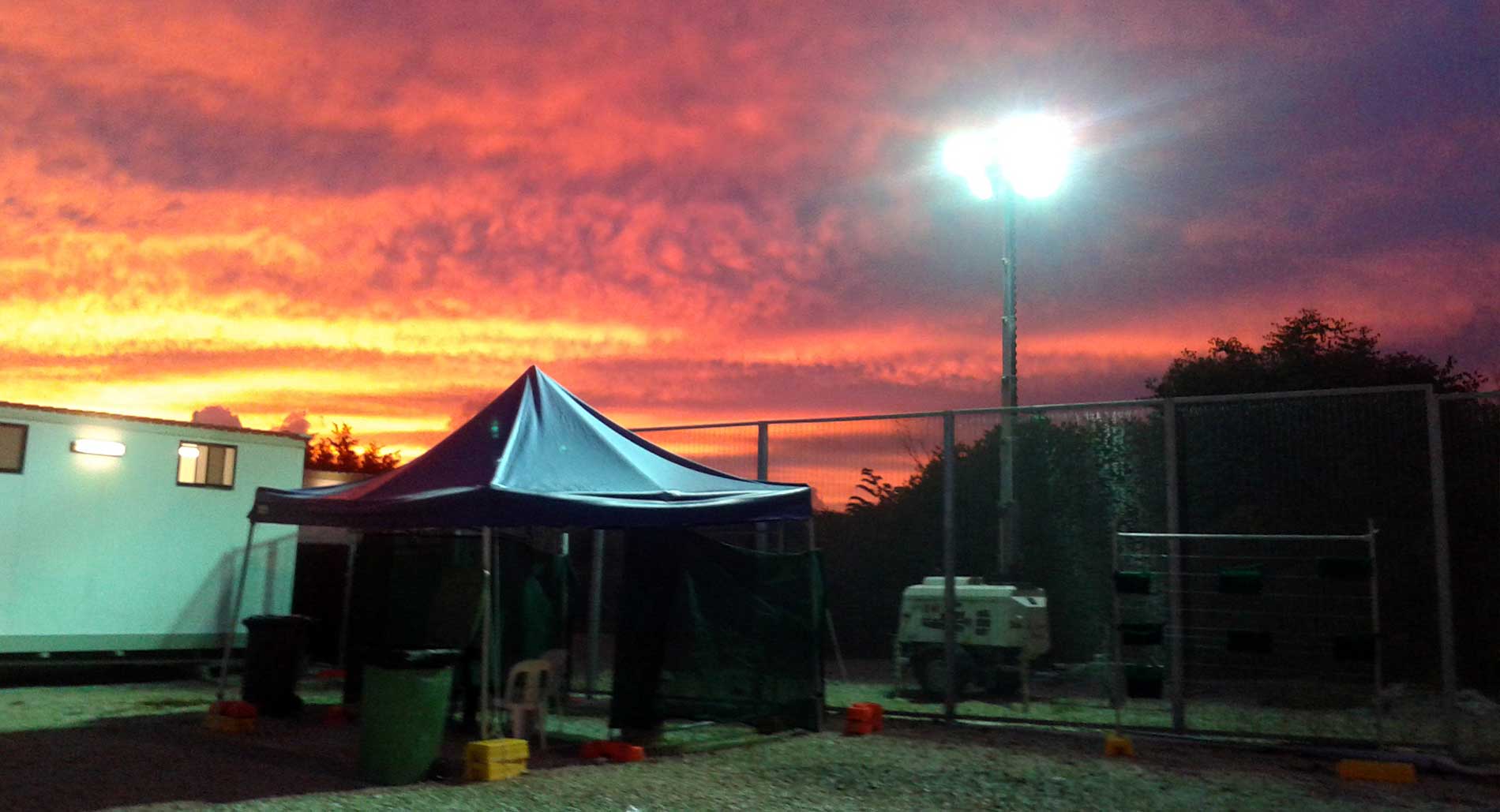
In an interview with The Project that aired last night, 17 April, former President of Nauru Sprent Dabwido condemned PNG’s agreement to hold Australian refugees on Nauru as ‘a deal with the devil’ and ‘torture’ for refugees.

In response, Dr Graham Thom, Refugee Adviser at Amnesty International Australia said:

“Amnesty International has long held that the conditions on Nauru amount to torture, designed to inflict suffering for a specific purpose, to stop some of the world’s most vulnerable people from trying to find safety in Australia.

“This commentary from the very person that originally approved the deal is truly condemning and supports the findings of our ‘Island of Despair’ report which documented deteriorating mental health, discrimination and violent attacks, sexual violence, inadequate medical care and harassment.

“The truth about the situation in Nauru is again being exposed, this time by those closest to implementing the policy itself. It never was and never will be an appropriate place for vulnerable people who come to Australia seeking safety from persecution. This torture has to end. Australia must immediately bring the refugees and people seeking asylum on Manus and Nauru to safety in Australia.”

Background:

The report: ‘Island of Despair’: Australia’s “processing” of refugees on Nauru was released in October 2016. Based on months of research, including interviews with more than 100 people in Nauru and Australia, Amnesty International’s report revealed the full scale of Australia’s system of deliberate cruelty.

While there have been continued denials from the Government about the extent of the issues in Manus and Nauru, since the launch of our report in 2016, there have been a number of deaths, reportedly suicides, on both Manus and Nauru, as well as the death of Faysal Ahmed from medical complications. All the families with children have now been medically evacuated off Nauru, with many of the children reportedly suffering both acute physical and psychological illnesses.

As of 18 February 2019, there were 431 individuals in Nauru and 584 in Papua New Guinea.

Stand against racism

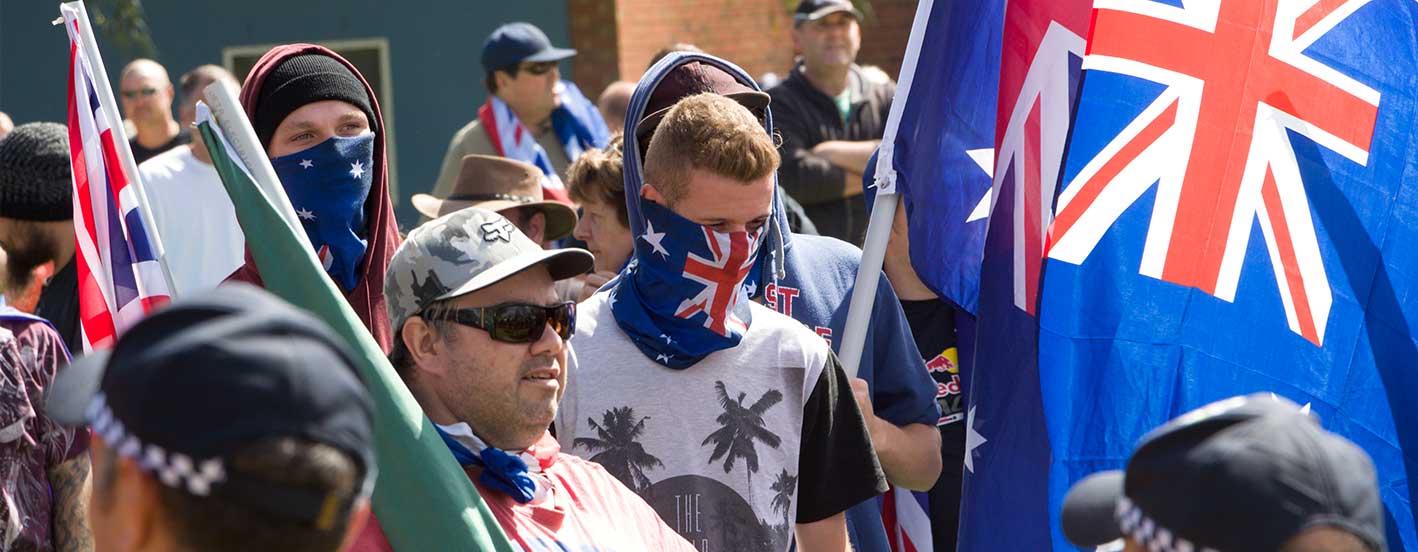
With the election campaign in full swing, Amnesty International Australia is urging all political parties to change the conversation by refusing to engage in divisive and stereotyping conversation.

Tim O’Connor, Impact Manager at Amnesty International Australia said:

“Today we are calling on our political leaders to stand against racism and unite Australia through inclusive leadership.The language our political leaders use and the messages they send have a profound effect on people’s lives. Too often we have seen our political leaders feed into the negative rhetoric that demonises particular parts of our society.

“When our leaders speak in ways that vilify whole communities such as migrant and refugee communities, they normalise discrimination and embolden those who support it. Instead our leaders must denounce racial and ethnic hatred.

“The recent heartbreaking events in Christchurch resulted in an outpouring of support both here and in New Zealand and highlighted Australians’ desire to come together and support each other.

“Australia is a multicultural society. Our political leaders should be embracing and highlighting the benefits that immigration and diversity bring.”

Amnesty is calling on all Australian’s who want to see an inclusive election debate to sign the petition.

Julian Assange must not be extradited to the US

Following the announcement of Julian Assange’s arrest, and request for extradition to the United States, Massimo Moratti, Amnesty International’s Deputy Director for Research in Europe, said:

“Amnesty International calls on the UK to refuse to extradite or send in any other manner Julian Assange to the USA where there is a very real risk that he could face human rights violations, including detention conditions that would violate the absolute prohibition of torture and other ill-treatment and an unfair trial followed by possible execution, due to his work with Wikileaks.

“We are aware of allegations of rape and other sexual violence against Julian Assange, which should be properly investigated in a way that respects the rights of both the complainants and the accused and be brought to justice if there is sufficient evidence against him. If Sweden decides to pursue an extradition of Mr. Assange from the UK, there must be adequate assurances that he would not be extradited or otherwise sent to the USA.”

“It remains unclear what formal process took place to allow the UK authorities to enter the Ecuadorian embassy and detain Julian Assange, who had reportedly had his Ecuadorian citizenship suspended yesterday. We urge the UK authorities to comply with the assurances provided to Ecuador that he would not be sent anywhere he could face the death penalty, torture or other ill-treatment.”

10 frequently asked questions about the death penalty

Does the death penalty stop crime? Does it give victims justice? Is there a humane way to execute? Get your facts straight about the death penalty with Amnesty’s top 10 FAQs on capital punishment.

1. Why does Amnesty International oppose the death penalty?

The death penalty violates the most fundamental human right – the right to life. It is the ultimate cruel, inhuman and degrading punishment.

The death penalty is discriminatory. It is often used against the most vulnerable in society, including the poor, ethnic and religious minorities, and people with mental disabilities. Some governments use it to silence their opponents. Where justice systems are flawed and unfair trials rife, the risk of executing an innocent person is ever present.

When the death penalty is carried out, it is final. Mistakes that are made cannot be unmade. An innocent person may be released from prison for a crime they did not commit, but an execution can never be reversed.

2. Don’t victims of violent crime and their families have a right to justice?

They do. Those who have lost loved ones in terrible crimes have a right to see the person responsible held to account in a fair trial without recourse to the death penalty. In opposing the death penalty, we are not trying to minimize or condone crime. But as many families who have lost loved ones have said, the death penalty cannot genuinely relieve their suffering. It just extends that suffering to the family of the condemned person.

“Revenge is not the answer. The answer lies in reducing violence, not causing more death’

-Marie Deans, whose mother-in-law was murdered in 1972.

3. If you kill someone else, don’t you deserve to die, too – “an eye for an eye”?

No. Executing someone because they’ve taken someone’s life is revenge, not justice.

An execution – or the threat of one –inflicts terrible physical and psychological cruelty. Any society which executes offenders is committing the same violence it condemns.

4. Doesn’t the death penalty prevent crime?

Not according to the research. There is no credible evidence that the death penalty deters crime more effectively than a prison term. In fact, crime figures from countries which have banned the death penalty have not risen. In some cases they have actually gone down. In Canada, the murder rate in 2008 was less than half that in 1976 when the death penalty was abolished there.

5.  What about capital punishment for terrorists?

Governments often resort to the death penalty in the aftermath of violent attacks, to demonstrate they are doing something to “protect” national security. But the threat of execution is unlikely to stop men and women prepared to die for their beliefs – for example, suicide bombers. Executions are just as likely to create martyrs whose memory becomes a rallying point for their organizations.

People accused of “terrorism” are especially likely to be sentenced to death after unfair trials. Many are condemned on the basis of “confessions” extracted through torture. In some cases, special or military courts set up through counter-terrorism laws have sentenced civilians to death, undermining international standards.

‘The death penalty is a cheap way for politically inclined people to pretend to their fearful constituencies that something is being done to combat crime.”

– Jan van Rooyen, South African law professor

6. Isn’t it better to execute someone than to lock them up forever?

Every day, men, women, even children, await execution on death row. Whatever their crime, whether they are guilty or innocent, their lives are claimed by a system of justice that values retribution over rehabilitation. As long as a prisoner remains alive, he or she can hope for rehabilitation, or to be exonerated if they are later found to be innocent.

7. Is there a humane and painless way to execute a person?

Any form of execution is inhumane. The lethal injection is often touted as somehow more humane because, on the surface at least, it appears less grotesque and barbaric than other forms of execution such as beheading, electrocution, gassing and hanging.

But the search for a “humane” way to kill people should be seen for what it really is – an attempt to make executions more palatable to the public in whose name they are being carried out, and to make the governments that execute appear less like killers themselves.

8. What business is it of Amnesty’s if different societies want to use the death penalty?

Human rights – including the most basic right to life – are universal and endorsed by the vast majority of countries in the world. Our call to end the death penalty is consistent with the mercy, compassion and forgiveness that all major world religions emphasize. To date, 140 countries have abolished the death penalty in law or in practice, demonstrating that the desire to end capital punishment is shared by cultures and societies in almost every region in the world.

9. What if public opinion is in favour of the death penalty?

Strong public support for the death penalty often goes hand in hand with a lack of reliable information about it – most often the mistaken belief that it will reduce crime. Many governments are quick to promote this erroneous belief even though there is no evidence to support it. Crucial factors that underlie how the death penalty is applied are often not understood. These include the risk of executing an innocent person, the unfairness of trials, and the discriminatory nature of the death penalty – all of which contribute to a fully informed view of capital punishment.

We believe governments need to be open about this information, while promoting respect for human rights through public education programmes.  Only then can there be meaningful debate on the death penalty.

Still the decision to execute someone cannot be decided by public opinion. Governments must lead the way.

10. Is the battle to abolish the death penalty being won?

Yes. Global executions fell by almost one-third last year to the lowest figure in at least a decade.

Following a change to its anti-narcotics laws, executions in Iran – a country where the use of the death penalty is rife – fell by a staggering 50%. Iraq, Pakistan and Somalia also showed a significant reduction in the number they carried out. As a result, execution figures fell globally from at least 993 in 2017, to at least 690 in 2018.

The statistics, from Amnesty’s 2018 global review of the death penalty, (PDF, 6MB) assess known executions worldwide except in China, where figures thought to be in their thousands remain classified as a state secret.

Death penalty 2018: Dramatic fall in global executions

Global executions fell by almost one-third last year to the lowest figure in at least a decade, Amnesty International said in its 2018 global review of the death penalty published today. The statistics assess known executions worldwide except in China, where figures thought to be in their thousands remain classified as a state secret.

Following a change to its anti-narcotics laws, executions in Iran – a country where the use of the death penalty is rife – fell by a staggering 50%. Iraq, Pakistan and Somalia also showed a significant reduction in the number they carried out. As a result, execution figures fell globally from at least 993 in 2017, to at least 690 in 2018.

“The dramatic global fall in executions proves that even the most unlikely countries are starting to change their ways and realize the death penalty is not the answer,” said Kumi Naidoo, Amnesty International’s Secretary General.

“Despite regressive steps from some, the number of executions carried out by several of the worst perpetrators has fallen significantly. This is a hopeful indication that it’s only a matter of time before this cruel punishment is consigned to history, where it belongs.”

“Despite regressive steps from some, the number of executions carried out by several of the worst perpetrators has fallen significantly. This is a hopeful indication that it’s only a matter of time before this cruel punishment is consigned to history, where it belongs.”

Reinstating the death penalty

However, it wasn’t all good news. Amnesty International found increases in executions in Belarus, Japan, Singapore, South Sudan and the USA. Thailand carried out its first execution since 2009, while Sri Lanka’s President Maithripala Sirisena declared he would resume executions after more than 40 years, posting an advert seeking executioners in February 2019.

“The positive news of 2018 has been marred by a small number of states who are shamefully determined to buck the trend,” said Kumi Naidoo.

“Japan, Singapore and South Sudan reported their highest levels of executions in years, and Thailand resumed executions after almost a decade; but these countries now form a dwindling minority. To all the countries that still resort to the death penalty, I challenge you to act boldly and put a stop to this abhorrent punishment now.”

Noura Hussein, a young Sudanese woman, was sentenced to death in May 2018 for killing the man she was forced to marry as he tried to rape her. After global outrage, including major campaigning efforts from Amnesty International, her death sentence was over-turned, and she was instead given a five-year prison sentence.

Noura told Amnesty International:

“I was in absolute shock when the judge told me I had been sentenced to death. I hadn’t done anything to deserve to die. I couldn’t believe the level of injustice – especially on women. I’d never imagined being executed before that moment. The first thing that came to my mind was, ‘How do people feel when they are executed? What do they do?’. My case was especially hard as at the time of sentencing, my family had disowned me. I was alone dealing with the shock.”

The world’s top executioners

China remained the world’s top executioner – but the true extent of the use of the death penalty in China is unknown as this data is classified as a state secret. Amnesty International believes thousands of people are sentenced to death and executed each year.

In an unprecedented move, death penalty figures were made publicly available by authorities in Viet Nam, who reported that at least 85 executions took place in 2018. This tally confirms its place within the world’s top five executing countries: China (1000s), Iran (at least 253), Saudi Arabia (149), Viet Nam (at least 85) and Iraq (at least 52).

Hồ Duy Hải, convicted of theft and murder after he says he was tortured into signing a “confession”, was sentenced to death in 2008. He remains at risk of execution on death row in Viet Nam. The stress of a pending death sentence has had a hugely detrimental impact on his family.

His mother, Nguyễn Thị Loan, told Amnesty International:

“It has been 11 years since he was arrested and our family was torn apart. I can no longer bear this pain. Just thinking about my son suffering behind bars hurts me so much. I would like the international community to help reunite my family. You are my only hope.”

Despite a significant decrease in the number of executions it carried out, Iran still accounted for more than one third of executions recorded globally.

Amnesty International was also concerned about a sharp spike in the number of death sentences that were imposed in some countries over the course of the year.

In Iraq, the number quadrupled from at least 65 in 2017, to at least 271 in 2018. In Egypt, the number of death sentences handed down rose by more than 75%, from at least 402 in 2017, to at least 717 in 2018. This rise can be attributed to the Egyptian authorities’ appalling track record of handing out mass death sentences after grossly unfair trials often based on “confessions” obtained under torture and flawed police investigations.

Global trend towards abolition
Overall, 2018’s figures show that the death penalty is firmly in decline, and that effective steps are being taken across the world to end the use of this cruel and inhuman punishment.

For example, Burkina Faso adopted a new penal code that effectively abolished the death penalty in June. In February and July respectively, Gambia and Malaysia both declared an official moratorium on executions. In the US, the death penalty statute in the state of Washington was declared unconstitutional in October.

During the United Nations General Assembly in December, 121 countries – an unprecedented number – voted to support a global moratorium on the death penalty. Only 35 states voted against it.

“Slowly but steadily, global consensus is building towards ending the use of the death penalty. Amnesty has been campaigning to stop executions around the world for more than 40 years – but with more than 19,000 people still languishing on death row worldwide, the struggle is far from over,” said Kumi Naidoo.

“From Burkina Faso to the US, concrete steps are being taken to abolish the death penalty. Now it’s up to other countries to follow suit. We all want to live in a safe society, but executions are never the solution. With the continued support of people worldwide, we can – and we will – put an end to the death penalty once and for all.”

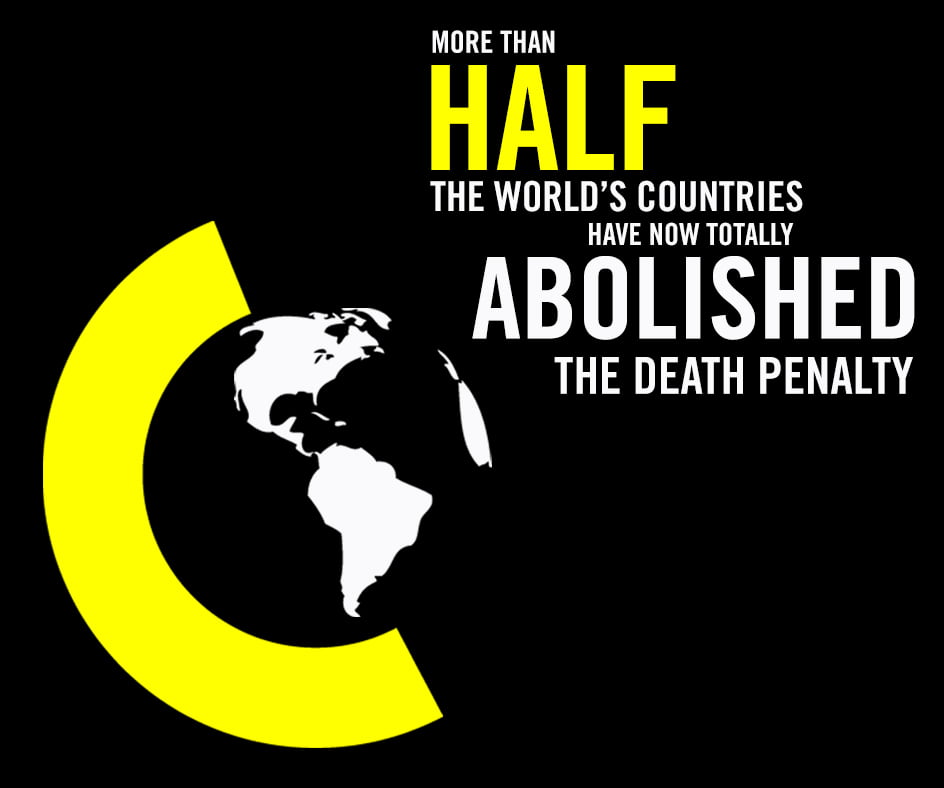
At the end of 2018, 106 countries had abolished the death penalty in law for all crimes and 142 countries had abolished the death penalty in law or practice.