Bangladesh: Rohingya refugees returns must be safe, voluntary and dignified

Call comes as Amnesty Secretary General meets Bangladesh Prime Minister

Looming monsoon season will put Rohingya lives at risk in Cox’s Bazar camps

Amnesty International called on the government of Bangladesh to uphold its commitment that Rohingya refugees are only returned in conditions that are safe, voluntary and dignified.

In a meeting with Bangladesh’s Prime Minister, Sheikh Hasina, Amnesty International’s Secretary General, Salil Shetty, acknowledged the generosity that the country had shown nearly a million Rohingya refugees who were forced out of their homes in Myanmar’s Rakhine State by crimes against humanity committed by the Myanmar military.

“At a time when many states have callously turned their backs on people fleeing persecution, Bangladesh has shown enormous generosity by opening its doors to nearly 700,000 refugees,” said Salil Shetty, Amnesty International’s Secretary General.

“This act of generosity has earned the country tremendous goodwill, and we hope that Bangladesh will stand by its commitment to support Rohingya refugees until it is possible for them to return in safe, voluntary and dignified conditions.”

Salil Shetty also reaffirmed Amnesty International’s position that the Myanmar military must be held accountable for the crimes against humanity committed against the Rohingya.

While visiting refugee camps in the Cox’s Bazar district, Salil Shetty met with several refugees who recounted the horrors visited on them, as well as details of how earlier campaigns of violence by the Myanmar military had repeatedly forced them to seek refuge across the border, in Bangladesh.

Noting efforts to improve conditions in the camps, Amnesty International urged the Bangladeshi government to enhance its efforts ahead of the looming monsoon season, when many refugees will be at risk of mudslides and other hazards associated with heavy rains.

Rohingya children, who have been denied opportunities to pursue their education ever since they began arriving in the Cox’s Bazar district in August 2017, also require major attention.

“Bangladesh cannot be left to deal with this crisis alone. The international community must continue to support the country to host Rohingya refugees for as long as is required,” said Salil Shetty.

“At the same time, world leaders must also press for accountability for the horrific crimes that were committed against the Rohingya, so that they may get the justice they deserve and the security that they need.”

Good news: Torture survivor Jerryme Corre is free!

Jerryme Corre has been released in the Philippines after being tortured by police and spending 6 years in jail on trumped up drug charges. Thousands of Amnesty activists in Australia and around the world have campaigned for his freedom since 2014.

Despite years of delay, hearings were held in January 2018 concerning the charges. On 2 March, a motion to dismiss his case was granted, citing a lack of evidence. Jerryme was released the same day.

What happened?

Jerryme was visiting a relative in Pampanga province in January 2012 when plain-clothed officers arrested him and took him to a police camp. They electrocuted him, punched him and threatened to kill him. The police accused him of being involved in drug-related crimes, of robbing and killing a foreigner, and of killing a police officer.

While torturing Jerryme, the police repeatedly called him by the name “Boyet”, even though his ID proved that was not his name. Jerryme was forced to sign a “confession” which he was not allowed to read.

In 2016 a police officer was convicted of torturing Jerryme, in the first ever conviction under the Philippines’ 2009 Anti-Torture Act.  Despite this ruling, Jerryme remained in prison and the charges against him were not dropped.

Background

Torture and ill-treatment by police remain a critical human rights problem in the Philippines. Despite declarations by the government that they would address this issue, justice is still out of reach for many victims.

Torture victims – most of whom come from disadvantaged backgrounds – are reluctant to come forward and file a complaint due to fear of reprisals and a lack of confidence that the perpetrators will be brought to justice.

A bill to establish a National Preventative Mechanism for torture in accordance with the Philippines’ obligations under the Optional Protocol to the UN Convention against Torture has yet to be adopted by the government.

How did Amnesty respond?

Jerryme’s case was featured in Write for Rights, our annual letter-writing marathon, and as part of Amnesty International’s global Stop Torture campaign.

In March 2015, Amnesty staff in the Philippines handed a petition with 70,000 signatures to the Philippine National Police calling for Jerryme’s release.

On 27 March, thousands of appeals calling for justice for Jerryme Corre were handed over to the Philippines National Police (PNP) Internal Affairs Service (IAS). © AI

Following this, Jerryme Corre and his family were informed that an investigation would be opened by the police’s Internal Affairs Service, in line with Amnesty International’s calls. During the first hearing, it was confirmed that the investigation was initiated as a result of letters received “by a human rights organisation”.

On 16 February, the day before his birthday, staff from Amnesty in the Philippines visited Jerryme in prison and delivered letters wrtten to him by Amnesty activists in Australia and around the world.

Jeremy Corre reading letters sent to him by Amnesty activists
© Amnesty International

During the visit, Jerryme said that he had also received letters directly, and the warden commented that Jerryme became quite the celebrity as letters poured in from across the globe.

Jerryme and his wife said that the amount of support they were getting gave them them hope and courage:

“I can never give enough thanks. These [letters] give me strength. It even changed the course of my case as compared to before. It also gives courage to my wife. We are not alone in this fight. Many people also seek justice for us.”

Jerryme corre, torture survivor

What next?

Following his release, Jerryme is back at home in Pampanga with his wife and step-children. He has been able to visit his mother and his father’s graveyard, following his father’s death while he was in prison.

Jerryme has asked that we pass on his utmost gratitude to Amnesty supporters for not giving up on him and continuing to campaign for human rights. While he hopes that he is the last to have been tortured and falsely accused in the Philippines, he knows that there are many like him.

Jerryme and Amnesty are urging the government to end impunity, make accountability for perpetrators a priority, further strengthen the criminal justice system, uphold the rule of law and due process, and ultimately, respect and protect human rights in the Philippines.

Myanmar: New president must do more to hold perpetrators to account

Responding to the appointment of Win Myint as the new President of Myanmar, James Gomez, Amnesty International’s Director for Southeast Asia and the Pacific, said:

“The Myanmar authorities should use the appointment of a new President as an opportunity to step back from the brink. We’ve seen a dramatic deterioration in the human rights situation in the last year, most especially for the Rohingya community, who have been targeted in a brutal campaign of ethnic cleansing involving crimes against humanity.

“While the military still wields considerable power, the civilian-led government must do more to end discrimination and ensure that perpetrators of human rights violations are held to account.”

My New Neighbour: How We Won in the ACT

By Johanna Larkin and Jill Moran

Johanna is studying Law and Arts at the ANU and convenes the ANU Amnesty International Group

Jill Moran is a policy expert and long time activist for women’s rights and human rights issues, based in the ACT

Last week, Amnesty International ACT achieved an enormous win for the national refugee campaign, My New Neighbour.

We wanted to share with you all our strategy to win in the ACT and how we successfully passed this milestone in only one month.

First of all, the ACT is unique, in that our Territory government is also our local government. We hope this can inspire activists around the country and set the tone for other governments and local councils to follow!

We did this with a core team of 6 volunteers, including students, retirees, young professionals and a local school teacher, and a few others who helped with calls and conversations at community stalls. 


The Campaign:

Community sponsorship is an alternative model of refugee resettlement that allows communities to sponsor refugees and help them adjust to life in Australia. The Australian government’s current community sponsorship program is extremely inaccessible to the majority of refugees and is not in addition to the humanitarian intake.

Amnesty’s new campaign shows that a fair and accessible community sponsorship program is not only possible, it is desperately needed.  We’re calling on governments of every level to support an expanded and improved model for community sponsorship, and we started with the ACT Legislative Assembly.

Find Out More

To reach our ambitious target of bringing a motion to the floor of the Legislative Assembly in just a few short weeks, we were going to need a solid plan. The idea was simple – talk to as many Members of the Legislative Assembly (MLAs) as we could, explain why community sponsorship matters, and convince them to support the motion.

We knew we had a good shot, as the ACT has a fairly progressive government and had already been declared a Refugee Welcome Zone. For many of our fellow activists, you may need to develop a strong ground base of community support before your local government will come on board.


Step 1

We gathered a list of our MLAs, and divided them amongst our diverse team of local activists. Many of us spent our time calling politician’s offices and organising to meet MLAs at community stalls or other events. By calling the offices of all MLAs we ensured all parties were talking about this issue and it was on their agenda.  Of course, it was important to prioritise meeting with MLAs who have portfolio responsibilities related to the topic, but a key lesson for us was to be open to receiving support from all MLAs and all ends of the political spectrum.


We talked with staffers, set up meetings where possible and found out where and when politicians had stalls and public appearances upcoming. We put all this info into a spreadsheet for our team and assigned nominees to visit each event, chat to the relevant politician and staffers and provide them with information on the proposal.

We owe so much to the behind-the-scenes staffers and advisors who helped push from the inside to get this motion passed, and the MLAs whose enthusiasm and support proved invaluable.

Step 2

We were able to have early conversations with MLAs and staffers at their community stalls. Showing up at the markets on a weekend was really effective. In the conversations that followed (there were many), we made sure to focus on the tangibility of this campaign: it is solutions-based, focusing on positive ways that current policy can be reformed to not only support refugees but also benefit Australian communities.

We successfully talked with 18 out of 25 elected MLA’s from both Labor and Liberal parties as well as staff on both sides, in a blitz over two weeks of visiting community stalls. This included key portfolio ministers and shadow members of the opposition.

Step 3

At this stage, the exact specifics of the program did not need to be clearly mapped out. Johanna and long time volunteer Darryl had a sit down meeting with two Greens MLAs, Caroline Le Couteur and Shane Rattenbury, and their staffers, who hold the balance of power in the ACT.

At this meeting, it was more important to discuss the inadequacies of the federal government’s program and the simple ways that it could be made more accessible for refugees with the greatest need.  

Referring to the positive outcomes of the Canadian model of refugee community sponsorship was very helpful here, given this model has been so successful precisely because it is accessible and in addition to the humanitarian intake.

This meeting was crucial in securing the support of Greens MLAs, who were able to introduce the motion and gain the support of the ACT Labor and Liberal parties, who had already heard from us and also from rights holders from Migrant and Refugee Settlement Services  many times on this issue.

Step 4

Blitzing. We called Labor and Liberal offices again to ensure our message was clear. We also had a contingency to ensure support by targeting specific offices of those we knew were already sympathetic to the cause. We also planned to petition each electorate and present these to the relevant member but this in the end did not prove necessary for us.

Step 5

Showing community support for the motion

When the day finally arrived for our motion to be put to the floor, we were overwhelmed with anticipation and enthusiasm. Large numbers of supporters, activists and members of Canberra’s migrant community had come to the gallery to be a part of this moment. We felt proud to sit in that gallery, and to know that we had been a part of making it happen. To see those MLAs who we had called, emailed and met with stand up and declare their support for the motion was a brilliant moment. This included members of all parties represented!

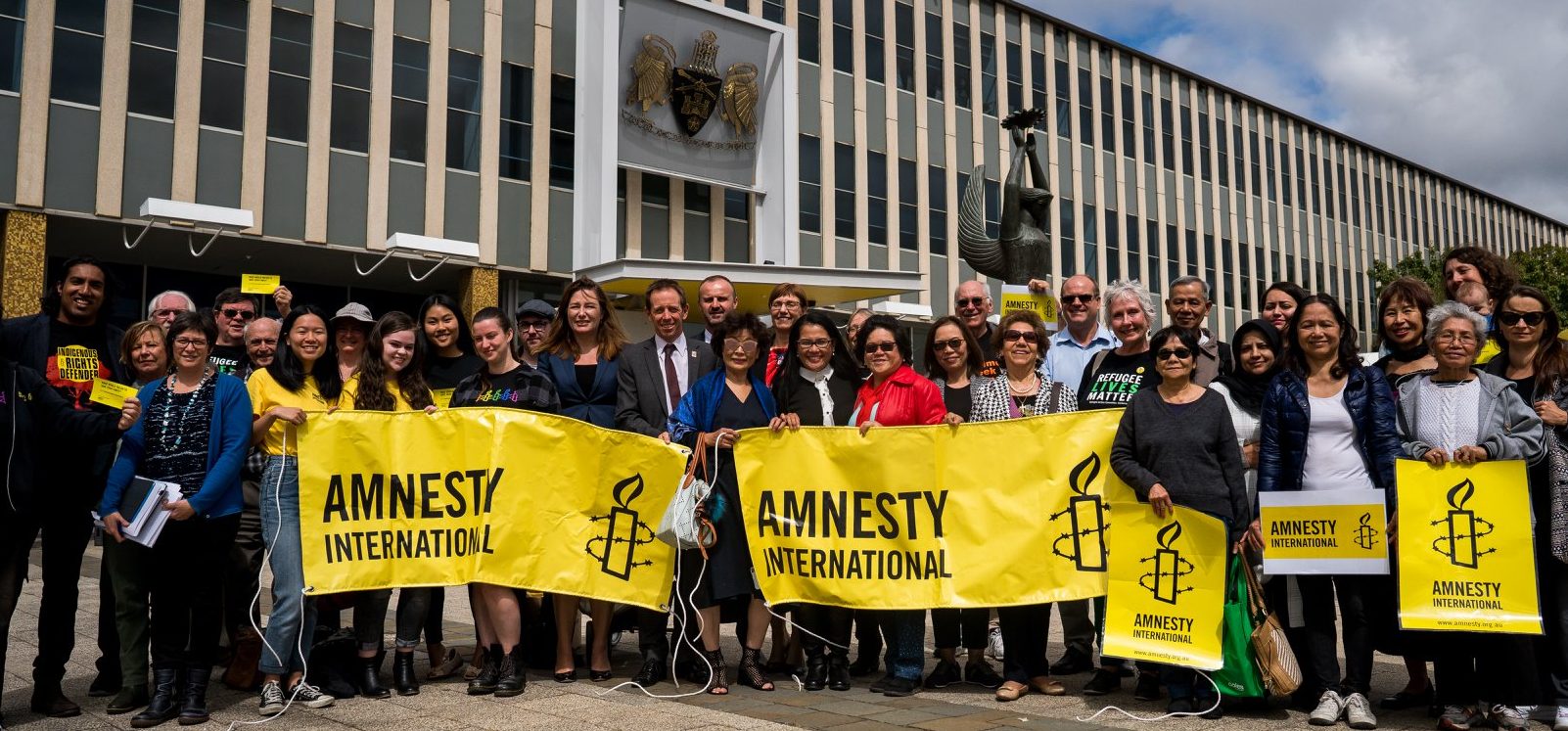
The motion passed. We clapped, hugged, and went outside with our banners, placards and shirts. Alongside some key MLAs, we took the time for a quick photo opportunity, and to thank everyone who had been involved – from the activists, to the political staffers, to the amazing supporting team at Amnesty who offered invaluable guidance every step of the way.

We know that this motion is just one small step, but it is an important one.

We are proud to have been the first jurisdiction to get this motion passed, but we are just the start. We know that activists across Australia are keen and eager to see a fair and equitable humanitarian intake program in Australia.

We hope having our example to point to will give you encouragement in approaching your own local community and governments. The #MyNewNeighbour campaign provides an opportunity to build a community-led, grassroots campaign that creates new pathways for refugees to settle in Australia. To sign the petition for community sponsorship, click here. Better yet, get involved in the campaign to make it happen.

It’s time to start focus on the solutions.

Get involved in the Community Sponsorship Campaign 


Our women’s rights campaign targeting Twitter is ramping up: get involved!

In March, we launched our global campaign to stop online abuse of women on Twitter and it’s been ramping up ever since!

Amnesty activists collected hundreds of petition signatures on the ground, thousands of people have emailed Twitter CEO, Jack Dorsey, and our national women’s rights network is blooming.

Ads promoting our online action are reaching thousands more people on Facebook and Twitter. And on Wednesday, to launch the campaign, we held a stunt outside the Twitter headquarters in Sydney and showed Twitter what we’re made of. We even ran a huge projection with our key message on George St in Sydney and smaller projections in and around central train stations in Melbourne and Brisbane. Our spies told us, that people stopped to talk about them all night!

We know that Twitter is feeling the heat and we’ll keep it up until they take action to enforce their own policies and stop online abuse of women on their platform.

Amnesty staff and activists with banners and props targeting Twitter on online abuse of women

Twitter has become a megaphone for powerful movements like #MeToo and #TimesUp – movements designed to defend the rights of women. And yet, the freedom of women to express themselves is routinely silenced by toxic abuse on the platform.

Despite repeated promises by Twitter to clean up their act, huge numbers of women are logging on to find rape threats, death threats, racist slurs and homophobic insults littering their feeds.

Social media platforms should amplify women’s voices – not silence them.

Our new report #ToxicTwitter: Violence and abuse against women online reveals how Twitter is failing to respect the human rights of women. It also outlines what the company can do to become a safer place for women online.

It’s time Twitter put its own rules into practice to stop this from happening. This means consistently enforcing their own policies that explicitly say violence and abuse against women has no place on Twitter. Because women want to be on Twitter – without fear of being shut down by prejudice and hate.

Let’s stand with thousands of women around the world to say #TimesUp #ToxicTwitter! Let’s make sure Twitter is a safe place where women can express themselves freely, equally and without fear.

HERE’S HOW YOU CAN GET INVOLVED

    • Send an email now to Twitter CEO, Jack Dorsey and tell him to enforce Twitter’s own policies on online abuse and harrassment.
    • Groups can hold stalls, have conversations and collect petition signatures to stop the online abuse of women. There are a whole bunch of fun resources groups can use to campaign locally here. Contact your local action centre if you need more info.
    • Amnesty’s national women’s rights network has been busy collecting Twitter actions & holding events and stalls to let Twitter know that #TimesUp for online abuse of women. The national network is also planning an entirely activist-led women’s rights campaign in Australia in 2019. They are looking for new members if you’re keen to join! The network meets quarterly via zoom and telephone while local networks meet in person more often. To join the women’s rights network, contact your local action centre and be part of an amazing team of activists campaigning for the rights of women worldwide. RSVP to the next national hookup on the 7 June here.
Amnesty's women's rights activists stand in front of a stall at WOMAD
Amnesty’s women’s rights activists in South Australia hold a stall at WOMAD

F2F pitch card

Redacted idea on Instagram – lets dust off this idea that LT had years ago and bring it to life under the refugee campaign! Great for engagement and getting people to start to ‘feel’

Redacted overview

  • Refugee passionate supporters ring fenced from other subject matter comms
  • Other version of the video – also an idea would be to also have other shorter version of the video that can be used earlier as a ‘teaser’ before the main video is launched? Also i reckon getting them to make a few different versions of different lengths (some 15sec) will ensure we can get it out across all platforms
  • Online PR- I would be happy to put some budge to get some external help from a PR company to really help us connect with influencers and also think about ‘stunts’ or other ways to can get our message out.
  • Homepage countdown clock
  • Adding countdown clock to ‘donate unsol’ page
  • Tax ‘donate’ strap sitting on every content page for June
  • Tax ‘donate’ strap within every email for June
  • Tax donate step up on all actions – last week of tax
© Andy Miller Imaginarium Photography


Redacted idea on Instagram- lets dust off this idea that LT had years ago and bring it to life under the refugee campaign! Great for engagement and getting people to start to ‘feel’

Redacted overview

  • Refugee passionate supporters ring fenced from other subject matter comms
  • Other version of the video- also an idea would be to also have other shorter version of the video that can be used earlier as a ‘teaser’ before the main video is launched? Also i reckon getting them to make a few different versions of different lengths (some 15sec) will ensure we can get it out across all platforms


https://www.youtube.com/watch?v=kX-WnlOCvXw

How ethical is your Easter binge?

We don’t want to be the bearer of bad news, but palm oil, it’s in everything. It’s in cooking oil, cereals, shampoo, soaps and – sweet tooths take note – it’s in chocolate.

To create palm oil, palm fruits on trees are harvested and processed into edible oils used for cooking and processed for foods and products. You may have heard about the environmental impact from expanding palm oil plantations but do you know about the appalling working conditions of many workers who harvest palm oil – including children?

Last year, Amnesty uncovered severe exploitation of labour rights on palm oil plantations owned by Wilmar International, which sells to many household brands including Nestlé. Wilmar controls more than 43 per cent of the global palm oil trade and the company’s revenue in 2015 was close to US$40 billion.

It’s just not good enough for major corporations to put profit before human rights, and you can help bring Wilmar into line. Make sure you pick the good choccies over the bad and show your support for human rights at the checkout too.

The good ‘uns

Haigh’s

You can literally taste the happiness of supply-chain fairness in every square of this Adelaide-based chocolate. Their products are palm-oil free and in 2014 Haigh’s became the first Australian-owned chocolate manufacturer to achieve international UTZ certification for the use of ethically and sustainably farmed cocoa beans. Haigh’s operate retail stores throughout Australia.

Alter Eco Pacific

Say yes to organic, fair trade and carbon neutral (surely that makes them better for our waistlines too, right?!), and to flavours like salted burnt caramel and mint truffle. Available at Oxfam stores, select health food stores and some Coles shops – check out this handy store locator for your nearest.

Chocolatier Australia

Also a great pick. Be mindful though that only some of their chocolates are certified fair trade, so check the labelling on each product first. Get your fix at the Chocolatier Shop in Ivanhoe Victoria, David Jones and selected fine food supermarkets around the country.

The bad ‘uns

Nestlé 

Nestlé is one of those mega-company beasts that owns thousands of brands/pretty much most of the world. With such power and profit, it’s disappointing that Nestlé often fails to do even the most basic checks on the human rights standards of the palm oil they use in their chocolate (and other products).

According to its website, Nestlé is committed to using 100 per cent responsibly-sourced palm oil by 2020.

Magnum

Magnum is owned by Unilever, another monster of a global corporation turning a blind eye to exploitation of workers in their supply chain – and like Nestlé they also source their palm oil from Wilmar plantations.

Corporate giants like Unilever assure consumers that their products use ‘sustainable palm oil’, but there is nothing sustainable about palm oil that is produced using child labour and forced labour.

Check out Ethical Shopper’s full guide to ethical chocolate.

Beyond the ‘refugee’ label: welcoming new people to our neighbourhoods

As a journalist in Zimbabwe throughout the 2000s, I reported on the brutal killing sprees and human rights abuses of Robert Mugabe’s henchmen and widespread corruption.

It was never going to be a walk in the park. An informed people is a powerful people and that’s why the dictatorship did everything to gag the media. But I had good reason for speaking out. I was contributing to the struggle for democracy and freedom in Zimbabwe through my work as a journalist – and I have no regrets. I did the right thing.

In the days before escaping from my birth country, I saw one of my cousins tortured to death, and I watched my mother die as a result of the wounds from an assault.

This was not the Zimbabwe I remembered as a child. It used to be a country carefree and full of promise.

Myself, I had received beatings and several death threats. I often took to the stage in Zimbabwe to speak about the violence and corruption I had uncovered, in front of crowds of thousands.

The last time I spoke on stage it ended badly. I was abducted, blindfolded, beaten, taken to an unknown location and held captive for days.

Seeking safety in Australia

I knew that for the sake of my children and those I loved, I had to escape Zimbabwe.

I arrived in Canberra as an asylum seeker in 2010, and found welcome and support through community organisations such as the Canberra Refugee Support, and the Migrant and Refugee Settlement Services, as well as from individuals. I experienced kindness and loving care, which helped me to make a fresh start.

I enrolled in a social work degree, as a process of self-healing. It was a way of confronting my past, and giving back to all those people who have assisted me in Australia and elsewhere that I may never meet.

I’m a strong advocate for mental health and working with youth, and I’m passionate about using music to create social inclusion. Before completing my studies, I joined the Australian Red Cross and worked with newly arrived asylum seekers.

I’m a drummer, and I’ve used music as therapy for people suffering from mental health issues. I’ve also used music to share my Zimbabwean culture with people in Australia.

While caring for my children and working full time, I studied for a Masters in child and adolescent welfare. I know that without community support, I never would have achieved this.

Felix Machiridza smiling next to a tree
Former refugee Felix Machiridza now calls Wagga Wagga, NSW home. © Fairfax Syndication

Arriving in Wagga Wagga

I recently moved to Wagga Wagga where I now work for an Indigenous community service as lead family therapist.

It has been a really wonderful experience to be here, with my family and to be able to contribute to the life of this wonderful town.

“There is a very strong community connection in this place, where everyone does their bit and helps each other out. It’s a very natural generosity and human connection”  

I support new alternatives to bring refugees to Australia, including Amnesty’s calls for a fairer, expanded community sponsorship program in Australia. There is great community capacity to sponsor and support refugees, especially in regional areas like Wagga Wagga and the Riverina.

I believe that if someone can be supported and assisted to rebuild hope and resilience, then they can manage to not only be stronger but make a tremendous contribution to the society that has nurtured and taken care of them.”


What happened at WOMAD!

WOMAD What?

For the past number of years, the SA/NT Branch Committee has taken an active role in organising an Amnesty Stall at the WOMADelaide Music Festival. A festival that celebrates diversity, equality, peace and understanding, it is the perfect place to meet other people from around the world to talk about and raise support for Amnesty’s current human rights campaigns.

What went on this year?

This year our focus was on BRAVE and Women’s Rights, in which we had a goal of 1000 hard actions to be taken for Azza Soliman and Taner Kilic as well as to end the violence experienced by women online through our Women’s Rights Twitter campaign. The amazing team of Amnesty activists from right across South Australia battled the hot, dry SA weather over the 4 day festival  to achieve this goal and much more!

There was something for everyone at the Amnesty Stall – actions to sign, merch to buy, BRAVE tattoos, balloons … even an Amnesty fortune teller! We enjoyed every minute of sharing our human rights activism with people of all ages, cultures and backgrounds.   This was a great time to meet artists and performers from different parts of the world, as well as other eager local, national and international festival goers who were interested in taking a stand to protect human rights.

Special Guest….

A major highlight was getting a special visit from well- respected journalist and former individual at risk, Peter Greste. Not only did Peter happily agree to pay us a visit, but he gave a warm public acknowledgement for his support to Amnesty and signed all our petitions and chatted with our volunteers on the importance of human rights and freedom of speech- among many other things.

Peter Greste at WOMADelaide

We don’t always get many good news stories, so it was so great to meet someone who Amnesty tirelessly campaigned for and saw successfully released. While AIA cannot take sole credit for the release of Peter Greste, we saw what it meant to be part of a collective movement for change that achieved someone’s freedom after over a year of imprisonment.

At WOMAD our SA/NT volunteers were able to band together to share in a beautiful 3 ½ days of unity, peace and cultural understanding. We gained support within the people of our region towards our work and made meaningful connections with other like-minded organisations. Most importantly though, we were able to share our human rights activism with the world; sharing in a time when different voices, people and sounds of the world united as one. Unity is a glorious sound.  

Written by Sarah Burrage Amnesty SA/NT Branch Committee Secretary

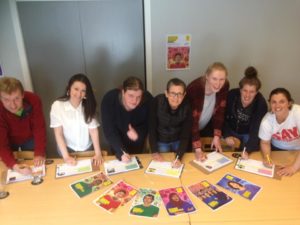
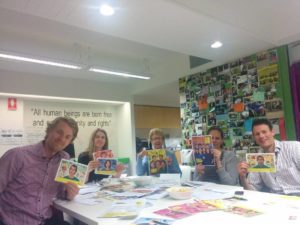
Write for Rights 2017: What we achieved

Over 5 million actions for Write for Rights were collected world wide last year with Australians adding over 160,000 actions. 32,000 of these people were signing an Amnesty action for the very first time.

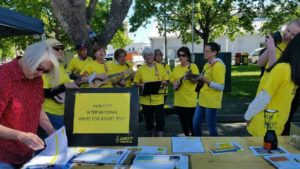
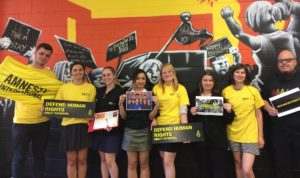
Across our communities, more than 90 of our groups organised over 200 events and collected almost 14,000 actions and letters. All this within three months! We didn’t reach our target of 20,000 actions by groups but we did see some impressive activities. 

Some of the highlights include:

  • The NSW Schools network collecting 1,258 actions through their schools conference and one school leading a street blitz action
  • The Amnesty Pop Culture Network at the Melbourne #Madman Anime Festival, collected 744 petition signatures over the two days.
  • The establishment of a new Individuals at Risk Network based in Melbourne as well as a pop up stalls group in Hobart 
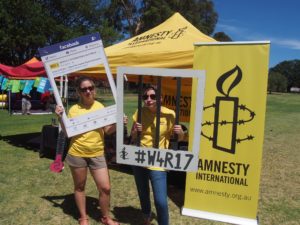
  • Activists Blitzing at the Dogs day out in Canberra with #HumanRightsarePawesome #W4Rs17 @Amnestyoz
  • Local media articles and mentions including local TV in Perth interviewing one of our activists on her work on Write for Rights

WINNERS! TEN lucky people who took offline actions for write for rights last year will be receiving an email letting them know they have won the Pet Bandana! So keep an eye out in your inbox! We will ask for the size of the pet you want the bandana made for and where you’d like it posted. Hopefully we’ll be sent back a pic or two to share with you all later.

What we learned

You told us that you found it difficult to find the off-line actions. Our Individuals at Risk work continues with our key campaign focused on BRAVE human rights defenders.

What we’ve done: Brave cases have one landing page for all offline resources:

st1.amnesty.org.au/Brave_activist

This landing page will not move throughout the year so you’ll always know where to go to find the things you need for your activities. We will add new information and resources here so keep checking for updates and new exciting materials!

What’s next?

Missed the Brave launch? Wanna know what it’s all about? You can find the Brave Launch video with the key information

9th April Brave catch up RSVP: Find out the latest, hear from others around the country on what they’re planning and get excited about your events!

Save the Date for Brave in 2018

6th June marks one year of imprisonment for Taner Kilic. 

Taner Kılıç, Chair of Amnesty International Turkey, was thrown into prison on 6 June last year in an effort to silence critics and crackdown on freedoms in Turkey.

6 June is the key date for the 2018

Plan your big events to coincide with or around this date. Take it to the streets, festivals and markets in your areas, tell everyone about what is happening to Taner and that we need him to be released. His court appearance is scheduled for 21st June so we are aiming for mass actions in the lead up to his court date. Please plan your events and collect as many actions as you can around 6th June, send them back to us as quickly as possible for they can be sent to the authorities before his court appearance.