Syria: UN Human Rights Council must ensure those responsible for atrocities in Eastern Ghouta are held to account

Amnesty calls on the United Human Rights Council to act ‘for the sake of humanity’.

Australia is attending its first session as a member of the United Nations Human Rights Council.

Responding to the impending vote at the United Nations Human Rights Council on a resolution on the situation in Eastern Ghouta, Kevin Whelan, Senior Advocate at Amnesty International said:

“The international community must act now to end the war crimes in Eastern Ghouta. The catastrophic humanitarian situation will further deteriorate if parties to the conflict continue to violate international humanitarian law with impunity.

“It is imperative, for the sake of humanity, for the Human Rights Council to do all that is in its power to ensure that those responsible for the atrocity crimes committed in Eastern Ghouta are held to account for these horrific acts.”

“It is imperative, for the sake of humanity, for the Human Rights Council to do all that is in its power to ensure that those responsible for the atrocity crimes committed in Eastern Ghouta are held to account for these horrific acts.

“The Syrian government must immediately provide UN independent monitors with access to Syria in order to investigate violations of international humanitarian law.”

Mardi Gras 2018: In the wake of the rainbow momentum

By Wing Hong Chu

Wing Hong Chu
Wing Hong Chu

Wing Hong also goes by (Vee) is the Co-founder of the Adelaide Amnesty International LGBTQI Network, current convenor of the Adelaide Artillery Network and former convenor of the Flinders University Amnesty International Activist Group

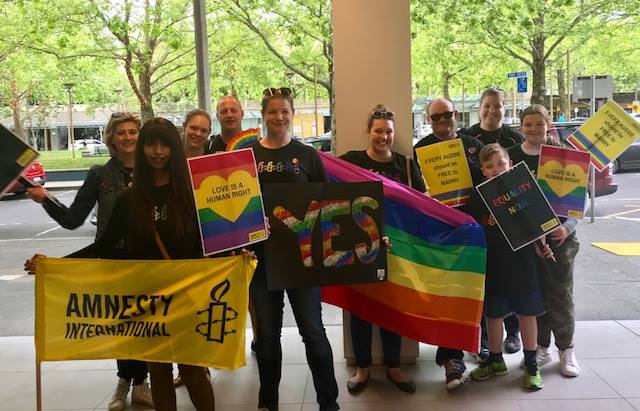
To celebrate the recent success of our marriage equality campaign, Amnesty International Australia has given two interstate queer rights activists the opportunity to attend this year’s Mardi Gras and I have been incredibly blessed to be selected as one of them.

A little less than a year ago, my queer, gender non-binary friends and I were still busy running around, collecting signatures for Amnesty International Australia’s petition on marriage equality. Today, it still feels so incredible that marriage equality has finally been actualized in Australia.

As the Queer Amnesty International Adelaide Action Group, we attended community events and had countless contentious discussions with people of all different political persuasions about the legalisation of same sex marriage.

We talked about the positive impacts marriage equality would bring to Australia, including improving the mental health of queer young Australians and reducing suicide rates (much like it has in the U.S.).

Given the damaging impact of inequality on mental health, numerous corporations and non-profit organisations have voiced their support for marriage equality. Even the Australian Medical Association has shown its solidarity.

We were adamant that our work would add to the momentum needed to pass a fair and just marriage equality bill to legalise same-sex marriage and protect same-sex couples from other forms of discrimination. Despite our efforts, the campaign led to a legally non-binding postal plebiscite which costed Australia tax payers $122 million.

Nonetheless, the majority of Australians – 61.6% – favour of love, and we celebrated. Thanks to everyone who voted ‘Yes’, marriage equality is now a part of Australian law. This is truly a historic and impressive achievement for Australia that I can’t wait to celebrate with the LGBTQI community in this year’s Mardi Gras Parade.

Although marriage equality is a blissful victory for the local Australian queer community, there are still so many brave individuals who face brutal prosecution and senseless violence for speaking out against injustice.

This Mardi Gras, I’ll be sparing a thought for those still struggling for equality. Amnesty is campaigning for BRAVE human rights defenders this year, including those like Transgender activist Sakris Kupila who is standing up for human rights in his native Finland despite continued threats and hostility. This year we’re marching for Sakris and others like him around the world who are fighting for equality under the law.

NT leads the way but it’s not enough: Australia must now raise criminal age to 14

Acknowledging the Northern Territory Government’s response to the The Royal Commission into the Protection and Detention of Children in the Northern Territory, Roxanne Moore, Amnesty International Indigenous Rights Campaigner said:

“The NT Government has today led the way for Australia by agreeing in principle to #RaiseTheAge of criminal responsibility.

“Right now, the Northern Territory, and all States and Territories, lock up primary-school kids. 10 is far too young to go to prison. 12 is a step in the right direction, but the age must be raised to 14, in line with the rest of the world.”

“What’s more, it’s not enough to only offer ‘in principle’ support for critical changes desperately needed to the youth justice system. Territory kids need to see firm commitments and timeframes around diversion away from prison, support for families and kids on bail, policing, independent oversight and accountability for change.

“These are children’s lives we are talking about. We look forward to seeing Minister Wakefield’s promised implementation plan by the end of this month. This must not be yet another set of recommendations that sit in a bottom drawer.”

“We’ve just heard a young person has been held in isolation for over 300 days in Western Australia – it’s critical that all Australian governments prohibit solitary confinement for children in prison. We know it’s not just Don Dale and that’s why the Prime Minister must adopt a national plan of action, to take these Royal Commission learnings across Australia.”

Group health checked!

Across late 2017 early 2018, Amnesty ran the Group Health Check (GHC) survey for the first time in two years. A big thanks to our action group convenors and members who took part in the survey.

This survey is opportunity for Amnesty to take the temperature of our action groups and to assess if our priorities and campaigns fit with you and how we can improve our support for the important work you do in your communities.

There were many valuable lessons gained from this latest survey. Below is a quick snapshot of the results. If you want to find out more check out the Executive Summary or if you’re really keen you can read the full report here.

Top 10 lessons from the 2017/18 GHC:

More organising groups

  • Twenty five of our action groups have closed over the past two years. In contrast however, our groups are organising in their communties and are more autonomous and strategic than ever before.

Conveners are feeling a tad overwhelmed

  • We ask a lot of our convenors: to support, grow and develop their action groups to contribute to Amnesty’s many campaigns. And convenors are feeling it. At present only 11% of groups have a succession plan in place.

We will work with our action groups and activists to find solutions to support our convenors better and ensure our action groups are healthy and sustainable. 

However our convenors are stayers!

  • In 2015 we had 57 new convenors. In 2017 those convenors are still here – 50 of the participating convenors have been around for between 2 and 5 years. Retention of convenors for five years plus has remained more or less stable.

A shout to Tim Ash (Forest Group), John Crawford (Walkerville Group) and Michael Becker (Unley Group) who have been conveners for over 25 years!  And a big thanks to all of our convenors for your ongoing leadership, passion and dedication.

Our groups are engaging in reconciliation and working with local Aboriginal and Torres Strait Islander communities

  • The number of groups that regularly say an Acknowledgement to Country grew by 50 per cent in the last 2 years. About 30 percent of action groups are participating in significant Aboriginal and Torres Strait Islander days or events. And about 20 groups have developed new partnerships with Aboriginal and Torres Strait Islander organisations.

Campaign priorities fit 

  • Groups are generally happy with Amnesty’s priorities and campaigns and the mix of domestic and international priorities.

The campaigns that are most important to our groups

  • The refugee campaign is the most worked on campaign among our groups, however some expressed feeling overwhelmed by the ongoing challenges and decline of human rights for people seeking asylum.
  • Community is Everything and Individuals at Risk both tied for the second place of most important campaign.

Some convenors are interested in having more Individual at Risk work. If you or your group want to focus on Individuals at Risk in 2018 then come along to the online launch of our BRAVE campaign to find out how you can stand up for human rights defenders.

Finding the information you need?

  • Our Leader bulletin used to be one of the primary sources of information for groups.  In 2017/18 you ranked it as 9th! People also expressed some confusion on what resources are available and where to find them. We are reviewing The Leader to make it more effective and resource accessibility to ensure you have the tools you need. Further we encourage our groups to review The Activism Planner regularly to find out what’s coming up.

Branch Committees and groups are building stronger relationships 

  • There is a 20 per cent increase in relationships between action groups and their regional Branch Committee. Contributing factors are increased participation in Branch AGMs, event proposals and BC members attending events.

Action groups are connecting with young activists

  • Fifty per cent of the participating groups have at least one member between the age of 18 of 25! Plus 88 of our groups expressed an interest in engaging with local high schools (depending on their availability).

We are taking on board the insights you provided us with in the GHC survey. We will ensure that you have the support you need to continue protecting and defending human rights and so we can achieve our 2020 Vision.

Syria: Alleged chemical weapons pact with North Korea would represent ‘a betrayal of humanity’

Reacting to a New York Times article alleging that an unpublished United Nations report reveals that from 2012 to 2017 North Korea secretly shipped supplies to Syria that could be used to produce internationally banned chemical weapons, Lynn Malouf, Director of Research for the Middle East at Amnesty International, said:

“Supplying any state with the means to produce these horrific weapons is utterly deplorable. But to help the Syrian government – which has repeatedly used chemical weapons against civilians – replenish its supplies would be a particularly egregious betrayal of humanity.

“The UN should publish its report. If the report is accurate, it would represent an ominous marker of how far the crimes and violations committed by the Syrian government have eroded respect for long-established prohibitions.

“The use of chemical weapons has long been reviled by the international community and they are prohibited for very good reasons. We fear their repeated use in Syria could have terrible implications that extend well beyond this conflict.

“Clearly the current arms embargoes and inspection regimes are not working; the international community needs to make clear that the world will not stand for such flagrant violations of international law.”

Background

Media and activists reported that another chemical attack had been launched in Eastern Ghouta on 25 February. The Organisation for the Prohibition of Chemical Weapons announced that it is investigating the attack. According to the Syrian American Medical Association, it was the seventh such attack in 2018 and the 197th since the conflict began in 2012, killing hundreds and inflicting terrible injuries on others.

The 1992 Chemical Weapons Convention prohibits the development, production, stockpiling, transfer and use of chemical weapons and requires States Parties to destroy chemical weapon stockpiles. Chemical weapons are inherently indiscriminate and their use is a war crime under customary international law.

Amnesty International calls for full respect of the prohibitions in international law of chemical and biological weapons. Such weapons should not be used, and any stockpiles should also be destroyed.

How to create a human rights ambassador?

Last year Amnesty Townsville created a new initiative to reach out to high school students in their community. Here is how they did it…

The Human Rights Ambassador Project is an initiative of the Townsville Amnesty Action Group in cooperation with James Cook University aimed at getting information on Human Rights into local High Schools. JCU students are trained as Human Rights Ambassadors (HRAs) to deliver presentations on Human Rights to students in participating high schools. In 2017 a pilot project was conducted with 10 Human Rights Ambassadors and three participating high schools.

How did they find Human Rights Ambassadors? 

BA3000 lecturer Marie Oelgemoeller with HRAs Jayden, Maigan and Brianna

JCU students with an interest in Human Rights were invited to participate in the program. Applicants we asked to submit an expression of interest and to participate in a selection process. Of the ten who were finally selected, six were from the subject BA3000. As part of BA3000, students can complete an internship with a community organisation (minimum of 20 hours) and write a report on this involvement. Perfect opportunity to have their Amnesty involvement contribute to their education!

Teachers from a number of Townsville High Schools were invited to participate in the program. The schools were asked to nominate a presentation they would like for their school. Three local high schools participated in the project in 2017. HRAs met with teachers at the three schools to negotiate topics for the presentations.

Training

The first part of the project were two training workshops where the HRAs were given a basic grounding in Human Rights and Human Rights education. The HRAs with the assistance of Amnesty group members then gathered materials for their presentations on the agreed topics.

Presentations and feedback 

The school presentations took place in October and the feedback from teachers at the participating schools was very positive.

From Kirwan SHS : “I surveyed the students afterward and asked for direct honesty and they universally loved the session. The presenters were good. The students thought that the information about refugees was the most valuable to them (they had no idea). Being delivered on a personal level meant that the take up was high. The movement of students and changes in learning modality were all well-conceived.”

From William Ross SHS : “I’d just like to express my sincere thanks to Maigan and Jayden for visiting William Ross State High School and running a Human Rights lesson for our Year 10 Extension class. The information was highly relevant, engaging and well presented. Our year 10 students were engaged for the full session and actively participated.”

Next Steps 

At the completion of the program Amnesty group members met with the HRAs to present certificates of appreciation to the HRAs and also get their ideas about the future of the program. All agreed that it had been a worthwhile experience. Several HRAs who will be at JCU in 2018 indicated they were interested in continuing in the program.

Our plan is to expand the project to at least six schools in 2018 with 15 HRAs. The HRAs will be recruited in August and September and will undergo a three day intensive training program in the lecture recess in September. The school presentations will then take place in the fourth school term in October.

Stay tuned for more information about how to engage with schools in your local area! A local group guide will be available later in March.

Ethiopian journalist Eskinder Nega released from prison

Journalist and prisoner of conscience Eskinder Nega was unconditionally released as part of a presidential pardon on the 14 February 2018.

What happened?

At an event to mark the Ethiopian New Year in 2011 Eskinder spoke about press freedom in the country. Shortly after, on the 14 September, Eskinder was arrested – for the ninth time – because of his activities as a journalist.

He was sentenced to 18 years in prison in 2012 on trumped up terrorism charges. A key part of the evidence against Eskinder was the impassioned speeches he made at a public meeting about Ethiopians’ need to struggle peacefully for freedom.

He has previously been tried for treason – alongside his wife, and 129 other journalists, opposition politicians and civil society activists – following post-election protests in 2005. Eskinder was detained for 18 months and then released in April 2007. Eskinder’s wife, Serkalem Fasil, gave birth to their only son, Nafkot, while she was in prison.

Repression of civil society

Ethiopia’s Anti-Terrorism Proclamation enables the prosecution of legitimate and peaceful activities as ‘terrorist’ acts. It contains broad provisions that can be used to criminalise freedom of expression and association.

Ethiopian authorities routinely use criminal charges and accusations of terrorism to silence dissent. Repression of freedom of expression has increased in recent years. Evidence against defendants has included newspaper articles criticising the government, communication with news outlets critical of the government, poems written by defendants, and even articles sent to the defendants by other people.

How did Amnesty respond?

Eskinder’s was featured as a case for Write for Rights in 2013 and activists all around the world took action to secure his release.

In Australia this included signing petitions, writing letters to the President of Ethiopia and to Eskinder himself to show solidarity.

Eskinder’s image was featured on buses around Australia, with the public encouraged to send text messages asking the Ethiopian government to release him.

On World Press Freedom Day in 2014, we handed over a petition with 30,000 signatures to Ethiopian authorities.

Eskinder sent a thank you message to Amnesty and our supporters:

“I shall continue to be a voice for non-violence, peace, democracy and reconciliation. Thanks Amnesty International. I am honoured to have been deemed worthy of your support.”

What next?

On Eskinder’s release, Sarah Jackson, Amnesty International’s Deputy Regional Director for East Africa, the Horn and the Great Lakes, said:

“We hope the release of this courageous journalist, along with hundreds of other prisoners, heralds a new dawn in the Ethiopian government’s handling of political dissent, a dawn of tolerance and respect for human rights.”

The Ethiopian Government must:

  • show good faith and free hundreds of other prisoners of conscience who remain behind bars simply for exercising their right to freedom of expression
  • take steps to reform the legal system under which arbitrary detentions and torture of dissidents have been allowed to flourish
  • review the sweeping and draconian anti-terrorism law which has been used to unjustly and ruthlessly deprive many dissidents of their freedom
  • order an impartial and independent investigation into allegations of torture and other ill-treatment of prisoners and the swift prosecution in fair trials of those found responsible for it.

Syria: Security Council must ensure civilians in Eastern Ghouta get immediate humanitarian assistance

Responding to the news that the United Nations Security Council (UNSC) finally voted on a much-delayed resolution calling for humanitarian aid into Eastern Ghouta and a partial ceasefire, Sherine Tadros, Head of Amnesty International’s UN Office said:

“It shouldn’t require a Security Council resolution or a ceasefire for starving civilians to be allowed life-saving assistance and protection from being deliberately bombarded. These are the requirements of international humanitarian law.  But now that the resolution has finally passed, the Security Council must follow through and ensure that attacks on civilians are ended and unfettered access to humanitarian assistance is provided without delay.

“For more than six years, Security Council members have abdicated their responsibility and relegated themselves to irrelevance in Syria. Even the resolutions that were belatedly adopted on ending violations and securing humanitarian access have not been enforced. They must now take all possible measures to implement the humanitarian measures of this and previous resolutions.

“While this resolution is a step in the right direction, we are worried that the long list of legitimate targets leaves too much room for warring parties to justify their indiscriminate attacks against civilians and civilian infrastructure.

“Regardless of whether the ceasefire is implemented, we are urging all parties to respect their obligations under international humanitarian law. The Syrian government and Russia must immediately stop the deliberate bombing of civilians in Eastern Ghouta and the targeting of civilian infrastructure including schools and hospitals. We are also calling on armed groups in Eastern Ghouta to immediately stop their indiscriminate shelling of Damascus.

“The siege of Eastern Ghouta must immediately be lifted and aid organisations granted unfettered access to respond to the catastrophic humanitarian situation in the area, and civilians must be granted safe passage to leave.  These atrocities must end. Civilians in Syria should not have to endure starvation and unspeakable suffering.

“The situation in Syria must be referred to the International Criminal Court. It is vital, for the sake of humanity, for all parties responsible for mass atrocity crimes in Syria to face justice.”

10 Years later: The National Apology

Tuesday 13 February marked the 10th anniversary of the National Apology to Australia’s First Peoples. A momentous day in history, this felt for many like a start towards National Reconciliation. But a decade on, we’ve made only marginal outward progress.  Many of the challenges recognised in the apology are still affecting Aboriginal and Torres Strait Islander communities and descendants of the stolen generations.

Rodney Dillon, a Palawa Elder and Indigenous rights advisor at Amnesty International Australia, says he has more hope for today’s Australia to make these changes. But it will require a movement.

“Not much has changed for the stolen generation yet, but Australia is becoming more truthful about its history.”

For the children, grandchildren, and wider communities of those one-in-three who were stolen, the intergenerational trauma has been ongoing and severe. Attempts to “wipe out” Aboriginal culture and the use of the stolen generation members as low or unpaid labourers has left families severed and lands stripped away.

“The issues we’re fighting today, like the overrepresentation of Aboriginal and Torres Strait Islander youth in detention, are a byproduct of that. Troubles the communities are facing with poverty, mental health, housing, education there is so much shame around it. But we have no reason to feel ashamed.”

It’s important that the nation has started to admit to these issues, especially in the past decade. Paul Keating’s iconic “Redfern” speech in 1993 “may have been too early”, Rodney says. “The country wasn’t ready yet.” But after the release of the Bringing Them Home report in 1997, momentum was gained to make things better.

Rodney was one of the 250,000 people who walked across the Corroboree Bridge in Sydney in 2000 in support of Aboriginal and Torres Strait Islander rights, but the walk was just the beginning.

Year after year, Aboriginal and Torres Strait people and activists called for the report to be publicly recognised by then-Prime Minister John Howard, who adamantly defended his decision not to for the 11 years he was in power.

With the opening of a parliament in 2008, new Prime Minister Kevin Rudd made it his first order of business. “There comes a time in the history of nations when their peoples must become fully reconciled to their past if they are to go forward with confidence to embrace their future. Our nation, Australia, has reached such a time,” he said in the famous speech.

But were we ready to embrace change, or are we still on the way?

Rodney says we have gathered the momentum to make a difference. He says anyone can help, just:

“Have empathy for the plight of Aboriginal and Torres Strait Islander Peoples. Show that the cause is strong and that you’re doing everything you can to stop this kind of atrocity from happening again.”

Making progress to #ChangeTheDate

‘What if Australia Day was a day that united us, rather than divided? A day where we all could come together to celebrate this huge, beautiful, unique land and waters, and our diverse cultures?’ Rodney Dillon, Palawa man and Amnesty’s Indigenous Rights Advisor, recently said in a Koori Mail article.

In 2017, Amnesty International Australia formally joined the growing movement calling on the Government to #ChangetheDate of our national day so that all Australians can join the celebrations.

Although Australia Day – also known as Survival Day – has only been officially nationally celebrated as a public holiday since 1994, protesting on 26 January is not new for Aboriginal people; protests date all the way back to the 1800s. Check out our video in which Aboriginal leaders and elders share their thoughts on why it’s important to #ChangetheDate:

Each year, momentum to change the date is growing. This year on 26 January there were large public protests across the country. Australians marched in solidarity with the nation’s First peoples in capital cities on Survival Day, and cultural events were held all around the country. Every year, people are coming together to say that 26 January is not a day of celebration.

Thousands of supporters have taken our online action calling on the Federal Government to:

  • acknowledge that 26 January has a long and painful history for Aboriginal and Torres Strait Islander Peoples; and
  • consult with the community to choose a new date for Australia Day so it can be celebrated by all.

Will you stand in solidarity with Aboriginal and Torres Strait Islander people and call on our elected representatives to #ChangeTheDate so we can all celebrate together?

Our country’s history goes back well beyond 26 January 1788. It began over 65,000 years ago – and we’re still making it now. Let’s respect the survival and resilience of our Indigenous peoples and #ChangeTheDate.