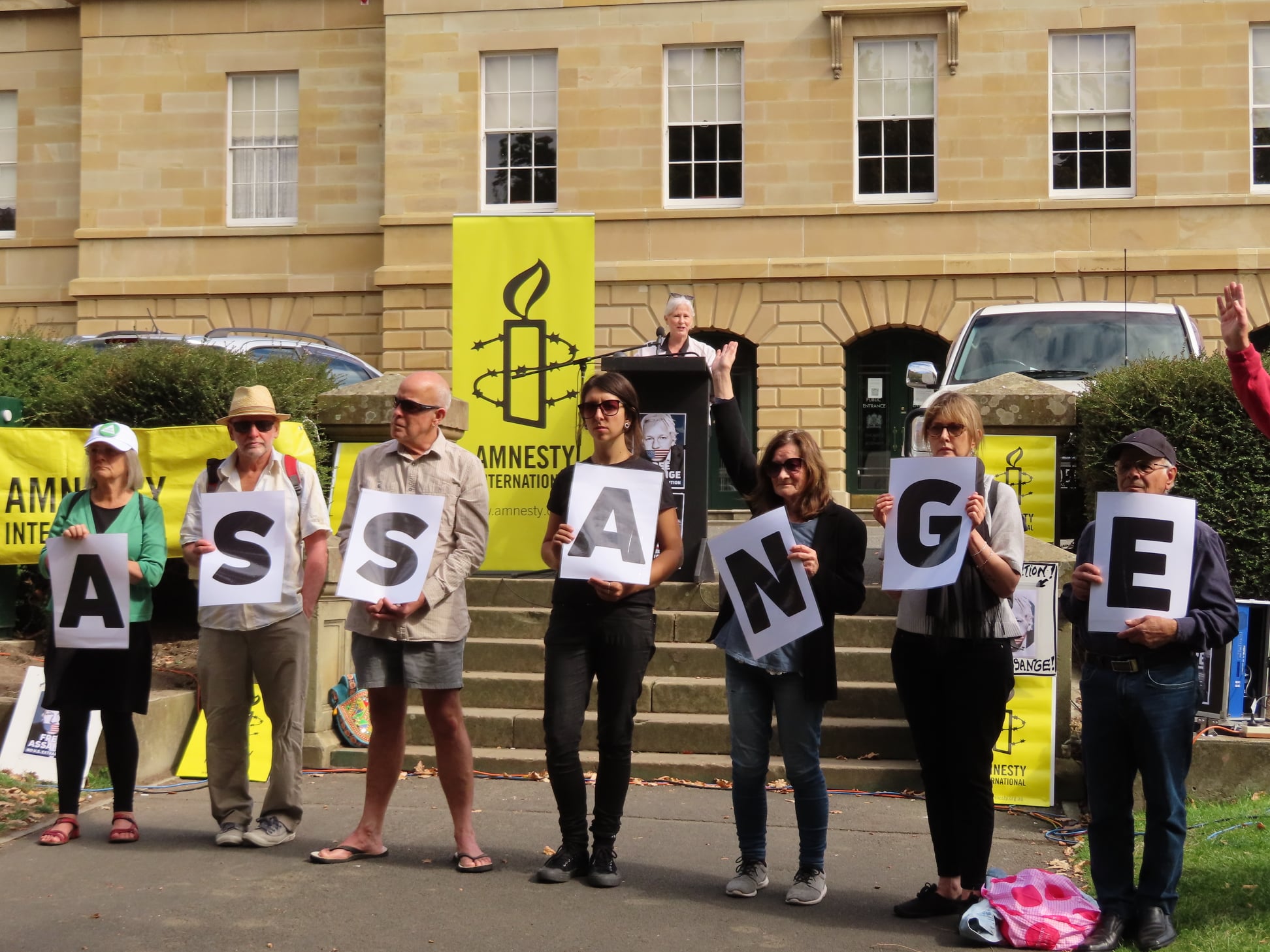
US/UK: “Drop the charges, stop the extradition and free Julian Assange,” says Amnesty head

  • Amnesty spokespeople at the court and available for interview

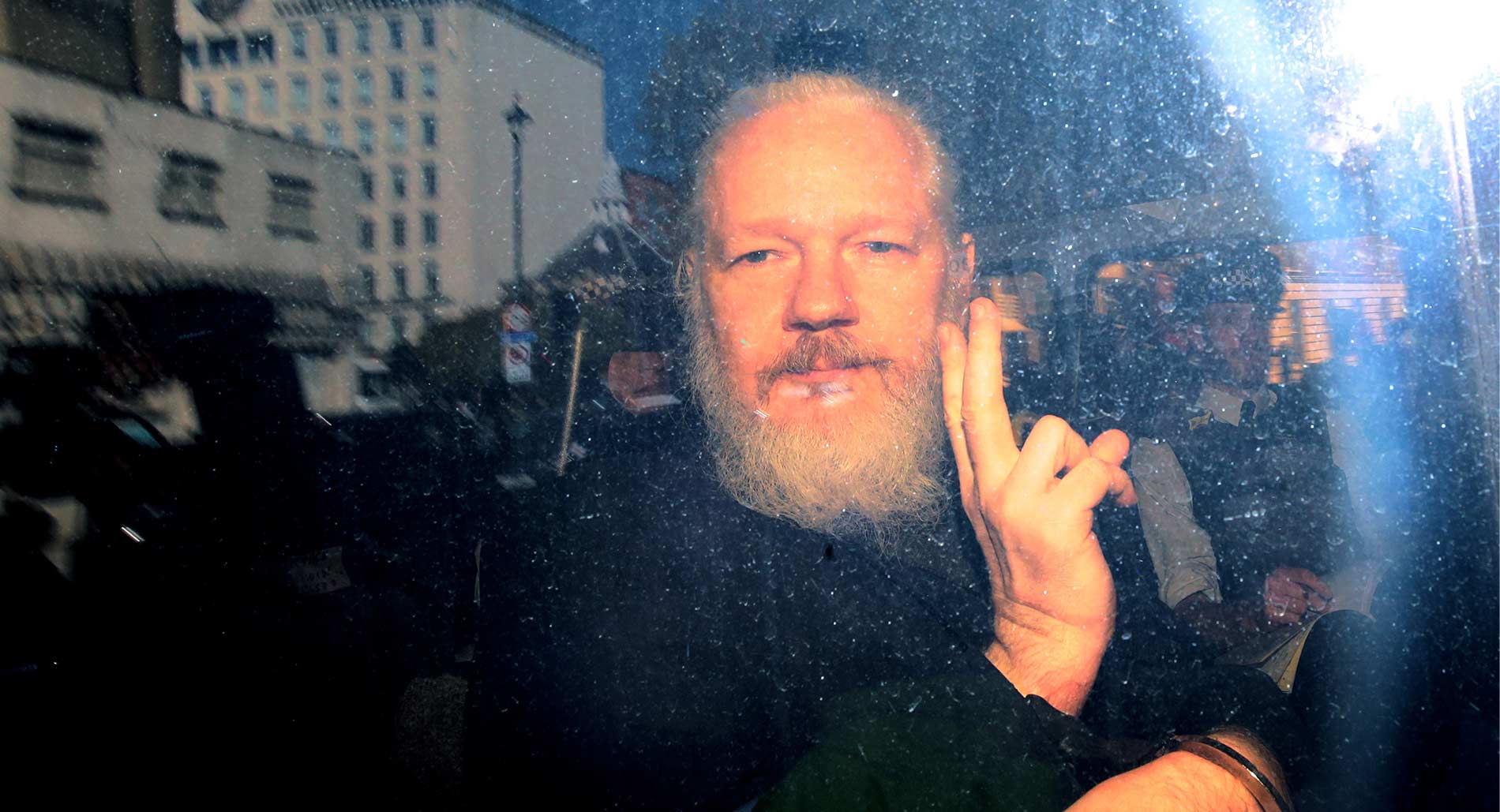
Ahead of an appeal hearing against the decision by a UK court not to extradite Julian Assange to the USA, Amnesty International’s Secretary General has called on US authorities to drop the charges against him and the UK authorities not to extradite him but release him immediately.

The call by Agnès Callamard follows an investigation by Yahoo News revealing that US security services considered kidnapping or killing Julian Assange when he was resident in the Ecuadorian embassy in London. These reports further weaken already unreliable US diplomatic assurances that Assange will not be placed in conditions that could amount to ill-treatment if extradited. 

“Assurances by the US government that they would not put Julian Assange in a maximum security prison or subject him to abusive Special Administrative Measures were discredited by their admission that they reserved the right to reverse those guarantees. Now, reports that the CIA considered kidnapping or killing Assange have cast even more doubt on the reliability of US promises and further expose the political motivation behind this case,” said Amnesty Secretary General, Agnès Callamard.

“It is a damning indictment that nearly 20 years on, virtually no one responsible for alleged US war crimes committed in the course of the Afghanistan and Iraq wars has been held accountable, let alone prosecuted, and yet a publisher who exposed such crimes is potentially facing a lifetime in jail.”

The appeal hearing, scheduled for 27-28 October, is expected to consider five grounds of appeal by the US, including the reliability of assurances offered by the US after a lower UK court ruled against Assange’s extradition in January 2021. Amnesty International has concluded that the assurances are unreliable.

The US charges allege that Assange conspired with a whistleblower — army intelligence analyst Chelsea Manning — to illegally obtain classified information. They want him to stand trial on charges under the Espionage Act and the Computer Fraud and Abuse Act in the US where he could face a prison sentence of up to 175 years.

The US government’s indictment poses a grave threat to press freedom both in the United States and abroad. The conduct it describes includes professional activities undertaken by investigative journalists and publishers on a daily basis. Were Julian Assange’s extradition to be allowed it would criminalize common journalistic practices and permit the US and possibly other countries to target publishers and journalists outside their jurisdictions for exposing governmental wrongdoing. 

“The US government’s unrelenting pursuit of Julian Assange makes it clear that this prosecution is a punitive measure, but the case involves concerns which go far beyond the fate of one man and put media freedom and freedom of expression in peril,” said Agnès Callamard.

“Journalists and publishers are of vital importance in scrutinizing governments, exposing their misdeeds and holding perpetrators of human rights violations to account. This disingenuous appeal should be denied, the charges should be dropped, and Julian Assange should be released.”

For more information or to arrange an interview contact at the court:press@amnesty.org stefan.simanowitz@amnesty.org +44 2030365599

BACKGROUND

The US extradition request is based on charges directly related to the publication of leaked classified documents as part of Julian Assange’s work with Wikileaks. Publishing information that is in the public interest is a cornerstone of media freedom and the public’s right to information about government wrongdoing. Publishing information in the public interest is protected under international human rights law and should not be criminalized.

If extradited to the US, Julian Assange could face trial on charges under the Espionage Act and under the Computer Fraud and Abuse Act. He would also face a real risk of serious human rights violations due to detention conditions that could amount to torture or other ill-treatment, including prolonged solitary confinement. Julian Assange is the first publisher to face charges under the Espionage Act.

For further information see
https://www.amnesty.org/en/documents/eur45/4450/2021/en/
https://www.amnesty.org/en/latest/news/2021/07/the-us-diplomatic-assurances-are-inherently-unreliable-julian-assange-must-be-released/

Amnesty International to close its Hong Kong offices

Amnesty International will close its two offices in Hong Kong by the end of the year, the organization announced today.

The local ‘section’ office will cease operations on 31 October while the regional office – which is part of Amnesty’s global International Secretariat – is due to close by the end of 2021. Regional operations will be moved to the organization’s other offices in the Asia-Pacific.

“This decision, made with a heavy heart, has been driven by Hong Kong’s national security law, which has made it effectively impossible for human rights organizations in Hong Kong to work freely and without fear of serious reprisals from the government,” said Anjhula Mya Singh Bais, chair of Amnesty’s International Board.

“Hong Kong has long been an ideal regional base for international civil society organizations, but the recent targeting of local human rights and trade union groups signals an intensification of the authorities’ campaign to rid the city of all dissenting voices. It is increasingly difficult for us to keep operating in such an unstable environment.”

There are two Amnesty International offices based in Hong Kong: a local membership section focused on human rights education in the city; and a regional office which carries out research, advocacy and campaigning work on East and Southeast Asia and the Pacific. All of the regional office’s work will continue from new locations.

“We are deeply indebted to Amnesty members and staff who over the last 40 years have worked tirelessly to protect human rights in and from Hong Kong. From successfully pushing for the full abolition of the death penalty in Hong Kong in 1993, to exposing evidence of excessive use of force by police during the 2019 mass protests, Amnesty in Hong Kong has shone a light on human rights violations in the darkest of days,” said Agnes Callamard, Secretary General of Amnesty International.

“In the wider region, our research and campaigning has tackled subjects including freedom of expression in North Korea, conscientious objection to military service in South Korea, the right to housing in Mongolia, Japan’s wartime atrocities against “comfort women”, and the crackdown on human rights lawyers in China.

“Moreover, Amnesty International Hong Kong’s education programmes – from classroom talks to a documentary film festival – have enhanced awareness of human rights not only in the city’s schools but among the general public as well. No one and no power can demolish that legacy.”

The national security law, imposed by the Chinese central government, was enacted on 30 June 2020. It targets alleged acts of “secession”, “subversion of state power”, “terrorist activities” and “collusion with foreign or external forces to endanger national security”. 

Its sweeping and vaguely worded definition of “national security”, which follows that of the Beijing authorities, has been used arbitrarily as a pretext to restrict the human rights to freedom of expression, peaceful assembly and association, as well as to repress dissent and political opposition.


Amnesty documented the rapid deterioration of human rights in Hong Kong one year after the enactment of the national security law in a June 2021 briefing.

“The environment of repression and perpetual uncertainty created by the national security law makes it impossible to know what activities might lead to criminal sanctions. The law has repeatedly been used to target people who have upset the authorities for any number of reasons – from singing political songs to discussing human rights issues in the classroom,” said Anjhula Mya Singh Bais.

“The pattern of raids, arrests and prosecutions against perceived opponents has highlighted how the vagueness of the law can be manipulated to build a case against whomsoever the authorities choose.”

A government crackdown targeting activists, opposition politicians and independent media has recently expanded to include civil society organizations. At least 35 groups have disbanded since the law was enacted, including some of the city’s largest unions and activist groups.

“There are difficult days ahead for human rights in Hong Kong, but Amnesty International will continue to stand with the people of Hong Kong.  We will fight for their rights to be respected and we will be vigilant in our scrutiny of those who abuse them,” said Agnes Callamard.

“While leaving the city that we have called home for decades is devastating, we do so proud of our achievements over that time, and confident that the strength of Amnesty’s 10 million-plus supporters worldwide will enable us to continue our work together to end human rights abuses everywhere.”

Background

Amnesty International is a global human rights movement of 10 million people, with operations in more than 70 countries. The organization holds governments around the world accountable to equal standards under international law.

Amnesty’s local Hong Kong section works principally on building awareness of human rights issues in the city and is funded primarily by individual donations from the Hong Kong public.

The Hong Kong regional office – which has a sister location in Bangkok – conducts research, campaigning and advocacy work across the region including on mainland China, Taiwan, Japan, South Korea, North Korea, Mongolia, Myanmar, Thailand, Viet Nam, Cambodia, Laos, Indonesia, Philippines, Brunei, Singapore, Timor-Leste, Australia, New Zealand, Papua New Guinea and the Pacific islands.

The overwhelming majority of Amnesty’s income comes from individuals the world over. These personal and unaffiliated donations allow the organization to maintain full independence from any and all governments, political ideologies, economic interests or religions. Amnesty neither seeks nor accepts any funds for human rights research from governments or political parties.

Sudan: Release prime minister and all those arbitrarily arrested

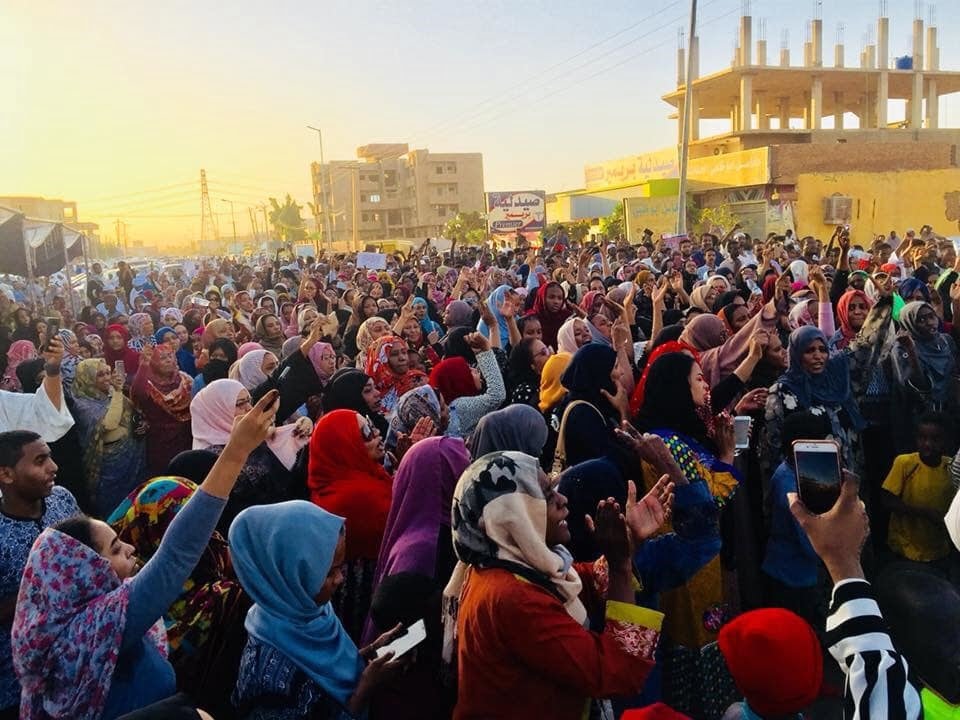
The Sudanese military leaders must immediately and unconditionally release Prime Minister Abdalla Hamdok and all others who were arbitrarily detained this morning, Amnesty International said.

At least seven other civilian government leaders are reportedly in detention, and military leaders have also restricted access to the internet and imposed a state of emergency.

“The arbitrary detentions and human rights violations today run counter to Sudan’s ambitions for a future where the human rights of all are respected and amount to a betrayal of the hopes and sacrifices of hundreds of thousands of Sudanese people.  Political differences must be resolved with recourse to human rights, not through high-handed and abusive military means”

Deprose Muchena, Regional Director for East and Southern Africa

“We call on the military leaders, led by General Abdel Fattah al-Burhan, to adhere to Sudan’s human rights obligations. This includes ensuring protection of the right to life and ensuring that the peaceful protesters now massing in response to today’s events can demonstrate unhindered and unharmed. We also call on the authorities restore full access to the internet, to facilitate freedom of information, association and peaceful assembly.”

Amnesty’s priorities for the G20 Summit and COP26

Amnesty International has written to Australian Prime Minister Scott Morrison ahead of the G20 summit in Rome and COP26 in Glasgow. In the letter, Amnesty underscores that the climate crisis and Covid-19 vaccine inequity are both global human rights emergencies, requiring swift and coordinated responses from the world’s advanced economies, including Australia.

The G20 is made up of some of the world’s biggest polluters who are responsible for around 75 percent of global greenhouse gas emissions. Australia is consistently ranked among the worst G20 countries on climate action. It still remains one of the few advanced economies that has not strengthened its emissions reductions targets by 2030.

And while much progress has been made in ensuring access to vaccines for populations in higher-income countries including Australia, we continue to witness the devastation in some lower-income countries, where minimal rates of vaccination risk leading to tens of thousands of preventable deaths and possible collapse of health systems. It is in this context that Amnesty International is calling on states to fulfil promises made to support fair vaccination roll-outs around the world and to rapidly scale up the redistribution of vaccines to low and lower-middle income countries, to meet the target of vaccinating 40% of the population in these countries by the end of the year set up by global organisations including the World Health Organisation, World Trade Organisation, World Bank and
International Monetary Fund.

“Being Asexual”

Ethan (he/him), an activist of the Amnesty International Australia LGBTQIA+ network, describes his personal experience in celebration of Asexual Awareness Week: an annual event from 25 to 31 October which helps to educate and give voice to the often overlooked and misunderstood ‘A’ in LGBTQIA+.

Asexuality. Noun: a lack of sexual attraction.

Look, let’s be real, this isn’t the most helpful definition in the world. 

How do you define an absence of something, when you don’t know what that something is like in the first place? I used to think that all of the descriptors we use for romantic love and sex were just hyperbole, because I have never experienced them. 

I’ve never been attracted to someone, be it a stranger or a close friend. I’ve never wanted to be so close to someone that my mouth is on theirs and then we’re doing this thing called kissing that we as a society have decided shows how much we love each other but honestly, just the thought of it makes me feel a bit ill. I’ve never felt that pure animal attraction towards another human being (and honestly, I still think you’re all pulling my leg on that one). But apparently, this whole time, everyone has been out here, attracted to and crushing on strangers and friends alike, and it wasn’t a joke?

Why didn’t anyone tell me this!?  

I honestly thought that there was something wrong with me; that some weird intersection of my mental illness and gender identity resulted in this strange, broken thing that meant I wasn’t attracted to anyone. I feared that I would be alone, forever. 

Sometimes, I still do. 

What I’ve learnt, however, is that there’s this neat little thing called asexuality and it doesn’t mean that I’m broken, or defective, but that I just am. There’s this misconception that asexual people are those who just choose not to have sex, or can’t find anyone who would deign to sleep with them. 

There is a major difference between celibacy and asexuality. Celibacy is a choice to not have sex, even if you think they’re really really hot; whereas asexuality is literally not being attracted to someone sexually. Lots of asexual people would be quick to reassure you that we are just like you; that just because we aren’t sexually attracted to others doesn’t mean that we can’t have sex, enjoy it, or fall in love. This is true for many asexual people, sure, but to me it just feels like platitudes to appeal to allosexuals. (N.B. Allosexual – someone who is not asexual). 

Now, I’m not invalidating the experiences of asexuals who want to or enjoy having sex, and we can absolutely fall in love (romantic and sexual attractions are different), but what I am saying is that we shouldn’t have to include that caveat to be considered people by the broader public. 

Many people are oriented asexual, which means that they are asexual and then have a specific romantic attraction like biromantic or homoromantic. I’m one of those people who are in a bit of a different position, in that I am aromantic (lack of romantic attraction) as well as asexual. I’ve never had a crush on anyone or really wanted to go on a date, or do whatever it is that alloromantic people do. I love my friends, deeply and humanly.  

Is that not enough?

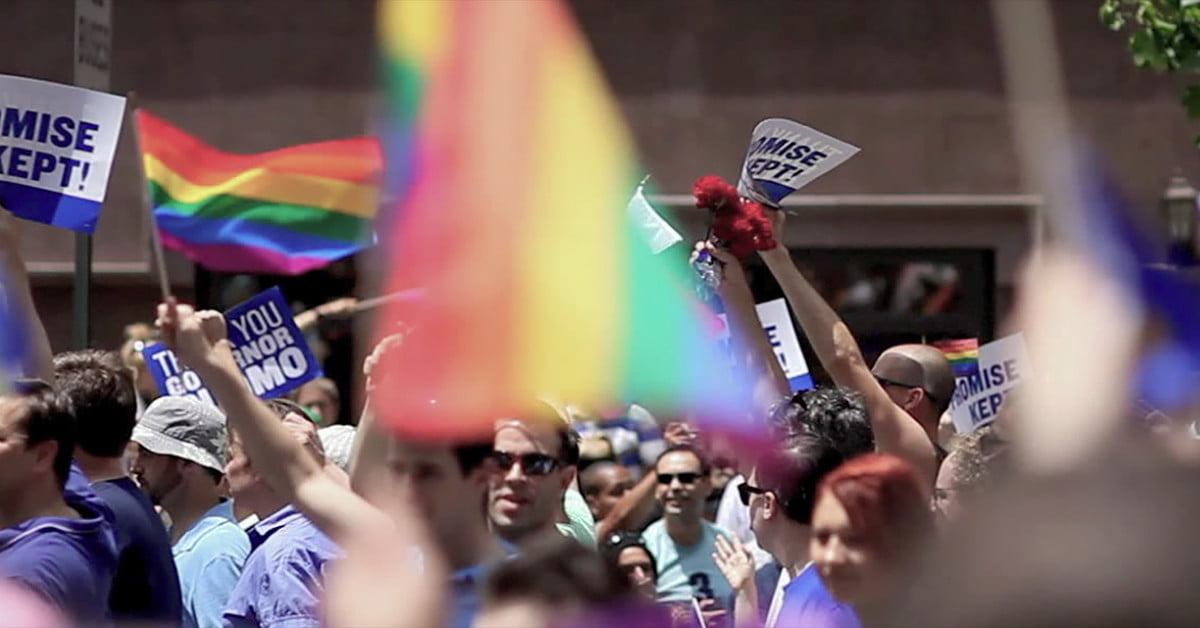
LGBTQIA+ rights are human rights. Everyone should be treated equally under the law. Love is love. Simple as that. Learn more about Amnesty International Australia’s work on LGBTQIA+ rights here.

Prime Minister Scott Morrison Must Intervene and Demand the US Drop the Charges Against Julian Assange

Ahead of the US appeal hearing on the extradition of Julian Assange, Amnesty International has written to both Prime Scott Morrison and Foreign Affairs Minister Marise Payne, urging the Australian Government to engage in a dialogue with the US and demand that all charges against Assange be dropped.

The importance of protecting journalists and publishers who play such a crucial role in not only informing our public, but ensuring that governments are held accountable, has never been greater. In this respect, the charges against Assange and his subsequent treatment in Belmarsh Prison are of grave concern.

If extradited to the US, Assange faces trial on 18 charges, 17 of them under the Espionage Act. Assange is the first publisher to face charges under the Espionage Act, and if convicted, could face up to 175 years in prison. A sentence that will lead to serious human rights violations due to detention conditions that could amount to torture or other ill-treatment, including prolonged solitary confinement.

Amnesty has received over half a million signatures from across the world, urging the US to drop the charges against Assange, with over 120,000 signatures added by Australians alone.

Finalists announced in Amnesty International Australia 2021 Media Awards

Amnesty International today has the pleasure of announcing the finalists in the 2021 Media Awards, which celebrate excellence in human rights reporting.

“A free press is one of the greatest safeguards against tyranny and corruption. This years’ entries from some of Australia’s finest media practitioners show just how important the media is in uncovering, reporting and commenting on issues authorities might not want you to know,” Amnesty International Australia Media Lead, Danielle Veldre, said.

“I am ever grateful to the judges for their thoughtful and insightful contributions to the process and encourage everyone to review the finalists’ work because it is exceptional,” she said.

The Amnesty International Media Award finalists, in no particular order, are: 

Cartoon:

Indigenous Issues Reporting:

Print/Online Media:

Radio:

Television:

  • ‘Embassy Guard’: Lucy Murray, World News, SBS
  • ‘Inside Myanmar’s Crackdown: State of Fear’: Drew Ambrose, Ali Fowle, Nick Olle & Sharon Roobol; Al Jazeera English
  • ‘The Australian-born children the government wants to deport because they have a disability’: Jessica Longbottom, ABC

No award was given in the Photography category.

Thank you to the Judges of this years’ awards:

  • Cathy Wilcox, The Sydney Morning Herald
  • Fiona Katauskas, Freelance/Eureka Street
  • Jon Kudelka, The Saturday Paper
  • Larissa Behrendt, ABC Radio – Speaking Out
  • Miriam Corowa, ABC News 24’s Weekend Breakfast
  • Jodan Perry, NITV
  • Nick Moir, Sydney Morning Herald
  • Syliva Liber, Illawarra Mercury
  • Jeff Darmanin, The Daily Telegraph & The Sunday Telegraph
  • Lisa Davies, The Sydney Morning Herald
  • Charis Chang, news.com.au
  • Josh Butler, The New Daily
  • Martin Walters, 2SER
  • Alexander Barwick, ABC Radio Alice Springs
  • Fauziah Ibrahim, ABC News Breakfast
  • Lindy Kerin, NITV
  • Stela Todorovic, 10 News

The winners will be announced on Thursday, 18 November at the Media Awards online ceremony.

As cases of COVID-19 increases among refugees and asylum seekers, the Australian Government must do more to ensure their safety

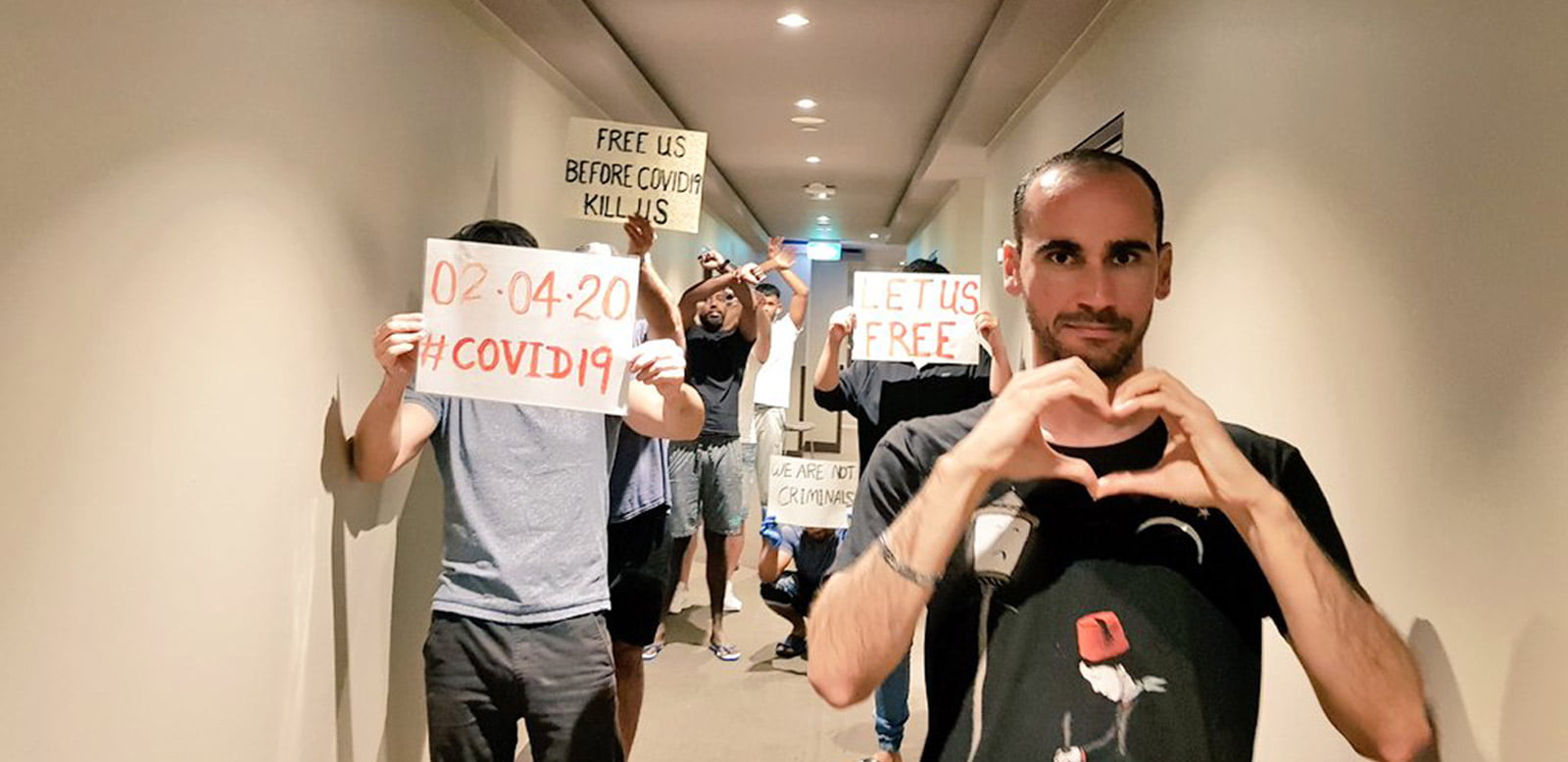
The Australian Government must honour its duty of care to look after the welfare of asylum seekers and refugees, following reports of an increase in the number of Covid-19 cases both onshore at the Park Hotel in Melbourne and offshore on Papua New Guinea.

According to media reports, the number of cases among the 123 asylum seekers and refugees still trapped on PNG is increasing as the Delta strain spreads throughout the country. Just 2 percent of the population is understood to be fully vaccinated and medical facilities are already struggling with the increase in cases. 

In Melbourne, the number of cases of those held at the Park Hotel for almost a year has increased to 15 – a third of all those detained –  with many of the men, already struggling with long term health conditions, at serious risk from the virus.

Dr Graham Thom, refugee adviser to Amnesty International Australia, said: “Because of Australia’s offshore detention policy there are 123 refugees and asylum seekers still trapped on PNG and another 87 detained onshore here in Australia.”

It is the responsibility of the Australian government to ensure they have access to the best possible medical treatment and that they are living in a Covid-19 safe environment. Neither of these two important elements are being provided –  the Government must do more.

Dr Graham Thom, refugee adviser to AIA

“New Zealand’s offer to resettle those refugees who have been in limbo for so long is still on the table. The Minister for Home Affairs, Karen Andrews, has previously said talks are taking place. Now it is more urgent than ever that she accepts the offer and gets those still trapped and at risk of Covid-19 to safety.”

Craig Foster AM, former Socceroo and human rights advocate, said: “The Government’s immediate responsibility is to ensure refugees under their care in PNG and at the Park Hotel have access to the required medical treatment. That includes ensuring people can isolate in safety. But that we’re even in this situation is staggering. Surely this is the wake up call the Government needs, and can at least provide the impetus to finally accept the New Zealand resettlement offer.”

Craig Foster spoke with detained refugee Mohamed from the Park Hotel Prison. Mohamed, along with most of the refugees detained there has recently tested positive to COVID-19. He shares his story in hopes of inspiring Australians to take action. From persecution in his homeland, to fleeing and attempting to find refuge in Australia, to being held in detention for nine years.

Mohamed’s story, like so many others, is a testament to the cruelty of Australia’s offshore detention policy and yet another example of why it must end. New Zealand has a standing offer to resettle all detained refugees, like Mohamed.

The Australian government has so far refused to accept this offer.

Afghanistan: Few routes to safety for Afghans at risk of Taliban reprisals

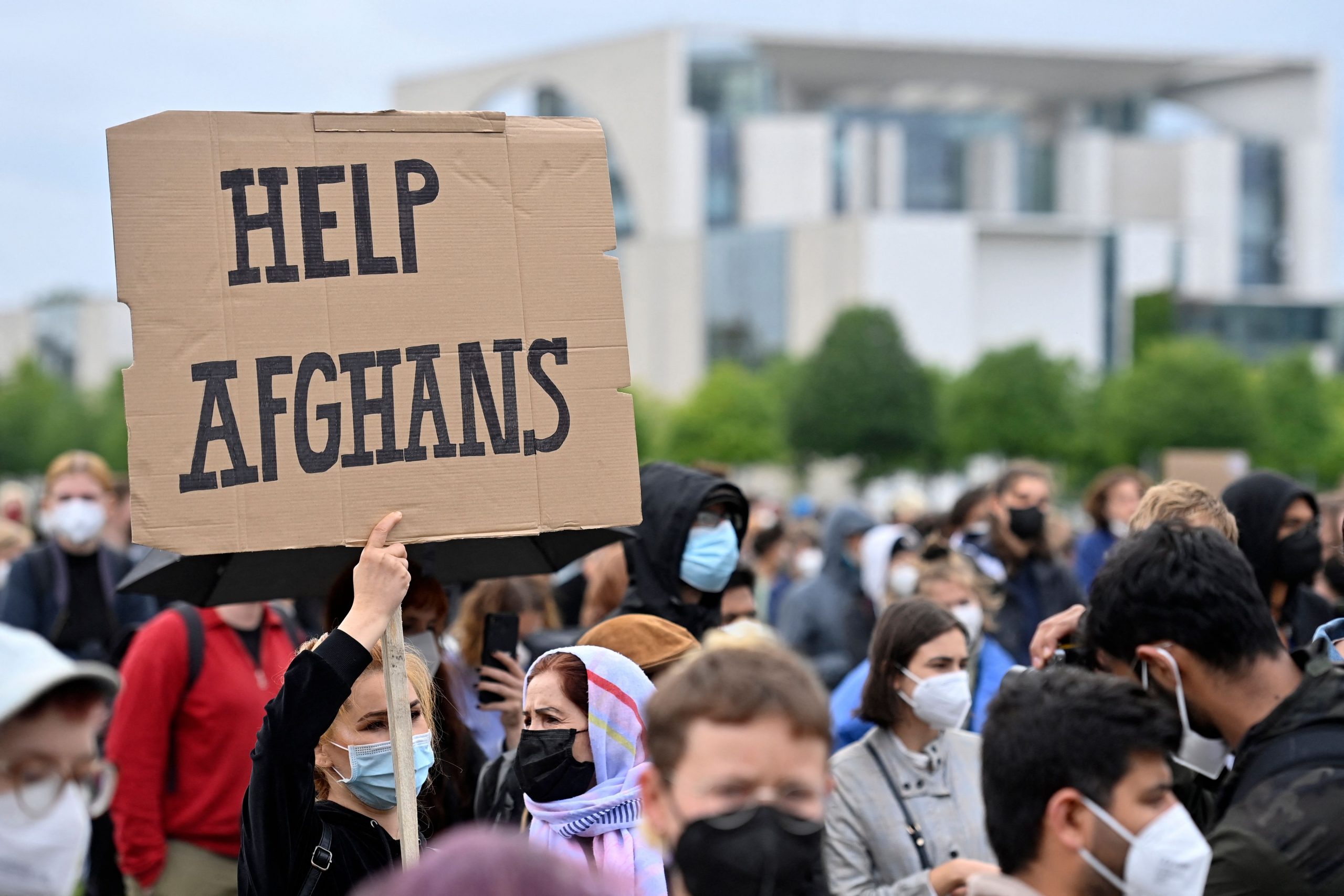
Nearly two months since airlift operations in Afghanistan ended, those left behind face formidable obstacles to seeking safety outside the country, Amnesty International said today. In an advocacy briefing, the organization highlights how neighbouring countries have closed their borders to Afghans without travel documents, leaving many with no choice but to make irregular crossings. Instead of granting protection to people who arrive on their territory in this way – as required by international law – countries across Europe and Central Asia have subjected Afghans to illegal pushbacks, detention and deportation.  

Amnesty International is calling on all countries to live up to their obligation to protect people at risk of serious human rights violations, by immediately ending all returns or deportations to Afghanistan and ensuring access to fair asylum procedures. They should also urgently take steps to secure safe passage for Afghans who are in danger of being targeted by the Taliban, including by minimizing requirements for travel documentation and offering humanitarian visas to those most at risk. 

“Trying to get out of Afghanistan right now is like an obstacle course. Since the Taliban takeover it has been near-impossible to obtain travel documents, forcing many Afghans to make irregular journeys which result in punitive treatment by other governments. Instead of finding safety and protection, Afghans who fled the Taliban end up trapped in makeshift camps at border zones, or detained while they await deportation to an uncertain fate,” said Francesca Pizzutelli, Head of Amnesty International’s Refugees and Migrants’ Rights Team. 

“We urge all countries to open their borders to Afghans seeking refuge, and to establish targeted resettlement schemes to bring the most at-risk to safety. Governments must offer international protection to new arrivals and to Afghans who are already on their territories, mindful of the international prohibition on non-refoulement.” 

Francesca Pizzutelli, Head of Amnesty International’s Refugees and Migrants’ Rights Team 

“We urge all countries to open their borders to Afghans seeking refuge, and to establish targeted resettlement schemes to bring the most at-risk to safety. Governments must offer international protection to new arrivals and to Afghans who are already on their territories, mindful of the international prohibition on non-refoulement.” 

Borders closed 

Amnesty’s briefing highlights how Pakistan, Uzbekistan, Iran, Tajikistan and Turkmenistan have all closed their borders to Afghans travelling without documents, despite the risk that returning people will put them at risk of serious human rights violations by the Taliban. IOM figures show that Iranian authorities deported 58,279 undocumented Afghans between 27 August and 9 September 2021, while Uzbekistan said on August 20 that it had returned 150 people to Afghanistan, based on an agreement with the Taliban.  

The international imperative to keep borders open for those seeking refuge, and the obligation on non-refoulement, does not just apply to countries which share a land border with Afghanistan. It also applies to countries that Afghans can reach via air or sea, or after journeys through other countries. In other words, it disregards any distinction between regular and irregular arrivals.  

Despite this, countries including Bulgaria, Croatia and Greece have continued to carry out pushbacks against Afghans, while Poland has introduced new restrictions which will make it impossible for people crossing the border irregularly to claim asylum in Poland. 

One group of 32 Afghans has been stranded on the Poland-Belarus border since 19 August, after they were moved from Poland to Belarus in a suspected pushback, without any individual assessment of their protection needs. Polish and Belarusian border guards have kept the group trapped in a small strip on the border, without adequate shelter, clean water, food or access to health care. 

Meanwhile, in July 2021, as arrivals from Afghanistan increased, Turkish authorities announced the extension of a wall with its border with Iran, and Turkey continues to round up undocumented Afghans in preparation for deportation.  

Amnesty also highlighted the impact of security clearance processes on Afghans seeking refuge. For example, Germany requires Afghans to present themselves to German authorities for security checks before they can be considered for evacuation – but there is currently no diplomatic representation in Afghanistan. In the US, the Biden administration has stated the intention to resettle 95,000 Afghan evacuees by the end of September 2022. However, questions remain about the treatment of Afghan evacuees in US military bases, and the detention and transfer to third countries of Afghan evacuees who have not cleared stringent US security checks. 

While Afghanistan’s human rights situation continues to deteriorate, all countries must take immediate measures to enable exit from Afghanistan, in particular for women activists, human rights defenders, journalists, and people from marginalized ethnic or religious minorities. They must offer international protection both to new arrivals and to those Afghans who are already on their territories, and support countries in the region to guarantee the rights of Afghans who travel there. 

“The lives of thousands of women and men who had worked to promote and defend human rights, gender equality, rule of law and democratic freedoms in their country are now hanging by a thread,” said Francesca Pizzutelli. 

“The world must not abandon Afghanistan at this critical moment – we need a concerted international effort to bring Afghans to safety.”

Pharmaceutical Companies Need to do More to Help Vaccinate the World

After finding pharmaceutical companies had failed to meet their human rights obligations in respect to the Covid-19 crisis in Amnesty International’s recent report, A Double Dose of Inequality: Pharma Companies and the Covid-19 Vaccines Crisis, Amnesty International Australia has written to Astrazenceca, urging the Australian based company to do more and to help end the pandemic.

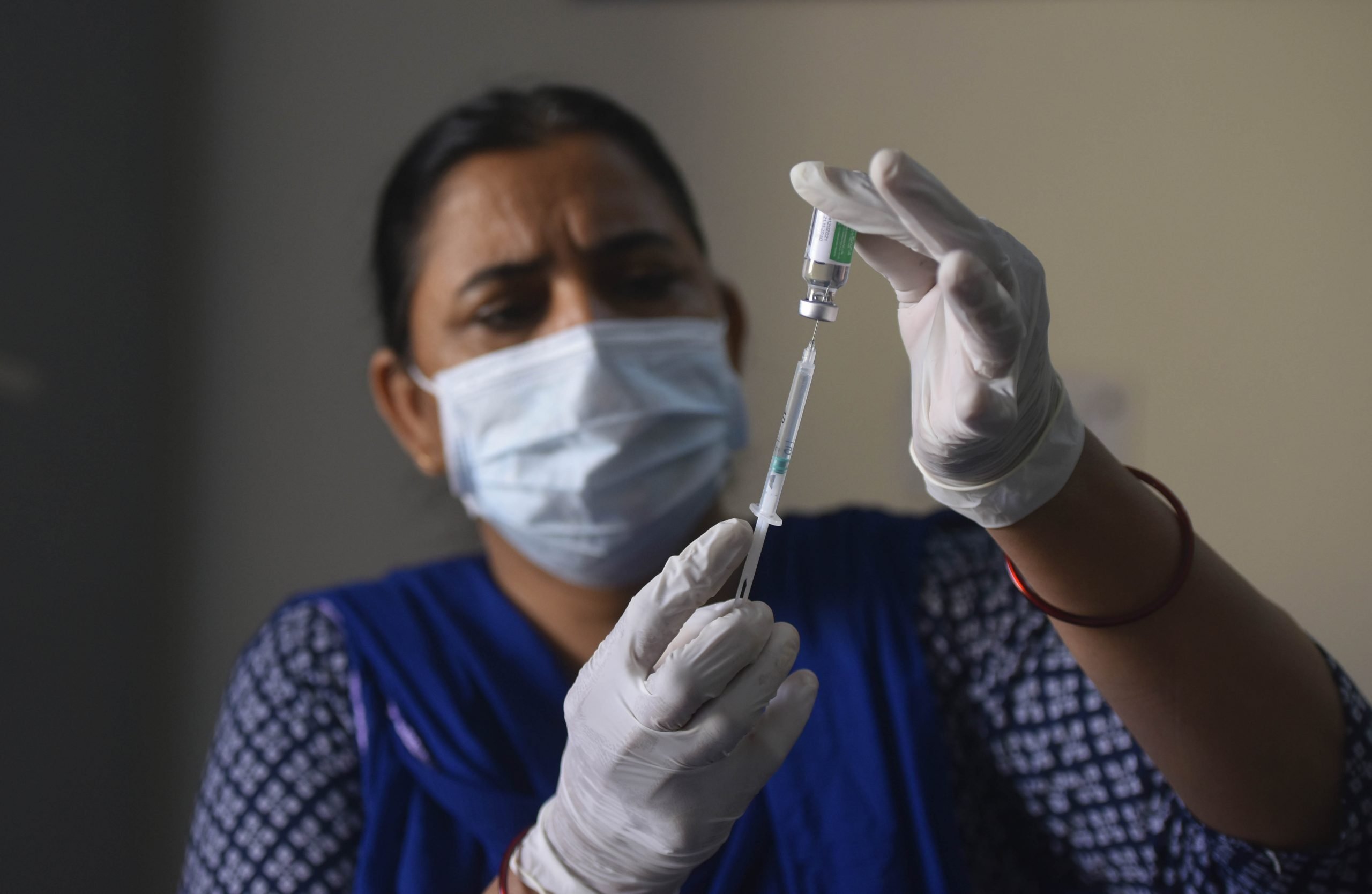
Global organisations including the World Health Organisation, World Trade Organisation, World Bank and International Monetary Fund have set a target of vaccinating 40% of the population of low- and lower-middle income countries by the end of 2021. Yet, less than 10% of people in these countries are fully vaccinated, and less than 20% of WHO-approved vaccines have been delivered to countries that make up half of the world’s population.

Companies, including pharmaceutical companies, have a responsibility to respect all human rights wherever they operate in the world and throughout their operations. For pharmaceutical companies developing and manufacturing vaccines in the context of the global health crisis, this means that all decisions and actions related to the vaccine roll-out should be rigorously assessed through proactive, ongoing human rights due diligence. Vaccine manufacturers should directly address gaps in policy and practice by developing and implementing policies that aim to make Covid-19 vaccines available, accessible, and affordable. They should remove all obstacles and refrain from any action that unduly impacts on states’ ability to make Covid-19 vaccines available to all. Failures to take the steps needed to ensure fair and comprehensive vaccine roll-out may result in companies causing or contributing to human rights harms.

Of particular concern in respect to Astrazeneca is their continued lobbying against initiatives seeking to increase manufacture and supply of Covid-19 vaccines and promote their fair distribution, such as the proposed TRIPS waiver and WHO technology sharing mechanisms.